This problem consists of three independent parts.
1A (3.5 points)
The body is a cube in the center of which a spherical cavity of radius is carved out. Inside the spherical cavity at its bottom there is a motionless puck whose geometric sizes are negligible. Find the minimal horizontal velocity (at all possible cube-to-puck mass ratios) which has to be imposed on the puck so as the cubic body should jump up from the table surface in the motion process followed. Friction in the system is completely absent. At which value of the cube-to-puck mass ratio that minimal velocity is achieved?
1B (4 points)
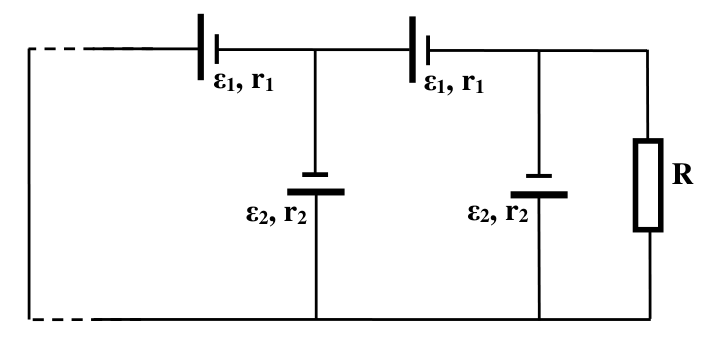
The resistance is connected to an infinite number of current sources obtained by repetition as shown in the figure on the right. Find the electric current flowing through the resistance . The emfs’ and internal resistances of the sources are known to be , , and , .
1C (2.5 points)
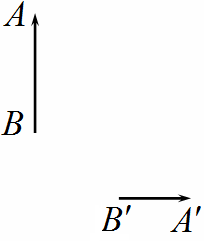
In Figure on the right b, you can see the object AB and its image A’B’ in a thin lens. By drawing method, please find:
a) the optical center of the lens (0.5 points);
b) the lens plane (1 point);
c) the main focuses of the lens (0.5 points).
Is the lens concave (diverging) or convex (collecting)? Please write down the answer. (0.5 points).
Questo problema è composto da tre parti indipendenti.
1A (3,5 punti)
Il corpo è un cubo al centro del quale è scavata una cavità sferica di raggio . All’interno della cavità, sul fondo, si trova una palla immobile le cui dimensioni geometriche sono trascurabili. Determinare la velocità orizzontale minima (per tutti i possibili rapporti di massa tra cubo e palla) che deve essere imposta alla palla affinché il corpo cubico possa saltare via dalla superficie del tavolo nel movimento successivo. La frizione nel sistema è completamente assente. A quale valore del rapporto di massa si ottiene tale velocità minima?
1B (4 punti)
La resistenza è collegata a un numero infinito di fonti di corrente ottenute ripetendo il disegno mostrato a destra. Determinare la corrente elettrica che scorre attraverso la resistenza . Le tensioni elettriche libere e le resistenze interne delle fonti sono note essere , , e , .
1C (2,5 punti)
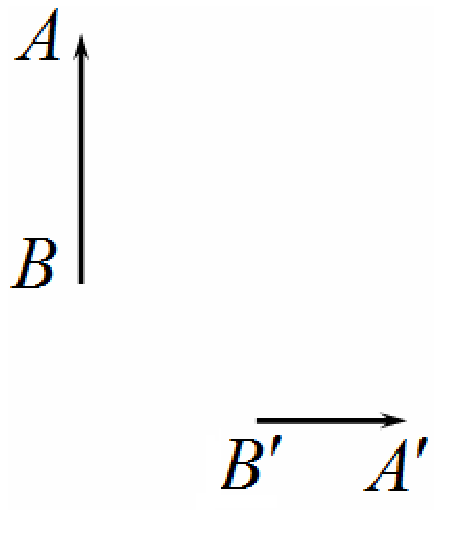
Nel disegno a destra b è rappresentato l’oggetto AB e la sua immagine A’B’ in una lente sottile. Utilizzando il metodo della traccia, determinare:
a) il centro ottico della lente (0,5 punti);
b) il piano della lente (1 punto);
c) i fuochi principali della lente (0,5 punti).
La lente è concava (divergente) o convessa (convergente)? Scrivere la risposta. (0,5 punti).
Electrical conductivity of metals (10 points)
Ohm’s law
Conductors are materials, usually metals, in which an ordered motion of free charges called an electric current is possible in the presence of an external electric field. The law relating
the electric current strength flowing through the conductor with a voltage applied to its ends was experimentally discovered by Georg Ohm (1787-1854) and has the following form:
where is called the resistance of the conductor.
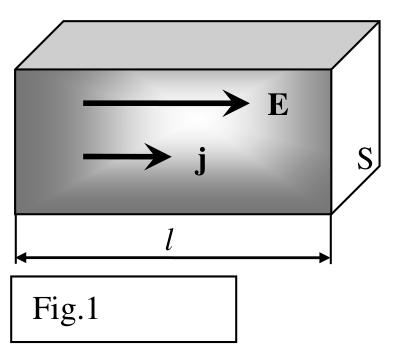
Consider a small element of the metallic material with the length and the cross section , whose ends are subject to the voltage . Let be the specific electrical conductivity of the substance which is the quantity inverse to the specific electrical resistivity . The resistance of the conductor and the electric current strength flowing through it are written as
where the current density is introduced, representing the amount of the electric charge that passes through the unit of the cross section in the unit of time. The current density depends on the electron number density and electron average ordered velocity.
Taking into account that stands for the electric field strength, the local (differential) form of Ohm’s law is obtained from Eqs. (1) and (2) as
Accounting for the same direction of the electric field strength and the current density vectors, relation (3) can be rewritten in vector form
- [1 point] Starting from the Joule-Lenz law, discovered first by James Joule and later by Heinrich Lenz, determine the volume density of the thermal power released in the conductor, i.e. the amount of heat generated by the electric current in the unit volume 1 m³ in the unit of time 1 s. Express your answer in terms of and .
The Drude model
After the discovery of the electron in 1900 by Joseph John Thompson, German physicist Paul Drude proposed the so-called classical theory of electrical conductivity of metals. According to this theory, the electrons with the number density , the mass and the electric charge can move freely in the ionic crystal lattice of metal, occasionally colliding with ions located at the sites and thereby transferring their kinetic energy to ions.
Real motion of an electron is very complicated because of the chaotic thermal motion. Under the influence of the external field, all electrons acquire the same acceleration and thus gain some extra velocity. This results in an ordered motion of electrons causing an electrical current to appear. We are only interested in that ordered motion of electrons which is superimposed on their random thermal walks.
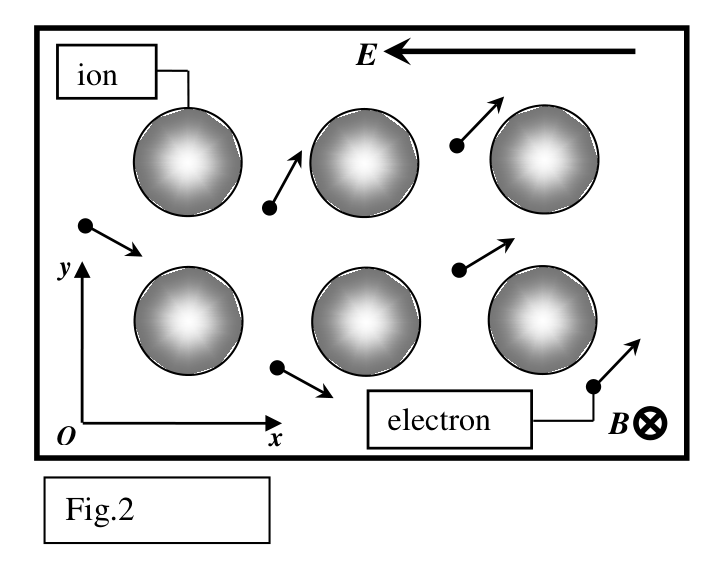
Since the real picture of the electrical conductivity is very complicated, we adopt the following simplified model. Assume that an electron with an initial zero velocity accelerates over time interval and then collides with an ion at the site, thereby transferring all the acquired kinetic energy. Then it again starts to accelerate and over time interval collides with another ion and so on. Keeping this in mind find answers to the following: In those processes the electrons do not interact with each other.
-
[1 point] Determine the vector of average ordered velocity of electrons . Express your answer in terms of , , , and .
-
[1 point] The current density in the sample is determined by the average velocity component parallel to the external electric field strength . Show that Ohm’s law holds in this simplified model and determine the specific conductivity of the metal. Express your answer in terms of , , , and .
-
[1 point] Determine the amount of the kinetic energy transferred by electrons to the crystal lattice in the unit volume and in the unit of time . Express your answer in terms of , , , , and .
Magnetoresistance
One of the important galvanomagnetic phenomenon is the change in the conductivity of a conductor that is subject to an external transverse magnetic field. This phenomenon is called a magnetoresistance effect. Due to experiments, the relative deviation of the specific conductivity at not very strong magnetic field with the induction is given by the formula
where and are some constants.
Making use of the Drude model described above, solve the following problems. Carefully examine figure 2 presented above, since it represents the system of coordinates in use and displays directions of all vectors.
-
[1 point] Find the dependences on time of the projections and of the electron velocity between two consecutive collisions. Express your answer in terms of , , , , and .
-
[2 points] The current density in the sample is determined by the average velocity component parallel to the external electric field strength . Assuming that the magnetic field induction is small enough, find the constants and in formula (5). Express your answer in terms of , , and .
The Hall effect
In 1879, Edwin Hall discovered the phenomenon of appearance of the transverse potential difference, later called the Hall voltage, by placing the current-carrying conductor in a constant transverse magnetic field.
In the simplest consideration, the Hall effect is described as follows. Suppose that an electric current flows through a metal bar due to the applied external electric field of the strength and is placed in a weak transverse magnetic field of induction . The magnetic field deflects electrons from their straight-line motion to one of the bar faces. Thus, the Lorentz force, in
contrast to the magnetoresistance effect, causes the accumulation of the negative charge near one of the bar faces and the positive charge near the opposite face. The accumulation of charge persists until the transverse electric field , generated by the accumulated charges themselves (directed along the axis as shown in the figure above), does totally compensate for the transverse displacement of electrons over the time interval .
Making use of the Drude model, described above, solve the following problems. Carefully examine figure 2 presented above, since it represents the system of coordinates in use and displays directions of all vectors.
-
[0.5 points] Look carefully at the second figure above. Near which of the faces, the top or the bottom, is the negative charge accumulated?
-
[1.5 points] Find the dependences on time of the projections and of the electron velocity between two consecutive collisions. Express your answer in terms of , , , , , and .
-
[1 point] Find the Hall electric field strength . Express your answer in terms of , , , , and , and then in terms of , , , and .
In solving these problems you can use the following approximate formulae valid for small values of :
Conduttività elettrica dei metalli (10 punti)
Legge di Ohm
I conduttori sono materiali, solitamente metalli, nei quali è possibile un movimento ordinato di cariche libere, chiamato corrente elettrica, in presenza di un campo elettrico esterno. La legge che relaziona l’intensità della corrente che scorre attraverso il conduttore con la tensione applicata alle sue estremità fu scoperta sperimentalmente da Georg Ohm (1787-1854) e ha la seguente forma:
dove è chiamata resistenza del conduttore.
Consideriamo un piccolo elemento del materiale metallico con lunghezza e sezione trasversale , le cui estremità sono sottoposte alla tensione . Sia la conducibilità elettrica specifica della sostanza, che è la quantità inversa alla resistività elettrica specifica . La resistenza del conduttore e l’intensità della corrente che vi scorre sono scritte come
dove la densità di corrente rappresenta la quantità di carica elettrica che passa attraverso l’unità di sezione in un’unità di tempo. La densità di corrente dipende dalla densità numerica di elettroni e dalla velocità media ordinata degli elettroni.
Tenendo conto che rappresenta l’intensità del campo elettrico, la forma locale (differenziale) della legge di Ohm si ottiene dalle equazioni (1) e (2) come
Tenendo conto che i vettori dell’intensità del campo elettrico e della densità di corrente hanno la stessa direzione, la relazione (3) può essere riscritta in forma vettoriale come
- [1 punto] Partendo dalla legge di Joule-Lenz, scoperta prima da James Joule e poi da Heinrich Lenz, determinare la densità di potenza termica rilasciata nel conduttore, cioè la quantità di calore generata dalla corrente nell’unità di volume 1 m³ in un’unità di tempo 1 s. Esprimi la tua risposta in termini di e .
Il modello di Drude
Dopo la scoperta dell’elettrone nel 1900 da parte di Joseph John Thompson, il fisico tedesco Paul Drude propose la cosiddetta teoria classica della conducibilità elettrica dei metalli. Secondo questa teoria, gli elettroni con densità numerica , massa e carica elettrica possono muoversi liberamente nella rete cristallina ionica del metallo, collidendo occasionalmente con gli ioni presenti nei siti e trasferendo loro la propria energia cinetica.
Il movimento reale di un elettrone è molto complicato a causa del caotico movimento termico. Sotto l’influenza del campo esterno, tutti gli elettroni acquisiscono lo stesso accelerazione e quindi guadagnano una velocità aggiuntiva. Ciò comporta un movimento ordinato degli elettroni che dà origine a una corrente elettrica. Ci interessa solo quel movimento ordinato degli elettroni che si sovrappone ai loro movimenti termici casuali.
Poiché la realtà della conducibilità elettrica è molto complessa, adottiamo il seguente modello semplificato. Supponiamo che un elettrone con velocità iniziale zero acceleri nel corso di un intervallo di tempo e poi collida con un iono situato in un certo sito, trasferendogli tutta l’energia cinetica acquisita. Successivamente, inizia nuovamente ad accelerare e, dopo un altro intervallo di tempo , collide con un altro iono, e così via. Tenendo questo a mente, rispondi alle seguenti domande: In questi processi, gli elettroni non interagiscono tra loro.
-
[1 punto] Determinare il vettore della velocità media ordinata degli elettroni . Esprimi la tua risposta in termini di , , e .
-
[1 punto] La densità di corrente nel campione è determinata dalla componente della velocità media parallela all’intensità del campo elettrico esterno . Dimostra che la legge di Ohm vale in questo modello semplificato e determina la conducibilità specifica del metallo. Esprimi la tua risposta in termini di , , e .
-
[1 punto] Determinare la quantità di energia cinetica trasferita dagli elettroni alla rete cristallina nell’unità di volume e nell’unità di tempo . Esprimi la tua risposta in termini di , , , e .
Magnetoresistenza
Uno dei fenomeni galvanomagnetici più importanti è il cambiamento nella conducibilità di un conduttore sottoposto a un campo magnetico trasversale esterno. Questo fenomeno è chiamato effetto di magnetoresistenza. Grazie agli esperimenti, la deviazione relativa della conducibilità specifica in presenza di un campo magnetico non molto forte, con induzione , è data dalla formula
dove e sono costanti.
Utilizzando il modello di Drude descritto sopra, risolvi i seguenti problemi. Esamina attentamente la figura 2 presentata sopra, poiché rappresenta il sistema di coordinate in uso e mostra le direzioni di tutti i vettori.
-
[1 punto] Trova le dipendenze dal tempo delle proiezioni e della velocità dell’elettrone tra due collisioni consecutive. Esprimi la tua risposta in termini di , , , e .
-
[2 punti] La densità di corrente nel campione è determinata dalla componente della velocità media parallela all’intensità del campo elettrico esterno . Supponendo che l’induzione del campo magnetico sia abbastanza piccola, trova le costanti e nella formula (5). Esprimi la tua risposta in termini di , e .
Effetto Hall
Nel 1879, Edwin Hall scoprì il fenomeno della comparsa di una differenza di potenziale trasversale, successivamente chiamata tensione Hall, posizionando un conduttore portatore di corrente in un campo magnetico trasversale costante.
Nella considerazione più semplice, l’effetto Hall viene descritto come segue. Supponiamo che una corrente elettrica scorra attraverso un barre metallica a causa dell’applicazione di un campo elettrico esterno di intensità e che la barra sia posta in un debole campo magnetico trasversale con induzione . Il campo magnetico devia gli elettroni dal loro movimento rettilineo verso una delle facce della barra. Pertanto, la forza di Lorentz, a differenza dell’effetto di magnetoresistenza, causa l’accumulo di carica negativa vicino a una delle facce della barra e di carica positiva vicino all’altra faccia. L’accumulo di carica persiste fino a quando il campo elettrico trasversale , generato dalle stesse cariche accumulate (diretto lungo l’asse come mostrato nella figura sopra), non compensi completamente lo spostamento trasversale degli elettroni nel corso dell’intervallo di tempo .
Utilizzando il modello di Drude descritto sopra, risolvi i seguenti problemi. Esamina attentamente la figura 2 presentata sopra, poiché rappresenta il sistema di coordinate in uso e mostra le direzioni di tutti i vettori.
-
[0,5 punti] Osserva attentamente la seconda figura sopra. Vicino a quale faccia, quella superiore o quella inferiore, si accumula la carica negativa?
-
[1,5 punti] Trova le dipendenze dal tempo delle proiezioni e della velocità dell’elettrone tra due collisioni consecutive. Esprimi la tua risposta in termini di , , , , e .
-
[1 punto] Trova l’intensità del campo elettrico Hall . Esprimi la tua risposta in termini di , , , e , e poi in termini di , , e .
Nella risoluzione di questi problemi puoi utilizzare le seguenti formule approssimative valide per valori piccoli di :
Thermodynamics of simple quantum ideal gas
In classical physics, the energy of the system varies continuously. In the physics of the microworld, most physical parameters are quantized, i.e., they can take a discrete set of values. Quantization of energy can result in actually observed macroscopic effects. In this problem, you are to consider the simplest model of a quantum ideal gas.
Model
Let a gas consist of identical atoms of mass , which are placed in a long cylindrical vessel of length and cross-section . Atoms can only move along the axis of the vessel. The kinetic energy of atoms is quantized, i.e. it can take a discrete set of values determined by
where and is a known constant value. Assume that the kinetic energy of an atom is expressed by the formula of classical physics.
The vessel is brought into contact with the thermostat so that the gas temperature in the vessel is . The value of kinetic energy of a single atom is changed due to contact with the
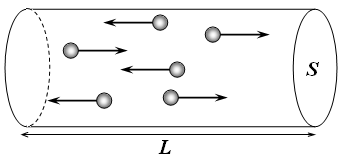
thermostat. Assume that the atom number density is such low that collisions between atoms are rare and can be neglected.
At thermodynamic equilibrium the number of atoms, which occupy the level with the energy , is determined by the Boltzmann distribution function of the form
where denotes the Boltzmann constant, is a normalization factor that you have to determine by yourself.
Subproblems:
1 [1 point] Find the number of atoms that occupy the energy level . Express your answer in terms of , , , and .
2 [3 points] Find the expression for the internal energy of the gas. Express your answer in terms of , , , and . Obtain approximate formulae for the internal energy of the gas in two limiting cases: (high temperature limit or classical limit) and (low temperature limit).
3 [3 points] Calculate the molar heat capacity of gas at constant volume. Express your answer in terms of , , , and . Obtain approximate formulae for the molar heat capacity at constant volume both in the classical limit and the limit of low temperatures. Draw a schematic plot of the molar heat capacity dependence against the gas temperature.
4 [3 points] Find the pressure exerted by the gas on the vessel walls. Express your answer in terms of , , , and . Obtain approximate formulae for the pressure both in the classical limit and the limit of low temperatures. Draw a schematic plot of the pressure dependence against the gas temperature.
In solving these problems you can use the following formulae:
Termodinamica di un semplice gas ideale quantistico
Nella fisica classica, l’energia del sistema varia in modo continuo. Nel mondo dei microrganismi, la maggior parte dei parametri fisici è quantizzata, cioè può assumere soltanto un insieme discreto di valori. La quantizzazione dell’energia può produrre effetti macroscopici realmente osservabili. In questa domanda, si considererà il modello più semplice di un gas ideale quantistico.
Modello
Supponiamo che un gas sia composto da atomi identici di massa , disposti all’interno di un contenitore cilindrico lungo e con sezione trasversale . Gli atomi possono muoversi soltanto lungo l’asse del contenitore. L’energia cinetica degli atomi è quantizzata, cioè può assumere soltanto un insieme discreto di valori determinati dalla seguente formula:
dove e è una costante nota. Si assume che l’energia cinetica di un atomo sia calcolata utilizzando la formula della fisica classica.
Il contenitore viene messo in contatto con un termostato in modo che la temperatura del gas all’interno sia . A causa del contatto con il termostato, il valore dell’energia cinetica di un singolo atomo cambia. Si assume che la densità numerica degli atomi sia così bassa da rendere le collisioni tra di essi rare e trascurabili.
In equilibrio termodinamico, il numero di atomi che occupano il livello energetico è determinato dalla funzione di distribuzione di Boltzmann:
dove rappresenta la costante di Boltzmann e è un fattore di normalizzazione che deve essere determinato dall’utente.
Sottodomande:
-
[1 punto] Calcolare il numero di atomi che occupano il livello energetico . Esprimere la risposta in termini di , , e .
-
[3 punti] Determinare l’espressione dell’energia interna del gas. Esprimere la risposta in termini di , , e . Ottenere formule approssimative per l’energia interna del gas nei due limiti: (limite ad alta temperatura o limite classico) e (limite a bassa temperatura).
-
[3 punti] Calcolare la capacità termica molare del gas a volume costante. Esprimere la risposta in termini di , , e . Ottenere formule approssimative per la capacità termica molare sia nel limite classico che nel limite a bassa temperatura. Disegnare un grafico schematico della dipendenza della capacità termica molare in funzione della temperatura del gas.
-
[3 punti] Calcolare la pressione esercitata dal gas sulle pareti del contenitore. Esprimere la risposta in termini di , , e . Ottenere formule approssimative per la pressione sia nel limite classico che nel limite a bassa temperatura. Disegnare un grafico schematico della dipendenza della pressione in funzione della temperatura del gas.
Per risolvere queste domande si possono utilizzare le seguenti formule: