Problem 1 (10 points)
This task consists of three parts which are not related to each other.
Task 1.A. 2012 (4 points)
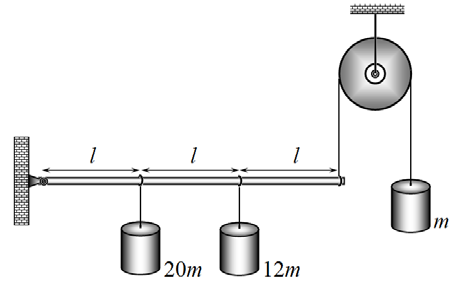
One end of the rigid weightless rod is pivotally attached. To the other end by the thread thrown over the weightless block, mass is hung. Two more masses of and are hung by the threads to the rod at the points that divide it into three equal parts (see Fig.). All the threads are inextensible and weightless. The rod is hold in a horizontal position and then it is released. Find the acceleration of all the weights immediately after the release of the rod.
Task 1.B. And diodes … (2.5 points)
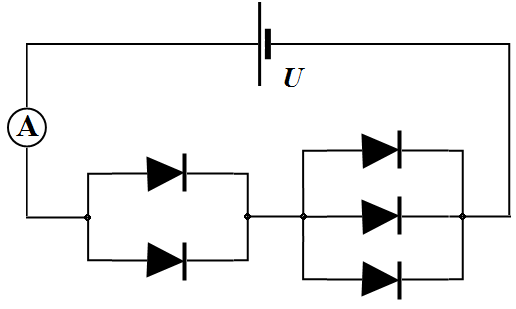
On a separate form you can find a graph of the current-voltage characteristics of one diode (dependence of the current through the diode on voltage on it, ). Five of same diodes are connected as shown in Figure. Plot a graph of the current in the circuit of the voltage source , if the latter varies from 0 to 3 V.
To plot, use a separate form given to you. Do not forget to return it!
Task 1.C. A flat lens (3.5 points)
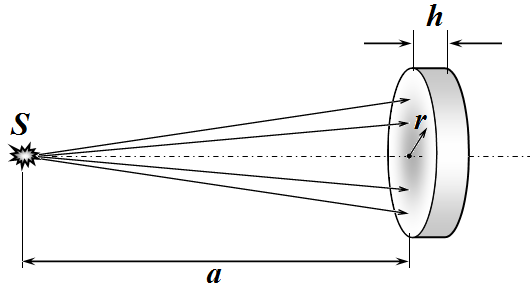
Round transparent plane-parallel plate of the thickness is made from the material which optical refractive index depends on the distance to the central axis of the plate according to the law
where , are known positive constants. The plate is in the air whose refractive index .
On the axis of the plate at a distance () the point light source is placed. Show that the plate is a kind of lens, that is, it forms an image of the source. Determine at what distance from the plate the image of the source occurs. What is the focal length of this lens?
Problema 1 (10 punti)
Questo problema è composto da tre parti indipendenti tra loro.
Parte 1.A. 2012 (4 punti)
Un estremo di un’asta rigida di massa trascurabile è incernierato. All’altro estremo, tramite un filo che passa su una carrucola di massa trascurabile, è appesa una massa . Altre due masse, e , sono appese con fili all’asta nei punti che la dividono in tre parti uguali (vedi figura). Tutti i fili sono inestensibili e di massa trascurabile. L’asta viene tenuta in posizione orizzontale e poi lasciata libera. Determinare l’accelerazione di tutte le masse immediatamente dopo il rilascio dell’asta.
Parte 1.B. E i diodi… (2,5 punti)
Su un foglio separato troverete un grafico che rappresenta la caratteristica corrente-tensione di un diodo (: la dipendenza della corrente che attraversa il diodo dalla tensione applicata). Cinque diodi uguali sono collegati come mostrato nella figura. Tracciate un grafico della corrente nel circuito, in funzione della tensione fornita dalla sorgente , quando questa varia da 0 a 3 V.
Per tracciare il grafico, utilizzate un modulo separato che vi sarà fornito. Non dimenticate di restituirlo!
Parte 1.C. Una lente piana (3,5 punti)
Una lastra trasparente piana e parallela, dello spessore , è realizzata con un materiale il cui indice di rifrazione dipende dalla distanza rispetto all’asse centrale della lastra secondo la legge
dove , sono costanti positive note. La lastra si trova in aria, il cui indice di rifrazione è .
Sull’asse della lastra, a una distanza (), viene posizionata una sorgente luminosa puntiforme . Dimostrare che la lastra funziona come una sorta di lente, cioè che forma un’immagine della sorgente. Determinare a quale distanza dalla lastra si forma l’immagine della sorgente. Qual è la distanza focale di questa lente?
Problem 2 — Adventures of a piston (10 points)
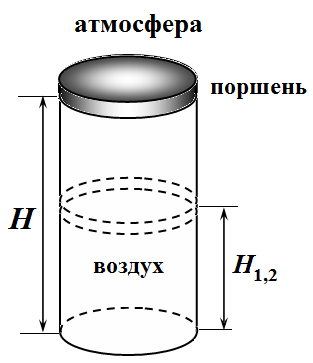
Labels in the figure (Russian): атмосфера = atmosphere, поршень = piston, воздух = air.
An open cylindrical vessel of the height cm and cross-sectional area is filled by air under normal conditions, i.e. at the atmospheric pressure Pa and the temperature K. The thin top heavy piston of mass kg is gently inserted into the vessel. The vessel wall and the piston are made of a material that conducts heat very poorly. Assume that air is an ideal diatomic gas with an average molar mass g/mol, the acceleration of free fall is , and the universal gas constant is equal to J/(mol·K). Heat capacity of the piston and the vessel, as well as the friction on the walls of the piston is completely ignored.
The piston is released. The process of transition to the final balance is done in two stages. In the first stage the piston oscillates. These gas processes cannot be considered in equilibrium. Because of the non-equilibrium, fluctuations of the piston are damped, i.e. mechanical energy is dissipated. Consider that half of the dissipated energy is transferred to the gas in the vessel and the other half to the atmosphere. At this stage it is also possible to neglect the thermal conductivity of the vessel and the piston. After the oscillations stop, the piston stops at some height .
The second stage is slow, i.e. during some period of time the piston moves and finally stops at the some height .
2.1 [0.5 points] What is the air pressure in the vessel at the end of the first stage? Express the reply in terms of atmospheric pressure , adiabatic index , and the parameter . Find the numerical value of .
2.2 [1.5 points] What is the temperature at the end of the first stage? Express the reply in terms of , , and . Find the numerical value of .
2.3 [0.5 points] Find the height . Express reply in terms of , , and . Find the numerical value of .
2.4 [0.5 points] What is the air pressure in the vessel at the end of the second stage? Express the reply in terms of and . Find the numerical value of .
2.5 [0.5 points] What is the temperature at the end of the second stage?
2.6 [0.5 points] Find the height . Express the reply in terms of and . Find the numerical value of .
2.7 [2 points] Find the frequency of small oscillations around the equilibrium position of the piston, assuming that the process is quasi-static and adiabatic. Express the reply in terms of , , , and . Find the numerical value of .
At the end of the second stage, a big number of small holes are made in the bottom of the vessel, with the total area of holes . The size of each hole is much smaller than the mean free path of molecules. After some time the piston starts to move with a constant velocity .
It is known that the average number of molecules hitting the unit surface area per unit time is equal to
where is the so called mean thermal velocity of the molecules, is the universal gas constant. The average kinetic energy of translational motion of molecules falling into the holes is
where is the Boltzmann constant.
Considering that the flow of heat through the walls and piston is negligible, answer the following questions:
2.8 [1 point] The final air pressure under the piston is of the form , where is a constant that depends on , and is a function of . Find and . Find the numerical value of .
2.9 [2 points] The final velocity of the piston is given by , where is a constant depending on , , , , and , while is a function of . Find and . Find the numerical value of .
2.10 [1 point] The final temperature of the gas under the piston is of the form , where is a constant that depends on , and is a function of . Find and . Find the numerical value of .
Problema 2 – Le avventure di un pistone (10 punti)
Le etichette nella figura (in russo): атмосфера = atmosfera, поршень = pistone, воздух = aria.
Un contenitore cilindrico aperto, alto cm e con una sezione trasversale di , è riempito d’aria in condizioni normali, cioè alla pressione atmosferica Pa e alla temperatura K. Un pistone sottile e pesante, di massa kg viene inserito delicatamente nel contenitore. Le pareti del contenitore e il pistone sono fatti di un materiale che conduce molto male il calore. Si assuma che l’aria sia un gas ideale diatomico con una massa molare media g/mol, che l’accelerazione di caduta libera sia , e che la costante universale dei gas sia pari a J/(mol·K). La capacità termica del pistone e del contenitore, nonché l’attrito sulle pareti del pistone, si trascurano completamente.
Il pistone viene rilasciato; il processo di transizione verso l’equilibrio finale avviene in due fasi. Nella prima fase il pistone oscilla. Questi processi gassosi non possono essere considerati in equilibrio. A causa della condizione di non-equilibrio, le oscillazioni del pistone sono smorzate, cioè l’energia meccanica viene dissipata. Si assuma che metà dell’energia dissipata venga trasmessa al gas presente nel contenitore e l’altra metà all’atmosfera. In questa fase è anche possibile ignorare la conducibilità termica del contenitore e del pistone. Dopo che le oscillazioni cessano, il pistone si ferma a una certa altezza .
La seconda fase è lenta: nel corso di un certo periodo di tempo il pistone continua a muoversi fino a fermarsi infine a un’altra altezza .
2.1 [0,5 punti] Qual è la pressione dell’aria all’interno del recipiente alla fine della prima fase? Esprimi la risposta in termini di pressione atmosferica , indice adiabatico e parametro . Trova il valore numerico di .
2.2 [1,5 punti] Qual è la temperatura alla fine della prima fase? Esprimi la risposta in termini di , e . Trova il valore numerico di .
2.3 [0,5 punti] Trova l’altezza . Esprimi la risposta in termini di , e . Trova il valore numerico di .
2.4 [0,5 punti] Qual è la pressione dell’aria all’interno del recipiente alla fine della seconda fase? Esprimi la risposta in termini di e . Trova il valore numerico di .
2.5 [0,5 punti] Qual è la temperatura alla fine della seconda fase?
2.6 [0,5 punti] Trova l’altezza . Esprimi la risposta in termini di e . Trova il valore numerico di .
2.7 [2 punti] Trova la frequenza delle piccole oscillazioni attorno alla posizione di equilibrio del pistone, assumendo che il processo sia quasi-statico e adiabatico. Esprimi la risposta in termini di , , e . Trova il valore numerico di .
Alla fine della seconda fase, vengono praticati numerosi piccoli fori sul fondo del recipiente; l’area totale dei fori è . Le dimensioni di ciascun foro sono molto inferiori alla cammino libero medio delle molecole. Dopo un certo tempo, il pistone inizia a muoversi con una velocità costante .
Si sa che il numero medio di molecole che colpiscono un’unità di superficie in un’unità di tempo è uguale a
dove è la cosiddetta velocità termica media delle molecole, è la costante universale dei gas. L’energia cinetica media del movimento traslatorio delle molecole che entrano nei fori è
dove è la costante di Boltzmann.
Considerando che il flusso di calore attraverso le pareti e il pistone sia trascurabile, rispondete alle seguenti domande:
2.8 [1 punto] La pressione finale dell’aria sotto il pistone ha la forma , dove è una costante che dipende da , e è una funzione di . Determinate e . Calcolate il valore numerico di .
2.9 [2 punti] La velocità finale del pistone è data da , dove è una costante che dipende da , , , e , mentre è una funzione di . Determinate e . Calcolate il valore numerico di .
2.10 [1 punto] La temperatura finale del gas sotto il pistone ha la forma , dove è una costante che dipende da , e è una funzione di . Determinate e . Calcolate il valore numerico di .
Problem 3 — Nuclear droplet (10 points)
In this task, we consider the main characteristics and conditions for the stability of atomic nuclei. Let the atomic nucleus contains nucleons ( is atomic weight of elements), namely, protons ( is element’s number in the table of chemical elements) and neutrons. The expression for the total energy of the nucleus can be written as
where is the mass of nucleus, is the mass of the free proton, is the mass of the free neutron, is the speed of light, and is the potential energy of the nucleons in the nucleus.
The potential energy of nucleon-nucleon interaction can be described by the following semi-empirical formula by Weizsäcker
where MeV, MeV, MeV, MeV.
Weizsäcker semiempirical formula corresponds to one of the simplest model of the atomic nucleus, the so-called spherical liquid drop model, which rely on the analogy between the nucleus and drop an ordinary liquid. The mass and charge of the nucleus assumed to be uniformly distributed inside a sphere of some radius, and the nucleon fluid is characterized by some parameter , which is an analogue of the surface tension of the liquid.
The formula for potential energy takes into account the following contributions:
- surface energy, which takes into account the surface tension of nuclear matter in the liquid drop model;
- the energy of the Coulomb repulsion of the protons within the nucleus;
- the exchange interaction energy, reflecting the trend towards the stability of nuclei at ;
- direct dependence on the number of nucleons due to nuclear forces.
Also in the derivation of this semiempirical formula Weizsäcker used experimentally established the following dependence of the radius of the atomic nucleus of the number of nucleons
where is a constant.
Based on all the above, give answers to the following questions:
3.1 [2 points] Find the electrostatic energy of a sphere of radius , uniformly charged with total charge . Express answer in terms of charge , the dielectric constant , and radius of the ball.
3.2 [1 point] Find the numerical value of the coefficient in the formula (3).
3.3 [1 point] Find the numerical value of the density of nuclear matter.
3.4 [1 point] Find the numerical value of the surface tension of liquid nucleons.
Suppose now that the nucleus is broken into two parts with atomic weights and respectively, where . We can assume that the nuclear charge and the number of neutrons are distributed between the fragments as the atomic weight.
3.5 [2 points] Nuclear fission becomes energetically favorable under the condition . Find an expression for the function and plot it schematically.
3.6 [0.5 points] With the accuracy up to two significant figures, find the limiting value at which the spontaneous fission is theoretically possible.
Under the condition of § 3.5, the nucleus can stay for a long time. For example, the half-life of Uranium-235 nucleus is equal to 713 million years. Consequently, an instantaneous fission is prevented by some energy barrier, which disappears at some critical value . In fact, the nucleus will be broken when a significant deviation in its shape from spherical occurs.
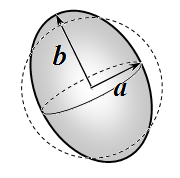
For simplicity, we assume that a spherical nucleus undergoes such deformations under which the surface is the surface of a prolate ellipsoid of rotation, which in Cartesian coordinates by the equation
where is small, and is big semi-axes of the ellipsoid, respectively.
The volume of a prolate spheroid is given by
and its surface area can be calculated by the formula
Let a spherical nucleus undergoes such a deformation that and , so that , and is initial radius of the nuclear droplet.
3.7 [0.5 points] Find the relation between and .
Calculations show that the energy of the electrostatic interaction of protons of the deformed nucleus is about .
3.8 [2 points] Find the expression and the numerical value of .
Known physical constants:
| Elementary charge | C |
| The dielectric constant | F/m |
| The mass of the nucleon (proton or neutron) | kg |
| 1 eV in J | J |
In addressing these tasks, you can use the formulas:
Problema 3 – Goccia nucleare (10 punti)
In questo problema consideriamo le principali caratteristiche e condizioni che influenzano la stabilità dei nuclei atomici. Supponiamo che un nucleo atomico contenga nucleoni, dove rappresenta il peso atomico dell’elemento in questione; in particolare, protoni (che corrispondono al numero atomico dell’elemento nella tavola periodica) e neutroni. L’espressione che descrive l’energia totale del nucleo può essere scritta come
dove è la massa del nucleo, è la massa del protone libero, è la massa del neutrone libero, è la velocità della luce e è l’energia potenziale dei nucleoni all’interno del nucleo.
L’energia potenziale dell’interazione nucleone-nucleone può essere descritta dalla seguente formula semiempirica proposta da Weizsäcker
dove MeV, MeV, MeV, MeV.
La formula semiempirica di Weizsäcker corrisponde a uno dei modelli più semplici del nucleo atomico, il cosiddetto modello della goccia liquida sferica, che si basa sull’analogia tra il nucleo e una goccia di liquido ordinario. Si assume che la massa e la carica del nucleo siano distribuite uniformemente all’interno di una sfera di determinato raggio, e il fluido di nucleoni è caratterizzato da un parametro , che rappresenta l’equivalente della tensione superficiale del liquido.
La formula per l’energia potenziale tiene conto dei seguenti fattori:
- L’energia superficiale, che riflette la tensione superficiale della materia nucleare nel modello della goccia liquida;
- L’energia dovuta alla repulsione elettrostatica tra i protoni all’interno del nucleo;
- L’energia delle interazioni di scambio, che riflette la tendenza dei nuclei alla stabilità per ;
- La dipendenza diretta dal numero totale di nucleoni , dovuta alle forze nucleari.
Nella derivazione di questa formula semiempirica, Weizsäcker ha anche usato la seguente dipendenza, stabilita sperimentalmente, del raggio del nucleo atomico dal numero di nucleoni
dove è una costante.
Sulla base di quanto sopra esposto, rispondi alle seguenti domande:
3.1 [2 punti] Calcola l’energia elettrostatica di una sfera di raggio , carica uniformemente con una carica totale . Esprimi la risposta in termini di carica , costante dielettrica e raggio della sfera.
3.2 [1 punto] Trova il valore numerico del coefficiente nella formula (3).
3.3 [1 punto] Calcola il valore numerico della densità della materia nucleare.
3.4 [1 punto] Trova il valore numerico della tensione superficiale del liquido nucleonico.
Ora supponiamo che il nucleo venga diviso in due parti con masse atomiche rispettivamente e , dove . Possiamo assumere che la carica nucleare e il numero di neutroni siano distribuiti tra i frammenti in modo proporzionale alle loro masse atomiche.
3.5 [2 punti] La fissione nucleare diventa energeticamente vantaggiosa quando si verifica la condizione . Trova un’espressione per la funzione e rappresentala graficamente in modo schematico.
3.6 [0,5 punti] Con precisione fino a due cifre significative, trova il valore limite al quale la fissione spontanea è teoricamente possibile.
Nella condizione descritta nel paragrafo 3.5, il nucleo può rimanere stabile per un lungo periodo di tempo; ad esempio, l’emivita del nucleo di Uranio-235 è di 713 milioni di anni. Pertanto, una fissione istantanea viene ostacolata da una barriera energetica che scompare al valore critico . In realtà, il nucleo si romperà quando la sua forma subisce una deviazione significativa rispetto a quella sferica.
Per semplicità, assumiamo che un nucleo sferico subisca tali deformazioni al punto che la sua superficie diventi quella di un ellissoide di rotazione allungato; che in coordinate cartesiane è descritto dall’equazione
dove è il semiasse minore e il semiasse maggiore dell’ellissoide.
Il volume di un ellissoide di rotazione allungato è dato da
La sua superficie può essere calcolata utilizzando la seguente formula:
Supponiamo che un nucleo sferico subisca una deformazione tale da far sì che e , con , e rappresenti il raggio iniziale del nucleo.
3.7 [0,5 punti] Determinare la relazione tra e .
I calcoli mostrano che l’energia dell’interazione elettrostatica tra i protoni del nucleo deformato è approssimativamente data da .
3.8 [2 punti] Determinare l’espressione e il valore numerico di .
Costanti fisiche note:
| Carica elementare | C |
| Costante dielettrica | F/m |
| Massa di un nucleone (protono o neutrono) | kg |
| 1 eV in J | J |
Per risolvere questi quesiti, è possibile utilizzare le seguenti formule: