Задача 1 (10 баллов)
Эта задача состоит из трех частей, не связанных друг с другом.
Задача 1.А. Блок (5.0 балла)
На круглый блок радиуса положили канат длиной и массы , который начал соскальзывать с блока без трения. В момент, когда разность высот свисающих с блока концов каната равна половине длины каната, найти:
- ускорение каната;
- натяжение каната в верхней точке;
- точку каната, в которой сила натяжения максимальна (достаточно найти угол между радиусом в эту точку и вертикалью).
Задача 1.В. Запарь (2.0 балла)
В физической лаборатории термометр показывал 20 ºC, а барометр — 1,00 атм. Лаборант Запарь достал из шкафа прочный сосуд, налил в него немного воды и герметично закрыл крышкой. Затем Запарь медленно нагрел сосуд до 200 ºC. При этой температуре давление в сосуде составило 2,88 атм. Определите температуру, при которой вся вода испарилась.
Задача 1.С. Пирамида (3.0 балла)
Правильная треугольная пирамида изготовлена из прозрачного материала с показателем преломления . Все углы при вершине пирамиды — прямые. В основании пирамиды лежит правильный треугольник , длины сторон которого равны мм. Эту пирамиду также можно представить, как «угол, отрезанный от куба». Пирамида однородно освещается так, что свет падает вдоль ее высоты, перпендикулярно плоскости основания.
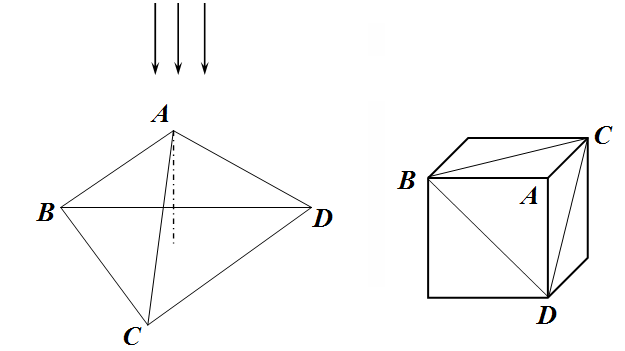
- Нарисуйте область на основании пирамиды, освещенную светом, преломленным гранью .
- Параллельно основанию пирамиды на расстоянии см от него расположен экран. Нарисуйте области освещенные светом, преломленным пирамидой, на этом экране. Укажите положение и размеры этих областей.
Problema 1 (10 punti)
Questo problema è composto da tre parti non correlate tra loro.
Parte 1.A. Carrucola (5,0 punti)
Su una carrucola circolare di raggio è posata una fune di lunghezza e massa , che comincia a scivolare dalla carrucola senza attrito. Nel momento in cui la differenza di altezza tra le estremità della fune che pendono dalla carrucola è uguale alla metà della sua lunghezza, determinare:
- l’accelerazione della fune;
- la tensione della fune nel punto più alto;
- il punto della fune in cui la tensione è massima (è sufficiente trovare l’angolo tra il raggio in quel punto e la verticale).
Parte 1.B. Zapar’ (2,0 punti)
In un laboratorio di fisica, un termometro indicava 20 ºC e un barometro 1,00 atmosfere. Il tecnico di laboratorio Zapar’ prese dall’armadio un contenitore resistente, vi versò un po’ d’acqua e lo chiuse ermeticamente con il coperchio. Successivamente riscaldò lentamente il contenitore fino a 200 ºC; a questa temperatura la pressione all’interno del contenitore era di 2,88 atmosfere. Determinare la temperatura alla quale tutta l’acqua è evaporata.
Parte 1.C. Piramide (3,0 punti)
Una piramide triangolare regolare è fatta di un materiale trasparente il cui indice di rifrazione è . Tutti gli angoli al vertice della piramide sono retti. La base della piramide è il triangolo equilatero , di lato mm. Questa piramide può anche essere considerata come “un angolo tagliato da un cubo”. La piramide viene illuminata uniformemente in modo che la luce incida lungo la sua altezza, perpendicolarmente al piano della base.
- Disegnate l’area illuminata sulla base della piramide dalla luce rifratta dalla faccia .
- Parallelamente alla base della piramide, a una distanza di cm da essa, è posizionato uno schermo. Disegnate sullo schermo le aree illuminate dalla luce rifratta dalla piramide; indicate anche la posizione e le dimensioni di queste aree.
Problem 1 (10 points)
This problem consists of three independent parts.
Part 1.A. Pulley (5.0 points)
A rope with length and mass is laid over a round pulley of radius and starts sliding off the pulley without friction. At the moment when the difference in the heights of the two ends of the rope hanging from the pulley is equal to half the length of the rope, determine:
- the acceleration of the rope;
- the tension in the rope at its highest point;
- the point on the rope where the tension is maximum (it is sufficient to find the angle between the radius at this point and the vertical).
Part 1.B. Zapar’ (2.0 points)
In a physics laboratory, the thermometer read 20 ºC, and the barometer showed 1.00 atm. Laboratory technician Zapar’ took a sturdy container from the cabinet, poured some water into it, and sealed it tightly with a lid. Then Zapar’ slowly heated the container to 200 ºC. At this temperature, the pressure inside the container was 2.88 atm. Determine the temperature at which all the water evaporated.
Part 1.C. Pyramid (3.0 points)
A regular triangular pyramid is made of a transparent material with a refractive index of . All angles at the vertex are right angles. The base of the pyramid is the equilateral triangle with side mm. This pyramid can also be considered as “a corner cut off from a cube”. The pyramid is uniformly illuminated such that the light falls along its height, perpendicular to the base plane.
- Draw the region on the base of the pyramid that is illuminated by light refracted by face .
- A screen is placed parallel to the base of the pyramid at a distance of cm from it. Draw the regions on this screen that are illuminated by light refracted by the pyramid. Indicate the position and size of these regions.
Задача 2 — Квадратная рамка (10 баллов)
Квадратная рамка со стороной см помещена в однородное магнитное поле с индукцией Тл, создаваемое постоянным магнитом. Полностью пренебрегайте краевыми эффектами, считая магнитное поле между полюсами магнита однородным и равным нулю снаружи. Для всех частей задачи считайте, что рамка массой г в начальный момент времени находится в покое у края полюсов магнита, смотрите рисунок.
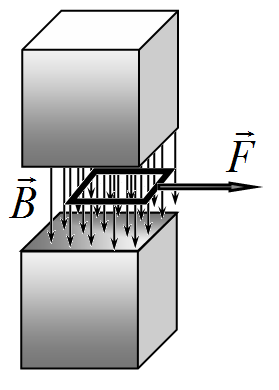
1. [0.2 балла] В вашем решении перерисуйте схематически этот рисунок и укажите, какой из полюсов магнита является северным , а какой южным .
Часть A
Пусть рамка изготовлена из проводящего материала, имеет сопротивление Ом и пренебрежимо малую индуктивность. В момент времени к рамке прикладывается постоянная сила Н, с помощью которой она вытягивается из магнитного поля.
2. [1.2 балла] Найдите аналитическую зависимость скорости рамки от времени , считая, что рамка все время остается между полюсами магнита. Запишите ответ через и .
3. [0.8 балла] Запишите точное уравнение для определения времени нахождения рамки между полюсами магнита. Запишите ответ через и . Приближенно вычислите время .
4. [1.2 балла] Постройте график зависимости скорости рамки от времени за интервал от 0 до 12 с.
5. [1.2 балла] Постройте график зависимости тока в рамке от времени за интервал от 0 до 12 с.
Часть B
Пусть рамка изготовлена из сверхпроводящего материала, имеет индуктивность Гн, ту же массу и размеры. В момент времени к рамке прикладывается постоянная сила , с помощью которой она вытягивается из магнитного поля.
6. [1.8 балла] Найдите минимальную силу , при которой рамку удастся вытянуть из магнита. Выразите ваш ответ через и рассчитайте численное значение.
7. [0.6 балла] В условиях предыдущего пункта найдите минимальное время до максимального выдвижения рамки из магнита. Выразите ваш ответ через и рассчитайте численное значение.
8. [1.0 балла] Постройте график зависимости тока в рамке от времени за интервал времени от 0 до .
Часть C
Квадратная рамка со стороной изготовлена из проводящего материала, имеет индуктивность , сопротивление и массу . В момент времени рамке сообщают начальную скорость , направленную так же, как и сила на рисунке сверху. Известно, что в момент, когда рамка практически покидает магнит, ее скорость обращается в ноль.
9. [2.0 балла] Найдите аналитическое выражение для силы тока в рамке в момент времени, когда ее скорость обращается в ноль. Запишите ответ через и .
Problema 2 – Spira quadrata (10 punti)
Una spira quadrata di lato cm è posta in un campo magnetico uniforme la cui induzione è di T, generato da un magnete permanente. Si trascurino completamente gli effetti di bordo, considerando il campo magnetico tra i poli del magnete uniforme e nullo al di fuori di essi. In tutte le parti del problema si assuma che la spira, di massa g, all’istante iniziale sia ferma sul bordo dei poli del magnete (vedi figura).
1. [0,2 punti] Nella tua soluzione, ridisegna schematicamente questa figura e indica quale polo del magnete è il nord e quale il sud .
Parte A
Supponiamo che la spira sia realizzata in un materiale conduttore, abbia una resistenza di Ω e che l’induttanza sia trascurabile. Nel momento , sulla spira viene applicata una forza costante di N, con cui viene estratta dal campo magnetico.
2. [1,2 punti] Trova la relazione analitica tra la velocità della spira e il tempo , assumendo che essa rimanga sempre tra i poli del magnete. Scrivi la risposta in termini di e .
3. [0,8 punti] Scrivi l’equazione esatta per determinare il tempo di permanenza della spira tra i poli del magnete. Scrivi la risposta in termini di e . Calcola approssimativamente il valore di .
4. [1,2 punti] Costruisci un grafico che rappresenti la relazione tra la velocità della spira e il tempo , nell’intervallo da 0 a 12 secondi.
5. [1,2 punti] Costruisci un grafico che rappresenti la relazione tra la corrente nella spira e il tempo , nell’intervallo da 0 a 12 secondi.
Parte B
Supponiamo che la spira sia realizzata in un materiale superconduttore, abbia un’induttanza di H, la stessa massa e le stesse dimensioni della spira precedente. Nel momento , sulla spira viene applicata una forza costante di , con cui viene estratta dal campo magnetico.
6. [1,8 punti] Trova la minima forza necessaria per estrarre la spira dal campo magnetico. Esprimi la tua risposta in termini di e calcola il valore numerico.
7. [0,6 punti] Nelle condizioni del punto precedente, determinare il tempo minimo fino alla massima estrazione della spira dal magnete. Esprimere la risposta in funzione di e calcolare il valore numerico.
8. [1,0 punti] Tracciare il grafico che rappresenta la variazione della corrente nella spira in funzione del tempo, nell’intervallo da 0 a .
Parte C
Una spira quadrata di lato , realizzata in materiale conduttore, presenta un’induttanza di , una resistenza di e una massa di . Nel momento , alla spira viene impartita una velocità iniziale , nella stessa direzione della forza rappresentata nella figura sopra. Si sa che, nel momento in cui la spira esce praticamente dal magnete, la sua velocità diventa zero.
9. [2,0 punti] Determinare l’espressione analitica per la corrente che attraversa la spira nel momento in cui la sua velocità diventa zero. Scrivere la risposta in funzione di e .
Problem 2 — Square Frame (10 points)
A square frame with side length cm is placed in a uniform magnetic field with induction T, generated by a permanent magnet. Edge effects can be completely neglected; assume that the magnetic field between the poles of the magnet is uniform and zero outside. For all parts of this problem, consider that the frame, with mass g, is initially at rest at the edge of the magnet poles, as shown in the diagram.
1. [0.2 points] In your solution, sketch this diagram and indicate which pole of the magnet is the north pole and which is the south pole .
Part A
Suppose the frame is made of a conductive material with resistance Ω, and assume that the inductance is negligible. At time , a constant force N is applied to the frame, pulling it out of the magnetic field.
2. [1.2 points] Determine the analytical expression for the speed of the frame as a function of time , assuming that the frame remains between the poles of the magnet at all times. Express your answer in terms of , and .
3. [0.8 points] Write down the exact equation that can be used for the time the frame spends between the poles of the magnet. Express your answer in terms of , and . Calculate approximately.
4. [1.2 points] Plot the graph of the speed of the frame as a function of time over the interval from 0 to 12 seconds.
5. [1.2 points] Plot the graph of the current in the frame as a function of time over the interval from 0 to 12 seconds.
Part B
Suppose the frame is made of a superconducting material with inductance H, and it has the same mass and dimensions as in Part A. At time , a constant force is applied to the frame, pulling it out of the magnetic field.
6. [1.8 points] Determine the minimum value of the force required to pull the frame out of the magnetic field. Express your answer in terms of , and calculate the numerical value.
7. [0.6 points] Under the conditions of the previous question, determine the minimum time until the frame is pulled out of the magnet as far as it gets. Express your answer in terms of , and calculate its numerical value.
8. [1.0 points] Plot the graph showing the relationship between the current flowing through the frame and time, over the interval from 0 to .
Part C
A square frame with side length is made of a conductive material. It has an inductance of , a resistance of , and a mass of . At time , the frame is given an initial velocity in the same direction as the force shown in the diagram above. It is known that at the moment when the frame practically leaves the magnet, its velocity becomes zero.
9. [2.0 points] Determine the analytical expression for the current flowing through the frame at the instant when its velocity becomes zero. Express your answer in terms of , and .
Задача 3 — Модель атома водорода по Бору (10 баллов)
Рассмотрим атом водорода, который состоит из протона, массу которого можно считать практически бесконечной, и электрона массой кг. При этом протон имеет положительный заряд Кл, а электрон – отрицательный заряд , так что в целом атом нейтрален.
1. [2.0 балла] Известно, что большинство атомов стабильно и могут существовать продолжительное время. Это значит, что электрон не может находиться в состоянии покоя, иначе под действием силы притяжения он неминуемо упал бы на протон. Пусть расстояние между электроном и протоном равно м. Считая применимыми законы классической физики, найдите время падения первоначально покоящегося электрона на протон.
Значит, для стабильности атома электрон должен двигаться вокруг протона так же, как планеты вращаются вокруг Солнца. Пусть орбита электрона круговая и законы классической физики по-прежнему применимы.
2. [1.0 балла] Найдите скорость движения электрона в зависимости от радиуса орбиты .
3. [0.5 балла] Найдите момент импульса движения электрона в зависимости от радиуса орбиты .
Датский физик Нильс Бор выдвинул постулат о том, что момент импульса электрона равен целому числу постоянных Планка Дж·с, то есть , где – главное квантовое число.
4. [0.5 балла] Найдите возможные радиусы орбит электрона в атоме водорода.
5. [0.5 балла] Рассчитайте численное значение минимального радиуса орбиты электрона в атоме водорода.
6. [1.0 балла] Найдите возможные значения полной энергии электрона в атоме водорода.
7. [0.5 балла] Рассчитайте численное значение минимального значения полной энергии электрона в атоме водорода.
Согласно классической электродинамике, если электрон движется с ускорением, то он теряет свою энергию на электромагнитное излучение. При этом мощность излучения определяется выражением
где – ускорение электрона, Ф/м – электрическая постоянная, м/с – скорость света в вакууме.
Электромагнитное излучение привело бы к тому, что в модели Бора электрон падал бы на протон. В дальнейшем считайте, что траектория электрона практически круговая.
8. [1.5 балла] Считая, что в момент времени электрон находится на орбите радиусом , найдите зависимость радиуса траектории от времени .
9. [0.5 балла] Найдите и вычислите время падения электрона с орбиты радиусом на протон.
10. [2.0 балла] Сколько оборотов успевает сделать электрон вокруг протона за время падения ?
Problema 3 – Modello dell’atomo di idrogeno secondo Bohr (10 punti)
Consideriamo l’atomo di idrogeno, che è composto da un protone la cui massa può essere considerata praticamente infinita e da un elettrone la cui massa è kg. Il protone ha carica positiva C, mentre l’elettrone ha carica negativa , quindi nell’insieme l’atomo è neutro.
1. [2,0 punti] Si sa che la maggior parte degli atomi è stabile e può esistere per lunghi periodi di tempo. Ciò significa che l’elettrone non può trovarsi in uno stato di quiete, altrimenti, sotto l’azione della forza di attrazione, cadrebbe inevitabilmente sul protone. Supponiamo che la distanza tra elettrone e protone sia m. Utilizzando le leggi della fisica classica, calcolare il tempo necessario perché un elettrone che si trova inizialmente in quiete cada sul protone.
Per garantire la stabilità dell’atomo, l’elettrone deve muoversi attorno al protone in modo simile ai pianeti che orbitano intorno al Sole. Supponiamo che l’orbita dell’elettrone sia circolare e che le leggi della fisica classica siano ancora applicabili.
2. [1,0 punti] Calcolare la velocità di movimento dell’elettrone in funzione del raggio orbitale .
3. [0,5 punti] Calcolare il momento angolare del movimento dell’elettrone in funzione del raggio orbitale .
Il fisico danese Niels Bohr propose l’ipotesi che il momento angolare di un elettrone sia uguale a un multiplo intero della costante di Planck J·s, cioè , dove è il numero quantistico principale.
4. [0,5 punti] Determinare i possibili valori del raggio orbitale dell’elettrone nell’atomo di idrogeno.
5. [0,5 punti] Calcolare il valore numerico del raggio minimo dell’orbita dell’elettrone nell’atomo di idrogeno.
6. [1,0 punti] Trovare i possibili valori dell’energia totale dell’elettrone nell’atomo di idrogeno.
7. [0,5 punti] Calcolare il valore numerico dell’energia totale minima dell’elettrone nell’atomo di idrogeno.
Secondo l’elettrodinamica classica, se un elettrone si muove con un’accelerazione, perde la propria energia sotto forma di radiazione elettromagnetica. In questo caso, la potenza irradiata è data dall’espressione
dove è l’accelerazione dell’elettrone, F/m è la costante elettrica, m/s è la velocità della luce nel vuoto.
Nel modello di Bohr l’irraggiamento elettromagnetico farebbe cadere l’elettrone sul protone. Nel seguito si assuma che la traiettoria dell’elettrone sia praticamente circolare.
8. [1,5 punti] Supponendo che al momento l’elettrone si trovi su un’orbita di raggio , determinare la dipendenza del raggio della traiettoria in funzione del tempo .
9. [0,5 punti] Determinare e calcolare il tempo necessario perché l’elettrone cada dall’orbita di raggio sul protone.
10. [2,0 punti] Quanti giri riesce a compiere l’elettrone attorno al protone nel tempo ?
Problem 3 — Bohr’s Model of the Hydrogen Atom (10 points)
Consider a hydrogen atom consisting of a proton, whose mass can be considered practically infinite, and an electron with a mass of kg. The proton carries a positive charge of C, while the electron has a negative charge of , so the atom as a whole is neutral.
1. [2.0 points] It is known that most atoms are stable and can exist for a long time. This means that the electron cannot be at rest; otherwise, due to the force of attraction, it would inevitably fall towards the proton. Let the distance between the electron and the proton be m. Using the laws of classical physics, determine the time it takes for an initially stationary electron to fall onto the proton.
For the atom to be stable, the electron must orbit the proton in a manner similar to how planets orbit the Sun. Assume that the electron’s orbit is circular and that the laws of classical physics still apply.
2. [1.0 point] Determine the speed of the electron as a function of its orbital radius .
3. [0.5 point] Determine the angular momentum of the electron as a function of its orbital radius .
The Danish physicist Niels Bohr proposed that the angular momentum of an electron is equal to an integer multiple of Planck’s constant J·s, i.e., , where is the principal quantum number.
4. [0.5 point] Determine the possible values of the electron’s orbital radius in a hydrogen atom.
5. [0.5 points] Calculate the numerical value of the minimum orbital radius of an electron in a hydrogen atom.
6. [1.0 points] Determine the possible values of the total energy of an electron in a hydrogen atom.
7. [0.5 points] Calculate the numerical value of the minimum total energy of an electron in a hydrogen atom.
According to classical electrodynamics, if an electron moves with acceleration, it loses its energy due to electromagnetic radiation. The power of this radiation is determined by the expression
where is the acceleration of an electron, F/m is the electric constant, and m/s is the speed of light in vacuum.
Electromagnetic radiation would cause, in the Bohr model, an electron to fall onto the proton. In what follows, assume that the trajectory of the electron is approximately circular.
8. [1.5 points] Assuming that at time the electron is in an orbit with radius , determine how the radius of the electron’s trajectory depends on time .
9. [0.5 points] Determine and calculate the time it takes for the electron to fall from the orbit with radius onto the proton.
10. [2.0 points] How many revolutions does the electron complete around the proton in the time ?