Problem 1. Plotting (7 points)
Theoretical competition — 13 January 2015. The theoretical competition lasts 4 hours; there are three Problems.
For each part of this Problem, please, use the provided separate sheets of papers with figures in which you should do all necessary plotting. Plotting and its justification should be made on the same separate sheets.
(Figures 1.1, 1.2 and 1.3 are on the separate answer sheets handed out during the competition; they are not included in the official PDF.)
Problem 1.1 (2.0 points)
Three small positively charged balls (whose charges are different) with masses , , , are connected to each other by inextensible nonconductive threads such that the balls are located at the vertices of the equilateral triangle (see figure 1.1). When the threads connecting balls have been cut down (not simultaneously) all balls start to move on the same plane. In figure 1.1 the positions and of two balls are shown at some time moment. With the help of geometric constructions, indicate position of third ball at the same time moment.
Problem 1.2 (2.0 points)
In figure 1.2, logarithmic scale is used to show straight lines of two processes performed by an ideal diatomic gas (, are some constants). Plot a cyclic process lying in between those lines, which has maximum efficiency. In the same figure, extreme points of that cycle are indicated, with being the point of the minimum volume and being the point of the maximum volume of the gas. Find the efficiency of the cycle.
Problem 1.3 (3.0 points)
In figure 1.3, positions are shown of the point light source and its image created by a thin lens. In the same figure, is the main optical axis of the lens. Plot an image of the point source created by the same thin lens.
Problema 1. Costruzioni grafiche (7 punti)
Prova teorica — 13 gennaio 2015. La prova teorica dura 4 ore e comprende tre problemi.
Per ciascuna parte di questo problema, si prega di utilizzare i fogli separati forniti, con le figure, sui quali vanno eseguite tutte le costruzioni grafiche richieste. Le costruzioni e la loro giustificazione devono essere realizzati su tali fogli separati.
(Le figure 1.1, 1.2 e 1.3 sono presenti nei fogli di risposta forniti durante la gara; non sono incluse nel PDF ufficiale.)
Problema 1.1 (2,0 punti)
Tre piccole sfere cariche positivamente (con cariche diverse) di masse , e sono collegate tra loro con fili inestensibili e non conduttivi, in modo che siano disposte ai vertici di un triangolo equilatero (vedi figura 1.1). Quando i fili vengono tagliati (non contemporaneamente), tutte le sfere iniziano a muoversi nello stesso piano. Nella figura 1.1 sono indicate le posizioni e di due delle sfere in un determinato istante. Con l’ausilio di costruzioni geometriche, indicate la posizione della terza sfera nello stesso istante.
Problema 1.2 (2,0 punti)
Nella figura 1.2 viene utilizzata una scala logaritmica per rappresentare le rette che descrivono due processi effettuati da un gas diatomico ideale (, sono costanti). Tracciate un processo ciclico situato tra queste rette e che presenti il rendimento massimo. Nella stessa figura sono indicati i punti estremi di tale ciclo: rappresenta il punto di volume minimo, mentre è il punto di volume massimo del gas. Calcolate il rendimento del ciclo.
Problema 1.3 (3,0 punti)
Nella figura 1.3 sono indicate le posizioni della sorgente luminosa puntiforme e della sua immagine creata da una lente sottile. Nella stessa figura, rappresenta l’asse ottico principale della lente. Tracciate un’immagine della sorgente luminosa puntiforme , anch’essa creata dalla stessa lente sottile.
Problem 2. Vessel with water (7 points)
In the cylindrical vessel with the cross section area and height a tube of length with opened ends is inserted vertically through the hermetically sealed lid. The lower end of the tube is a bit above the bottom of the vessel. Water with the density is poured into the vessel as shown in the figure on the right. The cross section area of the tube is much smaller than the cross section area of the vessel and the vessel wall material conducts heat very well. Assume that the atmospheric pressure is , the ambient temperature is and the acceleration of gravity is .
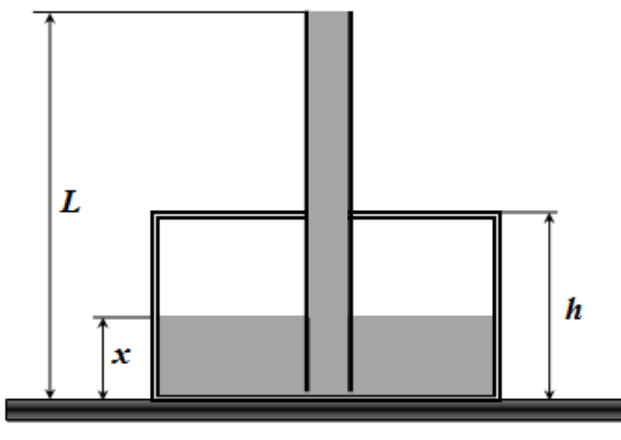
1. [2.0 points] Find the height of the water level in the vessel at the time moment when the tube is completely filled with water. Express your answer in terms of , and find its numerical value.
Now, assume that the walls of the vessel and the tube are coated with a material which does not conduct heat at all. The air inside the vessel is then heated fast enough such that the water does not have enough time to warm up.
2. [0.5 points] Find air pressure inside the vessel as a function of . Express your answer in terms of .
3. [1.0 points] Find air temperature inside the vessel as a function of . Express your answer in terms of .
4. [1.0 points] Find the temperature to which the air in the vessel must be heated in order to displace all the water from the vessel. Express your answer in terms of and find its numerical value.
5. [2.5 points] Find the amount of heat , which must be given to the air in the vessel in order to displace all the water from the vessel. Express your answer in terms of , and find its numerical value.
Problema 2. Recipiente con acqua (7 punti)
In un recipiente cilindrico con sezione di area e altezza è inserito verticalmente, attraverso il coperchio chiuso ermeticamente, un tubo di lunghezza aperto alle due estremità. L’estremità inferiore del tubo si trova poco sopra il fondo del recipiente. Nel recipiente viene versata acqua la cui densità è , come mostrato nella figura a destra. L’area della sezione trasversale del tubo è molto più piccola di quella del recipiente, e il materiale delle pareti del recipiente conduce il calore molto bene. Si assuma che la pressione atmosferica sia , la temperatura ambiente e l’accelerazione di gravità .
1. [2,0 punti] Determinare l’altezza del livello dell’acqua nel recipiente nell’istante in cui il tubo è completamente riempito d’acqua. Esprimere la risposta in termini di , e calcolarne il valore numerico.
Ora si assuma che le pareti del recipiente e del tubo siano rivestite con un materiale che non conduca affatto il calore. L’aria all’interno del recipiente viene quindi riscaldata abbastanza rapidamente che l’acqua non faccia in tempo a riscaldarsi.
2. [0,5 punti] Determinare la pressione dell’aria all’interno del recipiente in funzione di . Esprimere la risposta in termini di .
3. [1,0 punti] Determinare la temperatura dell’aria all’interno del recipiente in funzione di . Esprimere la risposta in termini di .
4. [1,0 punti] Determinare la temperatura alla quale l’aria all’interno del recipiente deve essere riscaldata per espellere completamente l’acqua dallo stesso. Esprimere la risposta in termini di , e calcolarne il valore numerico.
5. [2,5 punti] Determinare la quantità di calore che occorre fornire all’aria nel recipiente per espellere completamente l’acqua dal recipiente. Esprimere la risposta in termini di , e calcolarne il valore numerico.
Problem 3. Delay and attenuation (16 points)
In this problem, do not take into account the finiteness of the propagation speed of the electromagnetic interaction.
Part 1: Magnet
1.1 Theoretical introduction
The magnetic field generated by a uniformly magnetized ferromagnetic cylinder (permanent magnet) is equivalent, at very large distances, to the field produced by a circular coil with a constant electric current.
The cylindrical magnet, as well as the coil with the current, are characterized by magnetic moment , which is defined for the current loop as the product of the current and the area of the loop,
Such a source of magnetic field is also referred to as a magnetic dipole. The figure shows the magnetic field lines of such a dipole.
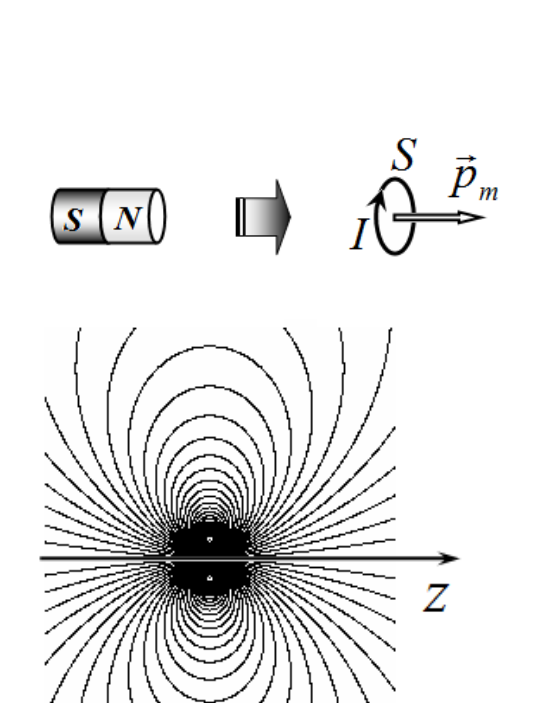
1.1.1. [0.75 points] Show that the magnetic field, , on the axis of the dipole is determined at large distances by the formula
where is the coordinate measured along the axis of the dipole from its center. Find the values of the parameters and in the above formula.
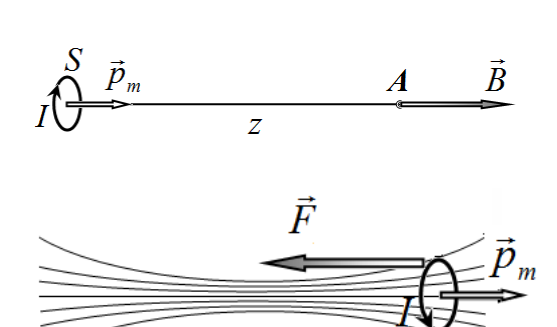
1.1.2. [1 point] Let the coil with a current (i.e., magnetic dipole) with the magnetic moment is influenced by an inhomogeneous axially symmetric field, the induction of which along the z-axis depends on as function . Dipole axis coincides with the axis of symmetry of the field. Show that the force acting on the dipole from the magnetic field is given by
1.2 Oscillations of the magnet
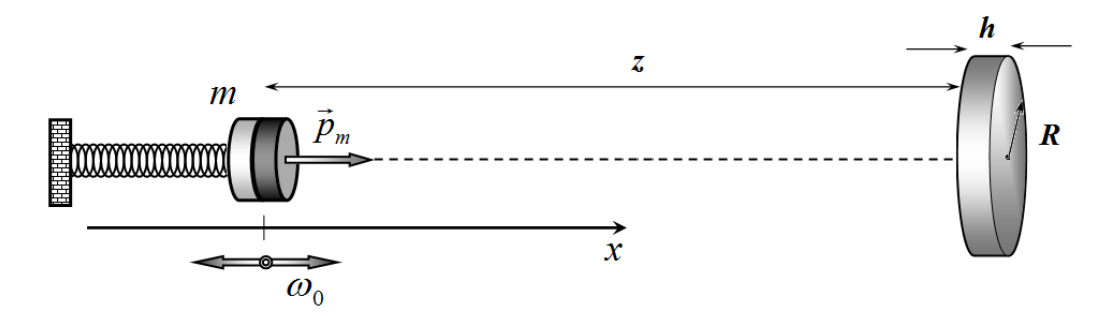
Cylindrical magnet of mass and magnetic moment , is attached to the spring of stiffness such that it can oscillate along the horizontal axis which is directed along the magnetic moment.
1.2.1. [0.25 points] Find the frequency of free oscillations of the magnet in the absence of external fields.
At some distance from the equilibrium position of the magnet a small metal disc is placed such that its axis coincides with the axis of the magnet. The disk has radius and thickness (), the electrical resistivity of the disk material is , and the magnetic permeability is put equal to . The magnet is moved from the equilibrium position and starts performing small oscillations described by function , where .
1.2.2. [2 points] Find the force exerted by the disc on the magnet as a function of its coordinate and velocity . Write down the equation of motion of the magnet.
1.2.3. [0.75 points] Find the relative change in the oscillation frequency of the magnet caused by the influence of the disc.
1.2.4. [0.25 points] Assuming that the attenuation is rather weak, obtain the characteristic attenuation time of the oscillations of the ball.
1.2.5. [1.5 points] Show that the loss of the mechanical energy of the magnet is equal to the amount of heat released in the disk for the same time period.
Mathematical tip The equation of attenuating oscillations has the solution where is the frequency of attenuating oscillations, is the characteristic attenuation time, and the parameters are determined by the initial conditions. It is known that if the following approximate inequality holds .
Part 2: Electric
2.1 Theoretical introduction
The system of two identical in magnitude and opposite in sign charges , located at some fixed distance from each other is called an electric dipole and is characterized by the dipole moment
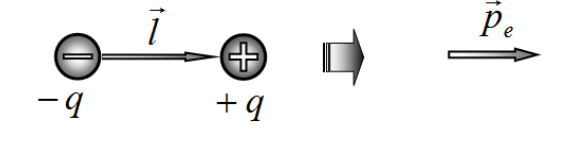
2.1.1. [0.75 points] The electric field generated by the dipole on its axis at the distance , is defined by the formula
Obtain the parameters in this formula.
2.2 Fluctuations of charged ball
A small ball of mass carrying the electric charge is attached to a non-conductive spring of stiffness and can oscillate along the horizontal axis . At some distance from the position of the equilibrium of the ball, a small metal perfectly conducting disk is fixed such that its axis coincides with the axis. The disc has radius and thickness ().
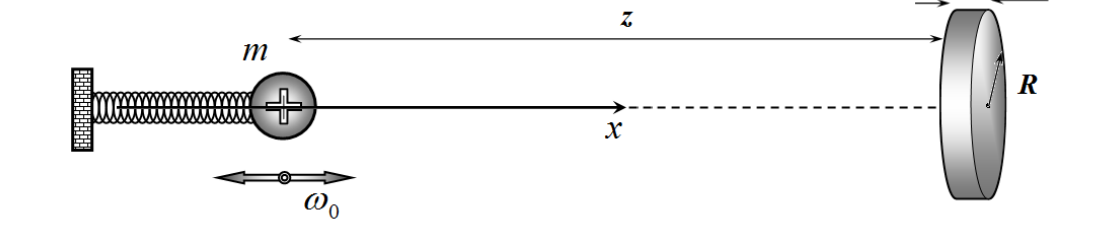
2.2.1. [0.75 points] Find the shift of the equilibrium position of the ball caused by the influence of the disc.
2.2.2. [0.75 points] Find the relative change in the oscillation frequency of the ball, , caused by the influence of the disc.
Assume now that the electrical resistivity of the material of the disk is (not zero).
2.2.3. [1.5 points] Obtain an equation describing the time variation of the induced dipole moment of the disc (i.e., the equation relating the dipole moment of the disk and its rate of change over time ).
2.2.4. [0.25 points] Assuming that the disk is a capacitor whose plates are connected to each other by a resistor, obtain the characteristic time of the equivalent RC-circuit. Express your answer in terms of resistivity of the material of the disk.
Assume in the following that the characteristic time obtained in 2.2.4 is much smaller than the oscillation period of the ball.
2.2.5. [0.25 points] Write down the relation between and expressing the above stated assumption.
In the case of ideal conductivity of the disk the oscillations of the ball do not attenuate. At low resistivity of the material of the disc the attenuation of oscillations should also be small, and such oscillation can be approximately regarded as harmonic ones.
2.2.6. [2 points] Using this approximation and the equation derived in 2.2.3, obtain the expression of the dipole moment of the disk via coordinate and the speed of the ball.
2.2.7. [1.5 points] Find expression for the force exerted on the ball by the disk. Write down the equation of motion of the ball.
2.2.8. [0.25 points] Find the characteristic attenuation time of the oscillations of the ball.
2.2.9. [1.5 points] Show that the loss of mechanical energy of the ball is equal to the heat generated in the disk for the same time period.
Problema 3. Ritardo e attenuazione (16 punti)
In questo problema, non si deve tenere conto della finitezza della velocità di propagazione dell’interazione elettromagnetica.
Parte 1: Magnete
1.1 Introduzione teorica
Il campo magnetico generato da un cilindro ferromagnetico uniformemente magnetizzato (magnete permanente) è, a distanze molto grandi, equivalente al campo prodotto da una bobina circolare attraversata da una corrente elettrica costante.
Sia il cilindro magnetico che la bobina con corrente sono caratterizzati dal momento magnetico , che per una spira di corrente è definito come il prodotto della corrente per l’area della spira,
Una sorgente di campo magnetico del genere viene anche definita dipolo magnetico. La figura mostra le linee di campo magnetico di un tale dipolo.
1.1.1. [0,75 punti] Dimostrare che il campo magnetico sull’asse di un dipolo, a grandi distanze, è determinato dalla formula
dove è la coordinata misurata lungo l’asse del dipolo a partire dal suo centro. Determinare i valori dei parametri e nella formula sopra indicata.
1.1.2. [1 punto] Supponiamo che una bobina attraversata da corrente (cioè un dipolo magnetico) con momento magnetico sia soggetta a un campo magnetico non omogeneo e simmetrico rispetto all’asse; l’induzione magnetica lungo l’asse z dipenda dalla coordinata secondo la funzione . L’asse del dipolo coincide con l’asse di simmetria del campo. Dimostrare che la forza esercitata dal campo magnetico sul dipolo è data da
1.2 Oscillazioni del magnete
Un magnete cilindrico di massa e momento magnetico è collegato a una molla di costante elastica , in modo che possa oscillare lungo l’asse orizzontale, che coincide con il verso del momento magnetico.
1.2.1. [0,25 punti] Determinare la frequenza delle oscillazioni libere del magnete in assenza di campi esterni.
A una certa distanza dalla posizione di equilibrio del magnete viene posto un piccolo disco metallico il cui asse coincide con quello del magnete. Il disco ha raggio e spessore (); la resistività elettrica del materiale del disco è , mentre la permeabilità magnetica viene considerata uguale a . Il magnete viene spostato dalla posizione di equilibrio e inizia a oscillare, il movimento essendo descritto dalla funzione , dove .
1.2.2. [2 punti] Determinare la forza esercitata dal disco sul magnete in funzione della coordinata e della velocità di quest’ultimo. Scrivere l’equazione del moto del magnete.
1.2.3. [0,75 punti] Determinare la variazione relativa della frequenza di oscillazione del magnete causato dall’influenza del disco.
1.2.4. [0,25 punti] Supponendo che l’attenuazione sia piuttosto debole, determinare il tempo caratteristico di attenuazione delle oscillazioni della sfera.
1.2.5. [1,5 punti] Dimostrare che la perdita di energia meccanica del magnete è uguale alla quantità di calore rilasciata nel disco nello stesso lasso di tempo.
Suggerimento matematico L’equazione delle oscillazioni attenuate ha la soluzione dove è la frequenza delle oscillazioni attenuate, è il tempo caratteristico di attenuazione, e i parametri sono determinati dalle condizioni iniziali. È noto che se , vale la relazione approssimata .
Parte 2: Elettrica
2.1 Introduzione teorica
Il sistema costituito da due cariche elettriche identiche per grandezza ma opposte per segno, , poste a una distanza fissa l’una dall’altra, è chiamato dipolo elettrico ed è caratterizzato dal momento di dipolo
2.1.1. [0,75 punti] Il campo elettrico generato da un dipolo lungo il suo asse alla distanza è dato dalla formula
Determinare i parametri e in questa formula.
2.2 Oscillazioni di una sfera carica
Una piccola sfera di massa con carica elettrica è fissata a una molla non conduttrice di costante elastica , e può oscillare lungo l’asse orizzontale . A una certa distanza dalla posizione di equilibrio della sfera, è fissato un piccolo disco metallico perfettamente conduttore il cui asse coincide con l’asse . Il disco ha raggio e spessore ().
2.2.1. [0,75 punti] Determinare lo spostamento della posizione di equilibrio della sfera causato dall’influenza del disco.
2.2.2. [0,75 punti] Determinare la variazione relativa della frequenza di oscillazione della sfera, , dovuto all’influenza del disco.
Si assuma ora che la resistività elettrica del materiale del disco sia (non nulla).
2.2.3. [1,5 punti] Ottenere un’equazione che descriva la variazione nel tempo del momento di dipolo indotto nel disco (cioè, l’equazione che lega il momento di dipolo del disco alla sua variazione temporale ).
2.2.4. [0,25 punti] Supponendo che il disco sia un condensatore le cui armature siano collegate da un resistore, determinare il tempo caratteristico del circuito RC equivalente. Esprimere la risposta in termini della resistività del materiale del disco.
Si assuma che il tempo caratteristico ottenuto in 2.2.4 sia molto più piccolo del periodo di oscillazione della sfera.
2.2.5. [0,25 punti] Scrivere la relazione tra e che esprima l’ipotesi sopra enunciata.
Nel caso di conducibilità ideale del disco, le oscillazioni della sfera non si attenuano. Con una bassa resistività del materiale del disco, anche l’attenuazione delle oscillazioni dovrebbe essere piccola; in tal caso, tali oscillazioni possono essere approssimativamente considerate armoniche.
2.2.6. [2 punti] Utilizzando questa approssimazione e l’equazione ottenuta in 2.2.3, determinare l’espressione del momento di dipolo del disco in funzione della coordinata e della velocità della sfera.
2.2.7. [1,5 punti] Determinare l’espressione della forza esercitata dal disco sulla sfera. Scrivere l’equazione del moto della sfera.
2.2.8. [0,25 punti] Determinare il tempo caratteristico di attenuazione delle oscillazioni della sfera.
2.2.9. [1,5 punti] Dimostrare che la perdita di energia meccanica della sfera è uguale al calore generato nel disco nello stesso lasso di tempo.