Problem 1 (10.0 points)
Theoretical competition — 14 January 2017 (XIII IZhO). The theoretical competition lasts 4 hours; there are three Problems.
This problem consists of three independent parts.
Problem 1A (3.0 points)
A new rapid-firing multibarrel machine gun is tested to provide . The flight speed of a bullet is , and its mass is equal to . The target is a sandbox of mass vertically suspended on a rope. Considering that the bullets are all stuck in the sandbox, evaluate the maximum deflection angle of the sandbox from the vertical after the shooting has started.
Problem 1B (4.0 points)
There is a bubble of radius somewhere in free space. With the help of an external ionizer the soap film is quickly charged up to some positive value, then over certain period of time the radius of the bubble ceases to change and becomes equal to . Find the electric charge , which has been acquired by the soap film, if its heat capacity and heat conductivity are both negligible. The surface tension of the soap film does not depend on the temperature. The air is considered as an ideal diatomic gas.
Problem 1C (3.0 points)
(The separate sheet with the points , , , and the oval area was handed out during the competition; it is not included in the official PDF.)
Two identical source of coherent monochromatic waves with the wavelength are placed at the points and (see the provided separate sheet of paper for this subproblem). On the sheet of paper provided one wavelength corresponds to the size of the two squares. Receivers of waves are located at the points and . Each source emits waves with the same intensity such that the change in the wave amplitude can be neglected with the distance from the sources. On the same sheet of paper for this subproblem plot those points in the highlighted oval area at which a third source should be placed to completely suppress the signals at the points and simulateously. What should be the intensity of the wave from the third source? All sources emit waves with the same phase and polarization perpendicular to the plane of the figure.
Attention! Make all the necessary drawings in the same sheet of paper provided for this subproblem, collect it together with the answer sheets Writing sheets, incorporating it into the overall numbering. Otherwise, your answer to this subproblem will not be evaluated!
Problema 1 (10,0 punti)
Competizione teorica – 14 gennaio 2017 (XIII IZhO). La competizione teorica dura 4 ore e comprende tre problemi.
Questo problema è composto da tre parti indipendenti.
Problema 1A (3,0 punti)
Viene testata una nuova mitragliatrice a canne multiple ad alta cadenza di fuoco in grado di sparare colpi al secondo. La velocità di volo di un proiettile è e la sua massa è . L’obiettivo è una scatola di sabbia con massa , sospesa verticalmente a una fune. Supponendo che tutti i proiettili rimangano conficcati nella scatola, calcolare l’angolo massimo di deviazione della scatola rispetto alla verticale dopo l’inizio del fuoco.
Problema 1B (4,0 punti)
In uno spazio libero si trova una bolla con raggio . Con l’aiuto di un ionizzatore esterno, la pellicola di sapone viene caricata rapidamente fino ad assumere un valore positivo di carica. Dopo un certo periodo di tempo, il raggio della bolla smette di cambiare e diventa uguale a . Calcolare la carica elettrica acquisita dalla pellicola di sapone, assumendo che sia trascurabile sia la sua capacità termica che la sua conducibilità termica. La tensione superficiale della pellicola di sapone non dipende dalla temperatura, e l’aria viene considerata un gas ideale biatomico.
Problema 1C (3,0 punti)
(La scheda separata con i punti , , , e l’area ovale non è inclusa nel PDF ufficiale.)
Due sorgenti identiche di onde monocromatiche coerenti, con lunghezza d’onda , sono posizionate ai punti e (vedi la scheda separata fornita per questo sottoproblema). Sulla stessa scheda, la lunghezza d’onda corrisponde alle dimensioni dei due quadrati disegnati. I ricevitori delle onde sono situati ai punti e . Ogni sorgente emette onde con la stessa intensità , tale che il cambiamento dell’ampiezza dell’onda possa essere trascurato al variare della distanza dalle sorgenti. Sulla stessa scheda, tracciare i punti dell’area ovale evidenziata in cui va posta una terza sorgente per sopprimere completamente i segnali nei punti e contemporaneamente. Qual deve essere l’intensità dell’onda emessa dalla terza sorgente? Tutte le sorgenti emettono onde con la stessa fase e polarizzazione perpendicolare al piano della figura.
Attenzione! Fare tutti i disegni necessari sulla stessa scheda fornita per questo sottoproblema, consegnarla insieme ai fogli risposta (Writing sheets) inserendola nella numerazione complessiva. In caso contrario, la risposta non verrà valutata.
Problem 2 (10.0 points) — Fantastic trip through the Universe
A reconnaissance spacecraft of the well developed civilization plows the universe. In this problem, you are asked to consider a few situations of that interstellar travel from the physical point of view. For all numerical calculations consider the gravitational constant known and equal to .
1. Planets with strange shapes (3.9 points)
At some distance from the spacecraft the crew captain discovers the first planet that has a strange shape of a parallelepiped with a square base of side and a very small thickness . The captain gives the order to pursue a course to planet’s center as shown in the figure below.
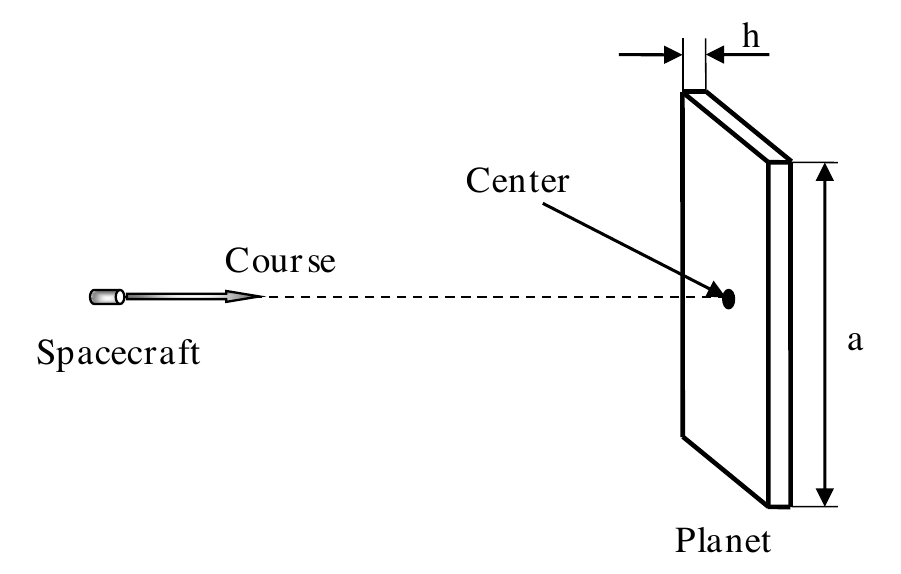
It has been revealed after turning off the engine that the spacecraft acceleration of the free fall , that the planet provides at distances much greater , remains proportional to the solid angle , at which the planet is seen from the spacecraft, that is:
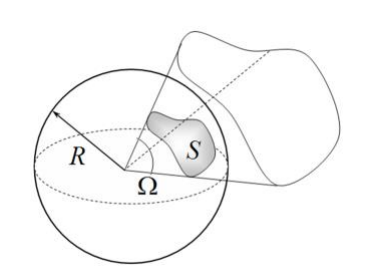
The solid angle is a part of the space, which unites all the rays emanating from a given point (the vertex) and intersecting a surface (which is called a surface subtending the solid angle). The boundary of the solid angle is a certain conical surface. The solid angle is measured by the ratio of the area of the sphere centered at the vertex, which is cut by this solid angle, to the square of the sphere radius: Solid angles are measured by abstract dimensionless quantities. The unit of the solid angle is a steradian, which, in SI units, is equal to the solid angle cutting out the surface area of from the sphere of radius . The whole sphere corresponds to the solid angle of steradian (full solid angle) from any vertex, situated inside the sphere, in particular, for the center of the sphere.
After landing on the planet surface and taking the soil samples, the scientists reported to the captain that the planet is composed of homogeneous material of the density and the free fall acceleration near the geometric surface center of the planet remains almost constant and is equal to .
1.1 [0.7 points] Find and calculate the thickness of the planet .
1.2 [0.5 points] Find and calculate the coefficient .
After leaving the first planet, the captain and his crew meet another exotic planet that shapes a regular pyramid with a square base of the side and of the height .
1.3 [0.7 points] Find and calculate the free fall acceleration measured at the top of the uniform pyramidal planet, if its density is equal to .
The spacecraft has left the pyramidal planet from its top, starting with the characteristic parabolic velocity . The next planet the spacecraft has met on its way is the one shaped like a perfect uniform cube with the side . After accurate measurements, the captain and his crew have found that the density of the cubic planet is .
1.4 [2.0 points] Find and calculate the parabolic velocity for the spacecraft to start from one of the vertices of the cubic planet.
2. Dusty cloud (6.1 points)
The spacecraft encounters a very large massive dust cloud of radius and of homogeneous density . The speed of the spacecraft at a large distance from the cloud reaches the value of , and the impact parameter measured from the cloud center is equal to . The engine remains switched off.
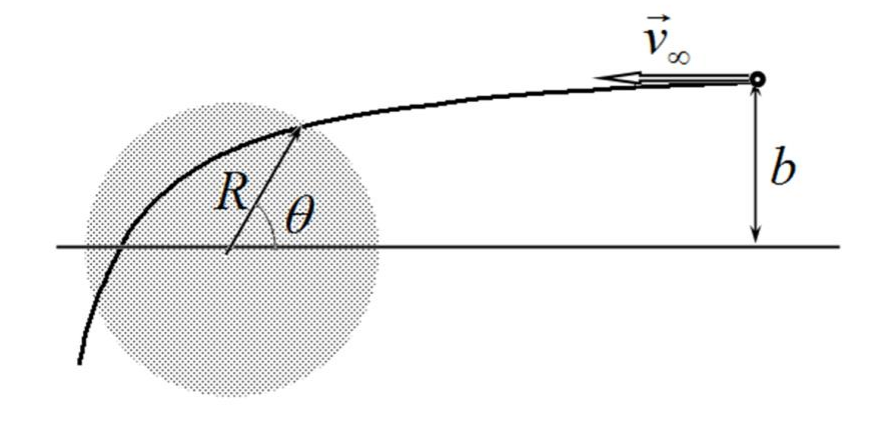
2.1 [2.5 points] Find and calculate the coordinate of the spacecraft entry into the dust cloud, characterized by the angle .
2.2 [2.0 points] Find and calculate the minimum distance , the spacecraft flies by from the cloud center. Resistance to the motion of the spacecraft caused by the cloud particles can be neglected.
Making sure that it is impossible to avoid a collision with the cloud, the captain of the spacecraft takes the decision to turn on the engine, thereby increasing the speed .
2.3 [1.0 points] Find and calculate the minimum speed , at which the spacecraft passes safely by the dust cloud.
Successfully passing the obstacle, the captain and his crew have discovered that the particles of the dust clouds contain valuable elements.
2.4 [0.6 points] Find the minimum work , which must be performed in order to gradually bring all the dust particles onto a very remote processing plant.
Problema 2 (10,0 punti) — Un fantastico viaggio attraverso l’Universo
Una navicella spaziale da ricognizione di una civiltà molto avanzata esplora l’universo. In questo problema vi viene chiesto di analizzare alcune situazioni legate a questo tipo di viaggi interstellari dal punto di vista fisico. Per tutti i calcoli numerici si utilizzi la costante gravitazionale nota, pari a .
1. Pianeti con forme strane (3,9 punti)
A una certa distanza dalla navicella, il comandante scopre il primo pianeta la cui forma è quella di un parallelepipedo con base quadrata di lato e spessore molto piccolo, tale che . Il comandante ordina di proseguire verso il centro del pianeta, come mostrato nella figura sottostante.
È stato scoperto che, dopo lo spegnimento del motore, l’accelerazione di caduta libera della navicella spaziale, fornita dal pianeta a distanze molto maggiori di , rimane proporzionale all’angolo solido con cui il pianeta viene visto dalla navicella, cioè:
L’angolo solido è una porzione dello spazio che unisce tutti i raggi che partono da un dato punto (il vertice) e intersecano una superficie (chiamata superficie sottendente l’angolo solido). Il confine dell’angolo solido è rappresentato da una certa superficie conica. L’angolo solido viene misurato in base al rapporto tra la superficie della sfera centrata nel vertice e tagliata da questo angolo solido, e il quadrato del raggio della sfera: Gli angoli solidi vengono misurati con quantità astratte e senza dimensioni. L’unità di misura dell’angolo solido è lo steradiante; nel SI, uno steradiante corrisponde all’angolo solido che taglia una superficie di area da una sfera di raggio . L’intera sfera corrisponde all’angolo solido di steradianti, considerando qualsiasi vertice situato all’interno della sfera, in particolare il suo centro.
Dopo essere atterrati sulla superficie del pianeta e aver raccolto dei campioni di terreno, gli scienziati riferirono al capitano che il pianeta era composto da un materiale omogeneo la cui densità era pari a , e che l’accelerazione di caduta libera vicino al centro geometrico del pianeta rimaneva quasi costante, uguale a .
1.1 [0,7 punti] Trovare e calcolare lo spessore del pianeta.
1.2 [0,5 punti] Trovare e calcolare il coefficiente .
Dopo aver lasciato il primo pianeta, il capitano e la sua squadra incontrarono un altro pianeta esotico la cui forma ricordava una piramide regolare con base quadrata di lato e altezza pari a .
1.3 [0,7 punti] Trovare e calcolare l’accelerazione di caduta libera misurata sulla sommità di questo pianeta piramidale, dato che la sua densità era uguale a .
La navicella spaziale lasciò il pianeta piramidale dalla sua sommità, partendo con una velocità parabolica caratteristica di . Il prossimo pianeta che la navicella incontrò lungo il suo percorso era un cubo perfettamente regolare con lato . Dopo misurazioni precise, il capitano e la sua squadra scoprirono che la densità di questo pianeta cubico era pari a .
1.4 [2,0 punti] Trovare e calcolare la velocità parabolica necessaria affinché la navicella spaziale parta da uno dei vertici del pianeta cubico.
2. Nube polverosa (6,1 punti)
La navicella spaziale incontra una nube di polvere molto estesa e massiccia, il cui raggio è pari a e la cui densità è omogenea, con valore . La velocità della navicella spaziale a una grande distanza dalla nube raggiunge il valore di , e il parametro d’impatto, misurato dal centro della nube, è uguale a . Il motore rimane spento.
2.1 [2,5 punti] Trovare e calcolare la coordinata del punto in cui la navicella spaziale entra nella nube di polvere, caratterizzata dall’angolo .
2.2 [2,0 punti] Trovare e calcolare la distanza minima alla quale la navicella spaziale passa dal centro della nube. La resistenza al movimento causata dalle particelle della nube può essere trascurata.
Essendo impossibile evitare una collisione con la nube, il comandante della navicella decide di accendere i motori, aumentando così la velocità .
2.3 [1,0 punti] Trovare e calcolare la velocità minima alla quale la navicella spaziale può passare in sicurezza accanto alla nube di polvere.
Dopo aver superato con successo questo ostacolo, il comandante e il suo equipaggio scoprono che le particelle della nube di polvere contengono elementi preziosi.
2.4 [0,6 punti] Trovare il lavoro minimo necessario per trasportare gradualmente tutte le particelle di polvere in un impianto di lavorazione molto lontano.
Problem 3 (10.0 points) — Resistance of a prism
1. Mathematical introduction (3,0 points)
By definition, it is believed that terms of the numerical sequence obey the recurrence relation if each successive term is expressed through the previous ones. For example, for a well known geometric progression we have
where , stands for a fixed number and zeroth term of the numerical sequence has some value of , i.e. .
1.1 [0.2 points] Obtain an explicit formula for an arbitrary term of the sequence , i.e. express it through the successive number , the initial value and .
Let us consider the number . Taking its natural power of , the result can be presented in the following form
where denote some integer numbers.
1.2 [0.4 points] Find the recurrence relations, expressing the values of through the previous values . Find also the inverse relations, expressing through .
1.3 [0.7 points] Calculate the numerical values of the coefficients for .
1.4 [0.2 points] Express the number in terms of .
Let the terms of a certain numerical sequence obey the recurrence relation
where it is known that is some integer number, and , designate some values.
1.5 [1.0 points] Obtain an explicit formula for an arbitrary term of the sequence (3), i.e. express it in terms of the number and values .
1.6 [0.5 points] Obtain an explicit formula for an arbitrary term of the sequence (3) through , found in 1.2-1.3.
Hint. The solution to the recurrence relation (3) must be sought in the form , where is a constant. Determine at what values of it is possible and construct an exact solution that satisfies all above stated conditions.
2. Wire frame in the shape of a prism (7.0 points)
Problems are widely known in which you are asked to find the electrical resistance of a simple wire frame. An example of such a frame shaped in the form of a cube is shown below. Let the electric resistance of each edge be equal to .
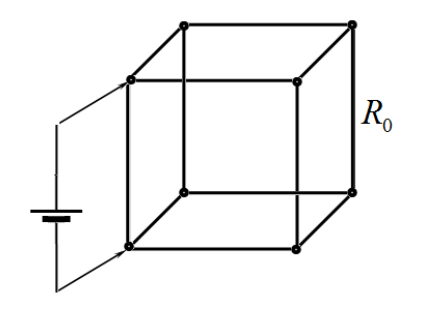
2.1 [0.8 points] Find the total resistance of the cube when the source is connected to the two adjacent cube vertices as shown on the right.
Let us now consider a more general case of the wire frame in the form of the regular prism with an arbitrary number of side faces and determine its electrical resistance when the source is connected to the adjacent vertices of the side edge, as shown in the figure below. The resistance of each frame edge is equal to .
For convenience, the vertices of the prism and their electric potentials on the upper and the bottom sides are consequently numbered and denoted, as shown in the figure below. DC voltage source is applied to zeroth vertices such that the source sets the potentials of the vertices equal to and , respectively.
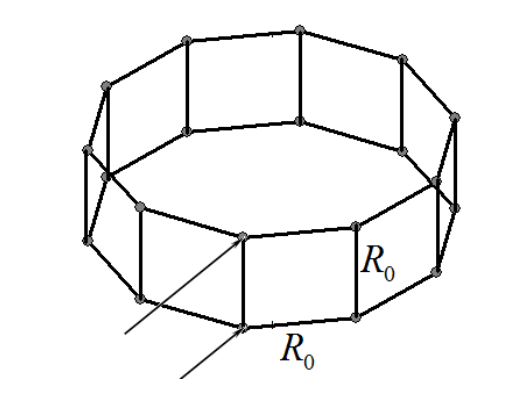
Wire frame in the shape of a prism
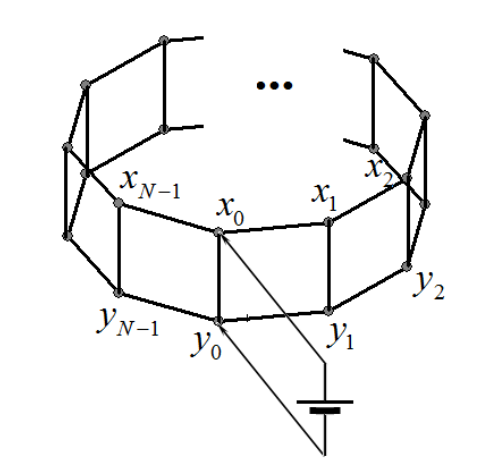
Numbering and denoting vertices’ potentials
2.2 [0.2 points] Find the relation between the potentials and . Find the relation between the potentials and .
Consider an arbitrary lateral edge, except zeroth () and the last () ones. The corresponding circuit diagram is shown below.
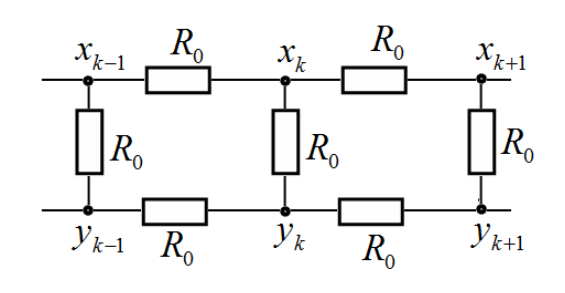
2.3 [1.0 points] Find an recurrence relation for the potential as expressed in terms of the neighboring vertices potentials for .
2.4 [0.2 points] Find boundary conditions at and necessary for unambiguous determination of the potential .
2.5 [0.2 points] Find explicit expressions for the potentials and for all possible numbers .
2.6 [0.4 points] Express the source current in terms of . Use the appropriate numbers obtained in the Mathematical introduction to this problem.
2.7 [0.2 points] Derive an explicit formula for the resistance of the wire frame, expressed in terms of .
2.8 [1.0 points] Find and tabulate the exact values of the frame resistances for .
2.9 [0.5 points] Draw the equivalent circuits for the exotic prisms with and .
2.10 [1.0 points] Find the resistance of the wire frame at .
2.11 [1.5 points] Find the minimum value of at which the prism resistance deviation from does not exceed 2%.
Problema 3 (10,0 punti) — Resistenza di un prisma
1. Introduzione matematica (3,0 punti)
Per definizione, si dice che i termini di una sequenza numerica seguono una relazione ricorsiva quando ciascun termine successivo può essere espresso in termini dei termini precedenti. Ad esempio, in una progressione geometrica ben nota, si ha
dove , rappresenta un numero fisso e il termine zero della sequenza numerica ha il valore , cioè .
1.1 [0,2 punti] Ottenere una formula esplicita per qualsiasi termine della sequenza , cioè esprimerlo in funzione del numero d’ordine , del valore iniziale e di .
Consideriamo il numero . Elevandolo alla potenza naturale , il risultato può essere espresso nella seguente forma
dove indicano alcuni numeri interi.
1.2 [0,4 punti] Trovare le relazioni di ricorsione che esprimono i valori di in termini dei valori precedenti . Trovare anche le relazioni inverse che esprimono in termini di .
1.3 [0,7 punti] Calcolare i valori numerici dei coefficienti per .
1.4 [0,2 punti] Esprimere il numero in termini di .
Siano i termini di una certa successione numerica legati dalla relazione ricorsiva
dove è noto che è un numero intero, e , dove indicano valori specifici.
1.5 [1,0 punti] Ottenere una formula esplicita per qualsiasi termine della sequenza (3), cioè esprimerlo in termini del numero e dei valori .
1.6 [0,5 punti] Ottenere una formula esplicita per qualsiasi termine della sequenza (3) utilizzando i valori determinati nelle parti 1.2-1.3.
Suggerimento. La soluzione alla relazione ricorsiva (3) deve essere cercata nella forma , dove è una costante. Determinare per quali valori di questa formula sia valida e costruire una soluzione esatta che soddisfi tutte le condizioni richieste.
2. Telaio di filo a forma di prisma (7,0 punti)
Sono molto comuni problemi in cui si deve calcolare la resistenza elettrica di una semplice telaio di filo. Di seguito è mostrato un esempio di tale telaio a forma di cubo; supponiamo che la resistenza elettrica di ciascuno spigolo sia uguale a .
2.1 [0,8 punti] Calcolare la resistenza totale del cubo quando la sorgente elettrica è collegata a due vertici adiacenti del cubo, come mostrato a destra.
Ora consideriamo un caso più generale: un telaio di filo nella forma di un prisma regolare con un numero arbitrario di facce laterali. Determiniamo la sua resistenza elettrica quando la sorgente è collegata ai vertici adiacenti di uno spigolo laterale, come mostrato nella figura seguente. La resistenza di ciascuno spigolo del telaio è uguale a .
Per comodità, i vertici del prisma e i loro potenziali elettrici sulle basi superiore e inferiore sono numerati in successione e indicati come mostrato nella figura. Una sorgente di tensione continua viene applicata ai vertici di indice zero, in modo che tali potenziali siano rispettivamente e .
Telaio di filo a forma di prisma
Numerazione e indicazione dei potenziali dei vertici
2.2 [0,2 punti] Trovare la relazione tra i potenziali e . Trovare la relazione tra i potenziali e .
Si consideri un qualsiasi spigolo laterale, ad eccezione di quello di indice zero () e dell’ultimo (). Il relativo diagramma elettrico è mostrato di seguito.
2.3 [1,0 punti] Trovare una relazione di ricorsione per il potenziale , espresso in termini dei potenziali dei vertici adiacenti, per .
2.4 [0,2 punti] Determinare le condizioni al contorno per e , necessarie per determinare in modo univoco il potenziale .
2.5 [0,2 punti] Trovare espressioni esplicite per i potenziali e per tutti i valori possibili di .
2.6 [0,4 punti] Esprimere la corrente della sorgente in termini di . Utilizzare i valori appropriati ottenuti nell’introduzione matematica a questo problema.
2.7 [0,2 punti] Ricavare una formula esplicita per la resistenza del telaio, espressa in termini di .
2.8 [1,0 punti] Calcolare e tabulare i valori esatti delle resistenze del telaio per .
2.9 [0,5 punti] Disegnare i circuiti equivalenti per i prismi esotici con e .
2.10 [1,0 punti] Calcolare la resistenza del telaio quando .
2.11 [1,5 punti] Determinare il valore minimo di per cui la deviazione della resistenza del prisma rispetto a non superi il 2%.