Problem 1 (10.0 points)
Theoretical competition — 12 January 2018 (XIV IZhO). The theoretical competition lasts 4 hours; there are three questions.
This problem consists of three independent parts.
Problem 1A (3.0 points)
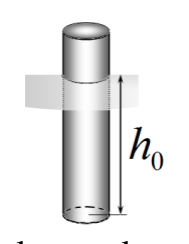
A1 A narrow cylindrical test-tube with a displaced center of mass floats vertically in water in a very wide vessel. In equilibrium state, the test-tube is immersed into water to a depth . The cross-sectional area of the tube is . Determine the period of small vertical oscillations of the test-tube.
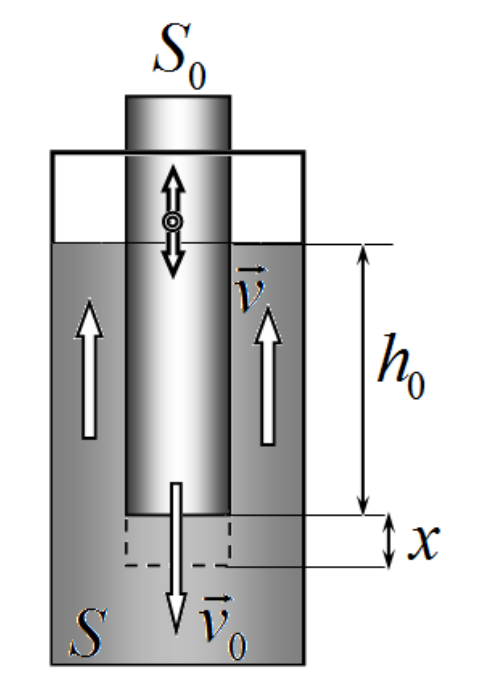
A2 The same test-tube is placed in a narrow cylindrical vessel with a cross-sectional area filled with water. The test-tube makes small oscillations along the axis of the vessel.
A2.1 The test-tube sinks by some small value . Express the change in the potential energy of the system through , the initial depth of immersion , cross-sectional areas , , the water density and the acceleration of gravity .
A2.2 Let the speed of the test-tube be near its equilibrium position. Express the kinetic energy of the system through the speed of the test tube , the depth of immersion , the cross-sectional areas , , and the water density . Consider that in the gap between the test-tube and the walls of the vessel all liquid moves with the same speed .
A2.3 Find the period of small oscillations of the test-tube in the narrow vessel.
Problem 1B (4.0 points)
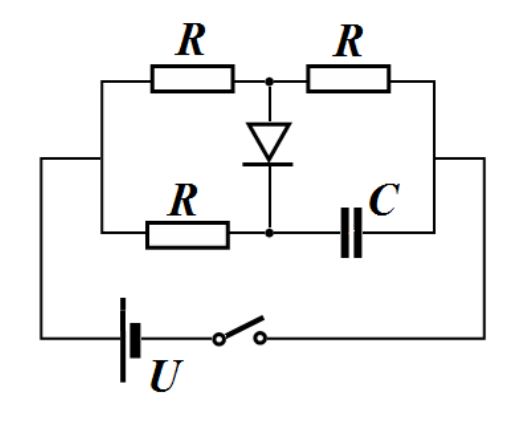
The circuit, shown in the figure, consists of a capacitor with the capacitance , an ideal diode, a constant voltage source , three identical resistors with the resistance and a switch. At the initial moment, the capacitor is not charged and the switch is open. When the switch is shorted, the current through the diode goes for the time interval , and then stops.
- Find the current through the diode immediately after shorting the switch.
- Find the total charge that has flowed through the diode.
Problem 1C (3.0 points)
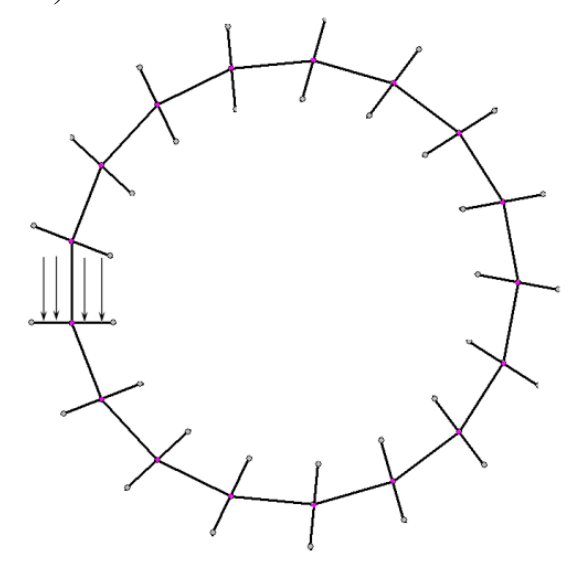
At the vertices of the regular 17-gon, there are 17 identical lenses. The optical centers of the lenses are located exactly at the vertices of the polygon, the planes of all lenses are perpendicular to one of the sides adjacent to the lens. The focal lengths of the lenses are all equal to sm and coinciude with the length of the side of the 17-gon. One of the lenses is illuminated by a parallel light flux directed along its optical axis. It turns out that one of the rays has a closed trajectory. Determine the radius of the circle inscribed in this trajectory. Consider two cases: all of the lenses are collecting; all of the lenses are diverging. Consider all angles small such that .
Problema 1 (10,0 punti)
Competizione teorica — 12 gennaio 2018 (XIV IZhO). La competizione teorica dura 4 ore; ci sono tre domande.
Questo problema è composto da tre parti indipendenti.
Problema 1A (3,0 punti)
A1 Una provetta cilindrica stretta, con il centro di massa spostato, galleggia verticalmente in acqua all’interno di un contenitore molto ampio. Nello stato di equilibrio, il tubo è immerso nell’acqua fino a una profondità di . L’area della sezione trasversale del tubo è . Determinare il periodo delle piccole oscillazioni verticali del tubo.
A2 Lo stesso tubo di prova viene posto all’interno di un contenitore cilindrico stretto, la cui sezione trasversale è pari a e che è riempito d’acqua. Il tubo di prova esegue piccole oscillazioni lungo l’asse del contenitore.
A2.1 Il tubo di prova affonda di una piccola distanza . Esprimere la variazione dell’energia potenziale del sistema in funzione di , della profondità iniziale di immersione , delle sezioni trasversali e , della densità dell’acqua e dell’accelerazione di gravità .
A2.2 Si supponga che la velocità del tubo di prova vicino alla sua posizione di equilibrio sia . Esprimere l’energia cinetica del sistema in funzione della velocità , della profondità di immersione , delle sezioni trasversali e e della densità dell’acqua . Si consideri che, nello spazio tra il tubo di prova e le pareti del contenitore, tutto il liquido si muova alla stessa velocità .
A2.3 Determinare il periodo delle piccole oscillazioni del tubo di prova all’interno del contenitore stretto.
Problema 1B (4,0 punti)
Il circuito, mostrato nella figura, è composto da un condensatore con capacità , un diodo ideale, una sorgente di tensione costante , tre resistori identici con resistenza e un interruttore. Nel momento iniziale, il condensatore non è carico e l’interruttore è aperto. Quando l’interruttore viene chiuso, la corrente che attraversa il diodo dura per l’intervallo di tempo , dopodiché si interrompe.
- Calcolare la corrente che attraversa il diodo immediatamente dopo la chiusura dell’interruttore.
- Calcolare la carica totale che è passata attraverso il diodo.
Problema 1C (3,0 punti)
Ai vertici del 17-gono regolare sono posizionate 17 lenti identiche. I centri ottici delle lenti si trovano esattamente nei vertici del poligono, e i piani di tutte le lenti sono perpendicolari a uno dei lati adiacenti alla rispettiva lente. Le lunghezze focali di tutte le lenti sono uguali a sm e coincidono con la lunghezza del lato del 17-gono. Una delle lenti viene illuminata da un flusso luminoso parallelo diretto lungo il suo asse ottico; si verifica che uno dei raggi segue una traiettoria chiusa. Determinare il raggio del cerchio inscritto in questa traiettoria. Considerare due casi: tutte le lenti sono convergenti; tutte le lenti sono divergenti. Assumere che tutti gli angoli siano piccoli, così da rendere valida l’approssimazione .
Problem 2 (10.0 points) — Physics in the mountains
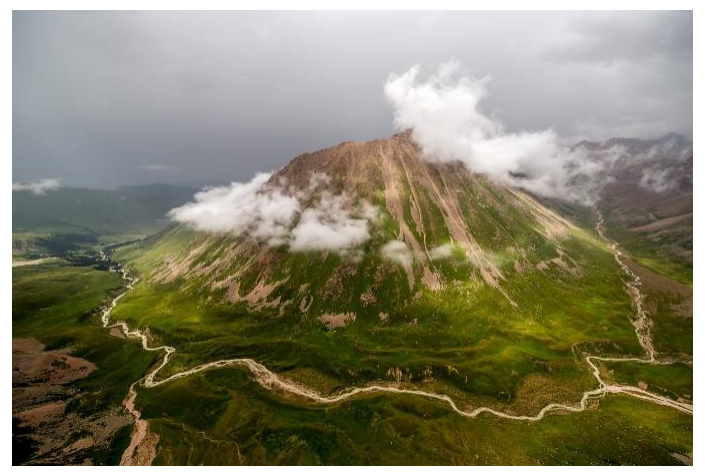
The atmosphere of a real planet, such as the Earth, has a rather complex structure in view of the great variety of processes and phenomena involved in its formation. In this problem we will consider two simple models of the lower layer of the atmosphere, called the troposphere, which extends to an altitude of 10-15 km above the Earth’s surface. To understand the physics of some phenomena it is sufficient to consider the Earth’s atmosphere consisting of a single-component diatomic gas with the molar mass .
Part 1. Isothermal atmosphere
In the atmosphere, the lowest near-surface layer has an almost constant temperature, as it is heated up by the surface of the Earth. Therefore, we assume in this part that the temperature of the atmosphere remains the same over its entire altitude and is equal to , and the air pressure at the Earth’s surface is . Assume that the acceleration of gravity is independent of the altitude above the Earth’s surface, since the total height of the atmosphere is much less than the Earth’s radius . The universal gas constant is .
1.1 Find and calculate the mass of the Earth’s atmosphere.
1.2 Find and calculate the air pressure at the altitude of above the Earth’s surface.
From the physical point of view, the interesting question is how fast the atmosphere warms up with the change of day and night. From space observations, the so-called solar constant is known, which is the total power of the solar radiation in the region of the Earth’s orbit passing through a unit of a surface oriented perpendicular to its flow.
1.3 Estimate the amount of heat needed to heat the atmosphere by .
1.4 Find and calculate the time interval for the Sun to shine in order to provide the Earth with the amount of heat .
Part 2. Adiabatic atmosphere
The real troposphere is not isothermal at all and the air temperature decreases with altitude. Due to the constantly flowing convective processes, the troposphere can be considered practically adiabatic. Let the air temperature and pressure at the Earth’s surface be and , respectively. Consider the acceleration of gravity be still independent of the altitude above the Earth’s surface.
2.1 Find and calculate the air temperature at the altitude of above the Earth’s surface.
2.2 Find and calculate the air pressure at the altitude of above the Earth’s surface.
In the constructed model, the height of the Earth’s troposphere is determined by reaching a certain critical temperature, at which other physical processes begin to play an important role.
2.3 Estimate the height difference of the Earth’s troposphere at day and night if the surface temperature changes within this period of time by .
A mountain climber starts climbing on a fairly high mountain, at the foot of which the temperature and the air pressure are equal to and . At the altitude of , he decides to make a halt in order to boil some water and discovers that it boils faster than usual. He opens the handbook on physics available at the moment and finds that at temperature , the saturated water vapor pressure is , and at temperature it is equal to .
2.4 Find and calculate the boiling temperature of water at the altitude of .
After having resumed his climbing, the mountain climber discovers that snow appears at a certain altitude and special equipment is needed to proceed further.
2.5 Find and calculate the altitude , at which the climber noticed the appearance of a snow cover on the mountain.
The climber recalled the conversation with the locals right before climbing, in which he was informed that the snow cover completely disappears from the mountain at temperatures at the foot of the mountain.
2.6 Find and calculate the height of the mountain on which the climber ascends.
Having risen even higher along the slope of the mountain to some altitude , the climber notices the appearance of fog. Looking around, he realizes that there are no clouds and there is no wind. The climber knows that the molar mass of water is , and according to the weather forecast, the relative humidity at the foot of the mountain was equal to . In the handbook on physics, he finds a formula for the pressure of saturated water vapor in the temperature range , which has the following form
where denotes the saturated vapor pressure at temperature , stands for the saturated vapor pressure at temperature , , are constants. In the calculations, consider that the water vapor is always in thermodynamic equilibrium with the surrounding air.
2.7 Find and calculate the altitude .
2.8 Find and calculate the minimum air humidity at the foot of the mountain such that the fog is still observed somewhere on the mountain slope.
Mathematical hint. You may need knowledge of the following integral .
Problema 2 (10,0 punti) – Fisica in montagna
L’atmosfera di un pianeta reale, come la Terra, presenta una struttura piuttosto complessa, data la grande varietà di processi e fenomeni coinvolti nella sua formazione. In questo problema considereremo due modelli semplificati dello strato inferiore dell’atmosfera, chiamato troposfera, che si estende fino a un’altitudine di 10-15 km sopra la superficie terrestre. Per comprendere la fisica di alcuni fenomeni, è sufficiente considerare l’atmosfera terrestre come costituita da un gas biatomico monocomponente la cui massa molare è .
Parte 1. Atmosfera isoterma
Lo strato più basso dell’atmosfera, vicino alla superficie terrestre, presenta una temperatura quasi costante, poiché viene riscaldato dal suolo. Pertanto, in questa parte assumiamo che la temperatura dell’atmosfera rimanga invariata lungo tutta la sua altitudine e sia uguale a , mentre la pressione atmosferica alla superficie terrestre è . Si assume inoltre che l’accelerazione di gravità sia indipendente dall’altitudine, poiché l’altezza totale dell’atmosfera è molto inferiore al raggio terrestre . La costante universale dei gas è .
1.1 Trovare e calcolare la massa dell’atmosfera terrestre.
1.2 Trovare e calcolare la pressione atmosferica all’altitudine di sopra la superficie terrestre.
Dal punto di vista fisico, la domanda interessante è quanto rapidamente l’atmosfera si riscalda con l’alternarsi del giorno e della notte. Dalle osservazioni spaziali è nota la cosiddetta costante solare , che rappresenta la potenza totale della radiazione solare nella regione dell’orbita terrestre, quando questa attraversa una superficie orientata perpendicolarmente al suo flusso.
1.3 Stimare la quantità di calore necessaria per riscaldare l’atmosfera di un valore pari a .
1.4 Trovare e calcolare l’intervallo di tempo durante il quale il Sole deve splendere per fornire alla Terra la quantità di calore .
Parte 2. Atmosfera adiabatica
La vera troposfera non è affatto isotermica e la temperatura dell’aria diminuisce con l’altitudine. A causa dei processi convettivi in corso, la troposfera può essere considerata praticamente adiabatica. Supponiamo che la temperatura e la pressione dell’aria alla superficie terrestre siano rispettivamente e . Consideriamo inoltre che l’accelerazione di gravità sia indipendente dall’altitudine.
2.1 Trovare e calcolare la temperatura dell’aria all’altitudine di sopra la superficie terrestre.
2.2 Trovare e calcolare la pressione dell’aria all’altitudine di sopra la superficie terrestre.
Nel modello considerato, l’altezza della troposfera terrestre è determinata dal raggiungimento di una certa temperatura critica, raggiunta la quale altri processi fisici iniziano a svolgere un ruolo importante.
2.3 Stimare la differenza di altitudine della troposfera terrestre durante il giorno e la notte, assumendo che la temperatura superficiale cambi nel corso di questo periodo di tempo di .
Un alpinista inizia l’ascesa su una montagna piuttosto alta; ai piedi della montagna, la temperatura e la pressione atmosferica sono rispettivamente e . A un’altitudine di , decide di fare una sosta per far bollire dell’acqua e si accorge che questa bolle più rapidamente del solito. Consulta il suo manuale di fisica e scopre che, alla temperatura , la pressione del vapore acqueo saturo è pari a , mentre alla temperatura questa pressione scende a .
2.4 Trovare e calcolare la temperatura di ebollizione dell’acqua all’altitudine di .
Dopo aver ripreso l’ascesa, l’alpinista nota che a una certa altitudine compare la neve e che per proseguire è necessario utilizzare attrezzature speciali.
2.5 Trovare e calcolare l’altitudine alla quale l’alpinista ha osservato la comparsa della neve sulla montagna.
L’alpinista ricorda di aver parlato con i locali prima dell’inizio dell’ascesa; questi gli avevano detto che la neve scompare completamente dalla montagna quando la temperatura supera i ai piedi della stessa.
2.6 Trovare e calcolare l’altezza della montagna su cui l’alpinista sta salendo.
Essendo salito ancora più in alto lungo il pendio della montagna, fino ad una certa altitudine , l’alpinista nota l’apparizione di nebbia. Guardandosi intorno, si rende conto che non ci sono nuvole e che non soffia vento. Sa che la massa molare dell’acqua è , e secondo le previsioni meteorologiche, l’umidità relativa ai piedi della montagna era pari a . Nel manuale di fisica trova una formula per la pressione del vapore acqueo saturo nell’intervallo di temperature , che ha la seguente forma
dove indica la pressione di vapore saturo alla temperatura , rappresenta la pressione di vapore saturo alla temperatura , , sono costanti. Nei calcoli si consideri che il vapore acqueo sia sempre in equilibrio termodinamico con l’aria circostante.
2.7 Trovare e calcolare l’altitudine .
2.8 Trovare e calcolare l’umidità relativa minima ai piedi della montagna, tale da garantire che la nebbia venga ancora osservata in qualche punto del pendio.
Suggerimento matematico. Potrebbe essere necessario conoscere il seguente integrale: .
Problem 3 (10.0 points) — Optics of moving media
Part 1. 4-dimensional vectors
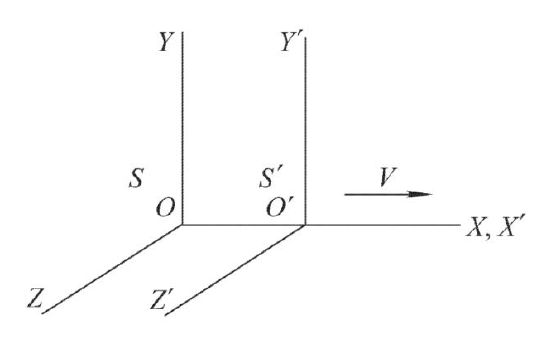
Consider two inertial reference frames and of which the second one moves at a speed relative to the first one as shown in the figure. It is assumed that the origins and coincide at the initial time moment by the clocks of both reference frames. It is known that the Lorentz transformation of space-time coordinates of any event in the frame into the space-time coordinates of the same event in the frame have the following form
where m/s is the speed of light.
In the formulas of the Lorentz transformation the spatial coordinates and the time are intentionally brought to the same dimension as they together form components of the so-called 4-vector. It is known that all the components of 4-vectors are transformed in the same way at the transition from one inertial frame to the other. In particular, the momentum and the energy constitute the components of the 4-vector.
Suppose that an object moves in the reference frame such that it has the total energy and the momentum projections on the coordinate axes , and , respectively.
1.1 Write down the transformation of energy and momentum of the object from the reference frame to the reference frame .
Suppose an object of the rest mass moves in the reference frame such that it has the total energy and the momentum . When converting its energy and momentum from one reference frame to another the value remains invariant.
1.2 Express in terms of and .
Part 2. Doppler effect and light aberration
Let a plane electromagnetic wave (EMW) propagate in -plane of the reference frame so that it has the frequency and makes the angle with the axis .
2.1 Find the frequency of EMW registered by an observer in the reference frame .
2.2 Find the angle that EMW makes with the axis in the reference frame .
Astronomical observations have shown that the position of a newly discovered massive star on the celestial sphere (i.e. relative to very distant objects) does not remain constant throughout the year. It moves along an ellipse with axial ratio 0.900. Ecliptic latitude of a star is the angle between the direction to the star and the ecliptic plane, which can be assumed coincident with the plane of the Earth orbit around the Sun.
2.3 Find the ecliptic latitude of the star and evaluate it in arc degrees.
Observation of the emission spectrum of the star has shown that all frequency in its spectrum are shifted to the red. The relative frequency deviation is . It has independently been established that the recession velocity of the star from the Sun is equal to .
2.4 Find and evaluate the escape velocity at the surface of the star .
Part 3. Light in a moving medium
Consider the same two reference frames as in Part 1. Let an object move in the plane of the reference frame such that the projections of its velocity on the axis and are equal and , respectively.
3.1 Find the projections of the object velocity on the axis and on the axis in the reference frame .
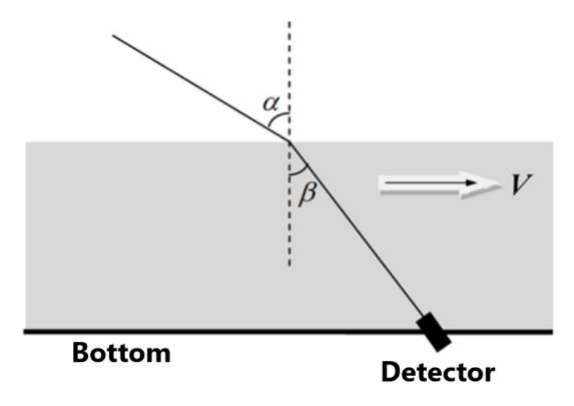
Consider a water flow moving at the speed of relative to the bottom of the vessel. A plane EMW falls onto the water surface to make the angle to the normal in the laboratory reference frame. A detector is fixed at the bottom of the vessel. The refractive index of water is known to be .
If the water velocity , the expression for the sine of the angle at which the detector registers the direction of EMW propagation, takes the form:
3.2 Find , and express them in terms of and .
If the water velocity , the expression for velocity of the light propagation in the laboratory reference frame is found as
3.3 Find , and express them in terms of , , .
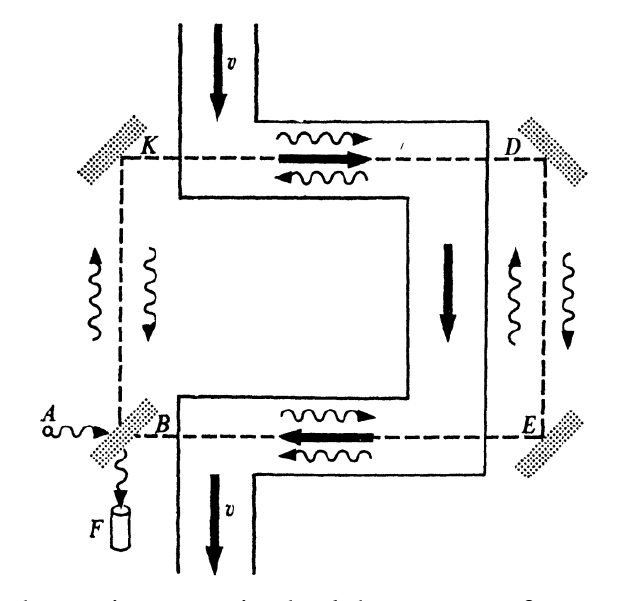
In 1860 A. Fizeau set up the following experiment. A monochromatic beam with the wavelength comes out of the source and falls onto the semitransparent plate at which it is divided into two coherent beams. The first beam, being reflected from the plate , goes along the way (, and are the mirrors), whereas the second beam, passing through the plate , goes along the way . The first beam, when returning to the plate , is partially reflected from it and reaches the interferometer . The second beam, when returning to the plate , partially passes through it and reaches the interferometer . Both interfering beams travels the same distance in the laboratory reference frame, including section and in which the water flows with the velocity . The total distance covered by each beam in water in the laboratory reference frame is equal to .
3.4 Find the number of bands the interference pattern is shifted by when the liquid velocity changes from 0 to and express it in terms of , , , , and .
In his own experiment A. Fizeau obtained at , and .
3.5 Evaluate refractive index of water in Fizeau’s experiment.
Mathematical hint. You may need to know the following approximate equality: , at .
Problema 3 (10,0 punti) – Ottica dei mezzi in movimento
Parte 1. Vettori quadridimensionali
Si considerino due sistemi di riferimento inerziali e , di cui il secondo si muove con una velocità rispetto al primo, come mostrato nella figura. Si assume che i punti di origine e coincidano nel momento iniziale , secondo gli orologi di entrambi i sistemi di riferimento. È noto che la trasformazione di Lorentz delle coordinate spazio-temporali di qualsiasi evento nel sistema di riferimento nelle coordinate spazio-temporali dello stesso evento nel sistema di riferimento ha la seguente forma
dove m/s è la velocità della luce.
Nelle formule della trasformazione di Lorentz, le coordinate spaziali e il tempo vengono intenzionalmente resi della stessa dimensione, in modo che insieme costituiscano i componenti del cosiddetto 4-vettore. È noto che tutti i componenti dei 4-vettori vengono trasformati nello stesso modo al passaggio da un sistema di riferimento all’altro. In particolare, la quantità di moto e l’energia costituiscono i componenti di questo 4-vettore.
Supponiamo che un oggetto si muova nel sistema di riferimento in modo tale da avere un’energia totale e componenti della quantità di moto rispettivamente sugli assi coordinati , e .
1.1 Scrivere la trasformazione dell’energia e della quantità di moto dell’oggetto dal sistema di riferimento al sistema di riferimento .
Supponiamo che un oggetto di massa a riposo si muova nel sistema di riferimento in modo tale da avere un’energia totale e una quantità di moto . Quando l’energia e la quantità di moto vengono convertiti da un sistema di riferimento all’altro, il valore rimane invariante.
1.2 Esprimere in termini di e .
Parte 2. Effetto Doppler e aberrazione ottica
Si supponga che un’onda elettromagnetica (OEM) piana si propaghi nel piano del sistema di riferimento , con una frequenza e formando un angolo con l’asse .
2.1 Trovare la frequenza dell’onda elettromagnetica osservata da un osservatore nel sistema di riferimento .
2.2 Determinare l’angolo che l’onda elettromagnetica forma con l’asse nel sistema di riferimento .
Le osservazioni astronomiche hanno dimostrato che la posizione di una stella massiccia appena scoperta, chiamata , sulla sfera celeste (cioè rispetto ad oggetti molto lontani) non rimane costante nel corso dell’anno. Si muove lungo un’ellisse il cui rapporto degli assi è 0,900. La latitudine eclittica di una stella è l’angolo tra la direzione verso di essa e il piano dell’eclittica, che si può assumere coincida con il piano dell’orbita terrestre attorno al Sole.
2.3 Determinare la latitudine eclittica della stella e calcolarla in gradi d’arco.
L’osservazione dello spettro di emissione della stella ha rivelato che tutte le frequenze presenti nello spettro sono spostate verso il rosso. La deviazione relativa di frequenza è pari a . È stato inoltre stabilito che la velocità di recessione della stella rispetto al Sole è uguale a .
2.4 Trovare e calcolare la velocità di fuga alla superficie della stella .
Parte 3. Luce in un mezzo in movimento
Consideriamo gli stessi due sistemi di riferimento utilizzati nella Parte 1. Supponiamo che un oggetto si muova nel piano del sistema di riferimento in modo tale che le proiezioni della sua velocità sugli assi e siano rispettivamente uguali a e .
3.1 Determinare le proiezioni della velocità dell’oggetto, , sull’asse e sull’asse , nel sistema di riferimento .
Si consideri un flusso d’acqua che si muove alla velocità rispetto al fondo del recipiente. Un’onda elettromagnetica piana incide sulla superficie dell’acqua formando un angolo rispetto alla normale nel sistema di riferimento del laboratorio. Un rilevatore è fissato sul fondo del recipiente; si sa che l’indice di rifrazione dell’acqua è .
Se la velocità dell’acqua , l’espressione per il seno dell’angolo , sotto cui il rilevatore registra la direzione di propagazione dell’onda, assume la seguente forma:
3.2 Determinare e ed esprimerli in termini di e .
Se la velocità dell’acqua , l’espressione per la velocità della luce nel sistema di riferimento del laboratorio si scrive
3.3 Determinare i valori di e ed esprimerli in termini di , e .
Nel 1860, A. Fizeau condusse il seguente esperimento. Un fascio monocromatico la cui lunghezza d’onda è proviene dalla sorgente e colpisce una lastra semitrasparente , dove viene diviso in due fasci coerenti. Il primo fascio, dopo essere stato riflesso dalla lastra , segue il percorso (dove , ed sono gli specchi), mentre il secondo fascio, passando attraverso la lastra , segue il percorso . Il primo fascio, tornando alla lastra , ne viene parzialmente riflesso e raggiunge l’interferometro . Il secondo fascio, tornando alla lastra , la attraversa in parte e raggiunge l’interferometro . I due fasci che interferiscono percorrono la stessa distanza nel sistema di riferimento del laboratorio, compresi i tratti e nei quali l’acqua scorre con velocità . La distanza totale percorsa da ciascun fascio in acqua, nel sistema di riferimento del laboratorio, è uguale a .
3.4 Determinare il numero di bande per cui si sposta la figura d’interferenza quando la velocità del liquido cambia da 0 a , ed esprimerlo in termini di , , , e .
Nel proprio esperimento, A. Fizeau ottenne con , e .
3.5 Calcolare l’indice di rifrazione dell’acqua nell’esperimento di Fizeau.
Suggerimento matematico. Potrebbe essere necessario conoscere la seguente approssimazione: , quando .