Maxwell’s Disc (15,0 points)
Experimental competition — 11 January 2020 (XVI IZhO). The experimental competition consists of one problem and lasts 3 hours.
In this experiment, you are asked to design all the experimental setups by yourself, connect threads and mark them up if necessary. You can further fasten the discs with pieces of plasticine.
Instruments and equipment: Maxwell’s disk (two disks mounted on a wooden stick), two tripods, threads, a wooden stick, stopwatch, ruler, 2 loads of 100 g each, a piece of plasticine, adhesive tape.
Do not calculate experimental errors if you are not asked to do so.
Part 1. Rolling down
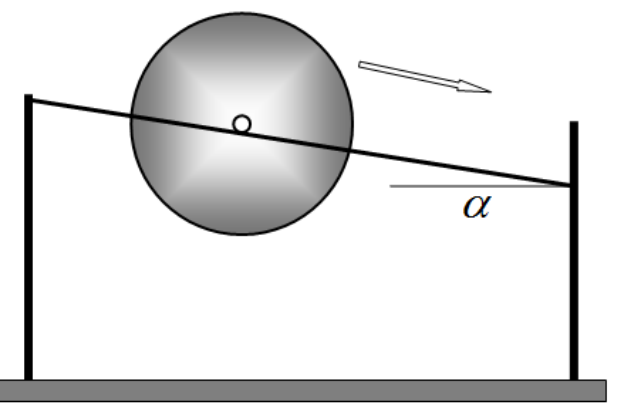
Pull two threads between the two tripods, so that they are parallel to each other and make up some angle to the horizontal. Maxwell’s disc should slide without slipping on these threads, resting on the wooden parts of the stick.
1.1 Derive the formula for the acceleration with which the axis of the disk rolls, depending on the angle of inclination . Assume the disc is homogeneous and neglect the mass of the wooden stick.
1.2 Investigate experimentally the law of motion, i.e. the dependence of the coordinate of the axis of the disk along the thread on time , when it rolls along the threads. Draw a graph of the resulting dependence. Prove that the motion of the disc axis is approximately uniformly accelerated. Calculate the disk axis acceleration. Indicate at what angle you have taken your measurements.
1.3 Measure the dependence of the acceleration of the disk axis on the angle of inclination of the threads . Draw a graph of the resulting dependence.
1.4 On the same graph plot the theoretical dependence of the acceleration on the angle of inclination of the threads. Indicate the results of additional measurements that you have used to calculate the accelerations.
Part 2. Moving down
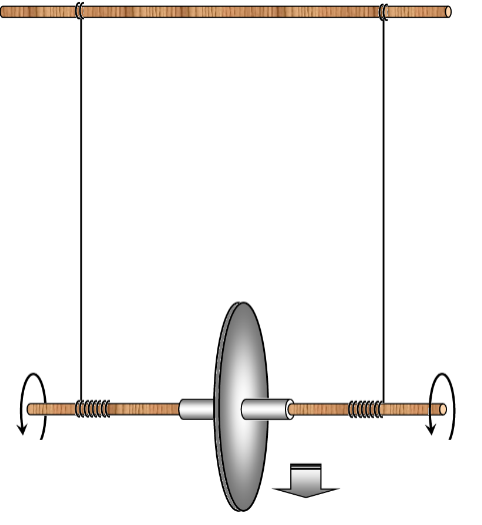
Hang the disc on two threads as shown. Fix the threads on the stick with the adhesive tape to prevent them from slipping. Wind the threads onto the sticks and release the disc.
2.1 Investigate the law of motion of the disk axis when it moves down. Draw a graph of the resulting dependence.
2.2 According to the measurement data, calculate the acceleration at which the axis of the disc moves down. Estimate the experimental error of the obtained acceleration.
2.3 Derive the theoretical formula for the acceleration of the disc axis. Calculate the theoretical value of the acceleration with which the axis of the disc moves down.
Part 3. Moving up
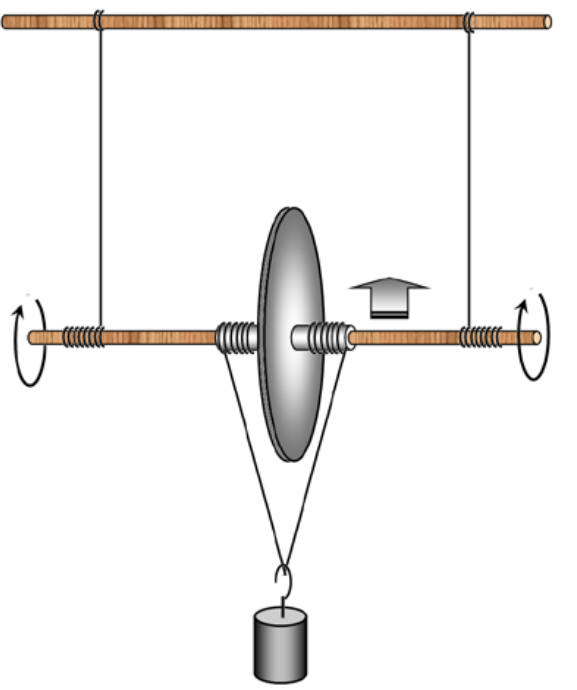
If two additional threads are wound on the stick and a load is suspended on them, then with proper winding of the threads, the disk starts to move up.
3.1 Design the experimental setup such that the disk moves up spinning around. Show schematically in the figure how the threads should be wound on the stick.
3.2 Measure the dependence of the acceleration of the disk axis for different masses of suspended loads.
Disco di Maxwell (15,0 punti)
Competizione sperimentale – 11 gennaio 2020 (XVI IZhO). La competizione sperimentale consiste in un unico problema e dura 3 ore.
In questo esperimento si chiede di progettare da sé tutti gli apparati sperimentali, collegare i fili e marcarli se necessario. Si possono inoltre fissare i dischi utilizzando pezzi di plastilina.
Strumenti ed attrezzature: Disco di Maxwell (due dischi montati su un bastone di legno), due treppiedi, fili, un bastone di legno, cronometro, righello, 2 carichi da 100 g ciascuno, un pezzo di plastilina, nastro adesivo.
Non calcolare gli errori sperimentali se non è richiesto.
Parte 1. Rotolamento verso il basso
Tendere due fili tra i due treppiedi in modo che siano paralleli tra loro e formino un angolo rispetto all’orizzontale. Il disco di Maxwell deve rotolare senza strisciare su questi fili, appoggiandosi alle parti in legno del bastone.
1.1 Ricavare la formula dell’accelerazione con cui si muove l’asse del disco, in funzione dell’angolo di inclinazione . Assumere che il disco sia omogeneo e trascurare la massa del bastone in legno.
1.2 Studiare sperimentalmente la legge del movimento, cioè la dipendenza della coordinata dell’asse del disco lungo i fili in funzione del tempo , quando il disco rotola su di essi. Tracciare un grafico di questa dipendenza e dimostrare che il movimento dell’asse del disco è approssimativamente uniformemente accelerato. Calcolare l’accelerazione dell’asse del disco e indicare a quale angolo sono state effettuare le misurazioni.
1.3 Misurare la dipendenza dell’accelerazione dell’asse del disco dall’angolo di inclinazione dei fili . Tracciare un grafico di questa dipendenza.
1.4 Sullo stesso grafico tracciare anche la dipendenza teorica dell’accelerazione dall’angolo di inclinazione dei fili. Indicare i risultati delle misurazioni aggiuntive utilizzate per calcolare le accelerazioni.
Parte 2. Movimento verso il basso
Appendere il disco a due fili come mostrato in figura. Fissare i fili sul bastone con il nastro adesivo per evitare che scivolino. Avvolgere i fili sul bastone e lasciare andare il disco.
2.1 Studiare la legge del moto dell’asse del disco quando scende. Tracciare un grafico che rappresenti questa relazione.
2.2 In base ai dati di misura, calcolare l’accelerazione con cui scende l’asse del disco. Stimare l’errore sperimentale di tale accelerazione.
2.3 Ricavare la formula teorica per l’accelerazione dell’asse del disco. Calcolare il valore teorico dell’accelerazione con cui scende l’asse del disco.
Parte 3. Movimento verso l’alto
Se vengono avvolti due fili aggiuntivi intorno al bastone e vi viene appeso un carico, allora, avvolgendo correttamente i fili, il disco inizia a muoversi verso l’alto.
3.1 Progettare l’apparato sperimentale in modo che il disco si muova verso l’alto ruotando. Mostrare schematicamente nella figura come i fili debbano essere avvolti intorno al bastone.
3.2 Misurare la dipendenza dell’accelerazione dell’asse del disco in funzione delle diverse masse dei carichi appesi.