Problem 1 (10.0 points)
Theoretical competition — 10 January 2020 (XVI IZhO). The theoretical competition lasts 4 hours; there are three questions.
This problem consists of three independent parts.
Problem 1.1 (4.0 points)
A mathematical pendulum is located on the equator of the Earth. Denote the period of its oscillations at midday , and at midnight . Find the relative difference of these periods . Use the following approximations and numerical values: Earth is an ideal ball of radius ; the Earth’s orbit is a circle of radius with the center located in the center of the Sun; the axis of rotation of the Earth is perpendicular to the plane of the Earth’s orbit; the influence of the Moon and other planets is neglected; acceleration of gravity at the Earth’s pole is ; the period of revolution of the Earth around its axis is 1 day; the period of revolution of the Earth around the Sun is 1 year.
Problem 1.2 (3.0 points)
The space between two concentric well conductive spheres of radii and is filled with a substance whose specific resistance depends only on the distance to the spheres’ common center. An electric current of strength flows in between the spheres, such that the bulk density of Joule heat losses in the substance is the same at all points and is equal to . Determine the average density of the space charge accumulated in the volume of the substance over a sufficiently long time of the electric current flow.
Problem 1.3 (3.0 points)
At equal distances in between the screen and the flat mirror , a flat matte source emitting white light only towards the mirror is placed. The planes of the screen, mirror and source are all parallel to one other. The source has the shape of a five-pointed star inscribed in a circle of radius , whereas the mirror has a regular triangle shape inscribed in a circle of radius . The source and mirror centers lie on the same axis perpendicular to the screen plane. Draw a schematic image of the source on the screen, keeping its orientation in accordance with the figure below. Estimate the sizes of all elements of the image.
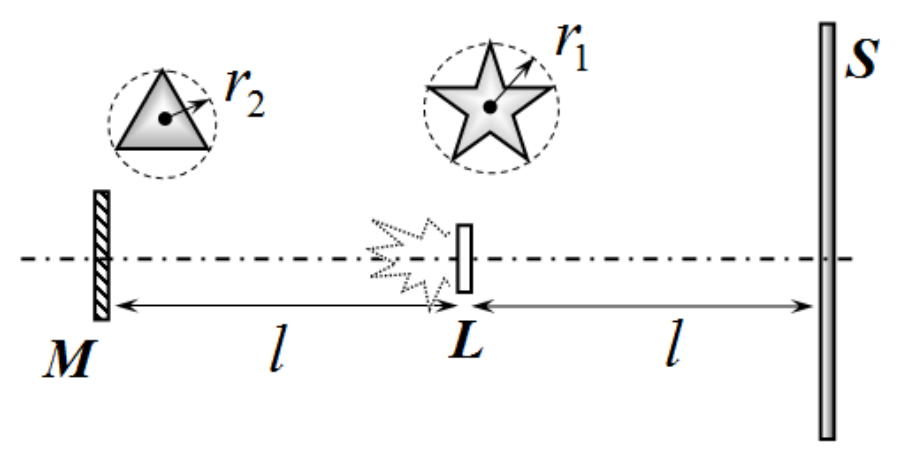
Consider only two specific cases:
1.3.1 and ;
1.3.2 and .
Problema 1 (10,0 punti)
Competizione teorica – 10 gennaio 2020 (XVI IZhO). La competizione teorica dura 4 ore e comprende tre domande.
Questo problema è composto da tre parti indipendenti.
Problema 1.1 (4,0 punti)
Un pendolo matematico è posizionato sull’equatore terrestre. Indichiamo con il periodo delle sue oscillazioni a mezzogiorno e con il periodo a mezzanotte. Calcolare la differenza relativa tra questi periodi, espressa come . Utilizzare le seguenti approssimazioni e valori numerici: la Terra è considerata una sfera ideale con raggio ; l’orbita terrestre è un cerchio con raggio e il suo centro coincide con quello del Sole; l’asse di rotazione della Terra è perpendicolare al piano dell’orbita; l’influenza della Luna e degli altri pianeti viene trascurata; l’accelerazione di gravità ai poli terrestri è ; il periodo di rotazione della Terra attorno al proprio asse è di 1 giorno; il periodo di rivoluzione della Terra attorno al Sole è di 1 anno.
Problema 1.2 (3,0 punti)
Lo spazio tra due sfere concentriche ben conduttrici di raggi e è riempito con una sostanza la cui resistenza specifica dipende esclusivamente dalla distanza dal centro comune delle due sfere. Tra le sfere scorre una corrente elettrica di intensità , tale che la densità volumica delle perdite di calore per effetto Joule nella sostanza sia la stessa in tutti i punti e uguale a . Determinare la densità media della carica spaziale accumulata nello spazio occupato dalla sostanza, dopo un periodo di tempo sufficientemente lungo durante il quale scorre la corrente.
Problema 1.3 (3,0 punti)
A distanze uguali di tra lo schermo e lo specchio piatto , viene posizionata una sorgente luminosa piatta e opaca che emette luce bianca esclusivamente verso lo specchio. I piani dello schermo, dello specchio e della sorgente sono tutti paralleli tra loro. La sorgente ha la forma di una stella a cinque punte inscritta in un cerchio di raggio , mentre lo specchio ha la forma di un triangolo regolare inscritto in un cerchio di raggio . I centri della sorgente e dello specchio si trovano sullo stesso asse perpendicolare al piano dello schermo. Disegnare una rappresentazione schematica dell’immagine proiettata dalla sorgente sullo schermo, mantenendo la sua orientazione conforme alla figura sottostante. Stimare le dimensioni di tutti gli elementi presenti nell’immagine.
Si considerino soltanto due casi specifici:
1.3.1 e ;
1.3.2 e .
Problem 2. Phase states and phase transitions (10.0 points)
At a given pressure, the transition from one phase state of matter to another always occurs at a strictly defined temperature, and the transition itself is called a phase transition. For example, ice at atmospheric pressure melts at , so that when the heat is supplied, the temperature of the mixture of ice and water remains unchanged until all the ice turns into water.
In all the subtasks proposed below, consider that the specific volume of the liquid phase is negligible compared to the specific volume of saturated vapor, which can be considered an ideal gas. Assume as well that the heat capacity of liquid water is independent of temperature.
Useful physical constants
- Gas constant ;
- molar mass of air ;
- acceleration of gravity .
- Normal conditions: pressure ; temperature .
Properties of water (H₂O)
- Molar mass of water ;
- water density ;
- ice density ;
- melting point of ice at normal pressure ;
- boiling point of water at normal pressure ;
- specific heat of water ;
- specific heat of melting ice ;
- specific heat of water vaporization (at ) ;
- Poisson’s adiabatic exponent for water vapor .
Specific heat of phase transition
If a transition from one phase state to another is associated with the release or absorption of a certain amount of heat, called the transition heat, then such a transition is called the first-order phase transition. In this case, the transition heat for a unit mass is called the specific heat of the phase transition (melting, evaporation, sublimation).
Since the phase transition occurs at constant pressure, according to the first law of thermodynamics, the heat is spent on changing the internal energy and on performing the work against constant external pressure:
where stand for the specific internal energies of the first and second phases, respectively.
During melting (crystallization), due to a small difference in the densities of the liquid and solid phases, the volume change as a result of the phase transition is small, therefore, the work can be neglected in comparison with the change in internal energy.
2.1 Evaluate how much of the evaporation heat of water at is spent on changing the internal energy. Express your answer in %.
2.2 Evaluate the specific heat of water vaporization at room temperature .
In the following, the specific heat of vaporization of all liquids is considered to be temperature independent.
The Clausius–Clapeyron relation
When the pressure changes, the temperature of the first-order phase transition changes as well, i.e. the phase transition occurs at a strictly defined dependence between the pressure and the temperature of the matter under investigation. This dependence, depicted on the -plane, is called the -phase diagram, and the curve itself is called the phase equilibrium curve. The Clapeyron-Clausius relation gives the slope of the phase equilibrium curve in the following form:
where denotes the specific heat of transition from phase 1 with the specific volume to phase 2 with the specific volume .
2.3 Assuming that the pressure of the saturated water vapor at the temperature is known, obtain an explicit dependence of the pressure of the saturated water vapor on its temperature .
2.4 Evaluate the boiling point of water at the highest peak in Kazakhstan – Khan-Tengri mountain. The height of the Khan-Tengri mountain peak is above the sea level. The altitude air temperature should be considered constant and equal to .
2.5 At what pressure (in atmospheres) the ice melts at the temperature of ?
2.6 It is known that ice crystals begin to break down if a force is applied along any direction of the crystal to create a pressure . Therefore, snow in frosty weather “crunches” when walking. Estimate the maximum air temperature at which the snow still “crunches” when walking.
2.7 One mole of the saturated water vapor occupies a vessel and has the temperature of . The vapor heats up and at the same time its volume changes such that it remains saturated at all times. Find the molar heat capacity of vapor in such a process.
Border boiling
Border boiling is boiling at the interface between two immiscible liquids. The border boiling point may vary significantly from the volume boiling points of each liquid.
Tetrachloromethane or hydrogen tetrachloride is a heavy (density ) transparent liquid with a molar mass . Under normal atmospheric pressure, carbon tetrachloride boils at a temperature of , while it practically does not dissolve in water. A vessel with a volume of is half-filled with the carbon tetrachloride, and the same (by volume) amount of water is poured over it. In this case, a clear water-carbon tetrachloride border is formed. When the vessel is uniformly heated in a water bath, the border boiling at the liquid interface begins at the temperature of , which is significantly lower than the volume boiling temperature of each liquid.
2.8 Calculate the specific heat of evaporation of carbon tetrachloride, if it is known that the pressure of the saturated water vapor at the border boiling point is .
2.9 Find the mass of liquid remaining in the vessel by the time the other liquid is completely boiled away at such border boiling.
Consider another pair of immiscible liquids, water and fluoroketone.
Fluoroketone, sometimes called “dry water”, is used to extinguish fires in libraries, museums, and offices because it does not wet paper. It is a heavy (density ) transparent liquid with a molar mass , which practically does not dissolve in water. The boiling point of fluoroketone at atmospheric pressure is , its specific heat of vaporization is . If water is poured over the fluoroketone into the vessel, a clear water-fluoroketone border is also formed.
2.10 Estimate the boiling point of liquids at the water-fluoroketone border if the saturated vapor pressure of water is known at the volume boiling point of fluoroketone to be .
Problema 2. Stati di fase e transizioni di fase (10,0 punti)
A una data pressione, la transizione da uno stato di fase della materia a un altro avviene sempre a una temperatura strettamente definita; tale processo viene chiamato transizione di fase. Ad esempio, il ghiaccio alla pressione atmosferica si scioglie a , quindi quando si fornisce calore, la temperatura del miscuglio di ghiaccio e acqua rimane invariata fino a quando tutto il ghiaccio non si trasforma in acqua.
In tutti i sottoquesiti proposti di seguito, si consideri che il volume specifico della fase liquida è trascurabile rispetto al volume specifico del vapore saturo, il quale può essere considerato un gas ideale. Si assuma inoltre che la capacità termica dell’acqua liquida sia indipendente dalla temperatura.
Costanti fisiche utili
- Costante dei gas ;
- Massa molare dell’aria ;
- Accelerazione di gravità .
- Condizioni normali: pressione ; temperatura .
Proprietà dell’acqua (H₂O)
- La massa molare dell’acqua è ;
- La densità dell’acqua è ;
- La densità del ghiaccio è ;
- Il punto di fusione del ghiaccio a pressione normale è ;
- Il punto di ebollizione dell’acqua a pressione normale è ;
- Il calore specifico dell’acqua è ;
- Il calore specifico della fusione del ghiaccio è ;
- Il calore specifico dell’evaporazione dell’acqua (a ) è ;
- L’esponente adiabatico di Poisson per il vapore acqueo è .
Calore specifico delle transizioni di fase
Se una transizione da uno stato di fase all’altro è associata alla liberazione o all’assorbimento di una certa quantità di calore, chiamata calore di transizione, allora tale transizione viene definita transizione di fase di primo ordine. In questo caso, il calore di transizione , per unità di massa, è denominato calore specifico della transizione di fase (fusione, evaporazione, sublimazione).
Poiché la transizione di fase avviene a pressione costante, secondo la prima legge della termodinamica, il calore viene impiegato per modificare l’energia interna e per compiere lavoro contro la pressione esterna costante:
dove rappresentano rispettivamente le energie interne specifiche della prima e della seconda fase.
Durante il processo di fusione (o cristallizzazione), a causa della piccola differenza di densità tra la fase liquida e quella solida, il cambiamento di volume dovuto al passaggio di fase è trascurabile; pertanto, il lavoro può essere ignorato rispetto al cambiamento nell’energia interna.
2.1 Stimare quale frazione del calore di evaporazione dell’acqua a viene utilizzata per modificare l’energia interna. Esprimere la risposta in %.
2.2 Stimare il calore specifico di vaporizzazione dell’acqua a temperatura ambiente .
In seguito, si consideri che il calore specifico di vaporizzazione di tutti i liquidi sia indipendente dalla temperatura.
La relazione di Clausius–Clapeyron
Quando la pressione cambia, anche la temperatura del passaggio di fase di primo ordine varia; in altre parole, il passaggio di fase avviene secondo una dipendenza strettamente definita tra la pressione e la temperatura della sostanza in esame. Questa relazione, rappresentata sul piano , è detta diagramma di fase ; la curva stessa viene chiamata curva di equilibrio di fase. La relazione di Clausius–Clapeyron fornisce l’inclinazione della curva di equilibrio di fase nella seguente forma:
dove rappresenta il calore specifico di transizione dalla fase 1, con volume specifico , alla fase 2, con volume specifico .
2.3 Supponendo che la pressione del vapore acqueo saturo alla temperatura sia nota, determinare una dipendenza esplicita tra la pressione del vapore acqueo saturo e la sua temperatura, .
2.4 Stimare il punto di ebollizione dell’acqua sulla cima più alta del Kazakistan, il monte Khan-Tengri. L’altitudine della vetta del monte Khan-Tengri è sopra il livello del mare. Si consideri che la temperatura dell’aria all’altitudine sia costante e uguale a .
2.5 A quale pressione (in atmosfere) si scioglie il ghiaccio alla temperatura di ?
2.6 Si sa che i cristalli di ghiaccio iniziano a rompersi se viene applicata una forza in qualsiasi direzione del cristallo, generando una pressione . Pertanto, la neve in condizioni di gelo “scricchiola” quando si cammina sopra di essa. Stimare la massima temperatura dell’aria alla quale la neve continua comunque a “scricchiolare” sotto il peso del piede.
2.7 Una mole di vapore acqueo saturo occupa un contenitore e si trova alla temperatura di . Il vapore viene riscaldato e, contemporaneamente, il suo volume cambia in modo che rimanga sempre saturo. Trovare la capacità termica molare del vapore in tale processo.
Ebollizione di confine
L’ebollizione di confine si verifica all’interfaccia tra due liquidi immiscibili. Il punto di ebollizione di confine può variare significativamente rispetto ai punti di ebollizione in volume di ciascun liquido.
Il tetraclorometano, o «tetracloruro di idrogeno», è un liquido pesante (densità ) e trasparente con massa molare . A pressione atmosferica normale il tetracloruro di carbonio bolle a una temperatura di e praticamente non si scioglie in acqua. Un recipiente con volume è riempito per metà di tetracloruro di carbonio e sopra vi si versa la stessa quantità (in volume) di acqua. In questo caso si forma un confine netto tra acqua e tetracloruro di carbonio. Quando il recipiente viene riscaldato uniformemente in una vasca d’acqua, l’ebollizione al confine tra i liquidi inizia alla temperatura , molto più bassa della temperatura di ebollizione in volume di ciascun liquido.
2.8 Calcolare il calore specifico di evaporazione del tetracloruro di carbonio, sapendo che la pressione del vapore acqueo saturo al punto di ebollizione di confine è .
2.9 Determinare la massa di liquido rimasto nel recipiente al momento in cui l’altro liquido sarà completamente evaporato in tale ebollizione di confine.
Si consideri un’altra coppia di liquidi immiscibili, acqua e fluorochetone.
Il fluorochetone, talvolta chiamato “acqua secca”, viene utilizzato per estinguere incendi in biblioteche, musei e uffici perché non bagna la carta. Si tratta di un liquido pesante (densità ), trasparente, con massa molare , che praticamente non si scioglie in acqua. Il punto di ebollizione del fluorochetone alla pressione atmosferica è , mentre il suo calore specifico di vaporizzazione è . Se si versa acqua sopra il fluorochetone all’interno dello stesso contenitore, si forma anche un confine netto tra l’acqua e il fluorochetone.
2.10 Stimare il punto di ebollizione dei liquidi presenti in questo confine, sapendo che la pressione di vapore saturo dell’acqua al punto di ebollizione in volume del fluorochetone è .
Problem 3. Ring in a magnetic field (10.0 points)
Uniformly charged ring
A very thin ring of mass and radius is uniformly charged along its length with a charge . At the initial moment of time, the ring rests horizontally and is released without a push. The subsequent motion of the ring appears in the vertical gravitational field of the Earth, characterized by the acceleration of gravity and in the horizontal radial magnetic field of induction . Neglect air resistance and assume that the plane of the ring remains horizontal at all times.
3.1 Find the maximum velocity of the ring center of mass for the entire time of motion.
3.2 Find the time interval elapsed from the start of the ring motion to its first reaching of the maximum velocity of the center of mass.
3.3 Find the maximum height at which the ring center of mass falls over the entire time of motion.
Conductive ring
A very thin ring of mass and radius is made of a conductive material with a resistivity and a cross section area . At the initial time moment the ring rests horizontally and is released without a push. The subsequent motion of the ring appears in the vertical gravitational field of the Earth, characterized by the acceleration of gravity and in the horizontal radial magnetic field of induction . Neglect air resistance and assume that the plane of the ring remains horizontal at all times.
3.4 Find the steady-state velocity of the ring center of mass after a sufficiently large period of time having passed.
3.5 The dependence of the current strength in the ring on time has the following form
Find the constants and .
Conductive ring with a cut
A very thin ring of mass and radius is made of a conductive material with a resistivity and a cross section area . A cut with a width was made along the radius of the ring. At the initial time moment the ring rests horizontally and is released without a push. The subsequent motion of the ring appears in the vertical gravitational field of the Earth, characterized by the acceleration of gravity and in the horizontal radial magnetic field of induction . Neglect air resistance and assume that the plane of the ring remains horizontal at all times.
3.6 Find the steady-state acceleration of the ring center of mass after a sufficiently large period of time having passed.
3.7 The dependence of the current strength in the ring on time has the following form
Find the constants and .
Mathematical hints for the theoretical problems. The following integrals may be useful:
Problema 3. Anello in un campo magnetico (10,0 punti)
Anello carico uniformemente
Un anello molto sottile di massa e raggio è carico uniformemente lungo tutta la sua lunghezza con una carica . Nel momento iniziale, l’anello si trova in posizione orizzontale e viene lasciato andare senza alcuna spinta. Il suo movimento successivo avviene nel campo gravitazionale verticale della Terra, caratterizzato dall’accelerazione di gravità , e nel campo magnetico radiale orizzontale di induzione . Si trascuri la resistenza dell’aria e si assuma che il piano dell’anello rimanga sempre orizzontale.
3.1 Determinare la velocità massima del centro di massa dell’anello, , per l’intero arco di tempo del movimento.
3.2 Calcolare l’intervallo di tempo trascorso dal momento iniziale del movimento fino al raggiungimento della velocità massima da parte del centro di massa.
3.3 Determinare la massima altezza di cui scende il centro di massa dell’anello durante l’intero moto.
Anello conduttore
Un anello molto sottile di massa e raggio è realizzato in un materiale conduttivo la cui resistività è e la cui sezione trasversale è . Nel momento iniziale , l’anello si trova in posizione orizzontale ed è lasciato andare senza alcuna spinta. Il suo movimento successivo avviene nel campo gravitazionale verticale della Terra, caratterizzato dall’accelerazione di gravità , e nel campo magnetico radiale orizzontale di induzione . Si trascuri la resistenza dell’aria e si assuma che il piano dell’anello rimanga sempre orizzontale.
3.4 Determinare la velocità di regime del centro di massa dell’anello dopo un lasso di tempo sufficientemente lungo.
3.5 La dipendenza dell’intensità della corrente nell’anello in funzione del tempo ha la seguente forma
Determinare le costanti e .
Anello conduttore con un taglio
Un anello molto sottile di massa e raggio è realizzato in un materiale conduttivo la cui resistività è e la cui sezione trasversale è . Lungo il raggio dell’anello è stata effettuata un taglio di larghezza . Nel momento iniziale , l’anello si trova in posizione orizzontale e viene lasciato andare senza alcuna spinta. Il suo movimento successivo avviene nel campo gravitazionale verticale terrestre, caratterizzato dall’accelerazione di gravità , nonché nel campo magnetico radiale orizzontale di induzione . Si trascuri la resistenza dell’aria e si assuma che il piano dell’anello rimanga sempre orizzontale.
3.6 Determinare l’accelerazione di regime del centro di massa dell’anello dopo un intervallo di tempo sufficientemente lungo.
3.7 La dipendenza dell’intensità della corrente nell’anello rispetto al tempo ha la seguente forma
Determinare le costanti e .
Suggerimenti matematici per i problemi teorici. I seguenti integrali possono rivelarsi utili: