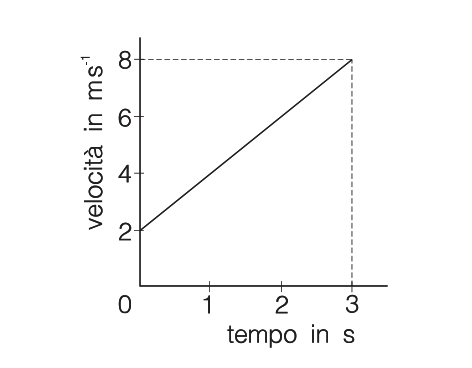
Q1. Il grafico velocità–tempo di un oggetto che si muove con accelerazione costante è mostrato in figura (retta da a tra e ). Qual è l’accelerazione dell’oggetto? A) ; B) ; C) ; D) ; E) .
p.2 — Grafico velocita-tempo, retta crescente
Topic: Newtonian Mechanics Metodi: Kinematic Equations Competenze: Diagrammatic Reasoning Objects: — Fonte: Testo (PDF) — p.2 Risposta: A · Soluzioni (PDF)
Q1. The velocity–time graph of an object moving with constant acceleration is shown in the figure (straight line from to between and ). What is the acceleration of the object? A) ; B) ; C) ; D) ; E) .
p.2 — Velocity-time graph, increasing straight line
Answer: A · Soluzioni (PDF)
Q2. Una forza di , che agisce su un carrello di spostandolo su un piano orizzontale lungo la direzione della forza stessa, fa un lavoro di . Lo spostamento del carrello è di… A) ; B) ; C) ; D) ; E) .
Topic: Newtonian Mechanics Metodi: Free-Body Diagram Competenze: Physical Reasoning Objects: Cart Fonte: Testo (PDF) — p.2 Risposta: C · Soluzioni (PDF)
Q2. A force of , acting on a cart of moving it on a horizontal plane along the direction of the force itself, does a work of . The displacement of the cart is… A) ; B) ; C) ; D) ; E) .
Answer: C · Soluzioni (PDF)
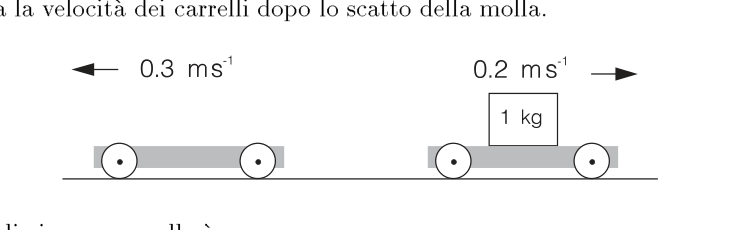
Q3. Due carrelli identici vengono tenuti insieme comprimendo una molla di massa trascurabile interposta tra di essi; su uno dei due carrelli viene fissata una massa di . Si fa scattare la molla e i due carrelli vengono lanciati da parti opposte ( a sinistra il carrello scarico, a destra quello con la massa). La massa di ciascun carrello è… A) ; B) ; C) ; D) ; E) .
p.2 — Due carrelli con molla e massa
Topic: Conservation of Momentum Metodi: Conservation of Momentum Competenze: Physical Reasoning Objects: Cart, Spring Fonte: Testo (PDF) — p.2 Risposta: D · Soluzioni (PDF)
Q3. Two identical carts are held together by compressing a spring of negligible mass placed between them; a mass of is fixed on one of the two carts. The spring is released and the two carts are launched in opposite directions ( to the left the unloaded cart, to the right the one with the mass). The mass of each cart is… A) ; B) ; C) ; D) ; E) .
p.2 — Two carts with spring and mass
Answer: D · Soluzioni (PDF)
Q4. Il benzene è un liquido incolore. L’indice di rifrazione del benzene e del vetro è, per entrambi, . Ne consegue che… A) benzene e vetro hanno la stessa densità; B) il vetro trasparente è invisibile se immerso nel benzene; C) una lente convergente di vetro immersa nel benzene ha una distanza focale minore che nell’aria; D) l’angolo limite per il passaggio della luce dal vetro al benzene è vicino a ; E) la velocità della luce nel benzene è volte maggiore che nel vetro.
Topic: Geometric Optics Metodi: Snell’s Law Competenze: Physical Reasoning Objects: Lens Fonte: Testo (PDF) — p.2 Risposta: B · Soluzioni (PDF)
Q4. Benzene is a colorless liquid. The refractive index of benzene and of glass is, for both, . It follows that… A) benzene and glass have the same density; B) transparent glass is invisible if immersed in benzene; C) a converging glass lens immersed in benzene has a shorter focal length than in air; D) the critical angle for the passage of light from glass to benzene is close to ; E) the speed of light in benzene is times greater than in glass.
Answer: B · Soluzioni (PDF)
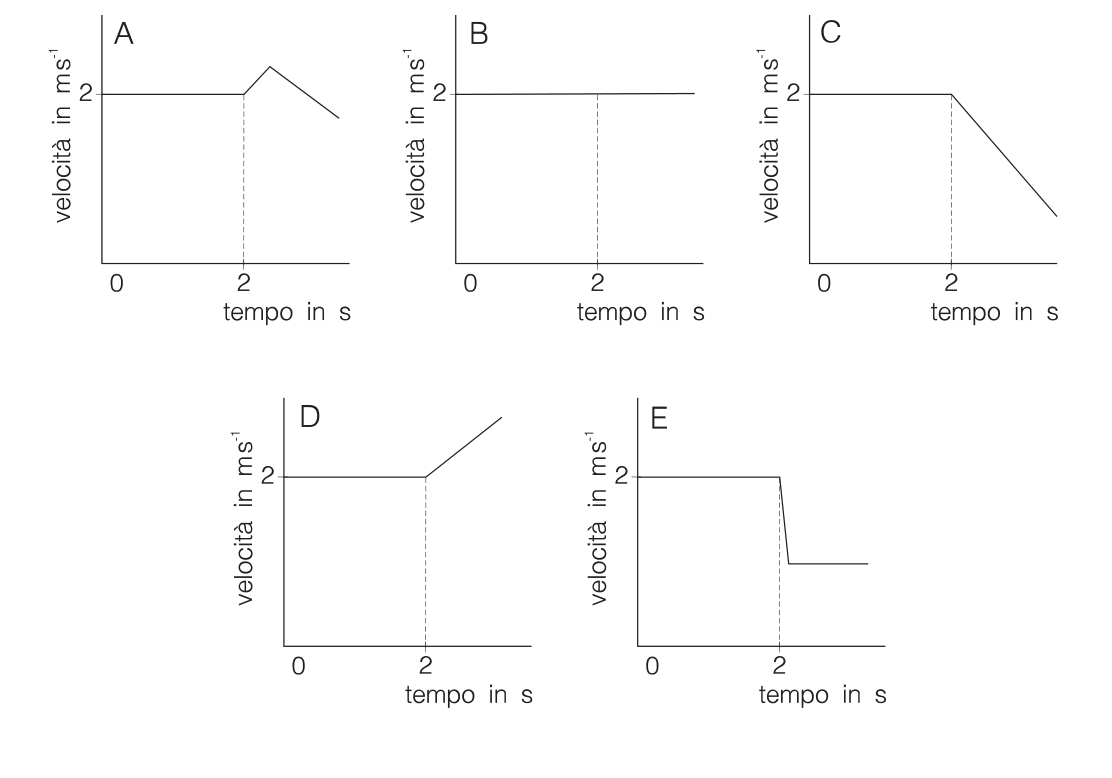
Q5. Un carrello di si muove su un piano alla velocità di per . Da un’altezza di pochi centimetri si fa cadere sul carrello un mattone di massa pari a . Assumendo trascurabile l’attrito alle ruote, quale dei seguenti grafici velocità–tempo rappresenta meglio il moto del carrello? [Cinque grafici –, A–E.]
p.3 — Cinque grafici velocita-tempo A-E
Topic: Conservation of Momentum Metodi: Conservation of Momentum Competenze: Diagrammatic Reasoning Objects: Cart, Block Fonte: Testo (PDF) — p.2 Risposta: E · Soluzioni (PDF)
Q5. A cart of moves on a plane at the speed of for . From a height of a few centimetres, a brick of mass is dropped on the cart. Assuming that friction is negligible, which of the following speed-time graphs best represents the wheelchair motion? [Cinque grafici –, A–E.]
p.3 — Cinque grafici velocita-tempo A-E
Topic: Conservation of Momentum Metodi: Conservation of Momentum Competenze: Diagrammatic Reasoning Objects: Cart, Block Fonte: Testo (PDF) — p.2 Risposta: E · Soluzioni (PDF)
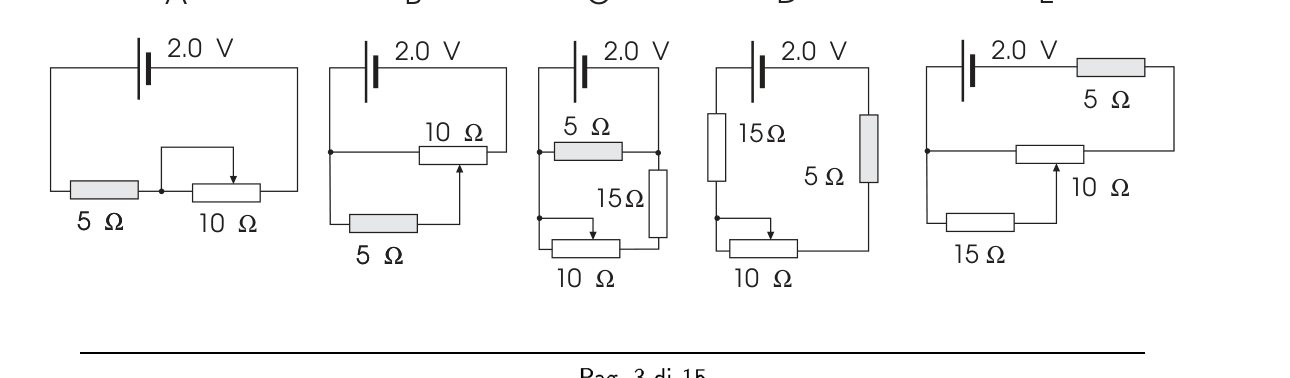
Q6. Ognuno dei circuiti raffigurati contiene una resistenza fissa pari a . L’alimentazione in ogni circuito è fornita da una batteria da e resistenza interna trascurabile. Quando il cursore della resistenza variabile è spostato da un estremo all’altro, in quale circuito la differenza di potenziale ai capi della resistenza da diventa nulla? [Cinque circuiti A–E con potenziometro e resistenza fissa da .]
p.3 — Cinque circuiti con resistenza variabile
Topic: Circuits Metodi: Equivalent Circuit Reduction, Kirchhoff’s Laws Competenze: Diagrammatic Reasoning Objects: Resistor, Battery Fonte: Testo (PDF) — p.3 Risposta: B · Soluzioni (PDF)
Q6. Each of the circuits shown contains a fixed resistor equal to . The power supply in each circuit is provided by a battery of with negligible internal resistance. When the slider of the variable resistor is moved from one end to the other, in which circuit does the potential difference across the resistor of become zero? [Five circuits A–E with potentiometer and fixed resistor of .]
p.3 — Five circuits with variable resistor
Answer: B · Soluzioni (PDF)
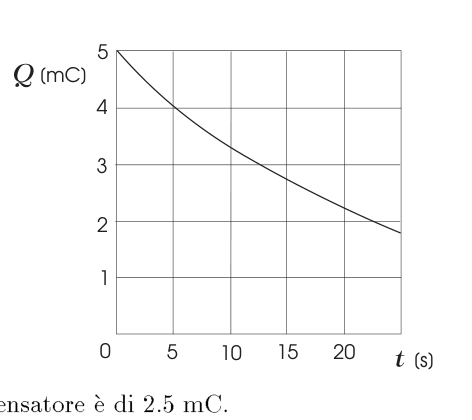
Q7. Il grafico mostra la carica presente su un condensatore da in funzione del tempo, quando il condensatore è fatto scaricare attraverso una resistenza da . Quale delle seguenti affermazioni è corretta? A) Dopo la carica residua è ; B) Raddoppiando la resistenza e dimezzando la capacità la costante di tempo si divide per 4; C) La costante di tempo del circuito è ; D) Il condensatore si scarica sempre più rapidamente al passare del tempo; E) Il valore iniziale della corrente, appena la carica inizia a fluire, è approssimativamente .
p.4 — Grafico carica-tempo scarica condensatore
Topic: Circuits Metodi: Kirchhoff’s Laws Competenze: Diagrammatic Reasoning, Physical Reasoning Objects: Capacitor, Resistor Fonte: Testo (PDF) — p.3 Risposta: E · Soluzioni (PDF)
Q7. The graph shows the charge present on a capacitor as a function of time, when the capacitor is made to discharge through a resistor. Which of the following statements is correct? A) After the residual charge is ; B) By doubling the resistance and halving the capacitance, the time constant is divided by 4; C) The time constant of the circuit is ; D) The capacitor always discharges more and more rapidly as time passes; E) The initial value of the current, as soon as the charge begins to flow, is approximately .
p.4 — Charge-time graph of capacitor discharge
Answer: E · Soluzioni (PDF)
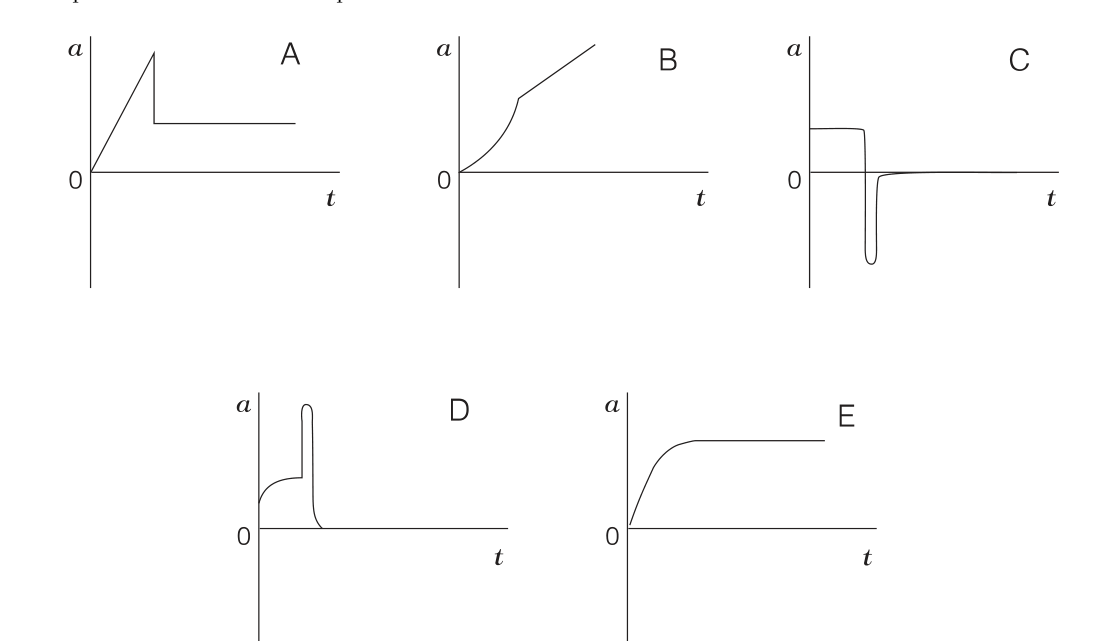
Q8. Un paracadutista si lancia dall’aereo rimanendo in caduta libera per , dopodiché apre il paracadute. Quale dei seguenti grafici accelerazione–tempo rappresenta meglio l’accelerazione verticale del paracadutista durante i primi del moto? [Cinque grafici –, A–E.]
p.4 — Cinque grafici accelerazione-tempo A-E
Topic: Newtonian Mechanics Metodi: Free-Body Diagram, Kinematic Equations Competenze: Diagrammatic Reasoning Objects: — Fonte: Testo (PDF) — p.2 Risposta: C · Soluzioni (PDF)
Q8. A parachutist jumps from the aircraft remaining in free fall for , after which he opens the parachute. Which of the following acceleration time graphs best represents the vertical acceleration of the parachutist during the first of the motorcycle? [Cinque grafici –, A–E.]
p.4 — Cinque grafici accelerazione-tempo A-E
Topic: Newtonian Mechanics Metodi: Free-Body Diagram, Kinematic Equations Competenze: Diagrammatic Reasoning Objects: — Fonte: Testo (PDF) — p.2 Risposta: C · Soluzioni (PDF)
Q9. In quale dei seguenti casi un pendolo potrebbe oscillare da due a quattro volte più lentamente di prima? A) Portandolo in alto, dal livello del mare sulla cima di una montagna molto alta; B) Portandolo in basso, in una profonda miniera; C) Portandolo dalla superficie della Terra sulla superficie della Luna; D) Portandolo dalla superficie della Luna sulla superficie della Terra; E) Portandolo dalla superficie della Terra in un punto dello spazio molto lontano da qualunque altra massa.
Topic: Oscillations & Waves Metodi: Simple Harmonic Motion Analysis Competenze: Physical Reasoning Objects: Pendulum Fonte: Testo (PDF) — p.2 Risposta: C · Soluzioni (PDF)
Q9. In which of the following cases could a pendulum oscillate two to four times more slowly than before? A) By taking it up, from sea level to the top of a very high mountain; B) By taking it down, into a deep mine; C) By taking it from the surface of the Earth to the surface of the Moon; D) By taking it from the surface of the Moon to the surface of the Earth; E) By taking it from the surface of the Earth to a point in space very far from any other mass.
Answer: C · Soluzioni (PDF)
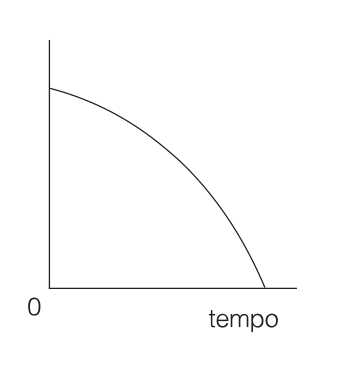
Q10. Il grafico è riferito al moto di un corpo che sta cadendo senza attrito per effetto della gravità (curva concava decrescente in funzione del tempo). Quale delle seguenti quantità è stata riportata sull’asse delle ordinate? A) La distanza percorsa; B) La quantità di moto; C) L’energia totale; D) L’energia cinetica; E) L’energia potenziale.
p.5 — Curva decrescente in funzione del tempo
Topic: Conservation of Energy Metodi: Energy Conservation Method Competenze: Diagrammatic Reasoning Objects: — Fonte: Testo (PDF) — p.2 Risposta: E · Soluzioni (PDF)
Q10. The graph refers to the motion of a body falling without friction under the effect of gravity (decreasing concave curve as a function of time). Which of the following quantities has been plotted on the ordinate axis? A) The distance traveled; B) The momentum; C) The total energy; D) The kinetic energy; E) The potential energy.
p.5 — Decreasing curve as a function of time
Answer: E · Soluzioni (PDF)
Q11. L’espressione finale di un calcolo è . Qual è l’unità di misura corretta nella risposta? A) Ampere; B) Joule; C) Ohm; D) Volt; E) Watt.
Topic: Electrostatics Metodi: Dimensional Analysis, Coulomb’s Law Competenze: Physical Reasoning Objects: — Fonte: Testo (PDF) — p.3 Risposta: D · Soluzioni (PDF)
Q11. The final expression of a calculation is . What is the correct unit of measurement in the answer? A) Ampere; B) Joule; C) Ohm; D) Volt; E) Watt.
Answer: D · Soluzioni (PDF)
Q12. Nel tempo in cui un paracadutista si lancia dall’aereo e tocca terra: 1 — la somma della sua energia cinetica e potenziale gravitazionale è costante; 2 — la sua energia cinetica dipende dalla sua velocità; 3 — la sua energia potenziale è proporzionale all’altezza dal suolo. Quali affermazioni sono corrette? A) Tutte e tre; B) Solo la 1 e la 2; C) Solo la 2 e la 3; D) Solo la 1; E) Solo la 3.
Topic: Conservation of Energy Metodi: Energy Conservation Method Competenze: Physical Reasoning Objects: — Fonte: Testo (PDF) — p.2 Risposta: C · Soluzioni (PDF)
Q12. During the time in which a parachutist jumps from the plane and touches the ground: 1 — the sum of his kinetic and gravitational potential energy is constant; 2 — his kinetic energy depends on his speed; 3 — his potential energy is proportional to the height above the ground. Which statements are correct? A) All three; B) Only 1 and 2; C) Only 2 and 3; D) Only 1; E) Only 3.
Answer: C · Soluzioni (PDF)
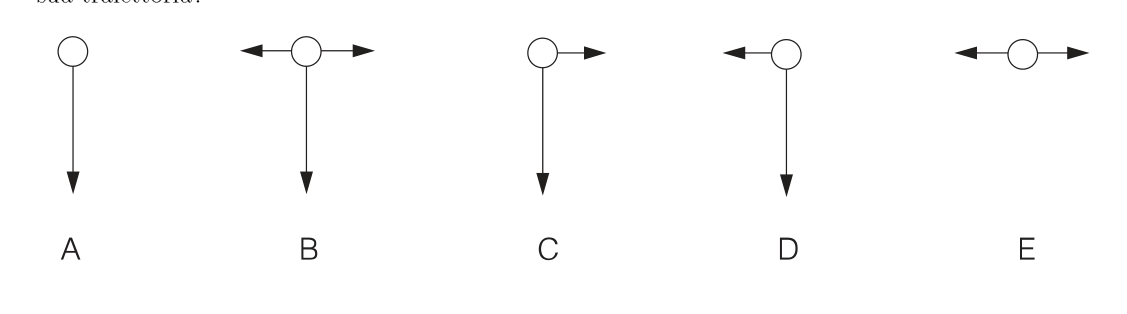
Q13. Una pietra è stata lanciata in aria, verso destra. Quale dei seguenti diagrammi rappresenta meglio il sistema di forze agenti sulla pietra nel momento in cui passa alla massima altezza? [Cinque diagrammi A–E di forze sulla pietra.]
p.6 — Cinque diagrammi di forze A-E
Topic: Newtonian Mechanics Metodi: Free-Body Diagram Competenze: Diagrammatic Reasoning Objects: Projectile Fonte: Testo (PDF) — p.2 Risposta: D · Soluzioni (PDF)
Q13. A stone was thrown into the air, toward the right. Which of the following diagrams best represents the system of forces acting on the stone at the moment it passes through its maximum height? [Five diagrams A–E of forces on the stone.]
p.6 — Five force diagrams A-E
Answer: D · Soluzioni (PDF)
Q14. La pressione dell’aria al livello del mare è di circa e la sua densità è di circa . Nell’ipotesi che la densità dell’aria sia costante con l’altezza e supponendo , si potrebbe dire che l’atmosfera ha uno spessore di… A) ; B) ; C) ; D) ; E) .
Topic: Fluid Mechanics Metodi: Hydrostatic Equilibrium, Order-of-Magnitude Estimation Competenze: Estimation & Approximation Objects: — Fonte: Testo (PDF) — p.6 Risposta: A · Soluzioni (PDF)
Q14. The air pressure at sea level is about and its density is about . Assuming that the air density is constant with height and supposing , one could say that the atmosphere has a thickness of… A) ; B) ; C) ; D) ; E) .
Answer: A · Soluzioni (PDF)
Q15. Un corpo ha volume e peso ; è sospeso a un filo e poi immerso completamente in acqua (). Assumendo positive le forze dirette verso il basso e , la tensione del filo, a corpo immerso, diventa… A) ; B) ; C) ; D) zero; E) .
Topic: Fluid Mechanics Metodi: Hydrostatic Equilibrium, Free-Body Diagram Competenze: Physical Reasoning Objects: String Fonte: Testo (PDF) — p.2 Risposta: C · Soluzioni (PDF)
Q15. A body has volume and weight ; it is suspended from a thread and then completely immersed in water (). Assuming positive the forces directed downward and , the tension of the thread, with the body immersed, becomes… A) ; B) ; C) ; D) zero; E) .
Answer: C · Soluzioni (PDF)
Q16. Il disegno rappresenta un blocco di materiale trasparente (perspex) dal quale è stato asportato un pezzo a sezione triangolare (riempito d’aria). Quale sarà il percorso seguito dal raggio di luce attraverso il blocco?
p.6 — Blocco perspex con cavita triangolare d’aria
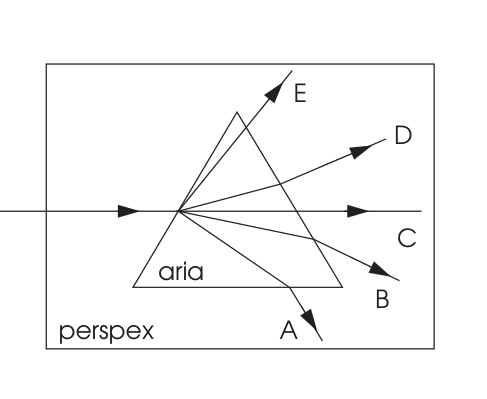
Topic: Geometric Optics Metodi: Snell’s Law, Ray Tracing Competenze: Diagrammatic Reasoning Objects: Block Fonte: Testo (PDF) — p.2 Risposta: D · Soluzioni (PDF)
Q16. The drawing represents a block of transparent material (perspex) from which a piece with a triangular cross-section has been removed (filled with air). What will be the path followed by the light ray through the block?
p.6 — Perspex block with triangular air cavity
Answer: D · Soluzioni (PDF)
Q17. Il flusso di calore attraverso una lastra di vetro a facce piane parallele, in condizioni stazionarie: 1 — è proporzionale alla differenza di temperatura tra le due facce; 2 — raddoppia se l’area della lastra viene raddoppiata; 3 — vale per una lastra di superficie con gradiente di temperatura e conducibilità termica del vetro . Quali affermazioni sono corrette? A) Tutte e tre; B) Solo la 1 e la 2; C) Solo la 2 e la 3; D) Solo la 1; E) Solo la 3.
Topic: Thermodynamics Metodi: — Competenze: Physical Reasoning Objects: — Fonte: Testo (PDF) — p.6 Risposta: B · Soluzioni (PDF)
Q17. The heat flow through a glass plate with parallel flat faces, under steady-state conditions: 1 — is proportional to the temperature difference between the two faces; 2 — doubles if the area of the plate is doubled; 3 — equals for a plate with surface area with temperature gradient and thermal conductivity of the glass . Which statements are correct? A) All three; B) Only 1 and 2; C) Only 2 and 3; D) Only 1; E) Only 3.
Answer: B · Soluzioni (PDF)
Q18. L’isotopo di boro reagisce con un neutrone lento producendo l’isotopo di litio e un’altra particella. Questa particella è… A) un elettrone; B) un positrone; C) un protone; D) un nucleo di deuterio; E) una particella alfa.
Topic: Nuclear & Particle Physics Metodi: Conservation Laws Competenze: Physical Reasoning Objects: Nucleus Fonte: Testo (PDF) — p.7 Risposta: E · Soluzioni (PDF)
Q18. The boron isotope reacts with a slow neutron producing the lithium isotope and another particle. This particle is… A) an electron; B) a positron; C) a proton; D) a deuterium nucleus; E) an alpha particle.
Answer: E · Soluzioni (PDF)
Q19. Il primo principio della termodinamica può essere espresso da , dove è la variazione dell’energia interna, il calore trasmesso al corpo e il lavoro fatto dal corpo. Quali delle seguenti affermazioni, applicate a un gas perfetto, sono vere? 1 — Se è positiva, la temperatura del gas aumenta; 2 — Se è positivo, è positivo; 3 — Se è positivo, la temperatura del gas cresce. A) Tutte e tre; B) Solo la 1 e la 2; C) Solo la 2 e la 3; D) Solo la 1; E) Solo la 3.
Topic: Thermodynamics Metodi: First Law of Thermodynamics Competenze: Physical Reasoning Objects: Gas Fonte: Testo (PDF) — p.6 Risposta: D · Soluzioni (PDF)
Q19. The first law of thermodynamics can be expressed by , where is the change in internal energy, the heat transferred to the body and the work done by the body. Which of the following statements, applied to a perfect gas, are true? 1 — If is positive, the temperature of the gas increases; 2 — If is positive, is positive; 3 — If is positive, the temperature of the gas increases. A) All three; B) Only 1 and 2; C) Only 2 and 3; D) Only 1; E) Only 3.
Answer: D · Soluzioni (PDF)
Q20. Nel circuito rappresentato in figura (batteria ; due condensatori da in serie sul ramo superiore, un condensatore da sul ramo inferiore), l’energia totale immagazzinata nei condensatori è… A) ; B) ; C) ; D) ; E) .
p.7 — Circuito con tre condensatori
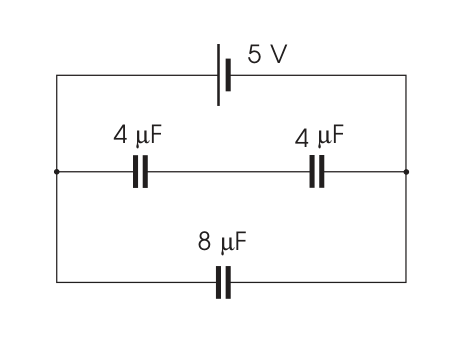
Topic: Circuits Metodi: Equivalent Circuit Reduction, Energy Conservation Method Competenze: Mathematical Modeling Objects: Battery, Capacitor Fonte: Testo (PDF) — p.3 Risposta: D · Soluzioni (PDF)
Q20. In the circuit shown in the figure (battery ; two capacitors of in series on the upper branch, a capacitor of on the lower branch), the total energy stored in the capacitors is… A) ; B) ; C) ; D) ; E) .
p.7 — Circuit with three capacitors
Answer: D · Soluzioni (PDF)
Q21. Nel circuito in figura (batteria , resistenza in serie con ), che valore dovrebbe assumere per avere una differenza di potenziale di ai capi della resistenza da ? A) ; B) ; C) ; D) ; E) .
p.8 — Circuito batteria con R e 1kohm
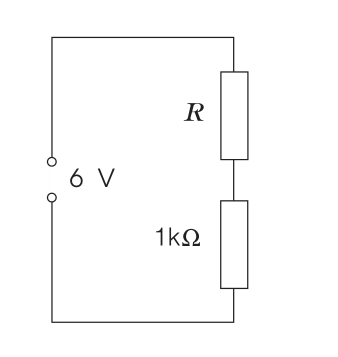
Topic: Circuits Metodi: Kirchhoff’s Laws Competenze: Mathematical Modeling Objects: Battery, Resistor Fonte: Testo (PDF) — p.3 Risposta: C · Soluzioni (PDF)
Q21. In the circuit shown in the figure (battery , resistance in series with ), what value should have in order to have a potential difference of across the resistance? A) ; B) ; C) ; D) ; E) .
p.8 — Battery circuit with R and 1kohm
Answer: C · Soluzioni (PDF)
Q22. Lo spostamento di un’automobile varia nel tempo secondo il grafico mostrato (orizzontale poi crescente lineare). I grafici 1 (velocità a gradino), 2 (accelerazione lineare crescente), 3 (accelerazione parabolica) mostrano possibili andamenti. Quali sono corretti? A) Tutti e tre; B) Solo l’1 e il 2; C) Solo il 2 e il 3; D) Solo l’1; E) Solo il 3.
p.8 — Grafico spostamento piu tre andamenti
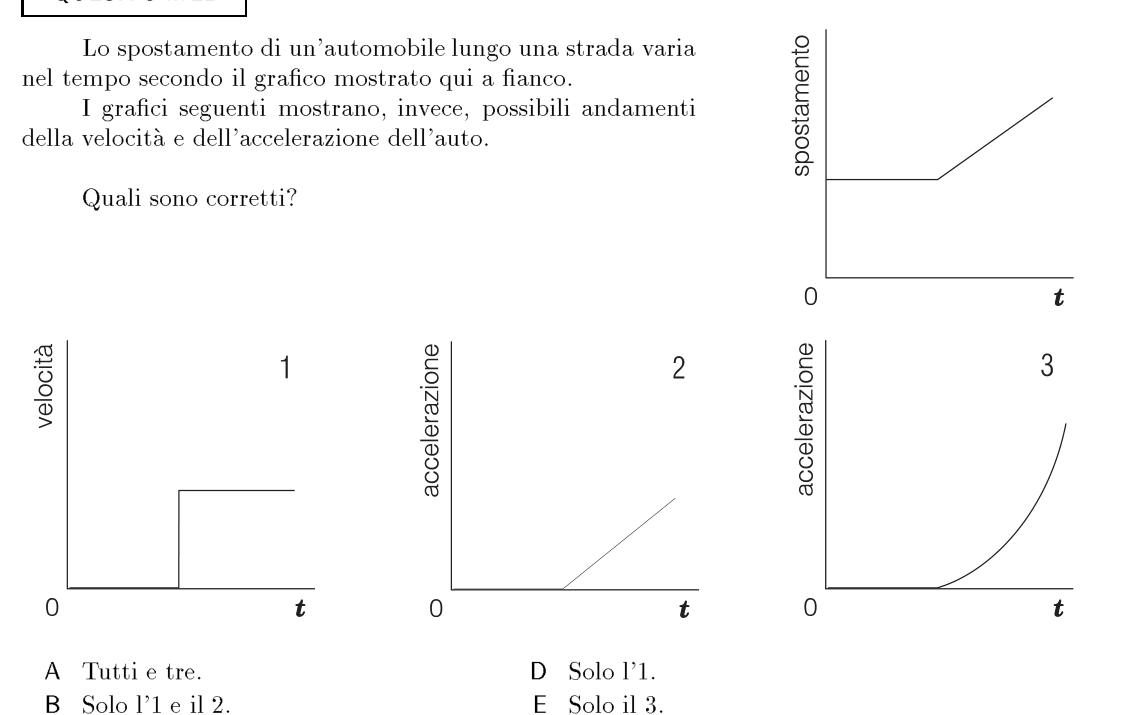
Topic: Newtonian Mechanics Metodi: Kinematic Equations Competenze: Diagrammatic Reasoning Objects: — Fonte: Testo (PDF) — p.2 Risposta: D · Soluzioni (PDF)
Q22. The displacement of a car varies over time according to the graph shown (horizontal then linearly increasing). Graphs 1 (step velocity), 2 (linearly increasing acceleration), 3 (parabolic acceleration) show possible trends. Which are correct? A) All three; B) Only 1 and 2; C) Only 2 and 3; D) Only 1; E) Only 3.
p.8 — Displacement graph plus three trends
Answer: D · Soluzioni (PDF)
Q23. I motori di manovra di un satellite in orbita circolare attorno alla Terra esercitano una forza esattamente uguale e opposta a quella del campo gravitazionale terrestre. Di conseguenza il satellite inizia a muoversi… A) lungo una spirale verso la superficie; B) lungo la retta radiale verso il centro della Terra; C) lungo la retta tangente all’orbita nel punto in cui sono accesi i motori; D) in un’orbita circolare con periodo più lungo; E) in un’orbita circolare con periodo più corto.
Topic: Gravitation Metodi: Newton’s Law of Gravitation Competenze: Physical Reasoning Objects: Satellite, Planet Fonte: Testo (PDF) — p.2 Risposta: C · Soluzioni (PDF)
Q23. The maneuvering engines of a satellite in a circular orbit around the Earth exert a force exactly equal and opposite to that of the Earth’s gravitational field. As a result, the satellite begins to move… A) along a spiral toward the surface; B) along the radial line toward the center of the Earth; C) along the line tangent to the orbit at the point where the engines are turned on; D) in a circular orbit with a longer period; E) in a circular orbit with a shorter period.
Answer: C · Soluzioni (PDF)
Q24. La bobina P, collegata a un alimentatore a corrente alternata da , è posta vicino alla bobina Q (separata). I terminali di Q sono connessi con l’ingresso verticale (asse ) di un oscilloscopio. Collegando le due bobine con una sbarretta di ferro dolce inserita all’interno, quale sarà l’effetto sulla traccia che appare sullo schermo? A) L’altezza della traccia aumenta e il numero di onde visibili aumenta; B) L’altezza diminuisce e il numero di onde aumenta; C) L’altezza rimane la stessa e il numero di onde aumenta; D) L’altezza aumenta e il numero di onde rimane lo stesso; E) L’altezza rimane la stessa e il numero di onde rimane lo stesso.
p.9 — Bobine P e Q con oscilloscopio
Topic: Electromagnetic Induction Metodi: Faraday’s Law of Induction Competenze: Physical Reasoning Objects: Coil Fonte: Testo (PDF) — p.3 Risposta: D · Soluzioni (PDF)
Q24. The coil P, connected to an alternating current power supply at , is placed near coil Q (separate). The terminals of Q are connected to the vertical input (axis ) of an oscilloscope. If the two coils are connected by a soft iron bar inserted inside them, what will be the effect on the trace appearing on the screen? A) The height of the trace increases and the number of visible waves increases; B) The height decreases and the number of waves increases; C) The height remains the same and the number of waves increases; D) The height increases and the number of waves remains the same; E) The height remains the same and the number of waves remains the same.
p.9 — Coils P and Q with oscilloscope
Answer: D · Soluzioni (PDF)
Q25. Un fascio di elettroni viene fatto passare in un tubo contenente un gas rarefatto. A bassa velocità gli elettroni attraversano il tubo senza che la loro energia si riduca, ma al di sopra di una certa velocità parte dell’energia degli elettroni viene trasferita al gas. Ciò avviene perché… A) a velocità più elevate il numero di elettroni che attraversano il gas è più alto e gli urti diventano più frequenti; B) a velocità inferiori a gli elettroni si muovono troppo lentamente perché sia probabile un urto con una molecola; C) al di sotto della velocità critica gli urti sono prevalentemente anelastici; D) l’energia degli elettroni è quantizzata: un quanto è dato da , dove è la costante di Planck; E) gli atomi possono assorbire energia solamente se questa è sufficiente a consentire transizioni a livelli energetici superiori.
Topic: Modern-Quantum Physics Metodi: — Competenze: Physical Reasoning Objects: Electron, Gas Fonte: Testo (PDF) — p.7 Risposta: E · Soluzioni (PDF)
Q25. A beam of electrons is passed through a tube containing a rarefied gas. At low speed the electrons pass through the tube without their energy being reduced, but above a certain speed part of the electrons’ energy is transferred to the gas. This happens because… A) at higher speeds the number of electrons passing through the gas is higher and the collisions become more frequent; B) at speeds lower than the electrons move too slowly for a collision with a molecule to be probable; C) below the critical speed the collisions are predominantly inelastic; D) the energy of the electrons is quantized: one quantum is given by , where is Planck’s constant; E) atoms can absorb energy only if this is sufficient to allow transitions to higher energy levels.
Answer: E · Soluzioni (PDF)
Q26. Un pendolo è costituito da un corpo sospeso al soffitto di una stanza. Se è il periodo di oscillazione e la sua altezza rispetto al pavimento, la dipendenza di da può essere rappresentata da una retta disegnando il grafico di… A) in funzione di ; B) in funzione di ; C) in funzione di ; D) in funzione di ; E) in funzione di .
Topic: Oscillations & Waves Metodi: Simple Harmonic Motion Analysis, Graph Linearization Competenze: Graph Linearization Objects: Pendulum Fonte: Testo (PDF) — p.2 Risposta: D · Soluzioni (PDF)
Q26. Un pendolo è costituito da un corpo sospeso al soffitto di una stanza. If is the oscillation period and its height relative to the floor, the dependence of on can be represented by a straight line drawing the graph of… The following conditions shall apply: (a) in the function of ; (b) in the function of ; (c) in the function of ; (d) in the function of ; (e) in the function of .
Topic: Oscillations & Waves Metodi: Simple Harmonic Motion Analysis, Graph Linearization Competenze: Graph Linearization Objects: Pendulum Fonte: Testo (PDF) — p.2 Risposta: D · Soluzioni (PDF)
Q26. (Quesito di meccanica/oscillazioni — vedi il blocco Meccanica.)
Topic: Oscillations & Waves Metodi: Simple Harmonic Motion Analysis Competenze: Physical Reasoning Objects: — Fonte: Testo (PDF) — p.2 Soluzione: Soluzioni (PDF)
Q26. (Mechanics/oscillations question — see the Mechanics block.)
Topic: Oscillations & Waves Metodi: Simple Harmonic Motion Analysis Competenze: Physical Reasoning Objects: — Fonte: Testo (PDF) — p.2 Soluzione: Soluzioni (PDF)
Q27. La temperatura di una massa di sostanza pura è stata misurata a intervalli regolari mentre veniva raffreddata, ottenendo un grafico temperatura–tempo con due tratti orizzontali di durata e (con ). L’ambiente è mantenuto a pochi gradi sotto il punto di fusione. Quali affermazioni si possono dedurre? 1 — La velocità con cui viene ceduto il calore durante è maggiore di quella durante ; 2 — Il calore ceduto durante è maggiore di quello ceduto durante ; 3 — Il volume della sostanza rimane costante durante e . A) Tutte e tre; B) Solo la 1 e la 2; C) Solo la 2 e la 3; D) Solo la 1; E) Solo la 3.
p.10 — Grafico temperatura-tempo raffreddamento
Topic: Thermodynamics Metodi: — Competenze: Physical Reasoning, Experimental Data Analysis Objects: — Fonte: Testo (PDF) — p.6 Risposta: B · Soluzioni (PDF)
Q27. The temperature of a mass of pure substance was measured at regular intervals while it was cooling, obtaining a temperature–time graph with two horizontal segments of duration and (with ). The environment is kept a few degrees below the melting point. Which statements can be deduced? 1 — The rate at which heat is released during is greater than that during ; 2 — The heat released during is greater than that released during ; 3 — The volume of the substance remains constant during and . A) All three; B) Only 1 and 2; C) Only 2 and 3; D) Only 1; E) Only 3.
p.10 — Temperature-time cooling graph
Answer: B · Soluzioni (PDF)
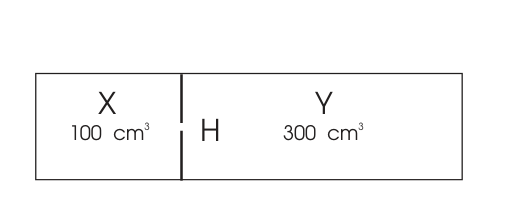
Q28. Una certa quantità d’aria a pressione è racchiusa nel contenitore X di volume . Il forellino H è inizialmente tappato e il contenitore Y, di volume , è vuoto. Si toglie il tappo al forellino H e, raggiunto l’equilibrio… A) le molecole si muovono ancora passando attraverso H; B) il prodotto pressione-volume in X è uguale a quello in Y; C) c’è lo stesso numero di molecole in X e in Y; D) la pressione in X vale ; E) le molecole in Y si muovono tre volte più velocemente di quelle in X.
p.10 — Contenitori X e Y con forellino H
Topic: Kinetic Theory Metodi: Ideal Gas Law Competenze: Physical Reasoning Objects: Container, Gas Fonte: Testo (PDF) — p.6 Risposta: A · Soluzioni (PDF)
Q28. A certain quantity of air at pressure is enclosed in container X of volume . The small hole H is initially plugged and container Y, of volume , is empty. The plug is removed from the small hole H and, once equilibrium is reached… A) the molecules still move passing through H; B) the pressure-volume product in X is equal to that in Y; C) there is the same number of molecules in X and in Y; D) the pressure in X is ; E) the molecules in Y move three times faster than those in X.
p.10 — Containers X and Y with small hole H
Answer: A · Soluzioni (PDF)
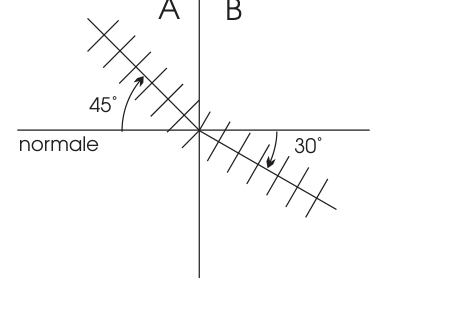
Q29. La figura mostra fronti d’onda piani che viaggiano da un mezzo A a un mezzo B. In A la direzione di propagazione forma con la normale un angolo di e in B di . Se la velocità di propagazione nel mezzo A è , la velocità in B è… A) ; B) ; C) ; D) ; E) .
p.10 — Fronti d’onda piani da mezzo A a B
Topic: Oscillations & Waves Metodi: Snell’s Law Competenze: Mathematical Modeling Objects: — Fonte: Testo (PDF) — p.2 Risposta: A · Soluzioni (PDF)
Q29. The figure shows plane wavefronts traveling from a medium A to a medium B. In A the direction of propagation forms an angle of with the normal, and in B an angle of . If the propagation speed in medium A is , the speed in B is… A) ; B) ; C) ; D) ; E) .
p.10 — Plane wavefronts from medium A to B
Answer: A · Soluzioni (PDF)
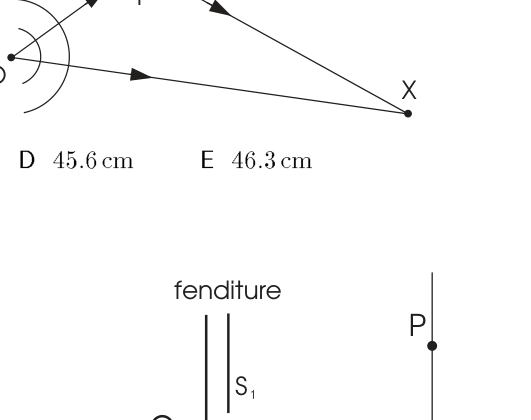
Q30. In un ondoscopio, dalla sorgente posta in O vengono prodotte onde circolari di lunghezza d’onda . Le onde riflesse dal bordo dell’ondoscopio interferiscono con quelle provenienti direttamente dalla sorgente; il punto X appartiene a una linea d’interferenza costruttiva. Se la distanza è , allora il percorso OYX (riflesso dalla parete) può essere lungo… A) ; B) ; C) ; D) ; E) .
p.11 — Ondoscopio con parete e punti O X
Topic: Wave Optics Metodi: Interference & Diffraction Analysis Competenze: Mathematical Modeling Objects: — Fonte: Testo (PDF) — p.2 Risposta: D · Soluzioni (PDF)
Q30. In a ripple tank, circular waves of wavelength are produced from the source placed at O. The waves reflected from the edge of the ripple tank interfere with those coming directly from the source; point X belongs to a line of constructive interference. If the distance is , then the path OYX (reflected from the wall) can be as long as… A) ; B) ; C) ; D) ; E) .
p.11 — Ripple tank with wall and points O X
Answer: D · Soluzioni (PDF)
Q31. La figura rappresenta il metodo delle fenditure di Young per ottenere frange di interferenza. Nel punto P si ottiene interferenza distruttiva se la differenza dei cammini è… A) un numero dispari di quarti di lunghezza d’onda; B) un numero dispari di mezze lunghezze d’onda; C) un numero pari di mezze lunghezze d’onda; D) un numero dispari di lunghezze d’onda; E) un numero pari di lunghezze d’onda.
p.11 — Fenditure di Young con schermo
Topic: Wave Optics Metodi: Interference & Diffraction Analysis Competenze: Physical Reasoning Objects: Slit, Screen Fonte: Testo (PDF) — p.2 Risposta: B · Soluzioni (PDF)
Q31. The figure represents Young’s slit method for obtaining interference fringes. At point P, destructive interference is obtained if the path difference is… A) an odd number of quarter wavelengths; B) an odd number of half wavelengths; C) an even number of half wavelengths; D) an odd number of wavelengths; E) an even number of wavelengths.
p.11 — Young’s slits with screen
Answer: B · Soluzioni (PDF)
Q32. Quali delle seguenti affermazioni sono vere per una navicella spaziale lanciata dalla Terra che entra in orbita attorno alla Terra stessa? 1 — L’energia potenziale gravitazionale della navicella aumenta; 2 — La forza gravitazionale che attrae la capsula verso la Terra diminuisce; 3 — L’intensità del campo gravitazionale all’interno della capsula diventa trascurabile. A) Tutte e tre; B) Solo la 1 e la 2; C) Solo la 2 e la 3; D) Solo la 1; E) Solo la 3.
Topic: Gravitation Metodi: Newton’s Law of Gravitation Competenze: Physical Reasoning Objects: Satellite, Planet Fonte: Testo (PDF) — p.2 Risposta: B · Soluzioni (PDF)
Q32. Which of the following statements are true for a spacecraft launched from the Earth that enters orbit around the Earth itself? 1 — The gravitational potential energy of the spacecraft increases; 2 — The gravitational force attracting the capsule toward the Earth decreases; 3 — The intensity of the gravitational field inside the capsule becomes negligible. A) All three; B) Only 1 and 2; C) Only 2 and 3; D) Only 1; E) Only 3.
Answer: B · Soluzioni (PDF)
Q33. Quando un corpo si muove di moto armonico semplice, quali delle seguenti quantità: 1 — accelerazione, 2 — forza di richiamo, 3 — velocità, variano nel tempo con uno sfasamento di rispetto alla posizione? A) Tutte e tre; B) Solo la 1 e la 2; C) Solo la 2 e la 3; D) Solo la 1; E) Solo la 3.
Topic: Oscillations & Waves Metodi: Simple Harmonic Motion Analysis Competenze: Physical Reasoning Objects: — Fonte: Testo (PDF) — p.2 Risposta: E · Soluzioni (PDF)
Q33. When a body moves with simple harmonic motion, which of the following quantities: 1 — acceleration, 2 — restoring force, 3 — velocity, vary over time with a phase shift of with respect to the position? A) All three; B) Only 1 and 2; C) Only 2 and 3; D) Only 1; E) Only 3.
Answer: E · Soluzioni (PDF)
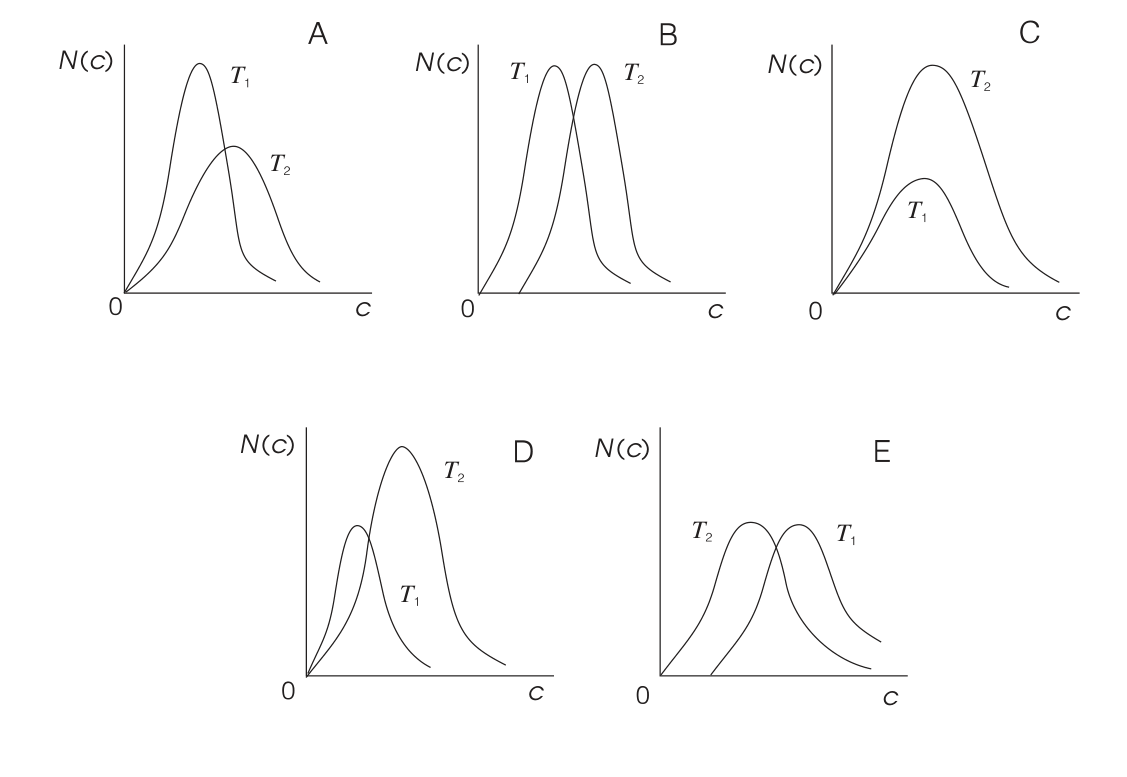
Q34. Ciascuno dei grafici mostra due possibili curve di distribuzione di velocità delle molecole di un gas . Quale coppia di curve si adatta correttamente a una massa di gas che si trova una volta alla temperatura e un’altra alla temperatura , con ? [Cinque coppie di curve A–E; alla temperatura maggiore il picco si sposta verso velocità più alte e si abbassa.]
p.12 — Cinque coppie di curve distribuzione velocita
Topic: Kinetic Theory Metodi: Kinetic Theory of Gases, Statistical Averaging Competenze: Diagrammatic Reasoning Objects: Gas Fonte: Testo (PDF) — p.6 Risposta: A · Soluzioni (PDF)
Q34. Each of the graphs shows two possible velocity distribution curves of the molecules of a gas . Which pair of curves correctly fits a mass of gas that is at one time at temperature and another time at temperature , with ? [Five pairs of curves A–E; at the higher temperature the peak shifts toward higher velocities and becomes lower.]
p.12 — Five pairs of velocity distribution curves
Answer: A · Soluzioni (PDF)
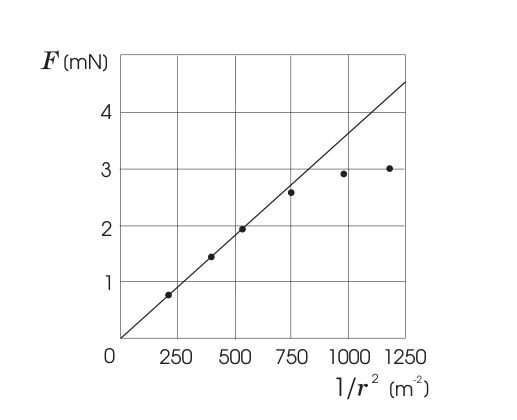
Q35. In un esperimento è stata misurata la forza tra due sfere cariche, sospese a fili isolanti, per diversi valori della distanza tra i centri. I valori di sono riportati in funzione di . Tracciando la retta che meglio si adatta alle misure sembra che siano stati ignorati due punti. Quali affermazioni spiegano questo fatto? 1 — È più difficile misurare con precisione le forze più grandi; 2 — È più difficile misurare con precisione le distanze più grandi; 3 — A piccole distanze le cariche potrebbero non essere distribuite uniformemente sulle sfere. A) Tutte e tre; B) Solo la 1 e la 2; C) Solo la 2 e la 3; D) Solo la 1; E) Solo la 3.
p.12 — Grafico forza in funzione di 1/r^2
Topic: Electrostatics Metodi: Coulomb’s Law, Experimental Data Analysis Competenze: Experimental Data Analysis Objects: Conducting Sphere, String Fonte: Testo (PDF) — p.3 Risposta: E · Soluzioni (PDF)
Q35. In an experiment, the force between two charged spheres, suspended by insulating threads, was measured for various values of the distance between the centers. The values of are plotted as a function of . Drawing the line that best fits the measurements, it appears that two points have been ignored. Which statements explain this fact? 1 — It is more difficult to measure larger forces precisely; 2 — It is more difficult to measure larger distances precisely; 3 — At small distances the charges might not be distributed uniformly on the spheres. A) All three; B) Only 1 and 2; C) Only 2 and 3; D) Only 1; E) Only 3.
p.12 — Graph of force as a function of 1/r^2
Answer: E · Soluzioni (PDF)
Q36. Un fascio di raggi paralleli giunge su una lente convergente di distanza focale . A che distanza da questa lente deve essere posta una seconda lente convergente di focale affinché i raggi emergenti siano ancora paralleli? A) ; B) ; C) ; D) ; E) Non esiste una posizione possibile.
Topic: Geometric Optics Metodi: Thin Lens & Mirror Equation, Ray Tracing Competenze: Mathematical Modeling Objects: Lens Fonte: Testo (PDF) — p.2 Risposta: A · Soluzioni (PDF)
Q36. A beam of parallel rays reaches a convergent lens of focal length . How far from this lens must a second convergent focal lens be placed so that the emerging rays are still parallel? A) ; B) ; C) ; D) ; E) Non esiste una posizione possibile.
Topic: Geometric Optics Metodi: Thin Lens & Mirror Equation, Ray Tracing Competenze: Mathematical Modeling Objects: Lens Fonte: Testo (PDF) — p.2 Risposta: A · Soluzioni (PDF)
Q37. Nella tabella sono riportati i valori della velocità di propagazione (in ) delle onde nell’acqua, misurati per diverse lunghezze d’onda ( … ) e per 4 valori della profondità ( … ). Quali affermazioni si possono sostenere? 1 — Per lunghezze d’onda di o più piccole la velocità è indipendente dalla profondità; 2 — Per lunghezze d’onda di la velocità cresce al crescere della profondità; 3 — Per lunghezze d’onda di o più la velocità varia al variare della lunghezza d’onda, specialmente a profondità maggiori. A) Solo la prima; B) Solo la seconda; C) Solo la prima e la terza; D) Solo la seconda e la terza; E) La prima, la seconda e la terza.
Topic: Oscillations & Waves Metodi: Experimental Data Analysis Competenze: Experimental Data Analysis Objects: — Fonte: Testo (PDF) — p.2 Risposta: D · Soluzioni (PDF)
Q37. The table shows the values of the propagation speed (in ) of waves in water, measured for different wavelengths ( … ) and for 4 values of depth ( … ). Which statements can be supported? 1 — For wavelengths of or smaller the speed is independent of depth; 2 — For wavelengths of the speed increases as depth increases; 3 — For wavelengths of or larger the speed varies as the wavelength varies, especially at greater depths. A) Only the first; B) Only the second; C) Only the first and the third; D) Only the second and the third; E) The first, the second and the third.
Answer: D · Soluzioni (PDF)
Q38. In situazioni opportune la potenza è data da: 1 — [corrente][differenza di potenziale]; 2 — [energia trasformata][tempo]; 3 — [forza][velocità]. A) Tutte e tre; B) Solo la 1 e la 2; C) Solo la 2 e la 3; D) Solo la 1; E) Solo la 3.
Topic: Newtonian Mechanics Metodi: — Competenze: Physical Reasoning Objects: — Fonte: Testo (PDF) — p.2 Risposta: A · Soluzioni (PDF)
Q38. In appropriate situations power is given by: 1 — [current][potential difference]; 2 — [transformed energy][time]; 3 — [force][velocity]. A) All three; B) Only 1 and 2; C) Only 2 and 3; D) Only 1; E) Only 3.
Answer: A · Soluzioni (PDF)
Q39. Una molla leggera viene tagliata in due parti, una di lunghezza doppia dell’altra. Il grafico forza–allungamento relativo alla molla più corta è lineare fino a un carico . Per l’altra molla: 1 — il grafico è lineare solo fino a un carico pari a ; 2 — la costante della seconda molla è diversa; 3 — per un dato carico, l’allungamento della molla più lunga è doppio. Quali affermazioni sono vere? A) Tutte e tre; B) Solo la 1 e la 2; C) Solo la 2 e la 3; D) Solo la 1; E) Solo la 3.
Topic: Elasticity & Materials Metodi: Hooke’s Law Competenze: Physical Reasoning Objects: Spring Fonte: Testo (PDF) — p.2 Risposta: C · Soluzioni (PDF)
Q39. A light spring is cut into two parts, one twice as long as the other. The force–extension graph for the shorter spring is linear up to a load . For the other spring: 1 — the graph is linear only up to a load equal to ; 2 — the spring constant of the second spring is different; 3 — for a given load, the extension of the longer spring is double. Which statements are true? A) All three; B) Only 1 and 2; C) Only 2 and 3; D) Only 1; E) Only 3.
Answer: C · Soluzioni (PDF)
Q40. Un cilindro metallico con pistone a tenuta contiene di gas perfetto. Quando il gas ha perso di calore, occupa un volume di . Se la pressione esterna sul pistone si mantiene a : 1 — si può rappresentare la variazione di stato in un diagramma – con un segmento di retta parallelo a un asse; 2 — il lavoro fatto sul gas è ; 3 — l’energia interna del gas è diminuita di . Quali affermazioni sono corrette? A) Tutte e tre; B) Solo la 1 e la 2; C) Solo la 2 e la 3; D) Solo la 1; E) Solo la 3.
Topic: Thermodynamics Metodi: First Law of Thermodynamics Competenze: Physical Reasoning, Mathematical Modeling Objects: Cylinder, Piston, Gas Fonte: Testo (PDF) — p.6 Risposta: A · Soluzioni (PDF)
Q40. Un cilindro metallico con pistone a tenuta contiene di gas perfetto. When the gas has lost heat, it occupies a volume of . If the external pressure on the piston is maintained at : 1 the change in state can be represented in a diagram – with a straight segment parallel to an axis; 2 the gas work is ; 3 the internal gas energy has decreased by . What statements are correct? (a) All three; (b) Only 1 and 2; (c) Only 2 and 3; (d) Only 1; (e) Only 3.
Topic: Thermodynamics Metodi: First Law of Thermodynamics Competenze: Physical Reasoning, Mathematical Modeling Objects: Cylinder, Piston, Gas Fonte: Testo (PDF) — p.6 Risposta: A · Soluzioni (PDF)