Tre in uno!
(Gara Nazionale, Senigallia 13–14 Aprile 2000 — Problema 1, 100 punti. Il problema è composto da tre parti indipendenti.)
A. Una sfera trasparente (30 punti)
Un sottile fascio di raggi luminosi paralleli incide su una sfera trasparente di raggio e indice di rifrazione lungo la direzione di un diametro, come mostrato in figura. I raggi vengono focalizzati dalla sfera in uno stesso punto che può essere interno o esterno alla sfera stessa.
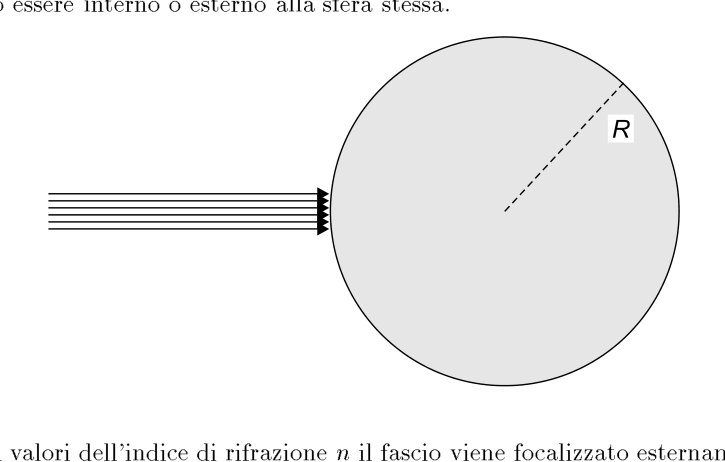 Sfera trasparente con fascio parallelo e raggio
- Trovare per quali valori dell’indice di rifrazione il fascio viene focalizzato esternamente alla sfera.
B. Un flusso continuo d’acqua (35 punti)
Da un rubinetto a sezione circolare di raggio scende un flusso continuo d’acqua con velocità iniziale . Il moto del liquido è stazionario ed è trascurabile sia l’attrito interno sia l’attrito con l’aria.
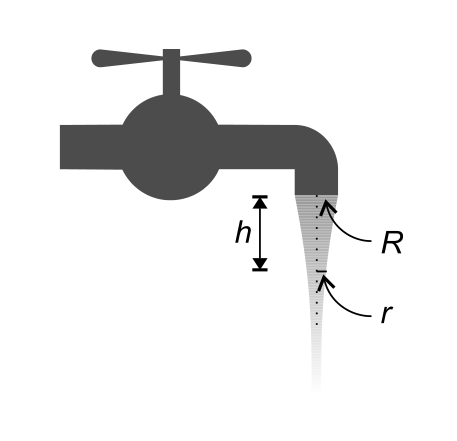 Rubinetto con flusso d’acqua, raggi e
- Trovare la relazione tra il raggio del flusso d’acqua, la distanza dal bordo del rubinetto e la velocità iniziale .
C. Una trasformazione termodinamica (35 punti)
Una mole di un gas perfetto biatomico subisce una trasformazione ciclica reversibile descritta nel piano – nel verso indicato in figura ed a partire dal punto 1.
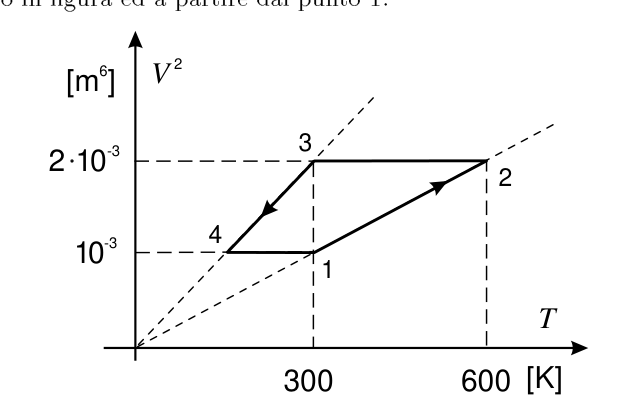 Ciclo termodinamico nel piano –
- Dopo aver rappresentato la stessa trasformazione nel piano –, calcolare il lavoro compiuto dal gas in un ciclo ed il rendimento del ciclo stesso.
Topic: Geometric Optics, Fluid Mechanics, Thermodynamics Metodi: Ray Tracing, Snell’s Law, Bernoulli’s Equation, Continuity Equation, Thermodynamic Cycle Analysis, First Law of Thermodynamics, Calculus-Integration Competenze: Diagrammatic Reasoning, Mathematical Modeling, Physical Reasoning Objects: Sphere, Tube, Gas Fonte: Testo (PDF) — p.2 Soluzione: Soluzioni (PDF)
Tre in uno!
(Gara Nazionale, Senigallia 13–14 Aprile 2000 — Problema 1, 100 punti. The problem is composed of three independent parts.)
A. A transparent sphere (30 points)
A thin beam of parallel light rays hits a transparent sphere of radius and refractive index along a diameter direction, as shown in Figure 1. The rays are focused by the sphere at the same point which can be either inside or outside the sphere itself.
Transparent sphere with parallel beam and beam
- Find out which values of the refractive index the beam is externally focused on the sphere.
B. Continuous flow of water (35 points)
A continuous flow of water with initial speed descends from a circular section tap radius. The motion of the liquid is stationary and both internal friction and air friction are negligible.
Rubber with flow of water, and
- Find the relationship between the radius of the water flow, the distance from the tap edge and the initial speed .
C. The Commission has also examined the possible effects of the measures on the environment.
A mole of a perfect biatomic gas undergoes a reversible cyclic transformation described in the T$$V^2 plane in the line shown in Figure 1 and starting at point 1.
Ciclo termodinamico nel piano –
- After the same transformation in the plan V$$p has been represented, calculate the work done by the gas in a cycle and the performance of the cycle itself.
Topic: Geometric Optics, Fluid Mechanics, Thermodynamics Metodi: Ray Tracing, Snell’s Law, Bernoulli’s Equation, Continuity Equation, Thermodynamic Cycle Analysis, First Law of Thermodynamics, Calculus-Integration Competenze: Diagrammatic Reasoning, Mathematical Modeling, Physical Reasoning Objects: Sphere, Tube, Gas Fonte: Testo (PDF) — p.2 Soluzione: Soluzioni (PDF)
Un cilindro tra due superfici
Un cilindro di massa e raggio ruota senza scivolare tra due superfici cilindriche e di raggio uno doppio dell’altro () e massa e , come mostrato in figura (le frecce indicano i versi positivi delle velocità angolari).
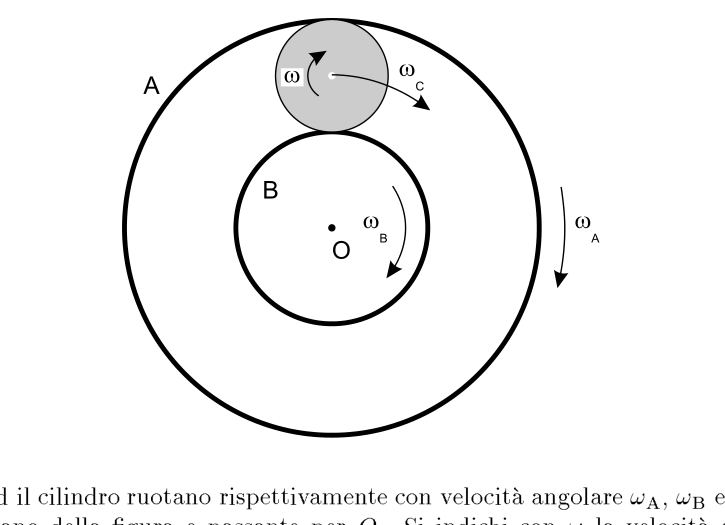 Cilindro tra due superfici cilindriche e
Le superfici e ed il cilindro ruotano rispettivamente con velocità angolare , ed attorno all’asse perpendicolare al piano della figura e passante per . Si indichi con la velocità angolare del cilindro rispetto al proprio asse di simmetria.
- Dopo aver espresso ed in funzione di , determinare le espressioni di ed in funzione di ed .
La superficie ruota in senso orario con velocità angolare pari a tre giri al secondo.
- Nel caso che la superficie venga mantenuta ferma, determinare il periodo di rotazione del centro di massa del cilindro intorno ad .
- Nel caso che il cilindro non ruoti intorno al proprio asse di simmetria, determinare la velocità del centro di massa del cilindro.
- Nel caso che il centro di massa del cilindro rimanga immobile, determinare la velocità angolare della superficie e del cilindro.
- Calcolare, in questa situazione, l’energia cinetica del sistema.
Si supponga che ad un certo istante, a causa di un leggerissimo disassamento della superficie interna (), il cilindro resti improvvisamente incastrato tra le due superfici e contemporaneamente un meccanismo di protezione disconnetta le superfici e dal motore che imponeva loro la velocità angolare precedente. (“Leggerissimo” significa che il momento d’inerzia del cilindro resta sostanzialmente invariato.)
- Descrivere — anche quantitativamente — il successivo moto del sistema.
Topic: Rotational Dynamics, Conservation of Momentum Metodi: Torque & Angular Momentum Analysis, Conservation Laws, Kinematic Equations Competenze: Diagrammatic Reasoning, Mathematical Modeling, Physical Reasoning Objects: Cylinder Fonte: Testo (PDF) — p.3 Soluzione: Soluzioni (PDF)
A cylinder between two surfaces
A cylinder of mass and radius rolls without slipping between two cylindrical surfaces and of radius twice the radius of the other () and mass and , as shown in Figure (the arrows indicate the positive angular velocity).
Cylinder between two cylindrical surfaces and
The and surfaces and the cylinder rotate at angular speeds , and respectively around the axis perpendicular to the plane of the figure and passing through . The cylinder angle velocity with respect to its axis of symmetry shall be indicated by .
- After expressing and as a function of , determine the expressions of and as a function of and .
The surface rotates clockwise at angular velocities of three turns per second.
- If the surface is kept stationary, determine the rotation period of the cylinder centre around .
- In the event that the cylinder does not rotate around its axis of symmetry, determine the speed of the cylinder’s center of mass.
- If the centre of mass of the cylinder remains motionless, determine the angular velocity of the surface and the cylinder.
- Calculate, in this situation, the kinetic energy of the system.
Suppose that at a certain moment, due to a very slight disassay of the inner surface (), the cylinder is suddenly embedded between the two surfaces and at the same time a protective mechanism disconnects the surfaces and from the engine that imposed their previous angular speed. (‘Very light’ means that the moment of inertia of the cylinder remains essentially unchanged.)
- Describe also quantitatively the next movement of the system.
Topic: Rotational Dynamics, Conservation of Momentum Metodi: Torque & Angular Momentum Analysis, Conservation Laws, Kinematic Equations Competenze: Diagrammatic Reasoning, Mathematical Modeling, Physical Reasoning Objects: Cylinder Fonte: Testo (PDF) — p.3 Soluzione: Soluzioni (PDF)
Fuoriuscita di mercurio
Una parete mobile di massa e spessore trascurabili può scorrere, senza attrito ed in modo da rimanere sempre in verticale, all’interno di un recipiente con sezione laterale di forma quadrata. Il recipiente e la parete mobile sono costruiti con un materiale termicamente isolante.
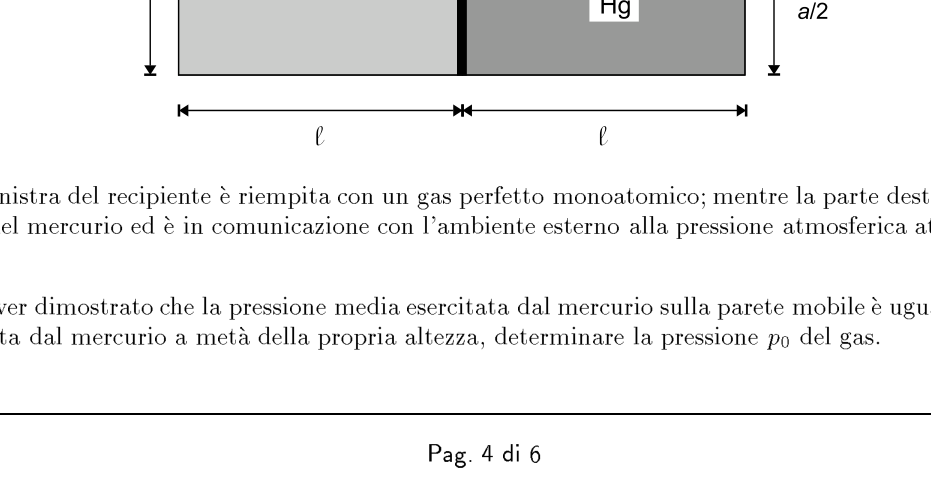 Recipiente quadrato con parete mobile e mercurio
La parte sinistra del recipiente è riempita con un gas perfetto monoatomico; mentre la parte destra contiene per metà del mercurio ed è in comunicazione con l’ambiente esterno alla pressione atmosferica attraverso la fessura A.
- Dopo aver dimostrato che la pressione media esercitata dal mercurio sulla parete mobile è uguale a quella esercitata dal mercurio a metà della propria altezza, determinare la pressione del gas.
- Ricavare, nel caso di un aumento del volume del gas, la relazione esistente tra la pressione del gas ed il suo volume.
Il gas viene riscaldato attraverso la resistenza mostrata in figura ed il conseguente spostamento della parete mobile provoca la fuoriuscita di tutto il mercurio attraverso la fessura A.
- Determinare la temperatura del gas quando la parete mobile è arrivata in fondo al recipiente.
- Determinare il lavoro compiuto dal gas.
- Determinare il calore fornito al gas.
Dati: , , , , .
Nota: può essere utile ricordare che .
Topic: Thermodynamics, Fluid Mechanics Metodi: Ideal Gas Law, First Law of Thermodynamics, Hydrostatic Equilibrium, Calculus-Integration Competenze: Mathematical Modeling, Physical Reasoning Objects: Gas, Container, Resistor Fonte: Testo (PDF) — p.4 Soluzione: Soluzioni (PDF)
Fuoriuscita di mercurio
A moving wall of negligible mass and thickness can flow, without friction and in a way that always remains vertical, within a container with a square-shaped side section. The container and the movable wall are constructed of a heat-insulating material.
Square container with movable wall and mercury
The left side of the container is filled with a perfect monoatomic gas; while the right side contains half the mercury and communicates with the outside atmospheric pressure environment through the A-slit.
- After having demonstrated that the average pressure exerted by mercury on the moving wall is equal to that exerted by mercury at half its height, determine the pressure of the gas.
- In the event of an increase in gas volume, the existing ratio between gas pressure and volume shall be obtained.
The gas is heated through the resistance shown in the figure and the resulting shift of the movable wall causes all the mercury to leak through the A-slit.
- Determine the temperature of the gas when the moving wall has reached the bottom of the container.
- Determine the work done by the gas.
- Determine the heat supplied to the gas.
Dati: , , , , .
Note: it may be helpful to remember that .
Topic: Thermodynamics, Fluid Mechanics Metodi: Ideal Gas Law, First Law of Thermodynamics, Hydrostatic Equilibrium, Calculus-Integration Competenze: Mathematical Modeling, Physical Reasoning Objects: Gas, Container, Resistor Fonte: Testo (PDF) — p.4 Soluzione: Soluzioni (PDF)
Particelle in campi magnetici
Un fascio di protoni entra dapprima in una regione di larghezza dove esiste un campo uniforme di induzione magnetica di modulo e, di seguito, in una regione di larghezza uguale alla precedente, dove esiste un campo uniforme di induzione magnetica di modulo , come mostrato in figura. I due vettori sono paralleli fra loro ed equiversi. La velocità iniziale dei protoni è perpendicolare sia alle linee di sia alla superficie che limita la regione dove esistono i campi ed è stata ottenuta da una d.d.p. acceleratrice .
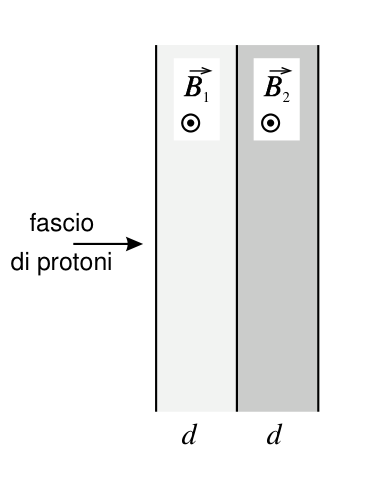 Due regioni con campi magnetici e
- Quanto deve valere affinché il fascio superi la prima regione?
- Quanto deve valere affinché il fascio superi anche la seconda regione?
- Quanto deve valere nel caso che il fascio, superate le due regioni, risulti deviato di rispetto alla direzione iniziale?
Topic: Magnetism, Newtonian Mechanics Metodi: Lorentz Force Analysis, Kinematic Equations, Vector Decomposition Competenze: Diagrammatic Reasoning, Mathematical Modeling Objects: Particle Beam Fonte: Testo (PDF) — p.5 Soluzione: Soluzioni (PDF)
The following information is provided for in the Annex to this Regulation:
A proton beam enters first a region of width where a uniform magnetic induction field of the form exists and then a region of width equal to the previous one where a uniform magnetic induction field of the form exists, as shown in Figure 1. The two vectors are parallel to each other and are equivalent. The initial proton velocity is perpendicular to both the lines and the surface bounding the region where the fields exist and was obtained from a d.d.p. The speedometer .
Two regions with magnetic fields and
- What is the value of for the beam to pass the first region?
- How much must be worth to pass the second region?
- What is the value of if the beam, after the two regions, is deviated from the initial direction by ?
Topic: Magnetism, Newtonian Mechanics Metodi: Lorentz Force Analysis, Kinematic Equations, Vector Decomposition Competenze: Diagrammatic Reasoning, Mathematical Modeling Objects: Particle Beam Fonte: Testo (PDF) — p.5 Soluzione: Soluzioni (PDF)