Due in uno!
(Gara Nazionale, Senigallia 20 Aprile 2001 — Problema 1, 100 punti. Composto da due parti indipendenti.)
A. Cilindro con pistone (35 punti)
Un cilindro di sezione e lunghezza è posto orizzontalmente. Le sue pareti sono termicamente isolanti e di capacità termica trascurabile. Al suo interno, come mostrato in figura, può scorrere un pistone di massa e di spessore trascurabile. Il calore specifico della sostanza di cui è costituito il pistone vale .
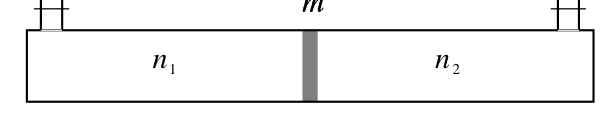 Cilindro orizzontale con pistone mobile : a sinistra moli di gas, a destra moli.
Nella parte sinistra del cilindro ci sono di un gas perfetto monoatomico alla temperatura ; nell’altra moli di un gas perfetto monoatomico alla temperatura . Il pistone si trova a dalla parete di sinistra del cilindro, in equilibrio meccanico.
- Determinare, in moli, la quantità di gas che è stata immessa nella parte destra del cilindro.
Il pistone inizialmente si trova alla temperatura . Successivamente il sistema si porta all’equilibrio termico.
- Determinare la temperatura di equilibrio del sistema.
- Determinare di quanto si è spostato il pistone.
B. Una sbarretta in un campo magnetico (65 punti)
Una sbarretta conduttrice rettilinea di lunghezza , disposta sul piano come mostrato in figura a sinistra, trasla sullo stesso piano alla velocità , immersa in un campo uniforme di induzione magnetica .
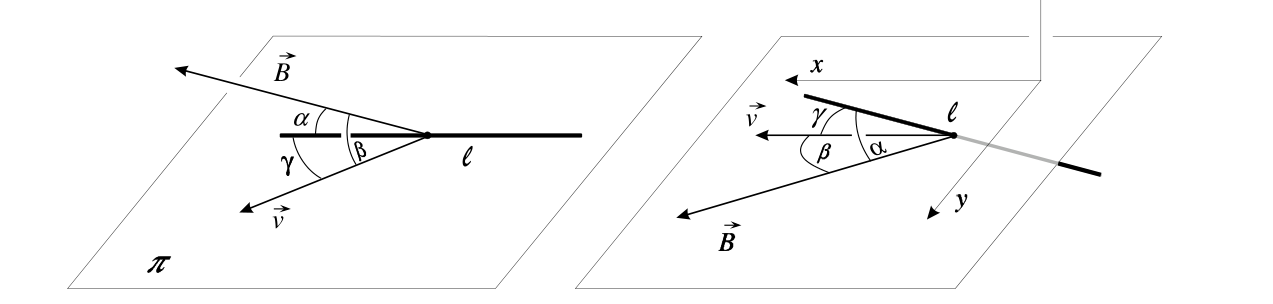 A sinistra la sbarretta nel piano con i vettori e e gli angoli (sbarretta–), (–), (–sbarretta); a destra la stessa situazione in una terna cartesiana .
L’angolo tra la sbarretta e il campo di induzione magnetica è , quello tra il campo di induzione magnetica e la velocità è e quello tra la velocità e la sbarretta è .
- Calcolare la forza elettromotrice indotta tra gli estremi della sbarretta conduttrice.
(Soluzione dettagliata non disponibile in questo archivio: il PDF della griglia di valutazione Gara individuale/nazionale/teorica/naz2001tpd/naz01g.pdf riporta solo la ripartizione dei punteggi, non lo svolgimento.)
Topic: Thermodynamics, Electromagnetic Induction Metodi: Ideal Gas Law, Energy Conservation Method, Lorentz Force Analysis, Vector Decomposition Competenze: Mathematical Modeling, Physical Reasoning, Diagrammatic Reasoning Objects: Cylinder, Piston, Gas, Rod Fonte: Testo (PDF) — p.1 Soluzione: Soluzioni (PDF)
Two in one!
The Commission has also adopted a proposal for a regulation on the protection of the environment. Composed of two independent parts.)*
A. Cylinder with piston (35 points)
A cylinder of section and length shall be placed horizontally. Its walls are thermal insulating and of negligible thermal capacity. Inside, as shown in the figure, a piston of mass and negligible thickness can flow. The specific heat of the substance from which the piston is made is .
Horizontal cylinder with movable piston : on the left gas grids, on the right grids.
On the left side of the cylinder there is of a perfect monoatomic gas at ; on the other there are moles of a perfect monoatomic gas at . The piston is located from the left wall of the cylinder, in mechanical equilibrium.
- Determine, in mills, the amount of gas that has been inserted into the right side of the cylinder.
The piston is initially at . The system then moves to thermal equilibrium.
- Determine the system equilibrium temperature.
- Determine how much the piston has moved.
B. A bar in a magnetic field (65 points)
A straight line conducting rod of length , arranged on the plane as shown in the left figure, shall move on the same plane at the speed , immersed in a uniform magnetic induction field .
Left of the bar in the plane with the vectors and and the angles (bar), (\vec B$$\vec v), (bar); right of the same situation in a Cartesian tube .
The angle between the bar and the magnetic induction field is , that between the magnetic induction field and the speed is and that between the speed and the bar is .
- Calculate the induced electromotive force between the ends of the conductor bar.
(Detailed solution not available in this archive: the PDF of the individual/national/theoretical/naz2001tpd/naz01g.pdf rating grid only shows the scores, not the performance.)
Topic: Thermodynamics, Electromagnetic Induction Metodi: Ideal Gas Law, Energy Conservation Method, Lorentz Force Analysis, Vector Decomposition Competenze: Mathematical Modeling, Physical Reasoning, Diagrammatic Reasoning Objects: Cylinder, Piston, Gas, Rod Fonte: Testo (PDF) — p.1 Soluzione: Soluzioni (PDF)
Misura del raggio di una stella
(Problema 2, 100 punti.)
Le figure qui sotto rappresentano schematicamente uno stesso campo stellare ripreso in direzione perpendicolare al piano dell’orbita terrestre a distanza di sei mesi una dall’altra.
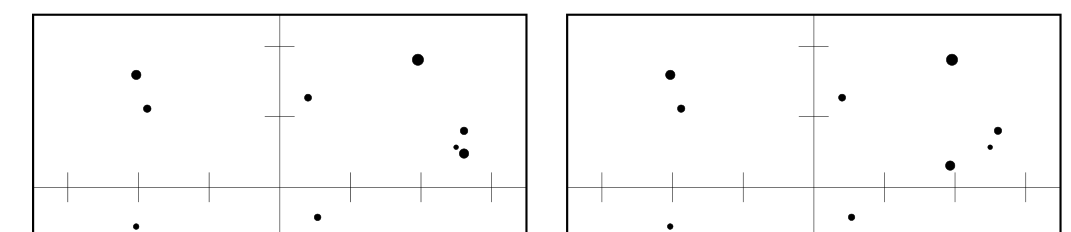 Due riprese del medesimo campo stellare a distanza di 6 mesi; la scala indicata corrisponde a d’arco. Tutte le stelle restano fisse tranne una, che appare spostata.
Come si vede, tutte le stelle tranne una sono nella stessa posizione; utilizzando anche altre immagini se ne deduce che la stella in questione appare spostarsi perché è molto più vicina delle altre.
- Stimare la distanza della stella in esame in Unità Astronomiche ( è il raggio dell’orbita terrestre, supposta circolare).
Si vorrebbe ora stimare il raggio della stella che, per la grande distanza, non è misurabile direttamente. Si utilizza uno strumento il cui obiettivo è schematizzabile come una lente sottile di di focale e di diametro e un rivelatore costituito da una matrice bidimensionale di elementi (pixel) fotosensibili, ciascuno dei quali fornisce un valore numerico proporzionale all’energia (luminosa) assorbita nel tempo di esposizione. Per semplicità si supponga che la risposta del rivelatore non dipenda dalla lunghezza d’onda della luce incidente. Si procede in questo modo:
A) Si riprende il Sole (il cui diametro angolare è ) per un tempo molto breve () interponendo tre filtri che lasciano passare ciascuno solo l’ della radiazione incidente; in questa condizione si ricava il valore medio dell’energia incidente sui pixel illuminati: in unità arbitrarie sia .
B) Si sfuoca lo strumento spostando il rivelatore in modo che l’area illuminata dalla stella abbia la stessa dimensione di quella del Sole, e si fanno diverse riprese, con tempi di posa crescenti, misurando ancora ogni volta il valore medio dell’energia incidente sui pixel illuminati. I risultati sono riportati nel grafico a fianco.
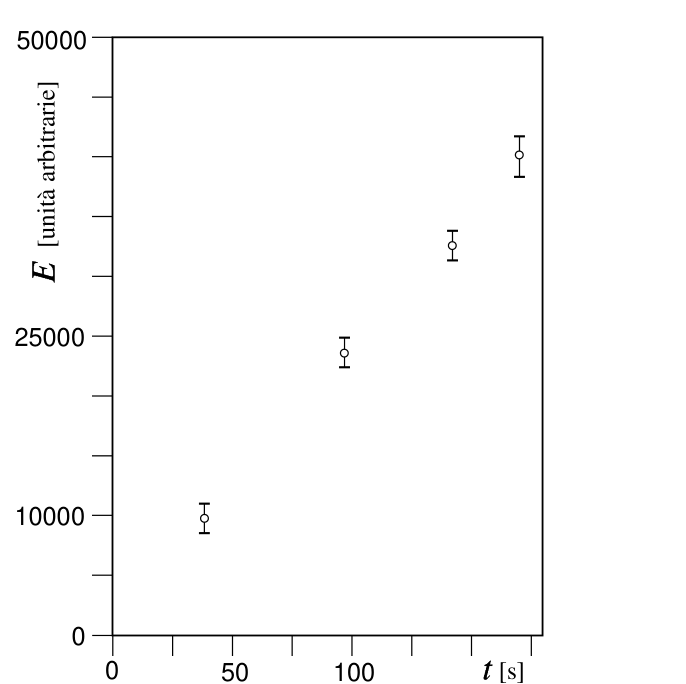 Grafico di (unità arbitrarie) in funzione del tempo di posa (s), con barre d’errore.
- Di quanto si deve spostare il rivelatore rispetto al piano focale per riprendere la stella?
- Utilizzando il grafico precedente determinare il rapporto tra i flussi luminosi (energia incidente per unità di tempo e di superficie) dal Sole e dalla stella.
- Utilizzando la distanza ottenuta al punto 1, stimare il raggio della stella in unità di raggi solari, nell’ipotesi che la temperatura superficiale della stella sia uguale a quella del Sole.
- Se, al contrario, la luce emessa dalla stella fosse più arrossata di quella solare, cosa se ne dovrebbe dedurre circa la stima del raggio?
(Soluzione dettagliata non disponibile in questo archivio: la griglia Gara individuale/nazionale/teorica/naz2001tpd/naz01g.pdf riporta solo i punteggi.)
Topic: Astrophysics, Geometric Optics, Thermodynamics Metodi: Order-of-Magnitude Estimation, Thin Lens & Mirror Equation, Graph Linearization, Experimental Data Analysis Competenze: Estimation & Approximation, Graph Linearization, Mathematical Modeling Objects: Star, Lens Fonte: Testo (PDF) — p.2 Soluzione: Soluzioni (PDF)
Measurement of the radius of a star
The following is the list of the main problems:
The figures below represent schematically the same star field taken in a direction perpendicular to the plane of Earth’s orbit six months apart.
*Two images of the same stellar field 6 months apart; the scale shown corresponds to arc. All the stars remain fixed except one, which appears to be displaced.
As you can see, all but one of the stars are in the same position; using other images, it is inferred that the star in question appears to be moving because it is much closer than the others.
- Estimate the distance of the star under consideration in Astronomical Units ( is the radius of Earth’s orbit, assumed to be circular).
Now we would like to estimate the radius of the star which, because of the great distance, is not directly measurable. A device whose objective is schematizable is used such as a thin lens of focal length and diameter and a detector consisting of a two-dimensional matrix of photosensitive elements (pixels), each of which provides a numerical value proportional to the energy (light) absorbed in exposure time. For simplicity’s sake, suppose that the detector’s response does not depend on the wavelength of the incident light. This is how it is done:
A) The Sun (whose angular diameter is ) is retrieved for a very short time () by interposing three filters that allow only incident radiation to pass through each; in this condition the average value of the incident energy on the illuminated pixels is obtained: in arbitrary units it is .
B) The instrument is fused by moving the detector so that the area illuminated by the star is the same size as that of the Sun, and several images are taken, with increasing lay times, measuring again each time the average value of the incident energy on the illuminated pixels. The results are shown in the graph next to you.
Graph of (arbitrary units) according to the load time (s), with error bars.
- How much of a shift does the detector have to do to the focal plane to capture the star?
- Using the previous graph, determine the ratio of light flows (incident energy per unit time and surface) from the Sun to the star.
- Using the distance at point 1, estimate the radius of the star in units of solar radiation, assuming that the surface temperature of the star is equal to that of the Sun.
- If, on the contrary, the light emitted by the star was more red than that of the sun, what should be inferred about the estimate of the radius?
(Detailed solution not available in this archive: the individual/national/theoretical/naz2001tpd/naz01g.pdf grid only records scores.)
Topic: Astrophysics, Geometric Optics, Thermodynamics Metodi: Order-of-Magnitude Estimation, Thin Lens & Mirror Equation, Graph Linearization, Experimental Data Analysis Competenze: Estimation & Approximation, Graph Linearization, Mathematical Modeling Objects: Star, Lens Fonte: Testo (PDF) — p.2 Soluzione: Soluzioni (PDF)
Pendolo con un fermo
(Problema 3, 100 punti.)
Una pallina di massa è legata a un piolo C rigido con un filo flessibile e inestensibile di lunghezza . Al di sotto di C e sulla verticale di esso, a distanza , si trova un secondo piolo P, parallelo al primo.
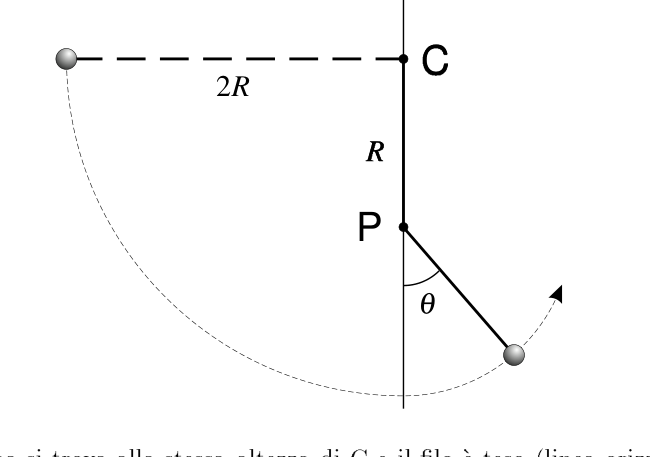 Il piolo C in alto; a distanza sotto, sulla verticale, il piolo P. La pallina parte alla stessa altezza di C con filo teso orizzontale (); oltre P il filo ruota su un arco di raggio , con angolo tra il filo oltre P e la verticale.
Inizialmente la pallina si trova alla stessa altezza di C e il filo è teso (linea orizzontale tratteggiata); essa viene lasciata cadere e quindi si muove su un arco di circonferenza di raggio . Quando il filo è verticale, cioè la pallina si trova esattamente al di sotto di C, il filo stesso urta contro il piolo P e il moto della pallina continua su un arco di circonferenza di raggio . Da questo punto in poi, si indichi con l’angolo fra il filo oltre P e la verticale.
Si considerino trascurabili i diametri dei due pioli e della pallina, la massa del filo, eventuali attriti interni al filo e la resistenza dell’aria.
- Per quale valore di la tensione del filo è pari a ?
- La pallina, risalendo, non giunge a colpire il piolo C. Si spieghi perché.
- Si calcoli il valore di per cui la pallina abbandona la traiettoria circolare di raggio e il filo cessa di essere teso.
- Quando la pallina incrocia il piano verticale CP, a quale distanza da C si trova? (la si esprima in funzione di ).
- Nell’istante di cui al punto 4, qual è (in modulo) la velocità della pallina?
(Soluzione dettagliata non disponibile in questo archivio: la griglia Gara individuale/nazionale/teorica/naz2001tpd/naz01g.pdf riporta solo i punteggi.)
Topic: Newtonian Mechanics, Conservation of Energy Metodi: Free-Body Diagram, Energy Conservation Method, Kinematic Equations Competenze: Diagrammatic Reasoning, Mathematical Modeling, Physical Reasoning Objects: Pendulum, Ball, String Fonte: Testo (PDF) — p.3 Soluzione: Soluzioni (PDF)
Hang it with a stop
The following is the list of the main problems:
A ball of mass is attached to a rigid C-pillar with a flexible, unstretchable wire of length . Below C and on its vertical, at a distance , there is a second pole P, parallel to the first.
The top of the C-pillar; at the bottom of the , on the vertical, the bottom of the P-pillar. The ball starts at the same height as C with horizontal wire (); beyond P the wire rolls over a arc of radius , with angle between the wire over P and the vertical.
Initially the ball is at the same height as C and the wire is stretched (a stretched horizontal line); it is dropped and then moves on an arc of radius . When the wire is vertical, i.e. the ball is just below C, the wire itself strikes the wire P and the ball continues to move on an arc of radius . From this point onwards, indicates the angle between the wire over P and the vertical.
The diameters of the two poles and the ball, the mass of the wire, any internal friction of the wire and the air resistance shall be considered negligible.
- For what value of is the voltage of the wire equal to ?
- The ball, going up, doesn’t hit the C-pillow. Explain why.
- The value of is calculated so that the ball leaves the radius circular path and the wire stops being stretched.
- When the ball crosses the CP vertical plane, how far away from C is it? (expressed as ).
- In the instant referred to in point 4, what is the speed of the ball (in form)?
(Detailed solution not available in this archive: the individual/national/theoretical/naz2001tpd/naz01g.pdf grid only records scores.)
Topic: Newtonian Mechanics, Conservation of Energy Metodi: Free-Body Diagram, Energy Conservation Method, Kinematic Equations Competenze: Diagrammatic Reasoning, Mathematical Modeling, Physical Reasoning Objects: Pendulum, Ball, String Fonte: Testo (PDF) — p.3 Soluzione: Soluzioni (PDF)
Ancora due in uno!
(Problema 4, 100 punti. Composto da due parti indipendenti.)
A. Apertura di un freezer (50 punti)
- Dimostrare che lo sportello del freezer di un frigorifero non può essere a perfetta tenuta d’aria.
Traccia da seguire: Si consideri che nel freezer di un frigorifero (a 4 stelle) la temperatura di equilibrio sia di e la pressione, uguale a quella esterna, sia quella atmosferica standard. Schematizzando fortemente la geometria si tratti il freezer come un parallelepipedo di di larghezza, di altezza e di profondità, la cui faccia anteriore rappresenta lo sportello; i cardini e la maniglia di questo siano quindi in corrispondenza dei due spigoli verticali anteriori. Si faccia l’ipotesi che durante un’apertura dello sportello metà della massa d’aria presente all’interno venga ricambiata con aria esterna (nel caso peggiore, quando il freezer è vuoto) alla temperatura di . Trattando l’aria come un gas perfetto, si valuti quindi la pressione interna a equilibrio termico raggiunto, nell’ipotesi che non ci sia scambio d’aria con l’esterno, e successivamente si calcoli la forza che si dovrebbe applicare alla maniglia per aprire lo sportello, traendone le dovute conseguenze.
B. Linea ad alta tensione (50 punti)
Si consideri una linea di trasporto dell’energia elettrica, tanto lunga che la sua resistenza sia confrontabile con la resistenza totale del carico utile. Semplificando molto la situazione reale, si schematizzi il circuito come un generatore ideale di f.e.m. collegato ad una resistenza (carico) attraverso due fili di resistenza totale (v. figura, in alto); detta la corrente che scorre nella resistenza è facile calcolare il rendimento del sistema, inteso come rapporto tra la potenza assorbita dal carico e quella erogata dal generatore.
 In alto: generatore () collegato al carico tramite una linea di resistenza totale .
 In basso: lo stesso circuito con due trasformatori ideali e identici, uno all’uscita del generatore e uno prima del carico.
- Esprimere il rapporto delle resistenze in funzione del rendimento .
Si sezioni ora il circuito in tre parti interponendo un trasformatore ideale tra il generatore e la linea di trasmissione e un secondo trasformatore uguale al primo tra la linea e il carico (v. figura, in basso). Lo scopo è quello di elevare la tensione del generatore di un fattore all’uscita del primo trasformatore e di diminuirla dello stesso fattore all’uscita del secondo trasformatore, senza perdita di potenza. (Suggerimento: quest’ultimo requisito, che caratterizza appunto un generatore ideale, implica una relazione tra i valori delle correnti in ingresso e in uscita di ciascun trasformatore.)
- In un caso in cui il rendimento nel collegamento diretto in bassa tensione sia pari al , quanto deve valere perché il rendimento raggiunga il con una linea di trasporto ad alta tensione?
Nota: ai fini della soluzione del problema le tensioni e le correnti possono essere intese indifferentemente come grandezze continue (costanti) oppure — come è di solito — come valori efficaci di grandezze alternate.
(Soluzione dettagliata non disponibile in questo archivio: la griglia Gara individuale/nazionale/teorica/naz2001tpd/naz01g.pdf riporta solo i punteggi.)
Topic: Thermodynamics, Circuits Metodi: Ideal Gas Law, Kirchhoff’s Laws, Physical Modeling Competenze: Mathematical Modeling, Physical Reasoning, Estimation & Approximation Objects: Gas, Resistor, Battery Fonte: Testo (PDF) — p.4 Soluzione: Soluzioni (PDF)
Ancora due in uno!
(Problema 4, 100 punti. Composed of two independent parts.)
A. Opening of a freezer (50 points)
- To prove that the fridge door can’t be airtight.
Track to follow: It is considered that the equilibrium temperature of a refrigerator (4 stars) is and the pressure, equal to the external pressure, is the standard atmospheric pressure. By schematizing the geometry, the freezer is treated as a parallel piped of width, height and depth, the front face of which represents the gate; the cardinals and handle of this are therefore in correspondence with the two front vertical tips. Assume that during a door opening half of the air mass inside is replaced by outside air (worst case, when the freezer is empty) at . Treating air as a perfect gas, the internal pressure at the thermal equilibrium is then assessed, assuming no exchange of air with the outside, and the force to be applied to the handle to open the gate is then calculated, drawing the appropriate consequences.
B. High voltage line (50 points)
Consider an electricity transmission line so long that its resistance is comparable to the total resistance of the payload. By simplifying the real situation a lot, the circuit is mapped as an ideal f.e.m. generator. connected to a resistance (load) through two strands of total resistance (v. figura, in alto); detta la corrente che scorre nella resistenza è facile calcolare il rendimento del sistema, inteso come rapporto tra la potenza assorbita dal carico e quella erogata dal generatore.
Overhead: generator () connected to the load via a total resistance line .
Lower: the same circuit with two identical and ideal transformers, one at the output of the generator and one before the load.
- Express the ratio of resistance to yield .
The circuit is now divided into three parts by placing an ideal transformer between the generator and the transmission line and a second transformer equal to the first between the line and the load (see. Figure below). The purpose is to raise the generator voltage of a factor at the output of the first transformer and to decrease it of the same factor at the output of the second transformer, without loss of power. (Suggest: this last requirement, which is an ideal generator, implies a relationship between the values of the incoming and outgoing currents of each transformer.)
- In the case where the yield in the direct connection at low voltage is , how much shall be worth for the yield to reach on a high voltage transmission line?
Note: For the purpose of solving the problem, voltages and currents can be understood as continuous (constant) quantities or as usual as effective values of alternating quantities.
(Detailed solution not available in this archive: the individual/national/theoretical/naz2001tpd/naz01g.pdf grid only records scores.)
Topic: Thermodynamics, Circuits Metodi: Ideal Gas Law, Kirchhoff’s Laws, Physical Modeling Competenze: Mathematical Modeling, Physical Reasoning, Estimation & Approximation Objects: Gas, Resistor, Battery Fonte: Testo (PDF) — p.4 Soluzione: Soluzioni (PDF)