PROBLEMA n. 1 — Tensione del filo di un pendolo (50 Punti)
Un sensore di forza collegato a un sistema di acquisizione automatica di dati consente di registrare valori di forze che variano rapidamente nel tempo.
Un pendolo è costituito da una sfera di massa collegata a un’estremità di un filo di lunghezza il quale è fissato, all’altra sua estremità, a un sostegno. Il pendolo viene deviato dalla verticale di un angolo e quindi lasciato oscillare liberamente, mentre un sensore di forza misura la componente verticale della tensione del filo; i valori misurati di tale componente sono riportati nel grafico che segue.
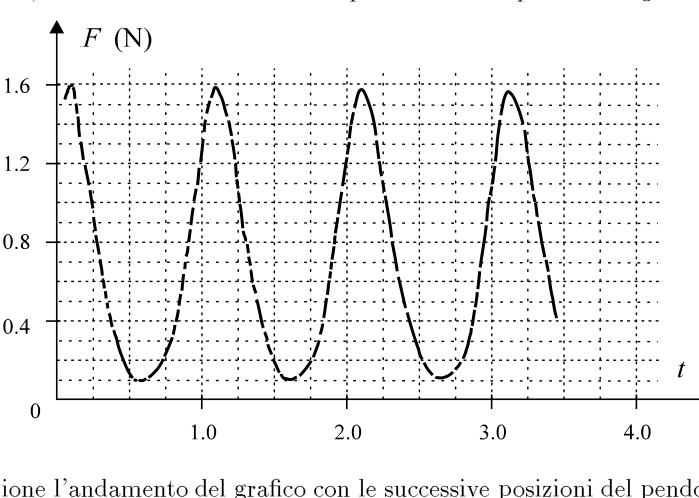 Componente verticale della tensione del filo (in N) in funzione del tempo (in s): curva periodica e asimmetrica, con massimi stretti ( N a s) e minimi larghi ( N).
- Mettere in relazione l’andamento del grafico con le successive posizioni del pendolo, motivando l’asimmetria tra i massimi e i minimi della curva.
- Stimare il periodo del pendolo.
- Utilizzando i valori massimo e minimo delle misure riportate nel grafico, determinare l’angolo e la massa del pendolo.
Note: Si tenga conto che non ci sono motivi per considerare piccolo l’angolo . Gli effetti di smorzamento sono da considerarsi trascurabili. Assumere .
Topic: Newtonian Mechanics, Oscillations & Waves, Conservation of Energy Metodi: Free-Body Diagram, Energy Conservation Method, Experimental Data Analysis Competenze: Physical Reasoning, Experimental Data Analysis, Graph Linearization Objects: Pendulum, Sphere, String Fonte: Testo (PDF) — p.1 Soluzione: Soluzioni (PDF)
PROBLEMA n. 1 Stretch of the wire of a pendulum (50 Points)
A force sensor connected to an automatic data acquisition system allows for recording force values that vary rapidly over time.
A pendulum consists of a sphere of mass connected to one end of a length of wire which is fixed, at its other end, to a support. The pendulum is deflected from the vertical of an angle and then left to oscillate freely, while a force sensor measures the ** vertical component ** of the wire voltage; the measured values of this component are shown in the following graph.
Vertical component of the wire voltage (in N) in terms of time (in s): periodic and asymmetrical curve, with narrow maximum ( N to s) and lowest width ( N).
- Relate the chart’s progress to the subsequent positions of the pendulum, thus justifying asymmetry between the maximum and minimum curves.
- Estimate the period of the pendulum.
- Using the maximum and minimum values of the measurements shown in the graph, determine the angle and the mass of the pendulum.
Note: Please note that there is no reason to consider the angle small. The effects of softening should be considered negligible. Assumere .
Topic: Newtonian Mechanics, Oscillations & Waves, Conservation of Energy Metodi: Free-Body Diagram, Energy Conservation Method, Experimental Data Analysis Competenze: Physical Reasoning, Experimental Data Analysis, Graph Linearization Objects: Pendulum, Sphere, String Fonte: Testo (PDF) — p.1 Soluzione: Soluzioni (PDF)
Interferenza su intercapedine d’aria
PROBLEMA n. 2 — Interferenza (50 Punti)
Una lastra di vetro spessa viene posta sopra un cubo di vetro. Tra la lastra e il cubo resta una sottile intercapedine d’aria di spessore uniforme . Un fascio di luce monocromatica di lunghezza d’onda compresa tra e incide perpendicolarmente sulla lastra producendo interferenza. Al variare della lunghezza d’onda in tutto l’intervallo considerato, si notano due soli massimi di luce riflessa, uno dei quali in corrispondenza del valore .
- Scrivere la condizione d’interferenza costruttiva in termini di e e determinare l’insieme dei possibili rapporti tra due qualunque lunghezze d’onda che danno luogo a massimi di interferenza.
- Calcolare il valore della seconda lunghezza d’onda per cui si ha un massimo di luce riflessa.
- Calcolare lo spessore dell’intercapedine d’aria.
Nota: Poiché la lastra è spessa l’interferenza è dovuta solo alla presenza dell’intercapedine d’aria.
Topic: Wave Optics Metodi: Interference & Diffraction Analysis, Superposition Principle Competenze: Mathematical Modeling, Physical Reasoning Objects: — Fonte: Testo (PDF) — p.1 Soluzione: Soluzioni (PDF)
The following information is provided for in the Annex to this Regulation:
The Commission has already adopted a proposal for a regulation on the protection of the environment. The following table shows the results of the tests:
A sheet of glass ** thickness ** is placed over a glass cube. A thin air intercavator of uniform thickness remains between the plate and the cube. A single-chromatic beam of light of wavelength between and shall impact the plate perpendicularly to the plate, causing interference. When the wavelength varies throughout the range considered, only two reflected light maxims are observed, one of which corresponds to the value .
- Write the constructive interference condition in terms of and and determine the set of possible relationships between two wavelengths giving rise to maximum interference.
- Calculate the value of the second wavelength for which you have a maximum reflected light.
- Calculate the thickness of the air interconnector.
Note: Because the sheet is thick, the interference is only due to the presence of the air intercavator.
Topic: Wave Optics Metodi: Interference & Diffraction Analysis, Superposition Principle Competenze: Mathematical Modeling, Physical Reasoning Objects: — Fonte: Testo (PDF) — p.1 Soluzione: Soluzioni (PDF)
Equilibrio di sfera e contrappeso su filo
PROBLEMA n. 3 — Equilibrio (100 Punti)
Dal soffitto di una stanza pende un filo di lunghezza maggiore di che termina in un piccolo anello B. Nell’anello passa un secondo lungo filo, di massa trascurabile, alle cui estremità sono appesi due corpi: uno è una sfera omogenea di centro A, raggio e massa e l’altro è un contrappeso di massa , con .
In assenza di attriti, i corpi si dispongono in una situazione di equilibrio in cui la sfera è più in alto e il contrappeso più in basso. La porzione di filo che regge il contrappeso si adagia per un tratto CD sulla superficie della sfera.
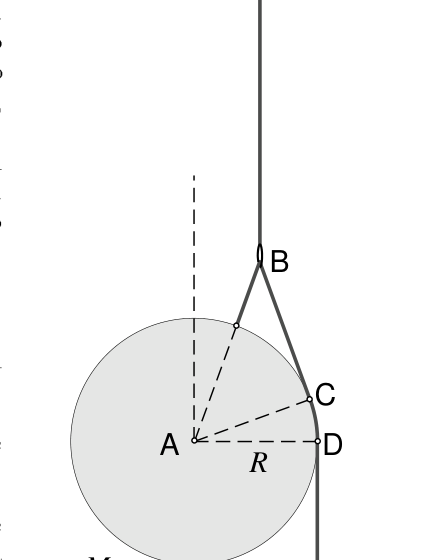 La sfera omogenea di centro A e raggio pende dal filo passante per l’anello B; il filo del contrappeso si adagia sulla sfera lungo l’arco CD (tangente in D) prima di scendere verticale.
- Disegnare le forze agenti sulla sfera e spiegarne l’origine fisica.
- Determinare quanto è lungo il tratto di filo che regge il contrappeso che rimane in contatto con la sfera.
- Descrivere, anche con un disegno, il caso limite in cui tende a 1, esplicitando le condizioni in cui ciò può verificarsi.
- Descrivere, anche con un disegno, il caso limite in cui tende a infinito, discutendo anche che cosa succede se la sfera tocca l’anello in B.
- Calcolare una risposta numerica per e per .
Topic: Rigid Body Statics, Newtonian Mechanics Metodi: Free-Body Diagram, Vector Decomposition, Symmetry Argument Competenze: Diagrammatic Reasoning, Mathematical Modeling, Physical Reasoning Objects: Sphere, String Fonte: Testo (PDF) — p.2 Soluzione: Soluzioni (PDF)
Wire balance and weight of the sphere
The Commission has already adopted a proposal for a regulation on the protection of the environment. The following table shows the total number of points of the calculation:
A wire of length hangs from the ceiling of a room and ends in a small ring B. In the ring passes a second long thread, of negligible mass, at the ends of which two bodies are suspended: one is a homogeneous sphere of center A, radius and mass and the other is a counterweight of mass , with .
In the absence of friction, the bodies are placed in a balanced position where the sphere is higher and the counterweight lower. The portion of wire holding the counterweight is laid for a stretch of CD on the surface of the sphere.
The homogeneous sphere of center A and radius hangs from the passing wire through ring B; the counterweight wire lies on the sphere along the arc CD (tangent in D) before descending vertically.
- Draw the forces acting on the sphere and explain their physical origin.
- Determine the length of the stretch of wire holding the counterweight that remains in contact with the sphere.
- Describe, including a drawing, the limit case where tends to 1, specifying the conditions under which this may occur.
- Describe, even with a drawing, the limit case where tends to infinity, also discussing what happens if the sphere touches the ring in B.
- Calculate a numerical answer for and for .
Topic: Rigid Body Statics, Newtonian Mechanics Metodi: Free-Body Diagram, Vector Decomposition, Symmetry Argument Competenze: Diagrammatic Reasoning, Mathematical Modeling, Physical Reasoning Objects: Sphere, String Fonte: Testo (PDF) — p.2 Soluzione: Soluzioni (PDF)
Lampada stroboscopica (circuito RC a scarica)
PROBLEMA n. 4 — Lampada stroboscopica (100 Punti)
Si consideri il circuito in figura 1. Se si indica con la carica sul condensatore al tempo , in cui viene chiuso l’interruttore, allora la carica ad ogni istante successivo è data dalla funzione essendo la resistenza equivalente al parallelo delle resistenze e .
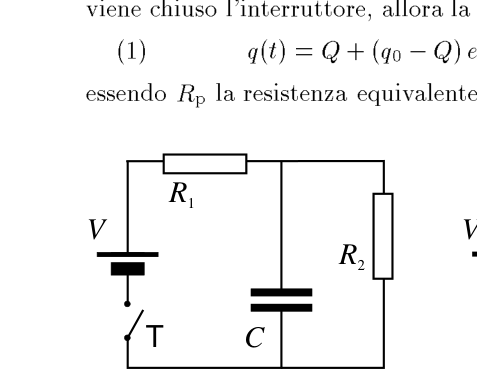 Figura 1 — Generatore di tensione con interruttore T in serie alla resistenza ; in parallelo, il ramo e il condensatore .
- Mostrare che la costante rappresenta il valore di regime della carica sul condensatore e determinarne il valore in funzione dei parametri , , .
- Calcolare le correnti nei tre rami del circuito usando la relazione (1) e verificare che il risultato è consistente con la legge dei nodi di Kirchhoff. Traccia suggerita: ricavare nell’ordine la ddp ai capi del condensatore ; la corrente nel ramo del condensatore; la corrente in ; la corrente in ; verificare la legge di Kirchhoff a uno dei nodi.
La resistenza viene sostituita da una lampada a gas (figura 2) schematizzabile come un componente resistivo definito in questo modo:
- quando la tensione applicata è nulla la resistenza è molto elevata () e rimane tale finché la tensione non supera il valore ; a questo punto la resistenza scende a e la lampada emette luce;
- la resistenza rimane molto bassa () quando la tensione applicata ai suoi capi resta superiore al valore ; quando la tensione scende al di sotto di questo valore la resistenza torna ad e la lampada si spegne.
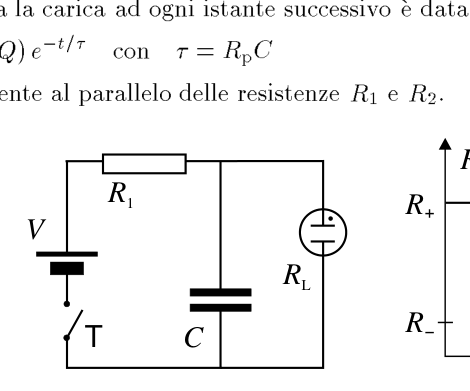 Figura 2 — Lo stesso circuito con sostituita da una lampada a gas di resistenza .
Il grafico di figura 3 mostra come la resistenza della lampada, nell’intervallo di tensione applicata , dipende dalla storia precedente.
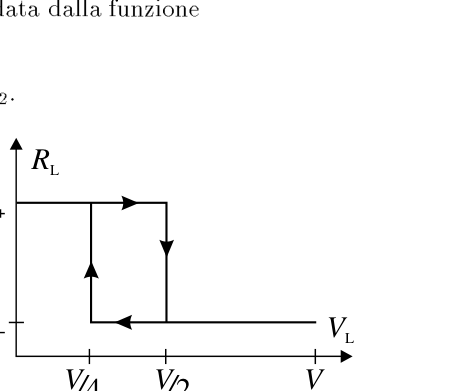 Figura 3 — Caratteristica isteretica : finché non supera , poi scende a ; risale a quando scende sotto .
- Partendo dalla condizione riportare in un grafico l’andamento della mostrando che la lampada emette una successione di lampi (lampada stroboscopica).
- Determinare la frequenza dei lampi nel caso ed , dandone poi il valore numerico per ed .
Si vuole osservare una corda vibrante alla luce di una lampada stroboscopica la cui frequenza può essere variata; è noto solo il valore minimo della frequenza . A partire da un valore certamente maggiore di quello di vibrazione della corda, la frequenza della lampada viene lentamente diminuita, fino al valore minimo. A un certo istante, durante questa operazione, si osserva che la corda appare ferma, ma poiché la frequenza dei lampi non è nota, non è possibile determinare la frequenza di oscillazione della corda. Diminuendo ancora progressivamente la frequenza della lampada, la corda appare ferma una seconda volta e subito dopo, raggiunta la frequenza minima della lampada , la corda sembra oscillare con un periodo apparente .
- A che frequenza oscilla la corda?
Topic: Circuits, Oscillations & Waves Metodi: Kirchhoff’s Laws, Differential Equations, Simple Harmonic Motion Analysis Competenze: Mathematical Modeling, Diagrammatic Reasoning, Physical Reasoning Objects: Capacitor, Resistor, Switch, Battery Fonte: Testo (PDF) — p.2 Soluzione: Soluzioni (PDF)
The following table shows the results of the calculation of the total value of the samples:
The Commission has already adopted a proposal for a regulation on the protection of the environment. The following table shows the results of the calculation of the total value of the samples:
Consider the circuit in Figure 1. If indicates the load on the capacitor at the time when the switch is closed, then the load at each subsequent moment is given by the function where is the resistance equivalent to the parallel resistance and .
Figure 1 Voltage generator with T series switch at resistance ; parallel to the branch and the capacitor.
- Show that the constant represents the current value of the load on the capacitor and determine its value according to the parameters , , .
- Calculate the currents in the three branches of the circuit using the relation (1) and verify that the result is consistent with Kirchhoff’s knot law. Suggested path: get the ddp in the order of the capacitor heads ; current in the capacitor branch; current in ; current in ; check Kirchhoff’s law at one of the nodes.
The resistance is replaced by a gas lamp (Figure 2) that can be schematized as a resistance component defined as follows:
- when the applied voltage is zero the resistance is very high () and remains so until the voltage exceeds ; at this point the resistance drops to and the lamp emits light;
- the resistance remains very low () when the voltage applied to its heads remains above ; when the voltage drops below this value the resistance returns to and the lamp turns off.
Figure 2 The same circuit with replaced by a resistance gas lamp .
The graph in Figure 3 shows how the lamp’s resistance, in the applied voltage range , depends on the previous history.
Figure 3 Hysterical characteristic : until does not exceed , then decreases to ; it goes back to when falls below .
- Starting from , report the trend of on a graph showing that the lamp emits a succession of flashes (stroboscopic lamp).
- Determine the frequency of lightning in the case of and , then give the numerical value for and .
A vibrating string is to be observed in the light of a stroboscopic lamp whose frequency can be varied; only the minimum frequency value is known. Starting from a value that is certainly higher than the vibration value of the rope, the lamp frequency is slowly reduced to the minimum value. At a certain moment, during this operation, the rope appears to be stationary, but since the frequency of lightning is not known, it is not possible to determine the frequency of oscillation of the rope. By further gradually decreasing the frequency of the lamp, the rope appears still a second time and immediately afterwards, when the minimum frequency of the lamp is reached, the rope appears to oscillate with an apparent period .
- What frequency does the rope swing at?
Topic: Circuits, Oscillations & Waves Metodi: Kirchhoff’s Laws, Differential Equations, Simple Harmonic Motion Analysis Competenze: Mathematical Modeling, Diagrammatic Reasoning, Physical Reasoning Objects: Capacitor, Resistor, Switch, Battery Fonte: Testo (PDF) — p.2 Soluzione: Soluzioni (PDF)