Chi sale, chi scende — doppia puleggia
PROBLEMA n. 1 — Chi sale, chi scende… (100 Punti)
Una “doppia puleggia” è formata da due dischi, di forma cilindrica e rigidamente connessi, rispettivamente di raggio ed e masse ed . Ciascun disco porta avvolta una corda inestensibile e di massa trascurabile alla cui estremità è appesa una massa di valore rispettivamente e , come mostrato in figura. Le corde non scivolano durante il loro moto intorno ai due dischi.
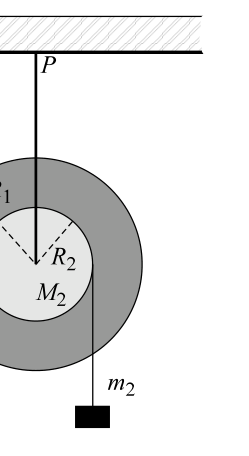 Doppia puleggia imperniata in : sul disco esterno di raggio e massa è avvolta la corda che sostiene , sul disco interno di raggio e massa la corda che sostiene .
- Determinare la condizione che deve essere soddisfatta tra le grandezze in gioco in modo tale che ci sia equilibrio meccanico.
Si assuma ora , , e .
- Con questi valori, in che verso ruotano le pulegge?
- Determinare la velocità della massa , dopo che si è spostata di un tratto a partire dalla posizione di quiete.
- Determinare le tensioni e delle due corde.
- La forza totale che il soffitto esercita nel punto per sostenere il sistema delle pulegge e delle masse è la stessa quando le masse e sono ferme oppure quando sono in moto? Motivare adeguatamente la risposta e successivamente calcolare la forza (o le forze, se diverse).
Nota: il momento di inerzia di un cilindro omogeneo di raggio e massa , rispetto al suo asse di simmetria, è .
Topic: Rotational Dynamics, Newtonian Mechanics, Conservation of Energy Metodi: Free-Body Diagram, Torque & Angular Momentum Analysis, Energy Conservation Method Competenze: Diagrammatic Reasoning, Mathematical Modeling, Physical Reasoning Objects: Pulley, Disk, String Fonte: Testo (PDF) — p.1 Soluzione: Soluzioni (PDF)
Chi sale, chi scende — doppia puleggia
PROBLEMA n. 1 — Chi sale, chi scende… (100 Punti)
A ‘double cleaning’ consists of two cylindrical discs, rigidly connected, of radius and and masses and respectively. Each disc carries a wrapped, unextensible, mass-negligible string to which a mass of and is attached, respectively, as shown in Figure 1. The ropes do not slip around the two disks while they are on their motorcycle.
Double threaded brush on : on the outer disc of radius and mass the rope supporting is wrapped, on the inner disc of radius and mass the rope supporting .
- Determine the condition that must be met between the quantities at stake so that there is mechanical balance.
Si assuma ora , , e .
- With these values, which way do the pulleys turn?
- Determine the speed of the mass after it has moved a stroke from the still position.
- Determine the and voltages of the two strings.
- Is the total force exerted by the ceiling at the point to support the pulley and mass system the same when the masses and are stationary or moving? Properly motivate the response and then calculate the force (or forces, if different).
Note: the torque of a cylinder of a uniform radius and mass , with respect to its axis of symmetry, is .
Topic: Rotational Dynamics, Newtonian Mechanics, Conservation of Energy Metodi: Free-Body Diagram, Torque & Angular Momentum Analysis, Energy Conservation Method Competenze: Diagrammatic Reasoning, Mathematical Modeling, Physical Reasoning Objects: Pulley, Disk, String Fonte: Testo (PDF) — p.1 Soluzione: Soluzioni (PDF)
PROBLEMA n. 2 — Anelli in campo (100 Punti)
In una regione di spazio cilindrica è presente un campo magnetico uniforme , diretto verticalmente verso l’alto, di cui modulo, inizialmente uguale a , varia linearmente annullandosi in un tempo .
Nella regione è posto un anello conduttore di raggio , giacente fermo in un piano perpendicolare a , con il centro sull’asse della regione.
- Determinare l’energia assorbita da una carica che percorre un giro completo nell’anello mentre il campo magnetico viene variato. Determinare quindi il modulo del campo elettrico che agisce sulla carica.
In un secondo tempo l’anello conduttore viene sostituito da due anelli concentrici liberi di ruotare senza attrito attorno al medesimo asse: gli anelli, fatti di materiale dielettrico ed omogeneo, hanno andamine massa , raggi ed , con , e su di essi è distribuita uniformemente una carica di modulo , positiva sull’anello esterno e negativa su quello interno. Facendo variare il campo magnetico allo stesso modo di prima i due anelli, inizialmente fermi, si mettono in rotazione.
- Determinare il modulo della velocità angolari raggiunte dai due anelli dopo che hanno compiuto un giro completo.
- Con quali velocità angolari e in quale verso girano gli anelli dopo il tempo ?
- In una prova successiva i due anelli sono rigidamente collegati fra di loro per mezzo di astine di materiale dielettrico e di massa trascurabile. Trovare la velocità angolare acquistata dal sistema al tempo , quando il campo è estinto.
Nota: il momento di inerzia di un anello omogeneo di raggio e massa è .
Topic: Electromagnetic Induction, Rotational Dynamics Metodi: Faraday’s Law of Induction, Torque & Angular Momentum Analysis, Calculus-Integration Competenze: Mathematical Modeling, Physical Reasoning, Diagrammatic Reasoning Objects: Coil Fonte: Testo (PDF) — p.1 Soluzione: Soluzioni (PDF)
The Commission has already adopted a proposal for a regulation on the protection of the environment. 2 Field rings** (100 Points)
In a region of cylindrical space there is a uniform magnetic field , pointed vertically upwards, whose modulus, initially equal to , varies linearly and cancels out over time .
A conductive ring of radius shall be placed in the region, fixed in a plane perpendicular to , with the centre on the axis of the region.
- Determine the energy absorbed by a charge that goes through a full spin in the ring as the magnetic field is varied. Determine the electric field module acting on the charge.
In a second time the conductive ring is replaced by two free-to-spin concentric rings on the same axis: the rings, made of dielectric and homogeneous material, have mass bands , and , with , and are uniformly distributed a module charge , positive on the outer and negative on the inner ring. By varying the magnetic field in the same way as before, the two rings, initially stationary, spin.
- Determine the angular velocity of the two rings after completing a complete turn.
- At what angular velocities and in which direction do the rings turn after time?
- In a subsequent test the two rings are rigidly connected by means of dielectric material and of negligible mass. Find the angular velocity acquired by the system at time, when the field is off.
Note: the moment of inertia of a ring of a uniform radius and mass is .
Topic: Electromagnetic Induction, Rotational Dynamics Metodi: Faraday’s Law of Induction, Torque & Angular Momentum Analysis, Calculus-Integration Competenze: Mathematical Modeling, Physical Reasoning, Diagrammatic Reasoning Objects: Coil Fonte: Testo (PDF) — p.1 Soluzione: Soluzioni (PDF)
Pianeti extra-solari (transito di HD209458)
PROBLEMA n. 3 — Pianeti extra-solari (100 Punti)
Il prossimo 7 Maggio sarà visibile dall’Italia un transito di Mercurio e il giorno 8 Giugno 2004 il fenomeno più raro del transito di Venere; i due pianeti appariranno come dischetti scuri in moto sulla superficie solare.
Da qualche anno si è pensato che l’esistenza di sistemi planetari diversi dal nostro e quindi di pianeti cosiddetti extra-solari potesse essere dedotta dall’osservazione di transiti e nel 1999 è stato dato il primo annuncio di un tale evento. Poiché le stelle appaiono come sorgenti puntiformi, tali transiti non possono essere osservati direttamente, ma solo attraverso la variazione di luminosità della stella.
Il grafico in fig. 3-1 riporta schematicamente la curva di luce di una stella (denominata HD209458, nella costellazione di Pegaso) che per caratteristiche spettrali e di luminosità può essere pensata come avente la stessa massa e lo stesso raggio del Sole. La riduzione di luminosità, che si ripete regolarmente ogni giorni, è dovuta al “transito” di un suo pianeta (oscuro e quindi non visibile).
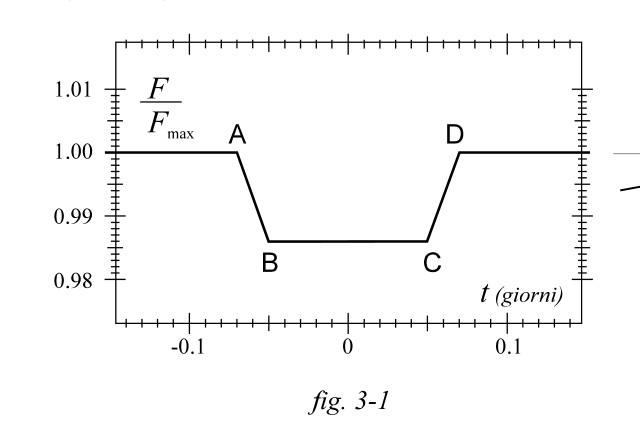 Fig. 3-1: curva di luce in funzione del tempo (giorni), con avvallamento trapezoidale tra i punti A, B, C, D da a circa .
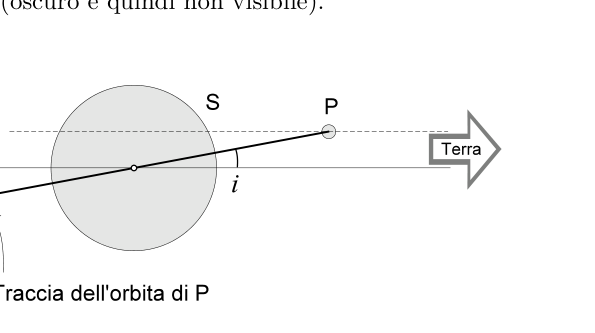 Fig. 3-2: schema geometrico del transito; stella S, pianeta P sulla traccia dell’orbita, angolo di inclinazione , Terra a destra.
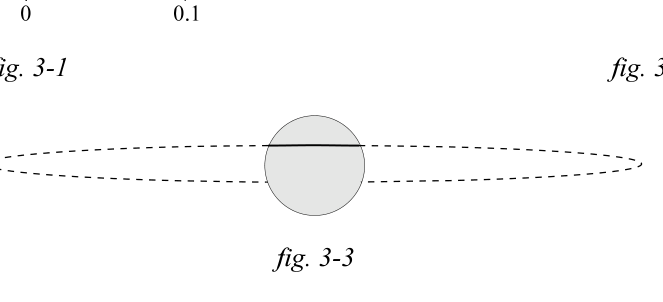 Fig. 3-3: disco stellare attraversato dal pianeta lungo una corda, con l’orbita (tratteggiata) vista da Terra.
Si assumano le seguenti ipotesi, come ipotesi di lavoro: a) il disco stellare sia uniformemente luminoso; b) l’orbita del pianeta sia circolare; c) la densità della stella e del pianeta siano praticamente uguali.
- Utilizzando la curva di luce e i dati del pianeta, in Unità Astronomiche, ricavare una stima del rapporto tra la massa del pianeta e quella di Giove ().
- Determinare il raggio dell’orbita del pianeta, in Unità Astronomiche.
- Indicare a quali fasi del transito corrispondono i punti A, B, C e D del grafico.
- Nell’ulteriore ipotesi semplificativa che la Terra si trovi nel piano della fig. 3-2, molto lontano a destra, e utilizzando i dati temporali del transito, stimare l’angolo di inclinazione del piano dell’orbita rispetto alla congiungente stella-Terra (in fig. 3-3 l’orbita del pianeta come si vedrebbe da Terra).
Suggerimento: si consiglia, come è tradizionale in astrofisica, di esprimere le masse in unità di Massa Solare (), le distanze in Unità Astronomiche (distanza media Sole–Terra: ), i tempi in anni terrestri di giorni (le unità “giorni” e “anni” si indicano rispettivamente con i simboli “d” e “y”; , ). Infine è utile conoscere il diametro angolare del Sole visto dalla Terra: .
Topic: Astrophysics, Gravitation Metodi: Kepler’s Laws, Order-of-Magnitude Estimation, Physical Modeling Competenze: Experimental Data Analysis, Estimation & Approximation, Physical Reasoning Objects: Star, Planet Fonte: Testo (PDF) — p.2 Soluzione: Soluzioni (PDF)
The following table shows the number of solar panels in the solar system.
The Commission has already adopted a proposal for a regulation on the protection of the environment. 3 Extrasolar planets** (100 Points)
On May 7, a transit of Mercury will be visible from Italy and on June 8, 2004, the rarest transit of Venus will occur. The two planets will appear as moving dark disks on the solar surface.
For some years it was thought that the existence of planetary systems other than our own and therefore of so-called exoplanets could be inferred from the observation of transits and in 1999 the first such event was announced. Because stars appear as point-like sources, such transits cannot be observed directly, but only through the change in brightness of the star.
The chart is fig. 3-1 schematically reports the light curve of a star (called HD209458, in the constellation of Pegasus) which by spectral and luminous characteristics can be thought of as having the same mass and radius as the Sun. The decrease in brightness, which is regularly repeated every day, is due to the “transit” of a planet of its own (dark and therefore not visible).
The following table shows the results of the evaluation: 3-1: light curve in terms of time (days), with trapezoidal clearance between points A, B, C, D from to approximately .*
The following table shows the results of the evaluation: 3-2: geometric pattern of transit; star S, planet P on orbit track, angle of inclination , Earth to the right.*
The following table shows the results of the evaluation: 3-3: a star disc traversed by the planet along a rope, with the orbit (treated) as seen from Earth.
The following assumptions are assumed as working assumptions: (a) the stellar disc is uniformly luminous; (b) the planet’s orbit is circular; (c) the density of the star and the planet are virtually equal.
- Using the curve of light and planetary data, in Astronomical Units, obtain an estimate of the ratio of the planet’s mass to that of Jupiter ().
- Determine the radius of the planet’s orbit in Astronomical Units.
- Indicate which stages of transit correspond to points A, B, C and D of the chart.
- In the further simplified assumption that the Earth is in the fig plane. 3-2, very far to the right, and using transit time data, estimate the angle of inclination of the orbit plane relative to the Earth-star conjunction (in Fig. 3-3 the planet’s orbit as seen from Earth).
Suggest: it is recommended, as is traditional in astrophysics, to express masses in units of Solar Mass (), distances in Astronomical Units (average distance SunEarth: ), times in Earth years of days (the units “days” and “years” are indicated by the symbols “d” and “y”; , respectively). Finally, it is useful to know the angular diameter of the Sun as seen from Earth: .
Topic: Astrophysics, Gravitation Metodi: Kepler’s Laws, Order-of-Magnitude Estimation, Physical Modeling Competenze: Experimental Data Analysis, Estimation & Approximation, Physical Reasoning Objects: Star, Planet Fonte: Testo (PDF) — p.2 Soluzione: Soluzioni (PDF)