Asta che cade da appoggio verticale
PROBLEMA n. 1 — Asta (100 Punti)
Un’asta omogenea di massa , lunghezza e dimensioni trasversali trascurabili è inizialmente appoggiata in posizione verticale su un pavimento orizzontale rigido, in equilibrio instabile. Discutere i casi seguenti, senza considerare l’attrito tranne che quando ciò viene esplicitamente richiesto, e indicando con il punto iniziale di appoggio e con l’angolo che essa forma in ogni istante col piano orizzontale.
Nel primo caso l’asta non ha alcun appoggio tranne il pavimento senza attrito. Essendo l’equilibrio instabile, ad un certo punto inizia a cadere verso destra.
- Dire a quale distanza da O si trova il centro dell’asta quando esso tocca il pavimento.
In questo secondo caso, l’asta è inizialmente appoggiata contro una parete verticale e inizia a cadere ruotando intorno a O. A un certo punto essa perde il contatto con la parete e, continuando la caduta, inizia a scivolare lateralmente sul pavimento.
2a. Calcolare le componenti radiale e tangenziale dell’accelerazione del centro di massa (o centro dell’asta) in funzione dell’angolo .
2b. Calcolare quanto vale e la velocità del centro di massa nell’istante in cui inizia a scivolare lateralmente sul pavimento.
Nel terzo caso l’asta è inizialmente appoggiata contro la parete, ma alla domanda 1, tra sul pavimento è presente un certo attrito statico, con coefficiente . Tuttavia, anche con comunque grande, si ha certamente uno slittamento del punto di appoggio dell’asta sul pavimento quando raggiunge un certo valore limite.
- Trovare questo valore.
Suggerimento: il momento d’inerzia dell’asta rispetto a un asse ortogonale ad essa e passante per un suo estremo è .
Topic: Rotational Dynamics, Newtonian Mechanics Metodi: Free-Body Diagram, Torque & Angular Momentum Analysis, Energy Conservation Method Competenze: Diagrammatic Reasoning, Mathematical Modeling, Physical Reasoning Objects: Rod Fonte: Testo (PDF) — p.2 Soluzione: Soluzioni (PDF)
This falls from the vertical support
The Commission has already adopted a proposal for a regulation on the protection of the environment. The following table shows the total number of points:
A homogeneous axis of mass, length and negligible cross-sectional dimensions is initially supported vertically on a rigid horizontal floor in unstable equilibrium. Discuss the following cases, without regard to friction except where explicitly required, and indicate with the starting support point and with the angle it forms at each instant with the horizontal plane.
In the first case the auction has no support except the floor without friction. Since the balance is unstable, at some point it begins to fall to the right.
- Tell how far from O is the center of the auction when it touches the floor.
In this second case, the axle is initially leaning against a vertical wall and begins to fall rotating around O. At some point it loses contact with the wall and, as it continues to fall, begins to slip laterally onto the floor.
2a. Calculate the radial and tangential components of the acceleration of the centre of mass (or axle centre) at the angle .
2b. Calculate the value of and the velocity of the centre of mass as it begins to slide laterally on the floor.
In the third case, the axle is initially supported against the wall, but in question 1, between the floor there is a certain static friction, with a coefficient . However, even with however large, there is certainly a shift in the support point of the auction on the floor when reaches a certain limit value.
- Find that value.
Suggest: the moment of inertia of the axle relative to an axis orthogonal to it and passing through one of its ends is .
Topic: Rotational Dynamics, Newtonian Mechanics Metodi: Free-Body Diagram, Torque & Angular Momentum Analysis, Energy Conservation Method Competenze: Diagrammatic Reasoning, Mathematical Modeling, Physical Reasoning Objects: Rod Fonte: Testo (PDF) — p.2 Soluzione: Soluzioni (PDF)
Oggetto in moto rettilineo (analisi del grafico velocità-tempo)
PROBLEMA n. 2 — Oggetto in moto rettilineo (60 Punti)
Un oggetto di massa si muove lungo una retta. L’andamento della velocità nel tempo è rappresentato dal grafico qui accanto.
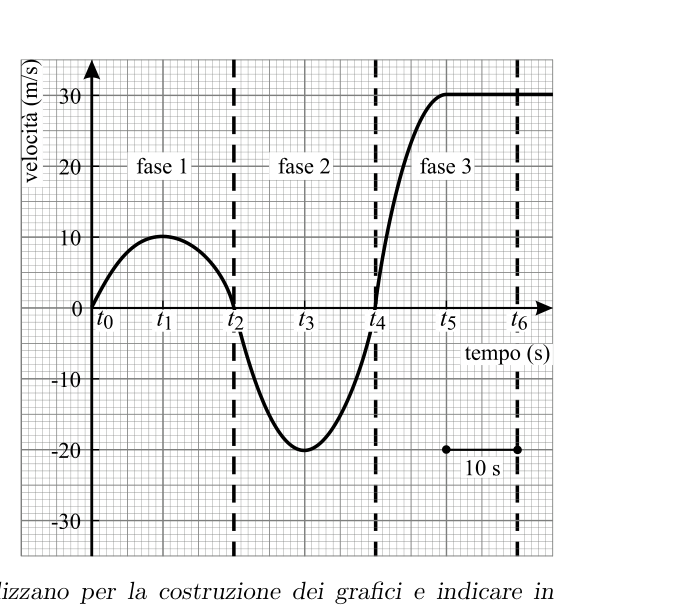 Grafico della velocità (m/s) in funzione del tempo (s): la curva è suddivisa in fase 1, fase 2 e fase 3 dalle linee tratteggiate; sono marcati gli istanti e la scala verticale va da a .
All’istante iniziale, l’oggetto si trova nell’origine del sistema di riferimento.
- Utilizzando il foglio risposte allegato, disegnare l’andamento della legge oraria del moto e quello dell’accelerazione in funzione del tempo (aiutarsi con la quadrettatura del foglio per determinare i valori da inserire nei grafici).
- Disegnare quindi, nella parte destra del foglio risposta, su scala arbitraria, ma adeguata, il vettore della velocità e quello della posizione in corrispondenza degli istanti , , , , , e .
- Tracciare, infine, il grafico dell’energia cinetica dell’oggetto in funzione della posizione in ogni fase del moto.
Suggerimento: i valori dei dati che si utilizzano per la costruzione dei grafici e indicare in maniera molto sintetica il modo in cui sono stati determinati.
Topic: Newtonian Mechanics Metodi: Kinematic Equations, Calculus-Integration, Energy Conservation Method Competenze: Diagrammatic Reasoning, Graph Linearization, Mathematical Modeling Objects: — Fonte: Testo (PDF) — p.2 Soluzione: Soluzioni (PDF)
**Object in straight motion (speed-time chart analysis) **
The Commission has already adopted a proposal for a regulation on the protection of the environment. 2 Object in straight motion** (60 Points)
An object of mass moves along a straight line. The speed of the motion over time is shown in the graph next to this.
Graph of speed (m/s) in terms of time (s): the curve is divided into phase 1, phase 2 and phase 3 by the lines drawn; the moments are marked and the vertical scale ranges from to .
At the initial moment, the object is located at the origin of the reference system.
- Using the attached answer sheet, draw the trend of the motion time law and that of acceleration in relation to time (help with the squaring of the sheet to determine the values to be entered in the graphs).
- Draw then, on the right side of the answer sheet, at an arbitrary but appropriate scale, the velocity vector and the position vector for the moments , , , , , and .
- Finally, draw the graph of the kinetic energy of the object according to the position at each stage of the motion.
Suggest: the values of the data used to construct the graphs and indicate in a very brief way how they were determined.
Topic: Newtonian Mechanics Metodi: Kinematic Equations, Calculus-Integration, Energy Conservation Method Competenze: Diagrammatic Reasoning, Graph Linearization, Mathematical Modeling Objects: — Fonte: Testo (PDF) — p.2 Soluzione: Soluzioni (PDF)
PROBLEMA n. 3 — Canna barometrica (70 Punti)
Durante la costruzione di un barometro a mercurio, per errore, un po’ d’aria è rimasta intrappolata nella canna barometrica, come mostrato in figura.
La canna è lunga e la sua sezione è trascurabile rispetto a quella della base sottostante, così che il livello del mercurio nella vaschetta non varia se vi sono variazioni del dislivello del mercurio nella canna.
All’equilibrio la colonna di mercurio è alta se la pressione atmosferica vale e la temperatura .
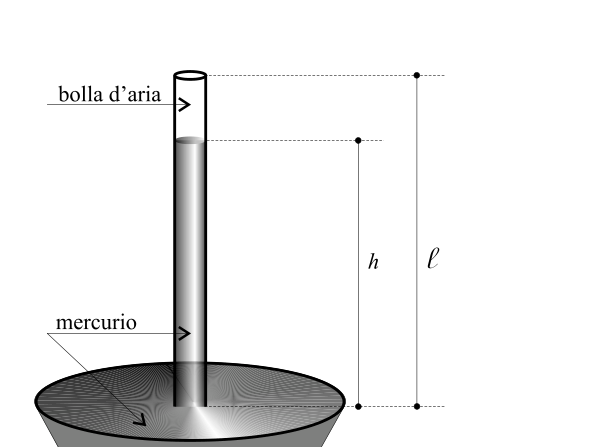 Canna barometrica verticale: in alto la bolla d’aria intrappolata, sotto la colonna di mercurio di altezza (lunghezza totale della canna ), con l’estremità immersa nella vaschetta di mercurio.
- La quantità d’aria intrappolata risulta essere di modesta entità. Quale sarebbe il suo volume se si trovasse alla pressione atmosferica e alla temperatura ?
Dopo un po’ di tempo l’altezza della colonna di mercurio risulta , anche se la pressione atmosferica non è variata, come verificato con una misura indipendente eseguita con un altro strumento.
- Quanto vale la temperatura del sistema?
- Quanto vale il lavoro compiuto dalla bolla d’aria racchiusa nella canna barometrica per espandersi?
- Quanto vale il calore assorbito dalla bolla d’aria?
Suggerimenti: 1. Approssimare il comportamento termodinamico dell’aria con quello di un gas perfetto biatomico. 2. Trascurare la dilatazione termica del mercurio. 3. Densità mercurio: .
Topic: Thermodynamics, Fluid Mechanics Metodi: Ideal Gas Law, First Law of Thermodynamics, Hydrostatic Equilibrium Competenze: Mathematical Modeling, Physical Reasoning Objects: Tube, Gas, Bubble Fonte: Testo (PDF) — p.3 Soluzione: Soluzioni (PDF)
PROBLEMA n. 3 — Canna barometrica (70 Punti)
During the construction of a mercury barometer, some air was mistakenly trapped in the barometer barrel, as shown in the figure.
The barrel is long and its section is negligible compared to that of the base below, so that the mercury level in the tank does not change if there are changes in the mercury level in the barrel.
At equilibrium the mercury column is high if the atmospheric pressure is and the temperature is .
Vertical barometric tube: above the air bubble trapped, below the mercury column of height (total length of tube ), with the end immersed in the mercury tank.
- The amount of trapped air appears to be modest. What would its volume be at atmospheric pressure and temperature ?
After some time the height of the mercury column is , even if the atmospheric pressure does not change, as verified by an independent measurement performed with another instrument.
- What’s the temperature of the system?
- What’s the work done by the air bubble trapped in the barometer barrel to expand?
- How much is the heat absorbed by the air bubble?
Suggerimenti: 1. Approximate the thermodynamic behavior of air to that of a perfect biatomic gas. 2. Neglect the thermal expansion of mercury. 3. Densità mercurio: .
Topic: Thermodynamics, Fluid Mechanics Metodi: Ideal Gas Law, First Law of Thermodynamics, Hydrostatic Equilibrium Competenze: Mathematical Modeling, Physical Reasoning Objects: Tube, Gas, Bubble Fonte: Testo (PDF) — p.3 Soluzione: Soluzioni (PDF)
PROBLEMA n. 4 — Cavo coassiale (70 Punti)
In figura è rappresentato un cavo coassiale costituito da due conduttori, un filo di raggio e una sottile superficie cilindrica di raggio aventi l’asse in comune, separati da un mezzo isolante di costante dielettrica approssimabile a quella del vuoto; la lunghezza del cavo è molto maggiore del suo diametro.
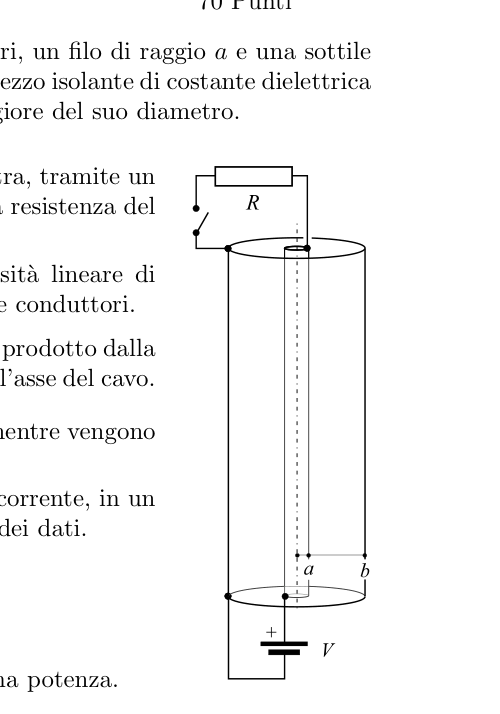 Cavo coassiale: il filo interno di raggio e la superficie cilindrica esterna di raggio ; a un’estremità il generatore di f.e.m. , all’altra l’interruttore e la resistenza .
Ad un’estremità del cavo è collegato un generatore di f.e.m. e all’altra, tramite un interruttore inizialmente aperto, una resistenza rispetto alla quale la resistenza del cavo può essere trascurata.
- Con l’interruttore aperto il cavo si carica; determinare la densità lineare di carica presente sul filo, in un punto del dielettrico a distanza dal cavo dei conduttori.
- Esprimere in funzione della d.d.p. , il campo elettrostatico prodotto dalla differenza di carica, in un punto del dielettrico a distanza dall’asse del cavo.
Chiudendo l’interruttore i due conduttori del cavo rimangono carichi mentre vengono percorsi da una corrente.
- Scrivere l’espressione del campo magnetico prodotto dalla corrente, in un punto del dielettrico a distanza dall’asse del cavo, in funzione dei dati.
Si consideri adesso il vettore (detto vettore di Poynting) il cui flusso attraverso una qualunque superficie ha le dimensioni di una potenza.
- Calcolare il vettore nei punti del dielettrico e il flusso di questo attraverso una sezione normale del cavo coassiale.
- Interpretare il risultato ottenuto.
Suggerimenti: 1. È utile ricordare che la derivata della funzione (logaritmo naturale) è . 2. Per la simmetria cilindrica del sistema, il flusso attraverso la sezione del cavo può essere pensato come la “somma” (integrale) dei contributi di corone circolari infinitesime di raggio e area .
Topic: Electrostatics, Magnetism, Electromagnetism Metodi: Gauss’s Law, Ampère’s Law, Calculus-Integration Competenze: Mathematical Modeling, Diagrammatic Reasoning, Physical Reasoning Objects: Wire, Battery, Switch, Resistor Fonte: Testo (PDF) — p.3 Soluzione: Soluzioni (PDF)
PROBLEMA n. 4 — Cavo coassiale (70 Punti)
In the figure a coaxial cable consisting of two conductors, a wire of radius and a thin cylindrical surface of radius having the same axis, separated by an insulating medium of dielectric constant approximately equal to that of the vacuum; the length of the cable is much larger than its diameter.
Coastal lead: the inner wire radius and the outer cylindrical surface radius; at one end the f.e.m. generator. , all’altra l’interruttore e la resistenza .
At one end of the cable is connected an F.E.M. generator. e all’altra, tramite un interruttore inizialmente aperto, una resistenza rispetto alla quale la resistenza del cavo può essere trascurata.
- The cable is charged with the switch open; determine the linear charge density present on the wire at a dielectric point at a distance from the conductor cable.
- Express according to the D.D.P. , the electrostatic field produced by the charge difference, at a dielectric point from the cable axis.
When the switch is closed, the two conductors of the cable remain charged as they are passed through a current.
- Write the expression of the magnetic field produced by the current at a dielectric point from the cable axis, according to the data.
Consider now the vector (called the Poynting vector) The flow through any surface is the size of a power.
- Calculate the vector at the dielectric points and the flow of the dielectric through a normal section of the coaxial cable.
- Interpret the result obtained.
Suggerimenti: 1. It is useful to remember that the derivative of the function (natural logarithm) is . 2. For the system’s cylindrical symmetry, the flow through the cable section can be thought of as the “sum” (integral) of the infinite circular crown contributions of radius and area .
Topic: Electrostatics, Magnetism, Electromagnetism Metodi: Gauss’s Law, Ampère’s Law, Calculus-Integration Competenze: Mathematical Modeling, Diagrammatic Reasoning, Physical Reasoning Objects: Wire, Battery, Switch, Resistor Fonte: Testo (PDF) — p.3 Soluzione: Soluzioni (PDF)