- Si trovi la relazione tra e l’angolo , cioè si trovi la funzione . Il fascio ha una sezione trasversale circolare il cui raggio è molto maggiore del raggio delle particelle e maggiore anche del raggio della sfera fissa. Si indichi con l’intensità del fascio, cioè il numero di particelle che incidono, nell’unità di tempo, sull’unità di superficie disposta perpendicolarmente al fascio, e si supponga che sia uniforme e costante.
p.1 — Diffusione elastica: parametro d’urto e angolo
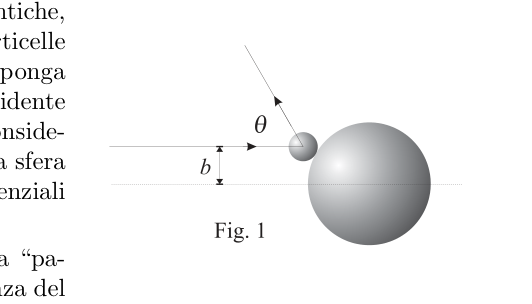
Topic: Newtonian Mechanics Metodi: Physical Modeling, Vector Decomposition, Conservation of Momentum Competenze: Mathematical Modeling, Diagrammatic Reasoning Objects: Sphere, Ball, Particle Beam Fonte: Testo (PDF) — p.1 Soluzione: Soluzioni (PDF)
- The relationship between and the angle is found, i.e. the function is found. The beam has a circular cross section whose radius is much greater than the radius of the particles and greater than the radius of the fixed sphere. Indicate the intensity of the beam, i.e. the number of particles, with which, in the unit of time, affect the unit of area perpendicular to the beam, and are assumed to be that is uniform and constant.
**p.1 ** Elastic diffusion: impact parameter and angle
Topic: Newtonian Mechanics Metodi: Physical Modeling, Vector Decomposition, Conservation of Momentum Competenze: Mathematical Modeling, Diagrammatic Reasoning Objects: Sphere, Ball, Particle Beam Fonte: Testo (PDF) — p.1 Soluzione: Soluzioni (PDF)
- Si trovi il numero di particelle diffuse, nell’unità di tempo, con un angolo compreso tra e . Per quale valore di la funzione ha il massimo? Si supponga ora di collocare un rivelatore, cioè un dispositivo che conta le palline in transito attraverso una certa superficie, ad una distanza dalla sfera fissa e ad un angolo rispetto al fascio incidente. Si supponga che l’area sensibile del rivelatore sia un quadrato che ovviamente viene disposto perpendicolarmente alla direzione da cui provengono le particelle diffuse. Il lato del quadrato, , sia molto maggiore dei raggi e e contemporaneamente molto minore di : . Si noti che nella figura 2 la scala è molto ridotta rispetto alla figura 1.
Topic: Newtonian Mechanics Metodi: Calculus-Integration, Physical Modeling, Symmetry Argument Competenze: Mathematical Modeling, Physical Reasoning Objects: Particle Beam Fonte: Testo (PDF) — p.1 Soluzione: Soluzioni (PDF)
- The number of diffuse particles in the unit of time is given at an angle between and . For what value of does the function have a maximum? Now suppose we put a detector, that is, a device Count balls in transit through a certain area, at a distance from the fixed sphere and at an angle from the I’m not sure. Assume that the sensing area of the detector is It’s a square that is obviously arranged perpendicular to the direction the particles are coming from. The side of the square, , is much larger than the radii and , and at the same time much less than : . Note that in Figure 2 the scale is very small compared to the figure 1.
Topic: Newtonian Mechanics Metodi: Calculus-Integration, Physical Modeling, Symmetry Argument Competenze: Mathematical Modeling, Physical Reasoning Objects: Particle Beam Fonte: Testo (PDF) — p.1 Soluzione: Soluzioni (PDF)
- Si calcoli il tasso di conteggi del rivelatore, , cioè il numero di conteggi nell’unità di tempo.
Topic: Newtonian Mechanics Metodi: Physical Modeling, Calculus-Integration Competenze: Mathematical Modeling, Physical Reasoning Objects: Particle Beam Fonte: Testo (PDF) — p.1 Soluzione: Soluzioni (PDF)
- The detector count rate, , i.e. the number of counts in the time unit, is calculated.
Topic: Newtonian Mechanics Metodi: Physical Modeling, Calculus-Integration Competenze: Mathematical Modeling, Physical Reasoning Objects: Particle Beam Fonte: Testo (PDF) — p.1 Soluzione: Soluzioni (PDF)
- In che modo il tasso di conteggi dipende dall’area della regione sensibile del rivelatore? Per quale angolo il tasso di conteggi ha il valore massimo? In che modo dipende da ?
p.1 — Fascio, rivelatore a distanza D
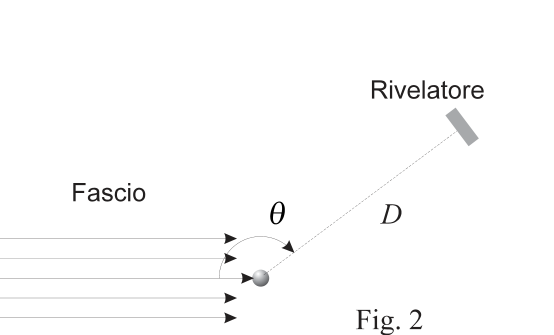
Topic: Newtonian Mechanics Metodi: Physical Modeling, Dimensional Analysis Competenze: Physical Reasoning, Mathematical Modeling Objects: Particle Beam Fonte: Testo (PDF) — p.1 Soluzione: Soluzioni (PDF)
- How does the count rate depend on the area of the detector’s sensitive region? For which angle The count rate is the maximum value? How does depend on ?
The following information shall be provided:
Topic: Newtonian Mechanics Metodi: Physical Modeling, Dimensional Analysis Competenze: Physical Reasoning, Mathematical Modeling Objects: Particle Beam Fonte: Testo (PDF) — p.1 Soluzione: Soluzioni (PDF)
- Si consideri un intervallo di tempo sufficientemente lungo perché sulla sfera fissa incida un numero molto grande di particelle. Qual è il valore medio della forza che le particelle esercitano sulla sfera?
Topic: Newtonian Mechanics, Thermodynamics Metodi: Conservation of Momentum, Free-Body Diagram, Experimental Data Analysis Competenze: Physical Reasoning, Experimental Data Analysis, Graph Linearization Objects: Sphere, Particle Beam Fonte: Testo (PDF) — p.1 Soluzione: Soluzioni (PDF)
- Consider a time interval long enough that a very large number is affected on the fixed sphere It’s a large particle. What is the average value of the force that particles exert on the sphere?
Topic: Newtonian Mechanics, Thermodynamics Metodi: Conservation of Momentum, Free-Body Diagram, Experimental Data Analysis Competenze: Physical Reasoning, Experimental Data Analysis, Graph Linearization Objects: Sphere, Particle Beam Fonte: Testo (PDF) — p.1 Soluzione: Soluzioni (PDF)
Equilibrio radiazione–materia. Punti 100.
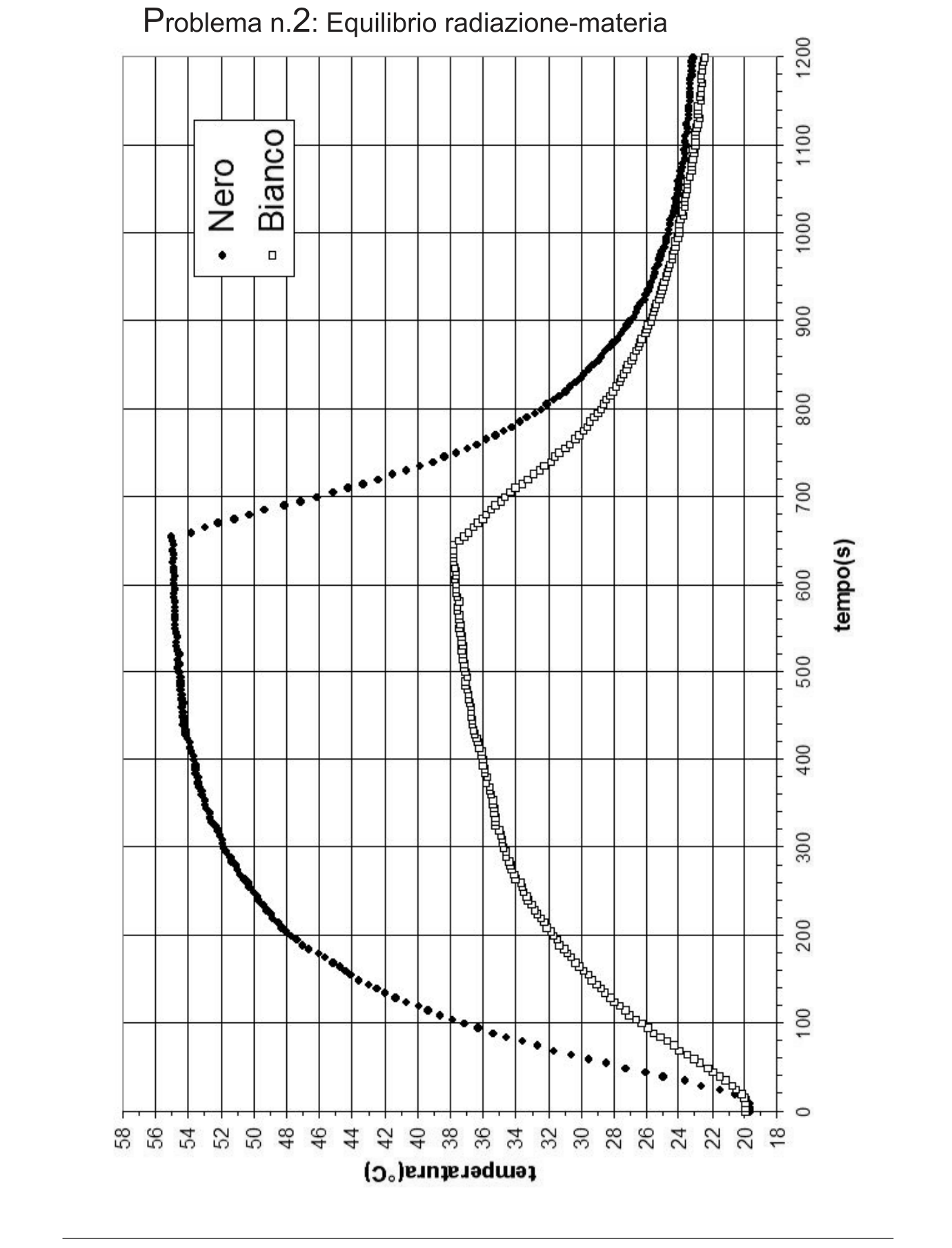
Vi sarà capitato sovente di osservare che un oggetto esposto al sole si scalda molto rapidamente soprattutto se è di colore scuro. Per indagare il fenomeno, è stato condotto il seguente semplice esperimento: – due barattoli cilindrici identici, con una sottile parete laterale metallica dipinta esternamente rispettivamente di vernice nera e bianca, erano esposti, in situazioni identiche di illuminazione, alla luce di una lampada a filamento incandescente che ne illuminava la superficie laterale; – le temperature venivano registrate ogni 5 s da un sensore termometrico, posto a contatto con la superficie interna di ciascun barattolo dal lato della parte illuminata; i dati venivano raccolti in tempo reale da un calcolatore attraverso una opportuna interfaccia; – dopo un certo tempo, quando le temperature dei due barattoli apparivano essersi circa stabilizzate, la lampada veniva spenta e allontanata, mentre continuava la registrazione online delle temperature fino a quando le temperature mostravano di essersi nuovamente stabilizzate. I risultati per i due barattoli sono mostrati nel grafico riprodotto nella pagina seguente.
- Si esamini attentamente, per ciascun barattolo, l’andamento della temperatura in funzione del tempo e si riportino sul foglio riassuntivo i valori rilevanti di temperatura e tempo, con una precisione rispettivamente di e 10 s. In particolare: – la temperatura ambiente, supposta uniforme, iniziale e quella finale , – la temperatura di equilibrio a lampada accesa , – le temperature di dimezzamento per entrambe le fasi, cioè la temperatura che sta a metà fra e , e la temperatura che sta a metà fra la temperatura al momento in cui inizia la fase di raffreddamento e . – i tempi di dimezzamento e corrispondenti che trascorrono finché la temperatura diventa quella di dimezzamento in ciascuna fase, a partire da quando la temperatura inizia effettivamente a salire o rispettivamente a scendere. Consideriamo dapprima la fase di raffreddamento. Per costruire un modello semplificato che permetta di interpretare l’andamento della temperatura, si tenga conto solo degli scambi di energia per conduzione verso il tavolo su cui appoggia il barattolo e di quelli per irraggiamento, mentre, per semplificare il modello, si trascuri la convezione. Per l’irraggiamento, occorre tener conto che il barattolo emette energia per irraggiamento alla temperatura , ma, allo stesso tempo, assorbe energia irradiata dall’ambiente alla temperatura . In principio, l’emissione di radiazione segue la legge di Stefan-Boltzmann secondo la quale la potenza emessa dipende da , dove è la temperatura assoluta del corpo che irradia, per cui il bilancio fra l’energia emessa e quella assorbita per irraggiamento è proporzionale a , dato che il coefficiente di proporzionalità è uguale per l’emissione e per l’assorbimento. Tenendo però conto della piccola differenza fra la temperatura dei barattoli e la temperatura dell’ambiente, nel modello si può scrivere una semplice proporzionalità da anziché da .
Topic: Thermodynamics, Conservation of Energy Metodi: Experimental Data Analysis, First Law of Thermodynamics, Approximation & Series Expansion Competenze: Experimental Data Analysis, Graph Linearization, Physical Reasoning Objects: Cylinder Fonte: Testo (PDF) — p.2 Soluzione: Soluzioni (PDF)
The radiation balance of matter. 100 points.
You may have often noticed that an object exposed to the sun warms up very quickly, especially if it is exposed to the sun. It’s dark in color. To investigate the phenomenon, the following simple experiment was conducted: two identical cylindrical jars, with a thin metallic side wall painted outwardly in black and white paint respectively, were exposed, in identical lighting situations, to a light of a a filament lamp illuminating its side surface; Temperatures were recorded every 5 seconds by a thermometer sensor, placed in contact with the surface The data were collected in real time from a the calculator through an appropriate interface; after some time, when the temperatures of the two bottles appeared to have stabilized, the The lamp was turned off and turned off while the online temperature recording continued until When the temperatures showed to be back to normal. The results for the two bottles are shown in the graph shown on the following page.
- The temperature changes with time for each bottle are carefully examined and the record on the summary sheet the relevant temperature and time values, with precision, respectively di e 10 s. In particular: the ambient temperature, assumed uniform, initial and final , the equilibrium temperature of the light bulb on , the half-life temperatures for both phases, i.e. the temperature which is halfway between and , and the temperature that is halfway between the temperature at the time the cooling phase begins e . the corresponding and halving times that pass until the temperature becomes that The temperature shall be reduced by half at each stage, starting from the moment when the temperature actually starts to rise or and then down. Let us consider the cooling phase first. To build a simplified model that allows The energy exchange rate for the energy supply is the same as for the energy supply. Table on which the bottle rests and irradiation table, while, to simplify the design, the ignition table The convection. For irradiation, it must be borne in mind that the barrel emits energy for irradiation to the The temperature , but at the same time absorbs the energy radiated from the environment at . In The principle of radiation emission follows Stefan-Boltzmann’s law, according to which the power emitted by the depends on , where is the absolute temperature of the radiating body, so the balance between the energy emitted and that absorbed by irradiation is proportional to , since the coefficient of proportionality It is the same for emission and absorption. However, given the small difference in temperature, dei barattoli e la temperatura dell’ambiente, nel modello si può scrivere una semplice proporzionalità da instead of .
Topic: Thermodynamics, Conservation of Energy Metodi: Experimental Data Analysis, First Law of Thermodynamics, Approximation & Series Expansion Competenze: Experimental Data Analysis, Graph Linearization, Physical Reasoning Objects: Cylinder Fonte: Testo (PDF) — p.2 Soluzione: Soluzioni (PDF)
- Si scriva pertanto un’espressione dello scambio complessivo di energia nell’unità di tempo e, introducendo opportuni coefficienti di proporzionalità per la conduzione e per l’irraggiamento, della corrispondente variazione di temperatura. Si definiscano chiaramente i coefficienti introdotti e si ricavi l’espressione della funzione che descrive l’andamento della temperatura nel tempo, a partire dall’istante in cui inizia il raffreddamento. Può essere utile ricordare che . Per chiarezza si prega di indicare con la lettera il coefficiente relativo alla conduzione e con la lettera quello per l’irraggiamento.
Topic: Thermodynamics, Conservation of Energy Metodi: First Law of Thermodynamics, Differential Equations, Approximation & Series Expansion Competenze: Mathematical Modeling, Physical Reasoning Objects: Cylinder Fonte: Testo (PDF) — p.2 Soluzione: Soluzioni (PDF)
- The total energy exchange in the unit of time is therefore expressed and, by introducing appropriate coefficients of proportionality for conduction and irradiation, the corresponding energy exchange is expressed as a percentage of the total energy exchange in the unit of time. the temperature change. The coefficients introduced are clearly defined and the expression of the function describing the temperature trend over time is obtained from the moment the temperature starts to rise. cooling. It may be helpful to remember that . For clarity, please indicate the driving coefficient under and under The radiation one.
Topic: Thermodynamics, Conservation of Energy Metodi: First Law of Thermodynamics, Differential Equations, Approximation & Series Expansion Competenze: Mathematical Modeling, Physical Reasoning Objects: Cylinder Fonte: Testo (PDF) — p.2 Soluzione: Soluzioni (PDF)
- Si scriva il rapporto fra i valori del tempo di dimezzamento dei due barattoli in termini dei coefficienti rispettivamente introdotti per la conduzione e l’irraggiamento, e se ne dia il valore numerico. Qui e nel seguito, si prega di usare il pedice B nei simboli che riguardano il barattolo bianco e il pedice N per quello nero. Si consideri ora la fase di riscaldamento costruendo un analogo modello in cui si introduca un termine aggiuntivo per descrivere la potenza assorbita dalla radiazione proveniente dalla lampada.
Topic: Thermodynamics, Conservation of Energy Metodi: First Law of Thermodynamics, Experimental Data Analysis, Physical Modeling Competenze: Mathematical Modeling, Experimental Data Analysis, Physical Reasoning Objects: Cylinder Fonte: Testo (PDF) — p.2 Soluzione: Soluzioni (PDF)
- Write down the ratio of the half-life values of the two barrels in terms of coefficients The values for the values for the values for the values for the values for the values for the values for the values for the values for the values for the values for the values for the values for the values for the values for the values for the values for the values for the values for the values for the values for the values for the values for the values for the values for the values for the values for the values for the values for the values for the values for the values for the values for the values for the values for the values for the values for the values for the values for the values for the values for the values for the values for the values for the values for the values for the values for the values for the values for the values for the values for the values for the values for the values for the values for the values for the values for the values for the values for the values for the values for the values for the values for the values for the values for the values for the values for the values for the values for the values for the values for the values for the values for the values for the values for the values for the values for the values for the values for the values for the values for the values for the values for the values for the values for the values for the values for the values for the values for the values for the values for the values for the values for the values for the values for the values for the values for the values for the values for the values for the values for the values for the first and for the values for the years for the years for the years for the years for the years for the years for the years for the years for each are to bearing. Here and below, please use the B-barrel in the symbols for the white jar and the N-barrel For the black one. Consider the heating phase by constructing an analogue model in which an additional term is introduced to describe the power absorbed by the radiation from the lamp.
Topic: Thermodynamics, Conservation of Energy Metodi: First Law of Thermodynamics, Experimental Data Analysis, Physical Modeling Competenze: Mathematical Modeling, Experimental Data Analysis, Physical Reasoning Objects: Cylinder Fonte: Testo (PDF) — p.2 Soluzione: Soluzioni (PDF)
- Si scriva l’espressione dello scambio complessivo di energia nell’unità di tempo e della corrispondente variazione di temperatura. Si esprima la temperatura di equilibrio in funzione dei coefficienti introdotti al punto 2 e del termine dovuto all’assorbimento dell’energia irradiata dalla lampada, definito attraverso un opportuno coefficiente di assorbimento di tale energia.
Topic: Thermodynamics, Conservation of Energy Metodi: First Law of Thermodynamics, Differential Equations, Physical Modeling Competenze: Mathematical Modeling, Physical Reasoning Objects: Container Fonte: Testo (PDF) — p.4 Soluzione: Soluzioni (PDF)
- The total energy exchange in the unit of time and the corresponding temperature change are recorded. The equilibrium temperature is expressed as a function of the coefficients introduced at the The term ‘lighting energy’ is defined in paragraph 2 of this Article as the energy absorbed by the lamp by means of a appropriate coefficient of absorption of such energy.
Topic: Thermodynamics, Conservation of Energy Metodi: First Law of Thermodynamics, Differential Equations, Physical Modeling Competenze: Mathematical Modeling, Physical Reasoning Objects: Container Fonte: Testo (PDF) — p.4 Soluzione: Soluzioni (PDF)
- Utilizzando i dati estratti dal grafico e i rapporti calcolati fra i vari coefficienti introdotti, si stimi il rapporto fra i coefficienti di assorbimento della radiazione nel barattolo nero e in quello bianco. Ricordando che, per uno stesso corpo, i coefficienti di assorbimento sono uguali a quelli di emissione della radiazione, si stimi, in ciascun barattolo, il rapporto fra l’energia persa per conduzione e quella persa per irraggiamento.
Galleggiamento in campo magnetico. Punti 100.
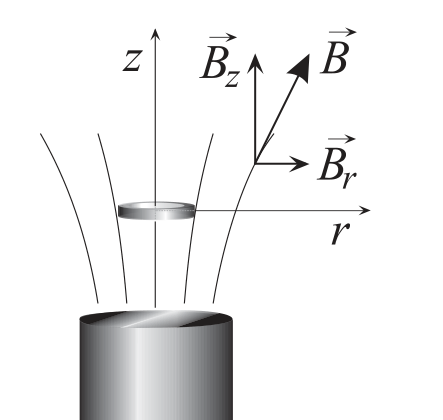
Un piccolo anello conduttore pesante, di massa , raggio e spessore trascurabile, viene posto in una regione di campo magnetico simmetrico, cioè invariante per rotazioni, rispetto ad un asse verticale. Sia questo l’asse orientato con il verso positivo in alto, cioè opposto a quello di , come mostrato in figura, nella quale è rappresentato anche il campo con le sue componenti radiale ed assiale, che, almeno in una regione finita intorno all’origine delle coordinate, possono essere approssimate in questo modo dove , e sono opportune costanti positive.
p.3 — Temperatura barattoli nero e bianco nel tempo
Topic: Thermodynamics, Conservation of Energy Metodi: Experimental Data Analysis, Physical Modeling, Approximation & Series Expansion Competenze: Experimental Data Analysis, Mathematical Modeling, Physical Reasoning Objects: Container, Coil Fonte: Testo (PDF) — p.4 Soluzione: Soluzioni (PDF)
- Using the graph data and the calculated ratios between the various coefficients introduced, the ratio is estimated between the radiation absorption coefficients in the black and white bottle. Recalling that, for The absorption coefficients are equal to those of radiation emission, you estimate, In each bottle, the ratio of energy lost by conduction to that lost by irradiation.
Floating in the magnetic field. 100 points.
A small heavy conductive ring, of mass, radius and thickness It’s placed in a symmetrical magnetic field region. That is, it is rotationally invariant with respect to a vertical axis. Whether this axis is oriented with the positive side upwards, i.e. opposite to , as shown in Figure 1, where the field with its radial and axial components, which, at least in a finite region around the origin of the coordinates, can be approximated This way where , and are appropriate positive constants.
**p.3 ** Temperature of black and white jars over time
Topic: Thermodynamics, Conservation of Energy Metodi: Experimental Data Analysis, Physical Modeling, Approximation & Series Expansion Competenze: Experimental Data Analysis, Mathematical Modeling, Physical Reasoning Objects: Container, Coil Fonte: Testo (PDF) — p.4 Soluzione: Soluzioni (PDF)
- Affinché possa esistere un campo così fatto, le costanti e devono essere legate da una relazione: si determini tale relazione. L’anello viene posto nel campo con il suo asse coincidente con l’asse di simmetria e, lasciato libero di muoversi, può traslare solo lungo l’asse . All’istante l’anello viene lasciato da fermo in posizione e per effetto del suo peso inizia a muoversi verso il basso. Si deve supporre che il moto si svolga tutto nella regione in cui il campo magnetico è descritto dalle equazioni mostrate sopra. Non appena l’anello si muove il flusso del campo , concatenato con l’anello, varia; dette ed la resistenza e l’induttanza (coefficiente di autoinduzione) dell’anello, questo può essere descritto come un circuito alimentato dalla f.e.m. indotta.
p.4 — Anello e magnete con campo magnetico
Topic: Magnetism, Electromagnetic Induction Metodi: Gauss’s Law, Symmetry Argument, Faraday’s Law of Induction Competenze: Mathematical Modeling, Physical Reasoning Objects: Coil Fonte: Testo (PDF) — p.4 Soluzione: Soluzioni (PDF)
- In order for a field to exist in this way, the constants and must be The Commission has already decided to adopt a proposal for a directive on the protection of workers’ rights. The ring is placed in the field with its axis coinciding with the symmetry axis and, left free of If the vehicle is moving, it can only move along the axis. All’istante l’anello viene lasciato da fermo in posizione And as a result of its weight, it starts to move downward. The motorcycle must be assumed to be running in the region where the magnetic field is described by the equations shown above. Non appena l’anello si muove il flusso del campo , concatenato con l’anello, varia; dette ed la The resistance and inductance (self-induction coefficient) of the ring, this can be described as a circuit powered by the f.e.m. It’s induced.
**p.4 ** Magnetic magnet ring and ring
Topic: Magnetism, Electromagnetic Induction Metodi: Gauss’s Law, Symmetry Argument, Faraday’s Law of Induction Competenze: Mathematical Modeling, Physical Reasoning Objects: Coil Fonte: Testo (PDF) — p.4 Soluzione: Soluzioni (PDF)
- Si scriva l’equazione del circuito, in termini della corrente che scorre nell’anello e della velocità dell’anello . Si consideri, d’ora in poi, che sia completamente trascurabile e quindi si ponga direttamente , come avverrebbe per un anello superconduttore. L’anello viene tenuto fermo in posizione e in esso non scorre corrente; appena l’anello viene lasciato libero inizia a muoversi e la corrente inizia a scorrere nell’anello determinando, in presenza del campo , una forza non nulla sull’anello.
Topic: Electromagnetic Induction, Circuits Metodi: Faraday’s Law of Induction, Kirchhoff’s Laws, Differential Equations Competenze: Mathematical Modeling, Diagrammatic Reasoning Objects: Coil Fonte: Testo (PDF) — p.4 Soluzione: Soluzioni (PDF)
- The circuit equation is written in terms of the current flowing in the ring and the speed of the ring. Consider, henceforth, that is completely negligible and therefore is directly placed, Like you would with a superconducting ring. The ring shall be kept stationary in the position and shall not be current flows; as soon as the ring is left free it starts moving and the current starts flowing into the ring determining, in the presence of the field, a non-zero force on the ring.
Topic: Electromagnetic Induction, Circuits Metodi: Faraday’s Law of Induction, Kirchhoff’s Laws, Differential Equations Competenze: Mathematical Modeling, Diagrammatic Reasoning Objects: Coil Fonte: Testo (PDF) — p.4 Soluzione: Soluzioni (PDF)
- Si dimostri che il flusso magnetico totale attraverso l’anello è costante.
Topic: Electromagnetic Induction, Magnetism Metodi: Faraday’s Law of Induction, Conservation Laws, Symmetry Argument Competenze: Mathematical Modeling, Physical Reasoning Objects: Coil Fonte: Testo (PDF) — p.4 Soluzione: Soluzioni (PDF)
- It is shown that the total magnetic flux through the ring is constant.
Topic: Electromagnetic Induction, Magnetism Metodi: Faraday’s Law of Induction, Conservation Laws, Symmetry Argument Competenze: Mathematical Modeling, Physical Reasoning Objects: Coil Fonte: Testo (PDF) — p.4 Soluzione: Soluzioni (PDF)
- Si mostri che la corrente che circola nell’anello, mentre questo si muove, è proporzionale alla coordinata che dà la posizione istantanea dell’anello.
Topic: Electromagnetic Induction, Circuits Metodi: Faraday’s Law of Induction, Kirchhoff’s Laws, Physical Modeling Competenze: Mathematical Modeling, Physical Reasoning Objects: Coil Fonte: Testo (PDF) — p.4 Soluzione: Soluzioni (PDF)
- The current circulating in the ring, as it moves, is proportional to the coordinate giving the instantaneous position of the ring.
Topic: Electromagnetic Induction, Circuits Metodi: Faraday’s Law of Induction, Kirchhoff’s Laws, Physical Modeling Competenze: Mathematical Modeling, Physical Reasoning Objects: Coil Fonte: Testo (PDF) — p.4 Soluzione: Soluzioni (PDF)
- Si calcoli la forza magnetica agente sull’anello, in funzione della sua posizione , si mostri che l’equazione di moto dell’anello è quella di un oscillatore armonico, e se ne determini il periodo.
Topic: Electromagnetic Induction, Oscillations & Waves, Newtonian Mechanics Metodi: Lorentz Force Analysis, Free-Body Diagram, Simple Harmonic Motion Analysis Competenze: Mathematical Modeling, Physical Reasoning Objects: Coil Fonte: Testo (PDF) — p.4 Soluzione: Soluzioni (PDF)
- If the magnetic force of the agent on the ring is calculated, based on its position , the equation is shown that The speed of the ring is that of a harmonic oscillator, and its period is determined.
Topic: Electromagnetic Induction, Oscillations & Waves, Newtonian Mechanics Metodi: Lorentz Force Analysis, Free-Body Diagram, Simple Harmonic Motion Analysis Competenze: Mathematical Modeling, Physical Reasoning Objects: Coil Fonte: Testo (PDF) — p.4 Soluzione: Soluzioni (PDF)
- Si determini la legge oraria che descrive il moto seguito dall’anello, dall’istante in cui l’anello viene lasciato da fermo in .
Topic: Oscillations & Waves, Electromagnetic Induction Metodi: Simple Harmonic Motion Analysis, Differential Equations, Conservation Laws Competenze: Mathematical Modeling, Physical Reasoning Objects: Coil Fonte: Testo (PDF) — p.4 Soluzione: Soluzioni (PDF)
- The time law describing the motion followed by the ring is determined as soon as the ring is left unchanged in .
Topic: Oscillations & Waves, Electromagnetic Induction Metodi: Simple Harmonic Motion Analysis, Differential Equations, Conservation Laws Competenze: Mathematical Modeling, Physical Reasoning Objects: Coil Fonte: Testo (PDF) — p.4 Soluzione: Soluzioni (PDF)
- Si trovi il valore massimo del modulo della corrente che circola nell’anello e si determini la posizione dell’anello quando si raggiunge tale massimo.
Alcune Costanti Fisiche ()
| COSTANTE | SIMBOLO | VALORE | UNITÀ |
|---|---|---|---|
| Velocità della luce nel vuoto | |||
| Carica elementare | C | ||
| Massa dell’elettrone | kg | ||
| Costante dielettrica del vuoto | |||
| Permeabilità magnetica del vuoto | |||
| Massa del protone | kg | ||
| Costante di Planck | J s | ||
| Costante universale dei gas | 8.31 | ||
| Numero di Avogadro | |||
| Costante di Boltzmann | |||
| Costante di Faraday | |||
| Costante di Stefan–Boltzmann | |||
| Costante gravitazionale | |||
| Pressione atmosferica standard | Pa | ||
| Temperatura standard () | 273 | K | |
| Volume molare di un gas perfetto in condizioni standard () | |||
| Unità di massa atomica | kg |
Altri dati che possono essere necessari ()
| SIMBOLO | VALORE | UNITÀ | |
|---|---|---|---|
| Accelerazione media di gravità | 9.81 | ||
| Densità dell’acqua | |||
| Calore specifico dell’acqua | |||
| Calore di fusione dell’acqua | |||
| Calore di vaporizzazione dell’acqua (a ) | |||
| Calore specifico del ghiaccio (a ) |
() Valori arrotondati, con errore relativo minore di
NOTA BENE È possibile utilizzare, riprodurre, distribuire, comunicare al pubblico questo materiale alle due seguenti condizioni: citare la fonte; non usare il materiale, nemmeno parzialmente, per fini commerciali.
Topic: Oscillations & Waves, Electromagnetic Induction Metodi: Simple Harmonic Motion Analysis, Calculus-Integration, Physical Modeling Competenze: Mathematical Modeling, Physical Reasoning Objects: Coil Fonte: Testo (PDF) — p.4 Soluzione: Soluzioni (PDF)
- Find the maximum value of the current module circulating in the ring and determine the position The ring when it reaches that peak.
Alcune Costanti Fisiche ()
♪ And I’m going to tell you ♪ | --- | --- | --- | --- | | Velocità della luce nel vuoto | | | | | Carica elementare | | | C | | Massa dell’elettrone | | | kg | | | | | | | Costante dielettrica del vuoto | | | | | Permeabilità magnetica del vuoto | | | | | Massa del protone | | | kg | | | | | | | Costante di Planck | | | J s | | Costante universale dei gas | | 8.31 | | | Numero di Avogadro | | | | | Costante di Boltzmann | | | | | Costante di Faraday | | | | | Costante di Stefan–Boltzmann | | | | | Costante gravitazionale | | | | | Pressione atmosferica standard | | | Pa | | Temperatura standard () | | 273 | K | | Volume molare di un gas perfetto in condizioni standard () | | | | | Unità di massa atomica | | | kg |
Other data that may be required ()
♪ And I’m going to be a big fan of the show ♪ | --- | --- | --- | --- | | Accelerazione media di gravità | | 9.81 | | | Densità dell’acqua | | | | | Calore specifico dell’acqua | | | | | Calore di fusione dell’acqua | | | | | Calore di vaporizzazione dell’acqua (a ) | | | | | Calore specifico del ghiaccio (a ) | | | |
() Rounded values with relative error less than
Good note . You can use, reproduce, distribute, communicate this material to the public at two o’clock the following conditions: to cite the source; not to use the material, even partially, for any purpose The Commission has already adopted a proposal.
Topic: Oscillations & Waves, Electromagnetic Induction Metodi: Simple Harmonic Motion Analysis, Calculus-Integration, Physical Modeling Competenze: Mathematical Modeling, Physical Reasoning Objects: Coil Fonte: Testo (PDF) — p.4 Soluzione: Soluzioni (PDF)