Un «velo» viscoso
La viscosità è una proprietà che quantifica la resistenza dei fluidi allo scorrimento relativo di uno strato di fluido sull’altro. Il coefficiente di viscosità dinamico (nel seguito semplicemente «viscosità») è definito considerando la forza che occorre applicare ad uno strato di fluido per farlo scorrere ad una velocità diversa rispetto ad un altro strato, adiacente al primo, posto ad una distanza , ovvero
dove è la forza applicata, la differenza di velocità tra i due strati e la porzione considerata di superficie di contatto tra i due strati.
Per un’ampia classe di liquidi, la viscosità è indipendente sia dal rapporto (chiamato sforzo di taglio) sia dal rapporto (gradiente di velocità): questi liquidi vengono chiamati liquidi newtoniani. In questi, la viscosità diminuisce all’aumentare della temperatura secondo la relazione di Arrhenius
dove è una costante legata al peso molecolare e al volume molare del liquido, è una costante caratteristica del liquido chiamata energia di attivazione ed è riferita a una mole, la costante dei gas e la temperatura assoluta.
I dati in tabella riportano l’andamento della viscosità del mercurio in funzione della temperatura:
| Temperatura (°C) | Viscosità ( Pa s) |
|---|---|
| 0 | 1.681 |
| 10 | 1.621 |
| 20 | 1.552 |
| 30 | 1.499 |
| 40 | 1.450 |
| 50 | 1.407 |
| 60 | 1.367 |
| 70 | 1.327 |
| 100 | 1.232 |
1. Si vogliono determinare i valori delle costanti ed per il mercurio. A tale scopo, sul foglio di carta millimetrata, si tracci un grafico utilizzando i dati riportati nella tabella, dopo aver scelto nel modo più opportuno le grandezze da riportare sui due assi. Da tale grafico si ricavino i valori richiesti.
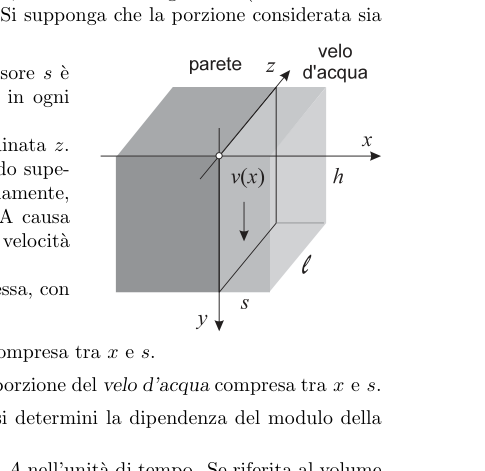
Si vuole studiare la velocità di un liquido newtoniano, di densità , che sotto l’azione della forza di gravità scorre su una parete verticale, formando un cosiddetto velo d’acqua di piccolo spessore . La natura del fluido è irrilevante. A tal fine si consideri una certa quantità di questo fluido, di altezza e larghezza (come mostrato in figura) molto minori dell’altezza e della larghezza della parete. Si supponga che la porzione considerata sia sufficientemente lontana dai bordi della parete.
In condizioni di regime, il flusso è stazionario e, se lo spessore è piccolo, anche laminare. Di conseguenza, il vettore velocità è in ogni punto del velo d’acqua sempre parallelo all’asse . Per uniformità, la velocità del fluido non dipende dalla coordinata . Inoltre, essendo la porzione di liquido considerata lontana dal bordo superiore della parete, la velocità risulta indipendente anche da . Ovviamente, però, la velocità dipende dalla distanza dalla parete: . A causa delle forze di adesione tra liquido e parete, si può assumere che la velocità dell’acqua a contatto con la parete sia nulla: .
Si consideri un piano parallelo alla parete, a distanza da essa, con .
2. Si ricavi la forza peso agente sulla porzione del velo d’acqua compresa tra e .
3. Si ricavi la forza d’attrito viscoso agente lungo il piano sulla porzione del velo d’acqua compresa tra e .
4. Dalla considerazione che ci si trova in condizione di regime, si determini la dipendenza del modulo della velocità dalla distanza dalla parete.
La portata è la quantità di fluido che attraversa una sezione di area nell’unità di tempo. Se riferita al volume viene detta portata volumetrica.
5. Si ricavi la portata volumetrica del velo d’acqua, relativamente alla porzione considerata.
Figura (dal testo)
Topic: Fluid Mechanics, Thermodynamics Metodi: Graph Linearization, Free-Body Diagram, Differential Equations Competenze: Graph Linearization, Mathematical Modeling Objects: — Fonte: Testo (PDF) — p.1 Soluzione: Soluzioni (PDF)
**A viscous fluid **
Viscosity is a property that quantifies the resistance of fluids to the relative flow of one layer of fluid over another. The dynamic viscosity coefficient (hereinafter simply viscosity) is defined by taking into account the force to be applied to a layer of fluid to move at a different speed than another layer adjacent to the first layer, at a distance , i.e.
where is the applied force, the difference in speed between the two layers and the portion of contact surface considered between the two layers.
For a wide class of liquids, viscosity is independent of both the ratio (called cutting effort) and the ratio (speed gradient): these liquids are called Newtonian liquids. In these, viscosity decreases with temperature rise according to Arrhenius’s report
where is a constant related to the molecular weight and molar volume of the liquid, is a constant characteristic of the liquid called activation energy and is related to a mole, the gas constant and the absolute temperature.
The data in the table show the temperature-related trend of mercury viscosity:
| Temperatura (°C) | Viscosità ( Pa s) |
|---|---|
| 0 | 1.681 |
| 10 | 1.621 |
| 20 | 1.552 |
| 30 | 1.499 |
| 40 | 1.450 |
| 50 | 1.407 |
| 60 | 1.367 |
| 70 | 1.327 |
| 100 | 1.232 |
1. Si vogliono determinare i valori delle costanti ed per il mercurio. For this purpose, a graph shall be drawn on the millimeter sheet of paper using the data in the table, after choosing the most appropriate size to be shown on the two axes. The values required are derived from this graph.
The aim is to study the velocity of a Newtonian fluid, density , which under the action of gravity flows over a vertical wall, forming a so-called water wave of small thickness . The nature of the fluid is irrelevant. For this purpose, a certain amount of this fluid, of height and width (as shown in Figure) is considered to be much smaller than the height and width of the wall. Assume that the portion in question is sufficiently far from the edges of the wall.
Under normal conditions, the flow is stationary and, if the thickness is small, also laminar. The speed vector is therefore at each point of the water veil always parallel to the axis. For uniformity, the fluid speed does not depend on the coordinate. In addition, since the portion of liquid is considered to be far from the upper edge of the wall, the speed is also independent of . Of course, however, the speed depends on the distance from the wall: . Due to the adhesion forces between the liquid and the wall, the water velocity in contact with the wall can be assumed to be zero: .
Consider a plane parallel to the wall, at a distance from it, with .
2. The force agent is obtained on the portion of the water veil between and .
3. Si ricavi la forza d’attrito viscoso agente lungo il piano sulla porzione del velo d’acqua compresa tra e .
4. Dalla considerazione che ci si trova in condizione di regime, si determini la dipendenza del modulo della velocità dalla distanza dalla parete.
The flow rate is the amount of fluid that passes through a section of area in the unit of time. When the volume is referred to, it is called volume range.
5. Si ricavi la portata volumetrica del velo d’acqua, relativamente alla porzione considerata.
**Figure (from the text) **
Topic: Fluid Mechanics, Thermodynamics Metodi: Graph Linearization, Free-Body Diagram, Differential Equations Competenze: Graph Linearization, Mathematical Modeling Objects: — Fonte: Testo (PDF) — p.1 Soluzione: Soluzioni (PDF)
L’attrazione dell’induzione elettrostatica
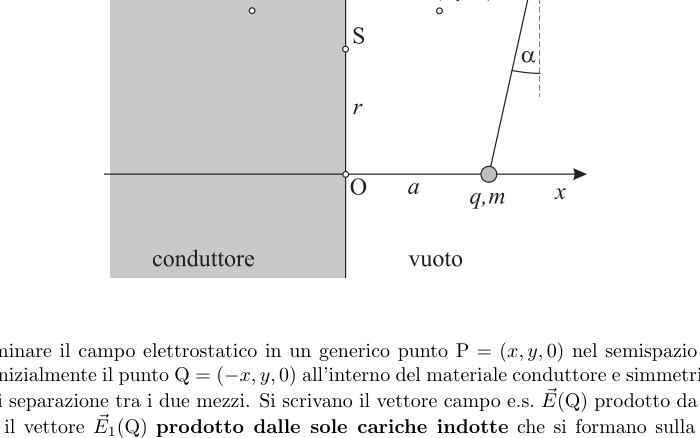
Una sferetta di massa possiede una carica ed è appesa ad un lungo filo. Se si dispone la sferetta vicino ad una lastra conduttrice scarica, si osserva che la sferetta viene attratta dalla lastra; questo accade perché, per induzione, sulla superficie della lastra si forma una distribuzione di cariche di segno opposto a . Si supponga che, all’equilibrio, la sferetta si trovi ad una distanza dalla lastra e che il filo formi un angolo con la verticale.
Rispetto alla distanza tra carica e lastra le dimensioni della sferetta sono molto piccole cosicché la carica può essere sempre considerata puntiforme; inoltre le dimensioni della lastra, molto maggiori di , possono essere considerate infinite. Si può quindi considerare un piano (di equazione ) come superficie di separazione tra un mezzo conduttore nel semispazio e il vuoto nel semispazio , entro cui si trova la sferetta. Nella figura è indicato anche il sistema di coordinate consigliato, in modo che la sferetta si trovi sull’asse , quindi nel punto di coordinate , che l’asse sia verticale e orientato verso l’alto e l’asse perpendicolare al piano della figura ed uscente.
Relativamente alla distribuzione delle cariche indotte, sarà sufficiente studiare la situazione lungo l’asse . Infatti, per simmetria, la densità di carica, , dipenderà solo dalla distanza del punto considerato dall’origine ().
1. Per determinare il campo elettrostatico in un generico punto nel semispazio vuoto si consideri inizialmente il punto all’interno del materiale conduttore e simmetrico di rispetto al piano di separazione tra i due mezzi. Si scrivano il vettore campo e.s. prodotto da tutte le cariche presenti e il vettore prodotto dalle sole cariche indotte che si formano sulla superficie della lastra (piano ). Qui — e nel seguito — si esprimano i vettori usando la notazione coi versori o per componenti.
2. Si scriva adesso il campo e.s. (prodotto dalle sole cariche indotte presenti sulla superficie della lastra) nel punto nel semispazio , mostrando che, limitatamente a questo semispazio, il campo è identico a quello generato da una singola carica puntiforme di cui si chiede il valore e la posizione.
3. A titolo d’esempio, si scriva il campo e.s. (totale) , nel punto .
4. Si scriva il campo e.s. (totale) , in prossimità del punto nel semispazio vuoto, cioè in un punto vicinissimo alla superficie della lastra, a distanza dall’origine ; in altri termini, il limite dell’espressione del campo per , , .
5. Si calcoli la densità di carica indotta nel punto e si dica quanto vale nel punto della superficie della lastra dove il suo modulo è massimo.
6. Si calcoli il valore della carica in funzione di , ed .
7. Si calcoli la quantità totale di carica indotta sul piano conduttore.
Figura (dal testo)
Topic: Electrostatics, Newtonian Mechanics Metodi: Coulomb’s Law, Electric Potential Method, Symmetry Argument, Gauss’s Law Competenze: Mathematical Modeling, Physical Reasoning Objects: Point Charge, String Fonte: Testo (PDF) — p.2 Soluzione: Soluzioni (PDF)
The following conditions shall apply:
A sphere of mass has a charge and is suspended from a long string. If the sphere is placed near a discharged conductive plate, it is observed that the sphere is attracted by the plate; this happens because, by induction, a distribution of sign loads opposite to is formed on the surface of the plate. Assume that, in equilibrium, the sphere is from the plate and that the wire forms an angle with the vertical.
Compared to the distance between load and plate the dimensions of the sphere are very small so that the load can always be considered pointy; furthermore, the dimensions of the plate, much larger than , can be considered infinite. A plane (of equation ) can therefore be considered as the separation surface between a conductive medium in the semispace and the vacuum in the semispace within which the sphere is located. The figure also indicates the recommended coordinate system, so that the sphere is on the axis, and then at the coordinate point, the axis being vertical and upward oriented and the axis perpendicular to the plane of the figure and outward.
For the distribution of induced loads, it will suffice to study the situation along the axis. In fact, by symmetry, the load density, , will depend only on the distance from the point considered from the source ().
1. To determine the electrostatic field at a generic point in the empty semispace , the point within the conductive material shall be considered initially as and asymmetrical with respect to the separation plane between the two means. They write the field vector e.s. produced by all the loads present and the carrier produced by the only induced loads forming on the plate surface (plan ). Here and in the following the vectors are expressed using the notation with vertices or for components.
2. Write the field e.s. now. (produced by the induced charge alone on the surface of the plate) at in the semispace, showing that, only at this semispace, the field is identical to that generated by a single point-shaped charge of which the value and position are requested.
3. For example, write the field e.s. (total) , in the heading.
4. Write the field e.s. (total) , in the vicinity of the point in the half-space, i.e. at a point very close to the surface of the plate, at a distance from the source ; in other words, the field expression limit for , , .
The induced charge density is calculated at and the value is stated at the point on the surface of the plate where its modulus is maximum.
The value of the load shall be calculated as a function of , and .
The total amount of induced charge on the conductive plane shall be calculated.
**Figure (from the text) **
Topic: Electrostatics, Newtonian Mechanics Metodi: Coulomb’s Law, Electric Potential Method, Symmetry Argument, Gauss’s Law Competenze: Mathematical Modeling, Physical Reasoning Objects: Point Charge, String Fonte: Testo (PDF) — p.2 Soluzione: Soluzioni (PDF)
Pressione di radiazione con moto elicoidale
In questo problema si studiano, in modo molto semplificato, gli effetti meccanici dell’interazione fra radiazione e materia.
Una sferetta microscopica omogenea di raggio e massa è costituita di un materiale perfettamente assorbente (corpo nero) e con un’alta conducibilità termica. Essa ha la stessa temperatura dell’ambiente circostante, pari a , e la sua capacità termica è . La sferetta è circondata dal vuoto, è libera di muoversi ma all’istante iniziale si trova in quiete istantanea nel sistema di riferimento del laboratorio, cioè ha velocità e velocità angolare nulle. A partire dall’istante iniziale essa è illuminata da un fascio di radiazione proveniente da un laser a , collimato (cioè parallelo e di intensità uniforme) e di sezione circolare di diametro , in modo da investire tutta la sferetta. Il fascio di radiazione è rivolto verticalmente dal basso verso l’alto e quindi la pressione di radiazione esercita sulla sferetta una forza che si oppone al suo peso. La radiazione emessa ha potenza costante (a partire dall’istante iniziale) ed ha lunghezza d’onda . Assorbendo la radiazione la sferetta subisce una spinta verso l’alto e per effetto del suo peso e di questa spinta essa inizia a muoversi in verticale.
Si trovi:
1. la potenza irradiata dalla sferetta verso l’ambiente e quella proveniente dall’ambiente assorbita dalla sferetta prima dell’inizio dell’irraggiamento;
2. la potenza assorbita dalla sferetta da parte del fascio laser; si calcoli il rapporto fra questa potenza e quella irradiata, immediatamente dopo l’inizio dell’irraggiamento;
3. dopo quanto tempo, , la sferetta raggiunge la temperatura di ; si tenga presente che l’energia associata al moto della sferetta è completamente trascurabile rispetto a quella assorbita dal fascio;
4. l’accelerazione della sferetta lungo la direzione verticale dopo l’inizio dell’irraggiamento, specificando se essa è rivolta verso l’alto o verso il basso.
La radiazione inoltre è completamente polarizzata circolarmente in verso destrorso, il che significa che il momento angolare di tutti i fotoni (detto «di spin», il cui modulo è , dove è la costante di Planck) è rivolto nella stessa direzione e nello stesso verso della loro velocità. Assorbendo i fotoni la sferetta acquista un momento angolare pari alla somma dei momenti angolari di spin dei fotoni assorbiti. Poiché questi sono tutti allineati, tale momento angolare non è nullo e la sfera inizia quindi a ruotare: pertanto i suoi punti (esclusi quelli sull’asse) descrivono traiettorie elicoidali.
5. Si trovi l’accelerazione angolare della sferetta dopo l’inizio dell’irraggiamento.
6. Si dimostri che l’elica descritta da ogni punto della sferetta (esclusi quelli sull’asse) è a passo costante e se ne determini il passo.
7. Si calcolino la velocità e la velocità angolare della sferetta al tempo .
Suggerimento: Può essere utile ricordare che il momento di inerzia di una sfera omogenea rispetto ad un asse passante per il centro è , dove e sono rispettivamente la massa e il raggio della sfera.
Topic: Modern-Quantum Physics, Newtonian Mechanics, Thermodynamics Metodi: Photon Energy Relation, Conservation of Energy, Torque & Angular Momentum Analysis, Kinematic Equations Competenze: Physical Reasoning, Mathematical Modeling Objects: Sphere, Photon, Particle Beam Fonte: Testo (PDF) — p.3 Soluzione: Soluzioni (PDF)
Radiation pressure with a helical motor
In this problem, the mechanical effects of the interaction between radiation and matter are studied in a very simplified way.
A homogeneous microscopic sphere of radius and mass is made up of a perfectly absorbent material (black body) and with high thermal conductivity. It has the same temperature as the surrounding environment, equal to , and its thermal capacity is . The sphere is surrounded by a vacuum, it is free to move but at the initial moment it is in instantaneous silence in the reference system of the laboratory, that is, it has zero velocity and angular velocity. From the initial moment it is illuminated by a beam of radiation from a laser, collimated (i.e. parallel and uniform intensity) and circular section with a diameter , so as to invest the entire sphere. The radiation beam is turned vertically from the bottom upwards and so the radiation pressure exerted on the sphere a force that opposes its weight. The radiation emitted has a constant power (starting at the initial instant) and a wavelength . By absorbing radiation, the sphere is pushed upwards and, by its weight and this push, it begins to move vertically.
It ‘s:
1. the power radiated from the sphere to the environment and that from the environment absorbed by the sphere before the start of irradiation;
2. the power absorbed from the sphere by the laser beam; the ratio of this power to the radiated power shall be calculated immediately after the start of the radiation;
3. after how long, , the sphere reaches the temperature of ; note that the energy associated with the sphere’s motion is completely negligible compared to that absorbed by the beam;
4. acceleration of the sphere along the vertical direction after the start of irradiation, specifying whether it is facing up or down.
Radiation is also completely polarised circularly to the right, meaning that the angular momentum of all photons (called di spin, whose modulus is , where is Planck’s constant) is turned in the same direction and in the same direction as their velocity. By absorbing photons, the sphere acquires an angular moment equal to the sum of the angular spin moments of the photons absorbed. Since these are all aligned, this angular moment is not zero and the sphere then begins to rotate: therefore its points (excluding those on the axis) describe helical trajectories.
The angular acceleration of the sphere after the start of radiation is found.
6. The propeller described at each point of the sphere (excluding those on the axis) is shown to be at constant speed and its speed is determined.
7. Calculate the speed and angular velocity of the sphere at time .
Suggest: It may be useful to remember that the moment of inertia of a homogeneous sphere relative to a passing axis through the centre is , where and are the mass and radius of the sphere respectively.
Topic: Modern-Quantum Physics, Newtonian Mechanics, Thermodynamics Metodi: Photon Energy Relation, Conservation of Energy, Torque & Angular Momentum Analysis, Kinematic Equations Competenze: Physical Reasoning, Mathematical Modeling Objects: Sphere, Photon, Particle Beam Fonte: Testo (PDF) — p.3 Soluzione: Soluzioni (PDF)