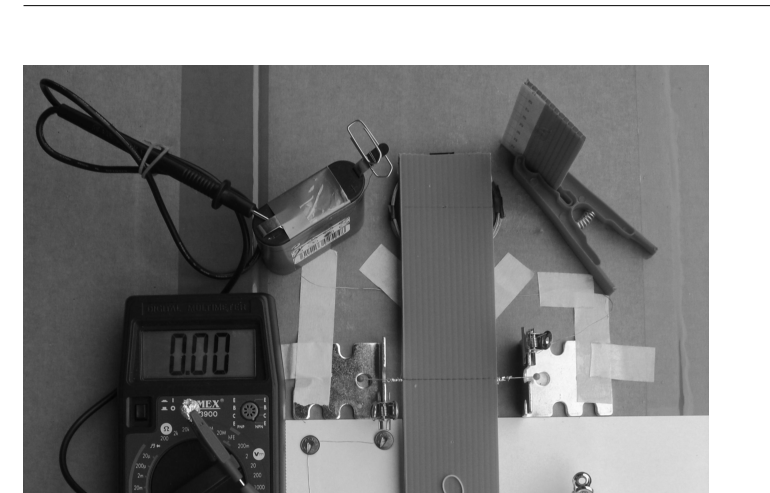
Quesito n. 1. L’orizzontalità della striscia può essere controllata con la squadretta o con il segmento di metro di carta fissato allo spessore verticale, spostati lungo tutta la striscia stessa. Le due bobine si presentano come due anelli di spessore non trascurabile: lo spessore della bobina mobile è compreso tra 1 e 2 mm e quello della bobina fissa tra 2 e 3 mm. Le altezze dei “centri” delle due bobine si trovano rispettivamente a metà del loro spessore. La distanza può essere letta direttamente sul segmento di metro di carta avvicinato alle due bobine affacciate, individuando a occhio i due punti a metà spessore. Può anche essere ricavata mediando le quote delle superfici inferiori e superiori delle due bobine, lette sulla squadretta o sul metro di carta. Ponendo la bobina fissa e gli angolari direttamente sul foglio di cartone, e gli spilli nei due intagli ad U, la distanza risulta mm. Ponendo invece gli angolari su spessori di 3 mm, si ottiene la distanza massima di mm. Distanze intermedie si possono ottenere usando opportunamente gli spessori, o sotto gli angolari, o sotto la bobina fissa se si sceglie di appoggiare gli spilli sul bordo superiore degli angolari invece che nell’intaglio.
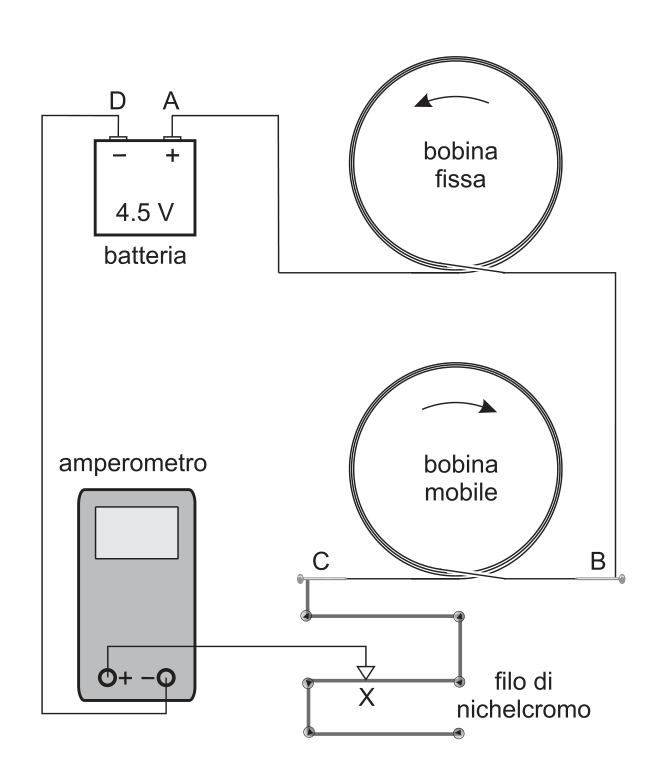
p.2 — Schema circuito con batteria, amperometro e bobine
p.3 — Fotografia disposizione dell’apparato sperimentale
Topic: Electromagnetism, Magnetism Metodi: Physical Modeling, Experimental Data Analysis Competenze: Measurement & Instrumentation, Physical Reasoning, Experimental Data Analysis Objects: Coil, Battery, Galvanometer Fonte: Testo (PDF) — p.5 Soluzione: Soluzioni (PDF)
Question No. 1. The horizontalness of the strip can be checked with the square or the fixed paper meter segment vertical thickness, moving along the entire strip itself. The two coils are presented as two rings of unremarkable thickness: the thickness of the moving coil is between 1 and 2 mm and that of the fixed coil between 2 and 3 mm. The heights of the centers of the two coils are They’re about half their thickness. The distance may be read directly on the paper meter segment near the two outline coils, By detecting the two points at half the thickness. It can also be obtained by measuring the area quotas the lower and upper parts of the two coils, read on the square or on the paper meter. By placing the fixed coil and the corners directly on the cardboard sheet, and the spindles in two U-shaped carvings, the The distance is mm. Instead, by placing the angles on 3 mm thicknesses, the maximum distance mm is obtained. Intermediate distances can be obtained by using the appropriate thicknesses, or under the corners, or under the fixed coil if chosen The brushes shall be mounted on the upper edge of the corners instead of the inside.
p.2 Battery, ampere and coil circuit scheme
The test equipment shall be designed to be capable of performing the following:
Topic: Electromagnetism, Magnetism Metodi: Physical Modeling, Experimental Data Analysis Competenze: Measurement & Instrumentation, Physical Reasoning, Experimental Data Analysis Objects: Coil, Battery, Galvanometer Fonte: Testo (PDF) — p.5 Soluzione: Soluzioni (PDF)
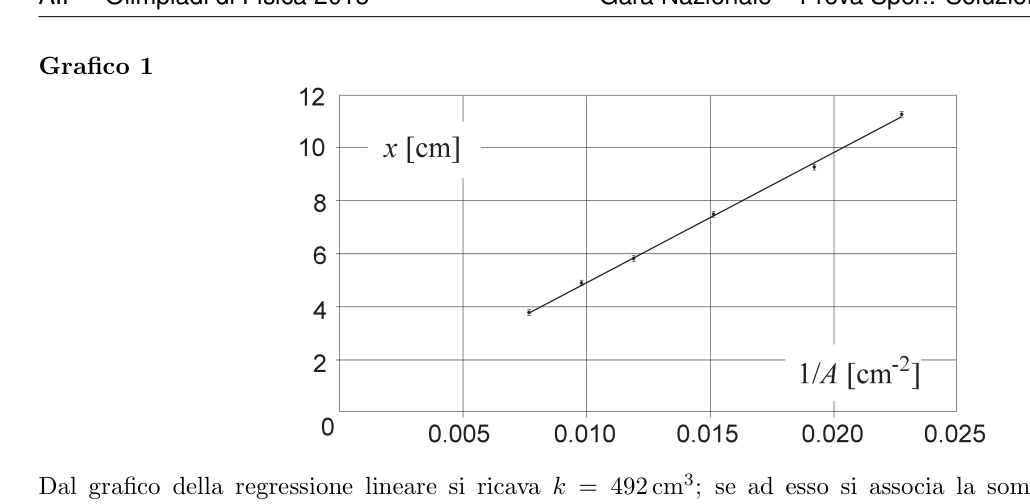
Quesito n. 2. Nei procedimenti riportati come esempi, l’operazione preliminare è di ritagliare un quadrato o un rettangolo di foglio di alluminio, di dimensioni note, e di piegarlo riducendolo ad una strisciolina sottile. Si può cosı` determinare facilmente la posizione del suo centro di massa. La bilancia è usata come una leva di primo genere. 2.1.1 Si ritaglia un quadrato di area , nel foglio di alluminio. Lo si piega più volte lungo lo stesso lato, a metà e poi ancora a metà ecc. fino ad ottenere una strisciolina lunga 10 cm e larga circa 0.5 cm. Il punto di cucitrice che fa da riferimento, è appoggiato con il centro di massa su uno dei due segmenti tracciati sulla bilancia. In posizione simmetrica rispetto al fulcro, si pone la strisciolina di alluminio. Il peso di questa prevale. Se ne taglia una lunghezza di 1 cm alla volta, corrispondente ad un’area di , finche ́ il peso della strisciolina è inferiore a quello del punto. Si aggiungono allora pezzetti di foglio di area nota fino ad ottenere l’equilibrio. Tabella 2.1.1 Massa del punto braccio Area braccio Massa di (g) di foglio (g) a b Si ricava dall’uguaglianza: , ottenuta nell’ipotesi dell’uguaglianza dei due bracci. Supporre comporta un errore di circa il 2 %. Incertezza relativa su : ; incertezza assoluta: g . 2.1.2 Si può tener conto della disuguaglianza dei due bracci, scambiando di posto punto e foglio di alluminio, in una specie di “pesata doppia”. L’equilibrio si riottene con una diversa superficie del foglio. Tabella 2.1.2 Massa del punto braccio Area braccio Massa di (g) di foglio (g) a b b a Dalle due uguaglianze ; moltiplicate membro a membro, si ricava . Incertezza relativa su : ; incertezza assoluta: g . 2.2.1 Un foglio quadrato di alluminio di area viene piegato più volte in una striscia rettangolare. Ad un estremo del giogo si pone il punto “sdraiato” in modo che uno dei due lati paralleli della “U” ne lambisca il bordo. — Pag. 1 — AIF – Olimpiadi di Fisica 2013 Gara Nazionale – Prova Sper.: Soluzione – 11 Aprile 2013 Per bilanciare il punto si fa scorrere sul giogo la striscia di alluminio, fino a trovare l’equilibrio. Si ripete scambiando le posizioni rispetto al fulcro, di punto e striscia di alluminio. Tabella 2.2.1; 2.2.2 Massa del punto braccio Area braccio Massa di (g) (cm) (cm) di foglio (g) con la (1) (procedimento 2.2.1) con la (2) (procedimento 2.2.2) Moltiplicando membro a membro le due uguaglianze dei momenti dei pesi si ricava l’espressione per : Incertezza relativa su : ; incertezza assoluta: g. 2.2.2 Se alla partenza c’è un lieve difetto di orizzontalità del giogo occorre tener conto nei calcoli anche del momento prodotto dal peso del giogo stesso. Di fatto esso rappresenta un errore sistematico. Realizzando le due situazioni di equilibrio come in 2.2.1, lavorando nelle medesime condizioni di azzeramento della bilancia si può eliminare l’errore sistematico, facendo la differenza membro a membro delle due equazioni che descrivono la condizione di equilibrio. In tal modo si ottiene: Incertezza relativa su : ; incertezza assoluta: g. 2.3.1 Posto il punto a 4 cm dal bordo, si cerca l’equilibrio con foglietti di alluminio di area nota piegati a strisciolina e posti a diverse distanze dal fulcro. Dall’uguaglianza dei momenti e dalla proporzionalità tra massa del foglio di alluminio e area , si ricava la diretta proporzionalità tra e . Dal grafico di in funzione di si può calcolare il coefficiente angolare della retta che permette di trovare la massa di del foglio. Dalla si ricava: e quindi . Tabella 2.3.1 Massa del punto Braccio Area Braccio Massa di (g) (cm) (cm) di foglio (g) — Pag. 2 — AIF – Olimpiadi di Fisica 2013 Gara Nazionale – Prova Sper.: Soluzione – 11 Aprile 2013 Grafico 1 Dal grafico della regressione lineare si ricava ; se ad esso si associa la somma delle incertezze percentuali su e su , che è intorno a 4 %, risulta: Incertezza relativa su : ; incertezza assoluta: g. Dalla semidispersione media dei valori di che è intorno al 2 %, si ricava: Incertezza relativa su : ; incertezza assoluta: g. NOTA. La massa di un rettangolo di foglio di alluminio di dimensioni cm e cm, misurata con bilancia elettronica è risultata pari a g. Da queste misure, nell’ipotesi che lo spessore sia uniforme, si ricava la massa di : g.
Topic: Newtonian Mechanics, Rigid Body Statics Metodi: Free-Body Diagram, Torque & Angular Momentum Analysis, Error Propagation, Graph Linearization Competenze: Error Propagation, Graph Linearization, Experimental Data Analysis Objects: Lever Fonte: Testo (PDF) — p.5 Soluzione: Soluzioni (PDF)
Question No. 2. In the procedures given as examples, the preliminary operation is to cut a square or rectangle It’s a piece of aluminum foil, of known size, and then fold it down to a thin strip. You can do that. easily determine the position of its center of mass. The scale is used as a first-rate lever. 2.1.1 Cut a square of area into aluminium foil. It folds over and over again along the same length side, half and then half again, etc. until a strip is 10 cm long and about 0.5 cm wide. The sewing point which it makes reference shall be supported by the centre of mass on one of the two segments drawn on the balance sheet. In a symmetrical position with respect to the core, the aluminium strip is placed. The weight of this It’s the prevailing. Cut 1 cm in length at a time, corresponding to an area of , until the weight of the The dash is less than the dot. Then pieces of sheet of known area are added until the result is The balance. The following table shows the following: Mass of the point arm Area arm Mass of (g) Other, of a width of <= 600 mm a b The is derived from the equality: , obtained from the assumption of equality of the two arms. Assuming involves an error of about 2%. Relative uncertainty about : ; absolute uncertainty: g. 2.1.2 The difference between the two arms can be taken into account by switching between aluminium foil and aluminium foil. In a kind of double weight. The balance is restored with a different surface area of the sheet. The following table shows the results of the study: Mass of the point arm Area arm Mass of (g) Other, of a width of <= 600 mm a b b a Of the two equations ; The number of members multiplied by member is . Relative uncertainty about : ; absolute uncertainty: g. 2.2.1 A square sheet of aluminium is folded several times into a strip The rectangle is the rectangle. At one end of the yoke is the point srai so that one of the two parallel sides of the yoke is You’re gonna have to lick the edge. Pag. 1 — AIF Physics Olympics 2013 National competition Test Hope.: Solution 11 April 2013 To balance the point, the aluminium strip is rolled over the yoke until the balance is found. It repeats . The following is the list of the components used in the manufacture of the product: The Commission shall adopt implementing acts in accordance with Article 21 of this Regulation. Mass of the point arm Area arm Mass of (g) (cm) (cm) Other, of a width of <= 600 mm with the (1) (procedure 2.2.1) with the (2) (procedure 2.2.2) Multiplying the two equal moments of weights by member to member gives the expression : Incertezza relativa su : ; incertezza assoluta: g. 2.2.2 If there is a slight lack of horizontalness of the game at the start, the calculations must also take account of the The moment produced by the weight of the yoke itself. In fact, it is a systematic error. The Commission The two equilibrium situations as in 2.2.1, working under the same conditions of zeroing the balance sheet can eliminate the systematic error by differentiating member to member of the two equations that describe The equilibrium condition. This is how you get: Relative uncertainty about : ; incertezza assoluta: g. 2.3.1 If the point is 4 cm from the edge, the balance is sought with folded aluminium sheets of notated area a strip and position at different distances from the centre. The equality of moments and the proportionality of the The aluminium foil mass and area is directly proportional to and . From the graph of in The function of can be calculated by the angle coefficient of the straight line to find the mass of on the sheet. From we get: and then . The following table shows the following: Mass of the point The arm Area Braccio Mass of (g) (cm) (cm) Other, of a width of <= 600 mm Pag. 2 — AIF Physics Olympics 2013 National competition Test Hope.: Solution 11 April 2013 The following table shows the following: The linear regression graph gives ; if the sum of the uncertainties is associated with it The percentage of and , which is around 4%, is: Incertezza relativa su : ; incertezza assoluta: g. From the mean half-dispersion of values which is around 2%, we get: Incertezza relativa su : ; incertezza assoluta: g.
- I’ll take that. The mass of a rectangle of aluminium foil of cm and cm, measured by weight The electronics was g. From these measurements, assuming uniform thickness, the mass of : g.
Topic: Newtonian Mechanics, Rigid Body Statics Metodi: Free-Body Diagram, Torque & Angular Momentum Analysis, Error Propagation, Graph Linearization Competenze: Error Propagation, Graph Linearization, Experimental Data Analysis Objects: Lever Fonte: Testo (PDF) — p.5 Soluzione: Soluzioni (PDF)
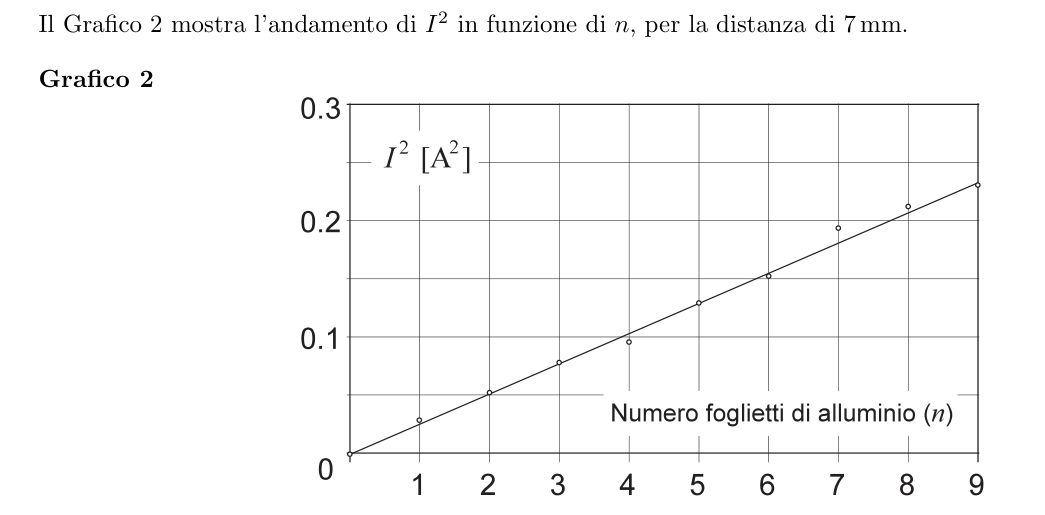
Quesito n. 3. Per bilanciare la forza repulsiva tra le bobine i campioni di peso vanno posti sul segno tracciato in corrispondenza del centro della bobina mobile. Le misure riportate nella tabella sottostante, sono state ottenute con le bobine poste a due differenti distanze. Nel primo caso, distanza mm, la bobina fissa e gli angolari sono appoggiati direttamente sul cartone, e gli spilli alloggiati negli intagli ad U dei due angolari. Nel secondo caso, distanza mm, l’unica differenza sta nel fatto che gli angolari sono posti sopra spessori di 3 mm. Con si indica il numero di campioni di peso posti sulla bilancia. N.B. nella tabella sottostante sono riportate anche le misure di corrente ottenute con forza attrattiva (v. domanda 6). Tabella 3–6 (Valori relativi alle domande 3 e 6) Distanza tra le bobine mm Distanza tra le bobine mm Corrente in Rapporto in Corrente in Corrente in Rapporto in Corrente in repulsione repulsione attrazione repulsione repulsione attrazione n (A) (A) (A) (A) 0 0.00 0.00 0.00 0.00 1 0.17 0.029 0.18 0.18 0.032 0.19 2 0.23 0.026 0.25 0.25 0.031 0.27 3 0.28 0.026 0.28 0.30 0.030 0.35 4 0.31 0.024 0.32 0.36 0.032 0.40 5 0.36 0.026 0.36 0.42 0.035 0.44 6 0.39 0.025 0.40 0.45 0.034 0.48 7 0.44 0.028 0.46 0.49 0.034 0.52 8 0.46 0.026 0.47 0.53 0.034 0.56 9 0.48 0.026 0.50 10 0.50 0.025 0.52 v. Nota 1 v. Nota 2 Nota 1: Rapporto medio : (da regressione lineare); (da media aritmetica). Nota 2: Rapporto medio : (da regressione lineare); (da media aritmetica). — Pag. 3 — AIF – Olimpiadi di Fisica 2013 Gara Nazionale – Prova Sper.: Soluzione – 11 Aprile 2013 Il Grafico 2 mostra l’andamento di in funzione di , per la distanza di 7 mm. Grafico 2 La relazione tra ed è: , oppure se la distanza tra le bobine è mm , oppure se la distanza tra le bobine è mm La semidispersione massima dei valori delle costanti di proporzionalità si può assumere uguale a , pari a 8 % o 6 %.
p.7 — Grafico 1: x in funzione di 1/A
Topic: Magnetism, Electromagnetism Metodi: Experimental Data Analysis, Graph Linearization, Physical Modeling Competenze: Experimental Data Analysis, Graph Linearization, Mathematical Modeling Objects: Coil Fonte: Testo (PDF) — p.7 Soluzione: Soluzioni (PDF)
Question No. 3. To balance the repulsive force between the coils the weight samples shall be placed on the corresponding marked mark the centre of the moving coil. The measurements in the table below were obtained by coils placed at two different distances. In the first case, the distance mm, the fixed coil and the angles shall be supported directly on the cardboard, and the spikes are housed in the U-shaped carvings of the two corners. In the second case, distance mm, the only The difference is that the corners are placed above 3 mm thick. indicates the number of samples Weight on the scales. N.B. The following table also shows the current measurements obtained by attractive force (see paragraphs 1 and 2). The Commission shall adopt delegated acts in accordance with Article 21 of this Regulation. Table 36 (Values for questions 3 and 6) The distance between the coils mm The distance between the coils mm Current in The report in Current in Current in The report in Current in Repulsion Repulsion attraction Repulsion Repulsion attraction n (A) (A) (A) (A) 0 0.00 0.00 0.00 0.00 1 0.17 0.029 0.18 0.18 0.032 0.19 2 0.23 0.026 0.25 0.25 0.031 0.27 3 0.28 0.026 0.28 0.30 0.030 0.35 4 0.31 0.024 0.32 0.36 0.032 0.40 5 0.36 0.026 0.36 0.42 0.035 0.44 6 0.39 0.025 0.40 0.45 0.034 0.48 7 0.44 0.028 0.46 0.49 0.034 0.52 8 0.46 0.026 0.47 0.53 0.034 0.56 9 0.48 0.026 0.50 10 0.50 0.025 0.52 v. The following information shall be provided: v. Note 2 to this chapter Note 1: Average ratio : (linear regression); (arithmetic mean). Note 2: Average ratio : (linear regression); (arithmetic mean). Pag. 3 — AIF Physics Olympics 2013 National competition Test Hope.: Solution 11 April 2013 Figure 2 shows the trend of as a function of , for the distance of 7 mm. The following table shows the following: The relationship between and is: , or if the distance between the coils is mm , or if the distance between the coils is mm The maximum half-dispersion of the values of the proportionality constants can be assumed to be , equal to a 8 % o 6 %.
The following table shows the number of samples taken from the sample:
Topic: Magnetism, Electromagnetism Metodi: Experimental Data Analysis, Graph Linearization, Physical Modeling Competenze: Experimental Data Analysis, Graph Linearization, Mathematical Modeling Objects: Coil Fonte: Testo (PDF) — p.7 Soluzione: Soluzioni (PDF)
Quesito n. 4. Uguagliando l’intensità della forza elettrodinamica al peso complessivo dei foglietti di alluminio necessari per l’equilibrio, si ottiene , dove è l’accelerazione di gravità. Poiche ́ , si ottiene Alla distanza mm risulta , da cui . Alla distanza mm risulta , da cui . NOTA. Si può ricavare, con una certa approssimazione, l’espressione teorica per l’intensità della forza elettrodinamica assimilando le due bobine a due conduttori rettilinei e paralleli. L’approssimazione è tanto migliore quanto più il raggio delle bobine è maggiore della distanza. Il campo magnetico creato dalla corrente nelle spire della bobina fissa, alla distanza è , dove è la permeabilità magnetica del vuoto uguale a quella dell’aria. La forza sulla corrente nelle spire della bobina mobile è . Sostituendo l’espressione di , e poiche ́ si ottiene Nel caso delle bobine della prova, ; ; m; Con questi dati, i valori teorici delle costanti richieste nelle domande 3 e 4 facilmente calcolabili con le formule (3) e (4), risultano (v. tabella) Tabella 3–4 (Valori relativi alle domande 3 e 4) d (mm) 7.00 8.00 9.00 10.00
p.8 — Grafico 2: I quadro in funzione di n
Topic: Magnetism, Newtonian Mechanics Metodi: Biot-Savart Law, Ampère’s Law, Free-Body Diagram Competenze: Mathematical Modeling, Physical Reasoning, Experimental Data Analysis Objects: Coil Fonte: Testo (PDF) — p.8 Soluzione: Soluzioni (PDF)
Question No. 4. The electrodynamic strength is equal to the total weight of the aluminium sheets needed for The balance is obtained , where is the gravitational acceleration. Poiche ́ , si ottiene The distance mm is , where . The distance mm is , where .
- I’ll take that. The theoretical expression for the electrodynamic force intensity can be obtained with some approximation. The two coils are parallel and straight. The approximation is the better the radius of the coil is greater than the distance. The magnetic field created by the current in the coil spindles at the distance is , where is the magnetic permeability of the vacuum equal to that of the air. The current force in the coil of the mobile coil is . Substituting the expression , and since is obtained In the case of test coils, ; ; m; With these data, the values are: Theoretical constants required in questions 3 and 4 which can be easily calculated using the formulas (3) and (4) are: Table of the table) Table 34 (Values for questions 3 and 4) d (mm) 7.00 8.00 9.00 10.00
p.8 — Grafico 2: I quadro in funzione di n
Topic: Magnetism, Newtonian Mechanics Metodi: Biot-Savart Law, Ampère’s Law, Free-Body Diagram Competenze: Mathematical Modeling, Physical Reasoning, Experimental Data Analysis Objects: Coil Fonte: Testo (PDF) — p.8 Soluzione: Soluzioni (PDF)
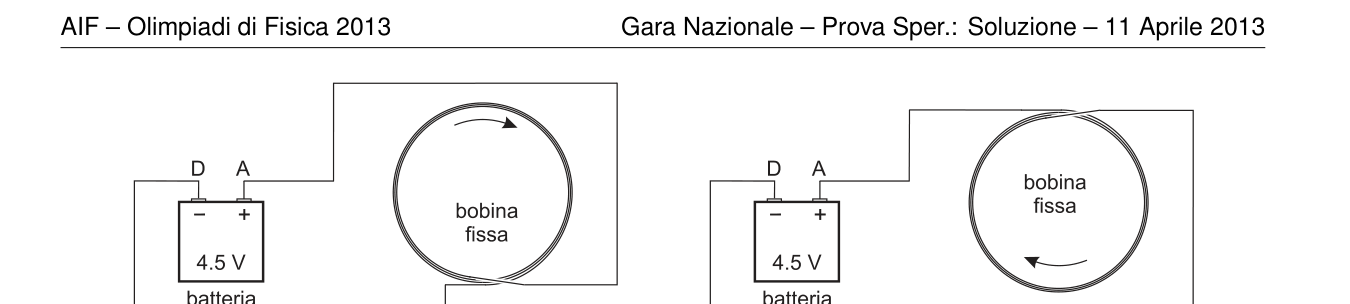
Quesito n. 5. Perche ́ la forza sia attrattiva, la corrente deve avere lo stesso verso nelle due bobine. Si può invertire la corrente nella bobina fissa, scambiando il collegamento dei due capi, a batteria e angolare (come in figura seguente a sinistra). Si possono anche lasciare i collegamenti cosı` come sono e ribaltare la bobina fissa sulla base di cartone (v. figura a destra). È più macchinoso invertire la corrente nella bobina mobile, scambiando il collegamento ai due angolari di bobina fissa e reostato. — Pag. 4 — AIF – Olimpiadi di Fisica 2013 Gara Nazionale – Prova Sper.: Soluzione – 11 Aprile 2013
p.9 — Schemi inversione corrente per forza attrattiva
Topic: Magnetism, Electromagnetism Metodi: Physical Modeling, Lorentz Force Analysis Competenze: Physical Reasoning, Diagrammatic Reasoning Objects: Coil, Battery Fonte: Testo (PDF) — p.8 Soluzione: Soluzioni (PDF)
Question No. 5. For the force to be attractive, the current must be the same in both coils. The current in the fixed coil can be reversed by switching the connection between the two conductors, battery and angular (as shown in the figure below on the left). You can also leave the links as they are and turn the coil fixed on a cardboard basis (see. Figure on the right). It is more machinably reversed in the current in the moving coil, switching the connection to the two coil angles fixed and re-restored. Pag. 4 — AIF Physics Olympics 2013 National competition Test Hope.: Solution 11 April 2013
The following is the list of the types of electricity generated by the electricity generated by the electricity generated by the electricity generated by the electricity generated by the electricity generated by the electricity generated by the electricity generated by the electricity generated by the electricity generated by the electricity generated by the electricity generated by the electricity generated by the electricity generated by the electricity generated by the electricity generated by the electricity generated by the electricity generated by the electricity generated by the electricity generated by the electricity generated by the electricity generated by the electricity generated by the electricity generated by the electricity generated by the electricity generated electricity generated by the electricity generated electricity generated by the electricity generated electricity generated by electricity generated by electricity.
Topic: Magnetism, Electromagnetism Metodi: Physical Modeling, Lorentz Force Analysis Competenze: Physical Reasoning, Diagrammatic Reasoning Objects: Coil, Battery Fonte: Testo (PDF) — p.8 Soluzione: Soluzioni (PDF)
Quesito n. 6. Le misure sono riportate nella Tabella 3–6 a pag. 3.
Topic: Magnetism, Electromagnetism Metodi: Experimental Data Analysis, Physical Modeling Competenze: Experimental Data Analysis, Physical Reasoning, Measurement & Instrumentation Objects: Coil Fonte: Testo (PDF) — p.9 Soluzione: Soluzioni (PDF)
Question No. 6. The measures are set out in Table 36 at p. 3.
Topic: Magnetism, Electromagnetism Metodi: Experimental Data Analysis, Physical Modeling Competenze: Experimental Data Analysis, Physical Reasoning, Measurement & Instrumentation Objects: Coil Fonte: Testo (PDF) — p.9 Soluzione: Soluzioni (PDF)
Quesito n. 7. La difficoltà nasce dal fatto che la forza elettrodinamica cresce al diminuire della distanza tra le due bobine. Per scostamenti dalla posizione orizzontale di equilibrio, in una bilancia “normale”, la somma dei momenti dei due pesi laterali è sempre nulla, mentre il momento del peso del giogo contrasta lo scostamento fino a farla tornare orizzontale dopo qualche oscillazione. Nel nostro caso, con gli stessi scostamenti, la somma dei due momenti laterali non è più nulla, poiche ́ la forza elettrodinamica è funzione decrescente della distanza. Se la bobina mobile si alza, il momento della forza attrattiva elettrodinamica, che tenderebbe a riportarla giù, diminuisce di una quantità . Al contrario se la bobina mobile si abbassa, il momento che tende ad abbassarla ancora di più, aumenta di . Se il momento del giogo prevale su o la bilancia torna in equilibrio orizzontale, altrimenti se ne scosta sempre di più. La posizione orizzontale della bilancia è ancora di equilibrio stabile ma in un intorno sempre più piccolo a mano a mano che cresce la corrente, poiche ́ la forza elettrodinamica cresce al crescere della corrente e quindi crescono anche le variazioni del suo momento o . Si riesce ad ottenere l’equilibrio senza accorgimenti particolari anche in attrazione, con uno, due o al massimo tre foglietti di alluminio sulla bilancia. Occorre solo agire delicatamente, per esempio con un dito, per “aiutare” la bilancia a mettersi orizzontale.
Topic: Newtonian Mechanics, Rigid Body Statics, Magnetism Metodi: Torque & Angular Momentum Analysis, Free-Body Diagram, Physical Modeling Competenze: Physical Reasoning, Diagrammatic Reasoning, Mathematical Modeling Objects: Coil, Beam Fonte: Testo (PDF) — p.9 Soluzione: Soluzioni (PDF)
Question No. 7. The difficulty arises from the fact that the electrodynamic force increases as the distance between the two coils decreases. For deviations from the horizontal equilibrium position, in a normal balance, the sum of the moments of the Two side weights is always zero, while the moment of the weight of the yoke counters the deviation until I’m gonna have to get it back to the horizontal after a few swings. In our case, with the same deviations, the sum of the two lateral moments is nothing, because the force is the same as the force of the other two sides. electrodynamics is a decreasing function of distance. If the moving coil is lifted, the force moment The electrodynamic attractiveness, which would tend to bring it down, decreases by a quantity . On the contrary, if the moving coil decreases, the momentum which tends to lower it even more increases by . Se il The time of play prevails on or the balance returns to horizontal equilibrium, otherwise it is shifted More and more. The horizontal position of the balance is still stable but in an increasingly small circle at hand As the current grows, because the electrodynamic force grows as the current grows, and so they grow. also the changes in its timing or . The balance can be achieved without special care even in attraction, with one, two or not more three aluminium sheets on the balance sheet. You just have to act gently, for example with your finger, to help The balance should be horizontal.
Topic: Newtonian Mechanics, Rigid Body Statics, Magnetism Metodi: Torque & Angular Momentum Analysis, Free-Body Diagram, Physical Modeling Competenze: Physical Reasoning, Diagrammatic Reasoning, Mathematical Modeling Objects: Coil, Beam Fonte: Testo (PDF) — p.9 Soluzione: Soluzioni (PDF)
Quesito n. 8. Le misure riportate nella Tabella 3–6 (colonne 4a e 7a) a pag. 3 sono state ottenute con il metodo seguente. Si dispone il giogo, caricato con i foglietti di alluminio, in modo che, con corrente nulla, risulti orizzontale e in lieve contatto con alcuni spessori posti sotto di esso, dalla parte opposta a quella delle bobine. Si aumenta lentamente l’intensità della corrente sino a quando il giogo inizia ad abbassarsi dalla parte delle bobine, e si legge sull’amperometro il valore della corrente. Con questo metodo la corrente letta ha un piccolo errore in eccesso. Si può notare nella Tabella 3–6 a pag. 3 che i valori di corrente in attrazione superano in genere quelli corrispondenti in repulsione. Si possono anche sistemare gli spessori sotto il giogo, all’interno della bobina fissa, in modo che il giogo sia orizzontale. Questo va poi caricato con i foglietti di alluminio. Gli si impedisce con un dito di sollevarsi, e si aumenta lentamente la corrente finche ́ resta in posizione orizzontale anche senza l’“aiuto” del dito. Si diminuisce poi la corrente finche ́ inizia a staccarsi dallo spessore. Con questo metodo, più macchinoso del precedente, la corrente letta ha un errore in difetto. Materiale elaborato dal Gruppo NOTA BENE È possibile utilizzare, riprodurre, distribuire, comunicare al pubblico questo materiale alle due seguenti condizioni: citare la fonte; non usare il materiale, nemmeno parzialmente, per fini commerciali. — Pag. 5 —
Topic: Magnetism, Newtonian Mechanics Metodi: Experimental Data Analysis, Physical Modeling, Error Propagation Competenze: Experimental Data Analysis, Measurement & Instrumentation, Physical Reasoning Objects: Coil Fonte: Testo (PDF) — p.9 Soluzione: Soluzioni (PDF)
Question No. 8. The measures set out in Table 36 (columns 4a and 7a) to p. 3 were obtained by the following method. The yoke is loaded with aluminium sheets so that, with no current, it is horizontal and in slight contact with some thickness placed underneath it, on the side opposite to that of the coils. The current intensity is slowly increased until the yoke begins to fall from the The coil is on the pressure gauge and the current is read. With this method the current read has a small I’m not sure what I’m saying. This can be seen in Table 36 at p. 3 where the current values in the attraction exceed in The Commission has already adopted a number of proposals. The thickness of the yoke can also be adjusted under the yoke, within the the coil is fixed so that the yoke is horizontal. This should then be loaded with the aluminum foil. I ‘ll give it to him . It prevents one finger from lifting, and it slowly increases the current until it stays in a horizontal position. Even without the help of your finger. Then the current decreases until it starts to detach from the thickness. With this The method, more machined than the previous one, the current read has a faulty error. Material prepared by the Group Good note . The use, reproduction, distribution and communication of this material to the public are permitted under the following two conditions: citing the source; not using the material, even partially, for commercial purposes. Pag. 5 —
Topic: Magnetism, Newtonian Mechanics Metodi: Experimental Data Analysis, Physical Modeling, Error Propagation Competenze: Experimental Data Analysis, Measurement & Instrumentation, Physical Reasoning Objects: Coil Fonte: Testo (PDF) — p.9 Soluzione: Soluzioni (PDF)