Sbarra in caduta — Punti 100
Il moto di una sbarra che cade urtando con un estremo il pavimento e rimbalza è in generale piuttosto complicato. Al variare dell’inclinazione della sbarra si possono presentare comportamenti differenti. Il modo più conveniente per affrontare questo tipo di problemi consiste nella schematizzazione del moto come composizione di una rotazione attorno al Centro di Massa (CdM) e una traslazione dello stesso. Questa schematizzazione è utile sia per descrivere il moto, sia per esprimere l’energia della sbarra. Il problema esamina un caso particolare.
La sbarra è rigida e omogenea, ha lunghezza e massa ; le sue dimensioni trasversali sono trascurabili rispetto alla lunghezza. All’inizio l’asta è ferma ed inclinata di un angolo (con ) rispetto al piano orizzontale ed il suo estremo sinistro, il più vicino al pavimento, è posto ad altezza dallo stesso. Il pavimento è piano, orizzontale, rigido e senza attrito. Gli urti sono elastici.
La sbarra viene lasciata cadere senza ruotare e urta il pavimento prima con l’estremità sinistra e poi con quella destra.
- Il primo urto avviene con velocità del CdM in modulo uguale a . Si esprima in funzione di .
L’urto con il pavimento può essere schematizzato mediante l’azione di una forza impulsiva che agisce per un intervallo di tempo (molto breve) .
-
Si scrivano le equazioni che consentono di calcolare le eventuali variazioni della quantità di moto, del momento angolare e dell’energia della sbarra “nell’urto”, e cioè tra “un istante immediatamente prima” l’urto e “uno immediatamente dopo”. È sufficiente considerare il primo urto. Si indichi con la velocità del CdM subito dopo il primo urto.
-
Si determinino e la velocità angolare con cui la sbarra ruota dopo il primo urto, in funzione di , e .
Si ricordi che per una sbarra di larghezza trascurabile, lunghezza e massa il momento di inerzia rispetto ad un asse passante per il CdM e ortogonale alla sbarra vale .
- Si dica qual è il tipo di moto del CdM dopo il primo urto, se ne trovi l’accelerazione e si specifichi quali sono i casi qualitativamente diversi che si possono presentare.
In qualche caso si osserva che, quando l’estremità destra della sbarra urta il pavimento, essa, inclinata dalla parte opposta, forma con l’orizzontale un angolo nuovamente uguale ad .
-
Si dica per quale intervallo di valori dell’angolo è impossibile che si verifichi la situazione descritta.
-
Nell’intervallo di valori di per cui il rimbalzo descritto è possibile, si trovi il rapporto in funzione di .
-
Si trovi per e .
Topic: Newtonian Mechanics, Rotational Dynamics, Conservation of Energy Metodi: Impulse-Momentum Theorem, Torque & Angular Momentum Analysis, Conservation of Energy Competenze: Physical Reasoning, Mathematical Modeling Objects: Rod Fonte: Testo (PDF) — p.1 Soluzione: Soluzioni (PDF)
Sbarra in caduta — Punti 100
The motion of a bar that falls and hits the floor and bounces off is generally quite complicated. The slope of the bar may vary with different behaviours. The most convenient way to deal with this type of problem is to diagram the motor as a composition of a rotation around the centre of mass (CdM) and a translation of it. This diagram is useful both for describing the motion and for expressing the energy of the bar. The problem is a particular case.
The bar is rigid and homogeneous, has a length and a mass ; its cross-sectional dimensions are negligible compared to the length. At the beginning the axle is fixed and tilted at an angle (with ) from the horizontal plane and its left extreme, the closest to the floor, is placed at a height from it. The floor is flat, horizontal, rigid and frictionless. The bumps are elastic.
The bar is dropped without rotating and hits the floor first with the left end and then with the right.
- The first impact occurs at a speed of the CdM in the form . Si esprima in funzione di .
The impact with the floor can be schematized by the action of an impulse force acting for a very short time interval .
-
The equations are written to calculate any changes in the amount of motion, angular momentum and energy of the bar “in impact”, i.e. between “an instant immediately before” the impact and “an instant after”. It’s enough to consider the first impact. Indicate the speed of the CdM immediately after the first impact with .
-
Determine and the angular speed at which the bar rotates after the first impact, according to , and .
Note that for a bar of negligible width, length and mass the moment of inertia with respect to a passing axis for the CdM and orthogonal to the bar is .
- The type of motorcycle of the CdM after the first impact is stated, the acceleration is found and the qualitatively different cases that may occur are specified.
In some cases, it is noted that when the right end of the bar hits the floor, it, slanted from the opposite side, forms an angle again equal to horizontally.
-
Specify for which range of values of the angle the situation described cannot occur.
-
In the range of values for which the described bounce is possible, the ratio is a function of .
-
Si trovi per e .
Topic: Newtonian Mechanics, Rotational Dynamics, Conservation of Energy Metodi: Impulse-Momentum Theorem, Torque & Angular Momentum Analysis, Conservation of Energy Competenze: Physical Reasoning, Mathematical Modeling Objects: Rod Fonte: Testo (PDF) — p.1 Soluzione: Soluzioni (PDF)
Trasformazione termodinamica — Punti 100
Nel dispositivo mostrato in figura un recipiente cilindrico, di sezione , munito di un pistone di massa trascurabile che può scorrere senza attrito, contiene una certa quantità di un gas perfetto biatomico alla temperatura di . Sopra il pistone, che si trova inizialmente ad un’altezza dal fondo del recipiente, c’è del mercurio che riempie completamente il cilindro e si raccorda, mediante un tubo di gomma pieghevole, con un altro recipiente aperto superiormente. In questo secondo recipiente la superficie libera si trova ad un’altezza sopra il pistone. La pressione atmosferica nell’ambiente ha il suo valore standard.
Nel cilindro che contiene il gas, il fondo, la superficie laterale e il pistone sono termicamente isolanti. All’interno del cilindro è contenuto un piccolo riscaldatore elettrico, di volume trascurabile, che all’istante viene acceso, e fornisce una potenza costante . Per effetto dell’energia che viene immessa nel sistema il pistone si solleva. Mediante un servomeccanismo, si abbassa il recipiente superiore in modo che, ad ogni salita del pistone di , la superficie libera del mercurio scenda contemporaneamente di .
Il riscaldatore viene spento, e il servomeccanismo arrestato, quando il volume del gas è raddoppiato. La trasformazione è sufficientemente lenta da poter essere trattata come quasi-statica.
-
Ricavare i valori dei parametri di stato (, e ) nello stato iniziale.
-
Ricavare i valori degli stessi parametri nello stato finale.
-
Scrivere l’espressione della funzione che rappresenta la trasformazione, calcolando il valore del parametro (o dei parametri) che vi compaiono, e rappresentarla graficamente in un piano cartesiano .
-
Calcolare , e nella trasformazione.
-
Calcolare quanto tempo dura la trasformazione.
-
Scrivere l’espressione della temperatura del gas in funzione del volume e dei parametri iniziali, e calcolare la massima temperatura raggiunta dal gas e il corrispondente volume.
-
Trovare l’espressione della velocità del pistone in funzione della potenza del riscaldatore e dei parametri di stato del sistema, e calcolarne il valore nell’istante in cui il volume del gas è raddoppiato.
p.2 — Grafico pressione-volume con assi p e V
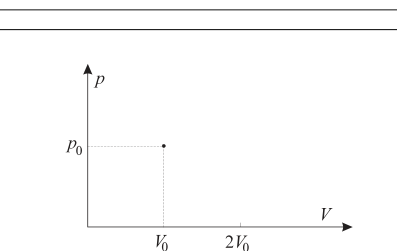
Topic: Thermodynamics, Fluid Mechanics Metodi: First Law of Thermodynamics, Ideal Gas Law, Hydrostatic Equilibrium Competenze: Physical Reasoning, Mathematical Modeling Objects: Gas, Cylinder, Piston, Tube Fonte: Testo (PDF) — p.2 Soluzione: Soluzioni (PDF)
The following table shows the results of the calculation of the total energy consumption of the product:
In the device shown in the figure a cylindrical container, section, equipped with a piston of negligible mass which can flow without friction, contains a certain amount of perfect biatomic gas at a temperature of . Above the piston, which is initially located at a height from the bottom of the container, there is mercury which fills the cylinder completely and connects, by means of a folding rubber tube, to another container open above. In this second container the free surface is at a height above the piston. The atmospheric pressure in the environment has its standard value.
In the cylinder containing the gas, the bottom, the side surface and the piston are thermal insulating. Inside the cylinder is a small electric heater, of negligible volume, which is instantly lit , and provides a constant power . The piston is lifted by the energy being put into the system. The upper vessel is lowered by means of a servo mechanism so that, at each rise of the piston, the free surface of mercury simultaneously drops to .
The heater is turned off, and the service mechanism is shut down when the volume of gas is doubled. The transformation is slow enough to be treated as quasi-static.
-
Find the values of the state parameters (, and ) in the initial state.
-
Retrieve the values of the same parameters in the final state.
-
Write the expression of the function representing the transformation, calculating the value of the parameter (s) that appear to it, and represent it graphically in a map .
-
Calculate , and in the processing.
-
Calculate how long the transformation takes.
-
Write the gas temperature expression according to the volume and initial parameters, and calculate the maximum temperature reached by the gas and the corresponding volume.
-
Find the expression of the piston speed in terms of heater power and system state parameters, and calculate its value the instant the volume of gas is doubled.
**p.2 ** Pressure-volume graph with axes p and V
Topic: Thermodynamics, Fluid Mechanics Metodi: First Law of Thermodynamics, Ideal Gas Law, Hydrostatic Equilibrium Competenze: Physical Reasoning, Mathematical Modeling Objects: Gas, Cylinder, Piston, Tube Fonte: Testo (PDF) — p.2 Soluzione: Soluzioni (PDF)
Pendolo elettrostatico — Punti 100
La figura a lato mostra un dispositivo che possiamo chiamare “pendolo elettrostatico”. È costituito da un pendolo fisico che oscilla in un piano verticale attorno ad un fulcro fisso . All’estremo inferiore dell’asta che lo forma è attaccato un contrappeso, mentre l’estremo superiore termina con una piccola sfera metallica , di raggio . Nello stesso piano verticale si trovano altre due sfere metalliche e , identiche a , poste in posizione simmetrica rispetto al pendolo, ad una distanza molto maggiore del loro raggio e ad un’altezza uguale a quella a cui oscilla . e sono collegate, tramite due conduttori aventi grande resistenza e capacità trascurabile, ad un generatore elettrostatico: è collegata al polo positivo, mentre a quello negativo, che è messo a terra. Sia la differenza di potenziale elettrico del generatore.
Nelle sue oscillazioni, la sfera viene periodicamente e alternativamente in contatto con e . Faremo l’ipotesi che la resistenza elettrica dei conduttori che collegano queste sfere al generatore e a terra sia sufficientemente alta da poterle considerare elettricamente isolate dal circuito durante il brevissimo tempo di contatto con la sfera oscillante ma sufficientemente piccola perché esse si riportino in una situazione di equilibrio in un tempo minore della metà del periodo di oscillazione del pendolo.
NOTA: A parte gli istanti di contatto, le sfere e si considereranno come conduttori isolati, trascurando ogni effetto di induzione e.s. tra loro e con la sfera del pendolo anche quando questa è vicina; questa schematizzazione, per quanto chiaramente grossolana, è adeguata alla trattazione del problema.
A causa delle interazioni elettrostatiche dovute ai contatti, il pendolo acquista dunque, ad ogni oscillazione, un’energia almeno sufficiente a compensare quella persa a causa degli attriti, e può così continuare a funzionare per un tempo molto lungo.
-
Determinare, in funzione di , l’espressione della carica depositata sulla sfera quando è lontana da questa, e analogamente quella della carica depositata su quando è lontana da . Si calcolino anche i valori numerici ponendo e .
-
Trovare l’espressione, in funzione di , della carica trasportata da nel suo moto da a , e di quella trasportata nel ritorno da ad . Si consideri la situazione di equilibrio, in cui e mantengono rispettivamente lo stesso valore ad ogni oscillazione. Calcolarne anche i valori numerici.
-
Il risultato trovato al punto precedente mostra che, considerando un’oscillazione completa, si ha un trasferimento netto di carica da a , e quindi una corrente elettrica di intensità media . Scrivere, in funzione di , del periodo delle oscillazioni e del potenziale , l’espressione di e della resistenza equivalente del circuito, . Calcolare i valori numerici supponendo che il pendolo compia 95 oscillazioni al minuto.
-
L’isolamento di un generatore reale non è mai perfetto (le pile si scaricano, dopo un tempo molto lungo, anche se non vengono usate), e quindi, oltre a quella già considerata trasportata dalla sferetta del pendolo, c’è anche un’altra piccola corrente, che chiameremo parassita, che scorre dal polo positivo a quello negativo del generatore; associata a questa corrente c’è ovviamente una resistenza . Disegnare lo schema del circuito elettrico complessivo tenendo conto di queste considerazioni. Calcolare il valore di supponendo e confrontarlo con .
Si supponga che nella reazione chimica che avviene nella pila ogni molecola di elettrolita fornisca due cariche elettriche elementari e che la pila funzioni per un tempo .
-
Scrivere l’espressione della carica totale che attraversa il generatore in un periodo di funzionamento e del minimo numero di moli di elettrolita, , che deve essere inizialmente presente nel generatore affinché la reazione duri per tutto il tempo . Calcolare i valori numerici ponendo .
-
Determinare l’espressione e il valore numerico della quantità di energia che il generatore eroga ad ogni oscillazione.
Topic: Electrostatics, Circuits Metodi: Electric Potential Method, Coulomb’s Law, Kirchhoff’s Laws Competenze: Physical Reasoning, Mathematical Modeling Objects: Pendulum, Sphere, Battery, Wire Fonte: Testo (PDF) — p.3 Soluzione: Soluzioni (PDF)
Pendolo elettrostatico — Punti 100
The figure on the side shows a device that we can call an electrostatic pendulum. It consists of a physical pendulum which oscillates vertically around a fixed centre . A counterweight is attached to the lower end of the shaft, while the upper end ends with a small metal sphere , with a radius . In the same vertical plane are two other metal spheres and , identical to , placed in a symmetrical position with respect to the pendulum, at a much greater distance from their radius and at a height equal to that at which oscillates. The and are connected, by two conductors of high resistance and negligible capacity, to an electrostatic generator: is connected to the positive pole, while is connected to the negative pole, which is grounded. Whether the difference in the electric potential of the generator.
In its oscillations, the sphere is periodically and alternately contacted by and . We will assume that the electrical resistance of the conductors connecting these spheres to the generator and to the ground is high enough that we can consider them electrically isolated from the circuit during the very short time of contact with the oscillating sphere but small enough that they return to a position of equilibrium in less than half the period of oscillation of the pendulum.
NOTE: Except for contact moments, the spheres and shall be considered as isolated conductors, neglecting any induction effect e.g. The Commission has already made a number of proposals to the Council and the Commission, which are in line with the objectives of the programme.
Because of the electrostatic interactions due to contact, the pendulum thus acquires, at each oscillation, at least enough energy to compensate for the energy lost due to friction, and can thus continue to operate for a very long time.
-
Determine, as a function of , the expression of the charge deposited on the sphere when is far from it, and similarly that of the charge deposited on when is far from . The numerical values are also calculated by and .
-
Trovare l’espressione, in funzione di , della carica trasportata da nel suo moto da a , e di quella trasportata nel ritorno da ad . Consider the equilibrium situation, where and respectively maintain the same value at each oscillation. Calculate the numerical values as well.
-
The result found in the previous point shows that, given a complete oscillation, a net charge transfer from to is obtained, and therefore an electric current of average intensity . Write, according to , the oscillation period and the potential , the expression of and the equivalent circuit resistance, . Calculate the numerical values assuming the pendulum is 95 oscillations per minute.
-
The isolation of a real generator is never perfect (the batteries discharge after a very long time, even if they are not used), and therefore, in addition to the one already considered to be carried by the sphere of the pendulum, there is also another small current, which we will call parasite, which flows from the positive pole to the negative pole of the generator; associated with this current there is obviously a resistance . Draw the overall electrical circuit pattern taking these considerations into account. Calculate the value of assuming and compare it with .
Suppose that in the chemical reaction taking place in the battery each electrolyte molecule provides two elementary electrical charges and that the battery is functioning for a time .
-
Write the expression of the total charge passing through the generator during a period of operation and the minimum number of electrolyte moles, , which must be initially present in the generator in order for the reaction to last for all time . Calculate the numerical values by .
-
Determine the expression and numerical value of the amount of energy the generator delivers at each oscillation.
Topic: Electrostatics, Circuits Metodi: Electric Potential Method, Coulomb’s Law, Kirchhoff’s Laws Competenze: Physical Reasoning, Mathematical Modeling Objects: Pendulum, Sphere, Battery, Wire Fonte: Testo (PDF) — p.3 Soluzione: Soluzioni (PDF)