P1 Lo stucco nel secchiello — Punti 100
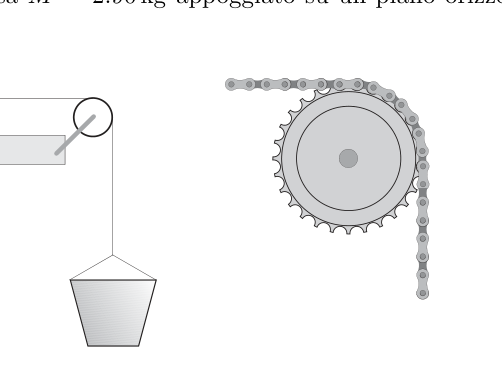
Un secchiello di massa è appeso ad un filo inestensibile che passa nella gola di una carrucola ed è attaccato, all’altra estremità, ad un blocco di massa appoggiato su un piano orizzontale (vedi figura a sinistra). Siano e i coefficienti di attrito, rispettivamente statico e dinamico, tra il blocco e il piano d’appoggio. Si trascuri la massa del filo e quella della carrucola. Si supponga che la carrucola possa ruotare sul proprio perno con attrito trascurabile.
- Si dimostri che in questa situazione il sistema, inizialmente fermo, è in equilibrio, e si calcoli il modulo della forza d’attrito tra il blocco e il piano. Una palla di stucco, di massa , viene fatta cadere verticalmente nel secchiello e, arrivata sul fondo, vi aderisce senza rimbalzare e senza far oscillare il secchiello. Sia la velocità della palla al momento dell’impatto. Sia l’intensità della forza che la palla esercita sul secchiello per un breve intervallo di tempo . Si indichi con il suo valore massimo (detto di picco) e con il suo valore medio durante l’urto. Posto , il valore di dipende dai dettagli dell’urto, ovvero dalla forma del picco nel grafico ; valori ragionevoli possono variare nell’intervallo tra 0.5 e 0.8. Si supponga che nel nostro caso sia .
- Tenendo conto di tutte le forze in gioco (anche di quelle non impulsive) si trovi qual è il minimo valore che dovrebbe avere la durata dell’urto affinché il secchiello e il blocco non vengano messi in moto dall’urto. Si supponga, d’ora in poi, di poter trattare l’urto come istantaneo.
- Si calcoli la velocità del secchiello immediatamente dopo l’urto.
- Si calcoli l’accelerazione del secchiello dopo l’urto. Si consideri ora una situazione in cui la carrucola è sostituita da una ruota dentata di massa (a destra in figura), il filo è sostituito da una catena ideale perfettamente flessibile e di massa trascurabile incastrata nella ruota. Per il calcolo del momento d’inerzia si supponga di poter assimilare la ruota dentata a un disco omogeneo di raggio .
- Si calcoli, in questa nuova situazione, la velocità del secchiello subito dopo l’urto.
- Si determini l’accelerazione del secchiello dopo l’urto.
p.4 — Secchiello, blocco, filo e carrucola dentata
Topic: Newtonian Mechanics, Conservation of Momentum, Rotational Dynamics Metodi: Free-Body Diagram, Impulse-Momentum Theorem, Conservation of Momentum, Torque & Angular Momentum Analysis Competenze: Diagrammatic Reasoning, Mathematical Modeling, Physical Reasoning Objects: Container, String, Pulley, Block, Ball, Gear Fonte: Testo (PDF) — p.4 Soluzione: Soluzioni (PDF)
P1 The stucco in the bucket Points 100
A mass bucket is suspended from an unextended wire that passes through the throat of a carriage and is attached, at the other end, to a mass block resting on a horizontal plane (see figure to the left). The friction coefficients, static and dynamic, between the block and the support plane are and respectively. You’re neglecting the mass of the wire and the carriage. Suppose the carriage can rotate on its own axle with negligible friction.
- It is shown that in this situation the system, initially stationary, is in balance, and the form of the force of friction between the block and the plane is calculated. A stucco ball, of mass, is dropped vertically into the bucket and, when it reaches the bottom, adheres to it without bouncing or swinging the bucket. Whether the speed of the ball at the time of impact. Both the intensity of force that the ball exerted on the can for a short time interval . Indicate its maximum value (peak) with and its mean value during impact with . Since , the value of depends on the impact details, or the shape of the peak in the graph; reasonable values can vary between 0.5 and 0.8. Suppose in our case it is .
- Taking into account all the forces involved (including non-impulsive forces), the minimum value for the duration of impact should be found so that the bucket and block are not set in motion by impact. It is assumed that from now on, the impact can be treated as instantaneous.
- The speed of the flask shall be calculated immediately after impact.
- The acceleration of the bucket after impact is calculated. Considering now a situation where the carriage is replaced by a toothed wheel of mass (right in the figure), the wire is replaced by a perfectly flexible, negligible mass ideal chain embedded in the wheel. For the calculation of moment of inertia, assume that the toothed wheel can be assimilated to a homogeneous disc of radius.
- In this new situation, the speed of the bucket is calculated immediately after the impact.
- The acceleration of the bucket after impact is determined.
The following table shows the number of units of the vehicle:
Topic: Newtonian Mechanics, Conservation of Momentum, Rotational Dynamics Metodi: Free-Body Diagram, Impulse-Momentum Theorem, Conservation of Momentum, Torque & Angular Momentum Analysis Competenze: Diagrammatic Reasoning, Mathematical Modeling, Physical Reasoning Objects: Container, String, Pulley, Block, Ball, Gear Fonte: Testo (PDF) — p.4 Soluzione: Soluzioni (PDF)
P2 Da lontano verso il solenoide — Punti 100
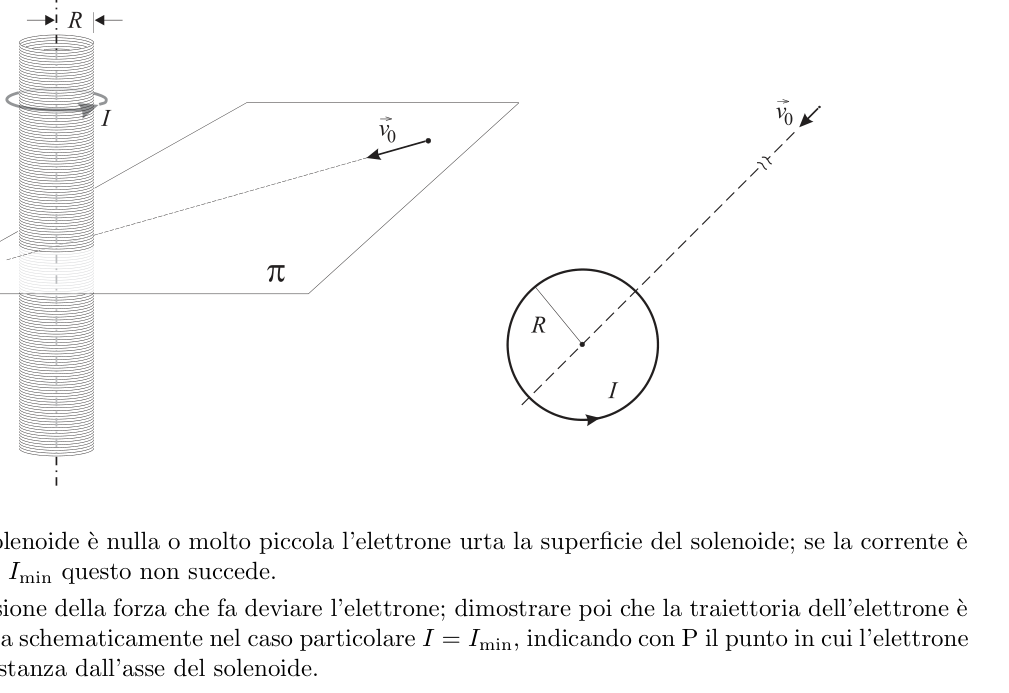
Si consideri un solenoide compatto di raggio , di lunghezza finita ma molto maggiore del raggio, con spire per unità di lunghezza ottenute con un filo molto sottile, tale che il suo spessore possa essere trascurato e che ogni spira possa essere descritta come una circonferenza su di un piano perpendicolare all’asse del solenoide. Gli effetti della gravità potranno essere ignorati e la permeabilità magnetica dell’aria sarà identificata con quella del vuoto . Di solito, in queste condizioni, il campo magnetico generato dalla corrente costante che scorre nel filo è approssimato con un campo uniforme all’interno del solenoide (), parallelo ed orientato come l’asse , mentre non si considera il campo esterno .
- Esprimere, in funzione dei dati, il modulo di e del flusso di attraverso una sezione ortogonale al solenoide passante per il suo centro, nell’approssimazione che il campo sia uniforme. In alcuni fenomeni, come quello che sarà esaminato in questo problema, il campo magnetico esterno non è affatto trascurabile anzi è proprio il campo esterno che crea gli effetti interessanti. In questo problema non sarà mai necessario calcolarne l’intensità ma solo conoscerne la direzione e il flusso. Si consideri il piano perpendicolare all’asse del solenoide per il suo punto medio, sul quale i punti saranno individuati da una coppia di coordinate polari con origine nel centro del solenoide. Nei punti del piano , esterni al solenoide, il campo magnetico è parallelo a quello interno ma con verso opposto.
- Si dimostri che il flusso attraverso la sola superficie del piano esterna al solenoide è uguale e contrario al flusso interno e se ne scriva l’espressione. Per esplorare il campo magnetico esterno si può pensare di lanciare un elettrone (di massa e carica ) da un punto del piano , a grande distanza, esattamente verso l’asse del solenoide. La velocità iniziale dell’elettrone sia di modulo e in direzione ortogonale all’asse del solenoide. Se la corrente nel solenoide è nulla o molto piccola l’elettrone urta la superficie del solenoide; se la corrente è maggiore di un valore questo non succede.
- Scrivere l’espressione della forza che fa deviare l’elettrone; dimostrare poi che la traiettoria dell’elettrone è piana e disegnarla schematicamente nel caso particolare , indicando con P il punto in cui l’elettrone è alla minima distanza dall’asse del solenoide. Si consideri il momento della forza individuata al punto precedente, calcolato rispetto all’asse del solenoide.
- Si dimostri che, in un punto generico della traiettoria dell’elettrone a distanza dall’asse, il modulo di tale momento può essere scritto come dove è la componente radiale della velocità, cioè . In presenza di un momento non nullo della forza, il momento angolare dell’elettrone, rispetto all’asse del solenoide, non è costante ma varia al variare della distanza dall’asse del solenoide. Sarà utile, nel seguito, trovare una relazione tra la variazione del momento angolare dell’elettrone e il flusso ottenuto come la somma (integrale) dei contributi infinitesimi di flusso attraverso corone circolari di superficie infinitesima, di raggio e spessore .
- Scrivere di quanto varia per una variazione della distanza e dimostrare che è proporzionale a .
- Utilizzando la relazione di proporzionalità fra e , esprimere il momento angolare dell’elettrone nel punto P di minimo avvicinamento (citato nella domanda 3) in funzione del modulo del flusso .
- Trovare infine l’espressione della corrente oltre la quale l’elettrone non urta il solenoide, in funzione della velocità iniziale dell’elettrone e del raggio del solenoide.
p.5 — Solenoide, piano e anello con velocita elettrone
Topic: Magnetism, Electromagnetism, Newtonian Mechanics Metodi: Ampère’s Law, Lorentz Force Analysis, Calculus-Integration, Conservation Laws Competenze: Mathematical Modeling, Physical Reasoning, Diagrammatic Reasoning Objects: Solenoid, Wire, Electron Fonte: Testo (PDF) — p.4 Soluzione: Soluzioni (PDF)
P2 From far away to the solenoid Points 100
A compact solenoid of radius, of finite length but much greater than the radius, with spires per unit length obtained with a very thin wire, such that its thickness can be neglected and that each spire can be described as a circumference on a plane perpendicular to the axis of the solenoid. The effects of gravity can be ignored and the magnetic permeability of the air will be identified with that of the vacuum . Usually, under these conditions, the magnetic field generated by the constant current flowing in the wire is approximated by a uniform field within the solenoid (), parallel and oriented as the axis , while the external field is not considered.
- Express, according to the data, the and the flow of through an orthogonal section to the solenoid passing through its center, in the approximation that the field is uniform. In some phenomena, such as the one that will be examined in this problem, the external magnetic field is not negligible at all, rather it is the external field that creates the interesting effects. In this problem it will never be necessary to calculate its intensity but only to know its direction and flow. Consider the plane perpendicular to the solenoid’s axis for its midpoint, where the points will be identified by a pair of polar coordinates originating in the center of the solenoid. In the points of the plane , outside the solenoid, the magnetic field is parallel to the inner one but with the opposite direction.
- The flow through the sole surface of the plane outside the solenoid is shown to be equal to and contrary to the flow inside and the expression is written as follows. To explore the external magnetic field one can think of launching an electron (mass and charge ) from a point in the plane , at a great distance, exactly towards the solenoid axis. The initial velocity of the electron is and in the orthogonal direction to the axis of the solenoid. If the current in the solenoid is small or very small the electron hits the surface of the solenoid; if the current is greater than a value this does not happen.
- Write down the force that causes the electron to deviate; then prove that the trajectory of the electron is flat and draw it schematically in the particular case , indicating with P the point at which the electron is at the minimum distance from the solenoid axis. Consider the moment of force identified in the previous point, calculated with respect to the solenoid axis.
- It is shown that at a generic point on the electron trajectory at a distance from the axis, the module at that point can be written as where is the radial component of the velocity, i.e. . In the presence of a non-zero moment of force, the angular moment of the electron, relative to the solenoid axis, is not constant but varies with the variation of the distance from the solenoid axis. It will be useful, below, to find a relationship between the variation in the angular momentum of the electron and the flow obtained as the (integral) sum of the infinitesim contributions of flow through circular crowns of infinitesim surface, radius and thickness .
- Write how much varies for a variation of the distance and prove that is proportional to .
- Using the proportionality ratio between and , express the angular moment of the electron at the point P of minimum approach (cited in Question 3) according to the flow formula .
- Finally, find the current over which the electron does not strike the solenoid, depending on the initial velocity of the electron and the radius of the solenoid.
**p.5 ** Solenoid, plane and electron-speed ring
Topic: Magnetism, Electromagnetism, Newtonian Mechanics Metodi: Ampère’s Law, Lorentz Force Analysis, Calculus-Integration, Conservation Laws Competenze: Mathematical Modeling, Physical Reasoning, Diagrammatic Reasoning Objects: Solenoid, Wire, Electron Fonte: Testo (PDF) — p.4 Soluzione: Soluzioni (PDF)
P3 Scalda e raffredda — Punti 100
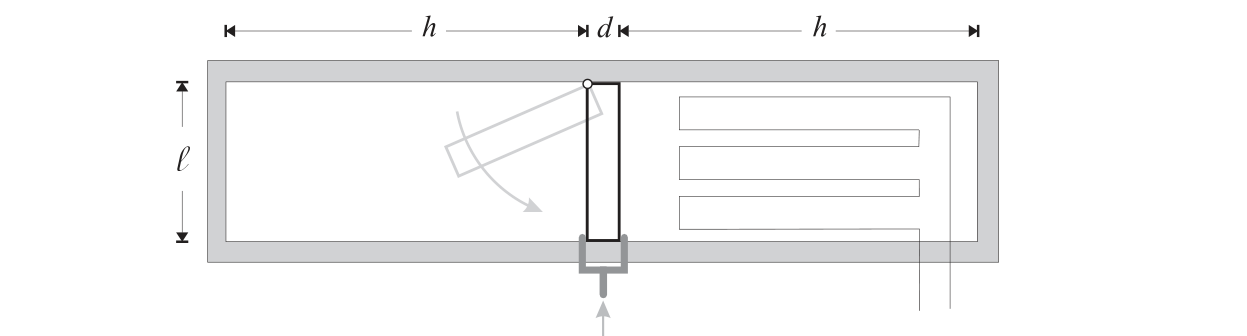
L’interno di un contenitore con pareti isolanti a sezione quadrata è lungo . Un setto mobile di forma quadrata di lato e spessore può essere ruotato per dividere a tenuta stagna in due parti uguali il contenitore. Nel contenitore vengono immesse moli di elio a temperatura e successivamente il setto viene lentamente abbassato e fissato con il blocco mostrato in figura; in questa è riportata schematicamente anche una resistenza elettrica , la cui reale geometria è tale da poter scaldare uniformemente il gas contenuto nella camera di destra; il volume occupato dalla resistenza può essere ignorato. La capacità termica dell’elemento riscaldante e del setto siano trascurabili. NOTA – Attenzione a non confondere il simbolo della resistenza con quello maiuscolo della costante dei gas perfetti. Il circuito elettrico viene collegato ad un generatore di f.e.m. per un breve tempo . Si faccia l’ipotesi che in questo tempo il setto costituisca un buon isolante termico tra le due camere; in altri termini, il coefficiente di conduzione termica del setto è piccolo ma non trascurabile su tempi lunghi.
- Ricavare l’espressione della potenza erogata dal riscaldatore e calcolare la temperatura del gas alla fine del riscaldamento.
- Ricavare l’espressione del valore massimo della potenza dispersa attraverso il setto durante il riscaldamento.
- Dal confronto delle due potenze, individuare la condizione che deve soddisfare il coefficiente di conduzione del materiale con cui è fatto il setto perché l’ipotesi che esso costituisca un buon isolante termico sia valida.
- In termini delle grandezze date, esprimere la forza che il blocco deve esercitare sul setto al momento in cui si spegne l’elemento riscaldante. Dato che il setto non è un perfetto isolante, le due parti di gas si porteranno in un tempo lungo all’equilibrio termico (questo è detto processo di termalizzazione).
- Calcolare la temperatura di equilibrio termico del sistema. Si indichi con il calore scambiato in un tempo tra le due parti di gas, con la temperatura del gas freddo, con quella del gas caldo.
- Poiché il processo di termalizzazione è irreversibile, l’entropia del sistema aumenta. Di quanto? Per rendere reversibile il processo di termalizzazione, con delle opportune modifiche e dopo aver sostituito il setto con uno perfettamente isolante, si mettono in contatto le due camere attraverso una macchina reversibile di Carnot e si ripete l’esperienza facendo eseguire alla macchina cicli infinitesimi tra le temperature istantanee e dei due gas, fino a raggiungere l’equilibrio termico.
- Spiegare perché la temperatura finale del gas sarà adesso minore di quella trovata sopra, al punto 5.
- Determinare la temperatura di equilibrio termico , che si raggiunge facendo uso della macchina reversibile.
p.6 — Contenitore quadrato con setto mobile ruotabile
Topic: Thermodynamics, Circuits, Kinetic Theory Metodi: First Law of Thermodynamics, Ideal Gas Law, Thermodynamic Cycle Analysis, Differential Equations Competenze: Mathematical Modeling, Physical Reasoning, Diagrammatic Reasoning Objects: Gas, Container, Resistor Fonte: Testo (PDF) — p.6 Soluzione: Soluzioni (PDF)
P3 Heat and cooling 100 points
The inside of a container with insulating walls in a square section is long. A movable set of a square side shape and thickness may be rotated to divide the container into two equal parts at a constant rate. The container is inserted moles of helium at temperature and the set is then slowly lowered and fixed with the block shown in the figure; in this one an electrical resistance is also reported schematically, the real geometry of which is such that the gas contained in the right chamber can be heated evenly; the volume occupied by the resistance can be ignored. The thermal capacity of the heating element and the seating is negligible. NOTE Please note that the resistance symbol is not to be confused with the perfect gas constant capital . The electrical circuit is connected to an electrical generator. for a short time . The assumption is that the septum is a good thermal insulator between the two chambers at this time; in other words, the heat conduction coefficient of the septum is small but not negligible over long periods.
- To obtain the power output from the heater and to calculate the gas temperature at the end of the heating.
- Find the expression of the maximum value of the power dispersed through the sept during heating.
- From the comparison of the two powers, determine the condition which must satisfy the conduction coefficient of the material with which the sexting is made in order for the assumption that it constitutes a good thermal insulator to be valid.
- In terms of the given quantities, express the force that the block must exert on the set when the heating element is turned off. Since the septum is not a perfect insulator, the two parts of the gas will eventually reach thermal equilibrium (called the thermalisation process).
- Calculate the heat equilibrium temperature of the system. The heat exchanged at a time between the two parts of the gas, with the temperature of the cold gas, with that of the hot gas, shall be indicated by .
- Since the thermalisation process is irreversible, entropy of the system increases. How much? To make the thermalisation process reversible, with appropriate modifications and after replacing the septum with a perfectly insulating one, the two chambers are put into contact through a reversible Carnot machine and the experience is repeated by running the machine endless cycles between the instantaneous temperatures and of the two gases, until the thermal equilibrium is reached.
- Explain why the final gas temperature will now be lower than the one above, point 5.
- Determine the thermal equilibrium temperature , which is achieved by using the reversible machine.
p.6 Square container with rotating mobile sevent
Topic: Thermodynamics, Circuits, Kinetic Theory Metodi: First Law of Thermodynamics, Ideal Gas Law, Thermodynamic Cycle Analysis, Differential Equations Competenze: Mathematical Modeling, Physical Reasoning, Diagrammatic Reasoning Objects: Gas, Container, Resistor Fonte: Testo (PDF) — p.6 Soluzione: Soluzioni (PDF)