P1 Cuneo Punti 100 Un cuneo di massa , avente la sezione di triangolo isoscele di semiapertura , poggia su due pistoni, ciascuno di massa , che possono scorrere entro due guide orizzontali. Le pareti dei pistoni a contatto con il cuneo hanno la stessa inclinazione delle sue facce. Ciascun pistone è a sua volta a contatto con una molla ideale di costante , la cui altra estremità è fissata a una parete verticale. Si suppongano trascurabili tutti i possibili attriti. Si adottino un asse orizzontale e un asse verticale e orientato verso il basso. Nella situazione iniziale il vertice Z del cuneo si trova sulla linea di riferimento AB, le molle hanno la loro lunghezza di riposo, , e i pistoni sono bloccati nella posizione mostrata in figura da due fermi (non rappresentati).
- Calcolare, nella situazione iniziale, il modulo della forza che il cuneo esercita su ciascun pistone. Tolti i fermi, il cuneo viene fatto scendere molto lentamente finché il sistema resta in equilibrio.
- Di quanto si comprime ciascuna molla e di quanto si abbassa il cuneo? Il cuneo viene di nuovo sollevato fino alla posizione iniziale e viene lasciato cadere.
- Calcolare il modulo della forza che il cuneo, subito dopo averlo lasciato andare, esercita su ciascun pistone e quelli delle forze che la molla e la guida esercitano sul pistone.
- Supponendo che l’altezza del cuneo sia abbastanza grande da permettergli di compiere un moto oscillatorio, dimostrare che si tratta di un moto armonico e calcolare l’ampiezza, il periodo e la velocità massima raggiunta dal cuneo.
p.4 — Cuneo su due pistoni con molle
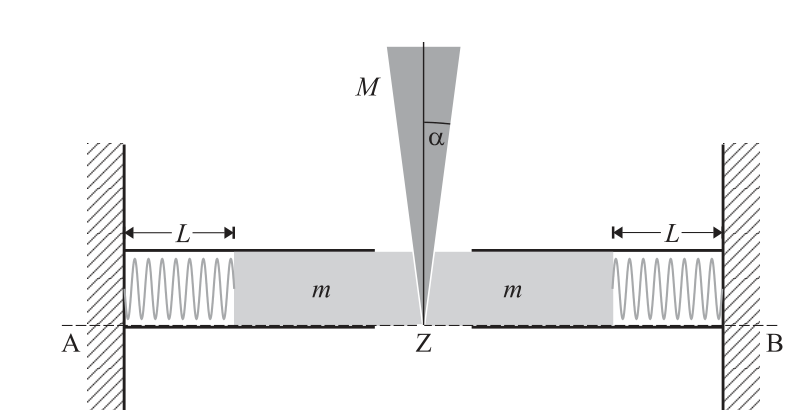
Topic: Newtonian Mechanics, Oscillations & Waves Metodi: Free-Body Diagram, Hooke’s Law, Vector Decomposition, Simple Harmonic Motion Analysis Competenze: Diagrammatic Reasoning, Mathematical Modeling, Physical Reasoning Objects: Wedge, Piston, Spring Fonte: Testo (PDF) — p.4 Soluzione: Soluzioni (PDF)
P1 Cuneo The following points shall be added: A cone of mass , having the triangle isosceles section of semiautomatic , rests on two Pistons, each in mass, which can flow within two horizontal guides. Piston walls When they come into contact with the cone, they have the same inclination as its faces. Each piston is in turn in contact with the other piston. with an ideal spring of constant , the other end of which is fixed to a vertical wall. Any possible friction is assumed to be negligible. A horizontal axis and a vertical axis shall be adopted and It’s downward facing. In the initial situation the Z-top of the cone is on the reference line AB, the springs have the their rest length , and the pistons are locked in the position shown in Figure by two stops (not represented).
- Calculate, in the initial situation, the force modulus exerted by the cune on each piston. When the stalls are removed, the cuneiform is lowered very slowly until the system remains in balance.
- How much is each spring compressed and how much is the cone lowered? The cuneiform is raised again to its initial position and dropped.
- Calculate the force modulus that the cune, as soon as it is released, exerts on each piston And the forces that release and guide the piston.
- Assuming the height of the cone is large enough to allow it to perform a oscillating motion, demonstrate that it is a harmonic motion and calculate the width, period and maximum speed reached by the cuneo.
**p.4 ** Two-spring piston coupling
Topic: Newtonian Mechanics, Oscillations & Waves Metodi: Free-Body Diagram, Hooke’s Law, Vector Decomposition, Simple Harmonic Motion Analysis Competenze: Diagrammatic Reasoning, Mathematical Modeling, Physical Reasoning Objects: Wedge, Piston, Spring Fonte: Testo (PDF) — p.4 Soluzione: Soluzioni (PDF)
P2 Trasformazione termodinamica Punti 40 Un sistema costituito da un gas perfetto biatomico esegue, in senso orario, il ciclo termodinamico reversibile mostrato nel diagramma seguente in cui la trasformazione CA è adiabatica. Si considerino noti e e sia con .
- Si determini in funzione di e .
- Si trovi il rendimento del ciclo, in funzione di .
- Tenendo conto che la funzione è monotona crescente per , si determini il valore di , con un errore inferiore a , per il quale il rendimento è pari al 24 %.
- Si determini in quale o in quali stati del ciclo l’entropia del sistema è massima, e in quale o quali stati minima. Si calcoli il valore di in funzione di e della quantità di sostanza espressa in moli ().
p.5 — Ciclo termodinamico nel piano p-V
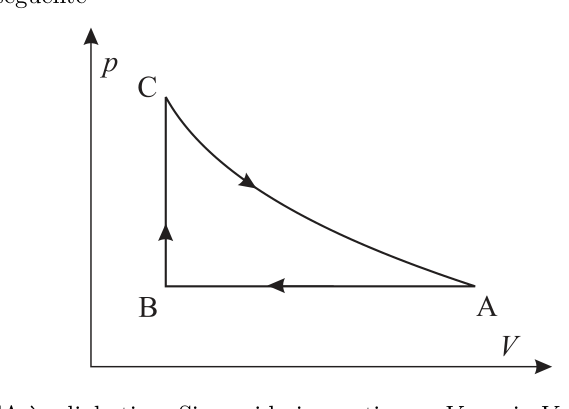
Topic: Thermodynamics Metodi: First Law of Thermodynamics, Thermodynamic Cycle Analysis, Ideal Gas Law Competenze: Mathematical Modeling, Physical Reasoning Objects: Gas Fonte: Testo (PDF) — p.5 Soluzione: Soluzioni (PDF)
P2 Thermodynamic transformation The Commission shall adopt implementing acts in accordance with Article 21 of this Regulation. A system consisting of a perfect biatomic gas executes the reversible thermodynamic cycle in a clockwise manner shown in the following diagram where the CA transformation is adiabatic. and are considered to be known and with .
- is determined by and .
- The yield of the cycle is found, as a function of .
- Taking into account that the function is increasingly monotonous for , the value of is determined with a error less than , for which the yield is 24%.
- Determine in which or in which system entropy cycle states is greatest, and in which or in which states The minimum. The value of shall be calculated as a function of and the amount of substance expressed in moles ().
The following table shows the results of the calculation of the energy efficiency of the p-V-plane:
Topic: Thermodynamics Metodi: First Law of Thermodynamics, Thermodynamic Cycle Analysis, Ideal Gas Law Competenze: Mathematical Modeling, Physical Reasoning Objects: Gas Fonte: Testo (PDF) — p.5 Soluzione: Soluzioni (PDF)
P3 Allargamento Doppler Punti 60 La luce di un laser non può essere mai rigorosamente monocromatica ma è sempre distribuita entro un piccolo intervallo di lunghezze d’onda, la cui ampiezza dipende da molti fattori. Questo problema prenderà in esame uno solo di questi, l’effetto Doppler classico, dovuto al moto di agitazione termica degli atomi che emettono la luce; altri effetti saranno del tutto ignorati. Si potrà dunque fare l’ipotesi che, se gli atomi fossero fermi, la luce emessa sarebbe rigorosamente monocromatica, con una lunghezza d’onda . Si consideri un laser He-Ne, schematicamente rappresentato in figura; si supponga che il sistema si trovi all’equilibrio termodinamico alla temperatura di 300 K. La luce viene generata da atomi di neon che si trovano all’interno di una cavità ottica, la quale ha lo scopo di amplificare la radiazione che si propaga in un’unica direzione (quella di emissione del fascio). A causa delle diverse velocità degli atomi, la radiazione emessa da ciascun atomo viene vista da un osservatore esterno, per effetto Doppler, con una lunghezza d’onda leggermente diversa da quella emessa dagli altri atomi, cosicché l’effetto complessivo è quello di un “allargamento” della riga spettrale attorno al valore . Si fissi un asse nella direzione e nel verso indicato in figura.
- Dalla teoria cinetica dei gas si ricava che la velocità quadratica media è , dove è la costante di Boltzmann, la massa di una molecola e la temperatura assoluta degli atomi del gas. Si ricavi il valore quadratico medio della componente della velocità degli atomi di neon (si ricordi che il neon è monoatomico). Per valutare l’allargamento della riga spettrale occorre conoscere la distribuzione della componente della velocità degli atomi di neon. In un modello teorico molto semplificato si può assumere che questa sia distribuita uniformemente entro un intervallo compreso tra e . Per “distribuzione di velocità” si intende una funzione tale che rappresenti la frazione di atomi con velocità compresa tra e .
- Nel caso del modello semplificato descritto sopra, la distribuzione ha un valore costante all’interno dell’intervallo e nulla fuori; si determini l’espressione di questa costante in funzione di . Per una data distribuzione di velocità, il valore medio di una funzione è dato dall’integrale
- Si determini l’ampiezza dell’intervallo di distribuzione delle velocità degli atomi, in modo tale che il valore quadratico medio di sia uguale a quello trovato al punto 1.
- Calcolare l’ampiezza dell’intervallo di lunghezze d’onda emesse dal laser, secondo questo modello semplificato. In un modello teorico un po’ più sofisticato, si può considerare che la componente delle velocità degli atomi si distribuisca secondo la legge di Maxwell-Boltzmann essendo per definizione e dove è un’opportuna costante.
- Ricavare analiticamente e disegnare schematicamente la funzione di distribuzione della luce emessa dal laser, cioè la funzione tale che rappresenti la frazione di fotoni aventi lunghezza d’onda compresa tra e .
- Calcolare l’ampiezza dell’intervallo di lunghezze d’onda emesse dal laser, secondo questo modello. Si intende la distanza in tra i punti per cui la distribuzione vale metà del massimo.
p.6 — Schema del laser He-Ne
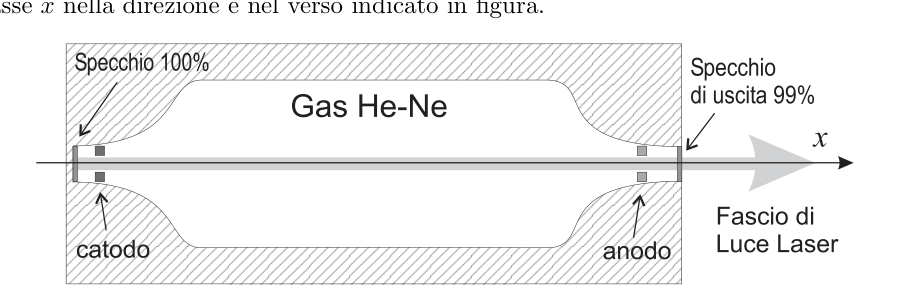
Topic: Oscillations & Waves, Kinetic Theory, Thermodynamics Metodi: Kinetic Theory of Gases, Statistical Averaging, Approximation & Series Expansion Competenze: Mathematical Modeling, Physical Reasoning Objects: Gas, Atom, Photon Fonte: Testo (PDF) — p.6 Soluzione: Soluzioni (PDF)
P3 Doppler expansion The following points shall be added: The light from a laser can never be strictly monochrome but is always distributed within a small The range of wavelengths, the width of which depends on many factors. This problem will be examined The classical Doppler effect, due to the thermal agitation motion of the atoms emitting the The lighting of the light, and other effects, will be completely ignored. So we can assume that if atoms were still, light would be The emission would be strictly monochrome, with a wavelength . Consider a He-Ne laser, diagrammatically represented in the figure; assume that the system is located in the at a temperature of 300 K. The light is generated by neon atoms that are located in the inside an optical cavity, which is intended to amplify the radiation propagating in a single direction (the direction of emission of the beam). Because of the different velocities of the atoms, radiation emitted by the Each atom is viewed by an outside observer, by the Doppler effect, with a slightly longer wavelength. The resulting effect is that of a line widening. spettrale attorno al valore . A axis shall be fixed in the direction and direction shown in Figure 1.
- The kinetic theory of gases shows that the average square velocity is , where is the Boltzmann constant, the mass of a molecule and the absolute temperature of the atoms of the The gas. The average square value of the component of neon atomic velocity is obtained (remember The neon is monoatomic. To assess the width of the spectral line, the distribution of the component of the The speed of neon atoms. In a very simplified theoretical model, we can assume that this is distributed uniformly within a range of to . Speed distribution means a function such that represents the fraction of atoms a speed between and .
- In the case of the simplified model described above, the distribution has a constant value within The value of the range and nothing outside; the expression of this constant is determined by . For a given speed distribution, the mean value of a function is given by the integral
- The width of the atomic velocity distribution range is determined so that the value of the average square of is equal to that found in point 1.
- Calculate the width of the laser-emitted wavelength range according to this simplified model. In a somewhat more sophisticated theoretical model, the component of atomic velocities can be considered as the It’s distributed according to Maxwell-Boltzmann’s law. being by definition and where is a constant opportunity.
- Analytically collect and schematically draw the distribution function of the light emitted by the laser, i.e. the function such that represents the fraction of photons with wavelengths including between and .
- Calculate the width of the laser-emitted wavelength range according to this model. The distance in between the points for which the distribution is half the maximum.
p.6 — Schema del laser He-Ne
Topic: Oscillations & Waves, Kinetic Theory, Thermodynamics Metodi: Kinetic Theory of Gases, Statistical Averaging, Approximation & Series Expansion Competenze: Mathematical Modeling, Physical Reasoning Objects: Gas, Atom, Photon Fonte: Testo (PDF) — p.6 Soluzione: Soluzioni (PDF)
P4 Spira triangolare Punti 100 Nella spira a forma di triangolo rettangolo isoscele (v. figura) il lato maggiore è , la massa e la resistenza elettrica . L’induttanza della spira e l’attrito meccanico possono considerarsi trascurabili. Nella prima parte di questo problema la spira viene spostata in un piano orizzontale a velocità costante , partendo da grande distanza, verso un semispazio ove è presente un campo magnetico verticale e uniforme, orientato come in figura. La posizione della spira sia individuata dalla coordinata del punto P rispetto all’origine O; si indichi con l’istante in cui il vertice P della spira transita nel punto O (), cosicché si dovranno usare valori negativi di per descrivere il moto della spira nel semispazio .
- Determinare la corrente indotta nella spira in funzione del tempo e riportare tale funzione in un grafico.
- Dopo aver determinato, in funzione della posizione , la forza esterna che occorre applicare alla spira in modo che il moto resti sempre uniforme a velocità , calcolare il lavoro complessivo fatto da tale forza.
- Verificare che l’energia dissipata per effetto Joule coincide con il lavoro fatto dalla forza esterna. Nella seconda parte si ripete l’esperimento, lanciando la spira sempre da grande distanza, e sempre a velocità ma, questa volta, senza applicare nessuna forza esterna.
- Spiegare perché la velocità della spira non può mai diventare negativa. Nella fase in cui la spira sta entrando nel semispazio , cioè mentre la spira è immersa solo parzialmente nella regione di campo magnetico, la sua velocità è legata alla posizione dalla relazione
- Verificare che questa legge di velocità soddisfa l’equazione del moto (seconda legge della dinamica) con le corrette condizioni iniziali.
- Dire per quali valori della velocità la spira raggiunge la posizione e calcolare l’energia dissipata per effetto Joule durante il moto in questo caso.
p.7 — Spira triangolare e campo magnetico
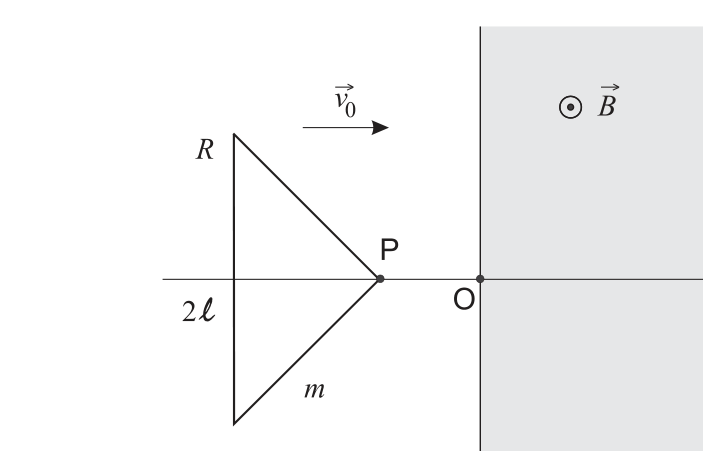
Topic: Electromagnetic Induction, Newtonian Mechanics, Conservation of Energy Metodi: Faraday’s Law of Induction, Free-Body Diagram, Energy Conservation Method Competenze: Mathematical Modeling, Diagrammatic Reasoning, Physical Reasoning Objects: Coil Fonte: Testo (PDF) — p.7 Soluzione: Soluzioni (PDF)
P4 Triangular spindle The following points shall be added: In the triangle-shaped spiral isosceles (v. Figure 1) the major side is , the mass and the resistance elettrica . The inductance of the spire and mechanical friction may be considered negligible. In the first part of this problem the spiral is moved horizontally at constant speed , Starting from a great distance, towards a semispace where a vertical and uniform magnetic field is present, The direction of the plane is as shown in the figure. The position of the spire is determined by the coordinate of the point P relative to the origin O; it is indicated by The moment the P-top of the spire transits the point O (), so negative values of to describe the motion of the spire in the semispace .
- Determine the induced current in the spire as a function of time and report this function in a graph.
- After determining, depending on the position , the external force to be applied to the spindle in the so that the engine is always uniform at , calculate the total work done by this force.
- Verify that the energy dissipated by the Joule effect coincides with the work done by the external force. In the second part, the experiment is repeated, throwing the spire always at a great distance, and always at speed. ma, questa volta, senza applicare nessuna forza esterna.
- Explain why the speed of the spire can never become negative. In the phase where the spiral is entering the semispace , that is, while the spiral is only partially submerged In the magnetic field region, its velocity is related to the position by the relation
- Verify that this law of speed satisfies the equation of motion (second law of dynamics) with the the correct initial conditions.
- Specify which speed values the spire reaches and calculate the energy dissipated The Joule effect during the engine in this case.
**p.7 ** Triangular spiral and magnetic field
Topic: Electromagnetic Induction, Newtonian Mechanics, Conservation of Energy Metodi: Faraday’s Law of Induction, Free-Body Diagram, Energy Conservation Method Competenze: Mathematical Modeling, Diagrammatic Reasoning, Physical Reasoning Objects: Coil Fonte: Testo (PDF) — p.7 Soluzione: Soluzioni (PDF)