- – Dallo studio delle oscillazioni che la sfera compie sulla guida determina la misura del raggio . Per valutare come l’arco di raggio approssima il profilo della guida, si procede come segue. Si riferisce la guida ad una coppia di assi cartesiani . L’asse delle ascisse è parallelo al listello di legno. L’asse delle ordinate è ad esso perpendicolare, passa per la mezzeria della guida arcuata e si considera positivo verso l’alto. La relazione che lega le coordinate di un punto appartenente ad un arco di cerchio è allora . Converremo di ritenere che l’arco di cerchio e quello appartenente alla guida siano indistinguibili se la coordinata calcolata e quella misurata direttamente differiscono non più di 2 mm. Per la misura diretta ti puoi avvalere di un pezzo di carta millimetrata opportunamente piegato.
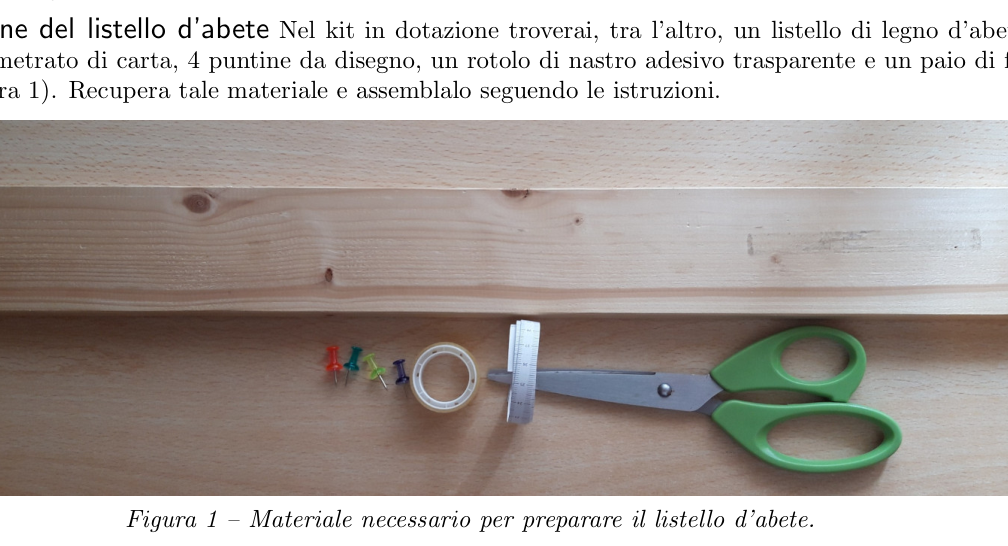
p.2 — Materiale per preparare il listello
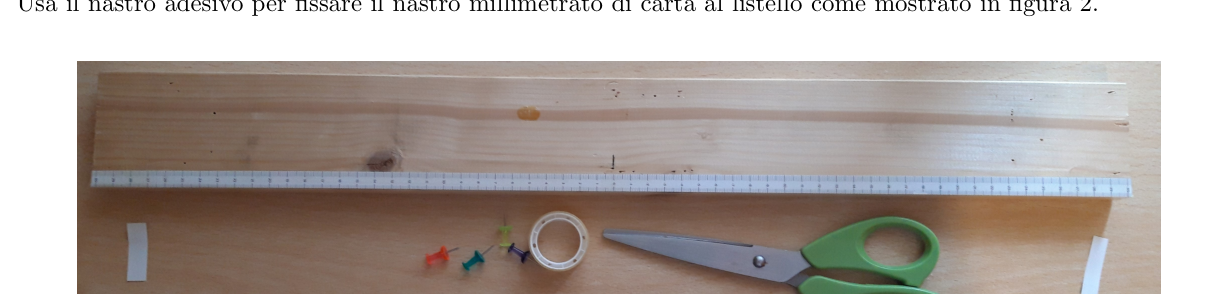
p.3 — Fissaggio nastro millimetrato al listello
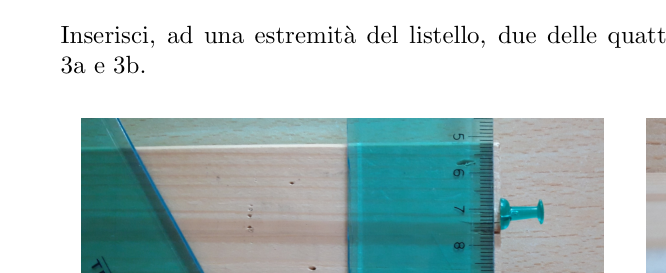
p.3 — Distanza centro-centro tra le puntine
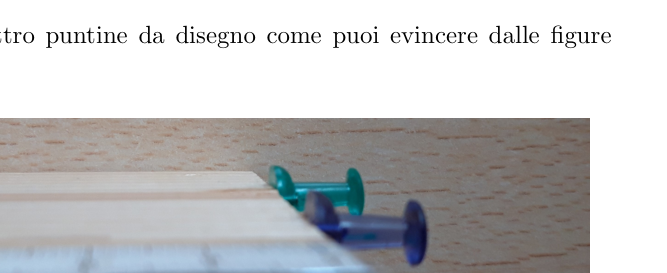
p.3 — Collare delle puntine sporge sopra
p.3 — Listello con puntine montate
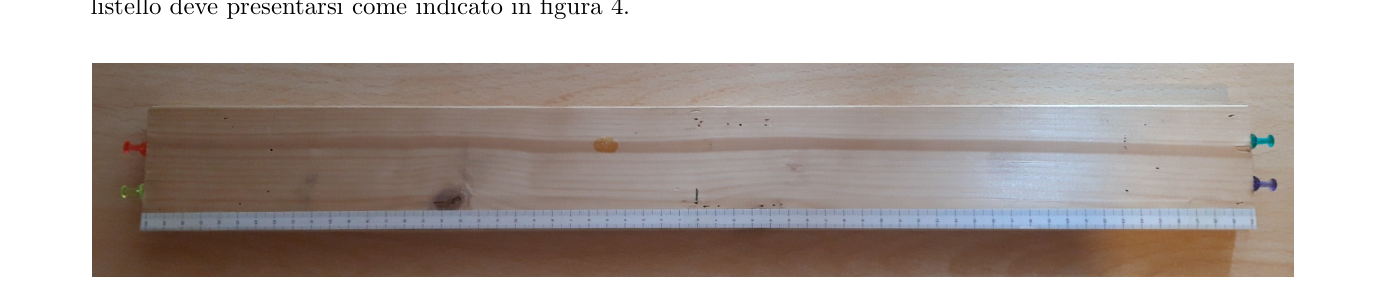
p.4 — Apparato di lavoro a montaggio ultimato

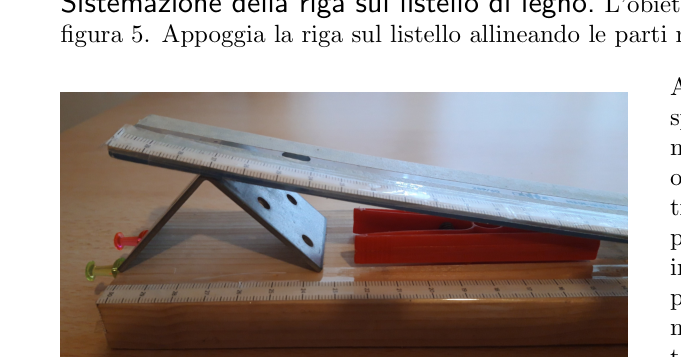
p.4 — Particolare del montaggio dell’angolare
p.5 — Geometria della guida: raggio, angolo, altezza
Topic: Oscillations & Waves, Newtonian Mechanics Metodi: Simple Harmonic Motion Analysis, Small-Angle Approximation, Experimental Data Analysis Competenze: Experimental Data Analysis, Mathematical Modeling, Physical Reasoning Objects: Sphere Fonte: Testo (PDF) — p.4 Soluzione: Soluzioni (PDF)
- The measurement of the radius is determined by studying the oscillations of the sphere on the wheel. To assess how the radius approximates the profile of the steering wheel, the following procedure is followed. It refers to the It is a pair of cartesian axes . The axis of the axes is parallel to the wooden axis. The number of The direction of the steering wheel is perpendicular to it, passes through the centre of the steering wheel and is considered positive upwards. The ratio of the coordinates of a point in a circle arc is then . We shall agree to consider that the circle and the wheel are indistinguishable if the calculated coordinate and the coordinate directly measured differ by no more than 2 mm. For direct measurement You can use a piece of millimeter paper that is folded properly.
The following table shows the list of the products used in the preparation of the list:
The following table shows the results of the tests:
p.3 Centre-center distance between points
**p.3 ** Collar of sporadic points above
**p.3 ** List with mounted points
The manufacturer shall ensure that the manufacturer is able to provide the manufacturer with the necessary information.
**p.4 ** Particular assembly of the corner
The vehicle shall be equipped with a single control unit.
Topic: Oscillations & Waves, Newtonian Mechanics Metodi: Simple Harmonic Motion Analysis, Small-Angle Approximation, Experimental Data Analysis Competenze: Experimental Data Analysis, Mathematical Modeling, Physical Reasoning Objects: Sphere Fonte: Testo (PDF) — p.4 Soluzione: Soluzioni (PDF)
- – Indica quale porzione di guida soddisfa a tale criterio. Riporta in tabella le misure effettuate e descrivi, eventualmente avvalendoti di un disegno schematico di supporto, tutti gli accorgimenti necessari che hai adottato. L’ampiezza del moto della sfera si riduce in modo evidente durante le oscillazioni. Gli effetti prodotti possono essere schematizzati ammettendo la presenza di una forza dissipativa dovuta all’attrito volvente, che si può considerare applicata al centro di massa della sfera, la cui intensità è direttamente proporzionale all’intensità della forza normale alla guida che nasce dall’interazione della sfera con la guida stessa. Volendo semplificare il problema è necessario ricercare le condizioni sperimentali per le quali la forza normale possa essere ritenuta costante. Infatti, la forza normale cambia perché la sfera descrive un arco di cerchio giacente su un piano verticale. Si possono comunque ricercare le condizioni di lavoro che rendono trascurabili (in pratica non misurabili) questi effetti, in modo che sia possibile porre , dove è la massa della sfera e è una costante adimensionale.
Topic: Newtonian Mechanics, Oscillations & Waves Metodi: Free-Body Diagram, Physical Modeling, Small-Angle Approximation Competenze: Experimental Data Analysis, Diagrammatic Reasoning, Physical Reasoning Objects: Sphere Fonte: Testo (PDF) — p.5 Soluzione: Soluzioni (PDF)
- Indicate which part of the vehicle meets this criterion. Table showing the measures taken; and describe, where appropriate, using a supporting schematic, all the measures You’ve adopted the necessary. The width of the sphere’s motion is significantly reduced during oscillations. The effects produced may be: be schematized to allow the presence of a dissipative force due to the rolling friction, which can be The energy of the sphere is directly proportional to the intensity of the sphere. della forza normale alla guida che nasce dall’interazione della sfera con la guida stessa. To simplify The problem is to look for the experimental conditions under which the normal force can be considered. The time is constant. In fact, the normal force changes because the sphere describes a circle arc lying on a vertical plane. However, it is possible to look for working conditions that make them negligible (in practice not measurable) So you can put , where is the mass of the sphere and is a constant. The size of the sample.
Topic: Newtonian Mechanics, Oscillations & Waves Metodi: Free-Body Diagram, Physical Modeling, Small-Angle Approximation Competenze: Experimental Data Analysis, Diagrammatic Reasoning, Physical Reasoning Objects: Sphere Fonte: Testo (PDF) — p.5 Soluzione: Soluzioni (PDF)
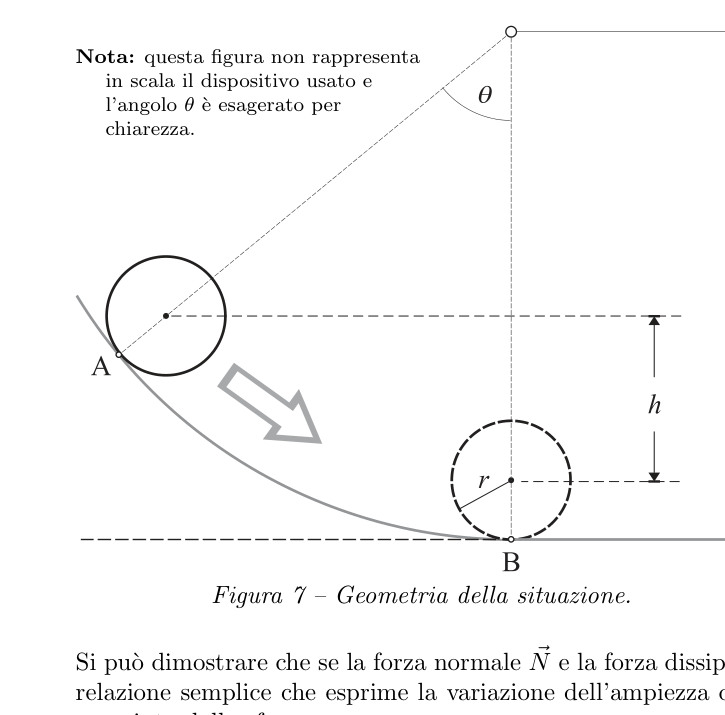
- – Descrivi quale criterio segui per realizzare la condizione per cui l’intensità della forza normale alla guida, , sia praticamente uguale all’intensità della forza peso. Nota: questa figura non rappresenta in scala il dispositivo usato e l’angolo è esagerato per chiarezza. Figura 7 – Geometria della situazione. La forza sottrae energia meccanica alla sfera compiendo su essa lavoro negativo. Ci si propone di esaminare questo fenomeno al fine di misurare il coefficiente . La posizione della sfera sulla porzione circolare di guida può essere espressa dalla misura diretta della lunghezza di un arco grazie all’impiego del nastro millimetrato che hai applicato alla riga (figura 7). Noti l’arco di cerchio e il raggio , è . Dalla figura si ricava la relazione che esprime l’altezza del centro di massa della sfera in funzione dell’angolo : Si può dimostrare che se la forza normale e la forza dissipativa sono quelle descritte sopra allora esiste una relazione semplice che esprime la variazione dell’ampiezza delle oscillazioni in ogni oscillazione completa compiuta dalla sfera
Topic: Newtonian Mechanics, Oscillations & Waves, Conservation of Energy Metodi: Energy Conservation Method, Free-Body Diagram, Small-Angle Approximation Competenze: Physical Reasoning, Mathematical Modeling, Diagrammatic Reasoning Objects: Sphere Fonte: Testo (PDF) — p.5 Soluzione: Soluzioni (PDF)
- Describe what criterion is used to achieve the condition that the intensity of the normal force at the The force of the vehicle, , is approximately equal to the force of the weight. Note: this figure does not represent the device used at scale; and The angle is exaggerated for I’m not going to lie. Figure 7 Geometry of the situation. The force subtracts mechanical energy from the sphere by performing negative work on it. It is proposed to examine this phenomenon in order to measure the coefficient. La The position of the sphere on the circular driving section can be expressed by the direct measurement of the length of an arc thanks the use of the millimeter tape you have The following table shows the results of the calculation of the total value of the input: Note the circle arc and the radius , è . The ratio of the height of the centre of the The mass of the sphere as a function of the angle : It can be shown that if the normal force and the dissipative force are the ones described above then there is a Simple ratio that expresses the change in the range of oscillations in each complete oscillation The sphere
Topic: Newtonian Mechanics, Oscillations & Waves, Conservation of Energy Metodi: Energy Conservation Method, Free-Body Diagram, Small-Angle Approximation Competenze: Physical Reasoning, Mathematical Modeling, Diagrammatic Reasoning Objects: Sphere Fonte: Testo (PDF) — p.5 Soluzione: Soluzioni (PDF)
- – Effettua e riporta in tabella le misure necessarie atte a verificare l’attendibilità della relazione (1), dandone anche una rappresentazione grafica. Dal grafico ricava il coefficiente . PARTE SECONDA – RAMPA DI LANCIO Introduzione. Togli dall’apparato un angolare, e con esso le puntine da disegno e la molletta da bucato corrispondenti, in modo da rendere piana, e orizzontale, una metà della guida, lasciando arcuata l’altra metà. Le puntine da disegno possono aiutarti a realizzare il requisito dell’orizzontalità della parte finale di guida se le impieghi come evidenziato nella figura 8 a pagina seguente. Si ammette che la nuova sistemazione non modifichi sensibilmente il raggio di curvatura della parte curva di riga millimetrata. Ottieni, in tal modo, una rampa di lancio con cui lanciare orizzontalmente la sfera e lasciare che atterri sul tavolo di lavoro. La sfera può essere fatta partire da punti differenti della zona arcuata della rampa e il punto di atterraggio può essere rilevato con la tecnica della carta carbone. Le gittate sono prevedibili e puoi studiare l’accordo tra le previsioni e le misure fornite dall’esperimento. Per prevedere la gittata basta considerare che l’energia potenziale della sfera alla partenza è , dove è l’altezza definita in figura 7. Inoltre, il lavoro fatto dalla forza dissipativa , ipotizzata costante durante tutta la fase di lancio, è possibile calcolarlo con la relazione , con la lunghezza del percorso totale effettuato dalla sfera a contatto con la guida. Alla fine della guida la sfera avrà una energia cinetica data dalla somma di due termini: l’energia del moto di traslazione del centro di massa, , e l’energia di rotazione della sfera intorno all’asse orizzontale passante per il centro di massa , dove è il momento d’inerzia di una sfera omogenea calcolato rispetto ad un diametro. Tenendo conto che, per la condizione di assenza di slittamento è , segue: . Dal bilancio energetico scritto per questa fase del lancio si ottiene, pertanto: Al di sotto di una certa velocità la sfera abbandona la guida solo dopo una rotazione attorno al bordo. Questo “effetto di bordo” altera i valori della velocità e della posizione del centro di massa al momento del distacco dalla guida.
Topic: Newtonian Mechanics, Oscillations & Waves, Conservation of Energy Metodi: Energy Conservation Method, Graph Linearization, Experimental Data Analysis Competenze: Experimental Data Analysis, Graph Linearization, Mathematical Modeling Objects: Sphere Fonte: Testo (PDF) — p.5 Soluzione: Soluzioni (PDF)
- It shall take and report on the measures necessary to verify the reliability of the report (1), And I’m going to give it a graphic representation. The graph shows the coefficient . Part II Ramp of the lance I’ll give you an introduction. Remove from the apparatus a corner, and with it the corresponding drawing points and washing machine, in This is a way of making one half of the wheel flat and horizontal, leaving the other half arched. Drawing points can help you to achieve the requirement of the horizontal end of the wheel if the uses as shown in Figure 8 on the following page. It is accepted that the new arrangement does not significantly alter the curvature radius of the curved part of the millimeter line. You get a launch pad to launch the ball horizontally and let it land on the I’m going to work on the desk. The sphere can be made from different points of the ramp’s arcade and the point The landing rate can be detected using the carbon paper technique. The ranges are predictable and you can study the agreement between the predictions and the measurements provided by the experiment. To predict the range, consider that the potential energy of the ball at the start is , where is the height defined in Figure 7. In addition, the work done by the dissipative force , assumed constant throughout the launch phase, can be calculated by the ratio , with the total length of the path taken by the sphere in contact with the wheel. At the end of the guide the The sphere shall have a kinetic energy given by the sum of two terms: the energy of the transmission The mass centre, , and the rotational energy of the sphere around the horizontal axis passing through the mass center , where is the moment of inertia of a homogeneous sphere calculated relative to It’s a diameter. Whereas, for the condition of absence of slitting , the following is the case: . The energy budget written for this phase of launch therefore provides: At a speed below a certain speed, the sphere leaves the wheel only after rotating around the edge. This one. Board effect Alters the values of the speed and position of the centre of mass at detachment from the driver.
Topic: Newtonian Mechanics, Oscillations & Waves, Conservation of Energy Metodi: Energy Conservation Method, Graph Linearization, Experimental Data Analysis Competenze: Experimental Data Analysis, Graph Linearization, Mathematical Modeling Objects: Sphere Fonte: Testo (PDF) — p.5 Soluzione: Soluzioni (PDF)
- – Effettua e riporta in tabella le misure atte a determinare l’intervallo dei valori dell’arco (vedi figura 3) affinché la sfera non risenta dell’effetto del bordo. La tecnica della carta carbone permette di rilevare alcuni rimbalzi della sfera dopo un lancio. Si ipotizza che negli urti col tavolo si verifichino due condizioni: – si conservi la componente orizzontale della velocità di traslazione – il coefficiente di restituzione , definito come il rapporto tra le intensità delle componenti verticali delle velocità in uscita e in ingresso nell’urto, sia costante nei vari rimbalzi.
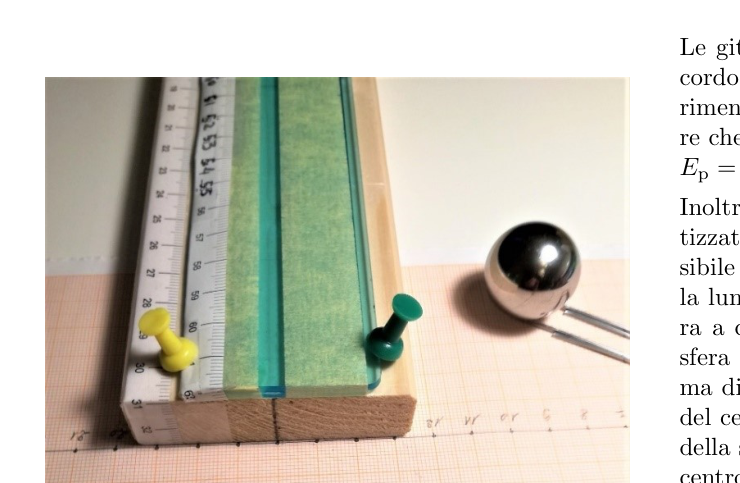
p.6 — Particolare della rampa di lancio
Topic: Newtonian Mechanics, Conservation of Energy, Rotational Dynamics Metodi: Energy Conservation Method, Kinematic Equations, Experimental Data Analysis Competenze: Experimental Data Analysis, Physical Reasoning, Mathematical Modeling Objects: Sphere Fonte: Testo (PDF) — p.6 Soluzione: Soluzioni (PDF)
- Implement and report in the table the measures to determine the range of values of the arc (see Figure 3 shows that the sphere is not affected by the edge. The carbon paper technique allows you to detect some bounce of the sphere after a launch. It is assumed that two conditions are met in the collision with the table: the horizontal component of the transfer speed is retained the return coefficient , defined as the ratio between the components’ intensities verticali delle velocità in uscita e in ingresso nell’urto, sia costante nei vari rimbalzi.
p.6 — Particolare della rampa di lancio
Topic: Newtonian Mechanics, Conservation of Energy, Rotational Dynamics Metodi: Energy Conservation Method, Kinematic Equations, Experimental Data Analysis Competenze: Experimental Data Analysis, Physical Reasoning, Mathematical Modeling Objects: Sphere Fonte: Testo (PDF) — p.6 Soluzione: Soluzioni (PDF)
- – Verifica che la distribuzione delle prime tre tracce lasciate dagli urti successivi dopo un lancio è compatibile con le due ipotesi suddette. Descrivi la procedura adottata e i risultati ottenuti.
Topic: Newtonian Mechanics, Conservation of Momentum Metodi: Conservation Laws, Physical Modeling, Experimental Data Analysis Competenze: Experimental Data Analysis, Physical Reasoning, Diagrammatic Reasoning Objects: Sphere Fonte: Testo (PDF) — p.6 Soluzione: Soluzioni (PDF)
- Verify that the distribution of the first three tracks left by subsequent impacts after a launch is compatible with the two above assumptions. Describe the procedure and the results obtained.
Topic: Newtonian Mechanics, Conservation of Momentum Metodi: Conservation Laws, Physical Modeling, Experimental Data Analysis Competenze: Experimental Data Analysis, Physical Reasoning, Diagrammatic Reasoning Objects: Sphere Fonte: Testo (PDF) — p.6 Soluzione: Soluzioni (PDF)
- – Quantifica il rapporto tra le energie cinetiche possedute dalla sfera subito dopo e subito prima del primo rimbalzo. Descrivi la procedura adottata e i risultati ottenuti. Materiale elaborato dal Gruppo NOTA BENE È possibile utilizzare, riprodurre, distribuire, comunicare al pubblico questo materiale alle due seguenti condizioni: citare la fonte; non usare il materiale, nemmeno parzialmente, per fini commerciali.
Topic: Newtonian Mechanics, Conservation of Momentum Metodi: Conservation Laws, Kinematic Equations, Experimental Data Analysis Competenze: Experimental Data Analysis, Physical Reasoning, Mathematical Modeling Objects: Sphere Fonte: Testo (PDF) — p.6 Soluzione: Soluzioni (PDF)
- Quantifies the ratio between the kinetic energies of the sphere immediately after and immediately before of the first bounce. Describe the procedure and the results obtained. Material prepared by the Group Good note . You can use, reproduce, distribute, communicate this material to the public to the following two Conditions: citing the source; not using the material, even partially, for commercial purposes.
Topic: Newtonian Mechanics, Conservation of Momentum Metodi: Conservation Laws, Kinematic Equations, Experimental Data Analysis Competenze: Experimental Data Analysis, Physical Reasoning, Mathematical Modeling Objects: Sphere Fonte: Testo (PDF) — p.6 Soluzione: Soluzioni (PDF)