Q.1 [36 p.] Usa la relazione (1) per misurare la costante elastica della molla. Stima l’incertezza da associare a . Progetta le misure in modo da assicurarti che l’incertezza percentuale sulla misura di risulti minore del 1 %.
Masse — Nota la costante elastica della molla, si potrebbero ottenere le misure delle masse delle rondelle in dotazione semplicemente appendendole alla molla e misurando l’allungamento (legge di Hooke). Per quanto tale metodo sia di semplice esecuzione, la precisione che esso consente di raggiungere non risulterebbe adeguata per gli sviluppi successivi dell’esperimento. Per ottenere la precisione richiesta è necessario l’utilizzo di una tecnica basata sulle misure di tempo. A tal scopo considera quanto segue. Appendi alla molla un carico di rondelle e poni il sistema in oscillazione verticale. Il periodo delle oscillazioni dipenderà dalla massa del carico appeso, ma sarà pure influenzato dalla massa della molla. Nel modello adottato vale la relazione:
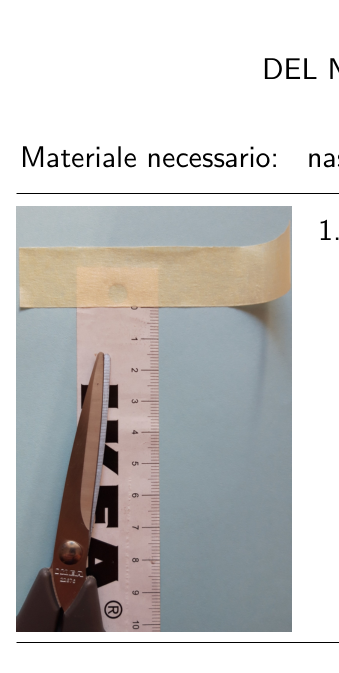
p.3 — Nastro metrico fissato con nastro adesivo
p.4 — Molla sospesa alla matita

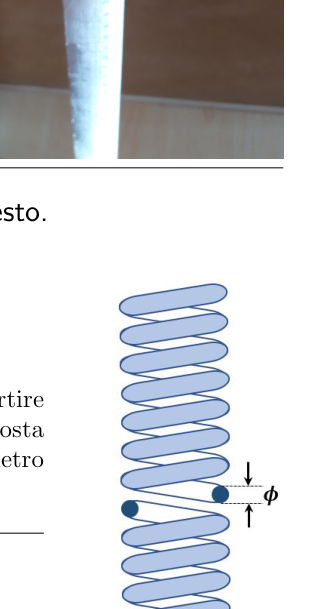
p.4 — Schema molla elicoidale, diametro phi
p.6 — Molla con rondella e fermaglio
p.6 — Foto A: foglio piegato a quadretti

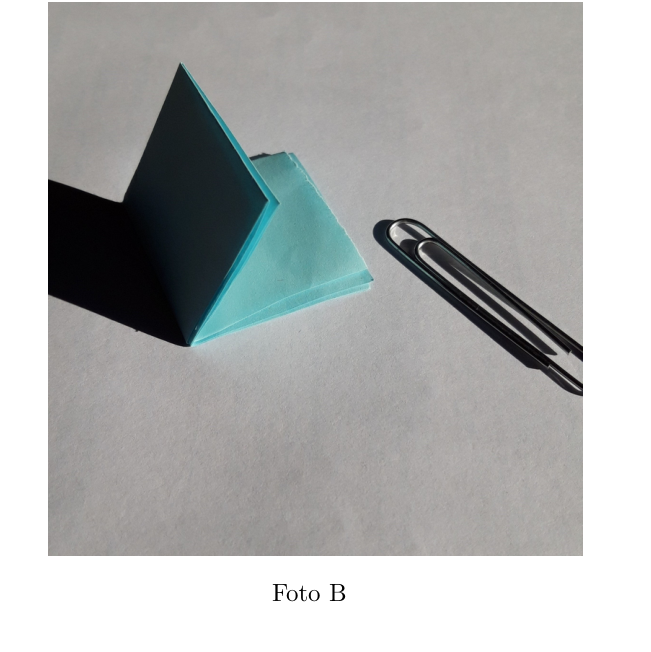
p.6 — Foto B: traguardo di carta piegato
Topic: Oscillations & Waves, Elasticity & Materials Metodi: Hooke’s Law, Error Propagation, Experimental Data Analysis Competenze: Experimental Data Analysis, Error Propagation, Measurement & Instrumentation Objects: Spring Fonte: Testo (PDF) — p.4 Soluzione: Soluzioni (PDF)
Q.1 [36 p.] Use the ratio (1) to measure the elastic constant of the spring. Estimate the uncertainty to be associated a . Design measures to ensure that the percentage uncertainty of the measurement is less than 1%.
Masses Note the elastic constant of the spring, measurements of the masses of the swirls could be obtained in The first is the length of the length of the length of the line. In that respect The method is simple to execute, the precision it allows to be achieved would not be adequate for The following developments in the experiment. The precision required requires the use of a technique based on time measurements. For that purpose, consider the following. Hang a load of swirls from the spring And you put the system in vertical oscillation. The period of oscillations will depend on the mass of the load appeso, ma sarà pure influenzato dalla massa della molla. The model adopted shall be the report:
p.3 — Nastro metrico fissato con nastro adesivo
**p.4 ** Pencil-suspended
p.4 — Schema molla elicoidale, diametro phi
**p.6 ** Mill with rim and stopper
p.6 — Foto A: foglio piegato a quadretti
p.6 — Foto B: traguardo di carta piegato
Topic: Oscillations & Waves, Elasticity & Materials Metodi: Hooke’s Law, Error Propagation, Experimental Data Analysis Competenze: Experimental Data Analysis, Error Propagation, Measurement & Instrumentation Objects: Spring Fonte: Testo (PDF) — p.4 Soluzione: Soluzioni (PDF)
Q.2 [34 p.] Calcola la massa associata al carico costituito da tutte le possibili combinazioni di rondelle. Non è richiesta la stima dell’incertezza su tuttavia, per raggiungere un grado di precisione utile per il seguito dell’esperimento, sarà necessario effettuare misure di periodo con un’incertezza percentuale %.
Periodi di oscillazione— Un modello empirico per descrivere il periodo di oscillazione in funzione della massa della molla più la massa dell’eventuale carico appeso, è di partire dalla nota relazione fra periodo, costante elastica e massa totale del sistema oscillante, . La relazione è valida solo se i corpi in oscillazione sono rigidi. Dato che nel nostro caso la molla non è un corpo rigido, non è lecito sostituire semplicemente a la somma . Si ricorre allora all’artificio di dividere il valore di per un coefficiente che varia con il valore della massa del carico
Topic: Oscillations & Waves, Elasticity & Materials Metodi: Simple Harmonic Motion Analysis, Experimental Data Analysis, Physical Modeling Competenze: Experimental Data Analysis, Measurement & Instrumentation, Mathematical Modeling Objects: Spring Fonte: Testo (PDF) — p.5 Soluzione: Soluzioni (PDF)
Q.2 [34 p.] Calculate the mass associated with the load consisting of all possible combinations of cones. I ‘m not . è richiesta la stima dell’incertezza su tuttavia, per raggiungere un grado di precisione utile per il Following the experiment, periodic measurements with a percentage uncertainty will be required. %.
Oscillation periods An empirical model to describe the oscillation period as a function of the mass of the spring plus mass of the any load suspended, shall be taken from the known period-to-period ratio, The elastic constant and total mass of the oscillating system, . The report shall be valid only if: Oscillating bodies are rigid. Since the spring is not a rigid body in our case, it is not permissible to replace the spring with a rigid body. semplicemente a la somma . The value of is then divided by a coefficient which varies with the mass of the load
Topic: Oscillations & Waves, Elasticity & Materials Metodi: Simple Harmonic Motion Analysis, Experimental Data Analysis, Physical Modeling Competenze: Experimental Data Analysis, Measurement & Instrumentation, Mathematical Modeling Objects: Spring Fonte: Testo (PDF) — p.5 Soluzione: Soluzioni (PDF)
Q.3 [34 p.] Costruisci il grafico che evidenzi l’andamento di in funzione del rapporto , compreso il caso .
Per piccoli valori di la relazione empirica
approssima bene le misure sperimentali del periodo.
Topic: Oscillations & Waves Metodi: Physical Modeling, Graph Linearization, Curve Fitting Competenze: Graph Linearization, Curve Fitting, Mathematical Modeling Objects: Spring Fonte: Testo (PDF) — p.5 Soluzione: Soluzioni (PDF)
Q.3 [34 p.] Build a graph showing the trend according to the ratio, including the case .
For small values of the empirical relationship
The Commission’s proposal for a regulation on the approximation of the measures in question is therefore not in line with the objectives of the regulation.
Topic: Oscillations & Waves Metodi: Physical Modeling, Graph Linearization, Curve Fitting Competenze: Graph Linearization, Curve Fitting, Mathematical Modeling Objects: Spring Fonte: Testo (PDF) — p.5 Soluzione: Soluzioni (PDF)
Q.4 [35 p.] Costruisci il grafico per verificare che la relazione empirica (4) si accorda con i punti sperimentali. Individua l’intervallo di valori per cui osservi un ragionevole accordo e calcola le costanti e . Esplicita il significato di .
Nel contesto sperimentale in cui hai operato, la molla impiegata ha un comportamento lontano da quello di una molla di massa trascurabile. Per poter trascurare la massa nel calcolo del periodo, occorre che il periodo misurato per un certo carico di rondelle di massa e quello calcolato con la relazione
siano compatibili entro le incertezze di misura.
Topic: Oscillations & Waves Metodi: Physical Modeling, Graph Linearization, Experimental Data Analysis Competenze: Graph Linearization, Experimental Data Analysis, Mathematical Modeling Objects: Spring Fonte: Testo (PDF) — p.5 Soluzione: Soluzioni (PDF)
Q.4 [35 p.] Build the chart to check that the empirical relationship (4) agrees with the experimental points. Find the range of values for which you see a reasonable agreement and calculate the constants and . Explain the meaning of .
In the experimental context in which you operated, the spring used behaves far from a The mass of the sample is negligible. In order to overlook the mass in the period calculation, the period must be measured for a given mass of swirls and calculated using the ratio
are compatible within the measurement uncertainties.
Topic: Oscillations & Waves Metodi: Physical Modeling, Graph Linearization, Experimental Data Analysis Competenze: Graph Linearization, Experimental Data Analysis, Mathematical Modeling Objects: Spring Fonte: Testo (PDF) — p.5 Soluzione: Soluzioni (PDF)
Q.5 [20 p.] Stima il valore della massa al di sopra del quale ritieni che si possa trascurare l’effetto della massa della molla sulle previsioni di periodo.
——— PARTE SECONDA ——— La parte finale dell’esperimento è riservata allo studio delle trasformazioni di energia meccanica durante la prima semi oscillazione del sistema molla-oggetto. Per effettuarlo occorre modificare l’apparato sperimentale come descritto di seguito. ISTRUZIONI RELATIVE ALLA COSTRUZIONE E AL MONTAGGIO DI UN TRAGUARDO DI CARTA SCORREVOLE LUNGO IL NASTRO METRICO Materiale necessario: rondella; fermaglio gigante del (60 mm); foglio di dimensioni 15 cm x 8 cm; nastro adesivo di carta.
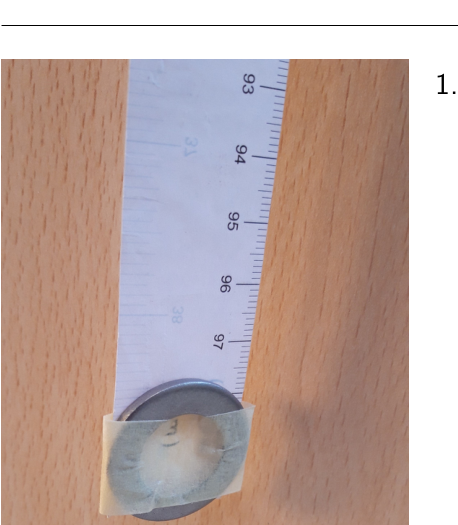
- Allo scopo di rendere teso il nastro metrico fissa una rondella sul fondo usando il nastro adesivo, come illustrato nella foto a fianco. La rondella usata dovrai successivamente impiegarla per fare altre misure e, in tal caso, dovrai provvedere a sostituirla con un’altra a tua disposizione.
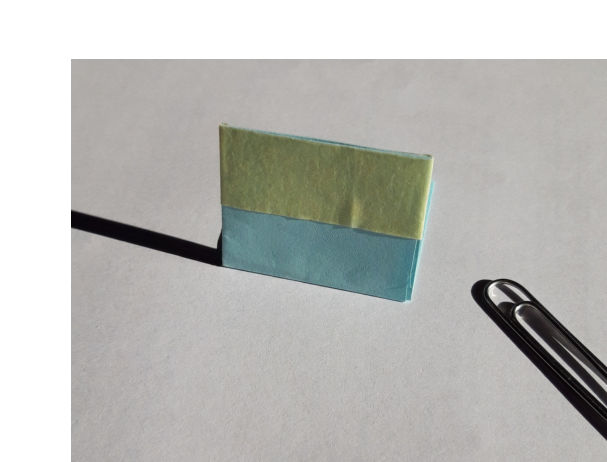
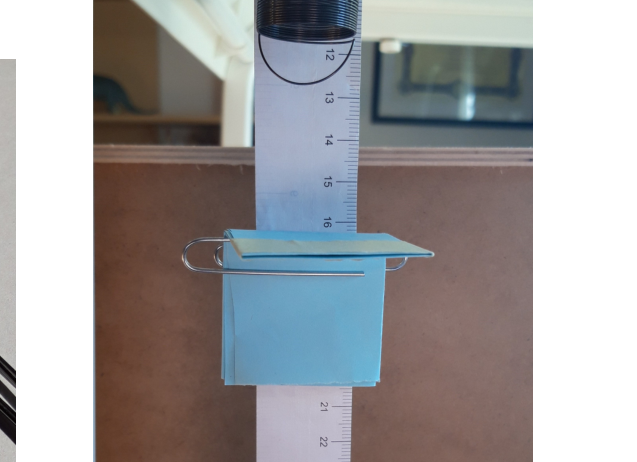
- Per costruire il traguardo mobile piega a metà il foglio di carta per quattro volte (foto A) in modo da ottenere il risultato riprodotto nella foto B Foto A Foto B Quindi, usa il nastro adesivo per far aderire le parti che costituiranno la superficie di riferimento del traguardo mobile utile per effettuare le misure (foto C). Infine, usa il fermaglio per montare il traguardo sul nastro metrico di carta (foto D). Facendo scorrere il fermaglio lungo il nastro metrico potrai spostare il traguardo di carta in alto e in basso. Foto C Foto D Energia — Appendi un carico di rondelle alla molla. Agendo sull’ultima spira della molla solleva il carico in modo che le spire risultino tutte accostate. Evita che il gancio di sospensione si deformi apprezzabilmente a causa del sollevamento. In tale situazione misura la posizione del lembo inferiore del carico avvalendoti del traguardo di carta che hai realizzato. Quindi, lascia il sistema libero di oscillare. Procedendo per tentativi potrai posizionare il traguardo in modo che, alla fine della prima mezza oscillazione, il lembo inferiore del carico lo sfiori e misurare la posizione finale raggiunta . (1) Effettua le misure utilizzando le quattro combinazioni di rondelle più pesanti che la situazione ti permette di realizzare.
Topic: Oscillations & Waves, Elasticity & Materials Metodi: Approximation & Series Expansion, Physical Modeling, Simple Harmonic Motion Analysis Competenze: Estimation & Approximation, Physical Reasoning, Mathematical Modeling Objects: Spring Fonte: Testo (PDF) — p.5 Soluzione: Soluzioni (PDF)
Q.5 [20 p.] Estimate the mass above which you believe the mass effect can be neglected The Commission has already adopted a proposal for a directive on the approximation of the laws of the Member States relating to the use of the energy sector.
Part Two The final part of the experiment is devoted to the study of mechanical energy transformations during the The first half oscillation of the spring-object system. To do this, the experimental apparatus must be modified. as described below. Instructions for construction and assembly From a card trade scratching along our metric Materials required: Round; giant brush of (60 mm); sheet of a size of 15 cm x 8 cm; paper adhesive tape.
- For the purpose of stretching the metric tape, a sling is fixed on the bottom using the tape, as shown in the photo next to it. The used round you’ll have to use to make more. The Commission will take the necessary measures to ensure that the measures are implemented in accordance with the provisions of the Treaty. Your disposition.
- To build the moving target fold the sheet of paper in half four times (photo A) so that you get the result shown in Figure B This is a photo A. Photo B Then use the adhesive tape to attach the parts that will form the reference surface of the finish The vehicle is equipped with a separate unit. Finally, use the stopwatch to mount the finish on the tape. The data shall be stored in the form of a paper metric (photo D). If you run the stop along the tape, you can move the paper finish up and down. The Commission This is the picture. Energy Hang a load of sponges to the spring. By working on the last spring-spindle, the load is lifted in So the spires are all close together. It prevents the suspension hook from deforming appreciably to cause of the lifting. In this situation, the position of the lower end of the load shall be measured using the paper threshold which: You did. So, let the system swing free. By proceeding by attempts you can position the target so that which, at the end of the first half of the oscillation, the lower end of the load is deflected and measures the final position raggiunta . (1) Make the measurements using the four heaviest combinations of combs that the situation allows you to I’m not going to make it.
Topic: Oscillations & Waves, Elasticity & Materials Metodi: Approximation & Series Expansion, Physical Modeling, Simple Harmonic Motion Analysis Competenze: Estimation & Approximation, Physical Reasoning, Mathematical Modeling Objects: Spring Fonte: Testo (PDF) — p.5 Soluzione: Soluzioni (PDF)
Q.6 [30 p.] Le richieste seguenti si riferiscono ai valori alla fine della prima mezza oscillazione. I risultati ottenuti per ciascuno dei carichi usati vanno raccolti in un’unica tabella in cui compaiono: a) le misure di , b) le variazioni dell’energia potenziale elastica , c) le variazioni dell’energia potenziale gravitazionale del carico appeso , d) il calcolo dello spostamento del CdM della molla. Specifica le ipotesi adottate e le formule impiegate. (1) Non è detto che nell’istante di massimo allungamento tutte le spire si fermino insieme per cui l’energia cinetica della molla in quell’istante può non essere nulla; nel nostro caso questo effetto sarà comunque trascurato.
p.7 — Foto C: traguardo mobile assemblato
p.7 — Foto D: traguardo montato sul nastro
Topic: Conservation of Energy, Oscillations & Waves Metodi: Energy Conservation Method, Conservation Laws, Simple Harmonic Motion Analysis Competenze: Mathematical Modeling, Physical Reasoning, Experimental Data Analysis Objects: Spring Fonte: Testo (PDF) — p.7 Soluzione: Soluzioni (PDF)
Q.6 [30 p.] The following requests refer to the values at the end of the first half of the swing. The results obtained For each of the loads used, the following shall be collected in a single table: (a) the measures of ; (b) changes in the elastic potential energy ; (c) the variations in the gravitational potential energy of the suspended load ; (d) calculation of the displacement of the spring CdM. Specify the assumptions and formulae used. (1) It is not said that at the moment of maximum elongation all the spires stop together so that the kinetic energy of the spring in the The Commission has already made a number of proposals to the Council.
The following information is provided by the Commission:
The following is the list of the main features of the vehicle:
Topic: Conservation of Energy, Oscillations & Waves Metodi: Energy Conservation Method, Conservation Laws, Simple Harmonic Motion Analysis Competenze: Mathematical Modeling, Physical Reasoning, Experimental Data Analysis Objects: Spring Fonte: Testo (PDF) — p.7 Soluzione: Soluzioni (PDF)