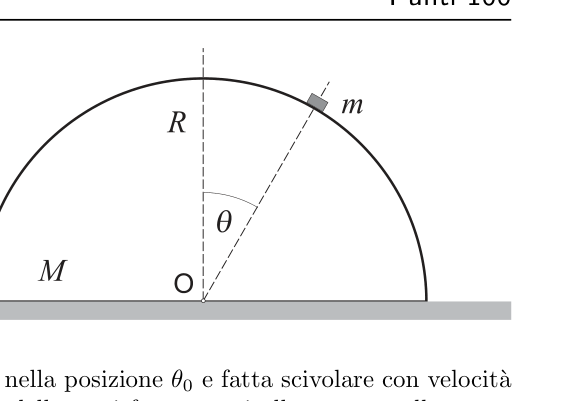
P1 Particella su semisfera Punti 100 Una semisfera di massa e raggio è appoggiata sopra un piano orizzontale. Una particella di massa , che ha dimensioni trascurabili rispetto a quelle della semisfera, può scivolare su di essa. Tutti gli attriti sono trascurabili. La posizione della particella sulla semisfera è definita dall’angolo mostrato in figura. La semisfera è tenuta ferma mediante un cavo orizzontale, inestensibile e di massa trascurabile, fissato in un punto alla sua base. La particella viene posta nella posizione e fatta scivolare con velocità iniziale nulla verso il punto in cui è fissato il cavo. Cavo, centro della semisfera e particella stanno nello stesso piano verticale durante tutto il moto.
- Disegnare schematicamente la situazione descritta e rappresentare il diagramma di corpo libero di .
- Quanto vale se la massa si stacca dalla semisfera nel punto con ?
- Ponendo adesso , esprimere il modulo della tensione del cavo in funzione dell’angolo compreso tra 0 e , dove indica l’angolo di distacco in questa nuova situazione.
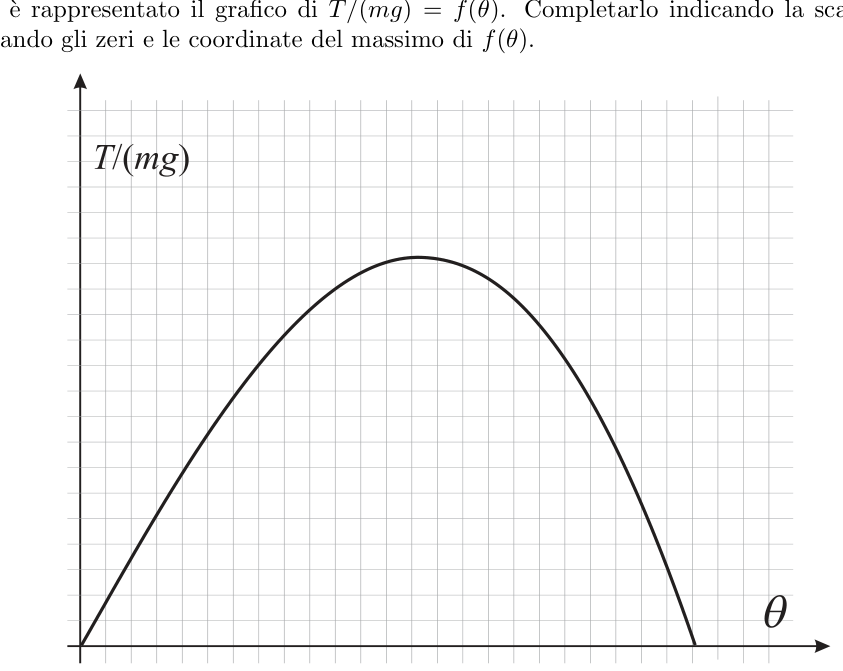
- In figura è rappresentato il grafico di . Completarlo indicando la scala su ciascun asse, determinando gli zeri e le coordinate del massimo di . Adesso la particella viene fissata alla sommità della semisfera con un filo (inestensibile e di massa trascurabile), di data lunghezza minore di . La particella è tenuta ferma dal filo teso a contatto, senza attrito, con la superficie della semisfera. A un certo istante il cavo che teneva la semisfera viene rimosso e alla base della semisfera viene applicata una forza orizzontale nel piano verticale che contiene sia il filo sia la particella. Il modulo della forza, inizialmente nullo, cresce nel tempo.
- Disegnare il diagramma delle forze applicate alla particella prima che venga attivata la forza . Discutere poi qualitativamente in quali condizioni la particella si può staccare dalla semisfera e in quali può iniziare a risalire sulla semisfera; disegnare queste due situazioni.
- Determinare la forza minima necessaria perché la particella si stacchi dalla semisfera.
- Determinare la forza minima necessaria perché la particella inizi a risalire lungo la semisfera.
p.4 — Semisfera con particella e angolo theta
p.4 — Grafico T/(mg) in funzione di theta
Topic: Newtonian Mechanics, Conservation of Energy Metodi: Free-Body Diagram, Energy Conservation Method, Vector Decomposition, Conservation of Energy Competenze: Diagrammatic Reasoning, Mathematical Modeling, Physical Reasoning Objects: Sphere, String Fonte: Testo (PDF) — p.4 Soluzione: Soluzioni (PDF)
P1 Particles on the hemisphere The following points shall be added: A hemisphere of mass and radius is supported above a horizontal plane. One of them. The mass of the particle , which is insignificant compared to that of the hemisphere, can be I’m gonna slip on it. All the friction is negligible. The position of the particle on the hemisphere is defined by the angle shown in Figure 1. The hemisphere is held firm by a horizontal cable, which is unobtrusive and of negligible mass, fixed at a point at its base. The particle is placed in the position and sliding at a speed Initial zero to the point where the cable is fixed. The cable, the center of the hemisphere and the particle are in the same place. vertical plane throughout the entire engine.
- Draw a diagram of the described situation and represent the free body diagram of .
- What is if the mass is detached from the hemisphere at the point with ?
- Now by placing , express the cable voltage form as a function of the angle included between 0 and , where indicates the angle of detachment in this new situation.
- The graph of is shown in Figure 1. Complete this by indicating the scale on each axis, determining the zeros and coordinates of the maximum . Now the particle is fixed to the top of the hemisphere with a wire (inextensible and of negligible mass), a length of less than . The particle is held firm by the thread stretched in contact, without friction, with the the surface of the hemisphere. At a certain moment the cable holding the hemisphere is removed and a cable is applied to the base of the hemisphere. horizontal force in the vertical plane containing both the wire and the particle. The force modulation, initially It grows over time.
- Draw a diagram of the forces applied to the particle before the force is activated. The Commission Then qualitatively, under what conditions can the particle detach from the hemisphere and where can it start I’m going to go back to the hemisphere, draw these two situations.
- Determine the minimum force required for the particle to detach from the hemisphere.
- Determine the minimum force required for the particle to begin to rise upward along the hemisphere.
**p.4 ** Hemisphere with theta particle and angle
The following table shows the number of samples taken:
Topic: Newtonian Mechanics, Conservation of Energy Metodi: Free-Body Diagram, Energy Conservation Method, Vector Decomposition, Conservation of Energy Competenze: Diagrammatic Reasoning, Mathematical Modeling, Physical Reasoning Objects: Sphere, String Fonte: Testo (PDF) — p.4 Soluzione: Soluzioni (PDF)
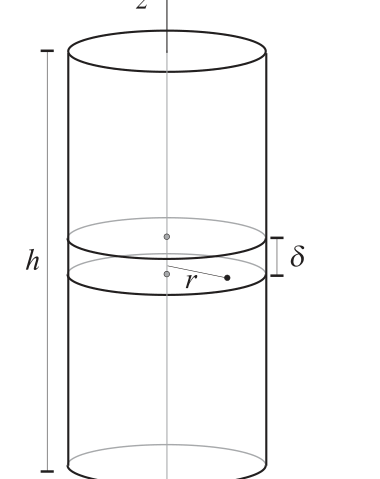
P2 Effetti di gravità e accelerazioni su un conduttore Punti 100 I punti di un conduttore isolato possono non trovarsi tutti allo stesso potenziale elettrico in presenza di campi gravitazionali o di un moto rotatorio del conduttore. Questo effetto, che è molto piccolo e normalmente trascurato, viene analizzato in questo problema. Si consideri un cilindro conduttore, isolato, globalmente neutro, di raggio e altezza , disposto verticalmente e fermo. Nel corso del problema potrebbe essere utile un sistema di coordinate cilindriche: si ponga l’asse coincidente con l’asse del cilindro e si indichi con la distanza da tale asse, come in figura. Nello studio della conduzione si assume il modello di Drude: si suppone che il conduttore sia formato da un reticolo di ioni positivi fermi e da un gas di elettroni di conduzione. Si trascurano le interazioni a distanza tra ioni ed elettroni e si assume che il gas di elettroni abbia un comportamento simile a quello di un gas perfetto classico. In assenza di campo elettrico la velocità media degli elettroni di conduzione è nulla; in presenza di campo elettrico si ha un effetto di trascinamento sugli elettroni che dà loro una velocità di deriva, diversa da zero, a sua volta legata allo scorrere di una corrente. Nella prima parte del problema si vuole considerare l’effetto del campo gravitazionale sugli elettroni di conduzione. Tale campo tenderebbe a trascinare gli elettroni di conduzione verso il basso, per cui per mantenere una condizione di equilibrio elettrostatico (velocità di deriva nulla) è necessario ammettere l’esistenza di un campo elettrico interno al conduttore.
- Esprimere il campo elettrico interno in funzione dell’accelerazione di gravità , della carica elementare e della massa dell’elettrone.
- Determinare un’espressione per la differenza di potenziale massima tra due punti del conduttore e calcolare il valore di .
- Determinare la densità di carica elettrica all’interno del conduttore.
- Esistono regioni della superficie del conduttore in cui la densità di carica superficiale non è nulla? Quanto vale la carica totale presente sulla superficie? Si consideri ora lo stesso cilindro, in moto rotatorio intorno al suo asse con velocità angolare costante . Si trascuri la presenza del campo gravitazionale. Si assuma per semplicità che gli elettroni di conduzione ruotino solidalmente con il cilindro con la stessa velocità angolare e si trascurino gli effetti magnetici dovuti alla presenza di cariche elettriche in rotazione. Nel seguito del problema, tutte le quantità su cui si lavora sono misurate nel sistema di riferimento del laboratorio.
- Determinare il campo elettrico interno al cilindro in funzione della carica elementare , della massa dell’elettrone e della velocità angolare .
- Trovare un’espressione per la densità di carica media in un volume cilindrico, interno e coassiale al conduttore, di raggio e altezza . Trovare un’espressione per la densità di carica puntuale in ogni punto del cilindro conduttore.
- Spiegare perché devono esistere regioni della superficie del conduttore in cui la densità di carica superficiale non è nulla. Quanto vale la carica totale presente sulla superficie?
- Determinare la differenza di potenziale massima tra due punti del conduttore in funzione dei dati del problema e calcolare la frequenza di rotazione che sarebbe necessaria per produrre una differenza di potenziale massima di 1 V. Essendo presente una densità di carica interna al conduttore, ed essendo queste cariche in rotazione, si genera un campo magnetico . Si vuole verificare se, nelle condizioni in cui abbiamo lavorato, gli effetti del campo siano effettivamente trascurabili. Si consideri, per poter trascurare effetti di bordo, una porzione centrale di altezza di un cilindro rotante con , come mostrato in figura. Tale porzione può essere considerata come globalmente neutra.
- Trovare un’espressione per il campo in funzione della distanza dall’asse del cilindro e per il rapporto tra la forza di Lorentz dovuta a tale campo e la forza di Coulomb dovuta al campo . Calcolare il valore massimo di tale rapporto per determinata al punto 8.
p.5 — Cilindro conduttore con raggio e altezza
Topic: Electrostatics, Magnetism, Rotational Dynamics Metodi: Gauss’s Law, Electric Potential Method, Ampère’s Law, Lorentz Force Analysis Competenze: Mathematical Modeling, Physical Reasoning, Diagrammatic Reasoning Objects: Cylinder, Electron Fonte: Testo (PDF) — p.5 Soluzione: Soluzioni (PDF)
P2 Effects of gravity and acceleration on a conductor The following points shall be added: The points of an isolated conductor may not all be in the same electrical potential in the the presence of gravitational fields or a rotating motion of the conductor. This effect, which is It’s very small and usually neglected, and it’s being analyzed in this problem. A conductive cylinder, isolated, globally neutral, with a radius and height , arranged vertically and stationary, shall be considered. In the case of the problem, a cylindrical coordinate system may be useful: place the axis which coincides with the cylinder axis and indicate with the distance from that axis, as shown in Figure 1. The study of conduction takes the Drude model: it is assumed that the conductor It is composed of a net of stationary positive ions and a conductive electron gas. The distance interactions between ions and electrons are neglected and the gas of electrons behave similarly to that of a classic perfect gas. In the absence The average speed of the conducting electrons is zero; The electric field has a drag effect on the electrons that gives them a velocity The value of the input data is the value of the input data. In the first part of the problem we want to consider the effect of the gravitational field on conduction electrons. This field would tend to drag the downward conduction electrons, so that in order to maintain an electrostatic equilibrium condition (zero drift velocity) it is necessary to admit the existence of an electric field inside the conductor.
- Express the internal electric field in terms of the acceleration of gravity , the elementary charge and the mass of the electron.
- Determine an expression for the maximum potential difference between two points of the conductor and calculate the value of .
- Determine the electrical charge density within the conductor.
- Are there regions on the surface of the conductor where the surface load density is zero? How much is the total surface load? Consider the same cylinder, rotating around its axis at constant angular velocity . Si You ignore the presence of the gravitational field. It is assumed for simplicity that the conduction electrons rotate solidly with the cylinder with the same angular velocity and the magnetic effects due to the presence of rotating electrical charges are ignored. In the following problem, all the quantities being worked on are measured in the reference system of the The lab.
- Determine the electric field inside the cylinder according to the elementary charge , the mass The electron and the angular velocity .
- Find an expression for the mean load density in a cylindrical, inner and coaxial volume to the conductor, radius and height . Find an expression for the point charge density at each point the conductive cylinder.
- Explain why there must be regions of the surface of the conductor where the surface load density is It’s not a big deal. What is the total charge on the surface?
- Determine the maximum potential difference between two conductor points based on the data of the The problem is to calculate the rotation frequency that would be required to produce a difference of The maximum power output of 1 V. If the conductor has a charge density inside it, and the charge is rotating, it generates a magnetic field . Si vuole verificare se, nelle condizioni in cui abbiamo lavorato, gli effetti del campo They’re actually negligible. Consider, in order to overlook on-board effects, a central part of a rotating cylinder with a height with as shown in Figure 1. This portion can be considered as globally neutral.
- Find an expression for the field in terms of the distance from the cylinder axis and the ratio between The Lorentz force due to this field and the Coulomb force due to the field. Calculate the value maximum of this ratio for as determined in point 8.
**p.5 ** Conducting cylinder with radius and height
Topic: Electrostatics, Magnetism, Rotational Dynamics Metodi: Gauss’s Law, Electric Potential Method, Ampère’s Law, Lorentz Force Analysis Competenze: Mathematical Modeling, Physical Reasoning, Diagrammatic Reasoning Objects: Cylinder, Electron Fonte: Testo (PDF) — p.5 Soluzione: Soluzioni (PDF)
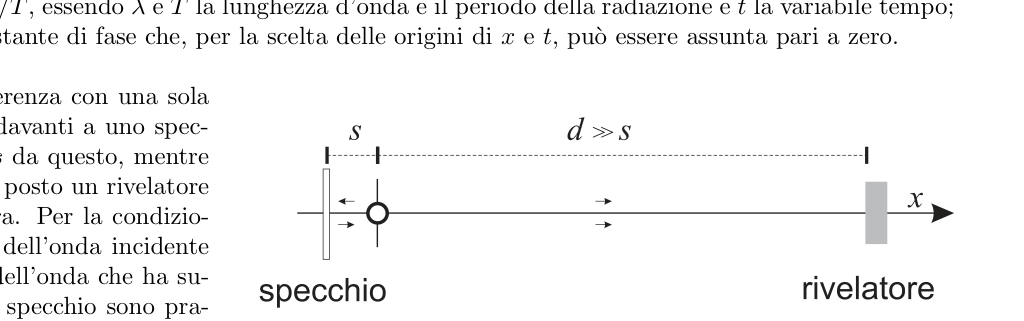
P3 Misure interferometriche Punti 100 Una sorgente emette un’onda elettromagnetica monocromatica e isotropa. Lungo l’asse , a grande distanza, l’onda può essere trattata come un’onda piana e descritta dal suo campo elettrico con e , essendo e la lunghezza d’onda e il periodo della radiazione e la variabile tempo; rappresenta una costante di fase che, per la scelta delle origini di e , può essere assunta pari a zero. Si può produrre interferenza con una sola sorgente se la si pone davanti a uno specchio piano a distanza da questo, mentre a distanza viene posto un rivelatore come mostrato in figura. Per la condizione data, l’ampiezza dell’onda incidente direttamente e quella dell’onda che ha subito la riflessione sullo specchio sono praticamente uguali sul rivelatore. Il rivelatore misura la potenza della radiazione ricevuta per unità di superficie mediata nel tempo; tale grandezza, proporzionale al quadrato del campo elettrico dell’onda, viene chiamata irradianza e, in questo caso, è uniforme sulla superficie del rivelatore.
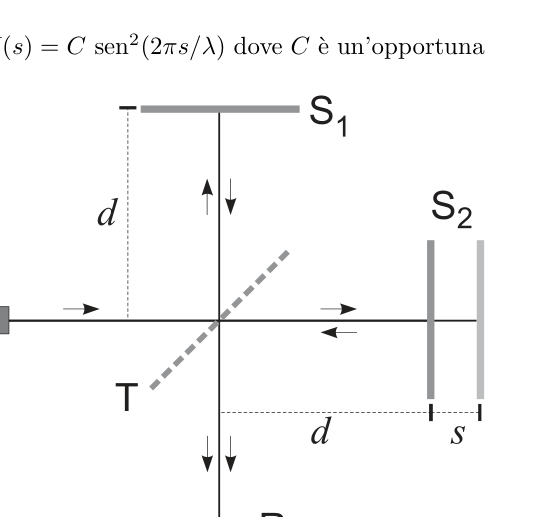
- Si dimostri che l’irradianza in funzione di si scrive come dove è un’opportuna costante. Nella figura a fianco è mostrato un interferometro montato sopra un tavolo, visto dall’alto. è un laser He-Ne che emette un fascio di luce di lunghezza d’onda verso uno specchio semi riflettente , di spessore trascurabile, posto ad un angolo di con il fascio luminoso. Quando uno specchio semi riflettente viene colpito da una radiazione, metà di questa viene riflessa e metà viene trasmessa. I due fasci prodotti da raggiungono quindi i due specchi e , vengono riflessi, incontrano nuovamente lo specchio e arrivano, ulteriormente dimezzati, sul rivelatore . I due fasci incidenti sul rivelatore possono essere trattati come onde piane (fasci collimati). ed hanno inizialmente la stessa distanza da . può essere traslato di un tratto , cosicché la distanza da risulta .
- Disegnare il grafico dell’irradianza sul rivelatore in funzione del tempo mentre lo specchio viene lentamente spostato alla velocità costante in modo che vari da 0 a in 8.437 s.
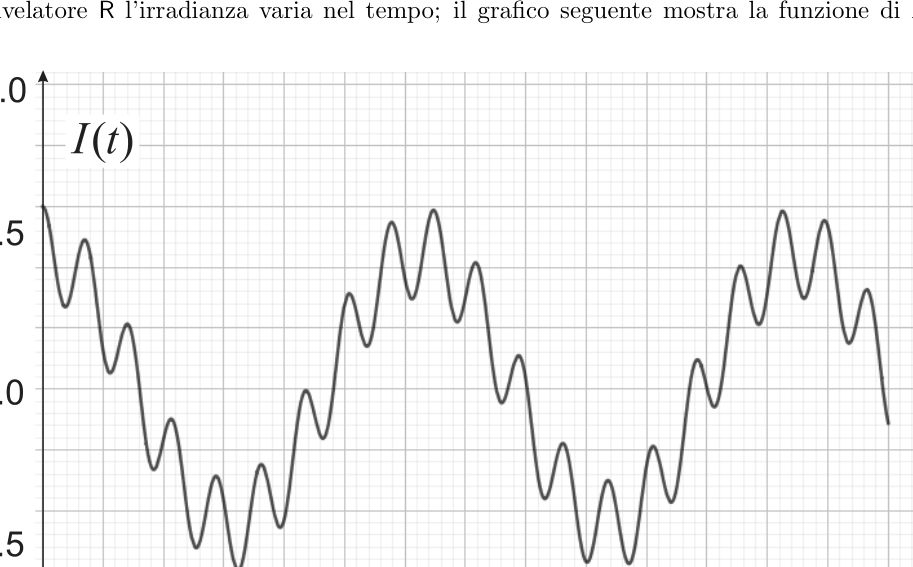
- Con quale errore relativo si dovrebbe poter misurare la frequenza della radiazione ricevuta per poter apprezzare l’effetto Doppler dovuto al fatto che lo specchio è in moto? Si sostituisce il laser con una lampada a vapori di idrogeno la quale emette radiazioni a diverse lunghezze d’onda; opportuni filtri lasciano passare solo due radiazioni monocromatiche. Come prima la distanza viene aumentata lentamente a partire da 0, con la stessa velocità del punto 2., cosicché sul rivelatore l’irradianza varia nel tempo; il grafico seguente mostra la funzione di in unità arbitrarie.
- Effettuando le necessarie misure sul grafico, calcolare le due lunghezze d’onda filtrate tra quelle emesse dalla lampada. Si assuma che le radiazioni considerate vengano prodotte la prima da una transizione di elettroni da un livello energetico al livello e la seconda da questo a un livello .
- Determinare i livelli energetici e sapendo che la composizione della radiazione è quella data al punto 4. Suggerimento: può essere utile consultare il quadro con le formule utili di matematica.
Tavola di Costanti Fisiche Costanti Fisiche Primarie [ Valori esatti per definizione – (26.CGPM/16.11.2018) ] COSTANTE SIMB. VALORE UNITÀ Velocità della luce nel vuoto Carica elementare C Costante di Planck J s Costante di Boltzmann Costante di Avogadro Altre Costanti Fisiche † Massa dell’elettrone kg Massa del protone kg Massa del neutrone kg Permeabilità magnetica del vuoto Costante dielettrica del vuoto: Costante elettrostatica: Costante universale dei gas: Costante di Faraday: Costante di Stefan–Boltzmann Costante di gravitazione universale Pressione atmosferica standard Pa Temperatura standard () K Volume molare di un gas perfetto in condizioni standard (, ) Unità di massa atomica kg Tavola di dati che possono essere necessari † Accelerazione di gravità (val. convenzionale) Densità dell’acqua (a )⋆ Calore specifico dell’acqua (a )⋆ Densità del ghiaccio (a )⋆ Calore di fusione del ghiaccio Calore di vaporizzazione dell’acqua (a )⋆ Livello fondamentale dell’atomo di idrogeno (H) eV (o energia di ionizzazione) J † Valori arrotondati, da considerare esatti nella soluzione delle prove dei Campionati di Fisica. ⋆ Salvo diversa indicazione esplicita, questi dati si potranno utilizzare anche ad altre temperature senza errori importanti.
p.6 — Schema sorgente specchio rivelatore lungo x
p.6 — Interferometro con specchi S1 S2
p.7 — Grafico irradianza I(t) nel tempo
Topic: Wave Optics, Oscillations & Waves, Modern-Quantum Physics Metodi: Superposition Principle, Interference & Diffraction Analysis, Bohr Model & Quantization, Experimental Data Analysis Competenze: Experimental Data Analysis, Graph Linearization, Mathematical Modeling Objects: Mirror Fonte: Testo (PDF) — p.6 Soluzione: Soluzioni (PDF)
P3 Interferometric measurements The following points shall be added: A source emits a monochrome and isotropic electromagnetic wave. Lungo l’asse , a grande distance, the wave can be treated as a flat wave and described by its electric field with and , the wavelength and radiation period being and and the variable time being ; is a phase constant which, for the choice of the origins of and , can be assumed to be zero. Interference can be produced with only one source if it is placed in front of a flat mirror at distance from this, while A detector is placed at As shown in the figure. For the given condition, the amplitude of the incident wave directly and the wave that was reflected in the mirror is pretty much the same on the detector. The detector shall measure the radiation power received per unit area over time; The size, proportional to the square of the wave electric field, is called the irradiance and, in this If the detector is uniformly positioned on the surface of the detector,
- It is shown that the irradiance in the function of is written as where is an opportunity The time is constant. In the figure next to this, an interferometer is shown. Mounted on a table, seen from above. is an He-Ne laser that emits a beam of light from Wavelength to a reflecting mirror of insignificant thickness , placed at a angle of with the beam of light. When a reflective mirror is hit by radiation, Half of it is reflected and half is transmitted. I Two beams produced by then reach the two mirrors and , are reflected, meet again The mirror and they arrive, further halved, on the rivelatore . The two beams of incident on the detector can be be treated as flat waves (collinear beams). and shall initially have the same distance from . can be moved from one stroke , so that the distance between the two The result of is .
- Draw the radiance graph on the detector depending on the time as the mirror is Slowly shifted to a constant speed so that varies from 0 to in 8,437 s.
- What relative error should be used to measure the frequency of radiation received in order to apprezzare l’effetto Doppler dovuto al fatto che lo specchio è in moto? Replace the laser with a hydrogen vapor lamp that emits radiation at different lengths The Commission has already adopted a proposal for a directive on the protection of the environment. As before the distance is slowly increased from 0, at the same speed as point 2. so that the irradiance on the detector varies over time; the following graph shows the function of in units The Commission has not yet adopted a decision.
- By taking the necessary measurements on the chart, calculate the two filtered wavelengths between those emitted from the lamp. The radiation in question is assumed to be first produced by an electron transition from a level The energy level at and the energy level from this to .
- Determine the energy levels and knowing that the radiation composition is that given at the following points are added: Suggestion: It may be helpful to consult the chart with useful mathematical formulas.
Table of physical constants Primary physical constants The following table shows the total value of the assets of the Union industry as defined in Article 107 (1) of the Treaty: The following is a list of the I’m going to be a little late. The value Unity Speed of light in vacuum Basic load C Planck constant J s The Boltzmann constant is the constant The Avogadro constant is the Other physical constants † Mass of the electron kg Mass of proton kg Mass of the neutron kg The magnetic permeability of the vacuum Costante dielettrica del vuoto: Costante elettrostatica: The gas constant is the universal gas constant: Costante di Faraday: The following is the list of the values of the values of the values of the values of the values of the values of the values of the values of the values of the values of the values of the values of the values of the values of the values of the values of the values of the values of the values of the values of the values of the values of the values of the values of the values of the values of the values of the values of the values of the values of the values of the values of the values of the values of the values of the values of the values of the values of the values of the values of the values of the values of the values of the values of the values of the values of the values of the values of the values of the values of the values of the values of the values of the values of the values of the values of the values of the values of the values of the values of the values of the values of the values of the values of the values of the values of the values of the values of the values of the values of the values of the values of the values of the values of the values of the values of the values of the values of the values of the values of the values of the values of the values of the values of the values of the values of the values of the values of the values of the values of the values of the values of the values of the values of the values of the values of the values of the values of the values of the values of the values of the values of the values of the values of the values of the values of the values of the values of the values of the values of the values of the values of the values of the values of the values of the values of the values of the values of the values of the values of the values of the values of the values of the values of the values of the values of the first The universal gravitational constant is the Standard atmospheric pressure Pa Standard temperature () K Molar volume of a perfect gas in standard conditions (, ) Unit of atomic mass kg Table of data that may be needed † The acceleration of gravity (value) is the acceleration of the acceleration of gravity. (Conventional) Density of water (in ) The specific heat of the water (at ) The ice density (in ) Heat of melting ice Heat of water vaporization (at ) The basic level of the hydrogen atom (H) eV (or ionization energy) J † Round values to be considered accurate in the solution of the Physics Championships tests. ⋆ Unless otherwise explicitly stated, these data can be used at other temperatures without significant errors.
p.6 — Schema sorgente specchio rivelatore lungo x
p.6 — Interferometro con specchi S1 S2
p.7 — Grafico irradianza I(t) nel tempo
Topic: Wave Optics, Oscillations & Waves, Modern-Quantum Physics Metodi: Superposition Principle, Interference & Diffraction Analysis, Bohr Model & Quantization, Experimental Data Analysis Competenze: Experimental Data Analysis, Graph Linearization, Mathematical Modeling Objects: Mirror Fonte: Testo (PDF) — p.6 Soluzione: Soluzioni (PDF)