Q.1 [42 p.] Riporta in tabella l’esito delle misure e dei calcoli previsti ai punti (a); (b); (c). Assicurati di curare la precisione delle misure di periodo T e di T0 in modo da avere errori relativi non superiori a 0.005. Dai evidenza al processo che hai seguito per raggiungere l’obiettivo.
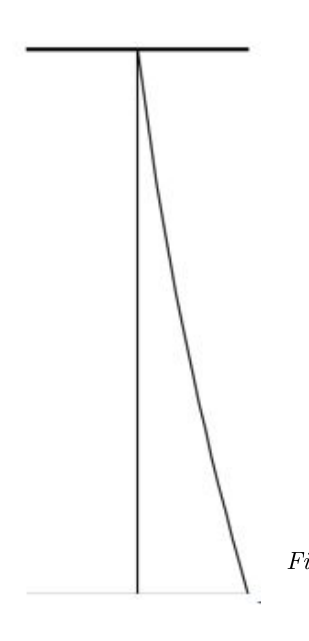
p.3 — Catena pendolo oscillante, posizione di equilibrio e oscillata
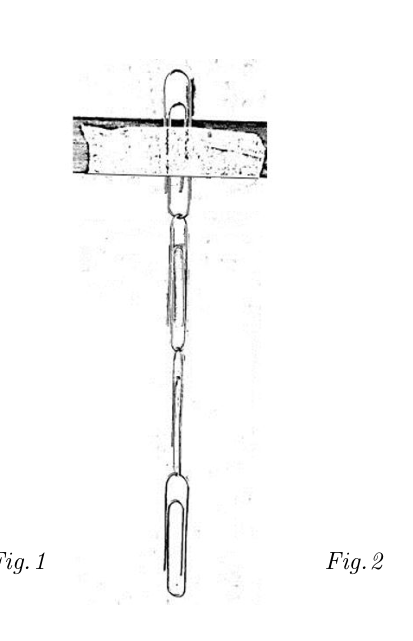
p.3 — Catena di clip fissata al bordo del tavolo
Topic: Oscillations & Waves Metodi: Simple Harmonic Motion Analysis, Experimental Data Analysis, Error Propagation Competenze: Measurement & Instrumentation, Experimental Data Analysis, Significant Figures Objects: Pendulum Fonte: Testo (PDF) — p.4 Soluzione: Soluzioni (PDF)
Q.1 [42 p.] Report in the table the results of the measures and calculations referred to in points (a); (b); (c). Make sure you take care of it the accuracy of the period T and of T0 measurements so that they have relative errors not exceeding 0,005. Provide evidence of the process you have followed to achieve your goal.
The following shall be added to the list of the following:
**p.3 ** Clip chain fixed to the edge of the table
Topic: Oscillations & Waves Metodi: Simple Harmonic Motion Analysis, Experimental Data Analysis, Error Propagation Competenze: Measurement & Instrumentation, Experimental Data Analysis, Significant Figures Objects: Pendulum Fonte: Testo (PDF) — p.4 Soluzione: Soluzioni (PDF)
Q.2 [20 p.] Analizzando i risultati ottenuti cosa puoi concludere circa il valore del rapporto T/T0 che caratterizza le catene impiegate? PARTE SECONDA. Piccole oscillazioni di una catena sospesa a un estremo e con un carico appeso all’altro estremo – Sia, ora, mc la massa di ciascuna clip, e m = nmc la massa dell’intera catena costituita da n clip. All’estremo libero della catena puoi appendere carichi di massa M che può essere opportunamente variata impiegando le rondelle in dotazione. L’obiettivo di questa seconda parte è lo studio della relazione T/T0 = f(M/m). La lunghezza L da inserire nel calcolo di T0 va misurata a partire dal punto di sospensione della catena fino al centro di massa del carico di rondelle. La riga millimetrata da 60 cm va impiegata per ricavare informazioni utili per il calcolo di M/m. Se opportunamente usata, la riga può svolgere la stessa funzione del giogo di una bilancia. A tal scopo, il fulcro della riga può essere costituito dal bordo squadrato del tavolo di lavoro.
Topic: Oscillations & Waves, Newtonian Mechanics Metodi: Simple Harmonic Motion Analysis, Physical Modeling, Experimental Data Analysis Competenze: Physical Reasoning, Experimental Data Analysis, Mathematical Modeling Objects: Pendulum Fonte: Testo (PDF) — p.4 Soluzione: Soluzioni (PDF)
Q.2 [20 p.] By analysing the results obtained, what can you conclude about the value of the T/T0 ratio that characterizes the chains used? Part two. Small oscillations of a chain suspended at one end and with a load suspended at the other end Now, either mc the mass of each clip, and m = nmc the mass of the entire chain consisting of n clips. We’re going to the extreme. Free of the chain you can hang loads of mass M which can be varied appropriately using the the equipment. The purpose of this second part is to study the T/T0 = f(M/m ratio. The length L to be entered in the T0 calculation shall be measured from the chain suspension point to the the centre of mass of the swirl load. The 60 cm millimeter line should be used to obtain useful information for the calculation of M/m. If used appropriately, the line can perform the same function as the balance-sheet. The Commission’s proposal for a directive on the The row may consist of the square edge of the work table.
Topic: Oscillations & Waves, Newtonian Mechanics Metodi: Simple Harmonic Motion Analysis, Physical Modeling, Experimental Data Analysis Competenze: Physical Reasoning, Experimental Data Analysis, Mathematical Modeling Objects: Pendulum Fonte: Testo (PDF) — p.4 Soluzione: Soluzioni (PDF)
Q.3 [17 p.] Indicando con Mg la massa di una rondella grande; Mm la massa di una rondella media; Mp la massa di una rondella piccola, usa la riga millimetrata per misurare i rapporti Mg/mc, Mm/mc, Mp/mc. Descrivi il metodo usato per le misure e gli accorgimenti utilizzati per ottenere la massima precisione. Riassumi in tabella le misure effettuate e i risultati della loro elaborazione. Non è richiesto il calcolo delle incertezze. Si può dimostrare che la funzione T/T0 = f(M/m) valida per un pendolo fisico costituito da una sottile asta rigida, di massa m, caricata a un estremo da un piccolo corpo di massa M è T T0
2 + 6M/m 3 + 6M/m (1) Ma cosa si può affermare per un pendolo realizzato con un corpo di massa M appeso a una catena di massa m? Ti viene proposto di studiare la situazione dal punto di vista sperimentale. A tal scopo impiegherai una catena costituita da 12 clip alla quale applicherai carichi diversi che andranno realizzati con le rondelle disponibili. Indicando con “p”, “m” e “g”, rispettivamente, la rondella piccola, media e grande, andranno realizzati carichi costituiti da 1p, 2p, 3p, 1m, 2m, 3m, 1g, 2g, 3g. Attenzione: per quanto l’entità dei carichi di rondelle sia compresa in un intervallo relativamente ampio, i corrispondenti periodi di oscillazione della catena varieranno entro pochi centesimi di secondo.
Topic: Newtonian Mechanics, Oscillations & Waves Metodi: Free-Body Diagram, Torque & Angular Momentum Analysis, Physical Modeling Competenze: Measurement & Instrumentation, Physical Reasoning, Experimental Data Analysis Objects: Pendulum, Rod Fonte: Testo (PDF) — p.4 Soluzione: Soluzioni (PDF)
Q.3 [17 p.] Indicating with Mg the mass of a large sponge; Mm the mass of an average sponge; Mp the mass of a small spindle, use the millimeter line to measure the Mg/mc, Mm/mc ratios, Mp/mc. Describe the method used for the measures and the methods used to obtain the maximum The exactness. Summary the measures taken and the results of their preparation. It ‘s not . The Commission has already taken the necessary steps to ensure that the Commission is able to take the necessary measures to ensure that the results of the examination are not compromised. It can be shown that the function T/T0 = f(M/m) is valid for a physical pendulum consisting of a thin axle rigid, m mass, loaded at one end by a small mass body M is T T0
2 + 6M/m 3 + 6M/m (1) But what can be said about a pendulum made with a mass M body hanging from a mass M chain? You are being asked to study the situation from an experimental point of view. To do this, you’ll use a chain of 12 clips to which you’ll apply different loads that will go made from available roundings. Indicating with p, m and g, respectively, the small, medium round and large, loads consisting of 1p, 2p, 3p, 1m, 2m, 3m, 1g, 2g, 3g shall be made. Note: although the quantity of loads of swaddling stock is covered in a relatively wide range, the The corresponding chain oscillation periods will vary within a few cents of a second.
Topic: Newtonian Mechanics, Oscillations & Waves Metodi: Free-Body Diagram, Torque & Angular Momentum Analysis, Physical Modeling Competenze: Measurement & Instrumentation, Physical Reasoning, Experimental Data Analysis Objects: Pendulum, Rod Fonte: Testo (PDF) — p.4 Soluzione: Soluzioni (PDF)
Q.4 [38 p.] Per tutti i carichi selezionati calcola il valore del rapporto M/m. Effettua le misure necessarie per poter calcolare il rapporto T/T0 da associare a ciascuno dei suddetti valori di M/m. Accèrtati di effettuare le misure di periodo T in modo da avere errori relativi er(T) . Dai evidenza al processo che hai seguito per raggiungere l’obiettivo. Assicurati che l’errore relativo sulla misura di T0 sia tale che er(T0) < 0.005. Riassumi in una tabella i risultati ottenuti includendo anche i valori ottenuti in precedenza per il caso M/m = 0. — Pagina 4 di 5 — AIF – Campionati di Fisica 2024 Gara Nazionale – 11 Aprile 2024 Prova Sperimentale
Topic: Oscillations & Waves, Newtonian Mechanics Metodi: Simple Harmonic Motion Analysis, Error Propagation, Experimental Data Analysis Competenze: Experimental Data Analysis, Measurement & Instrumentation, Significant Figures Objects: Pendulum Fonte: Testo (PDF) — p.4 Soluzione: Soluzioni (PDF)
Q.4 [38 p.] For all loads selected, calculate the M/m ratio. It shall take the necessary measures to: be able to calculate the T/T0 ratio to be associated with each of the above M/m values. Make sure that The measurements shall be carried out in the period T so that errors are not related to er(T) . Provide evidence to the The process you have followed to achieve your goal. Make sure that the error in the measurement of T0 is such that er(T0) < 0.005. Summarize the results in a table including the values previously obtained for the case M/m = 0. Page 4 of 5 AIF 2024 Physics Championships National competition 11 April 2024 Experimental Test
Topic: Oscillations & Waves, Newtonian Mechanics Metodi: Simple Harmonic Motion Analysis, Error Propagation, Experimental Data Analysis Competenze: Experimental Data Analysis, Measurement & Instrumentation, Significant Figures Objects: Pendulum Fonte: Testo (PDF) — p.4 Soluzione: Soluzioni (PDF)
Q.5 [30 p.] Riporta su un unico piano cartesiano l’andamento della funzione T/T0 = f(M/m) valida per un pendolo semplice, i punti sperimentali ottenuti impiegando la catena, ed elencati nella tabella ottenuta in Q4, e i corrispondenti punti calcolati per un’asta rigida. Riassumi in tabella i risultati relativi al calcolo di quest’ultimi. Si ipotizza che, nel caso della catena, la funzione T/T0 = f(M/m) assuma la forma T T0 = a (2 + 6M/m 3 + 6M/m )b (2)
Topic: Oscillations & Waves Metodi: Simple Harmonic Motion Analysis, Curve Fitting, Graph Linearization Competenze: Curve Fitting, Graph Linearization, Mathematical Modeling Objects: Pendulum, Rod Fonte: Testo (PDF) — p.5 Soluzione: Soluzioni (PDF)
Q.5 [30 p.] Report on a single cartesian plane the function T/T0 = f(M/m) valid for a simple pendulum, the test points obtained using the chain, and listed in the table The figures for the first quarter of the year are: Summary of results in table The Commission has also adopted a number of proposals for the It is assumed that, in the case of the chain, the function T/T0 = f(M/m) takes the form T T0 = a (2 + 6M/m 3 + 6M/m )b (2)
Topic: Oscillations & Waves Metodi: Simple Harmonic Motion Analysis, Curve Fitting, Graph Linearization Competenze: Curve Fitting, Graph Linearization, Mathematical Modeling Objects: Pendulum, Rod Fonte: Testo (PDF) — p.5 Soluzione: Soluzioni (PDF)
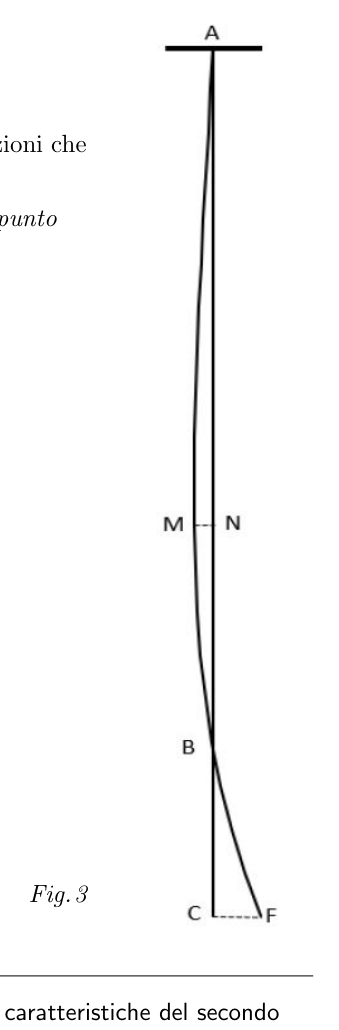
Q.6 [28 p.] Calcola il valore dei parametri a e b e confronta le tue misure con le corrispondenti previsioni fornite dalla (2). Commenta i risultati che hai ottenuto. PARTE TERZA. Secondo modo di oscillazione – Nel suo lavoro D. Bernoulli descrisse le condizioni che caratterizzano il secondo modo di oscillazione della catena, affermando che … le oscillazioni della catena sono caratterizzate da due punti fissi (o nodi): il punto di sospensione, e un punto giacente sulla verticale … (il punto B in Fig.3.) e, con riferimento, ancora, alla Fig.3 … CN corrisponde a 0.47 le MN è approssimativamente (2/5) FC … Fig.3
Topic: Oscillations & Waves Metodi: Simple Harmonic Motion Analysis, Curve Fitting, Experimental Data Analysis Competenze: Experimental Data Analysis, Physical Reasoning, Mathematical Modeling Objects: Pendulum Fonte: Testo (PDF) — p.5 Soluzione: Soluzioni (PDF)
Q.6 [28 p.] Calculate the values of parameters a and b and compare your measurements with the corresponding forecasts provided from (2). He’s commenting on the results you’ve got. Part three. Second oscillation mode In his work D. Bernoulli described the conditions under which the They characterise the second mode of oscillation of the chain, stating that … The chain oscillations are characterised by two fixed points (or nodes): the point Suspension, and a lying point on the vertical… (point B in Figure 3.) and, again, with reference to Figure 3. … CN corresponds to 0.47 MN is approximately (2/5) FC … Figure 3
Topic: Oscillations & Waves Metodi: Simple Harmonic Motion Analysis, Curve Fitting, Experimental Data Analysis Competenze: Experimental Data Analysis, Physical Reasoning, Mathematical Modeling Objects: Pendulum Fonte: Testo (PDF) — p.5 Soluzione: Soluzioni (PDF)
Q.7 [25 p.] Fai oscillare la sola catena costituita da 11 clip in modo da realizzare le caratteristiche del secondo modo di oscillazione. Misura il periodo T2 delle piccole oscillazioni e l’incertezza da associarvi. Riporta in tabella l’esito delle misure e la loro elaborazione. Misura il rapporto T2/T0 relativo a questo modo di oscillazione. Infine, misura il rapporto l2/ltra la lunghezza l2 del pendolo semplice isocrono e la lunghezza ldella catena. — Pagina 5 di 5 —
p.5 — Secondo modo di oscillazione, nodi A B
Topic: Oscillations & Waves Metodi: Simple Harmonic Motion Analysis, Experimental Data Analysis, Error Propagation Competenze: Measurement & Instrumentation, Experimental Data Analysis, Physical Reasoning Objects: Pendulum Fonte: Testo (PDF) — p.5 Soluzione: Soluzioni (PDF)
Q.7 [25 p.] Swing the single chain of 11 clips to create the characteristics of the second The oscillation mode. Measures the T2 period of the small oscillations and the uncertainty associated with them. The results of the measures and their elaboration shall be given in the table. Measures the T2/T0 ratio for This way of swinging. Finally, measure the ratio l2/l2 between the length l2 of the simple pendulum isocrons and the length of the chain. Page 5 of 5
The following is the list of the following:
Topic: Oscillations & Waves Metodi: Simple Harmonic Motion Analysis, Experimental Data Analysis, Error Propagation Competenze: Measurement & Instrumentation, Experimental Data Analysis, Physical Reasoning Objects: Pendulum Fonte: Testo (PDF) — p.5 Soluzione: Soluzioni (PDF)