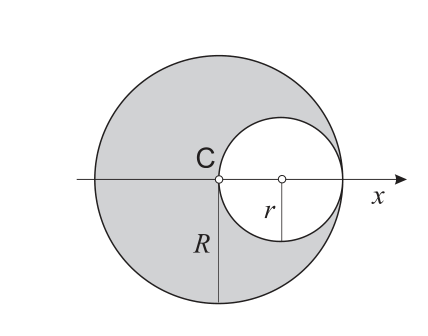
P1 Puro rotolamento Punti 100 Un disco sottile omogeneo ha raggio ; in esso viene praticato un foro circolare di raggio il cui centro è a distanza dal centro C del disco (v. figura a sinistra); sia la massa dell’oggetto cosı` ottenuto.
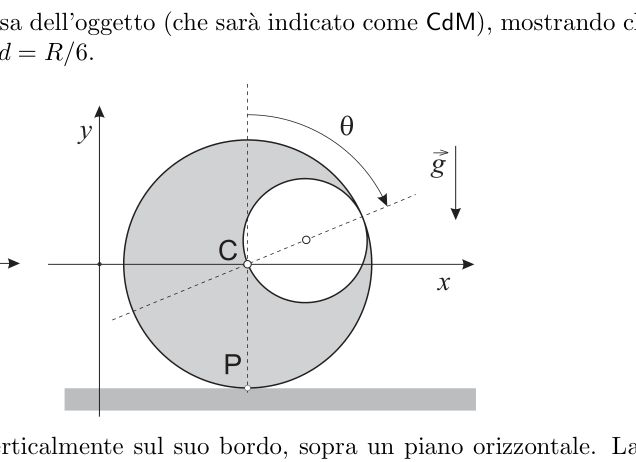
- Determinare la posizione del centro di massa dell’oggetto (che sarà indicato come CdM), mostrando che la distanza del CdM dal centro del disco C è . Prima parte. L’oggetto viene appoggiato verticalmente sul suo bordo, sopra un piano orizzontale. La sua disposizione è descritta dalla coordinata del centro C e dall’angolo orientato tra la verticale passante per C e la congiungente dei due centri, come mostrato in figura a destra. Quando l’oggetto si muove, rotola sempre senza strisciare rimanendo nello stesso piano verticale.
- Trovare le posizioni di equilibrio dell’oggetto e dire quali sono di equilibrio stabile e quali di equilibrio instabile, giustificando la risposta.
- Dimostrare che il momento d’inerzia dell’oggetto rispetto al punto di appoggio, quando è in equilibrio stabile, è pari a . L’oggetto viene disposto in con e successivamente ruotato verso destra fino all’angolo . Lasciato libero, si muove e inizia a oscillare.
- Mostrare che, ponendo nulla l’energia potenziale gravitazionale nella posizione di equilibrio stabile, l’energia totale è formalmente uguale a quella di un oggetto di massa fissato a una molla di costante elastica e quindi si può scrivere come con e e funzioni dei parametri del problema. Nota: in generale il momento di inerzia rispetto al punto di contatto dipende dall’angolo ; tuttavia, per queste piccole oscillazioni, si può ritenere costante.
- Scrivere la legge oraria del moto per la coordinata ed esplicitare l’espressione del periodo del moto. Seconda parte. Si supponga adesso che il disco si muova di puro rotolamento in modo che la velocità del centro C sia costante. Per ottenere questo moto si applica una forza orizzontale nel punto C; sia al tempo .
- Mostrare che il momento angolare rispetto al punto C, in funzione del tempo, nel riferimento inerziale solidale al punto C, è costante.
- Determinare, in funzione del tempo e in termini dei dati del problema, l’espressione della forza di attrito , della reazione normale del piano e di .
- Trovare la condizione sulla velocità tale per cui l’oggetto non si stacca dal piano orizzontale, indicando con la velocità limite.
- Qual è il minimo valore che deve avere il coefficiente di attrito statico affinche ́ il moto sia sempre di puro rotolamento?
p.4 — Disco con foro circolare, raggio R e r
p.4 — Disco appoggiato su piano, angolo theta
Topic: Rotational Dynamics, Newtonian Mechanics, Oscillations & Waves Metodi: Free-Body Diagram, Torque & Angular Momentum Analysis, Simple Harmonic Motion Analysis, Energy Conservation Method Competenze: Mathematical Modeling, Physical Reasoning, Diagrammatic Reasoning Objects: Disk Fonte: Testo (PDF) — p.4 Soluzione: Soluzioni (PDF)
P1 Pure rolling The following points shall be added: A uniform thin disc has a radius ; a circular radius hole is practiced in it the centre of which is from the centre of C of the disc (see. Figure on the left); either the mass of the object The result.
- Determine the position of the object’s centre of mass (which will be referred to as the CdM), showing that the The distance of the CdM from the centre of disk C is . Part one. The object is supported vertically on its edge, above a horizontal plane. His . The position is described by the coordinate of the centre C and the oriented angle between the vertical passing through C and the junction of the two centers, as shown in the figure to the right. When moving, the object always rolls without cracking and stays in the same vertical plane.
- Find the equilibrium positions of the object and tell which are stable and which are equilibrium The Commission has already taken a number of measures to ensure that the Commission is able to take the necessary measures to ensure that the Commission is able to take the necessary measures to ensure that the Commission is able to take the necessary measures.
- Demonstrate that the moment of inertia of the object with respect to the point of support, when in equilibrium is stable, equal to . The object is placed in with and then rotated right up to the angle. Left unattended, it moves and starts to oscillate.
- To show that, by placing gravitational potential energy in the position of stable equilibrium, the energy Total is formally equal to that of a mass object fixed to an elastic constant spring and So you can write it as with and and functions of the problem parameters. Note: in general, the moment of inertia with respect to the contact point depends on the angle ; however, for these small oscillations, you can think of them as constant.
- Write the motion time law for the coordinate and specify the expression of the motion time. Part two. Now suppose that the disk is moving at a pure rolling rate so that the speed of the Center C is constant. To obtain this motion a horizontal force is applied in point C; either is applied to the The time .
- Show that the angular momentum with respect to point C, as a function of time, in the inertial reference Solidarity at point C, it’s constant.
- Determine, in terms of time and problem data, the expression of friction force , della reazione normale del piano e di .
- Find the condition on the speed such that the object does not detach from the horizontal plane, by indicating with the speed limit.
- What is the minimum value that the static friction coefficient must have for the engine to be pure at all times ?
- What’s that?
**p.4 ** Circular bore disc, radius R and r
p.4 — Disco appoggiato su piano, angolo theta
Topic: Rotational Dynamics, Newtonian Mechanics, Oscillations & Waves Metodi: Free-Body Diagram, Torque & Angular Momentum Analysis, Simple Harmonic Motion Analysis, Energy Conservation Method Competenze: Mathematical Modeling, Physical Reasoning, Diagrammatic Reasoning Objects: Disk Fonte: Testo (PDF) — p.4 Soluzione: Soluzioni (PDF)
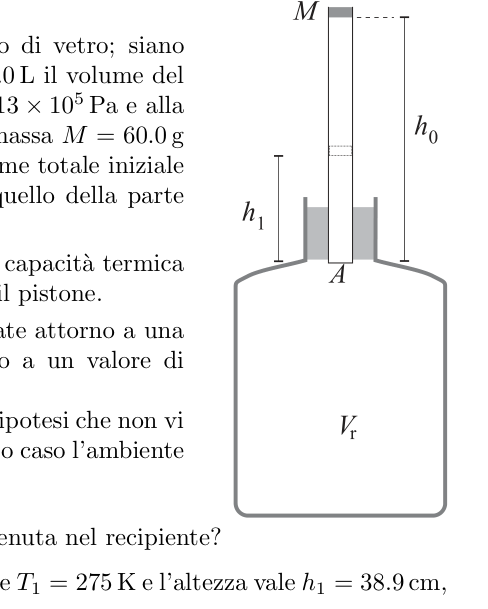
P2 Evoluzioni termodinamiche Punti 100 Questo problema si ispira alla misura del coefficiente , rapporto tra i calori specifici di un gas a pressione e a volume costante, con una tecnica messa a punto da Rüchardt, basata su misure di tempo, più precise delle misure calorimetriche. Di questa tecnica saranno analizzate le modalità e alcune criticità, facendo riferimento all’aria, trattata come un gas perfetto biatomico, di massa molare , mentre il valore di si supporrà noto e pari a 7/5. Un recipiente di vetro a tenuta è munito di un sottile cilindro cavo di vetro; siano cm l’altezza del cilindro, la sua sezione e L il volume del recipiente. Esso è riempito di aria alla pressione atmosferica Pa e alla temperatura K, pari a quella dell’ambiente. Un pistone di massa g è attentamente inserito a tenuta nel cilindro. Si indichi con il volume totale iniziale dell’aria contenuta nel recipiente pari al volume del recipiente più quello della parte chiusa del cilindro, . In prima approssimazione si supponga che siano trascurabili sia la capacità termica delle pareti del recipiente e del pistone sia l’attrito tra il recipiente e il pistone. Il pistone viene lasciato scendere e compie delle oscillazioni smorzate attorno a una posizione di equilibrio ; analogamente la pressione oscilla attorno a un valore di equilibrio . In questa prima fase si calcolerà la posizione di equilibrio sotto l’ipotesi che non vi sia flusso di calore tra l’aria intrappolata e l’ambiente esterno. In questo caso l’ambiente esterno compie lavoro soltanto su tale volume.
- A equilibrio raggiunto, quanto vale la pressione dell’aria contenuta nel recipiente?
- Verificare che la temperatura dell’aria contenuta nel recipiente vale K e l’altezza vale cm, utilizzando come un dato la pressione trovata sopra. Successivamente, il pistone viene leggermente spostato e inizia a compiere piccole oscillazioni; per un breve intervallo di tempo le oscillazioni si possono considerare quasistatiche e si possono trascurare sia lo smorzamento dovuto all’attrito che gli scambi di calore con l’esterno.
- Quanto vale il periodo di queste oscillazioni? Si analizzano ora due criticità che diventano rilevanti a tempi molto lunghi. La prima è l’effetto della conducibilità residua delle pareti del cilindro. A causa di questo effetto, il pistone si sposta in una nuova posizione di equilibrio .
- Quanto valgono la temperatura dell’aria contenuta nel recipiente e l’altezza ? Qual è il nuovo valore del periodo di eventuali nuove piccole oscillazioni? La seconda criticità è la non perfetta tenuta del pistone. Si schematizzi la situazione considerando che la differenza tra la sezione del cilindro e la sezione del pistone sia . Per questo motivo il pistone non rimane in equilibrio, ma continua a scendere con una velocità che si può ritenere costante. Si può ipotizzare che il processo avvenga cosı` lentamente che l’aria contenuta nel recipiente sia in equilibrio termico con l’ambiente circostante per tutta la durata del processo. Si trascurino gli urti tra le molecole.
- Nell’ipotesi che dove è il valor medio di ciascuna componente della velocità delle molecole d’aria, qual è il valore di ? Qual è il valore dell’abbassamento del pistone nel periodo di una oscillazione? Suggerimento: ricordare che per una particella di aria a temperatura , la media di una delle componenti della velocità è data da .
p.5 — Apparato di Ruchardt con pistone M
Topic: Thermodynamics, Oscillations & Waves, Kinetic Theory Metodi: Ideal Gas Law, Simple Harmonic Motion Analysis, Kinetic Theory of Gases, Thermodynamic Cycle Analysis Competenze: Mathematical Modeling, Physical Reasoning, Estimation & Approximation Objects: Gas, Cylinder, Piston, Container Fonte: Testo (PDF) — p.5 Soluzione: Soluzioni (PDF)
P2 The thermodynamic evolution of the system The following points shall be added: This problem is inspired by the measurement of the coefficient , the ratio of specific heat to a gas The first is the use of a constant pressure and volume system, with a technique developed by Rüchardt, based on time measurements, plus the use of a constant pressure and volume system. the precise calorimetric measurements. The methods and some of the criticisms of this technique will be analysed, with reference to the air, which is treated as a perfect biatomic gas, with a molar mass , whereas the value of is assumed to be known and equal to 7/5. A glass container with a holding is fitted with a thin glass-cable cylinder; either cm the height of the cylinder, its section and L the volume of the cylinder container. It is filled with air at atmospheric pressure Pa and at The temperature K, equal to that of the environment. A piston of a mass g It is carefully inserted into the cylinder. Indicate the initial total volume with of the air contained in the container equal to the volume of the container plus the volume of the part the cylinder closed, . In the first approximation, both thermal capacity and the The walls of the container and the piston shall be torn between the container and the piston. The piston is let down and makes a series of oscillations around a posizione di equilibrio ; analogamente la pressione oscilla attorno a un valore di equilibrio . In this first step, the equilibrium position is calculated under the assumption that there is no The heat flow between the trapped air and the external environment. In this case the environment The Commission has not yet taken any further action.
- At equilibrium, what is the pressure of the air contained in the container?
- Verify that the air temperature in the container is K and the height is cm, using the pressure above as a data. The piston is then slightly moved and starts to oscillate slightly; for a short time, the piston is moved slightly. The time intervals can be considered quasi-static and both the deflection and the deflection can be overlooked. The heat exchanged with the outside is due to the friction.
- Quanto vale il periodo di queste oscillazioni? We are now looking at two critical issues that become relevant over a very long period of time. The first is the effect of residual conductivity of the cylinder walls. Because of this effect, the piston moves to a new position of equilibrio .
- What is the temperature of the air contained in the container and the height ? What is the new value The time period of any further small oscillations? The second critical issue is the imperfect grip of the piston. The situation is outlined in the light of the fact that the The difference between the cylinder section and the piston section shall be . For this reason the piston does not It remains in equilibrium, but continues to descend at a rate that can be considered constant. It can be assumed The process should be so slow that the air contained in the container is in thermal equilibrium with the environment. The Commission shall, by means of implementing acts, adopt implementing acts in accordance with Article 21 of Regulation (EC) No 1272/2009. Ignore the collisions between the molecules.
- In the assumption that where is the mean value of each component of the molecular velocity What is the value of ? What is the piston’s lowering value in the period of a oscillation? Suggestion: remember that for an air particle at , the average of one of the components of the speed is given by .
p.5 — Apparato di Ruchardt con pistone M
Topic: Thermodynamics, Oscillations & Waves, Kinetic Theory Metodi: Ideal Gas Law, Simple Harmonic Motion Analysis, Kinetic Theory of Gases, Thermodynamic Cycle Analysis Competenze: Mathematical Modeling, Physical Reasoning, Estimation & Approximation Objects: Gas, Cylinder, Piston, Container Fonte: Testo (PDF) — p.5 Soluzione: Soluzioni (PDF)
P3 Conduttore con cavità Punti 100 L’energia magnetica associata a un circuito costituito da una maglia percorsa da corrente si può esprimere in termini di un parametro detto “coefficiente di autoinduzione” , dato dal rapporto tra il flusso del campo magnetico , concatenato alla maglia stessa, e la corrente che scorre nel circuito. dipende solo dalla geometria del circuito e del mezzo in cui è posto il circuito. In un circuito alimentato da un generatore di corrente costante, ogni variazione di determina una variazione di energia magnetica , a spese del generatore che alimenta il circuito.
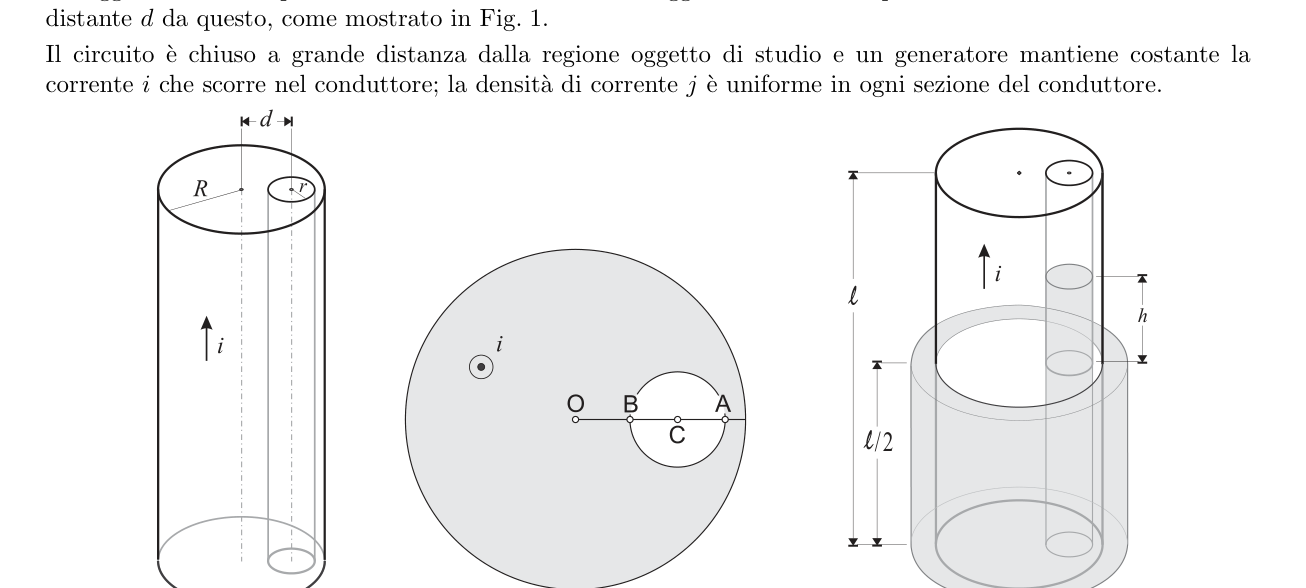
- Mostrare che il lavoro compiuto dal generatore è dato da più l’energia dissipata per effetto Joule. Si consideri ora un circuito in cui è presente un conduttore elettrico rettilineo di lunghezza , a sezione circolare di raggio che presenta una cavità cilindrica di raggio il cui asse è parallelo all’asse del conduttore e distante da questo, come mostrato in Fig. 1. Il circuito è chiuso a grande distanza dalla regione oggetto di studio e un generatore mantiene costante la corrente che scorre nel conduttore; la densità di corrente è uniforme in ogni sezione del conduttore.
- Trovare modulo, direzione e verso del campo magnetico nei punti A, B e C indicati nella Fig. 2.
- Dimostrare che il campo magnetico nella regione della cavità è uniforme. Il conduttore viene immerso verticalmente, per metà della sua lunghezza, in un grande recipiente che contiene un liquido paramagnetico di permeabilità magnetica e densità ; una membrana porosa per l’aria, posta a metà della cavità, mantiene il liquido alla stessa altezza di quello esterno. Sia questo lo stato iniziale del sistema. Si osserva che, rimossa la membrana, il liquido risale fino a un’altezza che, all’equilibrio, supera di un tratto il livello del liquido fuori dal cilindro, come in Fig. 3.
- Determinare l’energia magnetica presente nella cavità del conduttore, in funzione di .
- Esprimere, in funzione di , il lavoro aggiuntivo fatto dal generatore, a causa della variazione di configurazione del sistema.
- Determinare l’espressione di . NOTA BENE È possibile utilizzare, riprodurre, distribuire, comunicare al pubblico questo materiale alle due seguenti condizioni: citare la fonte; non usare il materiale, nemmeno parzialmente, per fini commerciali.
p.6 — Conduttore cilindrico con cavita, Fig.1-2-3
Topic: Magnetism, Electromagnetic Induction, Conservation of Energy Metodi: Ampère’s Law, Superposition Principle, Energy Conservation Method, Biot-Savart Law Competenze: Mathematical Modeling, Physical Reasoning, Diagrammatic Reasoning Objects: Wire, Membrane Fonte: Testo (PDF) — p.6 Soluzione: Soluzioni (PDF)
P3 Conductor with cavity The following points shall be added: Magnetic energy associated with a circuit consisting of a net travelling by current can be expressed in terms of a parameter called self-induction coefficient , given by the flow ratio The magnetic field , which is connected to the mesh itself, and the current flowing through the circuit. depends on the only by the geometry of the circuit and the medium in which the circuit is placed. In a circuit powered by a DC generator, each change of results in a change di energia magnetica , a spese del generatore che alimenta il circuito.
- Show that the work done by the generator is given by plus the energy dissipated by Joule effect. Consider now a circuit in which a straight line electrical conductor of length is present, circular section a radius having a cylindrical cavity of radius whose axis is parallel to the conductor axis; and distance from this, as shown in Fig. 1. The circuit is closed at a great distance from the region under study and a generator keeps the current flowing in the conductor; current density is uniform in each section of the conductor.
- Find the shape, direction and direction of the magnetic field in points A, B and C shown in Fig. 2.
- Demonstrate that the magnetic field in the cavity region is uniform. The conductor is immersed vertically, half its length, in a large container containing a paramagnetic liquid of magnetic permeability and density ; a porous air membrane, set at half of the cavity, keeps the liquid at the same height as the outside. Let’s see if this is the initial state of the system. It is noted that, when the membrane is removed, the liquid rises to a height which, when in equilibrium, exceeds the liquid level outside the cylinder, as shown in Fig. 3.
- Determine the magnetic energy present in the conductor cavity, as a function of .
- Express, according to , the additional work done by the generator due to the change in the system configuration.
- Determine the expression of . Good note . You can use, reproduce, distribute, communicate this material to the public to the following two Conditions: citing the source; not using the material, even partially, for commercial purposes.
p.6 — Conduttore cilindrico con cavita, Fig.1-2-3
Topic: Magnetism, Electromagnetic Induction, Conservation of Energy Metodi: Ampère’s Law, Superposition Principle, Energy Conservation Method, Biot-Savart Law Competenze: Mathematical Modeling, Physical Reasoning, Diagrammatic Reasoning Objects: Wire, Membrane Fonte: Testo (PDF) — p.6 Soluzione: Soluzioni (PDF)