P1 Ps = Positronio Punti 100 Il positrone è l’antiparticella dell’elettrone: ha massa uguale a quella dell’elettrone, ma carica elettrica opposta; insieme all’elettrone può formare uno “stato legato” chiamato positronio, simile all’atomo di idrogeno. Il positronio(1), come l’atomo di idrogeno, è tenuto insieme dalla forza di attrazione coulombiana. Per un sistema classico di due particelle, l’energia totale non relativistica si può ottenere come somma dell’energia di traslazione del sistema, dovuta al moto del centro di massa (CdM) con l’energia interna , dovuta al moto relativo delle particelle e all’energia potenziale legata alla loro interazione.
- Mostrare che l’energia totale di un sistema di due particelle cariche di masse e e cariche e si può scrivere, in termini della velocità del CdM e della velocità relativa delle due particelle, come
dove è la massa totale e è chiamata massa ridotta del sistema. In fisica atomica e nucleare conviene usare come unità di misura dell’energia l’elettronvolt (eV) e i suoi multipli e come unità di massa il . L’unità di massa atomica vale . 2. Calcolare la massa ridotta dell’idrogeno e quella del positronio esprimendole con quattro cifre significative nelle unità suggerite. Supporre che l’orbita dell’elettrone attorno al protone nell’idrogeno o attorno al positrone nel positronio sia circolare e ricavare la relazione fra il raggio dell’orbita e il modulo dell’energia interna. Secondo la meccanica quantistica non relativistica, l’energia interna dello stato fondamentale di un sistema costituito da una particella positiva di carica elettrica e una negativa di carica è data da . 3. Calcolare l’energia interna dello stato fondamentale del positronio. Usando la relazione classica ricavata sopra, calcolare il raggio da associare a un positronio nello stato fondamentale. A differenza dell’atomo di idrogeno, il positronio è instabile, perche ́ l’elettrone e il positrone possono annichilirsi con trasformazione di tutta la loro energia in energia di fotoni. Questo processo è intrinsecamente relativistico. Il positronio nello stato fondamentale ha una vita media di s; l’annichilazione più probabile è quella in due fotoni. 4. Calcolare, nel sistema di riferimento del CdM, l’energia di ciascun fotone emesso nel decadimento del positronio e l’angolo tra le direzioni di emissione dei fotoni stessi. Il positrone non è presente stabilmente nel nostro mondo ricco di elettroni, ma può essere prodotto grazie ai decadimenti di alcuni isotopi instabili, come ad esempio l’isotopo F del fluoro che decade in O, un positrone e un neutrino elettronico: . Le masse di F e O sono rispettivamente u e u mentre la massa del neutrino è trascurabile. Si vogliono analizzare ora le caratteristiche del positrone emesso nel decadimento di un nucleo di fluoro a riposo, in particolare la sua energia minima e massima. 5. Calcolare il valore minimo dell’energia del positrone prodotto nel decadimento. 6. Mostrare che, nel decadimento del fluoro, l’energia cinetica dell’ossigeno è trascurabile rispetto alla sua energia a riposo. SEGUE (1) Il positronio può esistere in due stati di spin diverso: lo stato di singoletto () chiamato para-positronio, in cui lo spin dell’elettrone e del positrone sono antiparalleli e quello di tripletto () che assume il nome di orto-positronio. In questo problema si discute del para-positronio.
Questo significa che la velocità dell’ossigeno è molto minore di , dunque è non relativistico; per la sua energia cinetica e la sua quantità di moto si possono usare le espressioni classiche. Inoltre il valore massimo dell’energia del positrone emesso si ottiene quando il neutrino è emesso con energia trascurabile. 7. Calcolare il valore massimo dell’energia del positrone emesso nel decadimento, avendo mostrato che l’energia cinetica dell’ossigeno è trascurabile rispetto all’energia relativistica del positrone. Il positronio non si trova in natura, ma viene prodotto artificialmente facendo urtare un elettrone e un positrone: nelle usuali condizioni sperimentali, l’elettrone può essere considerato fermo, mentre il positrone può avere velocità anche elevata. In maniera largamente prevalente, il positronio si forma quasi fermo e i due fotoni prodotti nell’annichilazione hanno quindi le caratteristiche dedotte al punto 4. Ora si vogliono esaminare le proprietà assai diverse dei fotoni prodotti nell’annichilazione di un positronio in moto, eventualmente relativistico. 8. Mostrare che le direzioni dei fotoni prodotti nell’annichilazione di un positronio in moto non sono collineari, escluso un caso particolare. In questo caso particolare, detto il modulo della velocità del positronio, determinare un’espressione per il rapporto tra le energie dei due fotoni prodotti, in termini , e mostrare che non può mai essere uguale a uno.
Topic: Modern-Quantum Physics, Special Relativity, Nuclear & Particle Physics Metodi: Bohr Model & Quantization, Coulomb’s Law, Mass-Energy Equivalence, Relativistic Energy-Momentum, Conservation of Momentum Competenze: Mathematical Modeling, Physical Reasoning, Significant Figures Objects: Electron, Photon, Nucleus, Atom Fonte: Testo (PDF) — p.2 Soluzione: Soluzioni (PDF)
P1 Ps = Positronium The following points shall be added: The positron is the antiparticle of the electron: it has a mass equal to that of the electron, but it is charged The electron is the opposite of the electron. It can form a bonded state called positronium, similar to the atom of Hydrogen is the source of the gas. Positronium (), as the hydrogen atom, is held together by the Colombian force of attraction. For a classical two-particle system, the nonrelativistic total energy can be obtained as sum the system transfer energy due to the motion of the centre of mass (CdM) with the internal energy , The relative motion of particles and the potential energy associated with their interaction.
- Show that the total energy of a system of two particles with masses and and charges and is can write, in terms of the speed of the CdM and the relative speed of the two particles, as
where is the total mass and is called the reduced mass of the system. In nuclear and atomic physics, the electronvolt (eV) and its multiples are used as the unit of energy. and as a unit of mass . The atomic mass unit is . 2. Calculate the reduced hydrogen and positron masses by four significant digits In the units suggested. Suppose that the electron’s orbit around the proton in hydrogen or around the Positrone in positrone is both circular and derive the relationship between the radius of the orbit and the energy module It’s inside. According to nonrelativistic quantum mechanics, the internal energy of a system’s fundamental state is the consisting of a positive electric charge particle and a negative charge particle is given by . 3. Calculate the internal energy of the fundamental state of positronium. Using the classical report obtained above, calculate the radius to be associated with a positron in the base state. Unlike the hydrogen atom, positronium is unstable because the electron and the positron can be annihilated. And then they’re going to turn all their energy into photon energy. This process is inherently relativistic. Positronium in the base state has an average life of s; the most likely annihilation is The two-photon one. 4. Calculate, in the CdM reference system, the energy of each photon emitted in the decay of the The position of the photon is the angle between the emission directions of the photon itself. Positrone is not permanently present in our electron-rich world, but it can be produced thanks to ai decadimenti di alcuni isotopi instabili, come ad esempio l’isotopo F del fluoro che decade in O, un Positrone and an electronic neutrinos: . The masses of F and O are u respectively. and u while the neutrinos are negligible in mass. The following is a description of the characteristics of the positron emitted in the decay of a fluorine nucleus at The Commission has already taken the necessary steps to ensure that the Community’s energy resources are adequately used. 5. Calculate the minimum value of the energy of the decaying positron. 6. To show that in the decay of fluorine, the kinetic energy of oxygen is negligible compared to its energy at rest. SEGUE (1) Positronium can exist in two different spin states: the singular state () called para-positronium, in which the spin is The electron and the positron are antiparallel and the triplet () is called ortho-positron. In this The problem is the para-positronium.
This means that the speed of oxygen is much less than , so it’s not relativistic; because of its energy The first is the kinetic and the amount of motion it produces. In addition, the maximum value of energy The emission of positron is achieved when the neutrinos are emitted with negligible energy. 7. Calculate the maximum value of the energy of the positron emitted in decay, having shown that the kinetic energy of oxygen is negligible compared to the relativistic energy of the positron. Positronium is not found in nature, but is produced artificially by impacting an electron and a positron: In the usual experimental conditions, the electron can be considered stationary, while the positron can have High speed too. In most cases, positronium forms almost stationary and the two photons produced in annihilation are have the characteristics of point 4. Now they want to examine the very different properties of photons. The product is the annihilation of a moving positron, possibly relativistic. 8. Show that the photon directions produced in the annihilation of a moving positron are not collinear, Except for one particular case. In questo caso particolare, detto il modulo della velocità del positronio, determine an expression for the energy ratio of the two photons produced, in terms of , and To show that he can never be equal to one.
Topic: Modern-Quantum Physics, Special Relativity, Nuclear & Particle Physics Metodi: Bohr Model & Quantization, Coulomb’s Law, Mass-Energy Equivalence, Relativistic Energy-Momentum, Conservation of Momentum Competenze: Mathematical Modeling, Physical Reasoning, Significant Figures Objects: Electron, Photon, Nucleus, Atom Fonte: Testo (PDF) — p.2 Soluzione: Soluzioni (PDF)
P2 Un biliardo magnetico Punti 100 Si considerino due sfere dielettriche di raggio e massa , caricate uniformemente(2) poste in una regione di campo magnetico uniforme orientato nel verso positivo dell’asse . Fissato un sistema di assi cartesiani ortogonali , le sfere scivolano senza ruotare sul piano orizzontale liscio , perpendicolare al campo magnetico. La sfera A si sta muovendo con velocità lungo l’asse , in verso positivo, nell’istante in cui urta la sfera B, mentre questa è praticamente ferma nell’origine delle coordinate; la collisione è centrale ed elastica. Con queste stesse condizioni iniziali si esaminano due casi diversi. Primo caso: la sfera A ha una carica negativa e la sfera B una carica ; inoltre il modulo della velocità della sfera A e l’intensità del campo magnetico sono tali che l’interazione elettrostatica può essere trascurata.
- Determinare la velocità della sfera B immediatamente dopo la collisione.
- Dopo aver fatto le considerazioni fisiche necessarie, mostrare geometricamente, a partire da una rappresentazione grafica, che dopo un tempo le due sfere si urtano nuovamente; determinare la posizione del centro della sfera B all’istante del secondo urto, l’intervallo e verificare che si tratta ancora di un urto centrale.
- Tenendo presente che nell’istante di un urto il punto di collisione coincide col centro di massa del sistema (CdM), determinare modulo e direzione della velocità media del CdM delle sfere tra il primo e il terzo urto. [Si può verificare che si troverebbe lo stesso risultato considerando qualunque coppia di urti.] Secondo caso: entrambe le sfere hanno carica e l’interazione elettrostatica non è più trascurabile.
- Scrivere l’equazione di moto del CdM del sistema. Sia (con ) il punto in cui le superfici delle due sfere sono a contatto all’istante dell’-esima collisione.
- Mostrare che comunque si scelgano due punti e la loro distanza è sempre minore o uguale a un valore e determinare . Valutazione dell’ipotesi iniziale: ci si chiede se un simile biliardo sia realizzabile. Facendo riferimento al primo dei due casi, si consideri che le palle da biliardo sono sfere di raggio cm, massa g e possono muoversi a una velocità ; si supponga poi che la carica su ogni palla sia in modulo nC.
- Che valore dovrebbe avere l’intensità del campo magnetico perche ́ l’ipotesi data nel primo caso sia soddisfatta?
- Che dimensioni minime dovrebbe avere il biliardo per poter avere le prime collisioni? (2) Per la simmetria sferica della distribuzione di carica e per il fatto che la sfera non rotola, la carica può essere pensata come puntiforme posta al centro della sfera; la dimostrazione qui non è richiesta.
Topic: Magnetism, Conservation of Momentum, Electrostatics Metodi: Lorentz Force Analysis, Conservation Laws, Conservation of Momentum, Free-Body Diagram Competenze: Diagrammatic Reasoning, Mathematical Modeling, Physical Reasoning Objects: Sphere Fonte: Testo (PDF) — p.3 Soluzione: Soluzioni (PDF)
P2 A magnetic pool The following points shall be added: Two dielectric spheres of radius and mass , uniformly charged, placed in the a uniform magnetic field region oriented towards the positive side of the axis. Fixed a system of orthogonal Cartesian axes , the spheres slide without rotating horizontally liscio , perpendicolare al campo magnetico. The sphere A is moving along the axis , in a positive direction, as soon as the sphere B hits, The collision is central and elastic. The same initial conditions apply to two different cases. First case: the sphere A has a negative charge and the sphere B a charge ; furthermore the speed module The magnetic field intensity of the sphere A and the magnetic field intensity are such that electrostatic interaction can be neglected.
- Determine the speed of the sphere B immediately after the collision.
- After having made the necessary physical considerations, show geometrically, starting from a graphic representation, that after some time the two spheres collide again; determine the position of the centre of the B-sphere near the second impact, the interval and verify that it is still a collision The central.
- Whereas, in the event of a collision, the point of collision coincides with the centre of mass of the system (CdM), determining the shape and direction of the average speed of the CdM of the spheres between the first and third I’m going to hit you. [It can be found that the same result would be found considering any pair of impacts.] Secondly, both spheres have a charge of and electrostatic interaction is no longer negligible.
- Write the system CdM motion equation. Whether (with ) the point at which the surfaces of the two spheres are in contact with the distant of -exima The collision.
- Show that any two points and are chosen, their distance is always less than or equal to a value and determine . Assessment of the initial hypothesis: one wonders whether such a pool can be achieved. Referring to the first In both cases, it is considered that billiard balls are spheres of radius cm, mass g and can be move at a speed ; then assume that the load on each ball is nC.
- What value should the magnetic field intensity be for the hypothesis in the first case to be satisfied?
- What size should the pool be to make the first collisions? (2) For the spherical symmetry of the charge distribution and the fact that the sphere does not roll, the charge can be thought of as The point is placed at the centre of the sphere; the demonstration is not required here.
Topic: Magnetism, Conservation of Momentum, Electrostatics Metodi: Lorentz Force Analysis, Conservation Laws, Conservation of Momentum, Free-Body Diagram Competenze: Diagrammatic Reasoning, Mathematical Modeling, Physical Reasoning Objects: Sphere Fonte: Testo (PDF) — p.3 Soluzione: Soluzioni (PDF)
P3 Rullo con molla Punti 100 Un rullo è costituito da un cilindro solido omogeneo di massa e raggio , è appoggiato su un tavolo orizzontale ed è sottoposto a una forza orizzontale di modulo , sempre applicata al suo asse e perpendicolare a esso, come mostrato nella figura sottostante, e a una forza di attrito – statico o dinamico – di modulo .
- Supponendo che il rullo rotoli senza strisciare, si ricavi che deve essere necessariamente . La condizione sulle forze è dunque necessaria per avere puro rotolamento ma non è sufficiente. Si supponga che il rullo si stia muovendo e che da un certo istante venga applicata al rullo una forza .
- Mostrare che questa condizione non è sufficiente per avere puro rotolamento e trovare quale altra condizione è richiesta per l’instaurarsi di un moto di tale tipo. In presenza di attrito il rullo viene lanciato con velocità e ; per quanto visto sopra, il rullo inizialmente slitta.
- Confermare questo risultato, considerando lo spostamento lineare e angolare del rullo in un intervallo temporale infinitesimo dall’istante di partenza, qualunque siano i valori della velocità e del coefficiente d’attrito. Il rullo viene ora collegato a una parete tramite una molla elicoidale di costante elastica e lunghezza di riposo indefinita ma tale che il rullo non arrivi mai a urtare la parete (v. figura). Si assuma inoltre che la molla abbia massa trascurabile e sia ideale, ovvero che la legge di Hooke rimanga valida anche per deformazioni arbitrariamente grandi; l’asse della molla si consideri sempre orizzontale. Sia la posizione di equilibrio del rullo. Il rullo viene spostato dalla posizione di equilibrio di una quantità e rilasciato da fermo all’istante .
- Nell’ipotesi di attrito trascurabile, trovare il periodo di oscillazione . Come cambia la situazione se ? Ora i coefficienti di attrito statico e dinamico tra il rullo e il tavolo non sono più nulli.
- Il rullo viene allontanato dalla posizione di equilibrio e lasciato da fermo; inizia a rotolare avanti e indietro. Per piccole oscillazioni, non si verifica slittamento tra il rullo e la superficie; trovare il nuovo periodo di oscillazione .
- Se l’ampiezza iniziale dell’oscillazione è maggiore di un certo valore critico , con e , il moto di rotolamento senza strisciamento non è più possibile. Esprimere in funzione di .
- Supponendo che l’elongazione iniziale sia con , dimostrare che il rullo può eventualmente ritornare a rotolare senza strisciare solo vicino al termine della prima semioscillazione. Infine il rullo, sempre collegato alla molla, viene lanciato a velocità dalla posizione di equilibrio con una forza orizzontale impulsiva applicata all’asse. Per quanto visto al quesito 2. il rullo parte strisciando.
- Dimostrare che la condizione di puro rotolamento si verifica certamente a un istante , prima che il rullo si arresti.
p.4 — Rullo cilindrico su tavolo collegato a molla
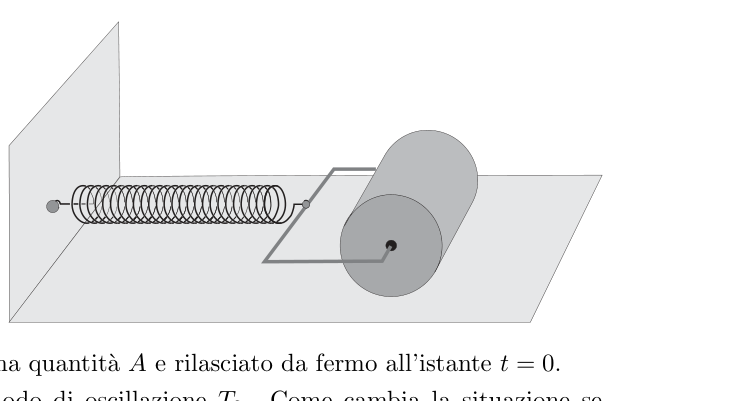
Topic: Rotational Dynamics, Oscillations & Waves, Newtonian Mechanics Metodi: Free-Body Diagram, Torque & Angular Momentum Analysis, Simple Harmonic Motion Analysis, Hooke’s Law Competenze: Mathematical Modeling, Physical Reasoning, Diagrammatic Reasoning Objects: Cylinder, Spring Fonte: Testo (PDF) — p.4 Soluzione: Soluzioni (PDF)
P3 Roll with spring The following points shall be added: A roller consists of a solid cylinder of a homogeneous mass and radius , resting on a horizontal table and is subjected to a horizontal force of , always applied to its axis; and perpendicular to it, as shown in the figure below, and to a friction force static or dynamic of modulo .
- Assuming that the roller rolls without cracking, it is obtained that it must necessarily be . The condition of the forces is therefore necessary for pure rolling, but not sufficient. Suppose that the roller is moving and a force is applied to the roller from a certain moment.
- To show that this condition is not enough to have a pure roll and find what other condition The motorcycle is required to be fitted with such a motorcycle. In the event of friction the roller is launched at and speeds; as shown above, the roller is initially sleighed.
- Confirm this result by considering the linear and angular displacement of the roller in an interval The time interval from the start distance, whatever the values of the speed and coefficient I’m sorry. I was just… The roller is now connected to a wall through a Helical spring of constant elasticity and length of Rest indefinitely but such that the roll never comes to hit the wall (v. The Commission has not yet adopted a proposal. It is also assumed that the spring has negligible mass and is ideal, i.e. that Hooke’s law remains The axis of the spring shall always be considered horizontal. The roll balance position shall be . The roll is moved from the equilibrium position of a quantity and released from the standstill .
- In the negligible friction hypothesis, find the oscillation period . How does the situation change if ? Now the static friction coefficients and dynamic between the roller and the table are no longer zero.
- The roller is removed from the equilibrium position and left unchanged; it starts rolling back and forth. For small oscillations, there is no slippage between the roller and the surface; find the new period of oscillazione .
- If the initial range of oscillation is greater than a certain critical value , with and , the rolling motor without crawling is no longer possible. Esprimere in funzione di .
- Providing that the initial elongation is with , prove that the roll can possibly be return to rolling without crawl only near the end of the first semi-swing. Finally, the roller, always connected to the spring, is launched at speed from the equilibrium position with a force horizontal impulse applied to the axis. As you can see from Question 2. The roller starts crawling.
- To demonstrate that the condition of pure rolling occurs certainly at a moment , before the rolling You’re going to stop.
**p.4 ** Cylindrical roll on a table connected to a spring
Topic: Rotational Dynamics, Oscillations & Waves, Newtonian Mechanics Metodi: Free-Body Diagram, Torque & Angular Momentum Analysis, Simple Harmonic Motion Analysis, Hooke’s Law Competenze: Mathematical Modeling, Physical Reasoning, Diagrammatic Reasoning Objects: Cylinder, Spring Fonte: Testo (PDF) — p.4 Soluzione: Soluzioni (PDF)