PROBLEMA n. 1 – Energia di dissociazione dell’ozono
Quesito n. 1.
Nei due scomparti sono presenti di ossigeno e di ozono.
La temperatura è
Il volume del secondo scomparto è
Messi in comunicazione i due scomparti, il volume della miscela è
Per la legge di Dalton la pressione della miscela di gas è uguale alla somma delle pressioni parziali:
Topic: Thermodynamics, Kinetic Theory Metodi: Ideal Gas Law, Physical Modeling Competenze: Mathematical Modeling, Physical Reasoning Objects: Gas Fonte: Testo (PDF) — p.1 Soluzione: Soluzioni (PDF)
The Commission has already taken a number of measures. 1 Ozone dissociation energy
Question No. 1.
In both compartments they are present of oxygen and The ozone layer.
The temperature is
The volume of the second compartment is
Put the two compartments in communication, the volume of the mixture is
According to Dalton’s law the pressure of the gas mixture is equal to the sum of the partial pressures:
Topic: Thermodynamics, Kinetic Theory Metodi: Ideal Gas Law, Physical Modeling Competenze: Mathematical Modeling, Physical Reasoning Objects: Gas Fonte: Testo (PDF) — p.1 Soluzione: Soluzioni (PDF)
Quesito n. 2.
L’energia del sistema gassoso, a meno di una costante arbitraria, all’inizio del processo è dove e è la temperatura iniziale all’interno del cilindro; si è tenuto conto che e .
Alla fine del processo, dopo la reazione , a temperatura , l’energia interna è:
La temperatura iniziale è nota, mentre resta da esprimere in termini di grandezze note la temperatura finale . L’equazione dei gas ideali comporta, nella situazione finale
Poiché il volume è aumentato, il lavoro fatto dal sistema è
L’energia sviluppata (o assorbita) nella reazione è
La reazione quindi è esotermica e l’energia sviluppata nlla reazione è e quindi .
Topic: Thermodynamics, Conservation of Energy Metodi: First Law of Thermodynamics, Ideal Gas Law, Energy Conservation Method Competenze: Mathematical Modeling, Physical Reasoning Objects: Gas, Cylinder Fonte: Testo (PDF) — p.2 Soluzione: Soluzioni (PDF)
Question No. 2.
The energy of the gas system, except for an arbitrary constant, at the beginning of the process is where and is the initial temperature inside the cylinder; and are taken into account.
At the end of the process, after the reaction , at temperature , the internal energy is:
The initial temperature is known, while the final temperature remains to be expressed in terms of known quantities. The ideal gas equation implies, in the final situation, that the
As the volume has increased, the work done by the system is
The energy developed (or absorbed) in the reaction is
The reaction is therefore exothermic and the energy developed in the reaction is and then .
Topic: Thermodynamics, Conservation of Energy Metodi: First Law of Thermodynamics, Ideal Gas Law, Energy Conservation Method Competenze: Mathematical Modeling, Physical Reasoning Objects: Gas, Cylinder Fonte: Testo (PDF) — p.2 Soluzione: Soluzioni (PDF)
Quesito n. 3.
Poiché l’ossigeno atomico si ricombina in , per ogni molecola di ozono che si dissocia, viene sviluppata l’energia di ricombinazione .
Indicando con l’energia sviluppata nella dissociazione di una molecola di ozono, si può scrivere e quindi
Tenedo conto della precedente espressione per
Dunque la dissociazione dell’ozono è endotermica, avviene cioè con assorbimento di energia.
Topic: Thermodynamics, Modern-Quantum Physics Metodi: First Law of Thermodynamics, Conservation Laws Competenze: Mathematical Modeling, Physical Reasoning Objects: — Fonte: Testo (PDF) — p.2 Soluzione: Soluzioni (PDF)
Question No. 3.
Because atomic oxygen recombines into , for each ozone molecule that dissociates, the recombining energy is developed.
Indicating with the energy developed in the dissociation of an ozone molecule, it can be written And then
I take into account the previous expression for
So the dissociation of ozone is endothermic, that is, it happens with energy absorption.
Topic: Thermodynamics, Modern-Quantum Physics Metodi: First Law of Thermodynamics, Conservation Laws Competenze: Mathematical Modeling, Physical Reasoning Objects: — Fonte: Testo (PDF) — p.2 Soluzione: Soluzioni (PDF)
PROBLEMA n. 2 – Trascinamento per attrito
Riferiremo il moto del blocco rispetto al terreno.
Quesito n. 1.
Il blocco è soggetto ad una forza orizzontale . Lo spostamento del blocco cessa quando il lavoro fatto da uguaglia l’energia potenziale immagazzinata nella molla:
Topic: Newtonian Mechanics, Conservation of Energy Metodi: Free-Body Diagram, Energy Conservation Method, Hooke’s Law Competenze: Diagrammatic Reasoning, Mathematical Modeling, Physical Reasoning Objects: Block, Spring Fonte: Testo (PDF) — p.3 Soluzione: Soluzioni (PDF)
The Commission has already taken a number of measures. 2 Friction dragging
We’ll report the motion of the block relative to the ground.
Question No. 1.
The block is subject to a horizontal force . The shift of the block is stopped when the work done by equals the potential energy stored in the spring:
Topic: Newtonian Mechanics, Conservation of Energy Metodi: Free-Body Diagram, Energy Conservation Method, Hooke’s Law Competenze: Diagrammatic Reasoning, Mathematical Modeling, Physical Reasoning Objects: Block, Spring Fonte: Testo (PDF) — p.3 Soluzione: Soluzioni (PDF)
Quesito n. 2.
Se la velocità del nastro è tale che si ha sempre condizione di strisciamento, la forza che agisce sul blocco, dovuta all’attrito dinamico, sarà una forza costante e soprattutto sarà diretta sempre nello stesso verso (quello del moto della striscia). La situazione è perciò indistinguibile da quella di una massa sospesa ad una molla sotto l’azione della forza gravitazionale (che in questo caso è rappresentata dalla forza ). Il moto sarà perciò armonico intorno al punto M, di equilibrio statico della massa. La posizione di tale punto è
Il periodo è e l’ampiezza, visto che la posizione iniziale è , sarà
ALTERNATIVA, più formale
La forza totale agente sul blocco, per un generico spostamento dalla posizione iniziale, è per cui
Questa relazione è caratteristica dei moti armonici, con posizione di equilibrio a distanza dalla posizione iniziale, come avevamo già detto.
Topic: Newtonian Mechanics, Oscillations & Waves Metodi: Free-Body Diagram, Simple Harmonic Motion Analysis, Differential Equations Competenze: Mathematical Modeling, Physical Reasoning, Diagrammatic Reasoning Objects: Block, Spring Fonte: Testo (PDF) — p.3 Soluzione: Soluzioni (PDF)
Question No. 2.
If the speed of the tape is such that it is always possible to crawle, the force acting on the block due to dynamic friction will be a constant force and above all will always be directed in the same direction (that of the motion of the tape). The situation is therefore indistinguishable from that of a mass suspended at a spring under the action of gravitational force (which in this case is represented by the force ). The motion will therefore be harmonious around the point M, of static mass equilibrium. The position of this point is
The period is and the width, since the starting position is , shall be
Alternative, more formal
The total force of the agent on the block, for a general displacement from the initial position, is whereby
This ratio is characteristic of harmonic motions, with a position of equilibrium from the initial position, as we have already said.
Topic: Newtonian Mechanics, Oscillations & Waves Metodi: Free-Body Diagram, Simple Harmonic Motion Analysis, Differential Equations Competenze: Mathematical Modeling, Physical Reasoning, Diagrammatic Reasoning Objects: Block, Spring Fonte: Testo (PDF) — p.3 Soluzione: Soluzioni (PDF)
Quesito n. 3.
Lo strisciamento deve cessare quando il blocco si trova fermo rispetto al nastro: questa situazione non può certamente verificarsi quando il blocco si muove verso la posizione iniziale e quindi con velocità di segno opposto a quella del nastro. Potrebbe invece verificarsi nella fase in cui il corpo si muove nello stesso verso del nastro ed alla stessa velocità. Ma la velocità del corpo, nel moto armonico, varia da 0 ad un valore massimo dove è l’ampiezza ed la pulsazione del moto.
Per mantenere la condizione di strisciamento basterà allora che la velocità del nastro sia superiore a .
Abbiamo:
Con i dati numerici, , mentre . Lo strisciamento quindi non può cessare.
Topic: Newtonian Mechanics, Oscillations & Waves Metodi: Simple Harmonic Motion Analysis, Free-Body Diagram, Kinematic Equations Competenze: Physical Reasoning, Mathematical Modeling Objects: Block, Spring Fonte: Testo (PDF) — p.4 Soluzione: Soluzioni (PDF)
Question No. 3.
The crawling must stop when the block is stationary relative to the tape: this situation cannot certainly occur when the block moves towards the initial position and thus at the opposite sign speed to that of the tape. It could occur at the stage when the body moves in the same direction and at the same speed as the tape. But the speed of the body in harmonic motion varies from 0 to a maximum value where is the width and the pulse of the motion.
The tape speed shall be greater than to maintain the condition of crawling.
We have:
With the numerical data, , while . The crawling cannot stop.
Topic: Newtonian Mechanics, Oscillations & Waves Metodi: Simple Harmonic Motion Analysis, Free-Body Diagram, Kinematic Equations Competenze: Physical Reasoning, Mathematical Modeling Objects: Block, Spring Fonte: Testo (PDF) — p.4 Soluzione: Soluzioni (PDF)
Quesito n. 4.
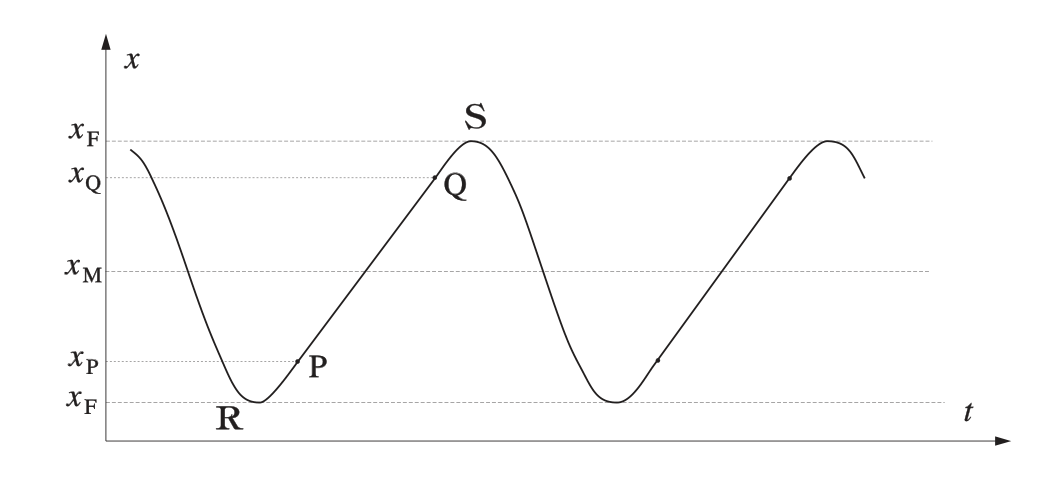
Fin quando il blocco striscia sul nastro, si muove di moto armonico come abbiamo visto. Appena raggiunge una velocità uguale a quella del nastro (e nello stesso verso) lo strisciamento cessa; indichiamo con P il punto in cui ciò avviene. L’attrito diventa ora statico con coefficiente ed il nastro trasporta il blocco facendo allungare la molla. La situazione si mantiene fino a quando la forza esercitata dalla molla supera la forza di attrito statico, provocando il distacco del blocco e l’inizio di una nuova fase di scivolamento; indichiamo con Q il punto in cui ciò accade. Al momento del distacco, il blocco continua a muoversi con velocità nello stesso senso del nastro e si trova in condizioni analoghe (strisciamento) a quelle della domanda 2). Riprende perciò un moto armonico intorno alla stessa posizione di equilibrio M e con lo stesso periodo. Questa fase termina quando il blocco riacquista, in P, la stessa velocità del nastro e vi aderisce di nuovo. I punti P e Q sono perciò simmetrici rispetto ad M, (stessa velocità nel moto armonico). Il moto sarà quindi composto di una fase a velocità costante () che si raccorda ad una fase di oscillazione armonica. Il grafico può essere del tipo di quello riportato in figura.
I punti significativi sono perciò P, Q, M già definiti e le posizioni estreme R, S.
Topic: Newtonian Mechanics, Oscillations & Waves Metodi: Simple Harmonic Motion Analysis, Free-Body Diagram, Kinematic Equations Competenze: Diagrammatic Reasoning, Physical Reasoning, Mathematical Modeling Objects: Block, Spring Fonte: Testo (PDF) — p.4 Soluzione: Soluzioni (PDF)
Question No. 4.
Until the block crawls onto the tape, it moves in a harmonious motion as we saw. As soon as the crawling speed reaches the same speed as the tape (and in the same direction) the crawling stops; we indicate with P the point where this happens. The friction becomes static with the coefficient and the tape carries the block by stretching the spring. The situation is maintained until the force exerted by the spring exceeds the static friction force, causing the block to detach and a new phase of slip to begin; we indicate with Q the point where this happens. At the time of detachment, the block continues to move in the same direction as the tape and is in similar conditions (crawling) to those in question 2. It therefore takes on a harmonic motion around the same equilibrium position M and with the same period. This phase ends when the block regains the same speed as the tape in P and adheres to it again. The P and Q points are therefore symmetrical to M, (the same speed in the harmonic motion). The engine will then be composed of a constant speed phase () which connects to a harmonic oscillation phase. The graph may be the same as the one shown in the figure.
The significant points are therefore P, Q, M already defined and the extreme positions R, S.
Topic: Newtonian Mechanics, Oscillations & Waves Metodi: Simple Harmonic Motion Analysis, Free-Body Diagram, Kinematic Equations Competenze: Diagrammatic Reasoning, Physical Reasoning, Mathematical Modeling Objects: Block, Spring Fonte: Testo (PDF) — p.4 Soluzione: Soluzioni (PDF)
Quesito n. 5.
Il punto Q è tale che
Il punto P è il simmetrico di Q rispetto ad M.
Subito dopo il distacco il blocco continua a muoversi nel verso del nastro fino a quando il lavoro fatto dalla forza di attrito, aggiungendosi all’energia cinetica posseduta al momento del distacco, uguaglia l’aumento di energia potenziale della molla. Indicando con la posizione di un punto di arresto: da cui e, tenendo conto dell’espressione di ,
Risolvendo l’equazione in :
I due valori trovati rappresentano la posizione del blocco negli estremi R, S, dell’oscillazione, e confermano le previsioni fatte al punto 4).
L’ampiezza è quindi:
p.5 — Posizione del blocco in funzione del tempo
Topic: Newtonian Mechanics, Oscillations & Waves, Conservation of Energy Metodi: Energy Conservation Method, Simple Harmonic Motion Analysis, Kinematic Equations Competenze: Mathematical Modeling, Diagrammatic Reasoning, Physical Reasoning Objects: Block, Spring Fonte: Testo (PDF) — p.4 Soluzione: Soluzioni (PDF)
Question No. 5.
The Q point is such that
The point P is the symmetrical of Q with respect to M.
Immediately after detachment the block continues to move towards the side of the tape until the work done by the friction force, adding to the kinetic energy possessed at the time of detachment, equals the potential energy increase of the spring. Indicating with the position of a stop point: from which and, taking into account the expression ,
Solving the equation in :
The two values found represent the position of the block at the R, S ends of the oscillation and confirm the predictions made in point 4).
The width is therefore:
The position of the block according to the time
Topic: Newtonian Mechanics, Oscillations & Waves, Conservation of Energy Metodi: Energy Conservation Method, Simple Harmonic Motion Analysis, Kinematic Equations Competenze: Mathematical Modeling, Diagrammatic Reasoning, Physical Reasoning Objects: Block, Spring Fonte: Testo (PDF) — p.4 Soluzione: Soluzioni (PDF)
PROBLEMA n. 3 – Giunzione n-p
Quesito n. 1.
Si ponga sulla giunzione l’origine di un sistema di riferimento e si indichi con l’ampiezza della regione di svuotamento nella parte di tipo n della giunzione e con l’ampiezza nella parte di tipo p. Allora .
In situazione di stazionarietà la corrente elettrica che circola nel semiconduttore è nulla. In questa condizione è nullo anche il campo elettrico nella zona dove ci sono cariche libere, cioè esternamente alla regione di svuotamento.
Poiché la regione di svuotamento è caratterizzata dalla dimensione trasversale molto maggiore rispetto all’ampiezza , si può assumere che al proprio interno il campo elettrico sia diretto parallelamente all’asse longitudinale del campione di semiconduttore.
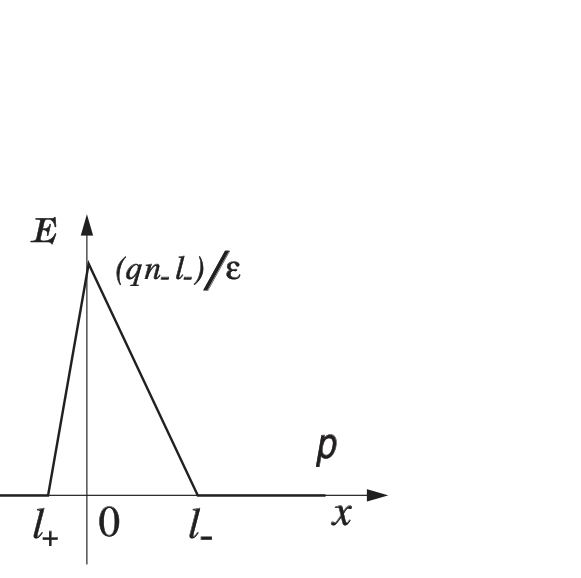
Ponendo e applicando il teorema di Gauss si ottiene nella parte di tipo n della giunzione e nella parte di tipo p della giunzione.
p.6 — Campo elettrico nella giunzione n-p
Topic: Electrostatics, Modern-Quantum Physics Metodi: Gauss’s Law, Electric Potential Method, Physical Modeling Competenze: Mathematical Modeling, Diagrammatic Reasoning Objects: — Fonte: Testo (PDF) — p.6 Soluzione: Soluzioni (PDF)
The Commission has already taken a number of measures. 3 Junction n-p
Question No. 1.
The origin of a reference system shall be placed on the junction and the width of the emptying region in the type n part of the junction shall be indicated by and the width in the type p part by . Allora .
In a stationary situation, the electric current circulating in the semiconductor is zero. In this situation, the electric field in the free zone, i.e. outside the drainage region, is also zero.
Since the emptying region is characterised by a much larger cross-sectional dimension than the width , it can be assumed that the electric field is directed parallel to the longitudinal axis of the semiconductor sample within itself.
Putting and applying Gauss’ theorem you get in type n part of the junction; and in the type p part of the junction.
**p.6 ** Electric field at junction n-p
Topic: Electrostatics, Modern-Quantum Physics Metodi: Gauss’s Law, Electric Potential Method, Physical Modeling Competenze: Mathematical Modeling, Diagrammatic Reasoning Objects: — Fonte: Testo (PDF) — p.6 Soluzione: Soluzioni (PDF)
Quesito n. 2.
Assegnando , il potenziale elettrico a distanza dalla giunzione si può determinare come l’area compresa tra la curva e l’asse delle ascisse nel grafico del campo elettrico in funzione della distanza. Si ricava per valori positivi della e per valori negativi della . La differenza di potenziale nella giunzione assumerà valore massimo per .
Considerando che il campione è complessivamente neutro e con i valori delle densità di carica del problema, si ha
Si può operare, quindi l’approssimazione
In tale condizione il massimo valore della differenza di potenziale si avrà per
Topic: Electrostatics Metodi: Gauss’s Law, Electric Potential Method, Approximation & Series Expansion Competenze: Mathematical Modeling, Diagrammatic Reasoning, Physical Reasoning Objects: — Fonte: Testo (PDF) — p.6 Soluzione: Soluzioni (PDF)
Question No. 2.
By assigning , the electric potential at a distance from the junction can be determined as the area between the curve and the axis of the axis in the electric field graph depending on the distance. He ‘s getting rich . for positive values of and for negative values of . The potential difference in the junction shall assume a maximum value for .
Considering that the sample is overall neutral and with the values of the load densities of the problem, we have
The operation can be performed, so the approximation
In this case, the maximum value of the potential difference shall be
Topic: Electrostatics Metodi: Gauss’s Law, Electric Potential Method, Approximation & Series Expansion Competenze: Mathematical Modeling, Diagrammatic Reasoning, Physical Reasoning Objects: — Fonte: Testo (PDF) — p.6 Soluzione: Soluzioni (PDF)
Quesito n. 3.
Quando il semiconduttore viene cortocircuitato si ha ; mentre nel caso in cui si applica una differenza di potenziale agli estremi del campione la relazione precedente diventa . Se l’estremità di tipo p del semiconduttore è posta ad un potenziale più basso rispetto l’estremità di tipo n, dalla relazione precedente si ricava che aumenta rispetto a ; in questo caso si dice che la giunzione è polarizzata inversamente. Viceversa invertendo il collegamento diminuisce e la giunzione si dice polarizzata direttamente.
Sostituendo nella relazione precedente l’espressione di in funzione di si ottiene
Lo spessore della giunzione aumenta quando essa è polarizzata inversamente e diminuisce quando è polarizzata direttamente.
Topic: Electrostatics, Circuits Metodi: Electric Potential Method, Gauss’s Law, Kirchhoff’s Laws Competenze: Physical Reasoning, Mathematical Modeling Objects: — Fonte: Testo (PDF) — p.7 Soluzione: Soluzioni (PDF)
Question No. 3.
When the semiconductor is short-circuited, it has ; whereas if a potential difference is applied to the sample ends, the previous ratio becomes . If the p-type end of the semiconductor is set to a lower potential than the n-type end, the previous report shows that increases with respect to ; in this case the junction is said to be reversely polarized. Conversely, by reversing the connection, the decrease and the junction is said to be directly polarized.
Substituting the expression for in the previous report gives
The thickness of the joint increases when it is reversely polarized and decreases when it is directly polarized.
Topic: Electrostatics, Circuits Metodi: Electric Potential Method, Gauss’s Law, Kirchhoff’s Laws Competenze: Physical Reasoning, Mathematical Modeling Objects: — Fonte: Testo (PDF) — p.7 Soluzione: Soluzioni (PDF)
Quesito n. 4.
La carica presente nella parte di tipo p della giunzione dipende dallo spessore secondo la relazione . Quindi . Inoltre .
Poiché ; si ricava
In definitiva si ottiene
Notare che il valore della capacità elettrica di transizione non dipende direttamente dalla densità di carica elettrica.
Topic: Electrostatics, Circuits Metodi: Electric Potential Method, Gauss’s Law, Approximation & Series Expansion Competenze: Mathematical Modeling, Physical Reasoning Objects: — Fonte: Testo (PDF) — p.7 Soluzione: Soluzioni (PDF)
Question No. 4.
The load present in the type p part of the junction depends on the thickness according to the ratio. Quindi . In addition, .
Since ; it is collected
The final result is
Note that the value of the transition electrical capacity does not depend directly on the electrical charge density.
Topic: Electrostatics, Circuits Metodi: Electric Potential Method, Gauss’s Law, Approximation & Series Expansion Competenze: Mathematical Modeling, Physical Reasoning Objects: — Fonte: Testo (PDF) — p.7 Soluzione: Soluzioni (PDF)
PROBLEMA n. 4 – Miraggio
Quesito n. 1.
Suddividendo l’atmosfera in sottili strati orizzontali omogenei ed applicando ripetutamente la legge di rifrazione si ha da cui
Topic: Geometric Optics Metodi: Snell’s Law, Ray Tracing, Superposition Principle Competenze: Physical Reasoning, Diagrammatic Reasoning Objects: — Fonte: Testo (PDF) — p.8 Soluzione: Soluzioni (PDF)
The Commission has already taken a number of measures. 4 Mirage
Question No. 1.
By dividing the atmosphere into thin, homogeneous horizontal layers and repeatedly applying the law of refraction, we have from which
Topic: Geometric Optics Metodi: Snell’s Law, Ray Tracing, Superposition Principle Competenze: Physical Reasoning, Diagrammatic Reasoning Objects: — Fonte: Testo (PDF) — p.8 Soluzione: Soluzioni (PDF)
Quesito n. 2.
La legge di stato dei gas perfetti, in termini di densità si scrive (essendo il peso molecolare medio), per cui
Il coefficiente termico di variazione è
Topic: Thermodynamics, Geometric Optics Metodi: Ideal Gas Law, Approximation & Series Expansion Competenze: Mathematical Modeling, Physical Reasoning Objects: Gas Fonte: Testo (PDF) — p.8 Soluzione: Soluzioni (PDF)
Question No. 2.
The perfect gas state law, in terms of density, is written (mean molecular weight ), where
The heat coefficient of variation is
Topic: Thermodynamics, Geometric Optics Metodi: Ideal Gas Law, Approximation & Series Expansion Competenze: Mathematical Modeling, Physical Reasoning Objects: Gas Fonte: Testo (PDF) — p.8 Soluzione: Soluzioni (PDF)
Quesito n. 3.
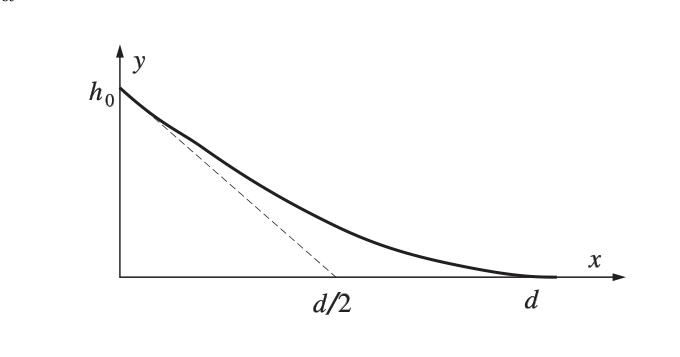
Si consideri il raggio che proviene dal punto più lontano della parte visibile della strada: esso descrive una parabola tangente al piano della strada in un punto a distanza dall’osservatore.
L’equazione della parabola è e per la condizione si ha
Il punto a distanza appare invece al guidare in posizione tale che essendo per cui
p.8 — Traiettoria parabolica del raggio luminoso
Topic: Geometric Optics Metodi: Ray Tracing, Snell’s Law, Physical Modeling Competenze: Mathematical Modeling, Diagrammatic Reasoning, Physical Reasoning Objects: — Fonte: Testo (PDF) — p.8 Soluzione: Soluzioni (PDF)
Question No. 3.
Consider the radius coming from the farthest point of the visible part of the road: it describes a tangent parabola to the road plane at a point from the observer.
The parabola equation is and for the condition we have
The distance appears when driving in a position such that being whereby
The light beam shall be measured in the direction of the beam.
Topic: Geometric Optics Metodi: Ray Tracing, Snell’s Law, Physical Modeling Competenze: Mathematical Modeling, Diagrammatic Reasoning, Physical Reasoning Objects: — Fonte: Testo (PDF) — p.8 Soluzione: Soluzioni (PDF)
Quesito n. 4.
Al suolo e dunque che sfruttando la condizione si può approssimare con
Topic: Geometric Optics Metodi: Snell’s Law, Approximation & Series Expansion, Physical Modeling Competenze: Mathematical Modeling, Physical Reasoning Objects: — Fonte: Testo (PDF) — p.9 Soluzione: Soluzioni (PDF)
Question No. 4.
Soil and therefore che sfruttando la condizione si può approssimare con
Topic: Geometric Optics Metodi: Snell’s Law, Approximation & Series Expansion, Physical Modeling Competenze: Mathematical Modeling, Physical Reasoning Objects: — Fonte: Testo (PDF) — p.9 Soluzione: Soluzioni (PDF)
Quesito n. 5.
Combinando le relazioni si ha, per ,
Uguagliando questa espressione con quella trovata al punto 4. si ricava immediatamente
Materiale prodotto dal Gruppo PROGETTO OLIMPIADI c/o Liceo Scientifico G. Bruno via Baglioni 26, 30173 Venezia Mestre fax: 041–5840462
Topic: Geometric Optics, Thermodynamics Metodi: Snell’s Law, Ideal Gas Law, Approximation & Series Expansion Competenze: Mathematical Modeling, Physical Reasoning Objects: — Fonte: Testo (PDF) — p.9 Soluzione: Soluzioni (PDF)
Question No. 5.
Combining the relationships has, for ,
By matching this expression to the one found in point 4. It’s a very quick recovery.
Material produced by the Group Olympic Project c/o Scientific High School G. Bruno The following points are added: The Commission has decided to extend the period of validity of the agreement.
Topic: Geometric Optics, Thermodynamics Metodi: Snell’s Law, Ideal Gas Law, Approximation & Series Expansion Competenze: Mathematical Modeling, Physical Reasoning Objects: — Fonte: Testo (PDF) — p.9 Soluzione: Soluzioni (PDF)