Chitarra scordata
Fabio sta cercando di accordare una corda della sua chitarra. Per farlo, si aiuta con un diapason che vibra alla frequenza di . Quando Fabio suona contemporaneamente il diapason e la corda, sente l’intensità del suono risultante aumentare e diminuire periodicamente, con periodo di . Allora Fabio aumenta leggermente la tensione della corda, e stavolta l’intensità del suono risultante aumenta e diminuisce ogni . Quanto valeva la frequenza del suono emesso originariamente dalla corda?
Unità di misura: Hz. Precisione richiesta: 0.02%.
Topic: Oscillations & Waves Metodi: Superposition Principle, Wave Equation, Simple Harmonic Motion Analysis Competenze: Mathematical Modeling, Physical Reasoning Objects: Tuning Fork, String Fonte: Testo (PDF) — p.3 Soluzione: Soluzioni (PDF)
The first is the “Missing” of the “Missing” of the “Missing” of the “Missing” of the “Missing” of the “Missing” of the “Missing” of the “Missing” of the “Missing” of the “Missing” of the “Missing” of the “Missing” of the “Missing” of the “Missing” of the “Missing” of the “Missing” of the “Missing” of the “Missing” of the “Missing” of the “Missing” of the “Missing” of the “Missing” of the “Missing” of the “Missing” of the “Missing” of the “Missing” of the “Missing” of the “Missing” of the “Missing” of the “Missing” of the “Missing” of the “Missing” of the “Missing”
Fabio’s trying to tune a string of his guitar. To do this, a diapason that vibrates at is used. When Fabio plays the diapason and the string simultaneously, he hears the resulting sound intensity increase and decrease periodically, with a period of . Then Fabio slightly increases the tension of the string, and this time the resulting sound intensity increases and decreases every . What was the value of the sound frequency originally emitted by the string?
The unit of measurement: * Hz. The following information is provided:
Topic: Oscillations & Waves Metodi: Superposition Principle, Wave Equation, Simple Harmonic Motion Analysis Competenze: Mathematical Modeling, Physical Reasoning Objects: Tuning Fork, String Fonte: Testo (PDF) — p.3 Soluzione: Soluzioni (PDF)
Velocità di fuga
Un satellite viene lanciato dalla superficie terrestre in direzione radiale, con la minima velocità necessaria ad allontanarsi indefinitamente. Quanto tempo è necessario affinché esso percorra una distanza pari al raggio della Terra?
Nota: si ignorino gli effetti della rotazione terrestre e della resistenza atmosferica.
Unità di misura: s. Precisione richiesta: 0.5%.
Topic: Gravitation Metodi: Energy Conservation Method, Calculus-Integration, Differential Equations Competenze: Mathematical Modeling Objects: Satellite, Planet Fonte: Testo (PDF) — p.3 Soluzione: Soluzioni (PDF)
The following information is provided for in the Annex to Regulation (EU) No 1303/2013.
A satellite is launched from the Earth’s surface in a radial direction, with the minimum speed necessary to move indefinitely away. How long does it take for it to travel a distance equal to the radius of the Earth?
Note: the effects of earth rotation and atmospheric resistance are ignored.
The following shall be added to the list of the units: The following information is provided:
Topic: Gravitation Metodi: Energy Conservation Method, Calculus-Integration, Differential Equations Competenze: Mathematical Modeling Objects: Satellite, Planet Fonte: Testo (PDF) — p.3 Soluzione: Soluzioni (PDF)
J sigillata
Un contenitore sigillato, a forma di “J” con angoli squadrati come in figura (sinistra), è appoggiato su un piano. Un braccio verticale è lungo ed è pieno d’aria, mentre l’altro braccio verticale è lungo ed è pieno d’acqua. I due bracci hanno sezione uguale e sono connessi da un braccio orizzontale pieno d’acqua. A un certo punto, il contenitore viene inclinato in modo da far salire l’intera bolla d’aria in cima al braccio verticale più lungo, e poi viene riappoggiato sul piano, come in figura (destra). Quanto vale la differenza tra la pressione, calcolata nel punto , nella nuova configurazione e quella nella vecchia configurazione?
Nota: si assuma che il processo avvenga a temperatura costante e che l’acqua sia un fluido incomprimibile.
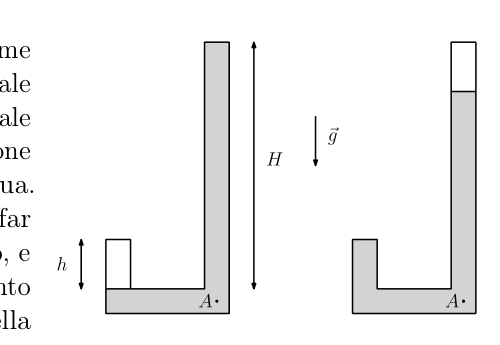 Contenitore a forma di “J”; a sinistra la bolla d’aria nel braccio corto (lungo ), a destra la bolla d’aria spostata in cima al braccio lungo (lungo ); punto alla base.
Unità di misura: Pa. Precisione richiesta: 0.5%.
Topic: Fluid Mechanics, Thermodynamics Metodi: Hydrostatic Equilibrium, Ideal Gas Law, Physical Modeling Competenze: Mathematical Modeling, Physical Reasoning Objects: Container, Bubble Fonte: Testo (PDF) — p.3 Soluzione: Soluzioni (PDF)
The following information shall be provided:
A sealed container, in the shape of a “J” with square corners as shown in the figure (left), is supported on a plane. One vertical arm is long and full of air, while the other vertical arm is long and full of water. The two arms have equal sections and are connected by a horizontal arm full of water. At a certain point, the container is tilted so that the entire air bubble rises to the top of the longest vertical arm, and then is repositioned on the plane, as shown in the figure (right). What is the difference between the pressure calculated in in the new configuration and the pressure in the old configuration?
Note: the process is assumed to be at a constant temperature and the water is an incompressible fluid.
J-shaped container; left the air bubble in the short arm (long ), right the air bubble moved upwards to the long arm (long ); point at the base.
The unit of measurement: * Pa. The following information is provided:
Topic: Fluid Mechanics, Thermodynamics Metodi: Hydrostatic Equilibrium, Ideal Gas Law, Physical Modeling Competenze: Mathematical Modeling, Physical Reasoning Objects: Container, Bubble Fonte: Testo (PDF) — p.3 Soluzione: Soluzioni (PDF)
Boa di tungsteno
Un guscio sferico, avente raggio esterno , spessore e densità , galleggia sull’acqua immerso esattamente per metà del suo volume. Quanto vale ?
Unità di misura: m. Precisione richiesta: 2.0%.
Topic: Fluid Mechanics Metodi: Hydrostatic Equilibrium, Approximation & Series Expansion Competenze: Mathematical Modeling Objects: Sphere Fonte: Testo (PDF) — p.3 Soluzione: Soluzioni (PDF)
Boa di tungsteno
A spherical shell, with an outer radius , thickness and density , floats on the submerged water exactly half its volume. Quanto vale ?
Unità di misura: m. Precisione richiesta: 2.0%.
Topic: Fluid Mechanics Metodi: Hydrostatic Equilibrium, Approximation & Series Expansion Competenze: Mathematical Modeling Objects: Sphere Fonte: Testo (PDF) — p.3 Soluzione: Soluzioni (PDF)
Specchio relativistico
Marco punta un laser, che emette luce di lunghezza d’onda , contro uno specchio che si allontana da lui alla velocità di . La luce si riflette ortogonalmente sullo specchio e torna nel punto in cui si trova Marco, dove egli ne misura la lunghezza d’onda . Qual è il valore di misurato da Marco?
Unità di misura: nm. Precisione richiesta: 0.5%.
Topic: Special Relativity, Oscillations & Waves Metodi: Lorentz Transformation Competenze: Mathematical Modeling, Physical Reasoning Objects: Mirror Fonte: Testo (PDF) — p.3 Soluzione: Soluzioni (PDF)
The following table shows the results of the calculations:
Mark points a laser, which emits wavelength light , against a mirror that moves away from him at a speed of . The light reflects orthogonally on the mirror and returns to the point where Marco is, where he measures its wavelength . What is the value of measured by Marco?
The measurement unit is the measurement unit of the measurement unit. The following information is provided:
Topic: Special Relativity, Oscillations & Waves Metodi: Lorentz Transformation Competenze: Mathematical Modeling, Physical Reasoning Objects: Mirror Fonte: Testo (PDF) — p.3 Soluzione: Soluzioni (PDF)
Traiettorie sul cono
Un punto materiale di massa , immerso nel campo gravitazionale terrestre, è vincolato a muoversi senza attrito sulla superficie di un cono di semiapertura , come in figura. L’asse del cono è verticale, il suo vertice punta verso il basso e la sua altezza è sufficiente a non far fuoriuscire l’oggetto. Quest’ultimo viene messo in moto con una velocità diretta orizzontalmente, a una quota verticale di rispetto al vertice del cono. Quanto vale il modulo della differenza fra la quota massima e la quota minima che l’oggetto raggiunge durante il suo moto?
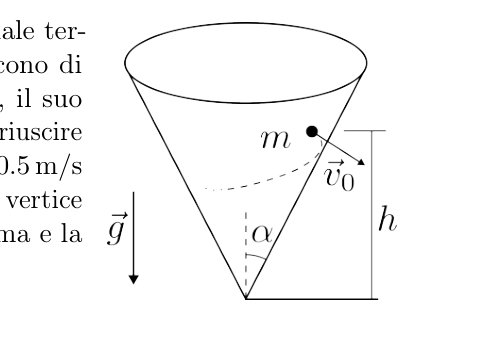 Cono con vertice in basso, asse verticale, semiapertura ; massa a quota con velocità orizzontale .
Unità di misura: m. Precisione richiesta: 0.5%.
Topic: Newtonian Mechanics, Conservation of Energy Metodi: Energy Conservation Method, Conservation Laws, Vector Decomposition Competenze: Mathematical Modeling, Physical Reasoning, Diagrammatic Reasoning Objects: — Fonte: Testo (PDF) — p.4 Soluzione: Soluzioni (PDF)
The following table shows the number of conical conical cones:
A material point of mass , immersed in the Earth’s gravitational field, is bound to move without friction on the surface of a semiaperitoneal cone , as shown in Figure 1. The axis of the cone is vertical, its tip points downwards and its height is sufficient to prevent the object from coming out. The latter is set in motion at a speed directed horizontally, at a vertical altitude of with respect to the top of the cone. What is the value of the difference between the maximum and minimum altitude the object reaches during its motorcycle?
Lower-top cone, vertical axis, half-open ; mass at height with horizontal speed .
The following is the list of the measurement units: The following information is provided:
Topic: Newtonian Mechanics, Conservation of Energy Metodi: Energy Conservation Method, Conservation Laws, Vector Decomposition Competenze: Mathematical Modeling, Physical Reasoning, Diagrammatic Reasoning Objects: — Fonte: Testo (PDF) — p.4 Soluzione: Soluzioni (PDF)
Orologio a pendolo
Il pendolo di un orologio, progettato per funzionare correttamente quando si trova a una temperatura di , è costituito da un’asta sottilissima, di massa e lunghezza , alla cui estremità libera è fissato il centro di un disco di spessore trascurabile, massa e raggio . Il disco e l’asta giacciono sullo stesso piano verticale, nel quale sono liberi di compiere piccole oscillazioni. Il materiale con cui sono stati costruiti i due oggetti ha una costante di dilatazione termica lineare pari a . Quanto vale la differenza tra il tempo segnato dall’orologio e il tempo reale, dopo che l’orologio è stato messo in funzione per un giorno alla temperatura di ?
Unità di misura: s. Precisione richiesta: 0.5%.
Topic: Oscillations & Waves, Rotational Dynamics Metodi: Small-Angle Approximation, Approximation & Series Expansion, Torque & Angular Momentum Analysis Competenze: Mathematical Modeling, Physical Reasoning Objects: Pendulum, Rod, Disk Fonte: Testo (PDF) — p.4 Soluzione: Soluzioni (PDF)
The following table shows the number of units of the vehicle:
The pendulum of a watch, designed to function properly at a temperature of , consists of a very fine axle, of mass and length , at the free end of which is fixed the centre of a disc of negligible thickness, mass and radius . The disc and the axle lie on the same vertical plane, in which they are free to make small oscillations. The material from which the two objects were constructed has a linear thermal expansion constant of . What is the difference between the time marked by the clock and the real time after the clock has been running for one day at ?
The following shall be added to the list of the units: The following information is provided:
Topic: Oscillations & Waves, Rotational Dynamics Metodi: Small-Angle Approximation, Approximation & Series Expansion, Torque & Angular Momentum Analysis Competenze: Mathematical Modeling, Physical Reasoning Objects: Pendulum, Rod, Disk Fonte: Testo (PDF) — p.4 Soluzione: Soluzioni (PDF)
Stella lontana
Un pianeta orbita circolarmente attorno a una stella con periodo di giorni terrestri. Osservata dal pianeta, la stella ha un diametro angolare pari a . Quanto vale la densità media della stella?
Unità di misura: kg/m. Precisione richiesta: 0.5%.
Topic: Gravitation, Astrophysics Metodi: Newton’s Law of Gravitation, Kepler’s Laws Competenze: Mathematical Modeling, Estimation & Approximation Objects: Planet, Star Fonte: Testo (PDF) — p.4 Soluzione: Soluzioni (PDF)
Stella lontana
A planet orbiting a star in a circular orbit with a period of Earth days. Observed from the planet, the star has an angular diameter of . What is the average density of the star?
Unità di misura: kg/m. Precisione richiesta: 0.5%.
Topic: Gravitation, Astrophysics Metodi: Newton’s Law of Gravitation, Kepler’s Laws Competenze: Mathematical Modeling, Estimation & Approximation Objects: Planet, Star Fonte: Testo (PDF) — p.4 Soluzione: Soluzioni (PDF)
Oscillazioni di molecole
Una molecola composta da due atomi di idrogeno può vibrare in modo che la distanza tra i due nuclei oscilli con frequenza di . Quanto vale tale frequenza di oscillazione per una molecola composta da un atomo di idrogeno e da uno di deuterio?
Nota: il nucleo dell’idrogeno è composto da un solo protone, mentre quello del deuterio è composto da un protone e un neutrone.
Unità di misura: Hz. Precisione richiesta: 0.5%.
Topic: Oscillations & Waves Metodi: Simple Harmonic Motion Analysis Competenze: Mathematical Modeling, Physical Reasoning Objects: Atom, Nucleus Fonte: Testo (PDF) — p.4 Soluzione: Soluzioni (PDF)
The following is a list of the most commonly used methods for measuring the concentration of the product:
A molecule composed of two hydrogen atoms can vibrate so that the distance between the two nuclei oscillates at a frequency of . How much is this frequency of oscillation for a molecule composed of a hydrogen atom and a deuterium atom?
Note: the hydrogen nucleus is composed of a single proton, while that of deuterium is composed of a proton and a neutron.
The unit of measurement: * Hz. The following information is provided:
Topic: Oscillations & Waves Metodi: Simple Harmonic Motion Analysis Competenze: Mathematical Modeling, Physical Reasoning Objects: Atom, Nucleus Fonte: Testo (PDF) — p.4 Soluzione: Soluzioni (PDF)
Linee di campo
Due cariche puntiformi di segno opposto, e , sono posizionate a una certa distanza l’una dall’altra. Si consideri una linea del campo elettrico che emerge da formando un angolo di con la congiungente le due cariche. Tale linea di campo cade su formando un angolo acuto con la congiungente le due cariche. Quanto vale ?
Unità di misura: rad. Precisione richiesta: 0.5%.
Topic: Electrostatics Metodi: Gauss’s Law, Symmetry Argument Competenze: Mathematical Modeling, Diagrammatic Reasoning, Physical Reasoning Objects: Point Charge Fonte: Testo (PDF) — p.4 Soluzione: Soluzioni (PDF)
Linee di campo
Two opposite-signal point-shaped loads, and , are placed at a certain distance from each other. Consider an electric field line emerging from forming an angle of with the two charges connecting. This field line falls on forming a sharp angle with the two charges connecting. Quanto vale ?
Unità di misura: rad. Precisione richiesta: 0.5%.
Topic: Electrostatics Metodi: Gauss’s Law, Symmetry Argument Competenze: Mathematical Modeling, Diagrammatic Reasoning, Physical Reasoning Objects: Point Charge Fonte: Testo (PDF) — p.4 Soluzione: Soluzioni (PDF)
E.T.1982
I simpatici abitanti del pianeta E.T.1982 sanno bene che ogni anno dura esattamente giorni ETiani. Sapendo che i versi di rivoluzione e rotazione del pianeta sono opposti, quanto vale (in un sistema di riferimento inerziale) il periodo di rotazione del pianeta E.T.1982?
Unità di misura: giorni ETiani. Precisione richiesta: 0.05%.
Topic: Astrophysics, Newtonian Mechanics Metodi: Kinematic Equations Competenze: Mathematical Modeling, Physical Reasoning Objects: Planet Fonte: Testo (PDF) — p.5 Soluzione: Soluzioni (PDF)
E.T.1982
I simpatici abitanti del pianeta E.T.1982 sanno bene che ogni anno dura esattamente giorni ETiani. Knowing that the revolution and rotation of the planet are opposite, how much is the rotation period of the planet E.T.1982 worth (in an inertial reference system)?
Unità di misura: giorni ETiani. Precisione richiesta: 0.05%.
Topic: Astrophysics, Newtonian Mechanics Metodi: Kinematic Equations Competenze: Mathematical Modeling, Physical Reasoning Objects: Planet Fonte: Testo (PDF) — p.5 Soluzione: Soluzioni (PDF)
Batterie burlone
La batteria di alcuni dispositivi presenta uno strano comportamento: meno essa è carica, più pare scaricarsi velocemente. Per spiegare questo fenomeno, supponiamo che la tensione ai capi di una batteria valga , dove e è la carica residua che la batteria può erogare prima di scaricarsi. Ipotizzando che il dispositivo consumi una potenza costante pari a , quanto tempo impiega la batteria a scaricarsi completamente se essa è in grado di erogare una carica totale di ?
Unità di misura: s. Precisione richiesta: 0.5%.
Topic: Circuits Metodi: Calculus-Integration, Differential Equations Competenze: Mathematical Modeling Objects: Battery, Capacitor Fonte: Testo (PDF) — p.5 Soluzione: Soluzioni (PDF)
The manufacturer shall provide the manufacturer with the following information:
The battery of some devices has a strange behavior: the less it is charged, the faster it seems to discharge. To explain this phenomenon, let us assume that the voltage at the head of a battery is , where and is the residual charge that the battery can deliver before discharging. Assuming that the device consumes a constant power of , how long does it take for the battery to fully charge if it is capable of delivering a total charge of ?
The following shall be added to the list of the units: The following information is provided:
Topic: Circuits Metodi: Calculus-Integration, Differential Equations Competenze: Mathematical Modeling Objects: Battery, Capacitor Fonte: Testo (PDF) — p.5 Soluzione: Soluzioni (PDF)
Chiudere una porta
Una porta di larghezza (rappresentata in figura con una prospettiva dall’alto) è incardinata a un muro, ed è inizialmente ferma e completamente aperta, ossia . Una molla di lunghezza a riposo nulla e costante elastica connette orizzontalmente il centro della porta a un punto sul muro, a distanza dal perno. La molla fa sì che la porta rimanga aperta. Luca vuole chiudere la porta: se riesce a modificarne l’angolo da a , un meccanismo la manterrà chiusa. Luca è in grado di esercitare una forza di modulo costante , potendo scegliere in ogni istante il punto e la direzione di applicazione. Qual è il minimo valore di necessario affinché Luca riesca a chiudere la porta?
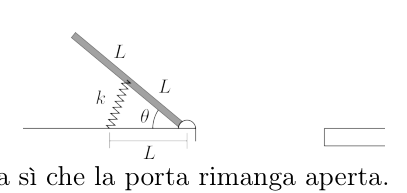 Vista dall’alto: porta di lunghezza incardinata al muro, formante un angolo ; molla di costante che collega il centro della porta a un punto del muro a distanza dal perno.
Unità di misura: N. Precisione richiesta: 0.5%.
Topic: Newtonian Mechanics, Rotational Dynamics Metodi: Energy Conservation Method, Torque & Angular Momentum Analysis, Calculus-Integration Competenze: Mathematical Modeling, Diagrammatic Reasoning, Physical Reasoning Objects: Spring Fonte: Testo (PDF) — p.5 Soluzione: Soluzioni (PDF)
The following information shall be provided:
A door of width (represented in the figure with a view from above) is enclosed in a wall, and is initially fixed and completely open, i.e. . A spring of zero rest length and constant elastic connects the centre of the door horizontally to a point on the wall, at a distance from the bolt. The spring keeps the door open. Luke wants to close the door: if he can change the angle from to , a mechanism will keep it closed. The vehicle is capable of exerting a constant force of , and can choose the point and direction of application at any time. What is the minimum value of required for Luke to be able to close the door?
View from above: wall-incardinated door length , forming an angle ; constant spring connecting the center of the door to a point of the wall at a distance from the bolt.
The following is the list of the measurement units: The following information is provided:
Topic: Newtonian Mechanics, Rotational Dynamics Metodi: Energy Conservation Method, Torque & Angular Momentum Analysis, Calculus-Integration Competenze: Mathematical Modeling, Diagrammatic Reasoning, Physical Reasoning Objects: Spring Fonte: Testo (PDF) — p.5 Soluzione: Soluzioni (PDF)
Parole al vento
Un vento a spira diretto da Alice verso Barbara, entrambe sedute su una panchina. Marta arriva e si siede in mezzo, equidistante dalle altre due. Quando Marta parla, quanto vale il rapporto tra l’intensità del suono udito da Alice e l’intensità del suono udito da Barbara? Si supponga che la velocità del suono sia pari a e che la voce di Marta sia approssimabile a un emettitore ideale isotropo.
Unità di misura: adimensionale. Precisione richiesta: 0.5%.
Topic: Oscillations & Waves Metodi: Wave Equation, Physical Modeling Competenze: Mathematical Modeling, Physical Reasoning Objects: — Fonte: Testo (PDF) — p.5 Soluzione: Soluzioni (PDF)
Parole al vento
Un vento a spira diretto da Alice verso Barbara, entrambe sedute su una panchina. Martha comes and sits in the middle, equidistant from the other two. When Martha speaks, what is the relationship between the intensity of the sound heard by Alice and the intensity of the sound heard by Barbara? Assume that the speed of sound is and that Marta’s voice is approximate to an ideal isotope emitter.
Unità di misura: adimensionale. Precisione richiesta: 0.5%.
Topic: Oscillations & Waves Metodi: Wave Equation, Physical Modeling Competenze: Mathematical Modeling, Physical Reasoning Objects: — Fonte: Testo (PDF) — p.5 Soluzione: Soluzioni (PDF)
Frigorifero regolabile
Un frigorifero, posizionato in un ambiente con una temperatura di con il quale scambia calore solo tramite conduzione, è mantenuto a una temperatura costante di tramite una macchina di Carnot. Consumando una potenza di , la macchina estrae calore dal frigorifero e lo rilascia nell’ambiente in cui si trova il frigorifero. Quale potenza sarebbe necessaria per mantenere la temperatura del frigorifero a , con la stessa temperatura ambiente?
Unità di misura: W. Precisione richiesta: 0.5%.
Topic: Thermodynamics Metodi: Thermodynamic Cycle Analysis, First Law of Thermodynamics Competenze: Mathematical Modeling, Physical Reasoning Objects: Heat Engine Fonte: Testo (PDF) — p.5 Soluzione: Soluzioni (PDF)
The manufacturer shall provide the manufacturer with the following information:
A refrigerator, located in an environment with a temperature of with which it exchanges heat only by conduction, is kept at a constant temperature of by a Carnot machine. By consuming a power of , the machine extracts heat from the refrigerator and releases it into the environment in which the refrigerator is located. What power would be needed to keep the refrigerator temperature at at the same ambient temperature?
The measuring unit: * W. The following information is provided:
Topic: Thermodynamics Metodi: Thermodynamic Cycle Analysis, First Law of Thermodynamics Competenze: Mathematical Modeling, Physical Reasoning Objects: Heat Engine Fonte: Testo (PDF) — p.5 Soluzione: Soluzioni (PDF)