Elio primordiale
Il 25% della massa barionica dell’universo osservabile è composta da , mentre il restante 75% è quasi interamente . Quanto vale il rapporto tra il numero di protoni e il numero di neutroni contenuti nell’universo osservabile?
Nota: in astrofisica, per “massa barionica” si intende quella della materia “normale”, ossia tutto ciò che non è materia oscura né energia oscura.
Unità di misura: adimensionale. Precisione richiesta: 4.0%.
Topic: Nuclear & Particle Physics, Astrophysics Metodi: Order-of-Magnitude Estimation, Physical Modeling Competenze: Mathematical Modeling, Estimation & Approximation Objects: Nucleus Fonte: Testo (PDF) — p.3 Soluzione: Soluzioni (PDF)
The following table shows the results of the study:
25% of the barionic mass of the observable universe is , while the remaining 75% is almost entirely . What is the ratio of the number of protons to the number of neutrons in the observable universe?
In astrophysics, “baryonic mass” means that of “normal” matter, that is, anything that is neither dark matter nor dark energy.
The measuring unit: ** additional dimension. The following information is provided:
Topic: Nuclear & Particle Physics, Astrophysics Metodi: Order-of-Magnitude Estimation, Physical Modeling Competenze: Mathematical Modeling, Estimation & Approximation Objects: Nucleus Fonte: Testo (PDF) — p.3 Soluzione: Soluzioni (PDF)
Tre cariche in fila
Gabriele ha a disposizione tre piccole sfere, di masse , , e cariche , , rispettivamente. La sfera più leggera e quella più pesante vengono ancorate agli estremi opposti di una sbarra di massa trascurabile lunga , mentre la sfera rimanente viene ancorata in un punto intermedio. Quando la sbarra viene posta in un campo elettrico uniforme, essa accelera senza ruotare a prescindere da come è orientata. Quanto vale la distanza tra la sfera più leggera e quella di massa intermedia?
Unità di misura: m. Precisione richiesta: 0.5%.
Topic: Electrostatics, Newtonian Mechanics Metodi: Free-Body Diagram, Vector Decomposition, Coulomb’s Law Competenze: Mathematical Modeling, Diagrammatic Reasoning Objects: Sphere, Rod Fonte: Testo (PDF) — p.3 Soluzione: Soluzioni (PDF)
Three loads in a row
Gabriele has three small spheres, with masses of , , and loads of , and respectively. The lighter and heavier sphere are anchored to the opposite ends of a bar of negligible mass length , while the remaining sphere is anchored in an intermediate point. When the bar is placed in a uniform electric field, it accelerates without rotating regardless of its orientation. What’s the distance between the lightest sphere and the one with the middle mass?
The following is the list of the measurement units: The following information is provided:
Topic: Electrostatics, Newtonian Mechanics Metodi: Free-Body Diagram, Vector Decomposition, Coulomb’s Law Competenze: Mathematical Modeling, Diagrammatic Reasoning Objects: Sphere, Rod Fonte: Testo (PDF) — p.3 Soluzione: Soluzioni (PDF)
Cilindro in caduta
Un cilindro cavo, di raggio e altezza , è chiuso inferiormente dalla base inferiore, e superiormente da un pistone di massa . Il pistone può scorrere liberamente lungo le pareti del cilindro, ma non può oltrepassarne il bordo superiore. Tra la base inferiore e il pistone è presente un gas monoatomico alla pressione di . Il pistone e il cilindro sono isolanti termici e hanno spessore trascurabile. Il sistema si trova, sospeso, in una stanza in cui è stato praticato il vuoto. L’asse del cilindro è verticale e la distanza iniziale del pistone dal pavimento è di . A un certo punto, il cilindro viene lasciato cadere e procede a urtare il pavimento in modo completamente anelastico. Qual è l’altezza minima raggiunta dal pistone rispetto al pavimento?
Nota: si supponga che la trasformazione termica subita dal gas sia quasi-statica.
Unità di misura: m. Precisione richiesta: 0.5%.
Topic: Thermodynamics, Newtonian Mechanics Metodi: Energy Conservation Method, First Law of Thermodynamics, Ideal Gas Law Competenze: Mathematical Modeling, Physical Reasoning Objects: Cylinder, Piston, Gas Fonte: Testo (PDF) — p.3 Soluzione: Soluzioni (PDF)
The following table shows the number of cylinders in the cylinder:
A cable cylinder, with a radius and height , is closed below the bottom base and above by a piston of mass . The piston may flow freely along the cylinder walls, but it may not pass over its upper edge. A monoatomic gas at pressure is present between the bottom and the piston. The piston and cylinder are thermal insulators and are negligible in thickness. The system is suspended in a room where vacuum was practiced. The cylinder axis is vertical and the initial distance of the piston from the floor is . At some point, the cylinder is dropped and the floor is struck completely with an elastic motion. What is the minimum height reached by the piston relative to the floor?
Note: the heat transformation of the gas is assumed to be quasi-static.
The following is the list of the measurement units: The following information is provided:
Topic: Thermodynamics, Newtonian Mechanics Metodi: Energy Conservation Method, First Law of Thermodynamics, Ideal Gas Law Competenze: Mathematical Modeling, Physical Reasoning Objects: Cylinder, Piston, Gas Fonte: Testo (PDF) — p.3 Soluzione: Soluzioni (PDF)
Urto bidimensionale
Una particella di massa si muove in un piano con velocità . Essa urta elasticamente una seconda particella, di massa , inizialmente ferma e anch’essa vincolata al piano. Dopo l’urto, la velocità della prima particella è , mentre la velocità della seconda particella è . Sapendo che e formano un angolo di , quanto vale l’angolo formato da e ?
Unità di misura: . Precisione richiesta: 0.5%.
Topic: Conservation of Momentum, Conservation of Energy Metodi: Conservation of Momentum, Conservation of Energy, Vector Decomposition Competenze: Mathematical Modeling, Physical Reasoning Objects: — Fonte: Testo (PDF) — p.3 Soluzione: Soluzioni (PDF)
Urto bidimensionale
A particle of mass moves in a plane with speed . It elastically hits a second particle, of mass, initially fixed and also bound to the plane. After impact, the velocity of the first particle is , while the velocity of the second particle is . Knowing that and form an angle of , what is the value of the angle formed by and ?
Unità di misura: . Precisione richiesta: 0.5%.
Topic: Conservation of Momentum, Conservation of Energy Metodi: Conservation of Momentum, Conservation of Energy, Vector Decomposition Competenze: Mathematical Modeling, Physical Reasoning Objects: — Fonte: Testo (PDF) — p.3 Soluzione: Soluzioni (PDF)
Consumo di benzina
Paolo guida la propria auto da casa a scuola e viceversa, percorrendo la stessa strada. Il display dell’auto riporta l’efficienza carburante del tragitto più recente, misurata in chilometri percorsi per litro di benzina: essa risulta di all’andata e di al ritorno. Una volta tornato a casa, Paolo nota di aver consumato di benzina in tutto. Quale distanza ha percorso la sua auto?
Unità di misura: m. Precisione richiesta: 0.5%.
Topic: Newtonian Mechanics Metodi: Dimensional Analysis Competenze: Unit Conversion, Mathematical Modeling Objects: — Fonte: Testo (PDF) — p.4 Soluzione: Soluzioni (PDF)
The following table shows the total energy consumption of the fuel:
Paul drives his car from home to school and vice versa, taking the same road. The car’s display shows the fuel efficiency of the most recent journey, measured in kilometres of tracks per litre of petrol: it is on the way and on the way back. When Paul returned home, he noticed that he had consumed of gasoline in all. How far did your car go?
The following is the list of the measurement units: The following information is provided:
Topic: Newtonian Mechanics Metodi: Dimensional Analysis Competenze: Unit Conversion, Mathematical Modeling Objects: — Fonte: Testo (PDF) — p.4 Soluzione: Soluzioni (PDF)
Urto in orbita
Due punti materiali, di cui uno avente massa trascurabile rispetto all’altro, si muovono lungo una stessa orbita ellittica attorno a una stella, ma in versi opposti. Essi urtano elasticamente nel punto della loro orbita più distante dalla stella. Si supponga che, appena prima dell’urto, l’energia cinetica di ciascuno dei due punti sia pari all’ del modulo dell’energia potenziale gravitazionale (la cui costante arbitraria è scelta in modo che l’energia potenziale sia zero a grande distanza dalla stella). Dopo l’urto, quanto vale il rapporto tra il periodo orbitale del punto materiale più massivo e il periodo orbitale del punto materiale meno massivo?
Unità di misura: adimensionale. Precisione richiesta: 0.5%.
Topic: Gravitation, Conservation of Energy Metodi: Energy Conservation Method, Conservation of Momentum, Kepler’s Laws Competenze: Mathematical Modeling, Physical Reasoning Objects: Star Fonte: Testo (PDF) — p.4 Soluzione: Soluzioni (PDF)
The following shall be added to the list of the following:
Two material points, one of which has a negligible mass relative to the other, move along the same elliptical orbit around a star, but in opposite directions. They collide elastically at the point of their orbit farthest from the star. Assume that, just before the impact, the kinetic energy of each of the two points is equal to of the gravitational potential energy module (whose arbitrary constant is chosen so that the potential energy is zero at a great distance from the star). After the impact, what is the ratio between the orbital period of the most massive material point and the orbital period of the least massive material point?
The measuring unit: ** additional dimension. The following information is provided:
Topic: Gravitation, Conservation of Energy Metodi: Energy Conservation Method, Conservation of Momentum, Kepler’s Laws Competenze: Mathematical Modeling, Physical Reasoning Objects: Star Fonte: Testo (PDF) — p.4 Soluzione: Soluzioni (PDF)
Terremoto in miniatura
Un ricercatore lavora presso una stazione di rilevamento terremoti, dotata di apparecchiatura molto sensibile. A un certo punto, per errore, fa cadere il suo telefono di massa dalla scrivania su cui sta lavorando. Quando il telefono colpisce il terreno, l’apparecchiatura misura un terremoto di magnitudo nella scala Richter. Il ricercatore ricorda che la scala Richter è una scala logaritmica che misura la quantità di energia rilasciata durante un terremoto. Un terremoto di magnitudo rilascia di energia, e a un aumento di unità di magnitudo corrisponde un aumento dell’energia di un fattore . Quanto è alta la scrivania del ricercatore?
Unità di misura: m. Precisione richiesta: 0.5%.
Topic: Conservation of Energy Metodi: Energy Conservation Method, Approximation & Series Expansion Competenze: Mathematical Modeling, Unit Conversion Objects: — Fonte: Testo (PDF) — p.4 Soluzione: Soluzioni (PDF)
Terremoto in miniatura
A researcher works at an earthquake detection station, equipped with highly sensitive equipment. A un certo punto, per errore, fa cadere il suo telefono di massa dalla scrivania su cui sta lavorando. When the phone hits the ground, the equipment measures an earthquake of magnitude on the Richter scale. The researcher recalls that the Richter scale is a logarithmic scale that measures the amount of energy released during an earthquake. An earthquake of magnitude releases of energy, and an increase of of magnitude unit corresponds to an increase in energy of a factor . How high is the researcher’s desk?
Unità di misura: m. Precisione richiesta: 0.5%.
Topic: Conservation of Energy Metodi: Energy Conservation Method, Approximation & Series Expansion Competenze: Mathematical Modeling, Unit Conversion Objects: — Fonte: Testo (PDF) — p.4 Soluzione: Soluzioni (PDF)
Ellisse termodinamica
Una macchina termica compie un ciclo termodinamico quasi-statico il quale, nel piano – (Temperatura–Entropia), ha la forma di una ellisse i cui assi sono paralleli agli assi del piano. Quanto vale, al massimo, il rendimento di questa macchina termica?
Unità di misura: adimensionale. Precisione richiesta: 0.5%.
Topic: Thermodynamics Metodi: Calculus-Integration, Thermodynamic Cycle Analysis Competenze: Mathematical Modeling, Physical Reasoning Objects: Heat Engine Fonte: Testo (PDF) — p.4 Soluzione: Soluzioni (PDF)
The following table shows the results of the calculations:
A thermal machine performs a quasi-static thermodynamic cycle which, in the plane T$$S (TemperatureEntropia), has the shape of an ellipse whose axes are parallel to the axes of the plane. What is the maximum yield of this heat engine?
The measuring unit: ** additional dimension. The following information is provided:
Topic: Thermodynamics Metodi: Calculus-Integration, Thermodynamic Cycle Analysis Competenze: Mathematical Modeling, Physical Reasoning Objects: Heat Engine Fonte: Testo (PDF) — p.4 Soluzione: Soluzioni (PDF)
Condensatori in serie e parallelo
Francesco dispone di due condensatori identici e un generatore di tensione ideale. Inizialmente collega i tre elementi in serie: in tal modo, il suo circuito riesce a immagazzinare una energia potenziale elettrica di (al netto di quella del generatore). In seguito, collega i tre elementi in parallelo: quanto vale l’energia potenziale elettrica immagazzinata nel circuito in questo caso?
Unità di misura: J. Precisione richiesta: 0.5%.
Topic: Circuits, Electrostatics Metodi: Equivalent Circuit Reduction, Electric Potential Method Competenze: Diagrammatic Reasoning, Mathematical Modeling Objects: Capacitor, Battery Fonte: Testo (PDF) — p.4 Soluzione: Soluzioni (PDF)
Serial and parallel capacitors
Francesco has two identical capacitors and an ideal voltage generator. It initially connects the three elements in series: thus, its circuit manages to store an electrical potential energy of (net of that of the generator). Next, connect the three elements in parallel: how much is the potential electrical energy stored in the circuit in this case?
The following is the list of the measurement units: The following information is provided:
Topic: Circuits, Electrostatics Metodi: Equivalent Circuit Reduction, Electric Potential Method Competenze: Diagrammatic Reasoning, Mathematical Modeling Objects: Capacitor, Battery Fonte: Testo (PDF) — p.4 Soluzione: Soluzioni (PDF)
Giro della morte aerodinamico
Un’auto da corsa è progettata in modo che la deportanza (ossia la componente della forza aerodinamica diretta verso l’asfalto) sia sempre volte maggiore della resistenza (ossia la componente della forza aerodinamica diretta in verso opposto al moto). Entrambe le forze sono proporzionali al quadrato della velocità dell’auto, e la deportanza è pari al peso dell’auto quando la velocità è pari a . Il pilota dell’auto vuole percorrere un “giro della morte”, cioè un tratto di pista circolare contenuto in un piano verticale, di raggio . Sapendo che il coefficiente di attrito statico tra le gomme e la pista vale , quanto deve valere, come minimo, la velocità dell’automobile affinché essa possa completare il giro della morte mantenendo una velocità costante e senza mai staccarsi dall’asfalto?
Nota: si trascurino le dimensioni dell’auto rispetto al raggio del giro della morte.
Unità di misura: km/h. Precisione richiesta: 0.5%.
Topic: Newtonian Mechanics Metodi: Free-Body Diagram, Vector Decomposition Competenze: Diagrammatic Reasoning, Mathematical Modeling Objects: — Fonte: Testo (PDF) — p.5 Soluzione: Soluzioni (PDF)
The following is the list of the airworthiness requirements for the aircraft:
A racing car is designed so that the deportance (i.e. the component of the aerodynamic force directed towards the asphalt) is always times greater than the resistance (i.e. the component of the aerodynamic force directed towards the motorcycle). Both forces are proportional to the square of the speed of the car, and the depotance is equal to the weight of the car when the speed is . The driver of the car wants to go through a “death course”, that is, a circular track section contained in a vertical plane, with a radius . Knowing that the static friction coefficient between the tyres and the track is , how much should the speed of the car be at least so that it can complete the death lap at a constant speed and never detach from the asphalt?
Note: the size of the car is neglected in relation to the radius of the death cycle.
The unit of measurement: ** km/h. The following information is provided:
Topic: Newtonian Mechanics Metodi: Free-Body Diagram, Vector Decomposition Competenze: Diagrammatic Reasoning, Mathematical Modeling Objects: — Fonte: Testo (PDF) — p.5 Soluzione: Soluzioni (PDF)
Carrello pieno d’acqua
Un carrello è pieno d’acqua fino a un’altezza di . Esso viene lasciato scendere lungo un piano inclinato di rispetto all’orizzontale, facendo in modo che l’acqua nel carrello rimanga in equilibrio durante la discesa. Sul fondo del carrello è presente un piccolo foro. Con quale velocità rispetto al carrello l’acqua esce dal foro?
Unità di misura: m/s. Precisione richiesta: 0.5%.
Topic: Fluid Mechanics, Newtonian Mechanics Metodi: Bernoulli’s Equation, Free-Body Diagram, Vector Decomposition Competenze: Mathematical Modeling, Diagrammatic Reasoning Objects: Container Fonte: Testo (PDF) — p.5 Soluzione: Soluzioni (PDF)
Water-filled cart
A cart is filled with water up to a height of . It is allowed to descend along a slope of from the horizontal, so that the water in the cart remains in balance during the descent. There’s a small hole in the bottom of the cart. How fast does the water come out of the hole relative to the cart?
The following is the maximum amount of the measurement: The following information is provided:
Topic: Fluid Mechanics, Newtonian Mechanics Metodi: Bernoulli’s Equation, Free-Body Diagram, Vector Decomposition Competenze: Mathematical Modeling, Diagrammatic Reasoning Objects: Container Fonte: Testo (PDF) — p.5 Soluzione: Soluzioni (PDF)
Energia minima per la produzione di un pione
Si consideri un protone , inizialmente fermo, che viene colpito da un fotone di energia . Tale interazione produce un pione neutro (di massa ), secondo la reazione Quanto vale, come minimo, ?
Unità di misura: MeV. Precisione richiesta: 0.5%.
Topic: Special Relativity, Nuclear & Particle Physics Metodi: Relativistic Energy-Momentum, Conservation of Momentum, Conservation of Energy Competenze: Mathematical Modeling, Physical Reasoning Objects: Photon Fonte: Testo (PDF) — p.5 Soluzione: Soluzioni (PDF)
Minimum energy for the production of a peony
Consider a proton , initially stationary, which is hit by a photon of energy . This interaction produces a neutral lead (mass ), according to the reaction Quanto vale, come minimo, ?
Unità di misura: MeV. Precisione richiesta: 0.5%.
Topic: Special Relativity, Nuclear & Particle Physics Metodi: Relativistic Energy-Momentum, Conservation of Momentum, Conservation of Energy Competenze: Mathematical Modeling, Physical Reasoning Objects: Photon Fonte: Testo (PDF) — p.5 Soluzione: Soluzioni (PDF)
Rotolando sulla guida
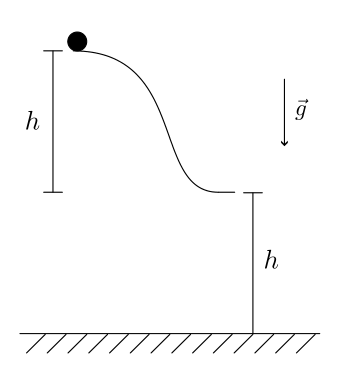
Una palla da tennis e una palla da biliardo scendono su una guida come in figura. La guida ha altezza e nel suo punto più basso è orizzontale, a una altezza rispetto al pavimento. Si assuma che l’attrito fra la guida e le due sfere sia sufficiente a permettere a entrambe di rotolare senza strisciare. Le due sfere toccano il suolo in punti diversi: quanto vale la distanza tra di essi?
Unità di misura: m. Precisione richiesta: 30.0%.
p.5 — Ball on curved guide above floor
Topic: Rotational Dynamics, Conservation of Energy Metodi: Energy Conservation Method, Torque & Angular Momentum Analysis, Kinematic Equations Competenze: Diagrammatic Reasoning, Mathematical Modeling, Physical Reasoning Objects: Ball Fonte: Testo (PDF) — p.5 Soluzione: Soluzioni (PDF)
Rolling on the wheel
A tennis ball and a pool ball come down on a guide as shown. The height of the wheel is and at its lowest point it is horizontal, at a height from the floor. The friction between the handlebar and the two spheres is assumed to be sufficient to allow both to roll without cracking. The two spheres touch the ground at different points: what is the distance between them?
The following is the list of the measurement units: The following information is provided:
The following table shows the results of the tests:
Topic: Rotational Dynamics, Conservation of Energy Metodi: Energy Conservation Method, Torque & Angular Momentum Analysis, Kinematic Equations Competenze: Diagrammatic Reasoning, Mathematical Modeling, Physical Reasoning Objects: Ball Fonte: Testo (PDF) — p.5 Soluzione: Soluzioni (PDF)
Elettroni in campo magnetico
Due elettroni sono vincolati a muoversi in un piano ortogonale a un campo magnetico uniforme di modulo . Entrambi gli elettroni si muovono con velocità , percorrendo la stessa orbita circolare, attorno al loro centro di massa, il quale è fermo. Quanto vale il raggio di tale orbita?
Nota: si trascurino le perdite di energia per irraggiamento.
Unità di misura: m. Precisione richiesta: 0.5%.
Topic: Magnetism, Electrostatics Metodi: Lorentz Force Analysis, Free-Body Diagram, Coulomb’s Law Competenze: Mathematical Modeling, Diagrammatic Reasoning Objects: Electron Fonte: Testo (PDF) — p.6 Soluzione: Soluzioni (PDF)
Magnetic field electrons
Two electrons are bound to move in an orthogonal plane to a uniform magnetic field of the form . Both electrons move at speed, traveling in the same circular orbit around their center of mass, which is stationary. What is the radius of that orbit worth?
Note: energy losses by irradiation are neglected.
The following is the list of the measurement units: The following information is provided:
Topic: Magnetism, Electrostatics Metodi: Lorentz Force Analysis, Free-Body Diagram, Coulomb’s Law Competenze: Mathematical Modeling, Diagrammatic Reasoning Objects: Electron Fonte: Testo (PDF) — p.6 Soluzione: Soluzioni (PDF)
Pianeta Nove
Le più avanzate indagini astronomiche riescono a rilevare oggetti che hanno una luminosità apparente pari a volte quella del Sole. Se un pianeta identico alla Terra orbitasse nella periferia del Sistema Solare, a quale distanza massima dal Sole dovrebbe trovarsi affinché risulti visibile nelle indagini astronomiche?
Unità di misura: m. Precisione richiesta: 45.0%.
Topic: Astrophysics, Geometric Optics Metodi: Order-of-Magnitude Estimation, Physical Modeling Competenze: Estimation & Approximation, Mathematical Modeling Objects: Planet, Star Fonte: Testo (PDF) — p.6 Soluzione: Soluzioni (PDF)
The Commission shall adopt delegated acts in accordance with Article 21 of this Regulation.
The most advanced astronomical surveys detect objects that have an apparent brightness equal to times that of the Sun. If a planet identical to Earth orbited the outer solar system, what maximum distance from the Sun should it be for astronomical surveys to make it visible?
The following is the list of the measurement units: The following information shall be provided:
Topic: Astrophysics, Geometric Optics Metodi: Order-of-Magnitude Estimation, Physical Modeling Competenze: Estimation & Approximation, Mathematical Modeling Objects: Planet, Star Fonte: Testo (PDF) — p.6 Soluzione: Soluzioni (PDF)