Q.1.1 [40 p.]
PARTE PRIMA – I MODI NORMALI DI OSCILLAZIONE
L’apparato sperimentale consiste in due pendoli accoppiati (dadi M12 di massa uguali, appesi a un filo corto con distanza interasse ) fissati a un filo di supporto orizzontale. Le lunghezze caratteristiche sono: (lunghezza dei pendoli), (lunghezza del tratto centrale del filo di supporto tra i due punti di attacco), (distanza tra i due pendoli).
È possibile dimostrare che i periodi dei due modi normali di oscillazione sono:
dove caratterizza il modo normale 1 (pendoli in fase) e il modo normale 2 (pendoli in controfase).
Determina il valore dei coefficienti che caratterizzano le oscillazioni del modo normale 1 e del modo normale 2. Predisponi l’apparato in modo che risultino fissi e . Lavora per . Non è richiesta la stima delle incertezze.
Suggerimento: si consiglia di lavorare per incrementi di maggiori o uguali a 2 cm e di impiegare per le misure di periodo almeno 30 oscillazioni.
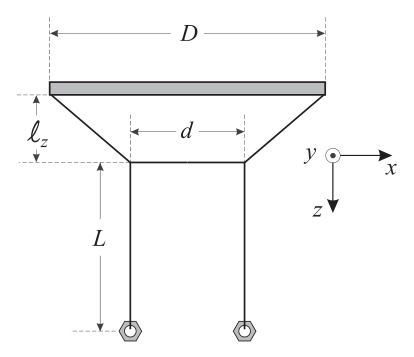 Fig.3: lunghezze apparato pendoli accoppiati
Topic: Oscillations & Waves, Newtonian Mechanics Metodi: Simple Harmonic Motion Analysis, Graph Linearization, Experimental Data Analysis Competenze: Experimental Data Analysis, Graph Linearization Objects: Pendulum, String Fonte: Testo (PDF) — p.4 Soluzione: Soluzioni (PDF)
Q.1.1 [40 p.]
Part I The normal modes of oscillation
The experimental apparatus consists of two coupled pendulums (M12 wires of equal mass , suspended from a short wire with an interacting distance ) attached to a horizontal support wire. The characteristic lengths are: (length of the pendulums), (length of the centre of the support wire between the two attachment points), (distance between the two pendulums).
It can be shown that the periods of the two normal modes of oscillation are:
where characterises normal mode 1 (stage suspension) and normal mode 2 (counter-stage suspension).
Determine the value of the coefficients that characterize the oscillations of normal mode 1 and normal mode 2. Set the apparatus so that and are fixed. It works for . The estimation of uncertainties is not required.
Suggest: it is recommended to work for increments of greater than or equal to 2 cm and to use at least 30 oscillations for period measurements.
Fig.3: lengths of the appliance by hanging them together
Topic: Oscillations & Waves, Newtonian Mechanics Metodi: Simple Harmonic Motion Analysis, Graph Linearization, Experimental Data Analysis Competenze: Experimental Data Analysis, Graph Linearization Objects: Pendulum, String Fonte: Testo (PDF) — p.4 Soluzione: Soluzioni (PDF)
Q.1.2 [45 p.]
Il secondo modo normale di oscillazione ha un ruolo fondamentale nel determinare il grado di accoppiamento dei pendoli. Il coefficiente che lo caratterizza dipende anche dalla distanza .
Predisponi l’apparato in modo che risultino fissi e .
Effettua le misure di periodo necessarie per trovare la funzione . Scrivila in modo esplicito e forniscine la rappresentazione grafica; non sono richieste le barre di errore. Riporta il dettaglio dei calcoli effettuati.
Suggerimento: imposta valori della distanza intervallati di 3 cm e impiega un congruo numero di oscillazioni (almeno 30) per ogni misura.
Topic: Oscillations & Waves, Newtonian Mechanics Metodi: Simple Harmonic Motion Analysis, Graph Linearization, Experimental Data Analysis Competenze: Experimental Data Analysis, Graph Linearization Objects: Pendulum, String Fonte: Testo (PDF) — p.5 Soluzione: Soluzioni (PDF)
Q.1.2 [45 p.]
The second normal mode of oscillation plays a key role in determining the degree of coupling of the pendulums. The coefficient that characterises it also depends on the distance.
Set the apparatus so that and are fixed.
Performs the period measurements necessary to find the function. Write it down explicitly and provide the graphic representation; no error bars are required. Report the details of the calculations made.
Suggest: sets distance values with intervals of 3 cm and uses an appropriate number of oscillations (at least 30) for each measurement.
Topic: Oscillations & Waves, Newtonian Mechanics Metodi: Simple Harmonic Motion Analysis, Graph Linearization, Experimental Data Analysis Competenze: Experimental Data Analysis, Graph Linearization Objects: Pendulum, String Fonte: Testo (PDF) — p.5 Soluzione: Soluzioni (PDF)
Q.1.3 [10 p.]
Nell’equazione di moto di ciascun pendolo è presente un termine che descrive l’effetto dovuto all’altro pendolo, attraverso un coefficiente detto “coefficiente di accoppiamento”: questo dipende dalle lunghezze e : . La condizione esprime il disaccoppiamento dei due pendoli. Si può dimostrare che è a sua volta proporzionale alla differenza dei quadrati delle pulsazioni dei due modi normali, .
Fissato il valore di impostato in Q.1.2, e sfruttando le informazioni sin qui ottenute, determina per quale distanza i pendoli risultano disaccoppiati. Non è richiesta la stima dell’incertezza.
Topic: Oscillations & Waves, Newtonian Mechanics Metodi: Simple Harmonic Motion Analysis, Experimental Data Analysis, Physical Modeling Competenze: Physical Reasoning, Experimental Data Analysis Objects: Pendulum Fonte: Testo (PDF) — p.5 Soluzione: Soluzioni (PDF)
Q.1.3 [10 p.]
In the motion equation of each pendulum there is a term describing the effect due to the other pendulum, through a coefficient called ‘coupling coefficient’: this depends on the lengths and : . The condition expresses the decoupling of the two pendulums. It can be shown that is in turn proportional to the difference in the squares of the pulses of the two normal modes, .
Set the value set in Q.1.2, and using the information thus obtained, determine the distance for which the pendulums are decoupled. The estimate of uncertainty is not required.
Topic: Oscillations & Waves, Newtonian Mechanics Metodi: Simple Harmonic Motion Analysis, Experimental Data Analysis, Physical Modeling Competenze: Physical Reasoning, Experimental Data Analysis Objects: Pendulum Fonte: Testo (PDF) — p.5 Soluzione: Soluzioni (PDF)
Q.2.1 [25 p.]
PARTE SECONDA – SOVRAPPOSIZIONE DEI MODI NORMALI – BATTIMENTI
Quando un solo pendolo viene spostato dalla posizione di riposo e lasciato libero, si ha uno scambio graduale di energia dal primo pendolo al secondo e viceversa: il fenomeno è noto come battimento. Si può dimostrare che il periodo dei battimenti è:
Effettua una verifica della formula (2) predisponendo l’apparato in modo che , e .
Topic: Oscillations & Waves, Newtonian Mechanics Metodi: Simple Harmonic Motion Analysis, Experimental Data Analysis, Superposition Principle Competenze: Experimental Data Analysis, Physical Reasoning Objects: Pendulum Fonte: Testo (PDF) — p.5 Soluzione: Soluzioni (PDF)
Q.2.1 [25 p.]
Part II Over-opposition of normal modes Baptisms
When a single pendulum is moved from its resting position and left free, there is a gradual change of energy from the first pendulum to the second and vice versa: the phenomenon is known as beating. It can be shown that the period of the batches is:
It shall check the formula (2) by arranging the apparatus so that , and .
Topic: Oscillations & Waves, Newtonian Mechanics Metodi: Simple Harmonic Motion Analysis, Experimental Data Analysis, Superposition Principle Competenze: Experimental Data Analysis, Physical Reasoning Objects: Pendulum Fonte: Testo (PDF) — p.5 Soluzione: Soluzioni (PDF)
Q.3.1 [20 p.]
PARTE TERZA – Pendoli con lunghezze diverse
Quando le lunghezze dei due pendoli sono diverse, il pendolo inizialmente a riposo si comporta approssimativamente come un oscillatore forzato. Si chiama pendolo pilota quello la cui lunghezza rimane costante, e pendolo forzato l’altro (lunghezza ).
Parametri fissi: ; ; .
Avvia il sistema spostando il pendolo pilota dalla posizione di riposo, mantenendo l’altro verticale. Assicurati di avviare il pendolo pilota realizzando sempre il medesimo spostamento. Misura il periodo dei battimenti () in funzione della pulsazione naturale del pendolo forzato. Varia quest’ultima nel più ampio range di valori che l’apparato consente. Spiega ogni altro eventuale accorgimento che hai adottato per ottimizzare il processo di misura.
Topic: Oscillations & Waves, Newtonian Mechanics Metodi: Simple Harmonic Motion Analysis, Experimental Data Analysis, Physical Modeling Competenze: Experimental Data Analysis, Physical Reasoning Objects: Pendulum Fonte: Testo (PDF) — p.6 Soluzione: Soluzioni (PDF)
Q.3.1 [20 p.]
PART III Pending of different lengths
When the lengths of the two pendulums are different, the pendulum initially behaves at rest approximately as a forced oscillator. The pilot pendulum * is called the one whose length remains constant, and the other (length ) is called the forced pendulum *.
The following parameters are used: ; ; .
Start the system by moving the pilot pendulum from its resting position while keeping the other vertical. Make sure you start the pilot pendulum and make the same move. Measures the duration of the beats () according to the natural pulse of the forced pendulum. Varies the latter in the widest range of values the device allows. Explain any other possible measures you have taken to optimise the measurement process.
Topic: Oscillations & Waves, Newtonian Mechanics Metodi: Simple Harmonic Motion Analysis, Experimental Data Analysis, Physical Modeling Competenze: Experimental Data Analysis, Physical Reasoning Objects: Pendulum Fonte: Testo (PDF) — p.6 Soluzione: Soluzioni (PDF)
Q.3.2 [40 p.]
Dalla teoria dell’oscillatore forzato, l’ampiezza delle oscillazioni del pendolo forzato è:
dove è la pulsazione naturale del pendolo forzato, è la pulsazione del pendolo pilota, e è un parametro che descrive lo scambio di energia tra i due oscillatori.
Poiché non è noto il rapporto , si costruisce il rapporto normalizzato:
Sfruttando le misure ottenute si può calcolare (dove è il periodo dei battimenti per ). Sotto l’ipotesi :
Trasforma la formula (3) in modo da ottenere un’equazione del tipo . Rappresenta il risultato sul piano cartesiano facendo una scelta appropriata delle variabili che ti consentano di riconoscere facilmente un’eventuale dipendenza lineare. Non sono richieste le barre di errore. La costruzione grafica che ottieni conferma o no l’ipotesi ? Motiva la risposta. Deduci dal grafico il valore della pulsazione di risonanza e i valori che assume il coefficiente .
Topic: Oscillations & Waves, Newtonian Mechanics Metodi: Simple Harmonic Motion Analysis, Graph Linearization, Experimental Data Analysis Competenze: Graph Linearization, Mathematical Modeling Objects: Pendulum Fonte: Testo (PDF) — p.6 Soluzione: Soluzioni (PDF)
Q.3.2 [40 p.]
From the forced oscillator theory, the amplitude of the forced pendulum oscillations is:
where is the natural pulse of the forced pendulum, is the pulse of the pilot pendulum, and is a parameter describing the energy exchange between the two oscillators.
Since the ratio is not known, the normal ratio is constructed:
Using the measurements obtained, can be calculated (where is the batch time for ). Sotto l’ipotesi :
Transform the formula (3) to obtain an equation of the type . It represents the result on the Cartesian plane by making an appropriate choice of variables that allow you to easily recognize a possible linear dependence. No error bars are required. The graphic construction that you confirm or not the hypothesis? Reason for the answer. Subtract from the graph the resonance pulse value and the values assumed by the coefficient .
Topic: Oscillations & Waves, Newtonian Mechanics Metodi: Simple Harmonic Motion Analysis, Graph Linearization, Experimental Data Analysis Competenze: Graph Linearization, Mathematical Modeling Objects: Pendulum Fonte: Testo (PDF) — p.6 Soluzione: Soluzioni (PDF)
Q.3.3 [20 p.]
Costituisci il grafico del periodo dei battimenti () in funzione della pulsazione naturale () del pendolo forzato. Anche in questo caso non sono richieste le barre di errore. Calcola il periodo dei battimenti previsto nel caso in cui si verifichi la condizione .
Topic: Oscillations & Waves, Newtonian Mechanics Metodi: Simple Harmonic Motion Analysis, Approximation & Series Expansion, Experimental Data Analysis Competenze: Physical Reasoning, Mathematical Modeling Objects: Pendulum Fonte: Testo (PDF) — p.6 Soluzione: Soluzioni (PDF)
Q.3.3 [20 p.]
Make the graph of the beat period () according to the natural pulse () of the forced pendulum. In this case, error bars are not required. Calculate the expected batch time in case of .
Topic: Oscillations & Waves, Newtonian Mechanics Metodi: Simple Harmonic Motion Analysis, Approximation & Series Expansion, Experimental Data Analysis Competenze: Physical Reasoning, Mathematical Modeling Objects: Pendulum Fonte: Testo (PDF) — p.6 Soluzione: Soluzioni (PDF)