Venus has an equatorial radius of 6052 km. The semi-major axis of its orbit around the Sun is 0.72 AU. The smallest diameter of the primary mirror/lens (objective) of an optical telescope to be used to just resolve the Venus disc during the transit of Venus is approximately
- (a) 200 cm
- (b) 20 cm
- (c) 10 cm
- (d) 0.25 cm
Topic: Astrophysics, Wave Optics Metodi: Interference & Diffraction Analysis Competenze: Estimation & Approximation Objects: Planet, Star, Lens Fonte: Testo (PDF) — p.3 Soluzione: Soluzioni (PDF)
Venere ha un raggio equatoriale di 6052 km. L’asse semimejor della sua orbita attorno al Sole è di 0,72 UA. Il diametro più piccolo dello specchio/l’obiettivo primario di un telescopio ottico da utilizzare per risolvere il disco di Venere durante il transito di Venere è di circa
- (a) 200 cm
- (b) 20 cm
- (c) 10 cm
- (d) 0.25 cm
Topic: Astrophysics, Wave Optics Metodi: Interference & Diffraction Analysis Competenze: Estimation & Approximation Objects: Planet, Star, Lens Fonte: Testo (PDF) — p.3 Soluzione: Soluzioni (PDF)
The Earth’s atmosphere is transparent across the most of the optical region and ……….. region of the electromagnetic spectrum. Choose the correct option to fill the blank.
- (a) ultraviolet
- (b) X-ray
- (c) some portions of the radio wave
- (d) gamma-ray
Topic: Astrophysics Metodi: Physical Modeling Competenze: Physical Reasoning Objects: Planet Fonte: Testo (PDF) — p.3 Soluzione: Soluzioni (PDF)
L’atmosfera terrestre è trasparente nella maggior parte della regione ottica e ……….. regione dello spettro elettromagnetico. Scegli l’opzione corretta per riempire il vuoto.
- a) ultravioletti
- b) radiografia
- c) alcune parti dell’onda radio
- d) raggi gamma
Topic: Astrophysics Metodi: Physical Modeling Competenze: Physical Reasoning Objects: Planet Fonte: Testo (PDF) — p.3 Soluzione: Soluzioni (PDF)
It is given that the pupil of the human eye is about 5 mm (in diameter). How many times more light-gathering power does a telescope with a primary mirror of diameter about 20 cm (8 inches) have than the human eye?
- (a) 4 times
- (b) 16 times
- (c) 40 times
- (d) 1600 times
Topic: Geometric Optics, Astrophysics Metodi: Physical Modeling Competenze: Physical Reasoning Objects: Mirror Fonte: Testo (PDF) — p.3 Soluzione: Soluzioni (PDF)
Si ritiene che la pupilla dell’occhio umano abbia circa 5 mm di diametro. Quante volte più luce può raccogliere un telescopio con uno specchio di diametro di circa 20 centimetri rispetto all’occhio umano?
- a) 4 volte
- b) 16 volte
- c) 40 volte
- d) 1600 volte
Topic: Geometric Optics, Astrophysics Metodi: Physical Modeling Competenze: Physical Reasoning Objects: Mirror Fonte: Testo (PDF) — p.3 Soluzione: Soluzioni (PDF)
An astronomer observes a spectral emission line from a galaxy at a wavelength of 600 nm. This same spectral line is measured in the laboratory using a stationary source and is seen to have wavelength 500 nm. The speed of the galaxy toward or away from Earth (in units of the speed of light ) is equal to
- (a) moving away from Earth
- (b) moving toward Earth
- (c) moving away from Earth
- (d) moving toward Earth
Topic: Astrophysics Metodi: Physical Modeling Competenze: Physical Reasoning Objects: — Fonte: Testo (PDF) — p.3 Soluzione: Soluzioni (PDF)
Un astronomo osserva una linea di emissione spettrale da una galassia a una lunghezza d’onda di 600 nm. Questa stessa linea spettrale viene misurata in laboratorio utilizzando una fonte stazionaria e si vede che ha una lunghezza d’onda di 500 nm. La velocità della galassia verso o lontano dalla Terra (in unità della velocità della luce ) è uguale a
- a) allontanandosi dalla Terra
- b) in movimento verso la Terra
- (c) allontanandosi dalla Terra
- (d) in movimento verso la Terra
Topic: Astrophysics Metodi: Physical Modeling Competenze: Physical Reasoning Objects: — Fonte: Testo (PDF) — p.3 Soluzione: Soluzioni (PDF)
An astronomer observes that Polaris is 40 degrees above her northern horizon. What can you say about the longitude of her location from her observations?
- (a) nothing
- (b) that it is 40 degrees north
- (c) that it is 50 degrees south
- (d) that it is 40 degrees east
Topic: Astrophysics Metodi: Physical Modeling Competenze: Physical Reasoning Objects: Star Fonte: Testo (PDF) — p.3 Soluzione: Soluzioni (PDF)
Un astronomo osserva che Polaris è a 40 gradi sopra il suo orizzonte settentrionale. Cosa puoi dire sulla longitudine della sua posizione dalle sue osservazioni?
- (a) nulla
- b) che è a 40 gradi nord
- c) che è a 50 gradi sud
- d) che è a 40 gradi est
Topic: Astrophysics Metodi: Physical Modeling Competenze: Physical Reasoning Objects: Star Fonte: Testo (PDF) — p.3 Soluzione: Soluzioni (PDF)
The spectrum of a cloud of cool gas seen against a bright background black body would show
- (a) bright lines (emission spectrum) against a continuum spectral emission background
- (b) a continuous spectrum
- (c) dark lines (absorption lines) against a continuum emission background
- (d) either bright or dark lines, depending on distance, against a continuum emission background
Topic: Astrophysics Metodi: Physical Modeling Competenze: Physical Reasoning Objects: Gas Fonte: Testo (PDF) — p.3 Soluzione: Soluzioni (PDF)
Lo spettro di una nuvola di gas fresco visto contro un fondo luminoso corpo nero mostrerebbe
- a) linee luminose (spettro di emissioni) contro uno sfondo di emissioni spettrali continui
- b) uno spettro continuo
- c) linee scure (linee di assorbimento) su sfondo di emissione continua
- d) linee chiare o scure, a seconda della distanza, su sfondo di emissione continua
Topic: Astrophysics Metodi: Physical Modeling Competenze: Physical Reasoning Objects: Gas Fonte: Testo (PDF) — p.3 Soluzione: Soluzioni (PDF)
If a star has a parallax of one-eighth of a second of arc, its distance from the earth is
- (a) 2,06,265 astronomical units
- (b) eight light years
- (c) one-eighth parsec
- (d) eight parsec
Topic: Astrophysics Metodi: Physical Modeling Competenze: Unit Conversion Objects: Star Fonte: Testo (PDF) — p.3 Soluzione: Soluzioni (PDF)
Se una stella ha una parallaccia di un ottavo di secondo di arco, la sua distanza dalla terra è
- a) 2.06.265 unità astronomiche
- b) otto anni luce
- c) un ottavo parsec
- d) otto parsec
Topic: Astrophysics Metodi: Physical Modeling Competenze: Unit Conversion Objects: Star Fonte: Testo (PDF) — p.3 Soluzione: Soluzioni (PDF)
The elemental composition of the Sun, by mass, is about
- (a) 50% metals, 50% hydrogen
- (b) 71% hydrogen, 27% helium, 2% others
- (c) 75% helium, 20% hydrogen, 5% others
- (d) 75% carbon, 25% helium
Topic: Astrophysics Metodi: Physical Modeling Competenze: Physical Reasoning Objects: Star Fonte: Testo (PDF) — p.3 Soluzione: Soluzioni (PDF)
La composizione elementare del Sole, per massa, è di circa
- a) Metalli del 50%, idrogeno del 50%
- b) 71% idrogeno, 27% elio, altri 2%
- c) 75% di elio, 20% di idrogeno, 5% altri
- d) 75% di carbonio, 25% di elio
Topic: Astrophysics Metodi: Physical Modeling Competenze: Physical Reasoning Objects: Star Fonte: Testo (PDF) — p.3 Soluzione: Soluzioni (PDF)
Which of the following planets has essentially no atmosphere?
- (a) Venus
- (b) Mercury
- (c) Jupiter
- (d) Mars
Topic: Astrophysics Metodi: Physical Modeling Competenze: Physical Reasoning Objects: Planet Fonte: Testo (PDF) — p.3 Soluzione: Soluzioni (PDF)
Quale dei seguenti pianeti non ha sostanzialmente atmosfera?
- a) Venere
- b) Mercurio
- (c) Giove
- (d) Marte
Topic: Astrophysics Metodi: Physical Modeling Competenze: Physical Reasoning Objects: Planet Fonte: Testo (PDF) — p.3 Soluzione: Soluzioni (PDF)
Sunspots are
- (a) relatively cool compared to the photosphere
- (b) related to convection cells
- (c) related to the Sun’s electric field
- (d) cyclonic storms similar to Jupiter’s great red spot
Topic: Astrophysics Metodi: Physical Modeling Competenze: Physical Reasoning Objects: Star Fonte: Testo (PDF) — p.4 Soluzione: Soluzioni (PDF)
Le macchie solari sono
- a) relativamente fresco rispetto alla fotosfera
- b) relative alle celle di convezione
- (c) correlati al campo elettrico del Sole
- d) tempeste cicloniche simili alla grande macchia rossa di Giove
Topic: Astrophysics Metodi: Physical Modeling Competenze: Physical Reasoning Objects: Star Fonte: Testo (PDF) — p.4 Soluzione: Soluzioni (PDF)
A planet moves fastest in its orbit
- (a) when it is in opposition
- (b) when it is closest to the Sun
- (c) the greater its mass
- (d) when it is farthest from the Sun
Topic: Gravitation, Astrophysics Metodi: Kepler’s Laws Competenze: Physical Reasoning Objects: Planet, Star Fonte: Testo (PDF) — p.4 Soluzione: Soluzioni (PDF)
Un pianeta si muove più velocemente in orbita
- a) quando è in opposizione
- b) quando è più vicino al Sole
- c) maggiore è la sua massa
- (d) quando è più lontano dal Sole
Topic: Gravitation, Astrophysics Metodi: Kepler’s Laws Competenze: Physical Reasoning Objects: Planet, Star Fonte: Testo (PDF) — p.4 Soluzione: Soluzioni (PDF)
A square loop of side 10 cm and resistance is placed vertically in the east-west (-) plane. A uniform magnetic field of strength is set up across the plane of the coil in the north-south direction. The coil is rotating about a vertical axis () through its center at the rate of one rotation per 4 second. At time , the plane of the coil makes an angle with the east-west (-) plane. The correct schematic diagram giving the emf induced in the coil is
Quesito 12

- (a) emf vs , crossing zero at s
- (b) emf vs , crossing zero at s
- (c) emf vs , crossing zero at s
- (d) emf vs , returning to zero at s
Topic: Electromagnetic Induction Metodi: Faraday’s Law of Induction Competenze: Diagrammatic Reasoning Objects: Coil Fonte: Testo (PDF) — p.4 Soluzione: Soluzioni (PDF)
Un ciclo quadrato di lato di 10 cm e resistenza è posizionato verticalmente nel piano est-ovest (-). Un campo magnetico uniforme di resistenza è montato sul piano della bobina in direzione nord-sud. La bobina ruota intorno ad un asse verticale () attraverso il suo centro al ritmo di una rotazione al secondo. Al tempo , il piano della bobina fa un angolo con il piano est-ovest (-). Il corretto diagramma schematico che indica l’emf indotto nella bobina è
Quesito 12
- a) emf vs , incrocio di zero a s
- b) emf vs , incrocio di zero a s
- (c) emf vs , incrocio zero a s
- (d) emf vs , che ritorna a zero a s
Topic: Electromagnetic Induction Metodi: Faraday’s Law of Induction Competenze: Diagrammatic Reasoning Objects: Coil Fonte: Testo (PDF) — p.4 Soluzione: Soluzioni (PDF)
In 1912 Henrietta Leavitt making observations of Cepheid variable stars in the Magellanic clouds discovered the period–luminosity relation – fainter stars have shorter periods. The relation between the apparent magnitude (the measured magnitude of a star situated at its actual distance pc) and its absolute magnitude (its magnitude if located at a distance of 10 pc) is given by the magnitude–distance relation . Here is the distance in parsec. The distance from Milky Way to the Andromeda galaxy is 765 kpc. The observed period–luminosity relation determined by observations in the K band for Cepheid variables in the Andromeda galaxy is
with slope and zero-point 18.73. For Cepheids in the Milky Way where is approximately
- (a)
- (b)
- (c)
- (d)
Topic: Astrophysics Metodi: Physical Modeling Competenze: Physical Reasoning Objects: Star Fonte: Testo (PDF) — p.4 Soluzione: Soluzioni (PDF)
Nel 1912 Henrietta Leavitt, facendo osservazioni delle stelle variabili di Cefeide nelle nuvole di Magellano, scoprì che le stelle più deboli hanno periodi più brevi. La relazione tra la magnitudine apparente (la magnitudine misurata di una stella situata alla sua distanza effettiva pc) e la sua magnitudine assoluta (la sua magnitudine se situata a una distanza di 10 pc) è data dalla relazione di magnitudinedistanza . Qui è la distanza in parsec. La distanza dalla Via Lattea alla galassia di Andromeda è di 765 kpc. La relazione di luminosità osservata determinata dalle osservazioni nella banda K per le variabili di Cefeide nella galassia di Andromeda è
con pendenza e punto zero 18,73. Per le cefeidi della Via Lattea , dove è approssimativamente
- (a)
- (b)
- (c)
- (d)
Topic: Astrophysics Metodi: Physical Modeling Competenze: Physical Reasoning Objects: Star Fonte: Testo (PDF) — p.4 Soluzione: Soluzioni (PDF)
A Red Giant star of mass and a White Dwarf star of mass form a binary system and are rotating in circular orbits around their common centre of mass with a period of one year. The White Dwarf is orbiting just within the photosphere of the Red Giant star. The Red Giant has a radius of 3.6 AU. An estimate for the mass of the Red Giant star in solar mass units is (note that )
- (a) 188
- (b) 94
- (c) 47
- (d) 13
Topic: Gravitation, Astrophysics Metodi: Kepler’s Laws, Newton’s Law of Gravitation Competenze: Estimation & Approximation Objects: Star Fonte: Testo (PDF) — p.4 Soluzione: Soluzioni (PDF)
Una stella del Gigante Rosso di massa e una stella nana bianca di massa formano un sistema binario e ruotano in orbite circolari intorno al loro centro di massa comune con un periodo di un anno. Il Nano Bianco orbita proprio all’interno della fotosfera della stella del Gigante Rosso. Il Gigante Rossa ha un raggio di 3,6 AU. Una stima della massa della stella del Gigante Rosso in unità di massa solare è (nota che )
- (a) 188
- (b) 94
- (c) 47
- (d) 13
Topic: Gravitation, Astrophysics Metodi: Kepler’s Laws, Newton’s Law of Gravitation Competenze: Estimation & Approximation Objects: Star Fonte: Testo (PDF) — p.4 Soluzione: Soluzioni (PDF)
In spectroscopy doublet lines are closely spaced spectral lines that arise from transitions from a common fundamental state to states which differ only in their total angular momentum value. If a source of light is moving away from us the light from the source will appear shifted to the longer wavelength (red) side of the spectrum. The shift is quantified by the redshift , where is the observed wavelength of the spectral line when the emitting source is at rest with respect to the observer and is the observed shift in the wavelength, so . Hubble observed that spectral lines of galaxies not very close to us are redshifted. A galaxy is showing a redshift of . The observed wavelength separation, in nanometre, of the sodium doublet at 589 and 589.6 nm and of the potassium doublet at 766.5 and 769.9 nm in the spectrum of the galaxy are respectively
- (a) 0.603, 3.417
- (b) 0.003, 0.017
- (c) 38.33, 29.45
- (d) 38.33, 38.5
Topic: Astrophysics Metodi: Physical Modeling Competenze: Physical Reasoning Objects: — Fonte: Testo (PDF) — p.4 Soluzione: Soluzioni (PDF)
Nella spettroscopia, le linee doppie sono linee spettrali spaziate a stretto distanza che derivano da transizioni da uno stato fondamentale comune a stati che differiscono solo nel loro valore di momentum angolare totale. Se una fonte di luce si allontana da noi la luce dalla fonte apparirà spostata verso il lato più lungo (rosso) dello spettro. Il spostamento è quantificato con il spostamento rosso , dove è la lunghezza d’onda osservata della linea spettrale quando la fonte emittente è in riposo rispetto all’osservatore e è il spostamento osservato nella lunghezza d’onda, quindi . Hubble osservò che le linee spettrali delle galassie non molto vicine a noi sono spostate in rosso. Una galassia mostra un spostamento rosso di . La separazione osservata di lunghezza d’onda, in nanometro, del doppio di sodio a 589 e 589,6 nm e del doppio di potassio a 766,5 e 769,9 nm nello spettro della galassia sono rispettivamente
- (a) 0.603, 3.417
- (b) 0.003, 0.017
- (c) 38.33, 29.45
- (d) 38.33, 38.5
Topic: Astrophysics Metodi: Physical Modeling Competenze: Physical Reasoning Objects: — Fonte: Testo (PDF) — p.4 Soluzione: Soluzioni (PDF)
The rotation curve of a spiral galaxy gives the ‘instantaneous’ local mean tangential velocity in the plane of the galaxy of stars/gas clouds in the galaxy lying along a line through the centre of the galaxy, with respect to the distant quasars as observed from the centre of the galaxy. The following is a schematic diagram of the rotation curve of a particular spiral galaxy (flat curve beyond 6 kpc).
As measured from a star orbiting at a distance kilo parsec from the centre, which one of the following diagrams gives a schematic representation of the mean tangential velocity with which objects at various distances from the star, along the line joining the star to the centre of the galaxy, will appear to move with respect to the distant quasars?
Quesito 16
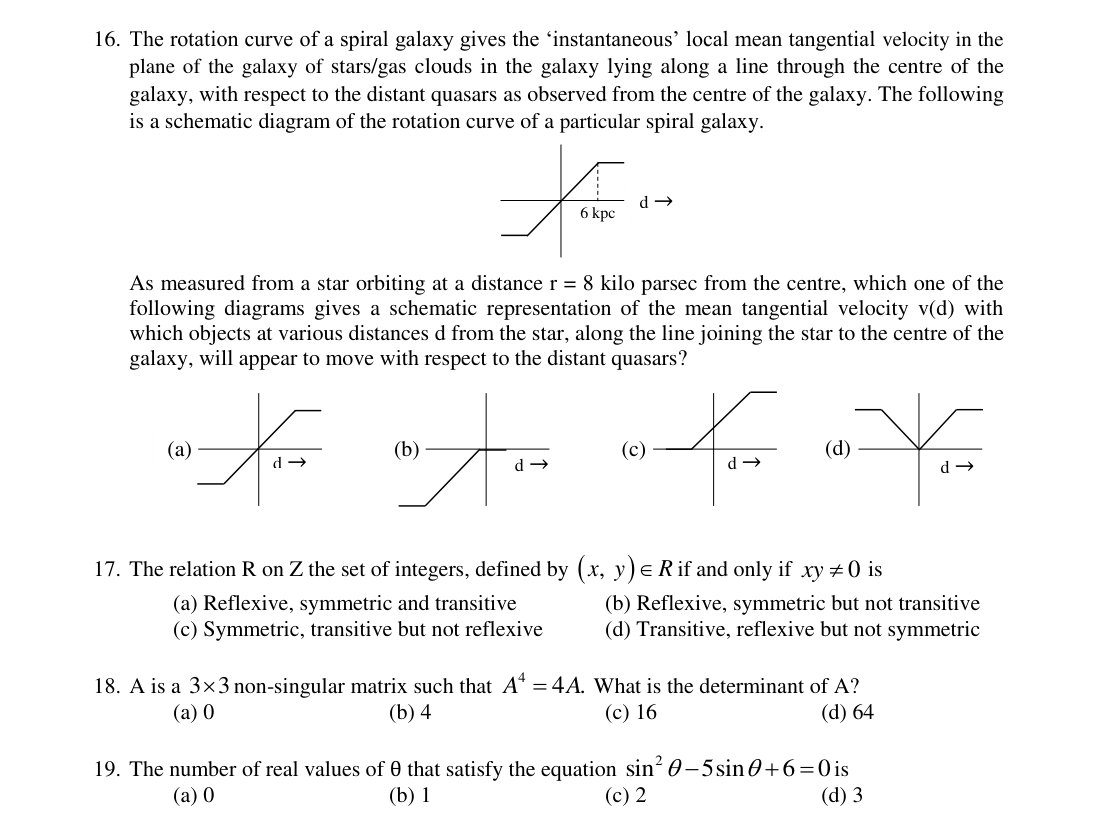
- (a) diagram (a)
- (b) diagram (b)
- (c) diagram (c)
- (d) diagram (d)
Topic: Astrophysics Metodi: Physical Modeling Competenze: Diagrammatic Reasoning Objects: Star Fonte: Testo (PDF) — p.5 Soluzione: Soluzioni (PDF)
La curva di rotazione di una galassia a spirale dà la velocità tangenziale media locale “istantanea” nel piano della galassia di stelle/nuvole di gas nella galassia che si trova lungo una linea attraverso il centro della galassia, rispetto ai quasar lontani osservati dal centro della galassia. Il seguente è un diagramma schematico della curva di rotazione di una particolare galassia a spirale (curva piatta oltre 6 kpc).
Come misurato da una stella che orbita a una distanza chiloparsec dal centro, quale dei seguenti diagrammi dà una rappresentazione schematica della velocità tangenziale media con cui gli oggetti a varie distanze dalla stella, lungo la linea che collega la stella al centro della galassia, sembreranno muoversi rispetto ai quasar lontani?
Quesito 16
- a) diagramma a)
- b) diagramma b)
- c) diagramma c)
- d) diagramma d)
Topic: Astrophysics Metodi: Physical Modeling Competenze: Diagrammatic Reasoning Objects: Star Fonte: Testo (PDF) — p.5 Soluzione: Soluzioni (PDF)
The relation on the set of integers, defined by if and only if is
- (a) Reflexive, symmetric and transitive
- (b) Reflexive, symmetric but not transitive
- (c) Symmetric, transitive but not reflexive
- (d) Transitive, reflexive but not symmetric
Topic: Mathematics Metodi: Physical Modeling Competenze: Mathematical Modeling Objects: — Fonte: Testo (PDF) — p.5 Soluzione: Soluzioni (PDF)
La relazione su l’insieme di enti, definita da se e solo se è
- a) Riflessivi, simmetrici e transitivi
- b) riflessivi, simmetrici ma non transitivi
- c) Simmetrica, transitiva ma non riflessiva
- d) transitivo, riflessivo ma non simmetrico
Topic: Mathematics Metodi: Physical Modeling Competenze: Mathematical Modeling Objects: — Fonte: Testo (PDF) — p.5 Soluzione: Soluzioni (PDF)
is a non-singular matrix such that . What is the determinant of ?
- (a) 0
- (b) 4
- (c) 16
- (d) 64
Topic: Mathematics Metodi: Physical Modeling Competenze: Mathematical Modeling Objects: — Fonte: Testo (PDF) — p.5 Soluzione: Soluzioni (PDF)
è una matrice non singolare tale che . Qual è il determinante di ?
- (a) 0
- (b) 4
- (c) 16
- (d) 64
Topic: Mathematics Metodi: Physical Modeling Competenze: Mathematical Modeling Objects: — Fonte: Testo (PDF) — p.5 Soluzione: Soluzioni (PDF)
The number of real values of that satisfy the equation is
- (a) 0
- (b) 1
- (c) 2
- (d) 3
Topic: Mathematics Metodi: Physical Modeling Competenze: Mathematical Modeling Objects: — Fonte: Testo (PDF) — p.5 Soluzione: Soluzioni (PDF)
Il numero dei valori reali di che soddisfano l’equazione è
- (a) 0
- (b) 1
- (c) 2
- (d) 3
Topic: Mathematics Metodi: Physical Modeling Competenze: Mathematical Modeling Objects: — Fonte: Testo (PDF) — p.5 Soluzione: Soluzioni (PDF)
If is a complex number such that , the value of is
- (a) 0
- (b) 1
- (c) 2
- (d) 3
Topic: Mathematics Metodi: Physical Modeling Competenze: Mathematical Modeling Objects: — Fonte: Testo (PDF) — p.5 Soluzione: Soluzioni (PDF)
Se è un numero complesso tale che , il valore di è
- (a) 0
- (b) 1
- (c) 2
- (d) 3
Topic: Mathematics Metodi: Physical Modeling Competenze: Mathematical Modeling Objects: — Fonte: Testo (PDF) — p.5 Soluzione: Soluzioni (PDF)
The number of positive divisors of is
- (a) 8
- (b) 18
- (c) 26
- (d) 54
Topic: Mathematics Metodi: Physical Modeling Competenze: Mathematical Modeling Objects: — Fonte: Testo (PDF) — p.5 Soluzione: Soluzioni (PDF)
Il numero dei divisori positivi di è
- (a) 8
- (b) 18
- (c) 26
- (d) 54
Topic: Mathematics Metodi: Physical Modeling Competenze: Mathematical Modeling Objects: — Fonte: Testo (PDF) — p.5 Soluzione: Soluzioni (PDF)
For what values of and is the following function continuous at ?
- (a)
- (b)
- (c)
- (d)
Topic: Mathematics Metodi: Physical Modeling Competenze: Mathematical Modeling Objects: — Fonte: Testo (PDF) — p.5 Soluzione: Soluzioni (PDF)
Per quali valori di e è continuata la seguente funzione a ?
- (a)
- (b)
- (c)
- (d)
Topic: Mathematics Metodi: Physical Modeling Competenze: Mathematical Modeling Objects: — Fonte: Testo (PDF) — p.5 Soluzione: Soluzioni (PDF)
Part A-2 (one or more correct)
The value of the integral is
- (a) 0
- (b) 1
- (c) 2
- (d) 3
Topic: Mathematics Metodi: Calculus-Integration Competenze: Mathematical Modeling Objects: — Fonte: Testo (PDF) — p.5 Soluzione: Soluzioni (PDF)
**Parte A-2 (una o più correzioni) **
Il valore dell’integrale è
- (a) 0
- (b) 1
- (c) 2
- (d) 3
Topic: Mathematics Metodi: Calculus-Integration Competenze: Mathematical Modeling Objects: — Fonte: Testo (PDF) — p.5 Soluzione: Soluzioni (PDF)
The area bounded by and is
- (a)
- (b)
- (c)
- (d)
Topic: Mathematics Metodi: Calculus-Integration Competenze: Mathematical Modeling Objects: — Fonte: Testo (PDF) — p.6 Soluzione: Soluzioni (PDF)
L’area dilimitata da e è
- (a)
- (b)
- (c)
- (d)
Topic: Mathematics Metodi: Calculus-Integration Competenze: Mathematical Modeling Objects: — Fonte: Testo (PDF) — p.6 Soluzione: Soluzioni (PDF)
Two unbiased dice are thrown simultaneously. What is the probability that both the dice show prime numbers?
- (a)
- (b)
- (c)
- (d)
Topic: Mathematics Metodi: Physical Modeling Competenze: Mathematical Modeling Objects: — Fonte: Testo (PDF) — p.6 Soluzione: Soluzioni (PDF)
Due dadi imparziali vengono lanciati contemporaneamente. Qual è la probabilità che entrambi i dadi mostrino numeri primi?
- (a)
- (b)
- (c)
- (d)
Topic: Mathematics Metodi: Physical Modeling Competenze: Mathematical Modeling Objects: — Fonte: Testo (PDF) — p.6 Soluzione: Soluzioni (PDF)
The differential equation represents
- (a) a family of concurrent straight lines
- (b) a family of straight lines passing through
- (c) a family of straight lines parallel to -axis
- (d) a family of straight lines parallel to -axis
Topic: Mathematics Metodi: Differential Equations Competenze: Mathematical Modeling Objects: — Fonte: Testo (PDF) — p.6 Soluzione: Soluzioni (PDF)
L’equazione differenziale rappresenta
- a) una famiglia di linee rette
- b) una famiglia di linee rette che attraversano
- (c) una famiglia di linee rette parallele all’asse
- d) una famiglia di linee rette parallele all’asse
Topic: Mathematics Metodi: Differential Equations Competenze: Mathematical Modeling Objects: — Fonte: Testo (PDF) — p.6 Soluzione: Soluzioni (PDF)
The volume of a magical right circular cylinder of fixed height changes at a constant rate. Initially, the base radius was 3 units and it changed to 6 units in 3 seconds. What is the radius of the base at time ?
- (a)
- (b)
- (c)
- (d)
Topic: Mathematics Metodi: Differential Equations Competenze: Mathematical Modeling Objects: — Fonte: Testo (PDF) — p.6 Soluzione: Soluzioni (PDF)
Il volume di un cilindro circolare magico a destra di altezza fissa cambia a un ritmo costante. Inizialmente, il raggio di base era di 3 unità e cambiò a 6 unità in 3 secondi. Qual è il raggio di radius della base al tempo ?
- (a)
- (b)
- (c)
- (d)
Topic: Mathematics Metodi: Differential Equations Competenze: Mathematical Modeling Objects: — Fonte: Testo (PDF) — p.6 Soluzione: Soluzioni (PDF)
The Lane–Emden equation is the governing equation for a crude model for a star. Here the star is treated as a sphere of gas with a polytropic equation of state. The differential equation admits exact solutions for polytropic index and as , and . The value of is such that defines the surface of the star.
The quantity gives the ratio of the central density to the average density for the model star. means the value of evaluated at . The values of for are
- (a)
- (b)
- (c)
- (d)
Topic: Astrophysics, Mathematics Metodi: Differential Equations Competenze: Mathematical Modeling Objects: Star, Gas Fonte: Testo (PDF) — p.6 Soluzione: Soluzioni (PDF)
L’equazione di LaneEmden è l’equazione di regola per un modello grezzo di una stella. Qui la stella è trattata come una sfera di gas con un’equazione politropica di stato. L’equazione differenziale ammette soluzioni esatte per gli indici politropici e come , e . Il valore di è tale che definisce la superficie della stella.
La quantità dà il rapporto tra la densità centrale e la densità media per la stella modello. significa il valore di valutato a . I valori di per sono:
- (a)
- (b)
- (c)
- (d)
Topic: Astrophysics, Mathematics Metodi: Differential Equations Competenze: Mathematical Modeling Objects: Star, Gas Fonte: Testo (PDF) — p.6 Soluzione: Soluzioni (PDF)
The logistic map iteratively maps to through the equation . Consider the two different initial values: and . For , the difference between the second iterates is approximately
- (a) 0.01
- (b)
- (c) 0.02
- (d) 0.001
Topic: Mathematics Metodi: Physical Modeling Competenze: Mathematical Modeling Objects: — Fonte: Testo (PDF) — p.6 Soluzione: Soluzioni (PDF)
La mappa logistica mappa iterativamente a attraverso l’equazione . Considerate i due valori iniziali diversi: e . Per , la differenza tra le seconde iterate è approssimativamente
- (a) 0.01
- (b)
- (c) 0.02
- (d) 0.001
Topic: Mathematics Metodi: Physical Modeling Competenze: Mathematical Modeling Objects: — Fonte: Testo (PDF) — p.6 Soluzione: Soluzioni (PDF)
In a class of 40 students 25 have opted Hindi as second language (event ). 35 students got first class (event ) in the examinations of which 20 had taken Hindi as second language. It is found that a student picked at random has secured first class. The probability that this student has taken Hindi as second language is
- (a)
- (b)
- (c)
- (d)
Topic: Mathematics Metodi: Physical Modeling Competenze: Mathematical Modeling Objects: — Fonte: Testo (PDF) — p.7 Soluzione: Soluzioni (PDF)
In una classe di 40 studenti, 25 hanno scelto l’hindi come seconda lingua (evento ). 35 studenti hanno ottenuto la prima classe (evento ) nelle esami, di cui 20 avevano preso l’hindi come seconda lingua. Si scopre che uno studente scelto a caso ha ottenuto la prima classe. La probabilità che questo studente abbia assunto l’indi come seconda lingua è
- (a)
- (b)
- (c)
- (d)
Topic: Mathematics Metodi: Physical Modeling Competenze: Mathematical Modeling Objects: — Fonte: Testo (PDF) — p.7 Soluzione: Soluzioni (PDF)
When a line segment/square/cube of side length is measured using a line segment/square/cube of side length , the number of line segments/squares/cubes covering the original line segment/square/cube is given by , , respectively. Define the dimension of an object as as . The , and steps of iteration of the process of obtaining the fractal curve called a Koch curve, of stretching and bending the middle one third of a line segment (of length ) into a triangle shape of side length , is shown in the figure; in the second () iteration each of the 4 line segments of length will have their middle one third stretched and bent into triangle shapes of side . After iterations the total number of line segments of length making up the figure will be . The dimension of the Koch curve, obtained as (i.e. as ) is
Quesito 31
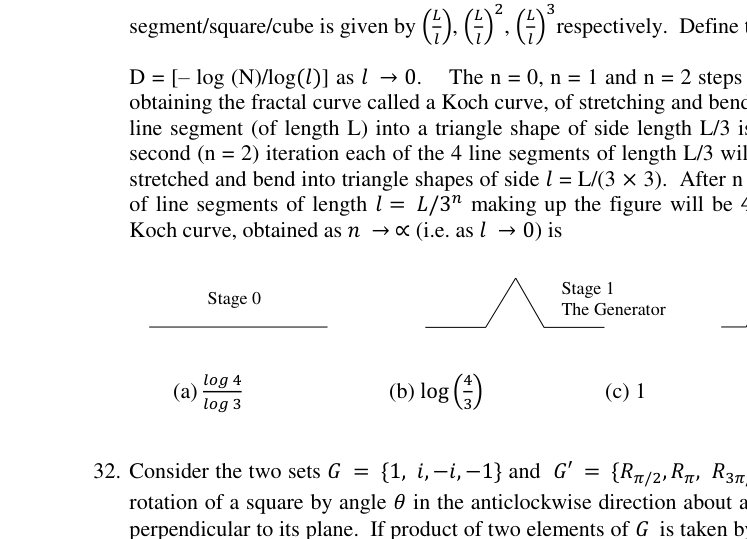
- (a)
- (b)
- (c) 1
- (d) 1.3
Topic: Mathematics Metodi: Physical Modeling Competenze: Mathematical Modeling Objects: — Fonte: Testo (PDF) — p.7 Soluzione: Soluzioni (PDF)
Quando un segmento/quadrato/cubo di longitudine laterale è misurato utilizzando un segmento/quadrato/cubo di longitudine laterale , il numero dei segmenti/quadrati/cubi di linea che coprono il segmento/quadrato/cubo di linea originale è indicato rispettivamente da , e . Definire la dimensione di un oggetto come come . Le fasi , e di iterazione del processo di ottenere la curva frattale chiamata curva di Koch, di allungare e piegare il terzo medio di un segmento di linea (di lunghezza ) in una forma triangolare di lunghezza laterale , sono mostrate nella figura; nella seconda iterazione () ciascuno dei 4 segmenti di linea di lunghezza avrà il loro terzo medio allungato e piegatuto in forme triangolari di lato . Dopo iterazioni il numero totale dei segmenti di linea di lunghezza che compongono la figura sarà . La dimensione della curva di Koch, ottenuta come (cioè as ) is
Quesito 31
- (a)
- (b)
- (c) 1
- (d) 1.3
Topic: Mathematics Metodi: Physical Modeling Competenze: Mathematical Modeling Objects: — Fonte: Testo (PDF) — p.7 Soluzione: Soluzioni (PDF)
Consider the two sets and , where stands for rotation of a square by angle in the anticlockwise direction about an axis through its centre and perpendicular to its plane. If product of two elements of is taken by complex multiplication and the product of two elements of are taken as , then, under which of the following mappings between and do the product relations hold unchanged?
- (a)
- (b)
- (c)
- (d)
Topic: Mathematics Metodi: Symmetry Argument Competenze: Mathematical Modeling Objects: — Fonte: Testo (PDF) — p.7 Soluzione: Soluzioni (PDF)
Considerate le due serie e , dove significa rotazione di un quadrato per angolo nella direzione anticlockwise intorno ad un asse attraverso il suo centro e perpendicolare al suo piano. Se il prodotto di due elementi di viene preso per moltiplicazione complessa e il prodotto di due elementi di viene preso come , allora, sotto quale delle seguenti mapping tra e le relazioni dei prodotti sono invariate?
- (a)
- (b)
- (c)
- (d)
Topic: Mathematics Metodi: Symmetry Argument Competenze: Mathematical Modeling Objects: — Fonte: Testo (PDF) — p.7 Soluzione: Soluzioni (PDF)
The objective of a reflecting telescope is a concave mirror of focal length 750 mm. To double the magnification, a concave lens of focal length 20 mm is placed near the focus of the primary mirror. What should be the position of the eyepiece focus from the concave lens?
- (a) 10 mm away from mirror
- (b) 10 mm towards mirror
- (c) 20 mm away from mirror
- (d) 20 mm towards mirror
Topic: Geometric Optics, Astrophysics Metodi: Thin Lens & Mirror Equation Competenze: Physical Reasoning Objects: Mirror, Lens Fonte: Testo (PDF) — p.7 Soluzione: Soluzioni (PDF)
L’obiettivo di un telescopio riflettente è uno specchio concavo di lunghezza focale di 750 mm. Per raddoppiare l’ingrandimento, si colloca una lente concava di lunghezza focale di 20 mm vicino al fuoco dello specchio primario. Qual dovrebbe essere la posizione del focus dell’occhio dalla lente concava?
- a) 10 mm di distanza dallo specchio
- b) 10 mm verso lo specchio
- c) a 20 mm di distanza dallo specchio
- 20 mm verso lo specchio
Topic: Geometric Optics, Astrophysics Metodi: Thin Lens & Mirror Equation Competenze: Physical Reasoning Objects: Mirror, Lens Fonte: Testo (PDF) — p.7 Soluzione: Soluzioni (PDF)
On the basis of Bohr Theory of atomic structure, the total energy required to remove both electrons from the helium atom in its ground state is 79 eV. How much energy is required to ionize helium, i.e. to remove the first electron?
- (a) 79.0 eV
- (b) 54.4 eV
- (c) 39.5 eV
- (d) 24.6 eV
Topic: Modern-Quantum Physics Metodi: Bohr Model & Quantization Competenze: Physical Reasoning Objects: Atom, Electron Fonte: Testo (PDF) — p.7 Soluzione: Soluzioni (PDF)
Sulla base della teoria di Bohr della struttura atomica, l’energia totale necessaria per rimuovere entrambi gli elettroni dall’atomo di elio nel suo stato di base è di 79 eV. Quanta energia è necessaria per ionizzare l’elio, ovvero per rimuovere il primo elettrone?
- (a) 79.0 eV
- (b) 54.4 eV
- (c) 39.5 eV
- (d) 24.6 eV
Topic: Modern-Quantum Physics Metodi: Bohr Model & Quantization Competenze: Physical Reasoning Objects: Atom, Electron Fonte: Testo (PDF) — p.7 Soluzione: Soluzioni (PDF)
Five positive charges, each of magnitude , are arranged symmetrically on the circumference of a circle of radius . The magnitude of the electric field at the center of the circle is
- (a) Zero
- (b)
- (c)
- (d)
Topic: Electrostatics Metodi: Coulomb’s Law, Symmetry Argument Competenze: Physical Reasoning Objects: Point Charge Fonte: Testo (PDF) — p.8 Soluzione: Soluzioni (PDF)
Cinque cariche positive, ciascuna di magnitudo , sono disposte simmetricamente sulla circonferenza di un cerchio di raggio . La magnitudo del campo elettrico al centro del cerchio è
- a) Zero
- (b)
- (c)
- (d)
Topic: Electrostatics Metodi: Coulomb’s Law, Symmetry Argument Competenze: Physical Reasoning Objects: Point Charge Fonte: Testo (PDF) — p.8 Soluzione: Soluzioni (PDF)
A particle is constrained to move along a circle of radius m. At a certain instant of time, the speed of the particle is m/s and the speed is increasing at the rate of m/s. The angle (in radian) between the velocity and the acceleration vectors of the particle is
- (a) Zero
- (b)
- (c)
- (d)
Topic: Rotational Dynamics Metodi: Vector Decomposition Competenze: Physical Reasoning Objects: — Fonte: Testo (PDF) — p.8 Soluzione: Soluzioni (PDF)
Una particella è costretta a muoversi lungo un cerchio di raggio m. In un certo istante, la velocità della particella è m/s e la velocità aumenta al ritmo di m/s. L’angolo (in radiano) tra la velocità e i vettori di accelerazione della particella è
- a) Zero
- (b)
- (c)
- (d)
Topic: Rotational Dynamics Metodi: Vector Decomposition Competenze: Physical Reasoning Objects: — Fonte: Testo (PDF) — p.8 Soluzione: Soluzioni (PDF)
A certain amount of helium gas is expanded adiabatically to one and half times of its initial volume. If the initial temperature is , the final temperature of the gas will be
- (a)
- (b)
- (c)
- (d)
Topic: Thermodynamics Metodi: Thermodynamic Cycle Analysis Competenze: Physical Reasoning Objects: Gas Fonte: Testo (PDF) — p.8 Soluzione: Soluzioni (PDF)
Una certa quantità di gas elio viene ampliata adiabaticamente fino a un volume pari a 1,5 volte il suo volume iniziale. Se la temperatura iniziale è , la temperatura finale del gas sarà
- (a)
- (b)
- (c)
- (d)
Topic: Thermodynamics Metodi: Thermodynamic Cycle Analysis Competenze: Physical Reasoning Objects: Gas Fonte: Testo (PDF) — p.8 Soluzione: Soluzioni (PDF)
Absorbing a neutron, U undergoes fission producing two fragments in the intermediate atomic mass range namely Kr and Ba along with three neutrons and energy. By what factor is the size of the so produced Ba nucleus smaller than that of the U nucleus?
- (a) 0.61
- (b) 0.72
- (c) 0.78
- (d) 0.85
Topic: Nuclear & Particle Physics Metodi: Physical Modeling Competenze: Physical Reasoning Objects: Nucleus Fonte: Testo (PDF) — p.8 Soluzione: Soluzioni (PDF)
Assorbendo un neutrone, U subisce una fissione producendo due frammenti nell’intervallo di massa atomica intermedio, vale a dire Kr e Ba insieme a tre neutroni ed energia. Per quale fattore il nucleo Ba prodotto è più piccolo di quello del nucleo U?
- (a) 0.61
- (b) 0.72
- (c) 0.78
- (d) 0.85
Topic: Nuclear & Particle Physics Metodi: Physical Modeling Competenze: Physical Reasoning Objects: Nucleus Fonte: Testo (PDF) — p.8 Soluzione: Soluzioni (PDF)
A small wooden block of mass 2 kg is dropped from a height cm on a vertical spring of force constant N/m. The maximum compression of the spring is
- (a) 0.1 cm
- (b) 1.0 cm
- (c) 10.0 cm
- (d) 23.0 cm
Topic: Oscillations & Waves, Conservation of Energy Metodi: Hooke’s Law, Conservation of Energy Competenze: Physical Reasoning Objects: Block, Spring Fonte: Testo (PDF) — p.8 Soluzione: Soluzioni (PDF)
Un piccolo blocco di legno di massa di 2 kg viene abbassato da un’altezza cm su una molla verticale di forza costante N/m. La compressione massima della molla è
- (a) 0.1 cm
- (b) 1.0 cm
- (c) 10.0 cm
- (d) 23.0 cm
Topic: Oscillations & Waves, Conservation of Energy Metodi: Hooke’s Law, Conservation of Energy Competenze: Physical Reasoning Objects: Block, Spring Fonte: Testo (PDF) — p.8 Soluzione: Soluzioni (PDF)
The intensity level of a particular sound source is increased by 10 dB, the corresponding change in the amplitude of the sound wave is
- (a) times
- (b) times
- (c) 10 times
- (d) 100 times
Topic: Oscillations & Waves Metodi: Physical Modeling Competenze: Physical Reasoning Objects: — Fonte: Testo (PDF) — p.8 Soluzione: Soluzioni (PDF)
Se il livello di intensità di una determinata fonte sonora è aumentato di 10 dB, la variazione corrispondente dell’ampiezza dell’onda sonora è
- a) volte
- b) volte
- c) 10 volte
- d) 100 volte
Topic: Oscillations & Waves Metodi: Physical Modeling Competenze: Physical Reasoning Objects: — Fonte: Testo (PDF) — p.8 Soluzione: Soluzioni (PDF)
Two stones of equal mass are thrown vertically up simultaneously from the edge of a cliff 400 m high with initial speeds of m/s and m/s respectively. Which of the following graphs best represents the time variation of relative position of the second stone with respect to the first? (Assume that the stones are not obstructed at the cliff while going down and do not rebound after hitting the ground. Also ignore the small horizontal separation between the stones as well as air resistance, take m/s)
Quesito 41
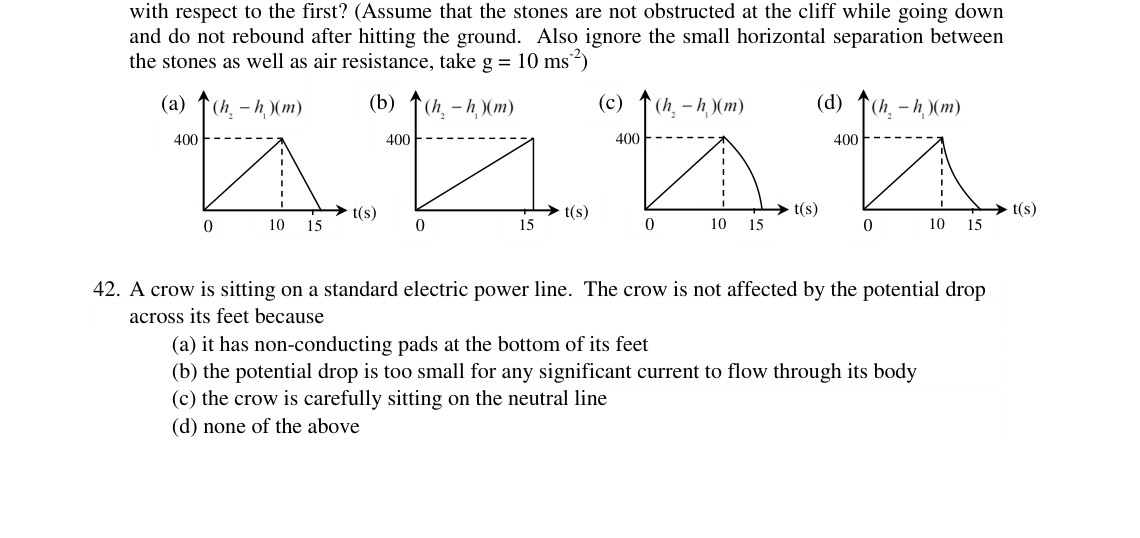
- (a) graph (a)
- (b) graph (b)
- (c) graph (c)
- (d) graph (d)
Topic: Newtonian Mechanics Metodi: Kinematic Equations Competenze: Diagrammatic Reasoning Objects: Projectile Fonte: Testo (PDF) — p.8 Soluzione: Soluzioni (PDF)
Due pietre di massa uguale vengono gettate in verticale contemporaneamente dal bordo di una scogliera alta 400 m con velocità iniziali rispettivamente di m/s e m/s. Quale dei grafici seguenti rappresenta meglio la variazione temporale della posizione relativa della seconda pietra rispetto alla prima? (Supponiamo che le pietre non siano ostruite dalla scogliera mentre scendono e che non rimbalzino dopo aver colpito il terreno. Ignorare anche la piccola separazione orizzontale tra le pietre e la resistenza all’aria, prendere m/s)
Quesito 41
- a) grafico a)
- b) grafico b)
- c) grafico c)
- d) grafico d)
Topic: Newtonian Mechanics Metodi: Kinematic Equations Competenze: Diagrammatic Reasoning Objects: Projectile Fonte: Testo (PDF) — p.8 Soluzione: Soluzioni (PDF)
A crow is sitting on a standard electric power line. The crow is not affected by the potential drop across its feet because
- (a) it has non-conducting pads at the bottom of its feet
- (b) the potential drop is too small for any significant current to flow through its body
- (c) the crow is carefully sitting on the neutral line
- (d) none of the above
Topic: Circuits Metodi: Physical Modeling Competenze: Physical Reasoning Objects: Wire Fonte: Testo (PDF) — p.8 Soluzione: Soluzioni (PDF)
Un corvo sta seduto su una linea elettrica standard. Il corvo non è influenzato dal potenziale caduta sui suoi piedi perché
- a) ha delle cuscinette non conduttrici al fondo dei piedi
- (b) il potenziale di caduta è troppo piccolo per che una corrente significativa possa fluire attraverso il suo corpo
- (c) il corvo si trova attentamente sulla linea neutrale
- (d) nessuna delle disposizioni di cui sopra
Topic: Circuits Metodi: Physical Modeling Competenze: Physical Reasoning Objects: Wire Fonte: Testo (PDF) — p.8 Soluzione: Soluzioni (PDF)
Standing waves have been produced in a 51 cm long, open end organ pipe with just one node within the pipe. The wavelength of the sound wave, which forms a standing wave in the same organ pipe such that there are three nodes within the pipe, is
- (a) 68 cm
- (b) 51 cm
- (c) 34 cm
- (d) 20.4 cm
Topic: Oscillations & Waves Metodi: Wave Equation Competenze: Physical Reasoning Objects: Tube Fonte: Testo (PDF) — p.9 Soluzione: Soluzioni (PDF)
Le onde in piedi sono state prodotte in un tubo di organo di 51 cm di lunghezza, con un solo nodo all’interno del tubo. La lunghezza d’onda dell’onda sonora, che forma un’onda in piedi nello stesso tubo di organo in modo che ci siano tre nodi all’interno del tubo, è
- (a) 68 cm
- (b) 51 cm
- (c) 34 cm
- (d) 20.4 cm
Topic: Oscillations & Waves Metodi: Wave Equation Competenze: Physical Reasoning Objects: Tube Fonte: Testo (PDF) — p.9 Soluzione: Soluzioni (PDF)
For the air-glass interface if the Brewster angle (polarizing angle) is , then the critical angle for the glass-air interface is expressed as
- (a)
- (b)
- (c)
- (d)
Topic: Wave Optics, Geometric Optics Metodi: Snell’s Law Competenze: Physical Reasoning Objects: — Fonte: Testo (PDF) — p.9 Soluzione: Soluzioni (PDF)
Per l’interfaccia aria-viaio se l’angolo di polarizzazione di Brewster è , l’angolo critico per l’interfaccia aria-viaio è espresso come
- (a)
- (b)
- (c)
- (d)
Topic: Wave Optics, Geometric Optics Metodi: Snell’s Law Competenze: Physical Reasoning Objects: — Fonte: Testo (PDF) — p.9 Soluzione: Soluzioni (PDF)
A gas in equilibrium attains a state of equipartition, wherein every active degree of freedom of every particle has on the average the same energy. In particular, the average translational kinetic energy will be the same for every particle; it will be equal to where is the Boltzmann constant and is the temperature of the gas in kelvin. Consider air at 300 kelvin. If the root mean square velocity of nitrogen molecules is m/s, the magnitude of the mean velocity and the root mean square velocity of oxygen molecules are respectively
- (a)
- (b)
- (c)
- (d)
Topic: Kinetic Theory Metodi: Kinetic Theory of Gases Competenze: Physical Reasoning Objects: Gas Fonte: Testo (PDF) — p.9 Soluzione: Soluzioni (PDF)
Un gas in equilibrio raggiunge uno stato di equipartizione, in cui ogni grado attivo di libertà di ogni particella ha in media la stessa energia. In particolare, l’energia cinetica traslazionale media sarà la stessa per ogni particella; sarà uguale a dove è la costante di Boltzmann e è la temperatura del gas in kelvin. Considera l’aria a 300 kelvin. Se la velocità quadrata media radicale delle molecole di azoto è m/s, la magnitudine della velocità media e la velocità quadrata media radicale delle molecole di ossigeno sono rispettivamente
- (a)
- (b)
- (c)
- (d)
Topic: Kinetic Theory Metodi: Kinetic Theory of Gases Competenze: Physical Reasoning Objects: Gas Fonte: Testo (PDF) — p.9 Soluzione: Soluzioni (PDF)
Formation of the iron peak elements Fe, Ni and Co by nuclear fusion marks the end of energy production in a star. If the mass of the iron core is greater than the Chandrasekhar mass (1.4 solar masses) the core cannot be supported by the degeneracy pressure of the electrons and will collapse to form a neutron star. Matter is crushed to nuclear densities with protons combining with electrons as . Neutron stars whose masses are not too high are supported by neutron degeneracy pressure against gravitational collapse. The number of neutrinos released, when a neutron star of 1.4 solar masses forms, is approximately
- (a)
- (b)
- (c)
- (d)
Topic: Astrophysics, Nuclear & Particle Physics Metodi: Physical Modeling Competenze: Estimation & Approximation Objects: Star, Electron Fonte: Testo (PDF) — p.9 Soluzione: Soluzioni (PDF)
La formazione degli elementi di picco di ferro Fe, Ni e Co mediante fusione nucleare segna la fine della produzione di energia in una stella. Se la massa del nucleo di ferro è maggiore della massa di Chandrasekhar (1,4 masse solari), il nucleo non può essere supportato dalla pressione di degenerazione degli elettroni e collasserà per formare una stella di neutroni. La materia viene schiacciata a densità nucleari con protoni che si combinano con elettroni come . Le stelle di neutroni le cui masse non sono troppo alte sono supportate dalla pressione di degenerazione dei neutroni contro il collasso gravitazionale. Il numero di neutrini rilasciati, quando si forma una stella di neutroni di 1,4 masse solari, è di circa
- (a)
- (b)
- (c)
- (d)
Topic: Astrophysics, Nuclear & Particle Physics Metodi: Physical Modeling Competenze: Estimation & Approximation Objects: Star, Electron Fonte: Testo (PDF) — p.9 Soluzione: Soluzioni (PDF)
The Seebeck coefficient of a material characterizes the voltage built up when a small temperature gradient is set up across it. It is defined by the relation . Only the relative Seebeck coefficients of materials may be determined since, connecting a voltmeter introduces other voltages. The relative Seebeck coefficients of some elemental materials in are:
(A) Aluminium: 3.5 (B) Carbon: 3 (C) Sodium: (D) Platinum: 0
The absolute Seebeck coefficient of Platinum is at room temperature. The combination of two metals which will give maximum voltage difference when used to make a thermocouple is
- (a) (A, D)
- (b) (C, D)
- (c) (A, C)
- (d) (B, C)
Topic: Thermodynamics Metodi: Physical Modeling Competenze: Physical Reasoning Objects: — Fonte: Testo (PDF) — p.9 Soluzione: Soluzioni (PDF)
Il coefficiente Seebeck di un materiale caratterizza la tensione generata quando un piccolo gradiente di temperatura viene impostato su di esso. È definito con la relazione . Solo i coefficienti relativi di Seebeck dei materiali possono essere determinati poiché, collegando un voltmeter, si introducono altre tensioni. I coefficienti relativi di Seebeck di alcuni materiali elementari in sono:
(A) Aluminio: 3,5 (B) Carbonio: 3 (C) Sodio: (D) Platino: 0
Il coefficiente di Seebeck assoluto del platino è a temperatura ambiente. La combinazione di due metalli che, quando utilizzati per la realizzazione di un termopare, danno la differenza massima di tensione è
- (a) (A, D)
- (b) (C, D)
- (c) (A, C)
- (d) (B, C)
Topic: Thermodynamics Metodi: Physical Modeling Competenze: Physical Reasoning Objects: — Fonte: Testo (PDF) — p.9 Soluzione: Soluzioni (PDF)
The mean power received per unit area just outside Earth’s atmosphere from the Sun known as the solar constant, is 1.362 kilowatt per square meter (kW/m). For receiving this much power per unit area at Earth, the Sun, if it is radiating like a black body, must have a surface temperature of
- (a) 5349 K
- (b) 5779 K
- (c) 5709 K
- (d) 5479 K
Topic: Astrophysics, Thermodynamics Metodi: Physical Modeling Competenze: Physical Reasoning Objects: Star, Planet Fonte: Testo (PDF) — p.9 Soluzione: Soluzioni (PDF)
La potenza media ricevuta per unità di area appena fuori dall’atmosfera terrestre dal Sole, nota come costante solare, è di 1.362 kilowatt per metro quadrato (kW/m). Per ricevere questa potenza per unità di superficie sulla Terra, il Sole, se si irradia come un corpo nero, deve avere una temperatura superficiale di
- (a) 5349 K
- (b) 5779 K
- (c) 5709 K
- (d) 5479 K
Topic: Astrophysics, Thermodynamics Metodi: Physical Modeling Competenze: Physical Reasoning Objects: Star, Planet Fonte: Testo (PDF) — p.9 Soluzione: Soluzioni (PDF)
Consider the electromagnetic radiation emitted by two stars. The hotter star will
- (a) emit more radiation at all wavelengths
- (b) have a higher frequency of peak emission in its spectrum
- (c) radiate energy at more than one wavelength
- (d) exhibit a continuous spectrum
Topic: Astrophysics, Modern-Quantum Physics Metodi: Physical Modeling Competenze: Physical Reasoning Objects: Star Fonte: Testo (PDF) — p.10 Soluzione: Soluzioni (PDF)
Considerate la radiazione elettromagnetica emessa da due stelle. La stella più calda
- a) emettono più radiazioni a tutte le lunghezze d’onda
- b) hanno una frequenza di emissioni di picco più elevata nel suo spettro
- (c) irradiare energia a più di una lunghezza d’onda
- d) presentano uno spettro continuo
Topic: Astrophysics, Modern-Quantum Physics Metodi: Physical Modeling Competenze: Physical Reasoning Objects: Star Fonte: Testo (PDF) — p.10 Soluzione: Soluzioni (PDF)
Because of the precession of the axis of rotation of Earth
- (a) the Polaris is not always our ‘pole star’
- (b) the average length of a sidereal day changes slowly with time
- (c) the declinations of the stars change slowly with time
- (d) the Vernal Equinox moves with respect to the stars
Topic: Astrophysics Metodi: Physical Modeling Competenze: Physical Reasoning Objects: Planet, Star Fonte: Testo (PDF) — p.10 Soluzione: Soluzioni (PDF)
A causa della precessione dell’asse di rotazione della Terra
- (a) la Polaris non è sempre la nostra “stella polare”
- b) la durata media di una giornata siderale cambia lentamente con il tempo
- (c) le declinazioni delle stelle cambiano lentamente nel tempo
- d) L’equinozio vernale si muove rispetto alle stelle
Topic: Astrophysics Metodi: Physical Modeling Competenze: Physical Reasoning Objects: Planet, Star Fonte: Testo (PDF) — p.10 Soluzione: Soluzioni (PDF)
A planet orbits the Sun at a distance of 4.0 AU from the Sun. The orbital speed () and the time period () of the planet are approximately
- (a) km/s
- (b) km/s
- (c) years
- (d) years
Topic: Gravitation, Astrophysics Metodi: Kepler’s Laws Competenze: Estimation & Approximation Objects: Planet, Star Fonte: Testo (PDF) — p.10 Soluzione: Soluzioni (PDF)
Un pianeta orbita intorno al Sole a una distanza di 4.0 AU dal Sole. La velocità orbitale () e il periodo di tempo () del pianeta sono approssimativamente
- (a) km/s
- (b) km/s
- (c) anni
- (d) anni
Topic: Gravitation, Astrophysics Metodi: Kepler’s Laws Competenze: Estimation & Approximation Objects: Planet, Star Fonte: Testo (PDF) — p.10 Soluzione: Soluzioni (PDF)
The rotation period of a spherical moon about its own axis is equal to its period of revolution round its parent planet. Which of the following statements is/are true?
- (a) If the orbital and spin angular momentum vectors of the moon are parallel to each other then, the moon will always show the same portion of its surface to the planet
- (b) If the spin angular momentum vector of the moon lies in its orbital plane, then every portion of the surface of the moon may be seen from the planet
- (c) If the orbital and spin angular momentum vectors of the moon are antiparallel with respect to each other then, viewed from the planet, the moon will appear to be non-rotating
- (d) If the spin angular momentum vector of the moon lies in its orbital plane, then, viewed from the planet, the moon will appear to be rotating with a higher angular speed
Topic: Astrophysics, Rotational Dynamics Metodi: Torque & Angular Momentum Analysis Competenze: Physical Reasoning Objects: Satellite, Planet Fonte: Testo (PDF) — p.10 Soluzione: Soluzioni (PDF)
Il periodo di rotazione di una luna sferica intorno al suo asse è uguale al suo periodo di rivoluzione intorno al suo pianeta madre. Quali delle seguenti affermazioni sono/sono vere?
- (a) Se i vettori di impulso orbitale e angolare di spin della luna sono paralleli l’uno all’altro, la luna mostrerà sempre la stessa parte della sua superficie al pianeta
- (b) Se il vettore di impulso angolare della luna si trova nel suo piano orbitale, allora ogni porzione della superficie della luna può essere vista dal pianeta
- (c) Se i vettori di impulso orbitale e angolare di spin della luna sono antiparalleli l’uno rispetto all’altro, allora, visto dal pianeta, la luna sembrerà non ruotare
- (d) Se il vettore di rotazione angolare della Luna si trova nel suo piano orbitale, allora, visto dal pianeta, la Luna sembrerà ruotare con una velocità angolare più alta
Topic: Astrophysics, Rotational Dynamics Metodi: Torque & Angular Momentum Analysis Competenze: Physical Reasoning Objects: Satellite, Planet Fonte: Testo (PDF) — p.10 Soluzione: Soluzioni (PDF)
The true statement(s) for the function
is/are
- (a) exists
- (b) does not exist
- (c) is differentiable at
- (d) has removable discontinuity at
Topic: Mathematics Metodi: Physical Modeling Competenze: Mathematical Modeling Objects: — Fonte: Testo (PDF) — p.10 Soluzione: Soluzioni (PDF)
La dichiarazione vera (s) della funzione
sono/sono
- (a) esiste un
- b) non esiste
- (c) è differenziabile a
- (d) ha discontinuità rimovibile a
Topic: Mathematics Metodi: Physical Modeling Competenze: Mathematical Modeling Objects: — Fonte: Testo (PDF) — p.10 Soluzione: Soluzioni (PDF)
Consider the differential equation . Which of the following is/are true?
- (a) is an integrating factor of this equation
- (b) is a solution of this equation
- (c) is a solution of this equation
- (d) The equation is a homogeneous differential equation
Topic: Mathematics Metodi: Differential Equations Competenze: Mathematical Modeling Objects: — Fonte: Testo (PDF) — p.10 Soluzione: Soluzioni (PDF)
Considerate l’equazione differenziale . Qual è/sono vera/vero tra le seguenti?
- a) è un fattore di integrazione di questa equazione
- b) è una soluzione di questa equazione
- (c) è una soluzione di questa equazione
- (d) L’equazione è un’equazione differenziale omogenea
Topic: Mathematics Metodi: Differential Equations Competenze: Mathematical Modeling Objects: — Fonte: Testo (PDF) — p.10 Soluzione: Soluzioni (PDF)
Consider the LPP (Linear Programming Problem) subject to the constraints , , , . Which of the following is/are true?
- (a) is a feasible solution of the LPP
- (b) is an optimal solution of the LPP
- (c) The only optimal solutions of the LPP are and
- (d) is an optimal solution of the LPP
Topic: Mathematics Metodi: Physical Modeling Competenze: Mathematical Modeling Objects: — Fonte: Testo (PDF) — p.11 Soluzione: Soluzioni (PDF)
Considerare il LPP (Problema di programmazione lineare) soggetto alle restrizioni , , , . Qual è/sono vera/vero tra le seguenti?
- a) è una soluzione fattibile del PPL
- b) è una soluzione ottimale del PPL
- (c) Le soluzioni ottimali dell’LPP sono e
- (d) è una soluzione ottimale della LPP
Topic: Mathematics Metodi: Physical Modeling Competenze: Mathematical Modeling Objects: — Fonte: Testo (PDF) — p.11 Soluzione: Soluzioni (PDF)
For vectors , & in three dimensional Euclidean space, let stand for the cross product, for the commutator of & and for the associator of , & . Then which of the following relations hold true?
- (a) for
- (b) for and
- (c) for and
- (d) for and
Topic: Mathematics Metodi: Vector Decomposition Competenze: Mathematical Modeling Objects: — Fonte: Testo (PDF) — p.11 Soluzione: Soluzioni (PDF)
Per i vettori , e nello spazio tridimensionale euclideo, deve indicare il prodotto incrociato, il commutatore di e e l’associatore di , e . Allora quale delle seguenti relazioni è vero?
- a) per
- b) per e
- c) per e
- (d) per e
Topic: Mathematics Metodi: Vector Decomposition Competenze: Mathematical Modeling Objects: — Fonte: Testo (PDF) — p.11 Soluzione: Soluzioni (PDF)
An artificial satellite is moving in an orbit around the Earth with orbital period of 8 hours, from west to east, with its orbit making an angle of with equator. An observer on the equator will see it
- (a) again after 6 hour, moving from east to west
- (b) again after about 11 hours, moving from west to east
- (c) going up to about from the equatorial plane
- (d) going up to about from the equatorial plane
Topic: Astrophysics, Gravitation Metodi: Physical Modeling Competenze: Physical Reasoning Objects: Satellite, Planet Fonte: Testo (PDF) — p.11 Soluzione: Soluzioni (PDF)
Un satellite artificiale si muove in un’orbita attorno alla Terra con un periodo orbitale di 8 ore, da ovest a est, con la sua orbita che fa un angolo di con l’equatore. Un osservatore sull’equatore lo vedrà.
- a) di nuovo dopo 6 ore, spostandosi da est a ovest
- b) di nuovo dopo circa 11 ore, spostandosi da ovest a est
- (c) in salita a circa dal piano equatoriale
- d) salire fino a circa dal piano equatoriale
Topic: Astrophysics, Gravitation Metodi: Physical Modeling Competenze: Physical Reasoning Objects: Satellite, Planet Fonte: Testo (PDF) — p.11 Soluzione: Soluzioni (PDF)
A particle of mass is moving under the influence of a central force; the correct statement(s) is/are
- (a) The motion always remains constrained to be in a plane
- (b) The trajectory will always be elliptical
- (c) The total angular momentum remains constant
- (d) The torque about the force center is always zero
Topic: Gravitation, Rotational Dynamics Metodi: Torque & Angular Momentum Analysis Competenze: Physical Reasoning Objects: — Fonte: Testo (PDF) — p.11 Soluzione: Soluzioni (PDF)
Una particella di massa si muove sotto l’influenza di una forza centrale; la corretta affermazione ((s) è/sono
- a) Il movimento rimane sempre costretto ad essere in un piano
- b) La traiettoria sarà sempre ellittica
- (c) La dinamica angolare totale rimane costante
- (d) La coppia intorno al centro di forza è sempre zero
Topic: Gravitation, Rotational Dynamics Metodi: Torque & Angular Momentum Analysis Competenze: Physical Reasoning Objects: — Fonte: Testo (PDF) — p.11 Soluzione: Soluzioni (PDF)
When a raw poori round (kneaded wheat dough rolled into thin rounds) is slipped into hot oil and the hot oil is swished immediately over it repeatedly, the poori puffs up because
- (a) the dough has comparatively low heat conductivity
- (b) hot oil causes a crust to form
- (c) the density of steam is low
- (d) the matrix of proteins in the dough formed during kneading helps trap gases
Topic: Thermodynamics Metodi: Physical Modeling Competenze: Physical Reasoning Objects: — Fonte: Testo (PDF) — p.11 Soluzione: Soluzioni (PDF)
Quando un poori crude (pasto di grano a rulli fino a rulli sottili) viene inserito nell’olio caldo e l’olio caldo viene immediatamente sopraffatto ripetutamente, il poori gonfia perché
- a) la pasta ha una conducibilità termico relativamente bassa
- (b) l’olio caldo provoca la formazione di una crosta
- c) la densità del vapore è bassa
- (d) la matrice di proteine della pasta formata durante il miscelato aiuta a catturare i gas
Topic: Thermodynamics Metodi: Physical Modeling Competenze: Physical Reasoning Objects: — Fonte: Testo (PDF) — p.11 Soluzione: Soluzioni (PDF)
Two positively charged conducting spheres and with charge on each, are placed on the -axis at and . A very small metallic ball with charge is gently placed at the origin (midway between the two spheres). The small ball with charge , in the middle, is
- (a) in stable equilibrium if constrained to move only along -axis
- (b) in unstable equilibrium if constrained to move only perpendicular to the -axis
- (c) always in unstable equilibrium
- (d) always in neutral equilibrium
Topic: Electrostatics Metodi: Coulomb’s Law Competenze: Physical Reasoning Objects: Conducting Sphere, Ball Fonte: Testo (PDF) — p.11 Soluzione: Soluzioni (PDF)
Due sfere di conduttore e con carica su ciascuna, sono posizionate sull’asse a e . Una palla metallica molto piccola con carica viene collocata delicatamente all’origine (a metà tra le due sfere). La piccola palla con carica , nel mezzo, è
- a) in equilibrio stabile se costretto a muoversi solo lungo l’asse
- b) in equilibrio instabile se costretto a muoversi solo perpendicolare all’asse
- c) sempre in equilibrio instabile
- d) sempre in equilibrio neutro
Topic: Electrostatics Metodi: Coulomb’s Law Competenze: Physical Reasoning Objects: Conducting Sphere, Ball Fonte: Testo (PDF) — p.11 Soluzione: Soluzioni (PDF)