The energy radiated per second by star A is twice that radiated per second by star B. Also the distance of star A from Earth is twice to that of star B from Earth. Which of the two stars appears brighter when seen from the Earth, and by how much?
- (a) Star A appears 2 times brighter than star B
- (b) Star B appears 2 times brighter than star A
- (c) Star B appears 4 times brighter than star A
- (d) The observed brightness of the stars A and B are equal
Topic: Astrophysics Metodi: Order-of-Magnitude Estimation, Physical Modeling Competenze: Physical Reasoning Objects: Star Fonte: Testo (PDF) — p.3 Soluzione: Soluzioni (PDF)
L’energia irradiata al secondo da stella A è il doppio di quella irradiata al secondo da stella B. Inoltre la distanza della stella A dalla Terra è due volte quella della stella B dalla Terra. Quale delle due stelle appare più luminosa quando si vede dalla Terra, e per quanto?
- (a) La stella A appare due volte più brillante della stella B
- (b) La stella B appare due volte più brillante della stella A
- (c) La stella B appare 4 volte più brillante della stella A
- (d) La luminosità osservata delle stelle A e B è uguale
Topic: Astrophysics Metodi: Order-of-Magnitude Estimation, Physical Modeling Competenze: Physical Reasoning Objects: Star Fonte: Testo (PDF) — p.3 Soluzione: Soluzioni (PDF)
How large should the aperture of a telescope be in order to achieve a diffraction limit of 0.001 arc second for visible light of wavelength 500 nm?
- (a) 2.4 m
- (b) 12.6 m
- (c) 126 m
- (d) 24 m
Topic: Astrophysics, Wave Optics Metodi: Interference & Diffraction Analysis Competenze: Mathematical Modeling Objects: — Fonte: Testo (PDF) — p.3 Soluzione: Soluzioni (PDF)
Quanto grande dovrebbe essere l’apertura di un telescopio per raggiungere un limite di diffrazione di 0,001 arco secondo per la luce visibile di lunghezza d’onda 500 nm?
- (a) 2.4 m
- (b) 12.6 m
- (c) 126 m
- (d) 24 m
Topic: Astrophysics, Wave Optics Metodi: Interference & Diffraction Analysis Competenze: Mathematical Modeling Objects: — Fonte: Testo (PDF) — p.3 Soluzione: Soluzioni (PDF)
A nearby star, Alpha Centauri, subtends a parallax angle of . The distance to Alpha Centauri from us is
- (a) 1.35 pc
- (b) 13.5 pc
- (c) 0.742 pc
- (d) 7.42 pc
Topic: Astrophysics Metodi: Small-Angle Approximation Competenze: Unit Conversion Objects: Star Fonte: Testo (PDF) — p.3 Soluzione: Soluzioni (PDF)
Una stella vicina, Alpha Centauri, sottende un angolo di parallassia di . La distanza da noi ad Alpha Centauri è
- (a) 1.35 pc
- (b) 13.5 pc
- (c) 0.742 pc
- (d) 7.42 pc
Topic: Astrophysics Metodi: Small-Angle Approximation Competenze: Unit Conversion Objects: Star Fonte: Testo (PDF) — p.3 Soluzione: Soluzioni (PDF)
The spectral lines of two stars in an eclipsing binary system with both stars moving in circular orbits, shift back and forth with a period of 2 years, second. The lines of one star (star 1) shift twice as far as the lines of the other (star 2). Which one of the following statements is true?
- (a) Masses of star 1 and star 2 are equal
- (b) Mass of star 2 is twice the mass of star 1
- (c) Mass of star 1 is twice the mass of star 2
- (d) Nothing can be predicted about the masses of the two stars from the given data
Topic: Gravitation, Astrophysics Metodi: Kepler’s Laws, Conservation of Momentum Competenze: Physical Reasoning Objects: Star Fonte: Testo (PDF) — p.3 Soluzione: Soluzioni (PDF)
Le linee spettrali di due stelle in un sistema binario che eclisce con entrambe le stelle che si muovono in orbite circolari, si spostano avanti e indietro con un periodo di 2 anni, secondo. Le linee di una stella (stella 1) si spostano due volte più lontano delle linee dell’altra (stella 2). Quale delle seguenti affermazioni è vera?
- (a) Le masse di stelle 1 e 2 sono uguali
- b) La massa della stella 2 è doppia della massa della stella 1
- (c) La massa della stella 1 è doppia della massa della stella 2
- (d) Non si può prevedere nulla sulle masse delle due stelle dai dati forniti
Topic: Gravitation, Astrophysics Metodi: Kepler’s Laws, Conservation of Momentum Competenze: Physical Reasoning Objects: Star Fonte: Testo (PDF) — p.3 Soluzione: Soluzioni (PDF)
The reciprocal of Hubble’s constant, or , tells us the age of the universe if the expansion rate has remained constant over time. How would the estimated age of the universe differ if the measured value of were 44 km/s/Mly rather than 22 km/s/Mly?
- (a) The estimated age will remain the same
- (b) Indeterminate
- (c) The estimated age will be twice the current estimated age
- (d) The estimated age will be half the current estimated age
Topic: Astrophysics Metodi: Order-of-Magnitude Estimation Competenze: Physical Reasoning Objects: — Fonte: Testo (PDF) — p.3 Soluzione: Soluzioni (PDF)
La reciproca della costante di Hubble, o , ci dice l’età dell’universo se il tasso di espansione è rimasto costante nel tempo. Come sarebbe differente l’età stimata dell’universo se il valore misurato di fosse di 44 km/s/Mly piuttosto che di 22 km/s/Mly?
- (a) L’età stimata rimarrà la stessa
- b) Indeterminato
- (c) L’età stimata sarà il doppio dell’età stimata attuale
- (d) L’età stimata sarà la metà dell’età stimata attuale
Topic: Astrophysics Metodi: Order-of-Magnitude Estimation Competenze: Physical Reasoning Objects: — Fonte: Testo (PDF) — p.3 Soluzione: Soluzioni (PDF)
If you live at latitude of 28 degrees North, what is the angle you observe between the northern horizon and North Celestial pole?
- (a) 62 degrees
- (b) 90 degrees
- (c) 23.5 degrees
- (d) 28 degrees
Topic: Astrophysics Metodi: Physical Modeling Competenze: Diagrammatic Reasoning Objects: — Fonte: Testo (PDF) — p.3 Soluzione: Soluzioni (PDF)
Se vivi a latitudine di 28 gradi nord, quale è l’angolo che osserva tra l’orizzonte settentrionale e il polo celeste settentrionale?
- a) 62 gradi
- b) 90 gradi
- c) 23,5 gradi
- d) 28 gradi
Topic: Astrophysics Metodi: Physical Modeling Competenze: Diagrammatic Reasoning Objects: — Fonte: Testo (PDF) — p.3 Soluzione: Soluzioni (PDF)
A new planet is discovered to be orbiting a star which has the same mass as our Sun in an approximately circular orbit. The planet orbits the star every 3 months. Approximately, what is the average distance of the planet from the star?
- (a) 3 AU
- (b) 0.4 AU
- (c) 0.125 AU
- (d) 1.25 AU
Topic: Gravitation, Astrophysics Metodi: Kepler’s Laws Competenze: Mathematical Modeling Objects: Planet, Star Fonte: Testo (PDF) — p.3 Soluzione: Soluzioni (PDF)
Un nuovo pianeta è stato scoperto orbitando intorno a una stella che ha la stessa massa del nostro Sole in un’orbita circolare approssimativa. Il pianeta orbita la stella ogni tre mesi. Circa, qual è la distanza media del pianeta dalla stella?
- (a) 3 AU
- (b) 0.4 AU
- (c) 0.125 AU
- (d) 1.25 AU
Topic: Gravitation, Astrophysics Metodi: Kepler’s Laws Competenze: Mathematical Modeling Objects: Planet, Star Fonte: Testo (PDF) — p.3 Soluzione: Soluzioni (PDF)
Suppose a future space station orbits the Earth in a circular geosynchronous orbit, 42,000 kilometre from the centre of the Earth. With what speed with respect to Earth, must a spacecraft be launched from this space station so as to escape the Earth?
- (a) 11.2 km/s
- (b) 112 km/s
- (c) 4.35 km/s
- (d) 2.45 km/s
Topic: Gravitation Metodi: Newton’s Law of Gravitation, Conservation of Energy Competenze: Mathematical Modeling Objects: Satellite, Planet Fonte: Testo (PDF) — p.4 Soluzione: Soluzioni (PDF)
Supponiamo che una futura stazione spaziale orbita la Terra in un’orbita geosincrona circolare, a 42.000 chilometri dal centro della Terra. Con quale velocità rispetto alla Terra, deve essere lanciata una nave spaziale da questa stazione spaziale per sfuggire alla Terra?
- (a) 11.2 km/s
- (b) 112 km/s
- (c) 4.35 km/s
- (d) 2.45 km/s
Topic: Gravitation Metodi: Newton’s Law of Gravitation, Conservation of Energy Competenze: Mathematical Modeling Objects: Satellite, Planet Fonte: Testo (PDF) — p.4 Soluzione: Soluzioni (PDF)
Planets orbiting very close to black holes show general relativistic effects; the orbits of such planets are precessing ellipses i.e. the major axis of the ellipse rotates about the occupied focus. A planet is on an elliptical orbit with semi-major axis 1.0 AU around an isolated black hole of one solar mass. A second planet is orbiting the black hole at a distance of 0.3 AU. If observations of this second planet are started when it is closest to the black hole, the minimum length of time over which observations should be carried out so that the precession rate may be ascertained with better accuracy, is a little more than
- (a) 30 days
- (b) 60 days
- (c) 75 days
- (d) 90 days
Topic: Gravitation, Astrophysics Metodi: Kepler’s Laws Competenze: Physical Reasoning Objects: Planet, Black Hole Fonte: Testo (PDF) — p.4 Soluzione: Soluzioni (PDF)
I pianeti che orbitano molto vicino ai buchi neri mostrano effetti relativistici generali; le orbite di tali pianeti sono ellisse precedenti, cioè. l’asse principale dell’ellisse ruota intorno al foco occupato. Un pianeta è in orbita ellittica con asse semimejor 1.0 AU attorno a un buco nero isolato di una massa solare. Un secondo pianeta sta orbitando intorno al buco nero a una distanza di 0,3 UA. Se le osservazioni di questo secondo pianeta vengono avviate quando è più vicino al buco nero, il periodo minimo di tempo per effettuare le osservazioni in modo da poter determinare con maggiore precisione il tasso di precessione è di un po’ superiore a quello di
- a) 30 giorni
- b) 60 giorni
- c) 75 giorni
- d) 90 giorni
Topic: Gravitation, Astrophysics Metodi: Kepler’s Laws Competenze: Physical Reasoning Objects: Planet, Black Hole Fonte: Testo (PDF) — p.4 Soluzione: Soluzioni (PDF)
Spectral resolution of a grating is given by where is the smallest difference in wavelength between two lines that may be resolved as separate at some order after dispersion by the grating. In the binary system consisting of a star and a planet, both the masses orbit around the common centre of mass. The orbital speed of the star will be extremely small due to its comparatively very large mass. The Doppler shift due to this orbital motion will also be extremely small. Doppler spectroscopy is a technique used to detect and estimate the orbital speeds of stars, induced by the presence of exoplanets around them. With what accuracy can the recession speed of a star be determined by simple use of a high resolution spectrograph with observing a spectral line at 0.3 micron?
- (a) 3.0 m/s
- (b) 30.0 m/s
- (c) 3.0 km/s
- (d) 30.0 km/s
Topic: Astrophysics Metodi: Order-of-Magnitude Estimation Competenze: Measurement & Instrumentation Objects: Star, Planet, Diffraction Grating Fonte: Testo (PDF) — p.4 Soluzione: Soluzioni (PDF)
La risoluzione spettrale di una griglia è data da , dove è la più piccola differenza di lunghezza d’onda tra due linee che possono essere risolte separatamente in un certo ordine dopo la dispersione della griglia. Nel sistema binario costituito da una stella e un pianeta, entrambe le masse orbitano intorno al centro di massa comune. La velocità orbitale della stella sarà estremamente piccola a causa della sua massa relativamente molto grande. Anche il spostamento di Doppler dovuto a questo movimento orbitale sarà estremamente piccolo. La spettroscopia doppler è una tecnica utilizzata per rilevare e stimare le velocità orbitali delle stelle, indotte dalla presenza di esopianeti intorno a loro. Con quale precisione la velocità di recessione di una stella può essere determinata mediante il semplice utilizzo di uno spettrografo ad alta risoluzione con osservando una linea spettrale a 0,3 micron?
- (a) 3.0 m/s
- (b) 30.0 m/s
- (c) 3.0 km/s
- (d) 30.0 km/s
Topic: Astrophysics Metodi: Order-of-Magnitude Estimation Competenze: Measurement & Instrumentation Objects: Star, Planet, Diffraction Grating Fonte: Testo (PDF) — p.4 Soluzione: Soluzioni (PDF)
Fermions (half-integer spin particles) obey the Pauli Exclusion Principle which says that no two fermions can have all physical characteristics (like position, momentum, spin, charge, electron number, muon number etc.) the same. As per the uncertainty principle position and momentum can be simultaneously measured only to a precision that satisfies the relation . So a ‘cell’ in phase space (position-momentum space) of size can contain only a pair of any one type of neutrino (for example electron neutrino) of opposing spin and all other quantum numbers the same. Consider a spherical dwarf galaxy of a total mass and radius consisting of a large amount of dark matter and very little ordinary matter. Suppose dark matter consists of different types of neutrinos all having the same mass equivalent to 1 eV. Given that the escape speed from the galaxy , a limit may be put on by the relation.
- (a)
- (b)
- (c)
- (d) No such limit may be extracted
Topic: Astrophysics, Modern-Quantum Physics Metodi: Order-of-Magnitude Estimation, Physical Modeling Competenze: Physical Reasoning Objects: — Fonte: Testo (PDF) — p.4 Soluzione: Soluzioni (PDF)
I fermioni (particole spin a mezzo numero intero) obbediscono al principio di esclusione di Pauli che dice che non due fermioni possono avere tutte le caratteristiche fisiche (come posizione, momentum, spin, carica, numero di elettroni, numero di muoni, ecc.) uguali. Secondo il principio di incertezza, la posizione e l’impulso possono essere misurati simultaneamente solo con una precisione che soddisfa la relazione . Quindi una “cellula” nello spazio di fase (spazio di posizione-momento) di dimensioni può contenere solo una coppia di qualsiasi tipo di neutrini (ad esempio neutrini elettronici) di spin opposto e tutti gli altri numeri quantistici allo stesso modo. Consideriamo una galassia nana sferica di massa totale e raggio costituita da una grande quantità di materia oscura e pochissima materia ordinaria. Supponiamo che la materia oscura sia costituita da diversi tipi di neutrini tutti con la stessa massa equivalente a 1 eV. Dato che la velocità di fuga dalla galassia , un limite può essere posto su dalla relazione.
- (a)
- (b)
- (c)
- d) Tale limite non può essere esteso
Topic: Astrophysics, Modern-Quantum Physics Metodi: Order-of-Magnitude Estimation, Physical Modeling Competenze: Physical Reasoning Objects: — Fonte: Testo (PDF) — p.4 Soluzione: Soluzioni (PDF)
Inverse Compton scattering is the scattering of low energy photon by high energy ultra-relativistic charged particle. The photon gains energy and the charged particle loses energy. The frequency of the photon gets multiplied by a factor equal to the square of the Lorentz factor of the ultra-relativistic particle. The low energy photons of the Cosmic Microwave Background (CMB) can be scattered by ultra-relativistic electrons in radio relics in galaxy clusters. If the microwave photons of the CMB (wavelength around 10 cm) get scattered, on the average, into soft X-ray region (wavelength ~ nanometre), the Lorentz factor for the electrons involved is
- (a)
- (b)
- (c)
- (d)
Topic: Astrophysics, Special Relativity Metodi: Order-of-Magnitude Estimation Competenze: Estimation & Approximation Objects: Photon, Electron Fonte: Testo (PDF) — p.5 Soluzione: Soluzioni (PDF)
La dispersione inversa di Compton è la dispersione di fotoni a bassa energia da particelle ultra-relativistiche a carica ad alta energia. Il fotone guadagna energia e la particella carica perde energia. La frequenza del fotone viene moltiplicata da un fattore uguale al quadrato del fattore di Lorentz della particella ultra-relativistica. I fotoni a bassa energia del microondate cosmiche (CMB) possono essere dispersi da elettroni ultra-relativistici nelle reliquie radio negli ammassi di galassie. Se i fotoni a microonde del CMB (lunghezza d’onda intorno ai 10 cm) si disperdono, in media, in una regione a raggi X morbida (lunghezza d’onda ~ nanometro), il fattore Lorentz per gli elettroni coinvolti è
- (a)
- (b)
- (c)
- (d)
Topic: Astrophysics, Special Relativity Metodi: Order-of-Magnitude Estimation Competenze: Estimation & Approximation Objects: Photon, Electron Fonte: Testo (PDF) — p.5 Soluzione: Soluzioni (PDF)
The Saha ionization formula gives the ratio of the number of times ionized ions of an element per unit volume to the number of times ionized ions of the same element in the same volume in a plasma. Normal stars show absorption spectra due to atoms/ions/molecules of the atmosphere of the star in a lower energy state absorbing photons of appropriate energy, from the continuum radiation emitted by the photosphere, to go into a higher energy state. Given the Saha ionization formula as
where is the number density of times ionized ions, is the number density of times ionized ions, is the electron pressure, is the partition function and is the ionization energy of the times ionized ion. The ionization energy of hydrogen = 13.54 eV, of first ionization of helium = 24.48 eV and of second ionization of helium = 54.17 eV. As the temperature of photosphere decreases from ~50,000 K, in the spectrum
- (a) Strength of lines of ionized helium and hydrogen will decrease together
- (b) Lines of hydrogen will decrease in strength, helium will increase
- (c) Lines of ionized helium will decrease in strength, of helium increase
- (d) Strength of hydrogen lines will decrease, ionized helium will increase
Topic: Astrophysics, Modern-Quantum Physics Metodi: Physical Modeling Competenze: Physical Reasoning Objects: Star, Atom, Photon Fonte: Testo (PDF) — p.5 Soluzione: Soluzioni (PDF)
La formula di ionizzazione Saha dà il rapporto tra il numero di ioni volte ionizzati di un elemento per unità di volume e il numero di ioni volte ionizzati dello stesso elemento nello stesso volume in un plasma. Le stelle normali mostrano spettri di assorbimento dovuti agli atomi/ioni/molecole dell’atmosfera della stella in uno stato di energia inferiore che assorbono fotoni di energia appropriata, dalla radiazione continua emessa dalla fotosfera, per passare a uno stato di energia superiore. Data la formula di ionizzazione Saha come
dove è la densità numerica di volte ioni ionizzati, è la densità numerica di volte ioni ionizzati, è la pressione elettronica, è la funzione di partizione e è l’energia di ionizzazione dell’ion volte ionizzato. L’energia di ionizzazione dell’idrogeno = 13,54 eV, della prima ionizzazione dell’elio = 24,48 eV e della seconda ionizzazione dell’elio = 54,17 eV. Quando la temperatura della fotosfera diminuisce da ~ 50.000 K, nello spettro
- a) La forza delle linee di elio e idrogeno ionizzati diminuirà insieme
- b) Le linee di idrogeno diminuiranno di forza, l’elio aumenterà
- (c) Le linee di elio ionizzato diminuiranno di forza, di elio aumenteranno
- d) La forza delle linee di idrogeno diminuirà, l’elio ionizzato aumenterà
Topic: Astrophysics, Modern-Quantum Physics Metodi: Physical Modeling Competenze: Physical Reasoning Objects: Star, Atom, Photon Fonte: Testo (PDF) — p.5 Soluzione: Soluzioni (PDF)
The observed Doppler shift of spectral lines of galaxies is used to determine their velocity of recession from us using the formula where (this may then be used in the Hubble relation to determine the distance to the galaxy). Spectrometry is expensive since the received light is highly dispersed and only a small number of photons are available in small frequency ranges and so observations have to be integrated over long hours to capture the spectrum. In photometry, light transmitted through various filters (which transmit light in a small band of wavelengths centred on given wavelengths) is measured. Photometry is much cheaper and faster. The hydrogen surrounding galaxies absorb light with wavelength below ~100 nm. Hence the observed brightness of the galaxy will drop drastically below this wavelength of emission. A galaxy was imaged through the u, g, r, i, z filters in the Sloan Digital Sky Survey. The pivot wavelengths of these filters are 354, 477, 623, 763, and 913 nm respectively. A galaxy is visible when imaged through the last three filters. The galaxy ‘drops out’ and is not visible through the other filters. The redshift of the galaxy as determined by this ‘dropout method’ lies between
- (a) 4.77 and 6.23
- (b) 5.77 and 7.23
- (c) 3.77 and 5.23
- (d) 5.23 and 6.63
Topic: Astrophysics Metodi: Physical Modeling Competenze: Physical Reasoning Objects: Photon Fonte: Testo (PDF) — p.5 Soluzione: Soluzioni (PDF)
Il spostamento Doppler osservato delle linee spettrali delle galassie viene utilizzato per determinare la loro velocità di recessione da noi usando la formula dove (questo può quindi essere utilizzato nella relazione Hubble per determinare la distanza dalla galassia). La spettrometria è costosa poiché la luce ricevuta è altamente dispersa e solo un piccolo numero di fotoni sono disponibili in piccole fasce di frequenza e quindi le osservazioni devono essere integrate per lunghe ore per catturare lo spettro. Nella fotometria, si misura la luce trasmessa attraverso vari filtri (che trasmettono la luce in una piccola fascia di lunghezze d’onda centrata su determinate lunghezze d’onda). La fotometria è molto più economica e più veloce. Le galassie circostanti di idrogeno assorbono la luce con lunghezza d’onda inferiore a ~ 100 nm. Pertanto la luminosità osservata della galassia diminuirà drasticamente al di sotto di questa lunghezza d’onda di emissioni. Una galassia è stata fotografata attraverso i filtri U, G, R, I, Z del Sloan Digital Sky Survey. Le lunghezze d’onda di pivot di questi filtri sono 354, 477, 623, 763 e 913 nm rispettivamente. Una galassia è visibile quando viene fotografata attraverso gli ultimi tre filtri. La galassia ‘scadisce’ e non è visibile attraverso gli altri filtri. Il spostamento rosso della galassia, determinato da questo “metodo di abbandono”, si trova tra
- a) 4.77 e 6.23
- b) 5,77 e 7,23
- 3,77 e 5,23
- d) 5.23 e 6.63
Topic: Astrophysics Metodi: Physical Modeling Competenze: Physical Reasoning Objects: Photon Fonte: Testo (PDF) — p.5 Soluzione: Soluzioni (PDF)
A liquid column of height 1.0 cm and having density 0.8 g/cc, is in a closed container on a horizontal surface inside Chandrayaan-3 Lander on the surface of Moon. The temperature where the landing took place was around 50°C. What is the hydrostatic pressure on the bottom of the container? Mass of the Moon kg and radius of the Moon = 1750 km.
- (a) 12.2 N/m²
- (b) 98.0 N/m²
- (c) 78.4 N/m²
- (d) 1.22 N/m²
Topic: Fluid Mechanics, Gravitation Metodi: Hydrostatic Equilibrium, Newton’s Law of Gravitation Competenze: Mathematical Modeling Objects: Container, Planet Fonte: Testo (PDF) — p.5 Soluzione: Soluzioni (PDF)
Una colonna liquida di altezza di 1,0 cm e densità di 0,8 g/cc, è in un contenitore chiuso su una superficie orizzontale all’interno del Chandrayaan-3 Lander sulla superficie della Luna. La temperatura in cui è avvenuta l’atterraggio era di circa 50°C. Qual è la pressione idrostatica sul fondo del contenitore? La massa della Luna kg e il raggio della Luna = 1750 km.
- (a) 12.2 N/m²
- (b) 98.0 N/m²
- (c) 78.4 N/m²
- (d) 1.22 N/m²
Topic: Fluid Mechanics, Gravitation Metodi: Hydrostatic Equilibrium, Newton’s Law of Gravitation Competenze: Mathematical Modeling Objects: Container, Planet Fonte: Testo (PDF) — p.5 Soluzione: Soluzioni (PDF)
Cerenkov radiation may be defined as “electromagnetic radiation emitted when a charged particle (such as an electron) passes through a dielectric medium (such as distilled water) at a speed greater than the phase velocity (speed of propagation of a wave front in a medium) of light in that medium”. Which of the following cosmic ray particles is likely to be detectable by the recording of the Cerenkov radiation emitted by it in its passage through the Earth’s atmosphere? The lower atmosphere near the Earth has a refractive index of 1.002.
- (a) A 13 GeV proton
- (b) A 13 MeV electron
- (c) A 25 MeV proton
- (d) A 0.51 MeV electron
Topic: Special Relativity Metodi: Order-of-Magnitude Estimation Competenze: Physical Reasoning Objects: Electron Fonte: Testo (PDF) — p.6 Soluzione: Soluzioni (PDF)
La radiazione di Cerenkov può essere definita come “radiation elettromagnetica emessa quando una particella carica (come un elettrone) passa attraverso un mezzo dielettrico (come l’acqua distillata) a una velocità superiore alla velocità di fase (velocità di propagazione di un fronte d’onda in un mezzo) della luce in quel mezzo”. Quale delle seguenti particelle di raggi cosmici è probabile essere rilevabile dalla registrazione della radiazione di Cerenkov emessa nel suo passaggio attraverso l’atmosfera terrestre? L’atmosfera inferiore vicino alla Terra ha un indice di rifrazione di 1,002.
- a) Un protone di 13 GeV
- b) Un elettrone di 13 MeV
- (c) Un protone di 25 MeV
- d) Un elettrone di 0,51 MeV
Topic: Special Relativity Metodi: Order-of-Magnitude Estimation Competenze: Physical Reasoning Objects: Electron Fonte: Testo (PDF) — p.6 Soluzione: Soluzioni (PDF)
Which of the following animals, if they develop their own number system, is likely to write 100 where you count 64?
- (a) Spiders
- (b) Ants
- (c) Crabs
- (d) Seahorses
Topic: Mathematics Metodi: Physical Modeling Competenze: Physical Reasoning Objects: — Fonte: Testo (PDF) — p.6 Soluzione: Soluzioni (PDF)
Quale degli animali seguenti, se sviluppa il proprio sistema di numeri, è probabile che scriva 100 quando si conta 64?
- a) Ragni
- (b) formiche
- (c) Crabi
- (d) Cavalieri di mare
Topic: Mathematics Metodi: Physical Modeling Competenze: Physical Reasoning Objects: — Fonte: Testo (PDF) — p.6 Soluzione: Soluzioni (PDF)
The Mercator projection maps the surface of the globe (excluding latitudes close to the two poles) onto a cylinder whose axis coincides with the rotation axis of the globe. The cylinder when cut open with a straight cut parallel to its axis gives a rectangular map which preserves directions. Maps made utilizing this projection are hence used for marine navigation and also by major online street mapping services. On a map of this kind the length of the equator is 40 cm. How many kilometres on the Earth does 1 cm at 60° N latitude on this map correspond to? Assume that the earth is a perfect sphere.
- (a) 866 km
- (b) 1732 km
- (c) 1000 km
- (d) 500 km
Topic: Mathematics, Earth & Environmental Science Metodi: Physical Modeling Competenze: Mathematical Modeling Objects: Planet Fonte: Testo (PDF) — p.6 Soluzione: Soluzioni (PDF)
La proiezione di Mercator mappa la superficie del globo (escluse le latitudini vicine ai due poli) su un cilindro il cui asse coincide con l’asse di rotazione del globo. Il cilindro, quando si apre con un taglio retto parallelo al suo asse, dà una mappa rettangolare che conserva le direzioni. Le mappe realizzate utilizzando questa proiezione sono quindi utilizzate per la navigazione marina e anche dai principali servizi di mappatura stradale online. Su una mappa di questo tipo la lunghezza dell’equatore è di 40 cm. Quanti chilometri sulla Terra corrispondono a 1 cm a latitudine N su questa mappa? Supponiamo che la terra sia una sfera perfetta.
- (a) 866 km
- (b) 1732 km
- (c) 1000 km
- (d) 500 km
Topic: Mathematics, Earth & Environmental Science Metodi: Physical Modeling Competenze: Mathematical Modeling Objects: Planet Fonte: Testo (PDF) — p.6 Soluzione: Soluzioni (PDF)
Five identical letters have to be posted to five different addresses and there are two messengers available. The number of ways in which the letters may be assigned for posting is
- (a)
- (b)
- (c)
- (d) 6
Topic: Mathematics Metodi: Physical Modeling Competenze: Mathematical Modeling Objects: — Fonte: Testo (PDF) — p.6 Soluzione: Soluzioni (PDF)
Cinque lettere identiche devono essere spedite a cinque indirizzi diversi e sono disponibili due fattorini. Il numero di modi in cui le lettere possono essere assegnate per la spedizione è
- (a)
- (b)
- (c)
- (d) 6
Topic: Mathematics Metodi: Physical Modeling Competenze: Mathematical Modeling Objects: — Fonte: Testo (PDF) — p.6 Soluzione: Soluzioni (PDF)
Consider the ellipse with equation with one focus at . The equation to the line that passes through the point and is perpendicular to the tangent to the ellipse at is
- (a)
- (b)
- (c)
- (d)
Topic: Mathematics Metodi: Calculus-Integration Competenze: Mathematical Modeling Objects: — Fonte: Testo (PDF) — p.6 Soluzione: Soluzioni (PDF)
Considera l’ellisse con l’equazione con un focus a . L’equazione della linea che attraversa il punto e è perpendicolare alla tangente dell’ellisse a è
- (a)
- (b)
- (c)
- (d)
Topic: Mathematics Metodi: Calculus-Integration Competenze: Mathematical Modeling Objects: — Fonte: Testo (PDF) — p.6 Soluzione: Soluzioni (PDF)
Consider a planet moving on an elliptical orbit that may be represented by the equation (in some units) with the parent star at the focus at . The area swept by the radius vector from the focus to the planet in equal intervals of time is a constant. The ratio of the time taken to traverse the portion of the path with to the time taken to traverse the portion of the path with is
- (a) , where and
- (b) , where and
- (c) 1 : 4
- (d) 4 : 1
Topic: Mathematics, Gravitation Metodi: Kepler’s Laws, Calculus-Integration Competenze: Mathematical Modeling Objects: Planet, Star Fonte: Testo (PDF) — p.6 Soluzione: Soluzioni (PDF)
Considera un pianeta in orbita ellittica che può essere rappresentato dall’equazione (in alcune unità) con la stella madre al foco a . L’area spazzata dal vettore del raggio dal foco al pianeta in intervalli di tempo uguali è costante. Il rapporto tra il tempo impiegato per attraversare la parte del percorso con e il tempo impiegato per attraversare la parte del percorso con è
- a) , dove e
- b) , dove e
- (c) 1 : 4
- (d) 4 : 1
Topic: Mathematics, Gravitation Metodi: Kepler’s Laws, Calculus-Integration Competenze: Mathematical Modeling Objects: Planet, Star Fonte: Testo (PDF) — p.6 Soluzione: Soluzioni (PDF)
The percentage error in determining by assuming that between and the sine function may be approximated by a straight line is
- (a) 9.3%
- (b) 7.5%
- (c) 5.7%
- (d) 3.6%
Topic: Mathematics Metodi: Approximation & Series Expansion Competenze: Estimation & Approximation Objects: — Fonte: Testo (PDF) — p.7 Soluzione: Soluzioni (PDF)
L’errore percentuale nella determinazione di presumendo che tra e la funzione seno può essere approssimata da una linea retta è
- (a) 9.3%
- (b) 7.5%
- (c) 5.7%
- (d) 3.6%
Topic: Mathematics Metodi: Approximation & Series Expansion Competenze: Estimation & Approximation Objects: — Fonte: Testo (PDF) — p.7 Soluzione: Soluzioni (PDF)
The relation on , the set of natural numbers, defined by if and only if is a perfect square is
- (a) reflexive, symmetric but not transitive
- (b) reflexive, symmetric and transitive
- (c) symmetric but neither reflexive nor transitive
- (d) symmetric, transitive but not reflexive
Topic: Mathematics Metodi: Physical Modeling Competenze: Mathematical Modeling Objects: — Fonte: Testo (PDF) — p.7 Soluzione: Soluzioni (PDF)
La relazione su , l’insieme dei numeri naturali, definito da se e solo se è un quadrato perfetto è
- a) riflessivo, simmetrico ma non transitivo
- b) riflessivi, simmetrici e transitivi
- c) simmetrica ma né riflessiva né transitiva
- d) simmetrica, transitiva ma non riflessiva
Topic: Mathematics Metodi: Physical Modeling Competenze: Mathematical Modeling Objects: — Fonte: Testo (PDF) — p.7 Soluzione: Soluzioni (PDF)
If is a matrix with determinant 2, what is the determinant of ?
- (a) 4
- (b) 512
- (c) 1024
- (d) 2048
Topic: Mathematics Metodi: Physical Modeling Competenze: Mathematical Modeling Objects: — Fonte: Testo (PDF) — p.7 Soluzione: Soluzioni (PDF)
Se è una matrice con determinante 2, qual è il determinante di ?
- (a) 4
- (b) 512
- (c) 1024
- (d) 2048
Topic: Mathematics Metodi: Physical Modeling Competenze: Mathematical Modeling Objects: — Fonte: Testo (PDF) — p.7 Soluzione: Soluzioni (PDF)
Consider the following system of linear equations:
Which of the following is true?
- (a) The system has a unique solution for
- (b) The system has a unique solution for any value of
- (c) The system is always inconsistent for any value of
- (d) The system has infinitely many solutions for
Topic: Mathematics Metodi: Physical Modeling Competenze: Mathematical Modeling Objects: — Fonte: Testo (PDF) — p.7 Soluzione: Soluzioni (PDF)
Considerate il seguente sistema di equazioni lineari:
Quale di queste parole è vero?
- a) Il sistema dispone di una soluzione unica per
- (b) Il sistema dispone di una soluzione unica per qualsiasi valore di
- (c) Il sistema è sempre incoerente per qualsiasi valore di
- (d) Il sistema ha infinite soluzioni per
Topic: Mathematics Metodi: Physical Modeling Competenze: Mathematical Modeling Objects: — Fonte: Testo (PDF) — p.7 Soluzione: Soluzioni (PDF)
The number of real values of in the closed interval that satisfy the equation is
- (a) 0
- (b) 1
- (c) 1012
- (d) 2024
Topic: Mathematics Metodi: Physical Modeling Competenze: Mathematical Modeling Objects: — Fonte: Testo (PDF) — p.7 Soluzione: Soluzioni (PDF)
Il numero dei valori reali di nell’intervallo chiuso che soddisfano l’equazione è
- (a) 0
- (b) 1
- (c) 1012
- (d) 2024
Topic: Mathematics Metodi: Physical Modeling Competenze: Mathematical Modeling Objects: — Fonte: Testo (PDF) — p.7 Soluzione: Soluzioni (PDF)
What is the centre and radius of the circle represented by ?
- (a) Centre , Radius 2
- (b) Centre , Radius 2
- (c) Centre , Radius 2
- (d) Centre , Radius 2
Topic: Mathematics Metodi: Physical Modeling Competenze: Mathematical Modeling Objects: — Fonte: Testo (PDF) — p.7 Soluzione: Soluzioni (PDF)
Qual è il centro e il raggio del cerchio rappresentato da ?
- a) Centro , raggio 2
- (b) Centro , raggio 2
- (c) Centro , raggio 2
- (d) Centro , raggio 2
Topic: Mathematics Metodi: Physical Modeling Competenze: Mathematical Modeling Objects: — Fonte: Testo (PDF) — p.7 Soluzione: Soluzioni (PDF)
In how many ways can 10 identical balls be distributed among three children?
- (a) 30
- (b) 66
- (c) 120
- (d) 156
Topic: Mathematics Metodi: Physical Modeling Competenze: Mathematical Modeling Objects: — Fonte: Testo (PDF) — p.7 Soluzione: Soluzioni (PDF)
In quanti modi si possono distribuire 10 palle identiche tra tre bambini?
- (a) 30
- (b) 66
- (c) 120
- (d) 156
Topic: Mathematics Metodi: Physical Modeling Competenze: Mathematical Modeling Objects: — Fonte: Testo (PDF) — p.7 Soluzione: Soluzioni (PDF)
Consider the function
Which of the following is not correct?
- (a) is discontinuous at
- (b) has removable discontinuity at
- (c) is continuous at where
- (d) is differentiable at where
Topic: Mathematics Metodi: Differential Equations Competenze: Mathematical Modeling Objects: — Fonte: Testo (PDF) — p.7 Soluzione: Soluzioni (PDF)
Considerate la funzione
Quale di queste considerazioni non è corretta?
- a) è discontinuo a
- b) ha discontinuità rimovibile a
- (c) è continuo a dove
- (d) è differenziabile a dove
Topic: Mathematics Metodi: Differential Equations Competenze: Mathematical Modeling Objects: — Fonte: Testo (PDF) — p.7 Soluzione: Soluzioni (PDF)
What is the value of the following limit?
- (a) 0
- (b)
- (c)
- (d)
Topic: Mathematics Metodi: Calculus-Integration Competenze: Mathematical Modeling Objects: — Fonte: Testo (PDF) — p.7 Soluzione: Soluzioni (PDF)
Qual è il valore del limite seguente?
- (a) 0
- (b)
- (c)
- (d)
Topic: Mathematics Metodi: Calculus-Integration Competenze: Mathematical Modeling Objects: — Fonte: Testo (PDF) — p.7 Soluzione: Soluzioni (PDF)
The area (arbitrary units) bounded by the curves and is
- (a) 4
- (b) 8
- (c) 12
- (d) 16
Topic: Mathematics Metodi: Calculus-Integration Competenze: Mathematical Modeling Objects: — Fonte: Testo (PDF) — p.8 Soluzione: Soluzioni (PDF)
L’area (unità arbitrarie) delimitata dalle curve e è
- (a) 4
- (b) 8
- (c) 12
- (d) 16
Topic: Mathematics Metodi: Calculus-Integration Competenze: Mathematical Modeling Objects: — Fonte: Testo (PDF) — p.8 Soluzione: Soluzioni (PDF)
Consider the set of all functions from to itself. What is the probability that a randomly picked function from is a one-one function?
- (a)
- (b)
- (c)
- (d)
Topic: Mathematics Metodi: Physical Modeling Competenze: Mathematical Modeling Objects: — Fonte: Testo (PDF) — p.8 Soluzione: Soluzioni (PDF)
Considera l’insieme di tutte le funzioni da a sé. Qual è la probabilità che una funzione scelto a caso da sia una funzione uno a uno?
- (a)
- (b)
- (c)
- (d)
Topic: Mathematics Metodi: Physical Modeling Competenze: Mathematical Modeling Objects: — Fonte: Testo (PDF) — p.8 Soluzione: Soluzioni (PDF)
Auroral Kilometric Radiation occurs due to emission from charged particles moving in helical paths around planetary magnetic field lines at or around the electron gyro frequency and/or its lower harmonics. Considering the emission from relativistic particles, the emission peaks around a frequency where , the Lorentz factor is and the cyclotron frequency is . Determine the frequency of peak emission by electrons moving at one-third the speed of light near the Earth’s poles. The average strength of the Earth’s magnetic field (which is approximately a dipole) at its surface is 50 μTesla. It varies from about 25 μTesla to 65 μTesla over the surface.
- (a) Hz
- (b) 1.89 MHz
- (c) Hz
- (d) 2 MHz
Topic: Electromagnetism, Astrophysics Metodi: Lorentz Force Analysis, Order-of-Magnitude Estimation Competenze: Mathematical Modeling Objects: Electron, Planet Fonte: Testo (PDF) — p.8 Soluzione: Soluzioni (PDF)
La radiazione chilometrica aurorale si verifica a causa delle emissioni di particelle cariche che si muovono in percorsi elicisi intorno alle linee del campo magnetico planetario a o intorno alla frequenza girometrica degli elettroni e/o alle sue armoniche inferiori. Considerando l’emissione di particelle relativiste, le picche di emissione si registrano intorno a una frequenza , dove , il fattore Lorentz è e la frequenza del ciclotrone è . Determina la frequenza di emissioni di picco da parte di elettroni che si muovono ad un terzo della velocità della luce nei poli della Terra. La forza media del campo magnetico terrestre (che è approssimativamente un dipolo) sulla sua superficie è di 50 μTesla. Varia da circa 25 μTesla a 65 μTesla sulla superficie.
- (a) Hz
- b) 1,89 MHz
- (c) Hz
- d) 2 MHz
Topic: Electromagnetism, Astrophysics Metodi: Lorentz Force Analysis, Order-of-Magnitude Estimation Competenze: Mathematical Modeling Objects: Electron, Planet Fonte: Testo (PDF) — p.8 Soluzione: Soluzioni (PDF)
Thermal diffusivity of a material is related to the speed with which thermal equilibrium is reached. Thermal diffusivity where is the thermal conductivity, is the density and is the specific heat capacity of the material. Vessel of thick walls and bottom, made of which of the following metals/alloys — aluminium ( = 385 W/m·K; = 2.7 g/cc; = 0.9 J/g·°C all at room temperature) or copper ( = 205 W/m·K; = 8.96 g/cc; = 0.385 J/g·°C) or steel ( = 50.2 W/m·K; = 7.75 g/cc; = 0.42 J/g·°C) — is more likely to develop cracks if cold water is suddenly poured in after the vessel has been heated to 400 kelvin. The other conditions like size, shape and thickness of the walls and the bottom of the vessels remaining the same.
- (a) Aluminium
- (b) Steel
- (c) Copper
- (d) All the three equally likely
Topic: Thermodynamics Metodi: Physical Modeling Competenze: Physical Reasoning Objects: Container Fonte: Testo (PDF) — p.8 Soluzione: Soluzioni (PDF)
La diffusività termica di un materiale è correlata alla velocità con cui si raggiunge l’equilibrio termale. La diffusività termica , dove è la conducibilità termica, è la densità e è la capacità termica specifica del materiale. Vessel of thick walls and bottom, made of which of the following metals/alloys — aluminium ( = 385 W/m·K; = 2.7 g/cc; = 0.9 J/g·°C all at room temperature) or copper ( = 205 W/m·K; = 8.96 g/cc; = 0.385 J/g·°C) or steel ( = 50.2 W/m·K; = 7.75 g/cc; = 0.42 J/g·°C) — is more likely to develop cracks if cold water is suddenly poured in after the vessel has been heated to 400 kelvin. Le altre condizioni, come la dimensione, la forma e lo spessore delle pareti e il fondo dei vasi, restano uguali.
- a) alluminio
- b) Acciaio
- c) rame
- (d) Tutti e tre ugualmente probabili
Topic: Thermodynamics Metodi: Physical Modeling Competenze: Physical Reasoning Objects: Container Fonte: Testo (PDF) — p.8 Soluzione: Soluzioni (PDF)
At the interface between two media which are transparent to the incident light, specular reflection with angle of reflection equal to angle of incidence will take place if surface irregularities are small (scale of micro-roughness less than times the wavelength of incident light). Reflectance is the fraction of the incident intensity that is reflected. For light going from a rarer medium to a denser one
are the reflectances respectively for radiation polarized parallel to the interface and perpendicular to that. Here, is the refractive index of medium two with respect to medium one. For unpolarised light is the mean of and ; it is a monotonic function of the angle of incidence . Headlights of a faraway car coming towards you are getting reflected off the wet road into your eyes. The emission cone of light is narrow. The brightness of the reflection will be
- (a) greatest when car is farther away
- (b) independent of distance
- (c) greatest when car is nearer
- (d) increases continuously
Topic: Wave Optics Metodi: Physical Modeling Competenze: Physical Reasoning Objects: — Fonte: Testo (PDF) — p.8 Soluzione: Soluzioni (PDF)
All’interfaccia tra due mezzi trasparenti alla luce incidente si verifica una riflessione speculare con angolo di riflessione pari all’angolo di incidenza se le irregolarità superficiali sono piccole (scala di micro-ruvidità inferiore a volte la lunghezza d’onda della luce incidente). La riflettività è la frazione dell’intensità dell’incidente che viene riflessa. Per la luce passando da un mezzo più raro a uno più denso
sono rispettivamente le riflessioni per radiazioni polarizzate parallele all’interfaccia e perpendicolari a quella. Qui, è l’indice di rifrazione di mezzo due rispetto a mezzo uno. Per la luce non polarizzata è la media di e ; è una funzione monotonica dell’angolo di incidenza . I fari di una lontana auto che ti sta avvicinando si riflettono nei tuoi occhi. Il cono di emissione della luce è stretto. La luminosità del riflesso sarà
- (a) maggiore quando l’auto è più lontana
- b) indipendentemente dalla distanza
- (c) più grande quando l’ auto è più vicina
- d) aumenta continuamente
Topic: Wave Optics Metodi: Physical Modeling Competenze: Physical Reasoning Objects: — Fonte: Testo (PDF) — p.8 Soluzione: Soluzioni (PDF)
Light from a sodium vapour lamp is diffracted by a plane transmission diffraction grating with lines per cm. The light is incident normally on the grating placed in air. The maximum angular separation (in minute of arc) achieved between the sodium doublets?
- (a) 0.014’
- (b) 0.029’
- (c) 0.155’
- (d) 9.9’
Topic: Wave Optics Metodi: Interference & Diffraction Analysis Competenze: Mathematical Modeling Objects: Diffraction Grating Fonte: Testo (PDF) — p.9 Soluzione: Soluzioni (PDF)
La luce di una lampada a vapore di sodio viene diffratta da una griglia di diffrazione di trasmissione a piano con linee per cm. La luce si accende normalmente sulla griglia posta in aria. La separazione angolare massima (in minuto d’arco) raggiunta tra i doppi di sodio?
- (a) 0.014’
- (b) 0.029’
- (c) 0.155’
- (d) 9.9’
Topic: Wave Optics Metodi: Interference & Diffraction Analysis Competenze: Mathematical Modeling Objects: Diffraction Grating Fonte: Testo (PDF) — p.9 Soluzione: Soluzioni (PDF)
A proton with kinetic energy 1 keV is shot at a static uranium nucleus. The radius of the uranium nucleus is approximately 15 femto-metre, the range of the strong force is of the order of a femto-metre and the impact parameter is 50 femto-metre. The angular momentum of the proton with respect to the centre of the Uranium nucleus in units of the reduced Planck’s constant () is
- (a) 6.96
- (b) 55.2
- (c) 1.04
- (d) 0.346
Topic: Nuclear & Particle Physics Metodi: Torque & Angular Momentum Analysis Competenze: Mathematical Modeling Objects: Nucleus Fonte: Testo (PDF) — p.9 Soluzione: Soluzioni (PDF)
Un protone con energia cinetica di 1 keV viene sparato a un nucleo di uranio statico. Il raggio del nucleo di uranio è di circa 15 femto-metri, l’intervallo della forza forte è dell’ordine di un femto-metro e il parametro di impatto è di 50 femto-metri. La dinamica angolare del protone rispetto al centro del nucleo di uranio in unità della costante di Planck ridotta () è
- (a) 6.96
- (b) 55.2
- (c) 1.04
- (d) 0.346
Topic: Nuclear & Particle Physics Metodi: Torque & Angular Momentum Analysis Competenze: Mathematical Modeling Objects: Nucleus Fonte: Testo (PDF) — p.9 Soluzione: Soluzioni (PDF)
In quantum mechanics the wave function carries all the information about the system. The spin part of the general state of a spin half particle, with spin pointing in the direction in three dimensional space can be written down in matrix form as . The scalar product between two vectors and is given by where stands for the complex conjugate transpose of . The vector orthogonal to is
- (a)
- (b)
- (c)
- (d)
Topic: Modern-Quantum Physics Metodi: Physical Modeling Competenze: Mathematical Modeling Objects: — Fonte: Testo (PDF) — p.9 Soluzione: Soluzioni (PDF)
Nella meccanica quantistica la funzione d’onda contiene tutte le informazioni sul sistema. La parte di spin dello stato generale di una semide particella spin, con spin puntato nella direzione nello spazio tridimensionale, può essere scritta in matrice come . Il prodotto scalare tra due vettori e è dato da dove rappresenta la trasposizione coniuga complessa di . Il vettore ortogonale a è
- (a)
- (b)
- (c)
- (d)
Topic: Modern-Quantum Physics Metodi: Physical Modeling Competenze: Mathematical Modeling Objects: — Fonte: Testo (PDF) — p.9 Soluzione: Soluzioni (PDF)
The value of in SI units is
- (a) 25.9 kΩ
- (b) 259 kV
- (c) 25.9 kJ/C²
- (d) 259 kJ/A²
Topic: Modern-Quantum Physics Metodi: Dimensional Analysis Competenze: Unit Conversion Objects: — Fonte: Testo (PDF) — p.9 Soluzione: Soluzioni (PDF)
Il valore di in unità SI è
- (a) 25.9 kΩ
- (b) 259 kV
- (c) 25.9 kJ/C²
- (d) 259 kJ/A²
Topic: Modern-Quantum Physics Metodi: Dimensional Analysis Competenze: Unit Conversion Objects: — Fonte: Testo (PDF) — p.9 Soluzione: Soluzioni (PDF)
Three identical convex lenses of focal length have been placed with common principal axis along the X axis. The separation between two adjacent lenses is . A laser beam is made incident parallel to principal axis. If the middle lens is now slightly shifted along ve y direction, the emergent rays from the third lens will
- (a) shift upward in the ve y direction and stay parallel to principal axis
- (b) move upward
- (c) shift downward in the ve y direction and stay parallel to principal axis
- (d) move downward
Topic: Geometric Optics Metodi: Ray Tracing Competenze: Diagrammatic Reasoning Objects: Lens Fonte: Testo (PDF) — p.9 Soluzione: Soluzioni (PDF)
Sono state posizionate tre identiche lenti convex di lunghezza focale con asse principale comune lungo l’ asse X. La separazione tra due obiettivi adiacenti è . Un raggio laser viene inciso parallelo all’asse principale. Se la lente centrale è ora leggermente spostata lungo ve y direzione, i raggi emergenti dalla terza lente
- a) spostarsi verso l’alto nella direzione e rimanere parallelo all’asse principale
- b) spostarsi verso l’alto
- (c) spostarsi verso il basso nella direzione e rimanere parallelo all’asse principale
- (d) spostarsi verso il basso
Topic: Geometric Optics Metodi: Ray Tracing Competenze: Diagrammatic Reasoning Objects: Lens Fonte: Testo (PDF) — p.9 Soluzione: Soluzioni (PDF)
Consider a coil of inductance 22.4 mH is connected in series with a capacitor 22.4 μF. The coil has resistance 22.4 Ω. This combination is connected to an AC source of 224 Hz, rms 22.4 V sinusoidal signal. The rms current in the circuit will be
- (a) 262 mA
- (b) 354 mA
- (c) 501 mA
- (d) 1000 mA
Topic: Circuits Metodi: Kirchhoff’s Laws Competenze: Mathematical Modeling Objects: Inductor, Capacitor, Resistor, Coil Fonte: Testo (PDF) — p.9 Soluzione: Soluzioni (PDF)
Considera che una bobina di 22,4 mH di inductanza è collegata in serie con un condensatore di 22,4 μF. La bobina ha una resistenza di 22,4 Ω. Questa combinazione è collegata a una fonte AC di 224 Hz, rms 22,4 V segnale sinusoidale. La corrente rms nel circuito sarà
- (a) 262 mA
- (b) 354 mA
- (c) 501 mA
- (d) 1000 mA
Topic: Circuits Metodi: Kirchhoff’s Laws Competenze: Mathematical Modeling Objects: Inductor, Capacitor, Resistor, Coil Fonte: Testo (PDF) — p.9 Soluzione: Soluzioni (PDF)
A proton moving with speed of 20 km/s enters a 200 cm long and 2.0 cm radius solenoid close to its axis. Solenoid has magnetic field of 200 gauss. If it leaves from the other end of the solenoid in 200 μs, how many revolutions can it complete (approximately) while inside the solenoid (neglect end effects)?
- (a) 20
- (b) 61
- (c) 102
- (d) 122
Topic: Magnetism Metodi: Lorentz Force Analysis Competenze: Mathematical Modeling Objects: Solenoid Fonte: Testo (PDF) — p.9 Soluzione: Soluzioni (PDF)
Un protone che si muove a velocità di 20 km/s entra in un solenoide lungo 200 cm e di raggio di 2,0 cm vicino al suo asse. Il solenoide ha un campo magnetico di 200 gauss. Se parte dall’altra estremità del solenoide in 200 μs, quante rivoluzioni può completare (circa) mentre è all’interno del solenoide (negli effetti finali)?
- (a) 20
- (b) 61
- (c) 102
- (d) 122
Topic: Magnetism Metodi: Lorentz Force Analysis Competenze: Mathematical Modeling Objects: Solenoid Fonte: Testo (PDF) — p.9 Soluzione: Soluzioni (PDF)
Four charges are placed at points whose Cartesian coordinates are , , and . The number of neutral points where electric field is zero is:
- (a) zero
- (b) one
- (c) four
- (d) infinite
Topic: Electrostatics Metodi: Coulomb’s Law, Symmetry Argument Competenze: Diagrammatic Reasoning Objects: Point Charge Fonte: Testo (PDF) — p.10 Soluzione: Soluzioni (PDF)
Quattro cariche sono posizionate in punti le cui coordinate cartesiane sono , , e . Il numero di punti neutrali in cui il campo elettrico è zero è:
- a) zero
- b) uno
- c) quattro
- (d) infinito
Topic: Electrostatics Metodi: Coulomb’s Law, Symmetry Argument Competenze: Diagrammatic Reasoning Objects: Point Charge Fonte: Testo (PDF) — p.10 Soluzione: Soluzioni (PDF)
Stars emit radiation approximately like perfectly black bodies. The amount of light energy emitted per unit time is called the luminosity of the star. Luminosity and radius of main sequence stars whose masses are neither too high nor too low are related to mass of star as and . The surface temperature depends on the mass as
- (a)
- (b)
- (c)
- (d)
Topic: Astrophysics Metodi: Dimensional Analysis Competenze: Mathematical Modeling Objects: Star Fonte: Testo (PDF) — p.10 Soluzione: Soluzioni (PDF)
Le stelle emettono radiazioni quasi come corpi perfettamente neri. La quantità di energia luminosa emessa per unità di tempo è chiamata luminosità della stella. La luminosità e il raggio delle stelle della sequenza principale, le cui masse non sono né troppo alte né troppo basse, sono correlate alla massa di stelle come e . La temperatura superficiale dipende dalla massa come
- (a)
- (b)
- (c)
- (d)
Topic: Astrophysics Metodi: Dimensional Analysis Competenze: Mathematical Modeling Objects: Star Fonte: Testo (PDF) — p.10 Soluzione: Soluzioni (PDF)
A box of 22.4 litre is filled with ideal gas at pressure 2.00 atm and temperature 300 K. The box is opened in vacuum chamber of volume 44.8 litres. The final temperature of the gas will be
- (a) 150 K
- (b) 200 K
- (c) 300 K
- (d) 450 K
Topic: Thermodynamics Metodi: Ideal Gas Law Competenze: Mathematical Modeling Objects: Gas, Container Fonte: Testo (PDF) — p.10 Soluzione: Soluzioni (PDF)
Una scatola di 22,4 litri è riempita di gas ideale a pressione di 2,00 atm e temperatura di 300 K. La scatola è aperta in una camera a vuoto di volume 44,8 litri. La temperatura finale del gas sarà
- (a) 150 K
- (b) 200 K
- (c) 300 K
- (d) 450 K
Topic: Thermodynamics Metodi: Ideal Gas Law Competenze: Mathematical Modeling Objects: Gas, Container Fonte: Testo (PDF) — p.10 Soluzione: Soluzioni (PDF)
If the density of a planet is varying with radius as , its gravity will be maximum at
- (a)
- (b)
- (c)
- (d)
Topic: Gravitation Metodi: Newton’s Law of Gravitation, Calculus-Integration Competenze: Mathematical Modeling Objects: Planet Fonte: Testo (PDF) — p.10 Soluzione: Soluzioni (PDF)
Se la densità di un pianeta varia con un raggio di , la sua gravità sarà massima a
- (a)
- (b)
- (c)
- (d)
Topic: Gravitation Metodi: Newton’s Law of Gravitation, Calculus-Integration Competenze: Mathematical Modeling Objects: Planet Fonte: Testo (PDF) — p.10 Soluzione: Soluzioni (PDF)
In the following circuit, voltmeter has 40 kΩ resistance and ammeter has 40 Ω resistance. Their readings are 4.00 V and 40.0 mA respectively. The actual values if the meters were ideal would be
Quesito 47
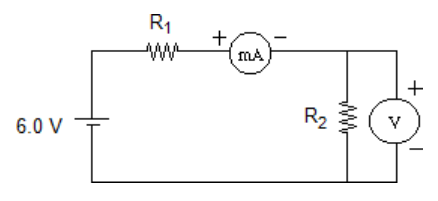
- (a) Larger than 4.00 V, smaller than 40.0 mA
- (b) Smaller than 4.00 V, smaller than 40.0 mA
- (c) Larger than 4.00 V, larger than 40.0 mA
- (d) Smaller than 4.00 V, larger than 40.0 mA
Topic: Circuits Metodi: Equivalent Circuit Reduction Competenze: Measurement & Instrumentation Objects: Galvanometer, Resistor Fonte: Testo (PDF) — p.10 Soluzione: Soluzioni (PDF)
Nel circuito seguente, il voltmeter ha una resistenza di 40 kΩ e l’ampimetro ha una resistenza di 40 Ω. Le loro letture sono rispettivamente di 4,00 V e 40,0 mA. I valori effettivi se i contatori fossero ideali sarebbero
Quesito 47
- a) Più grande di 4,00 V, inferiore a 40,0 mA
- b) Più piccolo di 4,00 V, inferiore a 40,0 mA
- c) Più di 4,00 V, più di 40,0 mA
- d) Piu’ di 4,00 V, superiore a 40,0 mA
Topic: Circuits Metodi: Equivalent Circuit Reduction Competenze: Measurement & Instrumentation Objects: Galvanometer, Resistor Fonte: Testo (PDF) — p.10 Soluzione: Soluzioni (PDF)
If an atom absorbs a red photon of 650 nm and a yellow photon of 580 nm and emits the entire absorbed energy as a single photon, the wavelength of the emitted photon is
- (a) 70.5 nm
- (b) 306.5 nm
- (c) 613 nm
- (d) 1230 nm
Topic: Modern-Quantum Physics Metodi: Photon Energy Relation Competenze: Mathematical Modeling Objects: Atom, Photon Fonte: Testo (PDF) — p.10 Soluzione: Soluzioni (PDF)
Se un atomo assorbe un fotone rosso di 650 nm e un fotone giallo di 580 nm ed emette tutta l’energia assorbita come un singolo fotone, la lunghezza d’onda del fotone emesso è
- (a) 70.5 nm
- (b) 306.5 nm
- (c) 613 nm
- (d) 1230 nm
Topic: Modern-Quantum Physics Metodi: Photon Energy Relation Competenze: Mathematical Modeling Objects: Atom, Photon Fonte: Testo (PDF) — p.10 Soluzione: Soluzioni (PDF)
Part A-2 (one or more correct)
A spectrometer can be used for
- (a) determining the wavelength of different lines seen in the spectrum
- (b) determining the extent to which specific spectral lines are Doppler shifted
- (c) determining the elements present in the atmosphere of a star
- (d) ascertaining the physical properties of the outer cooler layers of a star
Topic: Astrophysics Metodi: Physical Modeling Competenze: Measurement & Instrumentation Objects: Star Fonte: Testo (PDF) — p.11 Soluzione: Soluzioni (PDF)
**Parte A-2 (una o più correzioni) **
Un spettrometro può essere utilizzato per
- a) determinazione della lunghezza d’onda di linee diverse nello spettro
- b) determinazione della portata di spostamento delle linee spettrali specifiche
- c) determinazione degli elementi presenti nell’atmosfera di una stella
- d) la verifica delle proprietà fisiche degli strati più freddi esterni di una stella
Topic: Astrophysics Metodi: Physical Modeling Competenze: Measurement & Instrumentation Objects: Star Fonte: Testo (PDF) — p.11 Soluzione: Soluzioni (PDF)
Choose all the correct statements pertaining to Earth
- (a) Winter in Southern hemisphere is longer than winter in Northern hemisphere
- (b) The Earth moves fastest in its orbit during summer in Northern hemisphere
- (c) The Earth is closest to the Sun in January
- (d) The orbit of the Earth is farthest from the Sun close to the summer solstice in the Northern hemisphere
Topic: Astrophysics, Gravitation Metodi: Kepler’s Laws Competenze: Physical Reasoning Objects: Planet, Star Fonte: Testo (PDF) — p.11 Soluzione: Soluzioni (PDF)
Scegliete tutte le dichiarazioni corrette relative alla Terra
- (a) L’inverno nell’emisfero meridionale è più lungo dell’inverno nell’emisfero settentrionale
- (b) La Terra si muove più velocemente in orbita durante l’estate nell’emisfero settentrionale
- (c) La Terra è più vicina al Sole a gennaio
- (d) L’orbita della Terra è la più lontana dal Sole vicino al solstizio estivo nell’emisfero settentrionale
Topic: Astrophysics, Gravitation Metodi: Kepler’s Laws Competenze: Physical Reasoning Objects: Planet, Star Fonte: Testo (PDF) — p.11 Soluzione: Soluzioni (PDF)
A gas cloud will collapse under self-gravity if the expansive force due to gas pressure is insufficient to counter the self-gravitational force. Such collapse and condensation can lead to the formation of stars. One way of expressing the situation is to note that collapse can take place if the travel time of sound (speed of sound is ~ rms speed of the gas molecules) across the cloud is more than the free fall time of the cloud under its own gravity. The condition for collapse may be specified as
(i) The radius of the cloud > Jeans length , or
(ii) The mass of the cloud > Jeans mass , which works out as in units of solar mass.
Here, is the mean molecular mass of the particles of the cloud, is the density, is the number density i.e. the number of particles per cc and is the temperature of the cloud. Which of the following interstellar molecular hydrogen clouds are unstable to collapse?
- (a) Giant molecular cloud of mass solar masses, with per cc and K
- (b) Molecular cloud core of mass 10 solar masses, with per cc and K
- (c) Molecular cloud core of mass equal to 1 solar mass, radius 0.001 pc and K
- (d) A molecular cloud core of radius 10 pc, temperature 10 K with per cc
Topic: Astrophysics, Gravitation Metodi: Order-of-Magnitude Estimation Competenze: Estimation & Approximation Objects: Gas, Star Fonte: Testo (PDF) — p.11 Soluzione: Soluzioni (PDF)
Una nuvola di gas collasserà sotto l’autogravitazione se la forza espansiva dovuta alla pressione del gas non è sufficiente per contrastare la forza di autogravitazione. Tale crollo e condensazione possono portare alla formazione di stelle. Un modo per esprimere la situazione è quello di notare che il collasso può verificarsi se il tempo di viaggio del suono (la velocità del suono è ~ rms velocità delle molecole di gas) attraverso la nuvola è più del tempo di caduta libera della nuvola sotto la sua stessa gravità. La condizione di collasso può essere specificata come
(i) Il raggio della nuvola > lunghezza di jeans , o
(ii) La massa della nuvola > massa di jeans , che si presenta come in unità di massa solare.
Qui, è la massa molecolare media delle particelle della nuvola, è la densità, è la densità numerica, cioè il numero di particelle per cc e è la temperatura della nuvola. Quali delle seguenti nuvole interstellari molecolari di idrogeno sono instabili al collasso?
- (a) Nuvola molecolare gigante di massa di massa solare, con per cc e K
- (b) Nuvo molecolare di massa solare di 10 masse, con per cc e K
- (c) Nuovo nucleo molecolare di massa pari a 1 massa solare, raggio 0,001 pc e K
- (d) Nuvo molecolare di radio 10 pc, temperatura 10 K con per cc
Topic: Astrophysics, Gravitation Metodi: Order-of-Magnitude Estimation Competenze: Estimation & Approximation Objects: Gas, Star Fonte: Testo (PDF) — p.11 Soluzione: Soluzioni (PDF)
Consider a spherical satellite of mass and radius , held intact by its own gravity, moving in a circular orbit around a planet of mass and radius . Consider the following possible critical distance (say), between the planet and the satellite. When the distance is less than the tidal force on the satellite, which is stretching the satellite along the line from the planet to the satellite, is greater than the self-gravitational force holding the satellite together. Hence if the planet-satellite separation becomes less than , the satellite disintegrates. Now consider the rotating reference frame in which both the planet and the satellite are stationary with respect to each other. In this frame, at the side of the satellite that is closest to the planet, the tidal acceleration towards the planet is given by . The magnitude of the acceleration due to self-gravity of the satellite is . The most appropriate value of may be obtained as
- (a)
- (b)
- (c)
- (d)
Topic: Gravitation, Astrophysics Metodi: Newton’s Law of Gravitation Competenze: Mathematical Modeling Objects: Satellite, Planet Fonte: Testo (PDF) — p.11 Soluzione: Soluzioni (PDF)
Considera un satellite sferico di massa e di raggio , tenuto intatto dalla sua stessa gravità, che si muove in orbita circolare attorno a un pianeta di massa e raggio . Considera la seguente distanza critica possibile (diciamo), tra il pianeta e il satellite. Quando la distanza è inferiore a , la forza di marea sul satellite, che estende il satellite lungo la linea dal pianeta al satellite, è maggiore della forza di auto-gravitazione che tiene insieme il satellite. Pertanto, se la separazione pianeta-satellite diventa inferiore a , il satellite si disintegra. Ora consideriamo il quadro di riferimento rotante in cui sia il pianeta che il satellite sono fermi l’uno rispetto all’altro. In questo quadro, sul lato del satellite più vicino al pianeta, l’accelerazione delle maree verso il pianeta è data da . L’ampiezza dell’accelerazione dovuta all’auto-gravità del satellite è . Il valore più appropriato di può essere ottenuto come
- (a)
- (b)
- (c)
- (d)
Topic: Gravitation, Astrophysics Metodi: Newton’s Law of Gravitation Competenze: Mathematical Modeling Objects: Satellite, Planet Fonte: Testo (PDF) — p.11 Soluzione: Soluzioni (PDF)
Calculus was invented by Newton to solve the equations that came up when he examined motion under a central force such as gravity. The force of gravity is the controlling force underlying the laws of Kepler. The possible solutions to the equation were obtained as conic sections. Which of the following is/are possible solutions (, , , , are standard coordinates; , , and are constants) to the Kepler problem?
- (a) ;
- (b) ; modulo
- (c) ;
- (d)
Topic: Gravitation, Mathematics Metodi: Kepler’s Laws, Differential Equations Competenze: Mathematical Modeling Objects: — Fonte: Testo (PDF) — p.12 Soluzione: Soluzioni (PDF)
Il calcolo fu inventato da Newton per risolvere le equazioni che sono venute quando ha esaminato il movimento sotto una forza centrale come la gravità. La forza di gravità è la forza di controllo alla base delle leggi di Kepler. Le possibili soluzioni dell’equazione sono state ottenute come sezioni coniche. Quali delle seguenti soluzioni (, , , , sono coordinate standard; , , e sono costanti) sono possibili per il problema di Kepler?
- (a) ;
- b) ; modulo
- (c) ;
- (d)
Topic: Gravitation, Mathematics Metodi: Kepler’s Laws, Differential Equations Competenze: Mathematical Modeling Objects: — Fonte: Testo (PDF) — p.12 Soluzione: Soluzioni (PDF)
Consider the functions and defined by , and , . Define the sum of and as , and difference of and as , . Which of the following is/are true?
- (a) is differentiable at
- (b) is not differentiable at
- (c) is not differentiable at
- (d) is differentiable at
Topic: Mathematics Metodi: Physical Modeling Competenze: Mathematical Modeling Objects: — Fonte: Testo (PDF) — p.12 Soluzione: Soluzioni (PDF)
Considerate le funzioni e definite da , e , . Definire la somma di e come , e la differenza di e come , . Qual è/sono vera/vero tra le seguenti?
- a) è differenziabile a
- b) non è differenziabile a
- (c) non è differenziabile a
- (d) è differenziabile a
Topic: Mathematics Metodi: Physical Modeling Competenze: Mathematical Modeling Objects: — Fonte: Testo (PDF) — p.12 Soluzione: Soluzioni (PDF)
Consider the tangents to the curve at the points where it meets the X-axis. Which of the following is/are true?
- (a) Two of the tangents are parallel to each other
- (b) Two of the tangents are perpendicular to each other
- (c) One of the tangents makes angle with the positive X-axis
- (d) Sum of the Y-intercepts made by the three tangents is
Topic: Mathematics Metodi: Calculus-Integration Competenze: Mathematical Modeling Objects: — Fonte: Testo (PDF) — p.12 Soluzione: Soluzioni (PDF)
Considerate le tangenti della curva nei punti in cui incontra l’asse X. Qual è/sono vera/vero tra le seguenti?
- a) Due tangenti sono parallele tra loro
- (b) Due delle tangenti sono perpendicolari l’una all’altra
- (c) Una delle tangenti fa un angolo con l’asse X positivo
- (d) La somma delle intersezioni Y effettuate dai tre tangenti è
Topic: Mathematics Metodi: Calculus-Integration Competenze: Mathematical Modeling Objects: — Fonte: Testo (PDF) — p.12 Soluzione: Soluzioni (PDF)
Consider the LPP
Which of the following is/are true?
- (a) , is a feasible solution of the LPP
- (b) , is an optimal solution of the LPP
- (c) , is an optimal solution of the LPP for
- (d) The LPP has infinitely many optimal solutions
Topic: Mathematics Metodi: Physical Modeling Competenze: Mathematical Modeling Objects: — Fonte: Testo (PDF) — p.12 Soluzione: Soluzioni (PDF)
Considerate l’LPP
Qual è/sono vera/vero tra le seguenti?
- a) , è una soluzione fattibile del PPL
- b) , è una soluzione ottimale del LPP
- (c) , è una soluzione ottimale del LPP per
- (d) La PPL ha infinite soluzioni ottimali
Topic: Mathematics Metodi: Physical Modeling Competenze: Mathematical Modeling Objects: — Fonte: Testo (PDF) — p.12 Soluzione: Soluzioni (PDF)
There are two whales of exactly the same shape and size. One can just float in a sea somewhat below the arctic circle (say arctic whale) and the other in a tropical sea near the equator (say equatorial whale). Salinity of sea water first increases in going from the equator towards the poles and then decreases in going close to the poles. Which of the following statement(s) is/are true?
- (a) The two whales are of the same mass
- (b) Equatorial whale has smaller mass
- (c) Equatorial whale has larger mass
- (d) Arctic whale has more weight
Topic: Fluid Mechanics Metodi: Hydrostatic Equilibrium Competenze: Physical Reasoning Objects: — Fonte: Testo (PDF) — p.12 Soluzione: Soluzioni (PDF)
Ci sono due balene della stessa forma e dimensione. Uno può semplicemente galleggiare in un mare un po’ al di sotto del cerchio artico (per esempio, la balena artica) e l’altro in un mare tropicale vicino all’equatore (per esempio, la balena equatoriale). La salinità dell’acqua marina aumenta prima di andare dall’equatore verso i poli e poi diminuisce quando si avvicina ai poli. Qual è/sono vera/s) di queste affermazioni?
- (a) Le due balene hanno la stessa massa
- b) Balena equatoriale ha una massa inferiore
- (c) Balena equatoriale ha una massa maggiore
- (d) Balena artica ha un peso maggiore
Topic: Fluid Mechanics Metodi: Hydrostatic Equilibrium Competenze: Physical Reasoning Objects: — Fonte: Testo (PDF) — p.12 Soluzione: Soluzioni (PDF)
A point charge μC and mass μg moves in a potential (), where V·μm² and V·μm³. The correct statement(s) is/are
- (a) There is an equilibrium at μm
- (b) Around μm, charge can make small oscillations
- (c) The period of small oscillations of charge around is 0.10 ms
- (d) A negative charge will not experience zero force at μm
Topic: Electrostatics, Oscillations & Waves Metodi: Simple Harmonic Motion Analysis Competenze: Mathematical Modeling Objects: Point Charge Fonte: Testo (PDF) — p.12 Soluzione: Soluzioni (PDF)
Una carica puntologica μC e massa μg si muovono in un potenziale (), dove V·μm2 e V·μm3. La corretta dichiarazione (s) è/sono
- a) Si verifica un equilibrio a μm
- b) Circa μm, la carica può produrre piccole oscillazioni
- (c) Il periodo di piccole oscillazioni di carica intorno a è di 0,10 ms
- (d) Una carica negativa non avrà forza zero a μm
Topic: Electrostatics, Oscillations & Waves Metodi: Simple Harmonic Motion Analysis Competenze: Mathematical Modeling Objects: Point Charge Fonte: Testo (PDF) — p.12 Soluzione: Soluzioni (PDF)
Two bodies are moving under their mutual gravitational force in circular orbits. Their mass ratio is 2:5. The ratio of their
- (a) Speeds of the two masses will be in ratio of 5 : 2
- (b) Angular speeds around CoM will be in ration of 4 : 25
- (c) Angular momenta about the CoM will be 1 : 1
- (d) Kinetic energies will be 5 : 2
Topic: Gravitation Metodi: Conservation of Momentum, Newton’s Law of Gravitation Competenze: Mathematical Modeling Objects: — Fonte: Testo (PDF) — p.13 Soluzione: Soluzioni (PDF)
Due corpi si muovono sotto la loro forza gravitazionale reciproca in orbite circolari. Il loro rapporto di massa è di 2:5. Il rapporto tra le
- (a) Le velocità delle due masse saranno in rapporto di 5: 2
- b) Le velocità angolari intorno al CoM saranno in razione di 4: 25
- (c) I momenti angolari della CoM saranno 1 : 1
- d) Le energie cinetiche saranno 5 : 2
Topic: Gravitation Metodi: Conservation of Momentum, Newton’s Law of Gravitation Competenze: Mathematical Modeling Objects: — Fonte: Testo (PDF) — p.13 Soluzione: Soluzioni (PDF)
Assume that the Moon’s orbit around the Earth is an almost circular ellipse and that neither its orbit nor its rotation axis precesses. From the Earth we can see more than 50% of the surface of the Moon because
- (a) rotation period and revolution period of the Moon are not equal
- (b) the Moon’s speed of revolution increases and decreases along the elliptical orbit
- (c) inclination of the Moon’s orbit with the ecliptic plane makes the Moon alternately show more northern or more southern part
- (d) other side of the Moon is also visible sometimes
Topic: Astrophysics, Gravitation Metodi: Kepler’s Laws Competenze: Physical Reasoning Objects: Satellite, Planet Fonte: Testo (PDF) — p.13 Soluzione: Soluzioni (PDF)
Supponiamo che l’orbita della Luna intorno alla Terra sia un’ellisse quasi circolare e che né la sua orbita né il suo asse di rotazione precedi. Dalla Terra possiamo vedere più del 50% della superficie lunare perché
- (a) il periodo di rotazione e il periodo di rivoluzione della Luna non sono uguali
- (b) la velocità di rivoluzione della Luna aumenta e diminuisce lungo l’orbita ellittica
- (c) l’inclinazione dell’orbita lunare con il piano eclittico fa sì che la Luna mostri alternativamente la parte più settentrionale o più meridionale
- (d) anche l’altra parte della Luna è visibile a volte
Topic: Astrophysics, Gravitation Metodi: Kepler’s Laws Competenze: Physical Reasoning Objects: Satellite, Planet Fonte: Testo (PDF) — p.13 Soluzione: Soluzioni (PDF)