In a hypothetical scenario the force experienced by a particle is given by , where is the expression for terminal velocity. Where is the mass, is the acceleration due to gravity, is the density of the medium, is the surface area of the particle, and is the coefficient of viscosity of the medium. The possible units of , and are
- (a) A: newton, B: newton kg m, p: m s
- (b) A: no units, B: newton kg m, p: m s
- (c) A: newton, B: kg m, p: no units
- (d) A: newton, B: newton s m, p: m s
Topic: Order-of-Magnitude Estimation Metodi: Dimensional Analysis Competenze: Unit Conversion Objects: — Fonte: Testo (PDF) — p.3 Soluzione: Soluzioni (PDF)
In uno scenario ipotetico la forza vissuta da una particella è data da , dove è l’espressione per la velocità terminale. Se è la massa, è l’accelerazione dovuta alla gravità, è la densità del mezzo, è l’area superficiale della particella e è il coefficiente di viscosità del mezzo. Le possibili unità di , e sono:
- a) A: Newton, B: Newton kg m, p: m s
- b) A: nessuna unità, B: Newton kg m, p: m s
- (c) A: Newton, B: kg m, p: nessuna unità
- (d) A: Newton, B: Newton s m, p: m s
Topic: Order-of-Magnitude Estimation Metodi: Dimensional Analysis Competenze: Unit Conversion Objects: — Fonte: Testo (PDF) — p.3 Soluzione: Soluzioni (PDF)
Gravity on the surface of Ganymede, a satellite of Jupiter, is of that on the Earth, while the gravity on the surface of the Moon is of that on the Earth. Two identical pendulums are taken one on Ganymede and the other on the Moon. The two pendulums start oscillating together, after how many oscillations on Moon will they come again in the same phase with approximately 1% uncertainty?
- (a) 24
- (b) 25
- (c) 26
- (d) 27
Topic: Oscillations & Waves, Gravitation Metodi: Simple Harmonic Motion Analysis Competenze: Estimation & Approximation Objects: Pendulum, Satellite Fonte: Testo (PDF) — p.3 Soluzione: Soluzioni (PDF)
La gravità sulla superficie di Ganimede, un satellite di Giove, è di quella sulla Terra, mentre la gravità sulla superficie della Luna è di quella sulla Terra. Due penduli identici sono stati scattati, uno su Ganimede e l’altro sulla Luna. I due penduli iniziano ad oscillarsi insieme, dopo quante oscillazioni sulla Luna ritorneranno nella stessa fase con circa l’incertitudine dell’1%?
- (a) 24
- (b) 25
- (c) 26
- (d) 27
Topic: Oscillations & Waves, Gravitation Metodi: Simple Harmonic Motion Analysis Competenze: Estimation & Approximation Objects: Pendulum, Satellite Fonte: Testo (PDF) — p.3 Soluzione: Soluzioni (PDF)
Consider two telescopes having equal apertures of 400 mm. One has a focal ratio of , the other has the focal ratio of . What is the relation between their focal lengths?
- (a) Focal length of the telescope with ratio is twice as compared to the focal length of telescope with ratio.
- (b) Focal length of the telescope with ratio is twice as compared to the focal length of telescope with ratio.
- (c) Focal length of the telescope with ratio is four times smaller as compared to the focal length of telescope with ratio.
- (d) Focal lengths of both telescopes are the same.
Topic: Geometric Optics, Astrophysics Metodi: Physical Modeling Competenze: Physical Reasoning Objects: Lens Fonte: Testo (PDF) — p.3 Soluzione: Soluzioni (PDF)
Considerate due telescopi con aperture uguali di 400 mm. Uno ha un rapporto focale di , l’altro ha il rapporto focale di . Qual è la relazione tra le loro lunghezze focali?
- (a) La lunghezza focale del telescopio con rapporto è doppia rispetto alla lunghezza focale del telescopio con rapporto .
- (b) La lunghezza focale del telescopio con rapporto è doppia rispetto alla lunghezza focale del telescopio con rapporto .
- (c) La lunghezza focale del telescopio con rapporto è quattro volte inferiore rispetto alla lunghezza focale del telescopio con rapporto .
- (d) Le lunghezze focali di entrambi i telescopi sono uguali.
Topic: Geometric Optics, Astrophysics Metodi: Physical Modeling Competenze: Physical Reasoning Objects: Lens Fonte: Testo (PDF) — p.3 Soluzione: Soluzioni (PDF)
Statement I: The radius vector of a planet sweeps equal area in equal time while revolving around the Sun.
Statement II: Gravitational force between the Sun and the planet is along the line joining the two.
- (a) Both the Statements are true, and Statement II is correct reason of Statement I.
- (b) Both the Statements are true, but Statement II is not the correct reason of Statement I.
- (c) The Statement I is true and the Statement II is false.
- (d) The Statement I is false and the Statement II is true.
Topic: Gravitation Metodi: Kepler’s Laws, Newton’s Law of Gravitation Competenze: Physical Reasoning Objects: Planet, Star Fonte: Testo (PDF) — p.4 Soluzione: Soluzioni (PDF)
Dichiarazione I: Il vettore del raggio di un pianeta spazza in superficie uguale in tempo uguale mentre ruota attorno al Sole.
Dichiarazione II: la forza gravitazionale tra il Sole e il pianeta è lungo la linea che li unisce.
- (a) Entrambe le dichiarazioni sono vere e la dichiarazione II è la ragione corretta della dichiarazione I.
- b) Entrambe le dichiarazioni sono vere, ma la dichiarazione II non è la ragione corretta della dichiarazione I.
- c) La dichiarazione I è vera e la dichiarazione II è falsa.
- (d) La dichiarazione I è falsa e la dichiarazione II è vera.
Topic: Gravitation Metodi: Kepler’s Laws, Newton’s Law of Gravitation Competenze: Physical Reasoning Objects: Planet, Star Fonte: Testo (PDF) — p.4 Soluzione: Soluzioni (PDF)
Which of the following graphs qualitatively depicts the variation in resistivity of a semiconductor with respect to temperature correctly?
Quesito 5
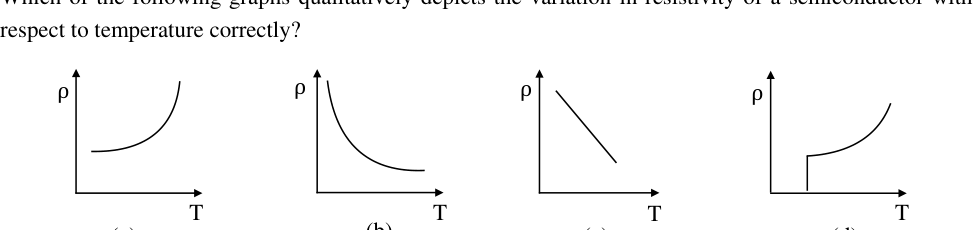
The four graphs (resistivity on the vertical axis, temperature on the horizontal axis) are:
- (a) increasing with , concave-up (exponential-like rise).
- (b) decreasing with (decaying curve).
- (c) decreasing linearly with .
- (d) roughly constant at low , then a step-up followed by a concave-up rise with .
Topic: Modern-Quantum Physics Metodi: Physical Modeling Competenze: Diagrammatic Reasoning Objects: — Fonte: Testo (PDF) — p.4 Soluzione: Soluzioni (PDF)
Quale dei seguenti grafici raffigura qualitativamente correttamente la variazione della resistività di un semiconduttore rispetto alla temperatura?
Quesito 5
I quattro grafici (resistenza sull’asse verticale, temperatura sull’asse orizzontale) sono:
- a) in aumento con , concavo (aumento esponenziale).
- (b) diminuendo con (curva di decadimento).
- (c) diminuisce linearmente con .
- (d) approssimativamente costante a basso , poi un incremento seguito da un incremento concavo con .
Topic: Modern-Quantum Physics Metodi: Physical Modeling Competenze: Diagrammatic Reasoning Objects: — Fonte: Testo (PDF) — p.4 Soluzione: Soluzioni (PDF)
Three identical bulbs, B, C and D are connected in a circuit as shown below. By connecting one more identical bulb
Quesito 6
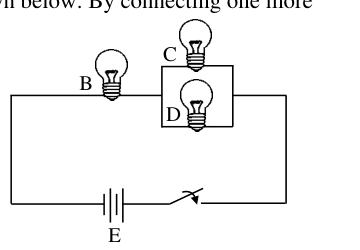
- (a) in series with bulb B, the intensity of bulb B will decrease but that of bulb C and D will increase.
- (b) in parallel with bulb B, the intensities of all the three bulbs B, C and D will decrease.
- (c) in parallel with bulbs C and D, the intensities of all the three bulbs B, C and D will increase.
- (d) in series with bulb C, the intensity of bulb B will decrease and that of bulb D will increase.
Topic: Circuits Metodi: Equivalent Circuit Reduction Competenze: Physical Reasoning Objects: Resistor Fonte: Testo (PDF) — p.4 Soluzione: Soluzioni (PDF)
Tre lampadine identiche, B, C e D, sono collegate in un circuito come mostrato di seguito. Connettere un’altra lampadina identica
Quesito 6
- (a) in serie con lampadina B, l’intensità del lampadino B diminuirà ma quella dei lampadini C e D aumenterà.
- b) parallelo con l’ampolla B, diminuiranno le intensità di tutte e tre le ampollette B, C e D.
- c) in parallelo con le lampadine C e D, aumenteranno le intensità di tutte e tre le lampadine B, C e D.
- (d) in serie con lampadina C, l’intensità del lampadino B diminuirà e quella del lampadino D aumenterà.
Topic: Circuits Metodi: Equivalent Circuit Reduction Competenze: Physical Reasoning Objects: Resistor Fonte: Testo (PDF) — p.4 Soluzione: Soluzioni (PDF)
Two cannons are placed on 1000 m high towers at a horizontal distance of 400 m between them along -axis. Ball A is fired at an angle of 45° to the ve -axis whereas Ball B is fired at an angle of 45° to the ve -axis. Initial velocity of projection given to each ball is m/s in magnitude. The point at which the two balls collide is
Quesito 7
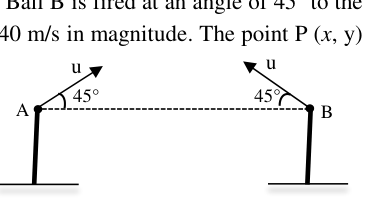
- (a) m, m
- (b) m,
- (c) m, m
- (d) the two balls will not collide
Topic: Newtonian Mechanics Metodi: Kinematic Equations, Vector Decomposition Competenze: Mathematical Modeling Objects: Ball, Projectile Fonte: Testo (PDF) — p.4 Soluzione: Soluzioni (PDF)
Due cannoni sono posizionati su torri alte 1000 m a una distanza orizzontale di 400 m tra di loro lungo l’asse . La palla A viene sparata ad un angolo di 45° all’asse ve mentre la palla B viene sparata ad un angolo di 45° all’asse ve . La velocità iniziale di proiezione data a ciascuna palla è m/s in magnitudine. Il punto in cui le due palle si incrociano è
Quesito 7
- (a) m, m
- (b) m,
- (c) m, m
- (d) le due palle non si colpiranno
Topic: Newtonian Mechanics Metodi: Kinematic Equations, Vector Decomposition Competenze: Mathematical Modeling Objects: Ball, Projectile Fonte: Testo (PDF) — p.4 Soluzione: Soluzioni (PDF)
Sixty moles of Helium gas are initially at 28°C (at A). It undergoes an isothermal process from A to B and then an isobaric process from B to C. Total change in the internal energy of the gas in the complete process from A to C would be approximately,
Quesito 8
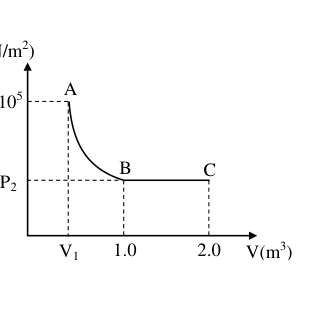
- (a) 206 kJ
- (b) 450 kJ
- (c) 431 kJ
- (d) 225 kJ
Topic: Thermodynamics Metodi: First Law of Thermodynamics, Ideal Gas Law Competenze: Mathematical Modeling Objects: Gas Fonte: Testo (PDF) — p.4 Soluzione: Soluzioni (PDF)
60 mol di gas di elio sono inizialmente 28°C (a A). Esso subisce un processo isotermico da A a B e poi un processo isobarico da B a C. La variazione totale dell’energia interna del gas nel processo completo da A a C sarebbe approssimativa,
Quesito 8
- (a) 206 kJ
- (b) 450 kJ
- (c) 431 kJ
- (d) 225 kJ
Topic: Thermodynamics Metodi: First Law of Thermodynamics, Ideal Gas Law Competenze: Mathematical Modeling Objects: Gas Fonte: Testo (PDF) — p.4 Soluzione: Soluzioni (PDF)
In an atom, the nucleus consists of 2 protons and 2 neutrons and one electron is revolving around the nucleus. According to Bohr’s atomic model, the only visible wavelength corresponds to the transition
- (a) 2nd to 1st orbit
- (b) 4th to 2nd orbit
- (c) 4th to 3rd orbit
- (d) 5th to 3rd orbit
Topic: Modern-Quantum Physics Metodi: Bohr Model & Quantization Competenze: Mathematical Modeling Objects: Atom, Nucleus, Electron Fonte: Testo (PDF) — p.5 Soluzione: Soluzioni (PDF)
In un atomo, il nucleo è composto da 2 protoni e 2 neutroni e un elettrone ruota intorno al nucleo. Secondo il modello atomico di Bohr, l’unica lunghezza d’onda visibile corrisponde alla transizione
- a) da 2a a 1a orbita
- b) da 4a a 2a orbita
- c) da 4a a 3a orbita
- d) da 5 a 3a orbita
Topic: Modern-Quantum Physics Metodi: Bohr Model & Quantization Competenze: Mathematical Modeling Objects: Atom, Nucleus, Electron Fonte: Testo (PDF) — p.5 Soluzione: Soluzioni (PDF)
Select the statement describing correctly the functioning of the circuit shown below.
Quesito 10
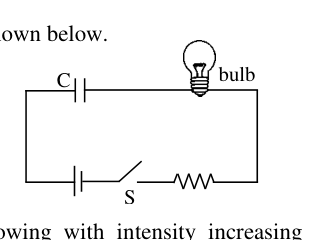
- (a) From the time the switch S is closed, the bulb will start glowing with intensity increasing uniformly to a maximum value and will turn off after some time.
- (b) As soon as the switch S is closed, the bulb will glow with maximum intensity which will then slowly decrease to zero.
- (c) From the time the switch S is closed, the bulb will start glowing with intensity increasing uniformly to a maximum value and will continue glowing thereafter.
- (d) If distance between the parallel plates of the capacitor is increased, bulb intensity will attain maximum value in shorter time after the switch is closed.
Topic: Circuits Metodi: Physical Modeling Competenze: Diagrammatic Reasoning Objects: Capacitor, Switch Fonte: Testo (PDF) — p.5 Soluzione: Soluzioni (PDF)
Selezionare la dichiarazione che descrive correttamente il funzionamento del circuito mostrato di seguito.
Quesito 10
- a) Dal momento in cui l’interruttore S è chiuso, l’ampolla inizierà a risplendere con un’intensità che aumenta uniformemente fino a raggiungere il valore massimo e si spegnerà dopo un certo tempo.
- b) Appena il interruttore S è chiuso, l’ampolla accenderà con la massima intensità che diminuirà lentamente fino a zero.
- (c) Dal momento in cui l’interruttore S è chiuso, l’ampolla inizierà a risplendere con un’intensità che aumenta uniformemente fino a raggiungere il valore massimo e continuerà a risplendere in seguito.
- d) Se si aumenta la distanza tra le piastre parallele del condensatore, l’intensità dell’ampolla raggiungerà il valore massimo in un periodo più breve dopo la chiusura del interruttore.
Topic: Circuits Metodi: Physical Modeling Competenze: Diagrammatic Reasoning Objects: Capacitor, Switch Fonte: Testo (PDF) — p.5 Soluzione: Soluzioni (PDF)
A mechanical spring deviates from Hooke’s law as , where is the strain. At what value of the strain , the force deviates from the one obeying Hooke’s law with same and unit length, just by 1%?
- (a)
- (b)
- (c)
- (d)
Topic: Elasticity & Materials Metodi: Hooke’s Law, Approximation & Series Expansion Competenze: Estimation & Approximation Objects: Spring Fonte: Testo (PDF) — p.5 Soluzione: Soluzioni (PDF)
Una molla meccanica si allontana dalla legge di Hooke come , dove è la tensione. A quale valore della tensione la forza si allontana da quella che obbedisce alla legge di Hooke con la stessa e lunghezza unità, di appena l’1%?
- (a)
- (b)
- (c)
- (d)
Topic: Elasticity & Materials Metodi: Hooke’s Law, Approximation & Series Expansion Competenze: Estimation & Approximation Objects: Spring Fonte: Testo (PDF) — p.5 Soluzione: Soluzioni (PDF)
Three lenses with focal lengths , and respectively are kept with common principal axis in that order with successive separation of between each pair. If the point object is placed on the common principal axis to the left of 1st lens at distance from it. What should be the value of focal length so as to form the final image at distance of from 3rd lens on the right of it?
- (a)
- (b)
- (c)
- (d)
Topic: Geometric Optics Metodi: Thin Lens & Mirror Equation Competenze: Mathematical Modeling Objects: Lens Fonte: Testo (PDF) — p.5 Soluzione: Soluzioni (PDF)
Tre obiettivi con lunghezze focali , e sono tenuti con asse principale comune in tale ordine, con successiva separazione di tra ciascuna coppia. Se l’oggetto puntante è posizionato sull’asse principale comune a sinistra della prima lente a distanza da esso. Qual è il valore della distanza focale per formare l’immagine finale a distanza di dalla terza lente a destra?
- (a)
- (b)
- (c)
- (d)
Topic: Geometric Optics Metodi: Thin Lens & Mirror Equation Competenze: Mathematical Modeling Objects: Lens Fonte: Testo (PDF) — p.5 Soluzione: Soluzioni (PDF)
A negatively charged small ball with charge pC and mass 1.00 mg is placed at the centre of a uniformly charged ring of radius 5.00 cm. The negatively charged ball is allowed to move only along the axis of the ring. The ball executes SHM with frequency of 1.00 kHz. The charge on the ring is
- (a) 27.4 mC
- (b) 0.55 mC
- (c) 13.9 C
- (d) 0.69 C
Topic: Electrostatics, Oscillations & Waves Metodi: Coulomb’s Law, Simple Harmonic Motion Analysis Competenze: Mathematical Modeling Objects: Point Charge Fonte: Testo (PDF) — p.5 Soluzione: Soluzioni (PDF)
Una piccola palla carica negativamente con carica pC e massa di 1,00 mg è collocata al centro di un anello uniformemente carico di raggio di 5,00 cm. La palla carica negativamente è consentita di muoversi solo lungo l’asse dell’anello. La palla esegue SHM con frequenza di 1,00 kHz. L’ accusa sull’ anello è
- (a) 27.4 mC
- (b) 0.55 mC
- (c) 13.9 C
- (d) 0.69 C
Topic: Electrostatics, Oscillations & Waves Metodi: Coulomb’s Law, Simple Harmonic Motion Analysis Competenze: Mathematical Modeling Objects: Point Charge Fonte: Testo (PDF) — p.5 Soluzione: Soluzioni (PDF)
Two hunters approach a prey from opposite directions. One hunter has a probability of for hitting the prey, the other has a probability of for hitting the prey. Both fires a burst of 3 shots each simultaneously. Assume that both the hunters fire one shot each at the same time simultaneously, followed by another shot each at the same time, followed by the third shot each at the same time, each round of shots have negligible time gap between them. The probability that the prey, in question, is hit
- (a) after the three rounds is 1
- (b) in the first round of shots is 1
- (c) after the three rounds is
- (d) after the three rounds is
Topic: Mathematics Metodi: Statistical Averaging Competenze: Mathematical Modeling Objects: — Fonte: Testo (PDF) — p.5 Soluzione: Soluzioni (PDF)
Due cacciatori si avvicinano a una preda da direzioni opposte. Un cacciatore ha una probabilità di per colpire la preda, l’altro ha una probabilità di per colpire la preda. Entrambi sparano tre colpi contemporaneamente. Supponiamo che entrambi i cacciatori sparino un colpo a ciascun momento contemporaneamente, seguiti da un altro colpo a ciascun momento, seguiti dal terzo colpo a ciascun momento, ogni round di colpi ha un intervallo di tempo trascurabile tra loro. La probabilità che la preda in questione sia colpita
- a) dopo i tre round è 1
- b) nel primo turno di colpi è 1
- c) dopo i tre round è
- d) dopo i tre round è
Topic: Mathematics Metodi: Statistical Averaging Competenze: Mathematical Modeling Objects: — Fonte: Testo (PDF) — p.5 Soluzione: Soluzioni (PDF)
A particle moving with constant velocity along -axis has angular momentum units about a reference point in plane. Which of the following statements is correct?
- (a) If the reference point is shifted parallel to axis, angular momentum need not change necessarily.
- (b) If the reference point is taken to double the present distance from origin, instantaneous angular velocity become half the present value.
- (c) It is always possible to increase instantaneous angular velocity to double the present value by shifting reference point parallel to axis.
- (d) If the reference point is shifted parallel to axis, angular momentum will surely not change about it.
Topic: Rotational Dynamics Metodi: Torque & Angular Momentum Analysis Competenze: Physical Reasoning Objects: — Fonte: Testo (PDF) — p.6 Soluzione: Soluzioni (PDF)
Una particella che si muove con velocità costante lungo l’asse ha unità di momentum angolare circa un punto di riferimento in piano . Quale delle seguenti affermazioni è corretta?
- a) Se il punto di riferimento è spostato parallelo all’asse , il momento angolare non deve necessariamente cambiare.
- b) Se si prende il punto di riferimento per raddoppiare la distanza attuale dall’origine, la velocità angolare istantanea diventa la metà del valore attuale.
- (c) È sempre possibile aumentare la velocità angolare istantanea per raddoppiare il valore attuale spostando il punto di riferimento parallelo all’asse .
- (d) Se il punto di riferimento è spostato parallelo all’asse , il momento angolare non cambierà certamente.
Topic: Rotational Dynamics Metodi: Torque & Angular Momentum Analysis Competenze: Physical Reasoning Objects: — Fonte: Testo (PDF) — p.6 Soluzione: Soluzioni (PDF)
An electron moving with speed of 0.1% speed of light enters a uniform magnetic field of strength 2.5 gauss at 60° angle. Calculate the number of helical turns it takes in moving 1 km distance.
- (a) 20000 to 22000
- (b) 22000 to 25000
- (c) 30000 to 32000
- (d) 45000 to 47000
Topic: Magnetism Metodi: Lorentz Force Analysis Competenze: Estimation & Approximation Objects: Electron Fonte: Testo (PDF) — p.6 Soluzione: Soluzioni (PDF)
Un elettrone che si muove a velocità dello 0,1% della velocità della luce entra in un campo magnetico uniforme di resistenza 2,5 gauss all’angolo 60°. Calcolare il numero di giri a propulsore che richiede per un movimento di 1 km.
- (a) 20000 to 22000
- (b) 22000 to 25000
- (c) 30000 to 32000
- (d) 45000 to 47000
Topic: Magnetism Metodi: Lorentz Force Analysis Competenze: Estimation & Approximation Objects: Electron Fonte: Testo (PDF) — p.6 Soluzione: Soluzioni (PDF)
If then is
- (a) 27
- (b) 0
- (c)
- (d) 81
Topic: Mathematics Metodi: Approximation & Series Expansion Competenze: Mathematical Modeling Objects: — Fonte: Testo (PDF) — p.6 Soluzione: Soluzioni (PDF)
Se , allora è
- (a) 27
- (b) 0
- (c)
- (d) 81
Topic: Mathematics Metodi: Approximation & Series Expansion Competenze: Mathematical Modeling Objects: — Fonte: Testo (PDF) — p.6 Soluzione: Soluzioni (PDF)
If then is
- (a) 4
- (b)
- (c) 1
- (d)
Topic: Mathematics Metodi: Approximation & Series Expansion Competenze: Mathematical Modeling Objects: — Fonte: Testo (PDF) — p.6 Soluzione: Soluzioni (PDF)
Se , allora è
- (a) 4
- (b)
- (c) 1
- (d)
Topic: Mathematics Metodi: Approximation & Series Expansion Competenze: Mathematical Modeling Objects: — Fonte: Testo (PDF) — p.6 Soluzione: Soluzioni (PDF)
If , , are in arithmetic progression and , , are in geometric progression, then the common ratio is
- (a) 0
- (b) 1
- (c) 2
- (d) 3
Topic: Mathematics Metodi: Approximation & Series Expansion Competenze: Mathematical Modeling Objects: — Fonte: Testo (PDF) — p.6 Soluzione: Soluzioni (PDF)
Se , , sono in progressione aritmetica e , , sono in progressione geometrica, allora il rapporto comune è
- (a) 0
- (b) 1
- (c) 2
- (d) 3
Topic: Mathematics Metodi: Approximation & Series Expansion Competenze: Mathematical Modeling Objects: — Fonte: Testo (PDF) — p.6 Soluzione: Soluzioni (PDF)
- (a)
- (b)
- (c)
- (d)
Topic: Mathematics Metodi: Calculus-Integration Competenze: Mathematical Modeling Objects: — Fonte: Testo (PDF) — p.6 Soluzione: Soluzioni (PDF)
- (a)
- (b)
- (c)
- (d)
Topic: Mathematics Metodi: Calculus-Integration Competenze: Mathematical Modeling Objects: — Fonte: Testo (PDF) — p.6 Soluzione: Soluzioni (PDF)
Let be defined as . Then
- (a) is differentiable everywhere
- (b) is continuous everywhere but not differentiable at
- (c) is not continuous at
- (d) is neither continuous nor differentiable
Topic: Mathematics Metodi: Physical Modeling Competenze: Mathematical Modeling Objects: — Fonte: Testo (PDF) — p.6 Soluzione: Soluzioni (PDF)
deve essere definito come . Allora…
- a) è differenziabile ovunque
- b) è sempre continuo ma non differenziabile a
- (c) non è continuo a
- (d) non è né continuo né differenziabile
Topic: Mathematics Metodi: Physical Modeling Competenze: Mathematical Modeling Objects: — Fonte: Testo (PDF) — p.6 Soluzione: Soluzioni (PDF)
Let denote an equilateral triangle of side length , be the triangle whose vertices are midpoints of sides of , be the triangle whose vertices are midpoints of sides of . We continue in similar manner to obtain the triangles . For each natural number , let denote the perimeter of the triangle . Then
- (a)
- (b)
- (c)
- (d)
Topic: Mathematics Metodi: Approximation & Series Expansion Competenze: Mathematical Modeling Objects: — Fonte: Testo (PDF) — p.6 Soluzione: Soluzioni (PDF)
indichi un triangolo equilaterale di lunghezza laterale , sia il triangolo le cui cime sono i punti di mezzo dei lati di , sia il triangolo i cui punti di cima sono i punti di mezzo dei lati di . Continuamo in modo simile per ottenere i triangoli . Per ogni numero naturale , indica il perimetro del triangolo . Poi
- (a)
- (b)
- (c)
- (d)
Topic: Mathematics Metodi: Approximation & Series Expansion Competenze: Mathematical Modeling Objects: — Fonte: Testo (PDF) — p.6 Soluzione: Soluzioni (PDF)
, where .
- (a)
- (b)
- (c)
- (d)
Topic: Mathematics Metodi: Physical Modeling Competenze: Mathematical Modeling Objects: — Fonte: Testo (PDF) — p.6 Soluzione: Soluzioni (PDF)
, dove .
- (a)
- (b)
- (c)
- (d)
Topic: Mathematics Metodi: Physical Modeling Competenze: Mathematical Modeling Objects: — Fonte: Testo (PDF) — p.6 Soluzione: Soluzioni (PDF)
A standard parabola is approximated as an arc of a circle for small values of . What will be the radius of that circle?
- (a) 72
- (b) 36
- (c) 18
- (d) 9
Topic: Mathematics Metodi: Approximation & Series Expansion, Calculus-Integration Competenze: Mathematical Modeling Objects: — Fonte: Testo (PDF) — p.7 Soluzione: Soluzioni (PDF)
Una parabola standard è approssimata come un arco di un cerchio per piccoli valori di . Qual sarà il raggio di questo cerchio?
- (a) 72
- (b) 36
- (c) 18
- (d) 9
Topic: Mathematics Metodi: Approximation & Series Expansion, Calculus-Integration Competenze: Mathematical Modeling Objects: — Fonte: Testo (PDF) — p.7 Soluzione: Soluzioni (PDF)
- (a)
- (b)
- (c)
- (d)
Topic: Mathematics Metodi: Calculus-Integration Competenze: Mathematical Modeling Objects: — Fonte: Testo (PDF) — p.7 Soluzione: Soluzioni (PDF)
- (a)
- (b)
- (c)
- (d)
Topic: Mathematics Metodi: Calculus-Integration Competenze: Mathematical Modeling Objects: — Fonte: Testo (PDF) — p.7 Soluzione: Soluzioni (PDF)
Let be continuous on and . Then
- (a)
- (b)
- (c)
- (d)
Topic: Mathematics Metodi: Calculus-Integration Competenze: Mathematical Modeling Objects: — Fonte: Testo (PDF) — p.7 Soluzione: Soluzioni (PDF)
Lasciate che sia continuo su e . Poi
- (a)
- (b)
- (c)
- (d)
Topic: Mathematics Metodi: Calculus-Integration Competenze: Mathematical Modeling Objects: — Fonte: Testo (PDF) — p.7 Soluzione: Soluzioni (PDF)
- (a) Exists and it equals
- (b) Exists and it equals
- (c) Does not exist because
- (d) Does not exist because left hand limit is not equal to right hand limit
Topic: Mathematics Metodi: Calculus-Integration Competenze: Mathematical Modeling Objects: — Fonte: Testo (PDF) — p.7 Soluzione: Soluzioni (PDF)
- a) Esiste ed è uguale a
- b) Esiste ed è uguale a
- (c) Non esiste perché
- (d) Non esiste perché il limite della mano sinistra non è uguale al limite della mano destra
Topic: Mathematics Metodi: Calculus-Integration Competenze: Mathematical Modeling Objects: — Fonte: Testo (PDF) — p.7 Soluzione: Soluzioni (PDF)
A water tank has the shape of an inverted right circular cone, whose semi-vertical angle is . Water is poured into it at a constant rate of 5 m/min. Then, the rate (in m/min) at which the water surface moves along the slant surface at the instant when the depth of water in the tank is 10 m is
- (a)
- (b)
- (c)
- (d)
Topic: Mathematics Metodi: Calculus-Integration, Differential Equations Competenze: Mathematical Modeling Objects: Container Fonte: Testo (PDF) — p.7 Soluzione: Soluzioni (PDF)
Un serbatoio d’acqua ha la forma di un cono circolare a destra invertito, il cui angolo semivertico è . L’acqua viene versata in esso a una velocità costante di 5 m/min. In seguito, la velocità (in m/min) con cui la superficie dell’acqua si muove lungo la superficie inclinata nel momento in cui la profondità dell’acqua nel serbatoio è di 10 m è
- (a)
- (b)
- (c)
- (d)
Topic: Mathematics Metodi: Calculus-Integration, Differential Equations Competenze: Mathematical Modeling Objects: Container Fonte: Testo (PDF) — p.7 Soluzione: Soluzioni (PDF)
How many people should there be in a group such that there is more than half the probability, that two people from the group have their birthdays with the same date, irrespective of in which months they were born.
- (a) 3 or more
- (b) 4 or more
- (c) 7 or more
- (d) 23 or more
Topic: Mathematics Metodi: Statistical Averaging Competenze: Mathematical Modeling Objects: — Fonte: Testo (PDF) — p.7 Soluzione: Soluzioni (PDF)
Quante persone dovrebbero essere presenti in un gruppo tale che ci sia più della metà della probabilità che due persone del gruppo abbiano la stessa data di compleanno, indipendentemente dal mese in cui sono nate.
- a) 3 o più
- b) 4 o più
- c) 7 o più
- d) 23 o più
Topic: Mathematics Metodi: Statistical Averaging Competenze: Mathematical Modeling Objects: — Fonte: Testo (PDF) — p.7 Soluzione: Soluzioni (PDF)
and alternatively toss a coin. The one who gets a head first wins. If starts the game, then what is the probability that wins?
- (a)
- (b)
- (c)
- (d)
Topic: Mathematics Metodi: Statistical Averaging Competenze: Mathematical Modeling Objects: — Fonte: Testo (PDF) — p.7 Soluzione: Soluzioni (PDF)
e lanciare alternativamente una moneta. Chi prima prende la testa vince. Se inizia la partita, qual è la probabilità che vinca?
- (a)
- (b)
- (c)
- (d)
Topic: Mathematics Metodi: Statistical Averaging Competenze: Mathematical Modeling Objects: — Fonte: Testo (PDF) — p.7 Soluzione: Soluzioni (PDF)
Consider the expression . From which term onwards, the total value of the expression exceeds ?
- (a) 4
- (b) 6
- (c) 8
- (d) 10
Topic: Mathematics Metodi: Order-of-Magnitude Estimation Competenze: Estimation & Approximation Objects: — Fonte: Testo (PDF) — p.7 Soluzione: Soluzioni (PDF)
Considera l’espressione . A partire da quale termine il valore totale dell’espressione supera ?
- (a) 4
- (b) 6
- (c) 8
- (d) 10
Topic: Mathematics Metodi: Order-of-Magnitude Estimation Competenze: Estimation & Approximation Objects: — Fonte: Testo (PDF) — p.7 Soluzione: Soluzioni (PDF)
Let . Which of the following statements is not true?
- (a) is symmetric
- (b) If then
- (c)
- (d)
Topic: Mathematics Metodi: Physical Modeling Competenze: Mathematical Modeling Objects: — Fonte: Testo (PDF) — p.7 Soluzione: Soluzioni (PDF)
Lasciate . Quale delle seguenti affermazioni non è vera?
- a) è simmetrica
- b) Se , allora
- (c)
- (d)
Topic: Mathematics Metodi: Physical Modeling Competenze: Mathematical Modeling Objects: — Fonte: Testo (PDF) — p.7 Soluzione: Soluzioni (PDF)
It has been four hours since Regulus (, ) has crossed the local meridian at Mumbai (, ). Which of the following stars will be closest to the meridian now?
- (a) Arcturus (, )
- (b) Sirius (, )
- (c) Betelgeuse (, )
- (d) Spica (, )
Topic: Astrophysics Metodi: Physical Modeling Competenze: Physical Reasoning Objects: Star Fonte: Testo (PDF) — p.8 Soluzione: Soluzioni (PDF)
Sono passate quattro ore da quando Regulus (, ) ha attraversato il meridiano locale di Mumbai (, ). Quale delle seguenti stelle sarà più vicina al meridiano ora?
- (a) Arcturus (, )
- (b) Sirio (, )
- (c) Betelgeuse (, )
- (d) Spica (, )
Topic: Astrophysics Metodi: Physical Modeling Competenze: Physical Reasoning Objects: Star Fonte: Testo (PDF) — p.8 Soluzione: Soluzioni (PDF)
A star has an apparent magnitude of 10, and an Absolute magnitude of 10. How many parsecs away from the Earth is it?
- (a) 100
- (b) 10
- (c) 1
- (d) 0.1
Topic: Astrophysics Metodi: Physical Modeling Competenze: Mathematical Modeling Objects: Star Fonte: Testo (PDF) — p.8 Soluzione: Soluzioni (PDF)
Una stella ha una magnitudo apparente di 10, e una magnitudo assoluta di 10. Quanti parsec a distanza dalla Terra?
- (a) 100
- (b) 10
- (c) 1
- (d) 0.1
Topic: Astrophysics Metodi: Physical Modeling Competenze: Mathematical Modeling Objects: Star Fonte: Testo (PDF) — p.8 Soluzione: Soluzioni (PDF)
Which of the following statement or statements about stars are true?
- (a) Among all one solar mass stars, the one with the largest radius is also the hottest.
- (b) Type I supernovae are characterized by the absence of Hydrogen in the spectrum.
- (c) Cooler stars show less absorption lines in their spectra.
- (d) The stars are spectrally classified as O, B, A, F, G, K, M; with O type stars showing dense hydrogen lines while M type stars having very less hydrogen lines.
Topic: Astrophysics Metodi: Physical Modeling Competenze: Physical Reasoning Objects: Star Fonte: Testo (PDF) — p.8 Soluzione: Soluzioni (PDF)
Quale delle seguenti affermazioni o affermazioni sulle stelle è vera?
- (a) Tra tutte le stelle di massa solare, quella con il più grande raggio è anche la più calda.
- b) Le supernova di tipo I sono caratterizzate dall’assenza di idrogeno nello spettro.
- (c) Le stelle più fresche mostrano meno linee di assorbimento nei loro spettri.
- (d) Le stelle sono classificate come spettrali O, B, A, F, G, K, M; le stelle di tipo O presentano linee di idrogeno dense mentre le stelle di tipo M presentano linee di idrogeno molto meno.
Topic: Astrophysics Metodi: Physical Modeling Competenze: Physical Reasoning Objects: Star Fonte: Testo (PDF) — p.8 Soluzione: Soluzioni (PDF)
As seen from Earth, angular separation between Proxima Centauri and Alpha Centauri is 2.2°. What is the physical separation between the two stars?
- (a) 4.25 light years
- (b) 0.16 light years
- (c) 2.2 light years
- (d) 0.33 light years
Topic: Astrophysics Metodi: Small-Angle Approximation Competenze: Estimation & Approximation Objects: Star Fonte: Testo (PDF) — p.8 Soluzione: Soluzioni (PDF)
Come visto dalla Terra, la separazione angolare tra Proxima Centauri e Alpha Centauri è 2.2°. Qual è la separazione fisica tra le due stelle?
- a) 4,25 anni luce
- b) 0,16 anni luce
- c) 2,2 anni luce
- 0,33 anni luce
Topic: Astrophysics Metodi: Small-Angle Approximation Competenze: Estimation & Approximation Objects: Star Fonte: Testo (PDF) — p.8 Soluzione: Soluzioni (PDF)
Two stars in a binary system are separated by 3.0 AU and have mass ratio of 2 : 1. Their orbital period is 6.0 years. What are the masses of the stars in terms of solar mass?
- (a) 2.0, 1.0
- (b) 0.50, 0.25
- (c) 2.25, 1.125
- (d) 1.78, 0.88
Topic: Astrophysics, Gravitation Metodi: Kepler’s Laws, Newton’s Law of Gravitation Competenze: Mathematical Modeling Objects: Star Fonte: Testo (PDF) — p.8 Soluzione: Soluzioni (PDF)
Due stelle in un sistema binario sono separate da 3,0 UA e hanno un rapporto di massa di 2: 1. Il loro periodo orbitale è di 6,0 anni. Quali sono le masse delle stelle in termini di massa solare?
- (a) 2.0, 1.0
- (b) 0.50, 0.25
- (c) 2.25, 1.125
- (d) 1.78, 0.88
Topic: Astrophysics, Gravitation Metodi: Kepler’s Laws, Newton’s Law of Gravitation Competenze: Mathematical Modeling Objects: Star Fonte: Testo (PDF) — p.8 Soluzione: Soluzioni (PDF)
A comet’s closest approach to Sun is at 1 AU. What is the radial component of its velocity at this position?
- (a) 0 km/s
- (b) 21.2 km/s
- (c) 30 km/s
- (d) 42.4 km/s
Topic: Astrophysics, Gravitation Metodi: Kepler’s Laws, Conservation of Energy Competenze: Mathematical Modeling Objects: Star Fonte: Testo (PDF) — p.8 Soluzione: Soluzioni (PDF)
Il più vicino a un cometa al Sole è a 1 UA. Qual è la componente radial della sua velocità in questa posizione?
- (a) 0 km/s
- (b) 21.2 km/s
- (c) 30 km/s
- (d) 42.4 km/s
Topic: Astrophysics, Gravitation Metodi: Kepler’s Laws, Conservation of Energy Competenze: Mathematical Modeling Objects: Star Fonte: Testo (PDF) — p.8 Soluzione: Soluzioni (PDF)
A new space station orbits the sun every four and a half years. In a particular year, it is seen on the local meridian at 1:00 am of the 21st of June, 2020. It will be again seen on the local meridian from the Earth, approximately, on
- (a) 21 June, 2024, at 1:00 am
- (b) 20 December, 2024, at 4:00 pm
- (c) 3 October, 2021, 4:00 pm
- (d) 21 March, 2021, 9:00 pm
Topic: Astrophysics, Gravitation Metodi: Kepler’s Laws Competenze: Physical Reasoning Objects: Satellite, Star Fonte: Testo (PDF) — p.8 Soluzione: Soluzioni (PDF)
Una nuova stazione spaziale orbita intorno al Sole ogni quattro anni e mezzo. In un determinato anno, è visto sul meridiano locale alle 1:00 del 21 giugno 2020. Sarà ancora visto sul meridiano locale dalla Terra, circa, su
- a) il 21 giugno 2024, alle ore 1:00
- b) il 20 dicembre 2024, alle 16:00
- c) 3 ottobre 2021, ore 16:00
- (d) 21 marzo 2021, ore 21:00
Topic: Astrophysics, Gravitation Metodi: Kepler’s Laws Competenze: Physical Reasoning Objects: Satellite, Star Fonte: Testo (PDF) — p.8 Soluzione: Soluzioni (PDF)
What is the advantage of an equatorial telescope mount over an alt-azimuth mount?
- (a) Reduced vibrations and provides a more stable viewing platform.
- (b) It allows tracking celestial objects using only one axis of motion.
- (c) It eliminates the need for polar alignment before observing.
- (d) It is easier to carry and transport due to its lightweight design.
Topic: Astrophysics Metodi: Physical Modeling Competenze: Physical Reasoning Objects: — Fonte: Testo (PDF) — p.8 Soluzione: Soluzioni (PDF)
Qual è il vantaggio di un telescopio equatoriale rispetto a un alt-azimuth?
- a) riduzione delle vibrazioni e una piattaforma di visione più stabile.
- (b) Consente di seguire gli oggetti celesti utilizzando solo un unico asse di movimento.
- (c) Elimina la necessità di allineamento polare prima dell’osservazione.
- d) È più facile da trasportare e trasportare grazie al suo design leggero.
Topic: Astrophysics Metodi: Physical Modeling Competenze: Physical Reasoning Objects: — Fonte: Testo (PDF) — p.8 Soluzione: Soluzioni (PDF)
Which of the following statements is correct about constellations?
- (a) Any star cannot belong to two constellations simultaneously.
- (b) Only the bright stars which are imagined as some figure in the sky make constellations.
- (c) Brightest star in any constellation has magnitude 1.
- (d) There are only 12 constellations along the Ecliptic belt.
Topic: Astrophysics Metodi: Physical Modeling Competenze: Physical Reasoning Objects: Star Fonte: Testo (PDF) — p.8 Soluzione: Soluzioni (PDF)
Quale delle seguenti affermazioni è corretta riguardo alle costellazioni?
- (a) Nessuna stella può appartenere contemporaneamente a due costellazioni.
- b) Solo le stelle luminose che si immaginano come figure del cielo formano costellazioni.
- (c) La stella più brillante di una costellazione ha una magnitudo di 1.
- (d) Ci sono solo 12 costellazioni lungo la cintura dell’Eclipsia.
Topic: Astrophysics Metodi: Physical Modeling Competenze: Physical Reasoning Objects: Star Fonte: Testo (PDF) — p.8 Soluzione: Soluzioni (PDF)
What would be the speed of a comet, on a parabolic orbit around the sun, whose point of closest approach is 1 AU, when at a distance of 4.0 AU?
- (a) 42.1 km/s
- (b) 29.8 km/s
- (c) 21.1 km/s
- (d) 84.4 km/s
Topic: Astrophysics, Gravitation Metodi: Conservation of Energy, Newton’s Law of Gravitation Competenze: Mathematical Modeling Objects: Star Fonte: Testo (PDF) — p.9 Soluzione: Soluzioni (PDF)
Qual sarebbe la velocità di una cometa, in orbita parabolica attorno al Sole, il cui punto di avvicinamento più vicino è di 1 UA, quando a una distanza di 4.0 UA?
- (a) 42.1 km/s
- (b) 29.8 km/s
- (c) 21.1 km/s
- (d) 84.4 km/s
Topic: Astrophysics, Gravitation Metodi: Conservation of Energy, Newton’s Law of Gravitation Competenze: Mathematical Modeling Objects: Star Fonte: Testo (PDF) — p.9 Soluzione: Soluzioni (PDF)
Globular clusters are typically found in the halo of Milky Way. In which of the following constellation, there are higher chances of seeing globular cluster?
- (a) Orion
- (b) Sagittarius
- (c) Ursa Minor
- (d) Virgo
Topic: Astrophysics Metodi: Physical Modeling Competenze: Physical Reasoning Objects: Star Fonte: Testo (PDF) — p.9 Soluzione: Soluzioni (PDF)
Gli ammassi globulari sono tipicamente presenti nell’alo della Via Lattea. In quale delle seguenti costellazioni c’è una maggiore probabilità di vedere un ammasso globulare?
- a) Orione
- (b) Sagittario
- (c) Ursa minore
- (d) Vergine
Topic: Astrophysics Metodi: Physical Modeling Competenze: Physical Reasoning Objects: Star Fonte: Testo (PDF) — p.9 Soluzione: Soluzioni (PDF)
Ecliptic plane makes approximately 60° with the Milky Way plane. One point of intersection lies in the constellation of Sagittarius, in which constellation does the other intersection point lie?
- (a) Aquarius
- (b) Libra
- (c) Pieces
- (d) Gemini
Topic: Astrophysics Metodi: Physical Modeling Competenze: Physical Reasoning Objects: Star Fonte: Testo (PDF) — p.9 Soluzione: Soluzioni (PDF)
Il piano dell’eclittica fa circa 60° con il piano della Via Lattea. Un punto di intersezione si trova nella costellazione di Sagittario, in quale costellazione si trova l’altro punto di intersezione?
- (a) Aquarius
- b) Libra
- c) pezzi
- (d) Gemelli
Topic: Astrophysics Metodi: Physical Modeling Competenze: Physical Reasoning Objects: Star Fonte: Testo (PDF) — p.9 Soluzione: Soluzioni (PDF)
Which of the following places will have minimum duration between the two zero shadow days in a given calendar year?
- (a) Manila (, )
- (b) Monteiro (, )
- (c) Kansanshi (, )
- (d) Barah (, )
Topic: Astrophysics Metodi: Physical Modeling Competenze: Physical Reasoning Objects: Planet Fonte: Testo (PDF) — p.9 Soluzione: Soluzioni (PDF)
Quale dei seguenti luoghi avrà la durata minima tra i due giorni di ombra zero in un determinato anno civile?
- a) Manila (, )
- b) Monteiro (, )
- (c) Kansanshi (, )
- (d) Barah (, )
Topic: Astrophysics Metodi: Physical Modeling Competenze: Physical Reasoning Objects: Planet Fonte: Testo (PDF) — p.9 Soluzione: Soluzioni (PDF)
An observer from Delhi, will see the Sun on the local meridian 365 times in the year 2025. A star, located on the celestial equator, will be seen how many times on the local meridian by the same observer in 2025?
- (a) 364
- (b) 365
- (c) 366
- (d) 367
Topic: Astrophysics Metodi: Physical Modeling Competenze: Physical Reasoning Objects: Star Fonte: Testo (PDF) — p.9 Soluzione: Soluzioni (PDF)
Un osservatore di Delhi vedrà il Sole nel meridiano locale 365 volte nell’anno 2025. Una stella, situata sull’equatore celeste, quante volte verrà vista sul meridiano locale dallo stesso osservatore nel 2025?
- (a) 364
- (b) 365
- (c) 366
- (d) 367
Topic: Astrophysics Metodi: Physical Modeling Competenze: Physical Reasoning Objects: Star Fonte: Testo (PDF) — p.9 Soluzione: Soluzioni (PDF)
Considering the nuclear reactions that power the energy output of the stars, the correct statement is:
- (a) the p-p chain is the dominant process that creates He in very massive stars.
- (b) the fusion of H into He is an exothermic process.
- (c) the CNO (Carbon-Nitrogen-Oxygen) cycle results in the creation of the elements like Si, S and P following the fusion of the lighter elements.
- (d) the fusion process is replaced by the fission process in heavier stars.
Topic: Astrophysics, Nuclear & Particle Physics Metodi: Physical Modeling Competenze: Physical Reasoning Objects: Star, Nucleus Fonte: Testo (PDF) — p.9 Soluzione: Soluzioni (PDF)
Considerando le reazioni nucleari che alimentano l’energia prodotta dalle stelle, la dichiarazione corretta è:
- (a) la catena p-p è il processo dominante che crea lui in stelle molto massicce.
- (b) la fusione di H in He è un processo esotermo.
- c) il ciclo di COC (carbone-azoto-ossigeno) produce la formazione di elementi come Si, S e P a seguito della fusione degli elementi più leggeri.
- d) il processo di fusione è sostituito dal processo di fissione nelle stelle più pesanti.
Topic: Astrophysics, Nuclear & Particle Physics Metodi: Physical Modeling Competenze: Physical Reasoning Objects: Star, Nucleus Fonte: Testo (PDF) — p.9 Soluzione: Soluzioni (PDF)
Which of the following constellations is broken in two disjoint parts in the sky?
- (a) Draco
- (b) Ursa
- (c) Serpens
- (d) Eridanus
Topic: Astrophysics Metodi: Physical Modeling Competenze: Physical Reasoning Objects: Star Fonte: Testo (PDF) — p.9 Soluzione: Soluzioni (PDF)
Quale delle seguenti costellazioni è rotta in due parti disunite nel cielo?
- a) Draco
- b) Ursa
- (c) Serpi
- d) Eridanus
Topic: Astrophysics Metodi: Physical Modeling Competenze: Physical Reasoning Objects: Star Fonte: Testo (PDF) — p.9 Soluzione: Soluzioni (PDF)
Part A-2 (one or more correct)
Inside a cylindrical well, at the bottom and touching the wall, a red ball is thrown at an angle of 45° to the horizontal towards the diametrically opposite end of the wall, and it hits the wall after a time interval of , where is the magnitude of velocity of the red ball and is acceleration due to gravity. A black ball identical in shape and mass to the red ball is thrown vertically upwards from the bottom of the well with a kinetic energy half of that of the red ball. A green ball having a mass half of the red ball is thrown from the bottom of the well but diametrically opposite to the red ball with a kinetic energy half of that of the red ball. All the balls, if and when they hit the wall, undergo completely elastic collision.
- (a) The red ball bounces off the bottom of the well for the first time when it hits the wall the third time.
- (b) The black ball will take double the time to hit the bottom of the well to that of the red ball.
- (c) The green ball hits the bottom of the well at the same spot as the red ball.
- (d) The green ball will take the same time as the red ball to hit the bottom of the well the first time.
Topic: Newtonian Mechanics, Conservation of Energy Metodi: Kinematic Equations, Conservation of Energy Competenze: Physical Reasoning Objects: Ball Fonte: Testo (PDF) — p.10 Soluzione: Soluzioni (PDF)
**Parte A-2 (una o più correzioni) **
All’interno di un pozzo cilindrico, in fondo e toccando la parete, una palla rossa viene lanciata in un angolo 45° all’orizzontale verso l’estremità diametricamente opposta della parete, e colpisce la parete dopo un intervallo di tempo di , dove è la magnitudine della velocità della palla rossa e è l’accelerazione dovuta alla gravità. Una sfera nera identica di forma e massa alla sfera rossa viene lanciata verticalmente verso l’alto dal fondo del pozzo con un’energia cinetica metà di quella della sfera rossa. Una palla verde di metà massa della palla rossa viene lanciata dal fondo del pozzo ma diametralmente opposta alla palla rossa con un’energia cinetica della metà di quella della palla rossa. Tutte le palle, se e quando colpiscono il muro, subiscono una collisione completamente elastica.
- (a) La palla rossa rimbalza dal fondo del pozzo per la prima volta quando colpisce il muro per la terza volta.
- (b) La palla nera impiega il doppio del tempo necessario per raggiungere il fondo del pozzo rispetto a quello della palla rossa.
- (c) La palla verde colpisce il fondo del pozzo nello stesso punto della palla rossa.
- (d) La palla verde avrà lo stesso tempo della palla rossa per raggiungere il fondo del pozzo per la prima volta.
Topic: Newtonian Mechanics, Conservation of Energy Metodi: Kinematic Equations, Conservation of Energy Competenze: Physical Reasoning Objects: Ball Fonte: Testo (PDF) — p.10 Soluzione: Soluzioni (PDF)
Read the two statements, I and II, about a RLC series circuit driven by an AC voltage source using an inductor having internal resistance . Assume that the maximum amplitude of AC signal is and frequency is :
I: When frequency is equal to the resonance frequency of the circuit, potential difference across the series combination of and has a non-zero amplitude.
II: When frequency is equal to the resonance frequency of the circuit, current in the circuit has amplitude less than .
Select correct statement(s) from the following:
- (a) If statement I is correct, statement II has to be correct.
- (b) If statement II is false, statement I cannot be false.
- (c) Statement II is false for most of the RLC series circuits with AC voltage source.
- (d) Statement I is correct for most of the RLC series circuits with AC voltage source.
Topic: Circuits Metodi: Physical Modeling Competenze: Physical Reasoning Objects: Capacitor, Inductor, Resistor Fonte: Testo (PDF) — p.10 Soluzione: Soluzioni (PDF)
Leggi le due affermazioni, I e II, su un circuito di serie RLC alimentato da una fonte di tensione a corrente alternata utilizzando un induttore con resistenza interna . Supponiamo che l’ampiezza massima del segnale AC sia e la frequenza :
I: quando la frequenza è uguale alla frequenza di risonanza del circuito, la differenza potenziale tra la combinazione di serie di e ha un’ampiezza non zero.
II: quando la frequenza è uguale alla frequenza di risonanza del circuito, la corrente nel circuito ha un’ampiezza inferiore a .
Selezionare la dichiarazione corretta (s) tra le seguenti:
- a) Se la dichiarazione I è corretta, la dichiarazione II deve essere corretta.
- b) Se la dichiarazione II è falsa, la dichiarazione I non può essere falsa.
- (c) La dichiarazione II è falsa per la maggior parte dei circuiti della serie RLC con sorgente di tensione a corrente alternata.
- (d) La dichiarazione I è corretta per la maggior parte dei circuiti della serie RLC con fonte di tensione AC.
Topic: Circuits Metodi: Physical Modeling Competenze: Physical Reasoning Objects: Capacitor, Inductor, Resistor Fonte: Testo (PDF) — p.10 Soluzione: Soluzioni (PDF)
Two current carrying wires A and B are held fixed, parallel to each other, at a distance of 1.8 m. A current of 3 A flows through wire A in a direction coming out of the plane of paper and that through the wire B is 9 A going into the plane of paper as shown.
Quesito 51

Which of the following statement(s) is/are true with reference to the given situation?
- (a) There can be a point on the left of wire A (PA side) where net magnetic field is zero.
- (b) There can be a point on the right of wire B (BQ side) where net magnetic field is zero.
- (c) There can be a point between the wires A and B, closer to A, where magnetic field produced by the two wires will be in the same direction having equal magnitude.
- (d) There can be a point Q on the right of wire B (BQ side) where net magnetic field is in the upward direction parallel to the plane of paper.
Topic: Magnetism Metodi: Biot-Savart Law, Superposition Principle Competenze: Physical Reasoning Objects: Wire Fonte: Testo (PDF) — p.10 Soluzione: Soluzioni (PDF)
Due fili di carico A e B sono fissati, paralleli l’uno all’altro, a una distanza di 1,8 m. Una corrente di 3 A scorre attraverso il filo A in una direzione che esce dal piano di carta e che attraverso il filo B è 9 A che va nel piano di carta come mostrato.
Quesito 51
Quali delle seguenti affermazioni sono/sono vere per la situazione data?
- (a) Può esserci un punto sulla sinistra del filo A (laterale PA) in cui il campo magnetico netto è zero.
- (b) Può esserci un punto sulla destra del filo B (laterale BQ) in cui il campo magnetico netto è zero.
- (c) Si può trovare un punto tra i fili A e B, più vicino a A, dove il campo magnetico prodotto dai due fili sarà nella stessa direzione, di uguale magnitudine.
- (d) Può esistere un punto Q sulla destra del filo B (laterale BQ) dove il campo magnetico netto è in direzione ascendente parallela al piano di carta.
Topic: Magnetism Metodi: Biot-Savart Law, Superposition Principle Competenze: Physical Reasoning Objects: Wire Fonte: Testo (PDF) — p.10 Soluzione: Soluzioni (PDF)
Two black bodies A and B are emitting in the approximate ratio 2:5. Which of the following statements may be correct from the given information?
- (a) Body B is 20% hotter and 10% larger in diameter than body A.
- (b) Body B is 50% hotter but half in diameter than body A.
- (c) Body B is 10% hotter and 30% larger in diameter than body A.
- (d) Body B has double the temperature of A and only 40% diameter of body A.
Topic: Thermodynamics, Astrophysics Metodi: Physical Modeling Competenze: Estimation & Approximation Objects: Star Fonte: Testo (PDF) — p.11 Soluzione: Soluzioni (PDF)
Due corpi neri A e B emettono in rapporto approssimativo di 2:5. Quali delle seguenti affermazioni possono essere corrette dalle informazioni fornite?
- (a) Il corpo B è del 20% più caldo e del 10% più grande di diametro rispetto al corpo A.
- (b) Il corpo B è del 50% più caldo ma di metà di diametro rispetto al corpo A.
- (c) Il corpo B è 10% più caldo e 30% più grande di diametro rispetto al corpo A.
- (d) Il corpo B ha il doppio della temperatura di A e solo il 40% del diametro del corpo A.
Topic: Thermodynamics, Astrophysics Metodi: Physical Modeling Competenze: Estimation & Approximation Objects: Star Fonte: Testo (PDF) — p.11 Soluzione: Soluzioni (PDF)
Let . Which of the following statements is not true?
- (a) is an even function
- (b) for all real
- (c) is a polynomial of degree 6
- (d) If , for all roots
Topic: Mathematics Metodi: Physical Modeling Competenze: Mathematical Modeling Objects: — Fonte: Testo (PDF) — p.11 Soluzione: Soluzioni (PDF)
Lasciate . Quale delle seguenti affermazioni non è vera?
- a) è una funzione uniforme
- b) per tutti i reali
- (c) è un polinomio di grado 6
- d) Se , per tutte le radici
Topic: Mathematics Metodi: Physical Modeling Competenze: Mathematical Modeling Objects: — Fonte: Testo (PDF) — p.11 Soluzione: Soluzioni (PDF)
Which of the following functions are periodic?
- (a)
- (b)
- (c)
- (d)
Topic: Mathematics Metodi: Physical Modeling Competenze: Physical Reasoning Objects: — Fonte: Testo (PDF) — p.11 Soluzione: Soluzioni (PDF)
Quali delle seguenti funzioni sono periodiche?
- (a)
- (b)
- (c)
- (d)
Topic: Mathematics Metodi: Physical Modeling Competenze: Physical Reasoning Objects: — Fonte: Testo (PDF) — p.11 Soluzione: Soluzioni (PDF)
If then which of the following are true?
- (a)
- (b)
- (c)
- (d)
Topic: Mathematics Metodi: Approximation & Series Expansion Competenze: Mathematical Modeling Objects: — Fonte: Testo (PDF) — p.11 Soluzione: Soluzioni (PDF)
Se , quale delle seguenti è vero?
- (a)
- (b)
- (c)
- (d)
Topic: Mathematics Metodi: Approximation & Series Expansion Competenze: Mathematical Modeling Objects: — Fonte: Testo (PDF) — p.11 Soluzione: Soluzioni (PDF)
Which of the following series are not convergent?
- (a)
- (b)
- (c)
- (d)
Topic: Mathematics Metodi: Approximation & Series Expansion Competenze: Mathematical Modeling Objects: — Fonte: Testo (PDF) — p.11 Soluzione: Soluzioni (PDF)
Quali delle seguenti serie non sono convergenti?
- (a)
- (b)
- (c)
- (d)
Topic: Mathematics Metodi: Approximation & Series Expansion Competenze: Mathematical Modeling Objects: — Fonte: Testo (PDF) — p.11 Soluzione: Soluzioni (PDF)
The Pole star
- (a) can be seen at night from all locations on the Earth.
- (b) will be visible during a solar eclipse from nearly the whole of the northern hemisphere.
- (c) will be visible during a solar eclipse from the equator.
- (d) can, in principle, be observed from India anytime during the day and night.
Topic: Astrophysics Metodi: Physical Modeling Competenze: Physical Reasoning Objects: Star Fonte: Testo (PDF) — p.12 Soluzione: Soluzioni (PDF)
La stella polare
- (a) può essere visto di notte da tutte le località della Terra.
- (b) sarà visibile durante un’eclissi solare da quasi tutto l’emisfero settentrionale.
- (c) sarà visibile durante un’eclissi solare dall’equatore.
- d) può, in linea di principio, essere osservato dall’India in qualsiasi momento del giorno e della notte.
Topic: Astrophysics Metodi: Physical Modeling Competenze: Physical Reasoning Objects: Star Fonte: Testo (PDF) — p.12 Soluzione: Soluzioni (PDF)
An observer measures the location of the Sun, moon, planets, and bright stars like Sirius, very diligently. The correct conclusions that she may reach is/are:
- (a) Planets rise and set at the same time as per the sidereal clock but not as per the solar clock for all days of the year.
- (b) The Sun rises and sets at the same time as per the solar clock and not as per the sidereal clock for all days of the year.
- (c) The stars rise and set at the same time as per the sidereal clock but not as per the solar clock for all days of the year.
- (d) The moon rises and sets at different times as per the sidereal clock and also as per the solar clock for all days of the month.
Topic: Astrophysics Metodi: Physical Modeling Competenze: Physical Reasoning Objects: Star, Planet Fonte: Testo (PDF) — p.12 Soluzione: Soluzioni (PDF)
Un osservatore misura la posizione del Sole, della Luna, dei pianeti e delle stelle luminose come Sirio, con molta diligenza. Le conclusioni corrette che può trarre sono:
- (a) I pianeti si alzano e si posano nello stesso momento del tempo del tempo di orologio siderico, ma non di orologio solare per tutti i giorni dell’anno.
- (b) Il sole sorge e tramonta nello stesso tempo di un orologio solare e non di un orologio siderico per tutti i giorni dell’anno.
- (c) Le stelle sorgono e tramontano nello stesso tempo del tempo del tempo di orologio siderico, ma non di orologio solare per tutti i giorni dell’anno.
- (d) La luna sorge e tramonta in tempi diversi secondo l’orologio siderico e anche secondo l’orologio solare per tutti i giorni del mese.
Topic: Astrophysics Metodi: Physical Modeling Competenze: Physical Reasoning Objects: Star, Planet Fonte: Testo (PDF) — p.12 Soluzione: Soluzioni (PDF)
Which of the following stars is/are circumpolar in Warsaw (, )?
- (a) Cygni (, )
- (b) Böotis (, )
- (c) Aurigae (, )
- (d) Draconis (, )
Topic: Astrophysics Metodi: Physical Modeling Competenze: Physical Reasoning Objects: Star Fonte: Testo (PDF) — p.12 Soluzione: Soluzioni (PDF)
Quale delle seguenti stelle è/sono circonpolare a Varsavia (, )?
- (a) Cygni (, )
- b) Böotis (, )
- (c) Aurigae (, )
- (d) Draconis (, )
Topic: Astrophysics Metodi: Physical Modeling Competenze: Physical Reasoning Objects: Star Fonte: Testo (PDF) — p.12 Soluzione: Soluzioni (PDF)
Star A rises half an hour before star B and it sets half an hour after star B from a particular location. Which of the following statement(s) is/are correct?
- (a) The location is on equator.
- (b) The location is in southern hemisphere and star A is more south than star B.
- (c) The location is in northern hemisphere and star A is more north than star B.
- (d) Both stars have the same right ascension.
Topic: Astrophysics Metodi: Physical Modeling Competenze: Physical Reasoning Objects: Star Fonte: Testo (PDF) — p.12 Soluzione: Soluzioni (PDF)
La stella A sorge mezz’ora prima della stella B e tramonta mezz’ora dopo la stella B da un luogo particolare. Qual è/sono corretta/s) delle seguenti affermazioni?
- (a) La posizione è sull’equatore.
- (b) La posizione è nell’emisfero meridionale e la stella A è più a sud della stella B.
- (c) La posizione è nell’emisfero settentrionale e la stella A è più a nord della stella B.
- (d) Entrambe le stelle hanno la stessa ascesa giusta.
Topic: Astrophysics Metodi: Physical Modeling Competenze: Physical Reasoning Objects: Star Fonte: Testo (PDF) — p.12 Soluzione: Soluzioni (PDF)