In the Bohr model of hydrogen atom, the force between the nucleus and the electron is modified as where is a small constant. Using the Bohr radius , the radius of orbit is
- (a)
- (b)
- (c)
- (d)
Topic: Modern-Quantum Physics Metodi: Bohr Model & Quantization Competenze: Mathematical Modeling Objects: Nucleus, Electron, Atom Fonte: Testo (PDF) — p.3 Soluzione: Soluzioni (PDF)
Nel modello di Bohr dell’atomo di idrogeno, la forza tra il nucleo e l’elettrone è modificata come dove è una piccola costante. Usando il raggio di Bohr , il raggio di orbita è
- (a)
- (b)
- (c)
- (d)
Topic: Modern-Quantum Physics Metodi: Bohr Model & Quantization Competenze: Mathematical Modeling Objects: Nucleus, Electron, Atom Fonte: Testo (PDF) — p.3 Soluzione: Soluzioni (PDF)
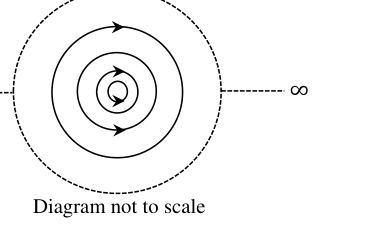
An infinite number of conducting rings having increasing radii and so on, such that , , , and so on … upto , have been placed concentrically on a plane. All the rings carry the same current but the current in consecutive rings is in opposite direction as shown. The magnetic field produced at the common center of the rings is
Quesito 2
- (a)
- (b)
- (c)
- (d)
Topic: Magnetism Metodi: Biot-Savart Law, Superposition Principle Competenze: Physical Reasoning Objects: Coil Fonte: Testo (PDF) — p.3 Soluzione: Soluzioni (PDF)
Un numero infinito di anelli conduttori con raggi in aumento e così via, come , , , e così via … fino a , sono stati posizionati in modo concentrico su un piano. Tutti gli anelli portano la stessa corrente , ma la corrente negli anelli consecutivi è in direzione opposta come mostrato. Il campo magnetico prodotto al centro comune degli anelli è
Quesito 2
- (a)
- (b)
- (c)
- (d)
Topic: Magnetism Metodi: Biot-Savart Law, Superposition Principle Competenze: Physical Reasoning Objects: Coil Fonte: Testo (PDF) — p.3 Soluzione: Soluzioni (PDF)
One mole of an ideal monoatomic gas, initially at temperature , is heated in such a way that its molar heat capacity during the process of heating is . The volume of the gas gets tripled (at constant pressure) during the process. The final temperature attained by the gas is
- (a)
- (b)
- (c)
- (d)
Topic: Thermodynamics Metodi: First Law of Thermodynamics, Ideal Gas Law Competenze: Mathematical Modeling Objects: Gas Fonte: Testo (PDF) — p.3 Soluzione: Soluzioni (PDF)
Un mol di gas monoatomo ideale, inizialmente a temperatura , viene riscaldato in modo tale che la sua capacità termico molare durante il processo di riscaldamento sia . Il volume del gas si triplica (a pressione costante) durante il processo. La temperatura finale raggiunta dal gas è
- (a)
- (b)
- (c)
- (d)
Topic: Thermodynamics Metodi: First Law of Thermodynamics, Ideal Gas Law Competenze: Mathematical Modeling Objects: Gas Fonte: Testo (PDF) — p.3 Soluzione: Soluzioni (PDF)
A spring is compressed under the action of a constant force . The compression of the spring is . Now the force is reversed suddenly as well as its magnitude is doubled. The maximum extension of the spring beyond its natural length will now be (the spring obeys Hook’s law).
- (a)
- (b)
- (c)
- (d)
Topic: Oscillations & Waves Metodi: Hooke’s Law, Conservation of Energy Competenze: Physical Reasoning Objects: Spring Fonte: Testo (PDF) — p.3 Soluzione: Soluzioni (PDF)
Una molla viene compressa sotto l’azione di una forza costante . La compressione della molla è . Ora la forza viene invertita improvvisamente e la sua magnitudine è raddoppiata. La massima estensione della sorgente oltre la sua lunghezza naturale sarà ora (la sorgente obbedisce alla legge di Hook).
- (a)
- (b)
- (c)
- (d)
Topic: Oscillations & Waves Metodi: Hooke’s Law, Conservation of Energy Competenze: Physical Reasoning Objects: Spring Fonte: Testo (PDF) — p.3 Soluzione: Soluzioni (PDF)
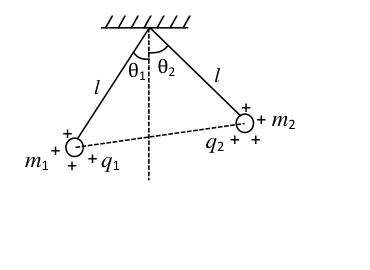
Two small charged balls are suspended from a common point at the ceiling by two non-conducting massless strings of equal length . The first ball has mass and charge while the second ball has mass and charge . If the two strings subtend angles and with the vertical as shown, then
Quesito 5
- (a)
- (b)
- (c)
- (d)
Topic: Electrostatics Metodi: Coulomb’s Law, Free-Body Diagram Competenze: Physical Reasoning Objects: Ball, String Fonte: Testo (PDF) — p.3 Soluzione: Soluzioni (PDF)
Due piccole palle cariche sono sospese da un punto comune al soffitto da due stringhe senza massa non conduttive di uguale lunghezza . La prima palla ha massa e carica , mentre la seconda palla ha massa e carica . Se le due stringhe sottoscrivono gli angoli e con la verticale come mostrato, allora
Quesito 5
- (a)
- (b)
- (c)
- (d)
Topic: Electrostatics Metodi: Coulomb’s Law, Free-Body Diagram Competenze: Physical Reasoning Objects: Ball, String Fonte: Testo (PDF) — p.3 Soluzione: Soluzioni (PDF)
An air filled parallel plate capacitor, with plate area and plate separation , is connected to a battery of emf volt having negligible internal resistance. One of the plates of the capacitor vibrates with amplitude () and angular frequency . If the instantaneous current in the circuit reaches a maximum value , the amplitude of the vibrations is equal to
- (a)
- (b)
- (c)
- (d)
Topic: Circuits, Electrostatics Metodi: Physical Modeling Competenze: Mathematical Modeling Objects: Capacitor, Battery Fonte: Testo (PDF) — p.4 Soluzione: Soluzioni (PDF)
Un condensatore di piastre parallele riempito di aria, con superficie e separazione , è collegato a una batteria di emf volt con una resistenza interna trascurabile. Una delle piastre del condensatore vibra con amplitudine () e frequenza angolare . Se la corrente istantanea nel circuito raggiunge un valore massimo , l’ampiezza delle vibrazioni è pari a
- (a)
- (b)
- (c)
- (d)
Topic: Circuits, Electrostatics Metodi: Physical Modeling Competenze: Mathematical Modeling Objects: Capacitor, Battery Fonte: Testo (PDF) — p.4 Soluzione: Soluzioni (PDF)
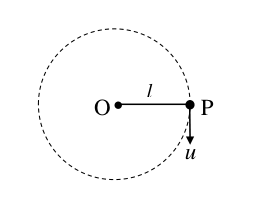
A small ball of mass is attached to one end of a massless un-stretchable string of length and is held at the point P. The other end of the string is fixed to a support at O such that OP is horizontal. The minimum downward speed , that should be imparted to the ball at the point P so that the ball can complete the vertical circle without any slack in the string, is
Quesito 7
- (a)
- (b)
- (c)
- (d)
Topic: Newtonian Mechanics Metodi: Conservation of Energy, Free-Body Diagram Competenze: Physical Reasoning Objects: Ball, String Fonte: Testo (PDF) — p.4 Soluzione: Soluzioni (PDF)
Una piccola sfera di massa è attaccata ad una estremità di una stringa non allungata senza massa di lunghezza e si tiene al punto P. L’altra estremità della corda è fissata ad un supporto a O in modo tale che OP sia orizzontale. La velocità minima verso il basso , che deve essere impartita alla palla al punto P in modo che la palla possa completare il cerchio verticale senza alcuna lacuna nella corda, è
Quesito 7
- (a)
- (b)
- (c)
- (d)
Topic: Newtonian Mechanics Metodi: Conservation of Energy, Free-Body Diagram Competenze: Physical Reasoning Objects: Ball, String Fonte: Testo (PDF) — p.4 Soluzione: Soluzioni (PDF)
An illuminated point object is placed on the principal axis, in front of an equi-convex glass lens of focal length cm, at a distance of m from the lens. A reflecting plane mirror has been placed behind the lens perpendicular to the principal axis and facing the lens. The distance of the plane mirror from the lens, so as to form the final image at the plane mirror itself, the nature of the final image and the distance of the plane mirror from the lens, is
- (a) virtual image, 40 cm
- (b) real image, 40 cm
- (c) virtual image, 50 cm
- (d) real image, 20 cm
Topic: Geometric Optics Metodi: Thin Lens & Mirror Equation Competenze: Mathematical Modeling Objects: Lens, Mirror Fonte: Testo (PDF) — p.4 Soluzione: Soluzioni (PDF)
Un oggetto di punto illuminato è posizionato sull’asse principale, di fronte a una lente di vetro equi-convexa di lunghezza focale cm, a una distanza di m dalla lente. È stato posto uno specchio a piano riflettente dietro la lente perpendicolare all’asse principale e rivolto verso la lente. La distanza dello specchio a piatto dalla lente, in modo da formare l’immagine finale allo specchio a piatto stesso, la natura dell’immagine finale e la distanza dello specchio a piatto dalla lente, è
- a) immagine virtuale, 40 cm
- b) immagine reale, 40 cm
- c) immagine virtuale, 50 cm
- d) immagine reale, 20 cm
Topic: Geometric Optics Metodi: Thin Lens & Mirror Equation Competenze: Mathematical Modeling Objects: Lens, Mirror Fonte: Testo (PDF) — p.4 Soluzione: Soluzioni (PDF)
A ball is kicked horizontally from the top C of a hemispherical rock ACB of radius on a horizontal ground, with a velocity , so as not to hit the rock at any point during its flight. Choose the correct statement (see the figure)
Quesito 9
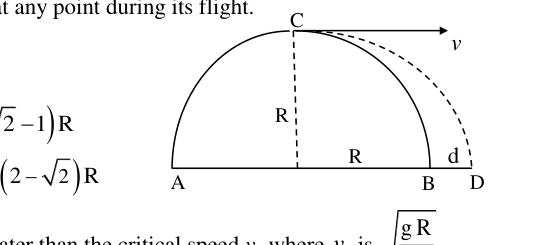
- (a) The ball will just strike at B
- (b) The ball will strike at D where
- (c) The ball will strike at D such that
- (d) The speed of the ball should always be greater than the critical speed where is
Topic: Newtonian Mechanics Metodi: Kinematic Equations Competenze: Mathematical Modeling Objects: Ball, Projectile Fonte: Testo (PDF) — p.4 Soluzione: Soluzioni (PDF)
Una palla viene calciata orizzontalmente dalla parte superiore C di una roccia emisferica ACB di raggio su un terreno orizzontale, con una velocità , in modo da non colpire la roccia in nessun punto durante il suo volo. Scegliere la dichiarazione corretta (vedi figura)
Quesito 9
- (a) La palla colpirà solo a B
- b) La palla colpirà a D dove
- (c) La palla colpirà a D in modo tale che
- (d) La velocità della palla deve essere sempre superiore alla velocità critica , quando è
Topic: Newtonian Mechanics Metodi: Kinematic Equations Competenze: Mathematical Modeling Objects: Ball, Projectile Fonte: Testo (PDF) — p.4 Soluzione: Soluzioni (PDF)
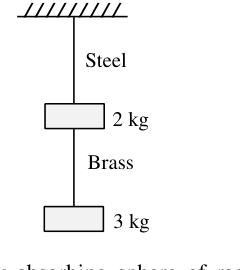
The ratio of lengths, radii and Young’s moduli of steel to brass wires in the figure are , and , respectively. The corresponding ratio of the increase in their lengths is
Quesito 10
- (a)
- (b)
- (c)
- (d)
Topic: Elasticity & Materials Metodi: Stress-Strain Analysis Competenze: Mathematical Modeling Objects: Wire Fonte: Testo (PDF) — p.4 Soluzione: Soluzioni (PDF)
Il rapporto tra lunghezza, raggio e moduli di acciaio Young con fili di ottone nella figura è , e , rispettivamente. Il corrispondente rapporto di aumento delle loro lunghezze è
Quesito 10
- (a)
- (b)
- (c)
- (d)
Topic: Elasticity & Materials Metodi: Stress-Strain Analysis Competenze: Mathematical Modeling Objects: Wire Fonte: Testo (PDF) — p.4 Soluzione: Soluzioni (PDF)
A uniform beam of light of intensity mW/m is incident on a totally absorbing sphere of radius m. The density of the material of the sphere is kg/m. The sphere is placed in a region free of gravity. The acceleration of the sphere is
- (a) m s
- (b) m s
- (c) m s
- (d) Zero
Topic: Modern-Quantum Physics Metodi: Photon Energy Relation Competenze: Mathematical Modeling Objects: Sphere, Photon Fonte: Testo (PDF) — p.4 Soluzione: Soluzioni (PDF)
Un fascio uniforme di luce di intensità mW/m si incide su una sfera totalmente assorbitrice di raggio m. La densità del materiale della sfera è kg/m. La sfera è collocata in una regione libera da gravità. L’accelerazione della sfera è
- (a) m s
- (b) m s
- (c) m s
- (d) Zero
Topic: Modern-Quantum Physics Metodi: Photon Energy Relation Competenze: Mathematical Modeling Objects: Sphere, Photon Fonte: Testo (PDF) — p.4 Soluzione: Soluzioni (PDF)
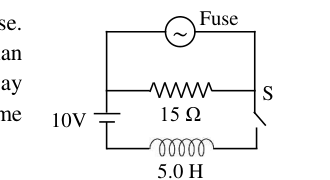
The fuse, in the upper branch of the circuit shown, is an ideal 4.0 A fuse. The fuse has zero resistance as long as current through it remains less than 4.0 A. The fuse blows out when the current reaches 4.0 A. Needless to say that the resistance becomes infinite thereafter. Switch S is closed at time . The fuse blows out at time
Quesito 12
- (a) sec
- (b) sec
- (c) sec
- (d) It won’t blow
Topic: Circuits Metodi: Kirchhoff’s Laws Competenze: Physical Reasoning Objects: Switch, Resistor Fonte: Testo (PDF) — p.5 Soluzione: Soluzioni (PDF)
Il fusibile, nella branca superiore del circuito mostrato, è un fusibile ideale di 4,0 A. Il fusibile ha una resistenza zero finché la corrente che lo attraversa rimane inferiore a 4,0 A. Il fusibile esplode quando la corrente raggiunge la 4.0A. Inutile dire che la resistenza diventa infinita dopo. Il interruttore S è chiuso al momento . Il fusibile esplode in tempo.
Quesito 12
- a) sec
- b) sec
- (c) sec
- (d) Non esplodera’.
Topic: Circuits Metodi: Kirchhoff’s Laws Competenze: Physical Reasoning Objects: Switch, Resistor Fonte: Testo (PDF) — p.5 Soluzione: Soluzioni (PDF)
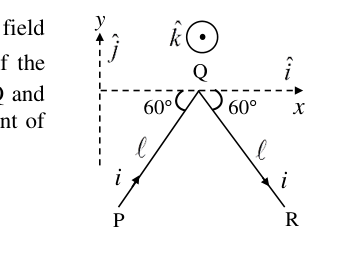
The bent wire PQR shown in the figure lies in a uniform magnetic field T. The direction being normal to the plane of the paper and directed towards the viewer. The two straight sections PQ and QR of the wire each have length 2.0 m and the wire carries a current of 2.5 A. Net force on the wire due to magnetic field is
Quesito 13
- (a) N
- (b) N
- (c) N
- (d) N
Topic: Magnetism Metodi: Lorentz Force Analysis, Vector Decomposition Competenze: Mathematical Modeling Objects: Wire Fonte: Testo (PDF) — p.5 Soluzione: Soluzioni (PDF)
Il PQR del filo piegato mostrato nella figura si trova in un campo magnetico uniforme T. La direzione è normale per il piano della carta e diretta verso il visitatore. Le due sezioni rette PQ e QR del filo hanno ciascuna una lunghezza di 2,0 m e il filo porta una corrente di 2,5 A. La forza netta del filo a causa del campo magnetico è
Quesito 13
- (a) N
- (b) N
- (c) N
- (d) N
Topic: Magnetism Metodi: Lorentz Force Analysis, Vector Decomposition Competenze: Mathematical Modeling Objects: Wire Fonte: Testo (PDF) — p.5 Soluzione: Soluzioni (PDF)
A charged spherical capacitor consists of two concentric spherical shells of radii and (). Half of the stored electrical energy of this system lies within a spherical region of radius if
- (a)
- (b)
- (c)
- (d)
Topic: Electrostatics Metodi: Calculus-Integration, Energy Conservation Method Competenze: Mathematical Modeling Objects: Capacitor Fonte: Testo (PDF) — p.5 Soluzione: Soluzioni (PDF)
Un condensatore sferica carico è costituito da due conchiglie concentriche sferiche di radii e (). La metà dell’energia elettrica immagazzinata di questo sistema si trova in una regione sferica di raggio se
- (a)
- (b)
- (c)
- (d)
Topic: Electrostatics Metodi: Calculus-Integration, Energy Conservation Method Competenze: Mathematical Modeling Objects: Capacitor Fonte: Testo (PDF) — p.5 Soluzione: Soluzioni (PDF)
Two stars of masses and (where = mass of the Sun) form a binary system. The two stars being at a separation of AU between them (1 AU m). They revolve in circular orbits about their center of mass. The period of revolution is
- (a) year
- (b) years
- (c) years
- (d) years
Topic: Gravitation Metodi: Kepler’s Laws, Newton’s Law of Gravitation Competenze: Mathematical Modeling Objects: Star Fonte: Testo (PDF) — p.5 Soluzione: Soluzioni (PDF)
Due stelle di massa e (dove = massa del Sole) formano un sistema binario. Le due stelle sono a una separazione di AU tra di loro (1 AU m). Ruotano in orbite circolari intorno al loro centro di massa. Il periodo della rivoluzione è
- a) anno
- b) anni
- (c) anni
- (d) anni
Topic: Gravitation Metodi: Kepler’s Laws, Newton’s Law of Gravitation Competenze: Mathematical Modeling Objects: Star Fonte: Testo (PDF) — p.5 Soluzione: Soluzioni (PDF)
The value of -decay of an ordinary Radium nucleus Ra (mass 116 u) is MeV. Then
- (a) energy of the recoiled daughter nucleus is nearly 8.7 keV
- (b) energy of the recoiled daughter nucleus is nearly 4.81 MeV
- (c) recoil speed of the daughter nucleus is m s
- (d) speed of emitted particle is nearly m s
Topic: Nuclear & Particle Physics Metodi: Conservation of Momentum, Mass-Energy Equivalence Competenze: Mathematical Modeling Objects: Nucleus Fonte: Testo (PDF) — p.5 Soluzione: Soluzioni (PDF)
Il valore di -decay di un nucleo di radio ordinario Ra (massa 116 u) è MeV. Allora…
- (a) l’energia del nucleo figlio ritroso è di quasi 8,7 keV
- b) l’energia del nucleo figlio ritirato è di quasi 4,81 MeV
- (c) la velocità di ritiro del nucleo figlio è m s
- (d) la velocità delle particelle emesse è quasi m s
Topic: Nuclear & Particle Physics Metodi: Conservation of Momentum, Mass-Energy Equivalence Competenze: Mathematical Modeling Objects: Nucleus Fonte: Testo (PDF) — p.5 Soluzione: Soluzioni (PDF)
A listener at rest (with respect to the air and the ground) hears a sound of frequency from a source moving towards him with a velocity of m s, towards East. If the listener now moves towards the approaching source with a velocity of m s, towards West, he hears a frequency that differs from by 40 Hz. The frequency of the sound produced by the source is (speed of sound in the air is m s)
- (a) 520 Hz
- (b) 450 Hz
- (c) 480 Hz
- (d) 550 Hz
Topic: Oscillations & Waves Metodi: Physical Modeling Competenze: Mathematical Modeling Objects: — Fonte: Testo (PDF) — p.5 Soluzione: Soluzioni (PDF)
Un ascoltatore a riposo (in relazione all’aria e al terreno) sente un suono di frequenza da una fonte che si muove verso di lui con una velocità di m s, verso est. Se l’ascoltatore si sposta ora verso la fonte in avvicinamento con una velocità di m s, verso ovest, sente una frequenza che differisce da di 40 Hz. La frequenza del suono prodotto dalla fonte è (la velocità del suono nell’aria è m s)
- (a) 520 Hz
- (b) 450 Hz
- (c) 480 Hz
- (d) 550 Hz
Topic: Oscillations & Waves Metodi: Physical Modeling Competenze: Mathematical Modeling Objects: — Fonte: Testo (PDF) — p.5 Soluzione: Soluzioni (PDF)
A uniform rod of length swings from a pivot as a physical pendulum. The position of the pivot can be varied along the length of the rod. The minimum time period with which the rod can oscillate with an appropriate position of the pivot is where is equal to
- (a)
- (b)
- (c)
- (d)
Topic: Oscillations & Waves Metodi: Simple Harmonic Motion Analysis, Torque & Angular Momentum Analysis Competenze: Mathematical Modeling Objects: Rod, Pendulum Fonte: Testo (PDF) — p.6 Soluzione: Soluzioni (PDF)
Una barra uniforme di lunghezza oscilla da un pivot come pendolo fisico. La posizione del pivot può essere variata lungo la lunghezza della canna. Il periodo minimo di tempo con il quale la canna può oscillare con una posizione adeguata del pivot è , quando è uguale a
- (a)
- (b)
- (c)
- (d)
Topic: Oscillations & Waves Metodi: Simple Harmonic Motion Analysis, Torque & Angular Momentum Analysis Competenze: Mathematical Modeling Objects: Rod, Pendulum Fonte: Testo (PDF) — p.6 Soluzione: Soluzioni (PDF)
The number density of conduction electrons in pure silicon at room temperature is about m. The number density of conduction electrons is increased by a factor of by doping the silicon lattice with phosphorus. Assume that at room temperature every phosphorus atom contributes one electron to the conduction band. The fraction of silicon atoms replaced by phosphorus atoms is (Given that the density of silicon is 2.33 gm/cm and that the molar mass of silicon gm)
- (a)
- (b)
- (c)
- (d)
Topic: Modern-Quantum Physics Metodi: Order-of-Magnitude Estimation Competenze: Estimation & Approximation Objects: Electron, Atom Fonte: Testo (PDF) — p.6 Soluzione: Soluzioni (PDF)
La densità numerica degli elettroni di conduttività nel silicio puro a temperatura ambiente è di circa m. La densità numerica degli elettroni di conduttività è aumentata di un fattore dopando la rete di silicio con fosforo. Supponiamo che a temperatura ambiente ogni atomo di fosforo contribuisca con un elettrone alla banda di conduzione. La frazione di atomi di silicio sostituiti da atomi di fosforo è (Dato che la densità del silicio è di 2,33 gm/cm e che la massa molare del silicio gm)
- (a)
- (b)
- (c)
- (d)
Topic: Modern-Quantum Physics Metodi: Order-of-Magnitude Estimation Competenze: Estimation & Approximation Objects: Electron, Atom Fonte: Testo (PDF) — p.6 Soluzione: Soluzioni (PDF)
A soap bubble 10 cm in radius, with a film thickness of cm, is charged to a potential of 80 V. The bubble bursts and converts into a single spherical drop. Assuming that the soap solution is a good conductor, the potential at the surface of the drop is
- (a) 2 kV
- (b) 4 kV
- (c) 6 kV
- (d) 8 kV
Topic: Electrostatics, Fluid Mechanics Metodi: Conservation Laws Competenze: Mathematical Modeling Objects: Bubble, Droplet Fonte: Testo (PDF) — p.6 Soluzione: Soluzioni (PDF)
Una bolla di sapone di 10 cm di raggio, con uno spessore di pellicola di cm, è caricata ad un potenziale di 80 V. La bolla scoppe e si trasforma in una singola goccia sferica. Supponendo che la soluzione di sapone sia un buon conduttore, il potenziale sulla superficie della goccia è
- (a) 2 kV
- (b) 4 kV
- (c) 6 kV
- (d) 8 kV
Topic: Electrostatics, Fluid Mechanics Metodi: Conservation Laws Competenze: Mathematical Modeling Objects: Bubble, Droplet Fonte: Testo (PDF) — p.6 Soluzione: Soluzioni (PDF)
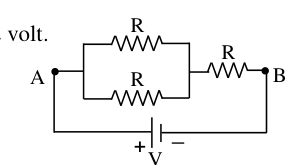
Three resistances, each of rated 16 W, are connected across A and B as shown. Potential difference of volt is applied between points A and B. Statement 1: Maximum potential difference that can be applied is 12 volt. Statement 2: Maximum power that can be dissipated is 24 watt.
Quesito 21
- (a) Statements 1 and 2 both are wrong
- (b) Statement 1 is correct but statement 2 is wrong
- (c) Statement 1 is wrong but statement 2 is correct
- (d) Statements 1 and 2 both are correct
Topic: Circuits Metodi: Equivalent Circuit Reduction Competenze: Physical Reasoning Objects: Resistor Fonte: Testo (PDF) — p.6 Soluzione: Soluzioni (PDF)
Tre resistenze, ciascuna di con 16 W, sono collegate tra A e B come mostrato. Si applica una differenza di potenziale di volt tra i punti A e B. Dichiarazione 1: La differenza massima di potenziale che può essere applicata è di 12 volt. Dichiarazione 2: Potenza massima che può essere dissipata è di 24 watt.
Quesito 21
- a) Le affermazioni 1 e 2 sono entrambe errate
- b) La dichiarazione 1 è corretta ma la dichiarazione 2 è sbagliata
- c) La dichiarazione 1 è sbagliata ma la dichiarazione 2 è corretta
- d) Le affermazioni 1 e 2 sono entrambe corrette
Topic: Circuits Metodi: Equivalent Circuit Reduction Competenze: Physical Reasoning Objects: Resistor Fonte: Testo (PDF) — p.6 Soluzione: Soluzioni (PDF)
Water is filled in a vertical cylinder up to a certain height . The cylinder is made to rotate with an angular velocity about a vertical axis coinciding with the axis of the cylinder. The water surface seen from top appears as a/an
- (a) ellipsoid
- (b) hemisphere
- (c) paraboloid
- (d) hyperboloid
Topic: Fluid Mechanics Metodi: Physical Modeling Competenze: Physical Reasoning Objects: Cylinder Fonte: Testo (PDF) — p.6 Soluzione: Soluzioni (PDF)
L’acqua viene riempita in un cilindro verticale fino a una certa altezza . Il cilindro è fatto per ruotare con una velocità angolare circa un asse verticale che coincide con l’asse del cilindro. La superficie dell’acqua vista dall’alto appare come un
- a) ellipsoide
- b) emisfero
- (c) paraboloide
- d) iperboloide
Topic: Fluid Mechanics Metodi: Physical Modeling Competenze: Physical Reasoning Objects: Cylinder Fonte: Testo (PDF) — p.6 Soluzione: Soluzioni (PDF)
A uniformly charged non-conducting sphere with its center at C carries positive charge with uniform charge density , except in a spherical cavity (inside the sphere) with center O. The electric field at any point inside the cavity is
Quesito 23
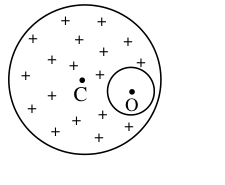
- (a) zero
- (b) uniform
- (c) directed radially outward
- (d) directed radially inward
Topic: Electrostatics Metodi: Gauss’s Law, Superposition Principle Competenze: Physical Reasoning Objects: Sphere Fonte: Testo (PDF) — p.6 Soluzione: Soluzioni (PDF)
Una sfera non conduttrice con carica uniforme con il suo centro a C porta una carica positiva con densità di carica uniforme , tranne in una cavità sferica (all’interno della sfera) con centro O. Il campo elettrico in qualsiasi punto all’interno della cavità è
Quesito 23
- a) zero
- b) uniforme
- c) orientata radialmente verso l’esterno
- d) orientata radicalmente verso l’interno
Topic: Electrostatics Metodi: Gauss’s Law, Superposition Principle Competenze: Physical Reasoning Objects: Sphere Fonte: Testo (PDF) — p.6 Soluzione: Soluzioni (PDF)
A cylindrical tank with base area m is filled with water up to a height cm. There is a small hole of area m () in the bottom of the tank. It takes time to empty the tank up to a height (i.e. to empty half of the water volume). The additional time required to empty the tank completely is
- (a)
- (b)
- (c)
- (d)
Topic: Fluid Mechanics Metodi: Bernoulli’s Equation, Continuity Equation Competenze: Mathematical Modeling Objects: Container, Cylinder Fonte: Testo (PDF) — p.6 Soluzione: Soluzioni (PDF)
Un serbatoio cilindrico con superficie di base m è riempito di acqua fino a una altezza cm. Nella parte inferiore del serbatoio si trova un piccolo buco di superficie m (). It takes time to empty the tank up to a height (i.e. per svuotare metà del volume d’acqua). Il tempo aggiuntivo necessario per svuotare completamente il serbatoio è
- (a)
- (b)
- (c)
- (d)
Topic: Fluid Mechanics Metodi: Bernoulli’s Equation, Continuity Equation Competenze: Mathematical Modeling Objects: Container, Cylinder Fonte: Testo (PDF) — p.6 Soluzione: Soluzioni (PDF)
OABC is a regular tetrahedron, each side of which is made of uniform wire of resistance /m. The length of each side is 2 m. The point M is the midpoint of the side BC. The resistance between O and M is
Quesito 25
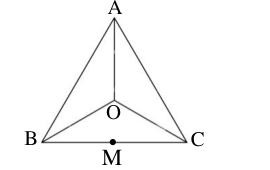
- (a)
- (b)
- (c)
- (d)
Topic: Circuits Metodi: Equivalent Circuit Reduction, Symmetry Argument Competenze: Physical Reasoning Objects: Wire Fonte: Testo (PDF) — p.7 Soluzione: Soluzioni (PDF)
OABC è un tetraedro regolare, ciascun lato del quale è costituito da filo uniforme di resistenza /m. La lunghezza di ciascun lato è di 2 m. Il punto M è il punto medio del lato BC. La resistenza tra O e M è
Quesito 25
- (a)
- (b)
- (c)
- (d)
Topic: Circuits Metodi: Equivalent Circuit Reduction, Symmetry Argument Competenze: Physical Reasoning Objects: Wire Fonte: Testo (PDF) — p.7 Soluzione: Soluzioni (PDF)
A box weighing is placed on a rough horizontal floor. The coefficient of static friction between the box and the floor is . To move the box, a pulling force is applied along the rope joined to the box at an angle with horizontal. By suitable choice of , the minimum value of that can make the box move is
Quesito 26
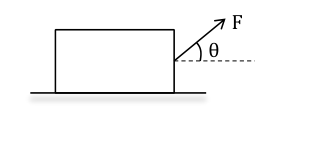
- (a)
- (b)
- (c)
- (d)
Topic: Newtonian Mechanics Metodi: Free-Body Diagram, Approximation & Series Expansion Competenze: Mathematical Modeling Objects: Block, String Fonte: Testo (PDF) — p.7 Soluzione: Soluzioni (PDF)
Una scatola di peso è posta su un pavimento orizzontale ruvido. Il coefficiente di attrito statico tra la scatola e il pavimento è . Per spostare la scatola, si applica una forza di trazione lungo la corda unita alla scatola in un angolo orizzontale. Per la scelta appropriata di , il valore minimo di che può far muovere la scatola è
Quesito 26
- (a)
- (b)
- (c)
- (d)
Topic: Newtonian Mechanics Metodi: Free-Body Diagram, Approximation & Series Expansion Competenze: Mathematical Modeling Objects: Block, String Fonte: Testo (PDF) — p.7 Soluzione: Soluzioni (PDF)
The external wall of a house consists of a layer of white pine of thickness cm and a layer of rock wool of unknown thickness in succession. The external temperature is 36 K below the indoor temperature (Given the thermal conductivity coefficient of white pine W m kelvin and that of rock wool W m kelvin). The thickness of the layer of the rock wool, so that the thermal conduction loss through the wall does not exceed 120 watt (assuming no loss of heat through the room and any energy transfer other than conduction), is
- (a) 1.2 cm
- (b) 6.4 cm
- (c) 4.8 cm
- (d) 0.8 cm
Topic: Thermodynamics Metodi: Physical Modeling Competenze: Mathematical Modeling Objects: — Fonte: Testo (PDF) — p.7 Soluzione: Soluzioni (PDF)
La parete esterna di una casa è costituita da uno strato di pino bianco di spessore cm e uno strato di lana di roccia di spessore sconosciuto. La temperatura esterna è inferiore a 36 K alla temperatura interna (Dato il coefficiente di conducibilità termica del pino bianco W m kelvin e di quella della lana rocciosa W m kelvin). Lo spessore dello strato della lana rocciosa, in modo che la perdita di conduzione termica attraverso la parete non superi i 120 watt (presumendo nessuna perdita di calore attraverso la stanza e qualsiasi trasferimento di energia diverso dalla conduzione), è
- (a) 1.2 cm
- (b) 6.4 cm
- (c) 4.8 cm
- (d) 0.8 cm
Topic: Thermodynamics Metodi: Physical Modeling Competenze: Mathematical Modeling Objects: — Fonte: Testo (PDF) — p.7 Soluzione: Soluzioni (PDF)
A 240 kg block is suspended from a fixed point O, at the end of a long ( m) massless rope. A horizontal force slowly pushes the block to move it a horizontal distance m sideways, to a position B where it remains stationary as shown in the figure. Statement 1: Force F at position B is 980 N. Statement 2: Work done by the force to bring the box from A to B is 2352 J.
Quesito 28
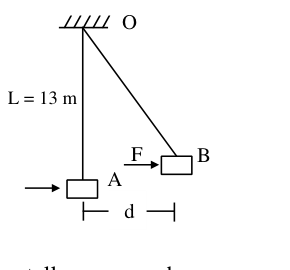
- (a) Only statement 1 is correct
- (b) Only statement 2 is correct
- (c) Both statements 1 and 2 are wrong
- (d) Both statements 1 and 2 are correct
Topic: Newtonian Mechanics Metodi: Free-Body Diagram, Conservation of Energy Competenze: Mathematical Modeling Objects: Block, String Fonte: Testo (PDF) — p.7 Soluzione: Soluzioni (PDF)
Un blocco di 240 kg è sospeso da un punto O fisso, alla fine di una lunga corda senza massa ( m). Una forza orizzontale spinge lentamente il blocco per spostarlo a distanza orizzontale m lateralmente, in una posizione B dove rimane fermo come mostrato nella figura. Dichiarazione 1: la forza F nella posizione B è 980 N. Dichiarazione 2: il lavoro svolto dalla forza per portare la scatola da A a B è 2352 J.
Quesito 28
- a) Solo la dichiarazione 1 è corretta
- b) Solo la dichiarazione 2 è corretta
- c) Entrambe le affermazioni 1 e 2 sono errate
- d) Entrambe le affermazioni 1 e 2 sono corrette
Topic: Newtonian Mechanics Metodi: Free-Body Diagram, Conservation of Energy Competenze: Mathematical Modeling Objects: Block, String Fonte: Testo (PDF) — p.7 Soluzione: Soluzioni (PDF)
The number of radioactive nuclei of a radioactive sample is experimentally measured as a function of time . At , and at s, . The half-life of the sample is estimated from these measurements. The error in the estimation of the half-life is approximately [note that for small values of , , ]
- (a) 0.26 s
- (b) 0.15 s
- (c) 0.05 s
- (d) 0.10 s
Topic: Nuclear & Particle Physics Metodi: Radioactive Decay Law, Error Propagation Competenze: Error Propagation Objects: Nucleus Fonte: Testo (PDF) — p.7 Soluzione: Soluzioni (PDF)
Il numero di nuclei radioattivi di un campione radioattivo viene misurato sperimentalmente in funzione del tempo . Al , e al s, . La semivida del campione è stimata a partire da queste misurazioni. L’errore nella stima della semivita è approssimativamente [nota che per piccoli valori di , , ]
- (a) 0.26 s
- (b) 0.15 s
- (c) 0.05 s
- (d) 0.10 s
Topic: Nuclear & Particle Physics Metodi: Radioactive Decay Law, Error Propagation Competenze: Error Propagation Objects: Nucleus Fonte: Testo (PDF) — p.7 Soluzione: Soluzioni (PDF)
An amount of heat equal to 10.61 J is given to an ideal gas at constant pressure of one atm. As a result its temperature rises by 4 K and its volume increases by 30.0 cm. The gas is
- (a) monoatomic
- (b) diatomic
- (c) triatomic
- (d) mixture of monoatomic and diatomic
Topic: Thermodynamics Metodi: First Law of Thermodynamics, Ideal Gas Law Competenze: Physical Reasoning Objects: Gas Fonte: Testo (PDF) — p.7 Soluzione: Soluzioni (PDF)
Un calore pari a 10,61 J viene assegnato a un gas ideale a pressione costante di un atm. As a result its temperature rises by 4 K and its volume increases by 30.0 cm. Il gas è
- a) monoatomica
- b) diatomica
- (c) triatomica
- d) miscela di monoatomi e di diatomi
Topic: Thermodynamics Metodi: First Law of Thermodynamics, Ideal Gas Law Competenze: Physical Reasoning Objects: Gas Fonte: Testo (PDF) — p.7 Soluzione: Soluzioni (PDF)
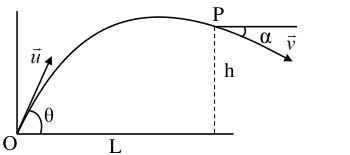
A ball is projected from point O on the ground with a certain velocity at angle from horizontal. When it reaches point P located at a horizontal distance from O and at a height above the ground, the angle subtended by the velocity vector with horizontal at this point P is expressed as
Quesito 31
- (a)
- (b)
- (c)
- (d)
Topic: Newtonian Mechanics Metodi: Kinematic Equations, Vector Decomposition Competenze: Mathematical Modeling Objects: Ball, Projectile Fonte: Testo (PDF) — p.8 Soluzione: Soluzioni (PDF)
Una palla viene proiettata dal punto O sul terreno con una certa velocità all’angolo dall’orizzontale. Quando raggiunge il punto P situato a distanza orizzontale da O e ad un’altezza sopra il terreno, l’angolo sottosinteso dal vettore di velocità con orizzontale a questo punto P è espresso come
Quesito 31
- (a)
- (b)
- (c)
- (d)
Topic: Newtonian Mechanics Metodi: Kinematic Equations, Vector Decomposition Competenze: Mathematical Modeling Objects: Ball, Projectile Fonte: Testo (PDF) — p.8 Soluzione: Soluzioni (PDF)
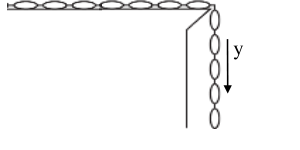
A flexible chain, of length and uniform mass per unit length , slides off the edge of a frictionless table (see figure). Initially a length of the chain hangs over the edge, with the chain held at rest. Now the chain is let free. The velocity of the chain when the chain becomes completely vertical (i.e. when the chain is just to leave the edge) is
Quesito 32
- (a)
- (b)
- (c)
- (d)
Topic: Newtonian Mechanics Metodi: Conservation of Energy, Calculus-Integration Competenze: Mathematical Modeling Objects: String Fonte: Testo (PDF) — p.8 Soluzione: Soluzioni (PDF)
Una catena flessibile, di lunghezza e massa uniforme per unità di lunghezza , scorre dal bordo di una tavola senza attrito (vedere figura). Inizialmente una lunghezza della catena si appende sul bordo, con la catena tenuta in riposo. Ora la catena è libera. La velocità della catena quando la catena diventa completamente verticale (cioè quando la catena è solo per lasciare il bordo) è
Quesito 32
- (a)
- (b)
- (c)
- (d)
Topic: Newtonian Mechanics Metodi: Conservation of Energy, Calculus-Integration Competenze: Mathematical Modeling Objects: String Fonte: Testo (PDF) — p.8 Soluzione: Soluzioni (PDF)
A Keplerian telescope is adjusted in its normal setting for parallel rays. Mounting of the objective has diameter and the diameter of the image of that mounting formed by the eye piece of the telescope is . Magnifying power of the telescope is
- (a)
- (b)
- (c)
- (d)
Topic: Geometric Optics Metodi: Thin Lens & Mirror Equation Competenze: Mathematical Modeling Objects: Lens Fonte: Testo (PDF) — p.8 Soluzione: Soluzioni (PDF)
Un telescopio kepleriano è regolato nella sua configurazione normale per raggi paralleli. Il diametro del montaggio dell’obiettivo è e il diametro dell’immagine del montaggio formato dal pezzo oculare del telescopio è . La potenza di ingrandimento del telescopio è
- (a)
- (b)
- (c)
- (d)
Topic: Geometric Optics Metodi: Thin Lens & Mirror Equation Competenze: Mathematical Modeling Objects: Lens Fonte: Testo (PDF) — p.8 Soluzione: Soluzioni (PDF)
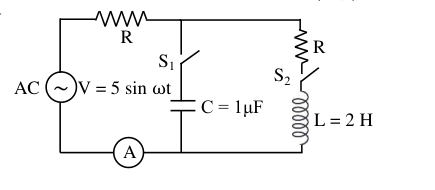
In the circuit shown below, the resistance , the inductance H and the capacitance F have been connected to an AC supply of the peak voltage of volt at a frequency . Either the switch or the switch is closed at a time. In either case, same maximum current () is recorded in the circuit. The frequency of the AC source is nearly
Quesito 34
- (a) 520 Hz
- (b) 450 Hz
- (c) 480 Hz
- (d) 550 Hz
Topic: Circuits Metodi: Physical Modeling Competenze: Mathematical Modeling Objects: Resistor, Inductor, Capacitor, Switch Fonte: Testo (PDF) — p.8 Soluzione: Soluzioni (PDF)
Nel circuito illustrato di seguito, la resistenza , l’inductanza H e la capacità F sono state collegate ad un’alimentazione in CA della tensione massima di volt a frequenza . Il switch o il switch sono chiusi in un momento. In entrambi i casi, viene registrata nella stessa corrente massima () nel circuito. La frequenza della fonte di CA è quasi
Quesito 34
- (a) 520 Hz
- (b) 450 Hz
- (c) 480 Hz
- (d) 550 Hz
Topic: Circuits Metodi: Physical Modeling Competenze: Mathematical Modeling Objects: Resistor, Inductor, Capacitor, Switch Fonte: Testo (PDF) — p.8 Soluzione: Soluzioni (PDF)
There are two given physical quantities and where is force, is density, is diameter, is velocity and is the Coefficient of viscosity. Which of the two A and B is/are dimensionless?
- (a) A
- (b) B
- (c) neither A nor B
- (d) both A and B
Topic: Fluid Mechanics Metodi: Dimensional Analysis Competenze: Physical Reasoning Objects: — Fonte: Testo (PDF) — p.8 Soluzione: Soluzioni (PDF)
Ci sono due dati quantitativi fisici e in cui è forza, è densità, è diametro, è velocità e è il coefficiente di viscosità. Quale delle due A e B è/sono senza dimensioni?
- (a) A
- (b) B
- (c) né A né B
- d) A e B
Topic: Fluid Mechanics Metodi: Dimensional Analysis Competenze: Physical Reasoning Objects: — Fonte: Testo (PDF) — p.8 Soluzione: Soluzioni (PDF)
A uniform inextensible string of length and mass is suspended vertically from a rigid support. A transverse pulse is allowed to propagate down through the string from the support. At the same time, a ball of mass is dropped from the rigid support. The ball will pass the pulse at a distance of (from the top of the string i.e. from the support)
- (a)
- (b)
- (c)
- (d)
Topic: Oscillations & Waves Metodi: Wave Equation, Kinematic Equations Competenze: Mathematical Modeling Objects: String, Ball Fonte: Testo (PDF) — p.8 Soluzione: Soluzioni (PDF)
Una corda uniforme inestensibile di lunghezza e di massa è sospesa verticalmente da un supporto rigido. Un impulso trasversale può propagarsi attraverso la corda dal supporto. Allo stesso tempo, viene scaricata dalla supporta rigida una palla di massa . La palla trascenderà il polso a una distanza di (da sopra della corda, cioè dal sostegno)
- (a)
- (b)
- (c)
- (d)
Topic: Oscillations & Waves Metodi: Wave Equation, Kinematic Equations Competenze: Mathematical Modeling Objects: String, Ball Fonte: Testo (PDF) — p.8 Soluzione: Soluzioni (PDF)
A radioactive carbon nucleus decays according to [the respective masses being and the mass of positron = the mass of electron MeV/c]. The maximum kinetic energy of the emitted positron (i.e. the value) is approximately
- (a) 1.45 MeV
- (b) 0.96 MeV
- (c) 0.43 MeV
- (d) MeV
Topic: Nuclear & Particle Physics Metodi: Mass-Energy Equivalence Competenze: Mathematical Modeling Objects: Nucleus Fonte: Testo (PDF) — p.9 Soluzione: Soluzioni (PDF)
Un nucleo di carbonio radioattivo si decompone secondo [le rispettive masse sono e la massa del positrone = la massa dell’elettrone MeV/c]. L’energia cinetica massima del positrone emesso (cioè il valore è approssimativamente
- a) 1,45 MeV
- b) 0,96 MeV
- c) 0,43 MeV
- (d) MeV
Topic: Nuclear & Particle Physics Metodi: Mass-Energy Equivalence Competenze: Mathematical Modeling Objects: Nucleus Fonte: Testo (PDF) — p.9 Soluzione: Soluzioni (PDF)
Two transverse harmonic waves are travelling on a stretched string described by and travelling in opposite direction superpose on each other. The position of the node (for ) nearest to the origin is
- (a) 5.45 cm
- (b) 6.54 cm
- (c) 6.54 cm
- (d) 5.45 cm
Topic: Oscillations & Waves Metodi: Superposition Principle, Wave Equation Competenze: Mathematical Modeling Objects: String Fonte: Testo (PDF) — p.9 Soluzione: Soluzioni (PDF)
Due onde armoniche transversali viaggiano su una corda allungata descritta da e viaggiando in direzione opposta superposate l’una sull’altra. La posizione del nodo (per ) più vicina all’origine è
- (a) 5.45 cm
- (b) 6.54 cm
- (c) 6.54 cm
- (d) 5.45 cm
Topic: Oscillations & Waves Metodi: Superposition Principle, Wave Equation Competenze: Mathematical Modeling Objects: String Fonte: Testo (PDF) — p.9 Soluzione: Soluzioni (PDF)
A perfectly reflecting solar sail, in the shape of a thin circular disc of radius , is facing the Sun such that the disc of the Sun subtends an angle of 0.01 radian at the sail. The intensity of sunlight is kW/m. The relation between and the aperture radius is
- (a)
- (b)
- (c)
- (d)
Topic: Modern-Quantum Physics Metodi: Order-of-Magnitude Estimation, Physical Modeling Competenze: Estimation & Approximation Objects: Disk, Star Fonte: Testo (PDF) — p.9 Soluzione: Soluzioni (PDF)
Una vela solare perfettamente riflettente, a forma di un sottile disco circolare di raggio , si affaccia sul Sole in modo tale che il disco del Sole sottenti un angolo di 0,01 radiano alla vela. L’intensità della luce solare è kW/m. Il rapporto tra e il raggio di apertura è
- (a)
- (b)
- (c)
- (d)
Topic: Modern-Quantum Physics Metodi: Order-of-Magnitude Estimation, Physical Modeling Competenze: Estimation & Approximation Objects: Disk, Star Fonte: Testo (PDF) — p.9 Soluzione: Soluzioni (PDF)
The electrostatic potential energy is stored within the volume of a non-conducting sphere of radius carrying total charge uniformly distributed over its volume. The total electrostatic energy contained within the sphere is . The value of is
- (a) Zero
- (b)
- (c)
- (d)
Topic: Electrostatics Metodi: Calculus-Integration, Energy Conservation Method Competenze: Mathematical Modeling Objects: Sphere Fonte: Testo (PDF) — p.9 Soluzione: Soluzioni (PDF)
L’energia potenziale elettrostatica è immagazzinata all’interno del volume di una sfera non conduttrice di raggio con carica totale uniformemente distribuita sul suo volume. L’energia elettrostatica totale contenuta nella sfera è . Il valore di è
- a) Zero
- (b)
- (c)
- (d)
Topic: Electrostatics Metodi: Calculus-Integration, Energy Conservation Method Competenze: Mathematical Modeling Objects: Sphere Fonte: Testo (PDF) — p.9 Soluzione: Soluzioni (PDF)
A long straight vertical wire of circular cross section of radius contains conduction electrons per unit volume. A current I flows upward in the wire. The expression for magnetic force on an electron at the surface of the wire is [Assume all the conduction electrons are moving with drift velocity]
- (a) outward
- (b) inward
- (c) inward
- (d) outward
Topic: Magnetism Metodi: Ampère’s Law, Lorentz Force Analysis Competenze: Mathematical Modeling Objects: Wire, Electron Fonte: Testo (PDF) — p.9 Soluzione: Soluzioni (PDF)
Un lungo filo verticale retto di sezione incrociata circolare di raggio contiene elettroni di conduttività per unità di volume. Una corrente che scorre verso l’alto nel filo. L’espressione per la forza magnetica su un elettrone alla superficie del filo è [Supponiamo che tutti gli elettroni di conduttività si muovano con velocità di deriva]
- a) all’esterno
- b) verso l’interno
- (c) verso l’interno
- (d) verso l’esterno
Topic: Magnetism Metodi: Ampère’s Law, Lorentz Force Analysis Competenze: Mathematical Modeling Objects: Wire, Electron Fonte: Testo (PDF) — p.9 Soluzione: Soluzioni (PDF)
In Young’s double slit experiment, a bright fringe is observed at cm from the center of the fringe pattern when monochromatic light of wavelength 612 nm is used. The screen is at 1.4 m from the plane of the two slits, whose separation is 0.4 mm. The number of dark fringes between the center and the said bright fringe at cm is
- (a) 13
- (b) 8
- (c) 7
- (d) 6
Topic: Wave Optics Metodi: Interference & Diffraction Analysis Competenze: Mathematical Modeling Objects: Slit, Screen Fonte: Testo (PDF) — p.9 Soluzione: Soluzioni (PDF)
Nell’esperimento di Young su doppia fessura, viene osservata una margine brillante a cm dal centro del modello margine quando viene utilizzata una luce monocromatica di lunghezza d’onda 612 nm. Lo schermo è a 1,4 m dal piano delle due fessure, la cui separazione è di 0,4 mm. Il numero di margini scuri tra il centro e la margine brillante di cui sopra a cm è
- (a) 13
- (b) 8
- (c) 7
- (d) 6
Topic: Wave Optics Metodi: Interference & Diffraction Analysis Competenze: Mathematical Modeling Objects: Slit, Screen Fonte: Testo (PDF) — p.9 Soluzione: Soluzioni (PDF)
An illuminated point object is placed in front of an equi-convex lens of refractive index and focal length cm, at a distance of m in front of the lens on its principal axis. Water () fills the space behind the lens up to a distance of 40 cm from the lens. The final image is formed on the principal axis beyond the lens at a distance from the lens. The value of and the nature of image are
- (a) 60 cm, virtual
- (b) 80 cm, virtual
- (c) 110 cm, real
- (d) 130 cm, real
Topic: Geometric Optics Metodi: Thin Lens & Mirror Equation, Snell’s Law Competenze: Mathematical Modeling Objects: Lens Fonte: Testo (PDF) — p.9 Soluzione: Soluzioni (PDF)
Un oggetto di punto illuminato è posto davanti a una lente equi-convexa di indice di rifrazione e di distanza focale cm, a una distanza di m di fronte alla lente sul suo asse principale. L’acqua () riempie lo spazio dietro la lente fino a una distanza di 40 cm dalla lente. L’immagine finale si forma sull’asse principale oltre l’obiettivo a una distanza dall’obiettivo. Il valore di e la natura dell’immagine sono
- a) 60 cm, virtuali
- b) 80 cm, virtuali
- 110 cm, reali
- d) 130 cm, reali
Topic: Geometric Optics Metodi: Thin Lens & Mirror Equation, Snell’s Law Competenze: Mathematical Modeling Objects: Lens Fonte: Testo (PDF) — p.9 Soluzione: Soluzioni (PDF)
A paramagnetic gas at room temperature 27 °C is placed in an external uniform magnetic field of magnitude tesla. The atoms of the gas have magnetic dipole moment where is Bohr magneton, and is the mass of electron. The energy difference between the parallel alignment and the antiparallel alignment of the atom’s magnetic dipole moment, with respect to the external field B, is eV where the value of is
- (a) 17.4
- (b) 1.74
- (c) 34.8
- (d) 8.7
Topic: Magnetism, Modern-Quantum Physics Metodi: Physical Modeling Competenze: Mathematical Modeling Objects: Gas, Atom, Magnetic Dipole Fonte: Testo (PDF) — p.10 Soluzione: Soluzioni (PDF)
Un gas paramagnetico a temperatura ambiente 27 °C viene posizionato in un campo magnetico esterno uniforme di magnitudo tesla. Gli atomi del gas hanno il momento di dipolo magnetico dove è il magnetone di Bohr e è la massa dell’elettrone. La differenza di energia tra l’allineamento parallelo e l’allineamento antiparallelo del momento di dipolo magnetico dell’atomo, rispetto al campo esterno B, è eV, dove il valore di è
- (a) 17.4
- (b) 1.74
- (c) 34.8
- (d) 8.7
Topic: Magnetism, Modern-Quantum Physics Metodi: Physical Modeling Competenze: Mathematical Modeling Objects: Gas, Atom, Magnetic Dipole Fonte: Testo (PDF) — p.10 Soluzione: Soluzioni (PDF)
A glass capillary with inner diameter of 0.40 mm is vertically submerged in water so that the length of its part protruding above the water surface is mm. Surface Tension of water is N m. Since the water wets the glass completely, it may be concluded that the
- (a) length of capillary above the water surface is insufficient so the water will flow out as a fountain
- (b) water will rise up to the brim forming a meniscus of radius 1.2 mm at the top
- (c) water will rise up to the brim forming a meniscus of radius 0.6 mm at the top
- (d) water will rise up to the brim forming a meniscus of radius equal to radius of the capillary
Topic: Fluid Mechanics Metodi: Hydrostatic Equilibrium Competenze: Physical Reasoning Objects: Tube Fonte: Testo (PDF) — p.10 Soluzione: Soluzioni (PDF)
Un capillario di vetro con diametro interno di 0,40 mm è immerso verticalmente in acqua in modo che la lunghezza della sua parte che si estende sopra la superficie dell’acqua sia mm. Tensione superficiale dell’acqua è N m. Poiché l’acqua bagna completamente il vetro, si può concludere che il
- a) la lunghezza dei capillari sopra la superficie dell’acqua è insufficiente per far scorrere l’acqua come fontana
- b) l’acqua si alzerà fino al bordo formando un menisco di raggio di 1,2 mm in alto
- l’acqua si alzerà fino al bordo formando un menisco di raggio di 0,6 mm in alto
- d) l’acqua si alzerà fino al bordo formando un menisco di raggio pari al raggio del capillio
Topic: Fluid Mechanics Metodi: Hydrostatic Equilibrium Competenze: Physical Reasoning Objects: Tube Fonte: Testo (PDF) — p.10 Soluzione: Soluzioni (PDF)
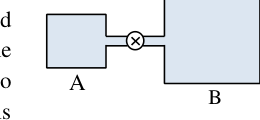
The container A in the figure holds an ideal gas at a pressure of Pa at 27 °C. It is connected to the container B by a thin tube fitted with a closed valve. Container B with volume four times the volume of A holds the same ideal gas at a pressure Pa at 127 °C. The valve is now opened to allow the pressure to equalize, but the temperature of each container is maintained as before. The common pressure in the two containers (in kPa) is
Quesito 46
- (a) 200
- (b) 300
- (c) 320
- (d) 180
Topic: Thermodynamics Metodi: Ideal Gas Law Competenze: Mathematical Modeling Objects: Container, Gas, Tube Fonte: Testo (PDF) — p.10 Soluzione: Soluzioni (PDF)
Il contenitore A nella figura contiene un gas ideale a una pressione di Pa a 27 ° C. È collegato al contenitore B con un tubo sottile dotato di una valvola chiusa. Il contenitore B con un volume quattro volte superiore a quello di A contiene lo stesso gas ideale a una pressione Pa a 127 ° C. La valvola è ora aperta per permettere di eguagliare la pressione, ma la temperatura di ogni contenitore è mantenuta come prima. La pressione comune nei due contenitori (in kPa) è
Quesito 46
- (a) 200
- (b) 300
- (c) 320
- (d) 180
Topic: Thermodynamics Metodi: Ideal Gas Law Competenze: Mathematical Modeling Objects: Container, Gas, Tube Fonte: Testo (PDF) — p.10 Soluzione: Soluzioni (PDF)
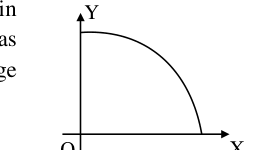
A thin plastic disc, which is a quarter of a circle of radius m, lies in the first quadrant of x-y plane, with the center of curvature at the origin O as shown. It is charged uniformly on one side (one face) with surface charge density . Electric potential at point P is
Quesito 47
- (a)
- (b)
- (c)
- (d)
Topic: Electrostatics Metodi: Electric Potential Method, Calculus-Integration Competenze: Mathematical Modeling Objects: Disk Fonte: Testo (PDF) — p.10 Soluzione: Soluzioni (PDF)
Un sottile disco di plastica, che è un quarto di un cerchio di raggio m, si trova nel primo quadrante del piano x-y, con il centro di curvatura all’origine O come mostrato. È caricato uniformemente su un lato (una faccia) con una densità di carica superficiale . Potenzialmente, il potenziale elettrico al punto P è
Quesito 47
- (a)
- (b)
- (c)
- (d)
Topic: Electrostatics Metodi: Electric Potential Method, Calculus-Integration Competenze: Mathematical Modeling Objects: Disk Fonte: Testo (PDF) — p.10 Soluzione: Soluzioni (PDF)
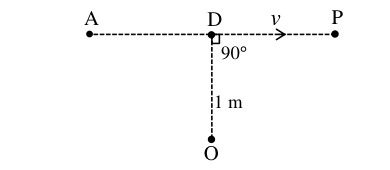
The charge on a small point object at A produces an electric potential volt at a point P. Because of an unavoidable situation, leakage of the charge from the object at A starts at at a constant rate of Cs. To maintain the potential of 3 volt at the point P, the object is made to move towards P with a certain velocity . When the point object crosses the point D shown in the figure, it is found to have a charge of C and the direction of its velocity is perpendicular to OD. The resulting magnetic field , at this instant, at the location O (such that m) is
Quesito 48
- (a)
- (b)
- (c)
- (d)
Topic: Electrostatics, Magnetism Metodi: Biot-Savart Law, Electric Potential Method Competenze: Mathematical Modeling Objects: Point Charge Fonte: Testo (PDF) — p.10 Soluzione: Soluzioni (PDF)
La carica su un piccolo oggetto a punto A produce un potenziale elettrico volt a punto P. A causa di una situazione inevitabile, la perdita della carica dall’oggetto a A inizia a a un tasso costante di Cs. Per mantenere il potenziale di 3 volt al punto P, l’oggetto viene fatto muoversi verso P con una certa velocità . Quando l’oggetto puntino attraversa il punto D mostrato nella figura, si scopre che ha una carica di C e la direzione della sua velocità è perpendicolare a OD. Il campo magnetico risultante , in questo istante, nella posizione O (come m) è
Quesito 48
- (a)
- (b)
- (c)
- (d)
Topic: Electrostatics, Magnetism Metodi: Biot-Savart Law, Electric Potential Method Competenze: Mathematical Modeling Objects: Point Charge Fonte: Testo (PDF) — p.10 Soluzione: Soluzioni (PDF)
Part A-2 (one or more options may be correct)
An electric circuit consists of a battery of emf , an inductance and a resistance in series. The switch S is closed at . The current in the circuit grows exponentially with time as depicted by curve (1). The values of the circuit parameters (, or ) are now somehow changed. The circuit is closed second time, the growth of current follows curve (2). The following conclusion(s) may be drawn
Quesito 49
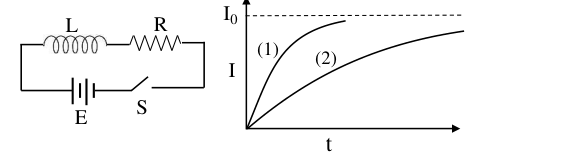
- (a) E and R are unchanged but L has increased
- (b) is unchanged but has increased
- (c) is unchanged but has decreased
- (d) Stored magnetic energy has increased
Topic: Electromagnetic Induction Metodi: Differential Equations, Faraday’s Law of Induction Competenze: Diagrammatic Reasoning Objects: Battery, Inductor, Resistor, Switch Fonte: Testo (PDF) — p.11 Soluzione: Soluzioni (PDF)
**Parte A-2 (una o più opzioni possono essere corrette) **
Un circuito elettrico è costituito da una batteria di emf , di induttanza e di resistenza in serie. Il interruttore S è chiuso a . La corrente nel circuito cresce esponenzialmente con il tempo come illustrato dalla curva (1). I valori dei parametri del circuito (, o ) sono ora in qualche modo modificati. Il circuito viene chiuso per la seconda volta, la crescita della corrente segue la curva (2). Si possono trarre le seguenti conclusioni:
Quesito 49
- a) E e R sono invariati ma L è aumentato
- b) è rimasto invariato ma è aumentato
- c) è rimasto invariato ma è diminuito
- d) L’energia magnetica immagazzinata è aumentata
Topic: Electromagnetic Induction Metodi: Differential Equations, Faraday’s Law of Induction Competenze: Diagrammatic Reasoning Objects: Battery, Inductor, Resistor, Switch Fonte: Testo (PDF) — p.11 Soluzione: Soluzioni (PDF)
The Earth is revolving around the Sun (mass ) in a circular orbit of radius with a period of revolution year. Suppose that during the revolution of the Earth, at any instant, the mass of the Sun instantaneously becomes double i.e. . The correct alternative(s) is/are [Assume that the Sun and the Earth are point masses]
- (a) The period of revolution of the Earth around the Sun now becomes year
- (b) There is no change in angular momentum of the Earth around the Sun
- (c) Minimum distance of the Earth from Sun during revolution is now
- (d) Maximum speed of the Earth during revolution around the Sun is
Topic: Gravitation Metodi: Kepler’s Laws, Conservation Laws Competenze: Physical Reasoning Objects: Planet, Star Fonte: Testo (PDF) — p.11 Soluzione: Soluzioni (PDF)
La Terra ruota attorno al Sole (massa ) in un’orbita circolare di raggio con un periodo di rivoluzione anno. Supponiamo che durante la rivoluzione della Terra, in qualsiasi istante, la massa del Sole diventerà istantaneamente doppia, cioè. . L’alternativa corretta (s) è/sono [Supponiamo che il Sole e la Terra siano masse puntine]
- (a) Il periodo di rivoluzione della Terra attorno al Sole ora diventa anno
- (b) Non vi è alcun cambiamento nel momento angolare della Terra attorno al Sole
- (c) La distanza minima della Terra dal Sole durante la rivoluzione è ora
- (d) La velocità massima della Terra durante la rivoluzione intorno al Sole è
Topic: Gravitation Metodi: Kepler’s Laws, Conservation Laws Competenze: Physical Reasoning Objects: Planet, Star Fonte: Testo (PDF) — p.11 Soluzione: Soluzioni (PDF)
An optical fibre consists of a glass core (refractive index ) surrounded by a cladding (refractive index ). A beam of light enters one end of the fibre at P, from air at angle , with the axis of fibre as shown in the figure. Choose the correct option(s)
Quesito 51
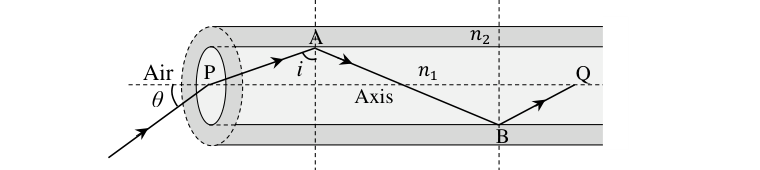
- (a) Maximum value of for which a ray can travel down the fibre is
- (b) Maximum value of for which a ray can travel down the fibre is
- (c) If (in air) and , then for reflection just at the critical angle, the value of is
- (d) A ray entering at travels a distance from P to Q, inside the fibre directly along the fibre axis. Another ray travelling through fibre is repeatedly reflected at the critical angle, at interface of glass core and surrounding layer/cladding. Both the rays travel from point P to point Q on the axis. If the two rays started from point P at the same time, the difference in the time taken to reach the point Q by the two rays is (here is the speed of light in vacuum)
Topic: Geometric Optics Metodi: Snell’s Law Competenze: Mathematical Modeling Objects: Tube Fonte: Testo (PDF) — p.11 Soluzione: Soluzioni (PDF)
Una fibra ottica è costituita da un nucleo di vetro (indice di rifrazione ) circondato da un rivestimento (indice di rifrazione ). Un raggio di luce entra in una estremità della fibra a P, dall’aria ad angolo , con l’asse della fibra come mostrato nella figura. Scegliere l’opzione corretta
Quesito 51
- a) Il valore massimo di per il quale un raggio può viaggiare lungo la fibra è
- b) Il valore massimo di per il quale un raggio può viaggiare lungo la fibra è
- c) Se (all’aria) e , il valore di è per la riflessione solo all’angolo critico
- (d) Un raggio che entra a percorre una distanza da P a Q, all’interno della fibra direttamente lungo l’asse della fibra. Un altro raggio che attraversa la fibra si riflette ripetutamente all’angolo critico, all’interfaccia del nucleo di vetro e dello strato/coperto circostante. Entrambi i raggi viaggiano dal punto P al punto Q sull’asse. Se i due raggi partono dal punto P contemporaneamente, la differenza nel tempo impiegato per raggiungere il punto Q da entrambi i raggi è (qui è la velocità della luce nel vuoto)
Topic: Geometric Optics Metodi: Snell’s Law Competenze: Mathematical Modeling Objects: Tube Fonte: Testo (PDF) — p.11 Soluzione: Soluzioni (PDF)
A series LCR circuit fed with AC has resonant angular frequency of rad/s. When the same circuit is driven at an angular frequency of rad/s, it has an impedance of k and phase constant of . The values of L, C and R for this circuit may be
- (a)
- (b) mH
- (c) nf
- (d)
Topic: Circuits Metodi: Physical Modeling Competenze: Mathematical Modeling Objects: Inductor, Capacitor, Resistor Fonte: Testo (PDF) — p.12 Soluzione: Soluzioni (PDF)
Un circuito LCR di serie alimentato con CA ha una frequenza angolare di risonanza di rad/s. Quando lo stesso circuito è a frequenza angolare di rad/s, ha un’impedenza di k e una costante di fase di . I valori di L, C e R per questo circuito possono essere:
- (a)
- (b) mH
- (c) nf
- (d)
Topic: Circuits Metodi: Physical Modeling Competenze: Mathematical Modeling Objects: Inductor, Capacitor, Resistor Fonte: Testo (PDF) — p.12 Soluzione: Soluzioni (PDF)
A long straight wire, having a radius greater than 4.0 mm, carries a current that is uniformly distributed over its cross-section. The magnitude of magnetic field due to the current is 0.28 mT at mm and 0.20 mT at mm, respectively, from the axis of the wire then the
- (a) magnitude of the magnetic field at a distance mm from axis is 0.14 mT
- (b) magnitude of the magnetic field at mm is greater than that at mm
- (c) current flowing in the wire is A
- (d) current density in the wire is A/m
Topic: Magnetism Metodi: Ampère’s Law Competenze: Mathematical Modeling Objects: Wire Fonte: Testo (PDF) — p.12 Soluzione: Soluzioni (PDF)
Un lungo filo retto, con un raggio superiore a 4,0 mm, porta una corrente uniformemente distribuita sulla sua sezione trasversale. La magnitudine del campo magnetico dovuto alla corrente è di 0,28 mT a mm e 0,20 mT a mm, rispettivamente, dall’asse del filo e poi la
- a) la magnitudine del campo magnetico a una distanza mm dall’asse è di 0,14 mT
- b) la magnitudine del campo magnetico a mm è superiore a quella a mm
- (c) corrente corrente nel filo è A
- (d) la densità di corrente nel filo è A/m
Topic: Magnetism Metodi: Ampère’s Law Competenze: Mathematical Modeling Objects: Wire Fonte: Testo (PDF) — p.12 Soluzione: Soluzioni (PDF)
In the given combination of capacitors F, F, F, F and F, a source of 12 volt is connected across the points A and B. Then the
Quesito 54
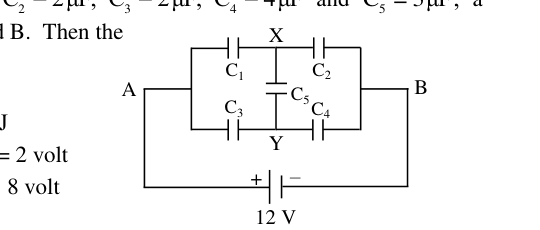
- (a) equivalent capacity between A and B is F
- (b) stored electrical energy of the system is J
- (c) potential difference between X and Y is volt
- (d) potential difference across the capacitor is 8 volt
Topic: Circuits Metodi: Equivalent Circuit Reduction Competenze: Mathematical Modeling Objects: Capacitor, Battery Fonte: Testo (PDF) — p.12 Soluzione: Soluzioni (PDF)
Nella data combinazione di condensatori F, F, F, F e F, è collegata una fonte di 12 volt attraverso i punti A e B. Poi il
Quesito 54
- a) capacità equivalente tra A e B è F
- b) l’energia elettrica immagazzinata del sistema è J
- c) la differenza di potenziale tra X e Y è volt
- (d) la differenza di potenziale del condensatore è di 8 volt
Topic: Circuits Metodi: Equivalent Circuit Reduction Competenze: Mathematical Modeling Objects: Capacitor, Battery Fonte: Testo (PDF) — p.12 Soluzione: Soluzioni (PDF)
One mole of an ideal monoatomic gas, initially at temperature , is compressed to of its volume by a piston in a cylinder such that the heat dissipated into the environment is equal to the change in the internal energy of the gas. Then the
- (a) molar heat capacity of the gas is
- (b) final temperature of the gas is
- (c) work done on the gas is
- (d) equation of state of the process is constant
Topic: Thermodynamics Metodi: First Law of Thermodynamics, Thermodynamic Cycle Analysis Competenze: Mathematical Modeling Objects: Gas, Piston, Cylinder Fonte: Testo (PDF) — p.12 Soluzione: Soluzioni (PDF)
Un mole di un gas monoatomico ideale, inizialmente a temperatura , viene compresso a del suo volume da un pistone in un cilindro in modo tale che il calore dissipato nell’ambiente sia uguale al cambiamento dell’energia interna del gas. Poi il
- a) la capacità termico molare del gas è
- b) la temperatura finale del gas è
- c) il lavoro svolto sul gas è
- (d) l’equazione dello stato del processo è costante
Topic: Thermodynamics Metodi: First Law of Thermodynamics, Thermodynamic Cycle Analysis Competenze: Mathematical Modeling Objects: Gas, Piston, Cylinder Fonte: Testo (PDF) — p.12 Soluzione: Soluzioni (PDF)
A solid ball of mass and radius (see figure) is lying on a horizontal table. The ball experiences a short horizontal impulse which imparts a momentum to the ball. The height of point of impact above the center line is (). Choose the correct option/option(s).
Quesito 56
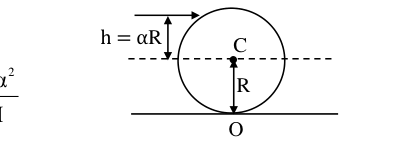
- (a) Translational energy of the ball is
- (b) Energy of pure rotational motion of the ball is
- (c) For , the ball rolls without sliding
- (d) For , pure rotational motion will be observed
Topic: Rotational Dynamics Metodi: Impulse-Momentum Theorem, Torque & Angular Momentum Analysis Competenze: Mathematical Modeling Objects: Ball Fonte: Testo (PDF) — p.12 Soluzione: Soluzioni (PDF)
Una palla solida di massa e raggio (vedi figura) si trova su una tavola orizzontale. La palla subisce un breve impulso orizzontale che conferisce un impulso alla palla. L’altezza del punto di impatto sopra la linea centrale è (). Scegliere l’opzione/opzioni corrette (s).
Quesito 56
- (a) L’energia di traslazione della palla è
- b) L’energia del movimento di rotazione puro della palla è
- (c) Per , la palla ruota senza scivolare
- (d) Per , si osserverà un movimento di rotazione puro
Topic: Rotational Dynamics Metodi: Impulse-Momentum Theorem, Torque & Angular Momentum Analysis Competenze: Mathematical Modeling Objects: Ball Fonte: Testo (PDF) — p.12 Soluzione: Soluzioni (PDF)
According to Bohr theory, in the ground state of hydrogen atom, an electron revolves in circular orbit of radius with velocity and circulation frequency . The magnetic dipole moment of the electronic orbit is . The magnetic field produced by the circulating electron at the center of the atom is . Then for a He ion in the state (electron in the orbit)
- (a) the radius of the orbit is
- (b) the magnetic dipole moment of the orbit is
- (c) the frequency of circulation is
- (d) the magnetic field at the center is
Topic: Modern-Quantum Physics Metodi: Bohr Model & Quantization Competenze: Mathematical Modeling Objects: Atom, Electron Fonte: Testo (PDF) — p.13 Soluzione: Soluzioni (PDF)
Secondo la teoria di Bohr, nello stato di base dell’atomo di idrogeno, un elettrone ruota in orbita circolare di raggio con velocità e frequenza di circolazione . Il momento di dipolo magnetico dell’orbita elettronica è . Il campo magnetico prodotto dall’elettrone circolante al centro dell’atomo è . Poi per un ione He nello stato (elettrone nell’orbita )
- a) il raggio di orbita è
- b) il momento di dipolo magnetico dell’orbita è
- c) la frequenza di circolazione è
- (d) il campo magnetico al centro è
Topic: Modern-Quantum Physics Metodi: Bohr Model & Quantization Competenze: Mathematical Modeling Objects: Atom, Electron Fonte: Testo (PDF) — p.13 Soluzione: Soluzioni (PDF)
A body of mass kg is moving along axis under the action of a conservative force. Its potential energy as a function of position is given by J ( in m). Then
- (a) force acting on the body at is 25 N
- (b) there is stable equilibrium at m
- (c) there is unstable equilibrium at m
- (d) the body executes (small) oscillations with angular frequency rad s
Topic: Oscillations & Waves Metodi: Conservation of Energy, Simple Harmonic Motion Analysis Competenze: Mathematical Modeling Objects: — Fonte: Testo (PDF) — p.13 Soluzione: Soluzioni (PDF)
Un corpo di massa kg si muove lungo l’asse sotto l’azione di una forza conservatrice. La sua energia potenziale in funzione della posizione è data da J ( in m). Allora…
- a) la forza che agisce sul corpo a è di 25 N
- b) l’equilibrio è stabile a m
- c) l’equilibrio è instabile a m
- (d) il corpo esegue oscillazioni (piccole) con frequenza angolare rad s
Topic: Oscillations & Waves Metodi: Conservation of Energy, Simple Harmonic Motion Analysis Competenze: Mathematical Modeling Objects: — Fonte: Testo (PDF) — p.13 Soluzione: Soluzioni (PDF)
A uniform rod OA of length is freely pivoted at one end O. Let C be the midpoint (i.e. ). Choose the correct statement(s)
Quesito 59
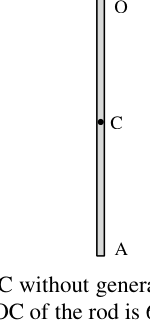
- (a) The rod can perform small angular oscillations with time period
- (b) The rod is brought to the horizontal position and then released from rest. The angular velocity of the rod at the instant when it is vertical is
- (c) When the oscillating rod comes to the vertical position, it breaks at midpoint C without generating any impulsive force, the largest angle from vertical reached by the upper part OC of the rod is 60°.
- (d) After breaking, the lower part just falls vertically rotating about its center.
Topic: Rotational Dynamics Metodi: Torque & Angular Momentum Analysis, Conservation of Energy Competenze: Physical Reasoning Objects: Rod Fonte: Testo (PDF) — p.13 Soluzione: Soluzioni (PDF)
Una barra uniforme OA di lunghezza è liberamente rotata ad una estremità O. C sia il punto medio (cioè ). Scegli la dichiarazione corretta
Quesito 59
- (a) La canna può eseguire piccole oscillazioni angolari con periodo di tempo
- b) La canna viene portata in posizione orizzontale e poi rilasciata dal riposo. La velocità angolare della canna nel momento in cui è verticale è
- (c) Quando la canna oscillante si trova in posizione verticale, si rompe al punto medio C senza generare alcuna forza impulsiva, l’angolo più grande da verticale raggiunto dalla parte superiore OC della canna è 60°.
- (d) Dopo la rottura, la parte inferiore cade semplicemente rotando verticalmente intorno al suo centro.
Topic: Rotational Dynamics Metodi: Torque & Angular Momentum Analysis, Conservation of Energy Competenze: Physical Reasoning Objects: Rod Fonte: Testo (PDF) — p.13 Soluzione: Soluzioni (PDF)
A boy stands on a stationary ice boat on a frictionless horizontal flat iceberg. The boy and the boat have a combined mass of kg. Two balls of masses kg and kg are placed on the boat. In order to get the boat moving, the boy throws the balls backward horizontally either in succession or both together. In each case the balls are thrown backward with a certain speed m s relative to the boat just when the ball is being thrown. The resulting speed of the system of the boat and the boy is
- (a) m s when both the balls and are thrown together.
- (b) m s when both the balls and are thrown together.
- (c) m s if the balls are thrown one after the other, first and then .
- (d) m s if the balls are thrown one after the other, first and then .
Topic: Conservation of Momentum Metodi: Conservation of Momentum Competenze: Mathematical Modeling Objects: Ball Fonte: Testo (PDF) — p.13 Soluzione: Soluzioni (PDF)
Un ragazzo è in una barca di ghiaccio fermo su un iceberg orizzontale piatto senza attrito. Il ragazzo e la barca hanno una massa combinata di kg. Al bordo sono collocate due palle di massa kg e kg. Per far muovere la barca, il ragazzo lancia le palle orizzontalmente indietro, in sequenza o insieme. In ogni caso le palle vengono lanciate indietro con una certa velocità m s rispetto alla barca proprio quando la palla viene lanciata. La velocità risultante del sistema della barca e del ragazzo è
- a) m s quando entrambe le palle e sono lanciate insieme.
- b) m s quando entrambe le palle e sono lanciate insieme.
- (c) m s se le palle sono lanciate una dopo l’altra, prima e poi .
- (d) m s se le palle vengono lanciate una dopo l’altra, prima e poi .
Topic: Conservation of Momentum Metodi: Conservation of Momentum Competenze: Mathematical Modeling Objects: Ball Fonte: Testo (PDF) — p.13 Soluzione: Soluzioni (PDF)