A point mass moves in a straight line under a retardation [where is a positive constant and is the instantaneous velocity]. The initial velocity of the point mass is . The displacement of the point mass at time is
- (a)
- (b)
- (c)
- (d)
Topic: Newtonian Mechanics Metodi: Differential Equations, Kinematic Equations Competenze: Mathematical Modeling Objects: — Fonte: Testo (PDF) — p.3 Soluzione: Soluzioni (PDF)
Una massa puntologica si muove in linea retta sotto un ritardo [dove è una costante positiva e è la velocità istantanea]. La velocità iniziale della massa puntaria è . Il spostamento della massa puntaria al tempo è
- (a)
- (b)
- (c)
- (d)
Topic: Newtonian Mechanics Metodi: Differential Equations, Kinematic Equations Competenze: Mathematical Modeling Objects: — Fonte: Testo (PDF) — p.3 Soluzione: Soluzioni (PDF)
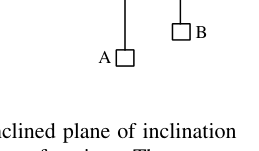
In the arrangement shown in figure, represents the magnitude of acceleration of small blocks A and B while is the tension in the massless string passing over the frictionless and massless pulley. The sum of the masses of blocks A and B is constant. For this system, a linear relationship can be obtained between
Quesito 2
- (a) and
- (b) and
- (c) and
- (d) and
Topic: Newtonian Mechanics Metodi: Free-Body Diagram, Newton’s Law of Gravitation Competenze: Graph Linearization Objects: Block, String, Pulley Fonte: Testo (PDF) — p.3 Soluzione: Soluzioni (PDF)
Nella disposizione mostrata nella figura, rappresenta la magnitudine di accelerazione dei piccoli blocchi A e B mentre rappresenta la tensione nella corda senza massa che passa sopra la polla senza attrito e senza massa. La somma delle masse dei blocchi A e B è costante. Per questo sistema, si può ottenere una relazione lineare tra
Quesito 2
- a) e
- b) e
- c) e
- (d) e
Topic: Newtonian Mechanics Metodi: Free-Body Diagram, Newton’s Law of Gravitation Competenze: Graph Linearization Objects: Block, String, Pulley Fonte: Testo (PDF) — p.3 Soluzione: Soluzioni (PDF)
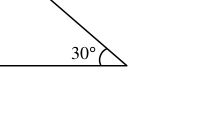
A thin uniform circular ring of mass is rolling without slipping down an inclined plane of inclination with the horizontal. The coefficient of friction between the ring and the surface is . The correct statement is
Quesito 3
- (a) linear acceleration of the center of the ring along the plane is
- (b) force of friction between the ring and the inclined plane is
- (c) the ring keeps rolling for all values of the coefficient of friction
- (d) linear acceleration of the center of the ring along the plane is
Topic: Rotational Dynamics Metodi: Torque & Angular Momentum Analysis, Free-Body Diagram Competenze: Physical Reasoning Objects: Inclined Plane Fonte: Testo (PDF) — p.3 Soluzione: Soluzioni (PDF)
Un anello circolare sottile uniforme di massa ruota senza scivolare in un piano inclinato di inclinazione con l’orizzontale. Il coefficiente di attrito tra l’anello e la superficie è . La dichiarazione corretta è:
Quesito 3
- (a) l’accelerazione lineare del centro dell’anello lungo il piano è
- b) la forza di attrito tra l’anello e il piano inclinato è
- c) l’anello continua a rotolare per tutti i valori del coefficiente di attrito
- (d) l’accelerazione lineare del centro dell’anello lungo il piano è
Topic: Rotational Dynamics Metodi: Torque & Angular Momentum Analysis, Free-Body Diagram Competenze: Physical Reasoning Objects: Inclined Plane Fonte: Testo (PDF) — p.3 Soluzione: Soluzioni (PDF)
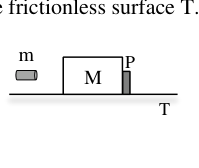
A bullet of mass can penetrate a target (a heavy block of mass ) up to a distance , when the target is held stationary by a stopper P (shown in figure). Up to what distance the bullet will penetrate if the block of mass is free to move (i.e. when the stopper P is removed) on the frictionless surface T?
Quesito 4
- (a)
- (b)
- (c)
- (d)
Topic: Conservation of Momentum, Conservation of Energy Metodi: Conservation of Momentum, Conservation of Energy Competenze: Physical Reasoning Objects: Block, Projectile Fonte: Testo (PDF) — p.3 Soluzione: Soluzioni (PDF)
Un proiettile di massa può penetrare un bersaglio (un blocco pesante di massa ) fino a una distanza , quando il bersaglio è tenuto fermo da un tappo P (visto nella figura). Fino a che distanza il proiettile penetrerà se il blocco di massa è libero di muoversi (cioè quando il tappo P è rimosso) sulla superficie T senza attrito?
Quesito 4
- (a)
- (b)
- (c)
- (d)
Topic: Conservation of Momentum, Conservation of Energy Metodi: Conservation of Momentum, Conservation of Energy Competenze: Physical Reasoning Objects: Block, Projectile Fonte: Testo (PDF) — p.3 Soluzione: Soluzioni (PDF)
Knowing that the atomic masses of Al and Mg are respectively and while electron mass is often expressed as , the value (energy liberated) of the decay nuclear reaction in MeV is
- (a) 4.278
- (b) 3.767
- (c) 3.256
- (d) 931.478
Topic: Nuclear & Particle Physics Metodi: Mass-Energy Equivalence Competenze: Physical Reasoning Objects: Nucleus Fonte: Testo (PDF) — p.3 Soluzione: Soluzioni (PDF)
Sapendo che le masse atomiche di Al e Mg sono rispettivamente e mentre la massa elettronica è spesso espressa come , il valore (energia liberata) della reazione nucleare di decadimento in MeV è
- (a) 4.278
- (b) 3.767
- (c) 3.256
- (d) 931.478
Topic: Nuclear & Particle Physics Metodi: Mass-Energy Equivalence Competenze: Physical Reasoning Objects: Nucleus Fonte: Testo (PDF) — p.3 Soluzione: Soluzioni (PDF)
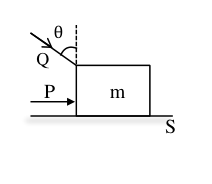
A block of mass , lying on a rough horizontal plane, is acted upon by a horizontal force and simultaneously by another force acting at an angle from the vertical as shown. The block will remain in equilibrium if the coefficient of friction between the block and the surface is
Quesito 6
- (a) at least
- (b) at least
- (c) equal to
- (d) equal to
Topic: Newtonian Mechanics, Rigid Body Statics Metodi: Free-Body Diagram, Vector Decomposition Competenze: Physical Reasoning Objects: Block Fonte: Testo (PDF) — p.4 Soluzione: Soluzioni (PDF)
Un blocco di massa , situato su un piano orizzontale grosso, è agito da una forza orizzontale e contemporaneamente da un’altra forza che agisce ad un angolo dalla verticale come mostrato. Il blocco rimarrà in equilibrio se il coefficiente di attrito tra il blocco e la superficie è
Quesito 6
- a) almeno
- b) almeno
- (c) pari a
- d) pari a
Topic: Newtonian Mechanics, Rigid Body Statics Metodi: Free-Body Diagram, Vector Decomposition Competenze: Physical Reasoning Objects: Block Fonte: Testo (PDF) — p.4 Soluzione: Soluzioni (PDF)
Knowing that the acceleration due to gravity on the Earth surface is and the radius of the Earth is , a small body of mass falls on the Earth from a height above the Earth’s surface. During the freefall, the potential energy of the falling body decreases by
- (a)
- (b)
- (c)
- (d)
Topic: Gravitation Metodi: Newton’s Law of Gravitation, Conservation of Energy Competenze: Physical Reasoning Objects: Planet Fonte: Testo (PDF) — p.4 Soluzione: Soluzioni (PDF)
Sapendo che l’accelerazione dovuta alla gravità sulla superficie terrestre è e il raggio della Terra è , un piccolo corpo di massa cade sulla Terra da un’altezza sopra la superficie terrestre. Durante la caduta libera, l’energia potenziale del corpo cadente diminuisce di
- (a)
- (b)
- (c)
- (d)
Topic: Gravitation Metodi: Newton’s Law of Gravitation, Conservation of Energy Competenze: Physical Reasoning Objects: Planet Fonte: Testo (PDF) — p.4 Soluzione: Soluzioni (PDF)
At some instant, a motor car is moving on a circular path of radius 600 m, with a speed . If its speed is increased at a rate of , the magnitude of the acceleration of the car at that instant is
- (a)
- (b)
- (c)
- (d)
Topic: Newtonian Mechanics Metodi: Kinematic Equations, Vector Decomposition Competenze: Physical Reasoning Objects: — Fonte: Testo (PDF) — p.4 Soluzione: Soluzioni (PDF)
In un istante, un’auto si muove su un percorso circolare di 600 m di raggio, con una velocità . Se la sua velocità è aumentata a un ritmo , la magnitudine dell’accelerazione dell’auto in quel momento è
- (a)
- (b)
- (c)
- (d)
Topic: Newtonian Mechanics Metodi: Kinematic Equations, Vector Decomposition Competenze: Physical Reasoning Objects: — Fonte: Testo (PDF) — p.4 Soluzione: Soluzioni (PDF)
A cricket ball, thrown across a field, is at heights of and above the point of projection, at time and time after the throw, respectively. It is then caught by the wicket keeper at the same height as that from which it was thrown. The Time of Flight () of the ball is
- (a)
- (b)
- (c)
- (d)
Topic: Newtonian Mechanics Metodi: Kinematic Equations Competenze: Mathematical Modeling Objects: Ball, Projectile Fonte: Testo (PDF) — p.4 Soluzione: Soluzioni (PDF)
Una palla di cricket, lanciata attraverso un campo, è ad altezza di e sopra il punto di proiezione, rispettivamente al tempo e al tempo dopo il lancio. Il portiere di pallone lo cattura poi alla stessa altezza da cui è stato lanciato. Il tempo di volo () della palla è
- (a)
- (b)
- (c)
- (d)
Topic: Newtonian Mechanics Metodi: Kinematic Equations Competenze: Mathematical Modeling Objects: Ball, Projectile Fonte: Testo (PDF) — p.4 Soluzione: Soluzioni (PDF)
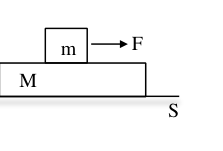
A plate of mass is placed on a horizontal frictionless surface . A block of mass is placed on the plate. The coefficient of dynamic friction between the block and the plate is . If a horizontal force is applied to the block (as shown), the acceleration of the plate will be
Quesito 10
- (a)
- (b)
- (c)
- (d)
Topic: Newtonian Mechanics Metodi: Free-Body Diagram, Physical Modeling Competenze: Physical Reasoning Objects: Block Fonte: Testo (PDF) — p.4 Soluzione: Soluzioni (PDF)
Una piastra di massa è collocata su una superficie orizzontale senza attrito . Il blocco di massa è posto sulla piastra. Il coefficiente di attrito dinamico tra il blocco e la piastra è . Se viene applicata una forza orizzontale al blocco (come mostrato), l’accelerazione della piastra sarà
Quesito 10
- (a)
- (b)
- (c)
- (d)
Topic: Newtonian Mechanics Metodi: Free-Body Diagram, Physical Modeling Competenze: Physical Reasoning Objects: Block Fonte: Testo (PDF) — p.4 Soluzione: Soluzioni (PDF)
A simple pendulum, with a bob of mass , oscillates in a vertical plane, with an angular amplitude . The tension in its string when it passes through the mean position is . Neglecting the effect of air friction and the viscosity of air, the angular amplitude is
- (a)
- (b)
- (c)
- (d)
Topic: Oscillations & Waves, Newtonian Mechanics Metodi: Conservation of Energy, Free-Body Diagram Competenze: Physical Reasoning Objects: Pendulum Fonte: Testo (PDF) — p.4 Soluzione: Soluzioni (PDF)
Un semplice pendolo, con una bobina di massa , oscilla in piano verticale, con un’ampiezza angolare . La tensione della sua corda quando passa attraverso la posizione media è . Nonostante l’effetto della friczione dell’aria e della viscosità dell’aria, l’ampiezza angolare è
- (a)
- (b)
- (c)
- (d)
Topic: Oscillations & Waves, Newtonian Mechanics Metodi: Conservation of Energy, Free-Body Diagram Competenze: Physical Reasoning Objects: Pendulum Fonte: Testo (PDF) — p.4 Soluzione: Soluzioni (PDF)
Because of their mutual gravitational attraction, four identical planets each of mass are orbiting in a circular path of radius in the same sense (angular direction). The magnitude of the velocity of each planet is
- (a)
- (b)
- (c)
- (d)
Topic: Gravitation Metodi: Newton’s Law of Gravitation, Symmetry Argument Competenze: Physical Reasoning Objects: Planet Fonte: Testo (PDF) — p.5 Soluzione: Soluzioni (PDF)
A causa della loro attrazione gravitazionale reciproca, quattro pianeti identici di massa orbitano in un percorso circolare di raggio nello stesso senso (direzione angolare). La magnitudo della velocità di ogni pianeta è
- (a)
- (b)
- (c)
- (d)
Topic: Gravitation Metodi: Newton’s Law of Gravitation, Symmetry Argument Competenze: Physical Reasoning Objects: Planet Fonte: Testo (PDF) — p.5 Soluzione: Soluzioni (PDF)
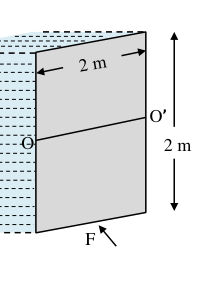
A rigid square sheet of size is hinged at the middle of the vertical edges to serve as a door which can turn about the horizontal axis . A fluid of density fills the space to the left of the sheet up to its top. The horizontal force required (to be applied at the lower edge) to hold the sheet vertical is
Quesito 13
- (a)
- (b)
- (c)
- (d)
Topic: Fluid Mechanics Metodi: Hydrostatic Equilibrium, Torque & Angular Momentum Analysis Competenze: Physical Reasoning Objects: — Fonte: Testo (PDF) — p.5 Soluzione: Soluzioni (PDF)
Un foglio quadrato rigido di dimensioni è inclinato al centro dei bordi verticali per servire da porta che può girare intorno all’asse orizzontale . Un fluido di densità riempie lo spazio a sinistra del foglio fino alla sua parte superiore. La forza orizzontale necessaria (da applicare sul bordo inferiore) per tenere il foglio verticale è
Quesito 13
- (a)
- (b)
- (c)
- (d)
Topic: Fluid Mechanics Metodi: Hydrostatic Equilibrium, Torque & Angular Momentum Analysis Competenze: Physical Reasoning Objects: — Fonte: Testo (PDF) — p.5 Soluzione: Soluzioni (PDF)
A major artery in human body, with radius 0.4 cm, carries blood at a flow rate of 5.0 cubic centimeters per second. The pressure difference of blood per meter length of the artery is nearly [Given that the coefficient of viscosity () of blood at body temperature is and the density of mercury is ]
- (a) 9.6 mm of Hg
- (b) 3.2 mm of Hg
- (c) 1.5 mm of Hg
- (d) 6.0 mm of Hg
Topic: Fluid Mechanics Metodi: Physical Modeling Competenze: Unit Conversion Objects: Tube Fonte: Testo (PDF) — p.5 Soluzione: Soluzioni (PDF)
Un’arteria principale del corpo umano, con un raggio di 0,4 cm, trasporta sangue a un flusso di 5,0 centimetri cubi al secondo. La differenza di pressione del sangue per ogni metro di lunghezza dell’arteria è quasi [Dato che il coefficiente di viscosità () del sangue a temperatura corporea è e la densità del mercurio è ]
- (a) 9.6 mm of Hg
- (b) 3.2 mm of Hg
- (c) 1.5 mm of Hg
- (d) 6.0 mm of Hg
Topic: Fluid Mechanics Metodi: Physical Modeling Competenze: Unit Conversion Objects: Tube Fonte: Testo (PDF) — p.5 Soluzione: Soluzioni (PDF)
If represents radiation pressure, represents radiation energy striking per unit area per unit time and represents speed of light then the possible values of non-zero integers , and such that is dimensionless, may be
- (a)
- (b)
- (c)
- (d)
Topic: Order-of-Magnitude Estimation Metodi: Dimensional Analysis Competenze: Physical Reasoning Objects: — Fonte: Testo (PDF) — p.5 Soluzione: Soluzioni (PDF)
Se rappresenta la pressione radiologica, rappresenta l’energia di radiazione che colpisce per unità di area per unità di tempo e rappresenta la velocità della luce, allora i possibili valori di integri non zero , e in modo tale che non abbia dimensioni possono essere:
- (a)
- (b)
- (c)
- (d)
Topic: Order-of-Magnitude Estimation Metodi: Dimensional Analysis Competenze: Physical Reasoning Objects: — Fonte: Testo (PDF) — p.5 Soluzione: Soluzioni (PDF)
A large tank, open at the top, has two small holes in the vertical wall. One is a square hole of side at a depth below the top and the other is a circular hole of radius at a depth below the top (given that ; ). When the tank is completely filled up to the brim with water, the quantity of water flowing out per second from each hole is the same, then is equal to
- (a)
- (b)
- (c)
- (d)
Topic: Fluid Mechanics Metodi: Bernoulli’s Equation, Continuity Equation Competenze: Physical Reasoning Objects: Container Fonte: Testo (PDF) — p.5 Soluzione: Soluzioni (PDF)
Un grande serbatoio, aperto in alto, ha due piccoli fori nella parete verticale. Uno è un buco quadrato di lato a una profondità sotto la parte superiore e l’altro è un buco circolare di raggio a una profondità sotto la parte superiore (dato che ; ). Quando il serbatoio è completamente riempito fino al bordo di acqua, la quantità di acqua che scorre da ogni buco al secondo è la stessa, quindi è uguale a
- (a)
- (b)
- (c)
- (d)
Topic: Fluid Mechanics Metodi: Bernoulli’s Equation, Continuity Equation Competenze: Physical Reasoning Objects: Container Fonte: Testo (PDF) — p.5 Soluzione: Soluzioni (PDF)
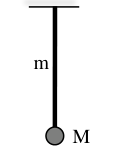
A pendulum consists of a heavy but very small bob of mass suspended at the end of a rigid rod of mass and length . The time period of small oscillations in the vertical plane, about a horizontal axis through the upper end of the rod is
Quesito 17
- (a)
- (b)
- (c)
- (d)
Topic: Oscillations & Waves Metodi: Simple Harmonic Motion Analysis, Torque & Angular Momentum Analysis Competenze: Physical Reasoning Objects: Pendulum, Rod Fonte: Testo (PDF) — p.6 Soluzione: Soluzioni (PDF)
Un pendolo è costituito da un pesante ma molto piccolo bob di massa sospeso alla fine di una canna rigida di massa e lunghezza . Il periodo di tempo delle piccole oscillazioni nel piano verticale, circa un asse orizzontale attraverso l’estremità superiore della canna è
Quesito 17
- (a)
- (b)
- (c)
- (d)
Topic: Oscillations & Waves Metodi: Simple Harmonic Motion Analysis, Torque & Angular Momentum Analysis Competenze: Physical Reasoning Objects: Pendulum, Rod Fonte: Testo (PDF) — p.6 Soluzione: Soluzioni (PDF)
A transverse wave is travelling along a long stretched string from left to right (along direction). The snapshot of a small part of the string at any moment is shown in the figure. At this particular instant
Quesito 18
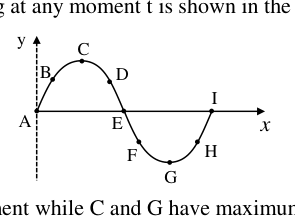
- (a) A and E are at rest for a moment while C and G have maximum speed
- (b) B and D have upward velocity whereas F and H have downward velocity
- (c) D, E, F are moving downward at that moment
- (d) B and H are moving downward at that moment
Topic: Oscillations & Waves Metodi: Wave Equation Competenze: Diagrammatic Reasoning Objects: String Fonte: Testo (PDF) — p.6 Soluzione: Soluzioni (PDF)
Un’onda trasversale si muove lungo una lunga corda estesa da sinistra a destra (in direzione ). Il momento di un piccolo pezzo della stringa in qualsiasi momento è mostrato nella figura. In questo momento particolare
Quesito 18
- (a) A e E sono in riposo per un momento mentre C e G hanno velocità massima
- b) B e D hanno velocità verso l’alto mentre F e H hanno velocità verso il basso
- (c) D, E, F si muovono verso il basso in quel momento
- (d) B e H si muovono verso il basso in quel momento
Topic: Oscillations & Waves Metodi: Wave Equation Competenze: Diagrammatic Reasoning Objects: String Fonte: Testo (PDF) — p.6 Soluzione: Soluzioni (PDF)
Two tuning forks, with natural frequency 700 Hz each, move relative to a stationary observer. Fork (1) moves towards the observer while the fork (2) moves away from the observer. Both the forks move with same velocity on the same line. The observer, standing between the two forks, hears 4 beats per sec. Using the speed of sound in air as , the speed of each tuning fork is
Quesito 19
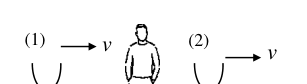
- (a)
- (b)
- (c)
- (d)
Topic: Oscillations & Waves Metodi: Physical Modeling Competenze: Physical Reasoning Objects: Tuning Fork Fonte: Testo (PDF) — p.6 Soluzione: Soluzioni (PDF)
Due forchette di sintonia, con una frequenza naturale di 700 Hz ciascuno, si muovono in relazione ad un osservatore stazionario. La forchetta (1) si sposta verso l’osservatore mentre la forchetta (2) si allontana dall’osservatore. Entrambe le forche si muovono con la stessa velocità sulla stessa linea. L’osservatore, che si trova tra le due forche, sente 4 battiti al secondo. Usando la velocità del suono nell’aria come , la velocità di ciascuna forchetta di sintonia è
Quesito 19
- (a)
- (b)
- (c)
- (d)
Topic: Oscillations & Waves Metodi: Physical Modeling Competenze: Physical Reasoning Objects: Tuning Fork Fonte: Testo (PDF) — p.6 Soluzione: Soluzioni (PDF)
The speed of sound in a mixture of 1 mole of Helium (molar mass = 4 g) and 2 moles of oxygen (molar mass = 32 g) at 27 °C is nearly
- (a)
- (b)
- (c)
- (d)
Topic: Oscillations & Waves, Kinetic Theory Metodi: Kinetic Theory of Gases Competenze: Physical Reasoning Objects: Gas Fonte: Testo (PDF) — p.6 Soluzione: Soluzioni (PDF)
La velocità del suono in una miscela di 1 mol di elio (massa molare = 4 g) e 2 mol di ossigeno (massa molare = 32 g) a 27 °C è quasi
- (a)
- (b)
- (c)
- (d)
Topic: Oscillations & Waves, Kinetic Theory Metodi: Kinetic Theory of Gases Competenze: Physical Reasoning Objects: Gas Fonte: Testo (PDF) — p.6 Soluzione: Soluzioni (PDF)
Three identical large metal plates are kept parallel and close to each other. Each plate can be treated as an ideal black body and has very high thermal conductivity. The first and third plates are maintained at high temperature and . The temperature of the middle (i.e. second) plate under steady state condition is
- (a)
- (b)
- (c)
- (d)
Topic: Thermodynamics Metodi: Physical Modeling, Statistical Averaging Competenze: Physical Reasoning Objects: — Fonte: Testo (PDF) — p.6 Soluzione: Soluzioni (PDF)
Tre identiche grandi piastre metalliche sono tenute parallele e vicine l’una all’altra. Ogni piastra può essere trattata come un corpo nero ideale e ha una elevata conducibilità termica. Le prime e le terze piastre sono mantenute ad alta temperatura e . La temperatura della parte centrale (cioè secondo) la piastra in stato di stabilità è
- (a)
- (b)
- (c)
- (d)
Topic: Thermodynamics Metodi: Physical Modeling, Statistical Averaging Competenze: Physical Reasoning Objects: — Fonte: Testo (PDF) — p.6 Soluzione: Soluzioni (PDF)
A thin uniform circular disc of radius is placed in the plane with its center at origin . A small circular disc of radius with center at is cut and taken out to create a hole. The center of mass of the remaining disc is at
Quesito 22
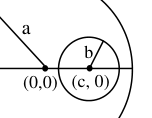
- (a)
- (b)
- (c)
- (d)
Topic: Rotational Dynamics Metodi: Calculus-Integration, Symmetry Argument Competenze: Mathematical Modeling Objects: Disk Fonte: Testo (PDF) — p.7 Soluzione: Soluzioni (PDF)
Un sottile disco circolare uniforme di raggio è posizionato nel piano con il suo centro di origine . Si taglia un piccolo disco circolare di raggio con centro a e si estrae per creare un buco. Il centro di massa del disco rimanente è a
Quesito 22
- (a)
- (b)
- (c)
- (d)
Topic: Rotational Dynamics Metodi: Calculus-Integration, Symmetry Argument Competenze: Mathematical Modeling Objects: Disk Fonte: Testo (PDF) — p.7 Soluzione: Soluzioni (PDF)
One mole of an ideal monoatomic gas, contained in a cylinder fitted with movable piston, is originally at , and . The gas is slowly heated. Initially 8.31 watt-hour of energy is added to it; at the same time it is allowed to expand at constant pressure to a new state , and . The correct option is
- (a) Value of is 1740 °C
- (b) Work done by the gas is 2160 joule
- (c) Internal energy of the gas increases by 1440 joule
- (d)
Topic: Thermodynamics Metodi: First Law of Thermodynamics, Ideal Gas Law Competenze: Physical Reasoning Objects: Gas, Cylinder, Piston Fonte: Testo (PDF) — p.7 Soluzione: Soluzioni (PDF)
Un mole di gas monoatomo ideale contenuto in un cilindro dotato di pistone mobile è originariamente , e . Il gas si riscalda lentamente. Inizialmente si aggiunge 8,31 watt-ora di energia; allo stesso tempo è consentito di espandersi a pressione costante a uno stato nuovo , e . L’opzione corretta è:
- a) Il valore di è 1740 °C
- b) Il lavoro effettuato dal gas è di 2160 joule
- (c) Internal energy of the gas increases by 1440 joule
- (d)
Topic: Thermodynamics Metodi: First Law of Thermodynamics, Ideal Gas Law Competenze: Physical Reasoning Objects: Gas, Cylinder, Piston Fonte: Testo (PDF) — p.7 Soluzione: Soluzioni (PDF)
A non-conducting solid sphere, of radius , with its center at A, has a spherical cavity of diameter with center at B as shown. There is no charge in the cavity while the solid part has a uniform volume charge density . Electric potential at the center of the sphere (at point A) is (in SI units) where the value of is
Quesito 24
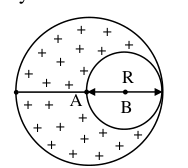
- (a) 3
- (b) 5
- (c) 7
- (d) 9
Topic: Electrostatics Metodi: Electric Potential Method, Superposition Principle Competenze: Physical Reasoning Objects: Sphere Fonte: Testo (PDF) — p.7 Soluzione: Soluzioni (PDF)
Una sfera solida non conduttrice, di raggio , con il suo centro a A, ha una cavità sferica di diametro con il centro a B come mostrato. Non vi è carica nella cavità mentre la parte solida ha una densità di carica di volume uniforme . Potenzialmente, il potenziale elettrico al centro della sfera (in punto A) è (in unità SI) dove il valore di è
Quesito 24
- (a) 3
- (b) 5
- (c) 7
- (d) 9
Topic: Electrostatics Metodi: Electric Potential Method, Superposition Principle Competenze: Physical Reasoning Objects: Sphere Fonte: Testo (PDF) — p.7 Soluzione: Soluzioni (PDF)
Energy from the Sun falls on the Earth surface at the rate of , which is known as solar constant. The respective rms values and of electric and magnetic fields in the sunlight (electromagnetic radiation) reaching Earth surface are (Take speed of light )
- (a) ,
- (b) ,
- (c) ,
- (d) ,
Topic: Electromagnetism Metodi: Physical Modeling Competenze: Physical Reasoning Objects: Star Fonte: Testo (PDF) — p.7 Soluzione: Soluzioni (PDF)
L’energia del Sole cade sulla superficie terrestre al ritmo di , che è conosciuta come costante solare. I rispettivi valori rms e dei campi elettrici e magnetici nella luce solare (radiazione elettromagnetica) che raggiungono la superficie terrestre sono (Tenga velocità della luce )
- (a) ,
- (b) ,
- (c) ,
- (d) ,
Topic: Electromagnetism Metodi: Physical Modeling Competenze: Physical Reasoning Objects: Star Fonte: Testo (PDF) — p.7 Soluzione: Soluzioni (PDF)
The figure below depicts the voltage wave forms of binary input signals A and B and the output signal C of a certain logic gate. The logic gate is
Quesito 26
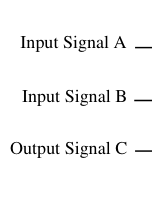
- (a) AND
- (b) NAND
- (c) OR
- (d) XOR
Topic: Circuits Metodi: Physical Modeling Competenze: Diagrammatic Reasoning Objects: — Fonte: Testo (PDF) — p.7 Soluzione: Soluzioni (PDF)
La figura seguente raffigura le forme di onde di tensione dei segnali di ingresso binari A e B e il segnale di uscita C di un certo gate logico. Il cancello logico è
Quesito 26
- a) E
- b) NAND
- (c) OR
- d) XOR
Topic: Circuits Metodi: Physical Modeling Competenze: Diagrammatic Reasoning Objects: — Fonte: Testo (PDF) — p.7 Soluzione: Soluzioni (PDF)
Two electric charges, at the origin O and at the point A are placed on the axis. The locus of the point P in the - plane where the potential vanishes () is
- (a) a straight line perpendicular to the axis and passing through
- (b) only the point
- (c) a circle with center at and radius 4
- (d) an ellipse with foci at O and A
Topic: Electrostatics Metodi: Electric Potential Method, Superposition Principle Competenze: Physical Reasoning Objects: Point Charge Fonte: Testo (PDF) — p.8 Soluzione: Soluzioni (PDF)
Due cariche elettriche, all’origine O e al punto A , sono posizionate sull’asse . Il punto P del piano - dove il potenziale scompare () è
- a) una linea retta perpendicolare all’asse e che attraversa
- b) solo il punto
- (c) un cerchio con centro a e raggio 4
- (d) ellisse con foci a O e A
Topic: Electrostatics Metodi: Electric Potential Method, Superposition Principle Competenze: Physical Reasoning Objects: Point Charge Fonte: Testo (PDF) — p.8 Soluzione: Soluzioni (PDF)
In the circuit shown, the Zener diode is an ideal one with breakdown voltage of 5.0 volt. The values of the resistances are and . The current through the resistances, when the supply voltage is 11.0 V, is
Quesito 28
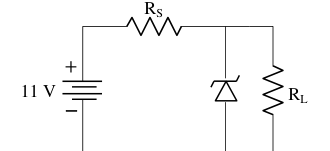
- (a) 0.6 mA through and 5.0 mA through
- (b) 1.0 mA through and 1.0 mA through
- (c) 1.1 mA through and no current through
- (d) no current through and 11 mA through
Topic: Circuits Metodi: Kirchhoff’s Laws, Equivalent Circuit Reduction Competenze: Physical Reasoning Objects: Resistor Fonte: Testo (PDF) — p.8 Soluzione: Soluzioni (PDF)
Nel circuito mostrato, il diodo Zener è un diodo ideale con una tensione di guasto di 5,0 volt. I valori delle resistenze sono e . La corrente attraverso le resistenze, quando la tensione di alimentazione è di 11,0 V, è
Quesito 28
- a) 0,6 mA a e 5,0 mA a
- b) 1,0 mA a e 1,0 mA a
- c) 1,1 mA fino a e nessuna corrente fino a
- d) nessuna corrente attraverso e 11 mA attraverso
Topic: Circuits Metodi: Kirchhoff’s Laws, Equivalent Circuit Reduction Competenze: Physical Reasoning Objects: Resistor Fonte: Testo (PDF) — p.8 Soluzione: Soluzioni (PDF)
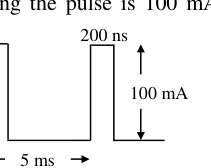
In an accelerator the electrons are accelerated up to an energy of 50 MeV. The electrons do not emerge continuously from the accelerator rather they come in pulses at time interval of 5.0 milliseconds. Each pulse has a much shorter duration of 200 nanoseconds. Electron current during the pulse is 100 mA, while the current is zero between the two successive pulses (see figure), then
Quesito 29
- (a) the average current per pulse is 4 mA
- (b) the peak value of power delivered by the electron beam is 50 MW
- (c) the average power delivered by the electron beam is 200 W
- (d) the average power delivered by the electron beam is 2 MW
Topic: Nuclear & Particle Physics, Circuits Metodi: Physical Modeling, Order-of-Magnitude Estimation Competenze: Physical Reasoning Objects: Particle Beam, Electron Fonte: Testo (PDF) — p.8 Soluzione: Soluzioni (PDF)
In un acceleratore gli elettroni vengono accelerati fino ad un’energia di 50 MeV. Gli elettroni non emergono continuamente dall’acceleratore, ma vengono in impulsi a intervalli di tempo di 5,0 millisecondi. Ogni impulso ha una durata molto più breve di 200 nanosecondi. La corrente elettronica durante l’impulso è di 100 mA, mentre la corrente è di zero tra i due impulsi successivi (vedi figura), quindi
Quesito 29
- (a) la corrente media per impulso è di 4 mA
- b) il valore massimo di potenza fornita dal fascio di elettroni è di 50 MW
- c) la potenza media fornita dal fascio di elettroni è di 200 W
- d) la potenza media fornita dal fascio di elettroni è di 2 MW
Topic: Nuclear & Particle Physics, Circuits Metodi: Physical Modeling, Order-of-Magnitude Estimation Competenze: Physical Reasoning Objects: Particle Beam, Electron Fonte: Testo (PDF) — p.8 Soluzione: Soluzioni (PDF)
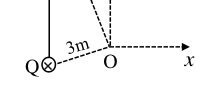
Two infinitely long straight parallel wires perpendicular to the plane of the paper are 5 m apart. One of the wires, P, carries current out of the plane of the paper and the other, Q, carries the current into the plane of paper. The magnetic field at the origin O of the coordinate system with and axes as perpendicular and parallel to PQ, respectively, is [Given and ]
Quesito 30
- (a)
- (b)
- (c)
- (d)
Topic: Magnetism Metodi: Biot-Savart Law, Superposition Principle Competenze: Physical Reasoning Objects: Wire Fonte: Testo (PDF) — p.8 Soluzione: Soluzioni (PDF)
Due fili paralleli dritti infinitamente lunghi perpendicolari al piano della carta sono distanti 5 m. Uno dei fili, P, porta la corrente fuori dal piano della carta e l’altro, Q, porta la corrente nel piano della carta. Il campo magnetico all’origine O del sistema di coordinate con gli assi e perpendicolare e parallelo al PQ, rispettivamente, è [Dato e ]
Quesito 30
- (a)
- (b)
- (c)
- (d)
Topic: Magnetism Metodi: Biot-Savart Law, Superposition Principle Competenze: Physical Reasoning Objects: Wire Fonte: Testo (PDF) — p.8 Soluzione: Soluzioni (PDF)
Charge is uniformly distributed over the surface of a thin non-conducting annular disc of inner radius and outer radius . The disc is made to rotate with constant frequency , about an axis passing through the center of the annular disc and perpendicular to its plane. The magnetic moment of the disc is
- (a)
- (b)
- (c)
- (d)
Topic: Magnetism Metodi: Calculus-Integration, Physical Modeling Competenze: Mathematical Modeling Objects: Disk Fonte: Testo (PDF) — p.8 Soluzione: Soluzioni (PDF)
La carica è uniformemente distribuita sulla superficie di un sottile disco anulare non conduttore di raggio interno e raggio esterno . Il disco è fatto per ruotare con frequenza costante , circa un asse che attraversa il centro del disco anulare e è perpendicolare al suo piano. Il momento magnetico del disco è
- (a)
- (b)
- (c)
- (d)
Topic: Magnetism Metodi: Calculus-Integration, Physical Modeling Competenze: Mathematical Modeling Objects: Disk Fonte: Testo (PDF) — p.8 Soluzione: Soluzioni (PDF)
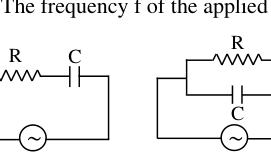
For a resistance and capacitance in series, the impedance is twice that of a parallel combination of the same elements when used with an AC voltage of frequency . The frequency of the applied emf is
Quesito 32
- (a)
- (b)
- (c)
- (d)
Topic: Circuits Metodi: Equivalent Circuit Reduction, Physical Modeling Competenze: Physical Reasoning Objects: Resistor, Capacitor Fonte: Testo (PDF) — p.8 Soluzione: Soluzioni (PDF)
Per una resistenza e una capacità in serie, l’impedenza è il doppio di una combinazione parallela degli stessi elementi quando utilizzata con una tensione CA di frequenza . La frequenza dell’emf applicato è
Quesito 32
- (a)
- (b)
- (c)
- (d)
Topic: Circuits Metodi: Equivalent Circuit Reduction, Physical Modeling Competenze: Physical Reasoning Objects: Resistor, Capacitor Fonte: Testo (PDF) — p.8 Soluzione: Soluzioni (PDF)
In an experiment on photoelectric effect on a metal surface, one finds a stopping potential of 1.8 V for the wavelength of 300 nm and a stopping potential of 0.9 V for the wavelength of 400 nm. The cutoff wavelength (the maximum wavelength that can produce photoelectric effect) for the metal is
- (a) 500 nm
- (b) 550 nm
- (c) 600 nm
- (d) 750 nm
Topic: Modern-Quantum Physics Metodi: Photon Energy Relation Competenze: Physical Reasoning Objects: Photon Fonte: Testo (PDF) — p.9 Soluzione: Soluzioni (PDF)
In un esperimento sull’effetto fotoelettrico su una superficie metallica, si trova un potenziale di arresto di 1,8 V per la lunghezza d’onda di 300 nm e un potenziale di arresto di 0,9 V per la lunghezza d’onda di 400 nm. La lunghezza d’onda di taglio (l’onda massima che può produrre un effetto fotoelettrico) per il metallo è
- (a) 500 nm
- (b) 550 nm
- (c) 600 nm
- (d) 750 nm
Topic: Modern-Quantum Physics Metodi: Photon Energy Relation Competenze: Physical Reasoning Objects: Photon Fonte: Testo (PDF) — p.9 Soluzione: Soluzioni (PDF)
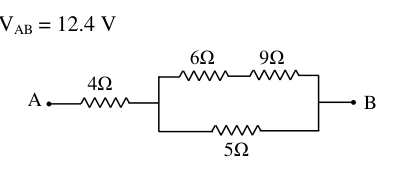
Given that the power dissipated in 5 Ω resistance is 7.2 W in the circuit shown.
Statement (1): Power dissipated in 6 Ω resistance is 6 W.
Statement (2): Potential difference between A and B is .
Then
Quesito 34
- (a) Statement (1) is correct but statement (2) is wrong
- (b) Statement (1) is wrong but statement (2) is correct
- (c) Both statements (1) and (2) are wrong
- (d) Both statements (1) and (2) are correct
Topic: Circuits Metodi: Kirchhoff’s Laws, Equivalent Circuit Reduction Competenze: Physical Reasoning Objects: Resistor Fonte: Testo (PDF) — p.9 Soluzione: Soluzioni (PDF)
Dato che la potenza dissipata in 5 Ω di resistenza è di 7,2 W nel circuito indicato.
Dichiarazione (1): Potenza dissipata in resistenza di 6 Ω è di 6 W.
Dichiarazione (2): la differenza potenziale tra A e B è .
Allora…
Quesito 34
- a) La dichiarazione (1) è corretta ma la dichiarazione (2) è errata
- b) La dichiarazione (1) è errata ma la dichiarazione (2) è corretta
- c) Entrambe le affermazioni (1) e (2) sono errate
- d) Entrambe le affermazioni (1) e (2) sono corrette
Topic: Circuits Metodi: Kirchhoff’s Laws, Equivalent Circuit Reduction Competenze: Physical Reasoning Objects: Resistor Fonte: Testo (PDF) — p.9 Soluzione: Soluzioni (PDF)
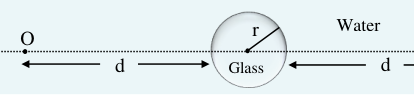
A transparent and homogeneous sphere of glass of radius is immersed in water (refractive indices of glass and water being and ). The image of a point object O, located at distance on its axis in front of the sphere, is formed at point I at the same distance from the sphere on the opposite side as shown. The distance is equal to
Quesito 35
- (a)
- (b)
- (c)
- (d)
Topic: Geometric Optics Metodi: Snell’s Law, Ray Tracing Competenze: Physical Reasoning Objects: Sphere Fonte: Testo (PDF) — p.9 Soluzione: Soluzioni (PDF)
Una sfera trasparente e omogenea di vetro di raggio è immersa nell’acqua (indici di rifrazione di vetro e acqua sono e ). L’immagine di un oggetto puntato O, situato a distanza sul suo asse davanti alla sfera, si forma al punto I alla stessa distanza dalla sfera sul lato opposto come mostrato. La distanza è uguale a
Quesito 35
- (a)
- (b)
- (c)
- (d)
Topic: Geometric Optics Metodi: Snell’s Law, Ray Tracing Competenze: Physical Reasoning Objects: Sphere Fonte: Testo (PDF) — p.9 Soluzione: Soluzioni (PDF)
A certain substance, with a dielectric constant and the dielectric strength , completely fills the space between the plates of a parallel plate capacitor (with circular plates) of capacitance . The minimum diameter of the circular plates, to ensure that the capacitor can withstand a potential difference of , is
- (a) 12 cm
- (b) 24 cm
- (c) 48 cm
- (d) 96 cm
Topic: Electrostatics Metodi: Physical Modeling Competenze: Physical Reasoning Objects: Capacitor Fonte: Testo (PDF) — p.9 Soluzione: Soluzioni (PDF)
Una certa sostanza, con costante dielettrica e resistenza dielettrica , riempie completamente lo spazio tra le piastre di un condensatore di piastre parallele (con piastre circolari) di capacità . Il diametro minimo delle piastre circolari, per garantire che il condensatore possa sopportare una differenza potenziale di , è
- (a) 12 cm
- (b) 24 cm
- (c) 48 cm
- (d) 96 cm
Topic: Electrostatics Metodi: Physical Modeling Competenze: Physical Reasoning Objects: Capacitor Fonte: Testo (PDF) — p.9 Soluzione: Soluzioni (PDF)
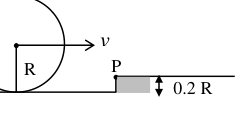
A uniform solid sphere of radius rolls without slipping on a rough horizontal surface with a forward velocity of its center. On its way, it suddenly encounters a small step of height as shown. The angular velocity of the sphere just after the impact is [given that the sphere does not bounce back, rather it goes ahead up the step]
Quesito 37
- (a)
- (b)
- (c)
- (d)
Topic: Rotational Dynamics Metodi: Torque & Angular Momentum Analysis, Conservation Laws Competenze: Physical Reasoning Objects: Sphere Fonte: Testo (PDF) — p.9 Soluzione: Soluzioni (PDF)
Una sfera solida uniforme di raggio ruota senza scivolare su una superficie orizzontale ruvida con una velocità in avanti del suo centro. Sulla sua strada, improvvisamente incontra un piccolo passo di altezza come mostrato. La velocità angolare della sfera appena dopo l’impatto è [dato che la sfera non rimbalza indietro, piuttosto va avanti verso l’alto]
Quesito 37
- (a)
- (b)
- (c)
- (d)
Topic: Rotational Dynamics Metodi: Torque & Angular Momentum Analysis, Conservation Laws Competenze: Physical Reasoning Objects: Sphere Fonte: Testo (PDF) — p.9 Soluzione: Soluzioni (PDF)
The magnetic field produced by the current flowing through the sides of a square loop of side , at a point P at distance from the center of the square, on the axis perpendicular to the plane of the square loop and passing through its center, is
- (a)
- (b)
- (c)
- (d)
Topic: Magnetism Metodi: Biot-Savart Law, Superposition Principle Competenze: Mathematical Modeling Objects: Wire Fonte: Testo (PDF) — p.10 Soluzione: Soluzioni (PDF)
Il campo magnetico prodotto dalla corrente che scorre attraverso i lati di un ciclo quadrato di lato , in un punto P a distanza dal centro del quadrato, sull’asse perpendicolare al piano del ciclo quadrato e che passa attraverso il suo centro, è
- (a)
- (b)
- (c)
- (d)
Topic: Magnetism Metodi: Biot-Savart Law, Superposition Principle Competenze: Mathematical Modeling Objects: Wire Fonte: Testo (PDF) — p.10 Soluzione: Soluzioni (PDF)
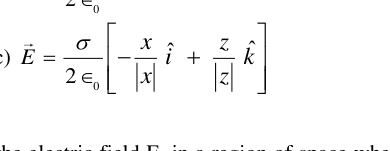
A linear positive charge distribution, with linear charge density coulomb per meter, extends along the -axis from to . The electric field at any point P on the -axis
Quesito 39
- (a) is proportional to irrespective of whether is positive or negative.
- (b) is always directed away and perpendicular to the line of charge.
- (c) has a vanishing component parallel to the line of charge.
- (d) is directed along a straight line of slope m if is positive but along a line of slope m if is negative.
Topic: Electrostatics Metodi: Coulomb’s Law, Calculus-Integration Competenze: Physical Reasoning Objects: — Fonte: Testo (PDF) — p.10 Soluzione: Soluzioni (PDF)
Una distribuzione lineare di cariche positive, con densità di carica lineare coulomb per metro, si estende lungo l’asse da a . Il campo elettrico in qualsiasi punto P sull’asse
Quesito 39
- a) è proporzionale a indipendentemente dal fatto che sia positivo o negativo.
- b) è sempre diretto e perpendicolare alla linea di carica.
- c) ha una componente in fuga parallela alla linea di carica.
- d) è orientata lungo una linea retta di pendenza m se è positiva ma lungo una linea di pendenza m se è negativa.
Topic: Electrostatics Metodi: Coulomb’s Law, Calculus-Integration Competenze: Physical Reasoning Objects: — Fonte: Testo (PDF) — p.10 Soluzione: Soluzioni (PDF)
Imagine a situation, in which an infinite sheet with positive charge per unit area lies in the -plane and a second infinite sheet with negative charge per unit area lies in the -plane. The net electric field at any point [that does not lie on either of these planes or ] can be expressed as
- (a)
- (b)
- (c)
- (d)
Topic: Electrostatics Metodi: Gauss’s Law, Superposition Principle Competenze: Physical Reasoning Objects: — Fonte: Testo (PDF) — p.10 Soluzione: Soluzioni (PDF)
Immaginate una situazione in cui un foglio infinito con carica positiva per unità di superficie si trova nel piano e un secondo foglio infinito con carica negativa per unità di superficie si trova nel piano . Il campo elettrico netto in qualsiasi punto [che non si trova su uno di questi piani o ] può essere espresso come
- (a)
- (b)
- (c)
- (d)
Topic: Electrostatics Metodi: Gauss’s Law, Superposition Principle Competenze: Physical Reasoning Objects: — Fonte: Testo (PDF) — p.10 Soluzione: Soluzioni (PDF)
For the electric field , in a region of space where a non-uniform, but spherically symmetric distribution of charge has a charge density as one can say that
- (a) : both at and
- (b) for and for
- (c) the magnitude of increases with and reaches its maximum at
- (d) the maximum electric field produced by the given charge distribution is
Topic: Electrostatics Metodi: Gauss’s Law, Calculus-Integration Competenze: Physical Reasoning Objects: — Fonte: Testo (PDF) — p.10 Soluzione: Soluzioni (PDF)
Per il campo elettrico , in una regione dello spazio in cui una distribuzione di carica non uniforme ma sferica simmetrica ha una densità di carica come Si può dire che
- a) : sia a che a
- b) per e per
- c) la magnitudine di aumenta con e raggiunge il suo massimo a
- d) il campo elettrico massimo prodotto dalla distribuzione di carica data è
Topic: Electrostatics Metodi: Gauss’s Law, Calculus-Integration Competenze: Physical Reasoning Objects: — Fonte: Testo (PDF) — p.10 Soluzione: Soluzioni (PDF)
A typical network of resistances and shown below extends to infinity towards the right. The total resistance of this network between points A and B is
Quesito 42
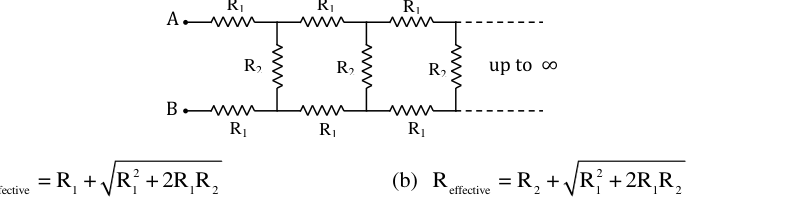
- (a)
- (b)
- (c)
- (d)
Topic: Circuits Metodi: Equivalent Circuit Reduction, Symmetry Argument Competenze: Mathematical Modeling Objects: Resistor Fonte: Testo (PDF) — p.11 Soluzione: Soluzioni (PDF)
Una rete tipica di resistenze e mostrata di seguito si estende all’infinito verso destra. La resistenza totale di questa rete tra i punti A e B è
Quesito 42
- (a)
- (b)
- (c)
- (d)
Topic: Circuits Metodi: Equivalent Circuit Reduction, Symmetry Argument Competenze: Mathematical Modeling Objects: Resistor Fonte: Testo (PDF) — p.11 Soluzione: Soluzioni (PDF)
A cylindrical cavity of diameter exists inside a long solid cylinder of diameter as shown in figure. Both the cylinder and the cavity are taken to be infinitely long. The axis of the cavity is parallel to the axis of the cylinder and is at a distance from it. A uniform current of current density (Am) flows through the cylinder along its length and not through the cavity. The magnitude of the magnetic field at a point P on the surface of the cylinder lying farthest from the axis of the cavity is
Quesito 43
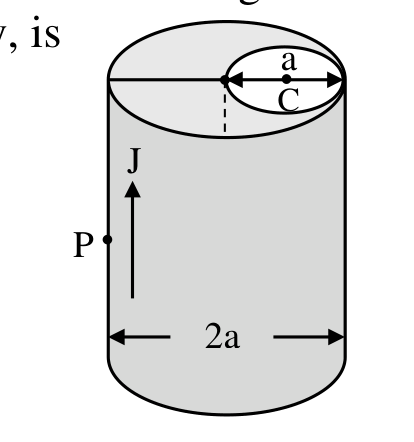
- (a)
- (b)
- (c)
- (d)
Topic: Magnetism Metodi: Ampère’s Law, Superposition Principle Competenze: Physical Reasoning Objects: Cylinder Fonte: Testo (PDF) — p.11 Soluzione: Soluzioni (PDF)
Un cilindro di diametro è presente all’interno di un cilindro solido lungo di diametro come mostrato nella figura. Sia il cilindro che la cavità sono considerati infinitamente lunghi. L’asse della cavità è parallelo all’asse del cilindro e si trova a una distanza da esso. Una corrente uniforme di densità di corrente (Am) scorre attraverso il cilindro lungo la sua lunghezza e non attraverso la cavità. La magnitudine del campo magnetico in un punto P sulla superficie del cilindro che si trova più lontano dall’asse della cavità è
Quesito 43
- (a)
- (b)
- (c)
- (d)
Topic: Magnetism Metodi: Ampère’s Law, Superposition Principle Competenze: Physical Reasoning Objects: Cylinder Fonte: Testo (PDF) — p.11 Soluzione: Soluzioni (PDF)
A thin uniform rod, of length with negligible mass, is attached to the floor by a frictionless hinge at a fixed point P. A horizontal spring connects the other end of the rod to a vertical wall. The rod is in a uniform magnetic field directed into the plane of paper. There is a current in the rod in the direction shown. Force constant of the spring is . The rod is in equilibrium at .
Statement (1): Torque on the rod due to magnetic force is 0.1 Nm clockwise.
Statement (2): In equilibrium the energy stored in the spring is 0.039 J.
Quesito 44
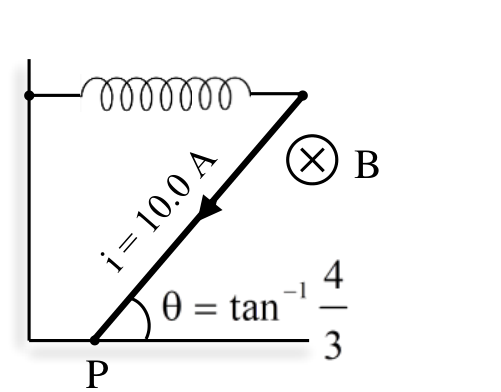
- (a) Statement (1) is correct but statement (2) is wrong
- (b) Statement (1) is wrong but statement (2) is correct
- (c) Both statements (1) and (2) are wrong
- (d) Both statements (1) and (2) are correct
Topic: Magnetism, Elasticity & Materials Metodi: Lorentz Force Analysis, Torque & Angular Momentum Analysis Competenze: Physical Reasoning Objects: Rod, Spring Fonte: Testo (PDF) — p.11 Soluzione: Soluzioni (PDF)
Una sottile canna uniforme, di lunghezza e di massa trascurabile, è attaccata al pavimento con una cerniera senza attrito in un punto fisso P. Una sorgente orizzontale collega l’altra estremità della canna a un muro verticale. La canna è in un campo magnetico uniforme diretto verso il piano di carta. C’è una corrente nella canna nella direzione indicata. Costante della forza della molla è . La canna è in equilibrio a .
Dichiarazione (1): la coppia della canna a causa della forza magnetica è di 0,1 Nm nel senso orario.
Dichiarazione (2): In equilibrio l’energia immagazzinata nella primavera è di 0,039 J.
Quesito 44
- a) La dichiarazione (1) è corretta ma la dichiarazione (2) è errata
- b) La dichiarazione (1) è errata ma la dichiarazione (2) è corretta
- c) Entrambe le affermazioni (1) e (2) sono errate
- d) Entrambe le affermazioni (1) e (2) sono corrette
Topic: Magnetism, Elasticity & Materials Metodi: Lorentz Force Analysis, Torque & Angular Momentum Analysis Competenze: Physical Reasoning Objects: Rod, Spring Fonte: Testo (PDF) — p.11 Soluzione: Soluzioni (PDF)
The electric flux through a certain area of a dielectric medium is in SI units. The displacement current through that area is 12.5 pA at a time . The dielectric constant of the dielectric medium is
- (a) 22.1
- (b) 5.52
- (c) 55.2
- (d) 2.76
Topic: Electromagnetism Metodi: Calculus-Integration, Physical Modeling Competenze: Physical Reasoning Objects: — Fonte: Testo (PDF) — p.11 Soluzione: Soluzioni (PDF)
Il flusso elettrico attraverso una determinata area di un mezzo dielettrico è in unità SI. La corrente di spostamento attraverso tale area è di 12,5 pA a tempo . La costante dielettrica del mezzo dielettrico è
- (a) 22.1
- (b) 5.52
- (c) 55.2
- (d) 2.76
Topic: Electromagnetism Metodi: Calculus-Integration, Physical Modeling Competenze: Physical Reasoning Objects: — Fonte: Testo (PDF) — p.11 Soluzione: Soluzioni (PDF)
A thin equi-convex lens of flint glass (refractive index ) is kept coaxially in contact with another thin equi-concave lens of crown glass (refractive index ). The system is completely immersed in water . Parallel rays of light incident parallel to the principal axis in water are focused by this system at a distance of 24 cm beyond the system. The thickness of the system is negligible. If the radius of curvature of each surface is , the difference is
Quesito 46

- (a)
- (b)
- (c)
- (d)
Topic: Geometric Optics Metodi: Thin Lens & Mirror Equation Competenze: Physical Reasoning Objects: Lens Fonte: Testo (PDF) — p.12 Soluzione: Soluzioni (PDF)
Un’obiettivo sottile equi-convexa di vetro di filamento (indice di refraczione ) è tenuto coassiale in contatto con un’altra lente sottile equi-concave di vetro di corona (indice di refraczione ). Il sistema è completamente immerso in acqua . I raggi paralleli di luce incident paralleli all’asse principale nell’acqua sono focalizzati da questo sistema a una distanza di 24 cm oltre il sistema. Lo spessore del sistema è trascurabile. Se il raggio di curvatura di ciascuna superficie è , la differenza è
Quesito 46
- (a)
- (b)
- (c)
- (d)
Topic: Geometric Optics Metodi: Thin Lens & Mirror Equation Competenze: Physical Reasoning Objects: Lens Fonte: Testo (PDF) — p.12 Soluzione: Soluzioni (PDF)
Two identical large thin metal plates carrying charges and (), respectively, are kept close at a distance apart and parallel to each other to form a parallel plate capacitor of capacitance . The potential difference between the plates is
- (a)
- (b)
- (c)
- (d)
Topic: Electrostatics Metodi: Gauss’s Law, Superposition Principle Competenze: Physical Reasoning Objects: Capacitor Fonte: Testo (PDF) — p.12 Soluzione: Soluzioni (PDF)
Due identiche grandi e sottili piastre metalliche con cariche e (), rispettivamente, sono tenute vicine a una distanza l’una dall’altra e parallele per formare un condensatore di piastre parallele di capacità . La differenza potenziale tra le piastre è
- (a)
- (b)
- (c)
- (d)
Topic: Electrostatics Metodi: Gauss’s Law, Superposition Principle Competenze: Physical Reasoning Objects: Capacitor Fonte: Testo (PDF) — p.12 Soluzione: Soluzioni (PDF)
In a certain electrical network, the three nodes A, B and C are each at a potential of 1.0 volt while the node D is at a potential 2.0 volt. The potential at the Node O in volt is
Quesito 48
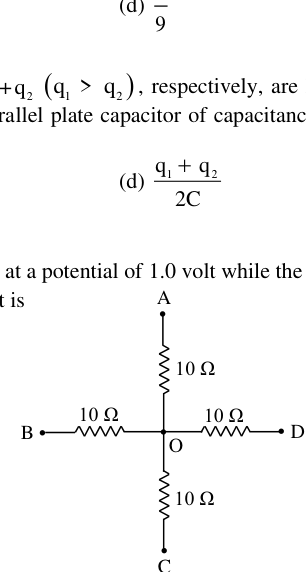
- (a)
- (b)
- (c)
- (d)
Topic: Circuits Metodi: Kirchhoff’s Laws, Superposition Principle Competenze: Physical Reasoning Objects: Resistor Fonte: Testo (PDF) — p.12 Soluzione: Soluzioni (PDF)
In una certa rete elettrica, i tre nodi A, B e C sono ognuno a un potenziale di 1,0 volt mentre il nodo D è a un potenziale di 2,0 volt. Il potenziale del nodo O in volt è
Quesito 48
- (a)
- (b)
- (c)
- (d)
Topic: Circuits Metodi: Kirchhoff’s Laws, Superposition Principle Competenze: Physical Reasoning Objects: Resistor Fonte: Testo (PDF) — p.12 Soluzione: Soluzioni (PDF)
Part A-2 (one or more options may be correct)
A thin uniform metallic rod, of length and area of cross section , is made to rotate with angular velocity in a horizontal plane about a vertical axis through one of its ends. The density and the Young’s modulus of the material of the rod are and . Taking as the distance of a point on the rod from the axis of rotation, the
- (a) tension at midpoint of the rod is .
- (b) tension in the rod varies with distance from the axis of rotation as .
- (c) stress in the rod at is .
- (d) elongation of the rod is .
Topic: Elasticity & Materials, Rotational Dynamics Metodi: Stress-Strain Analysis, Calculus-Integration Competenze: Mathematical Modeling Objects: Rod Fonte: Testo (PDF) — p.13 Soluzione: Soluzioni (PDF)
**Parte A-2 (una o più opzioni possono essere corrette) **
Una sottile e uniforme canna metallica, di lunghezza e superficie di sezione trasversale , è realizzata per ruotare con velocità angolare in un piano orizzontale intorno ad un asse verticale attraverso una delle sue estremità. La densità e il modulo del Young del materiale della canna sono e . Prendendo come distanza di un punto della canna dall’asse di rotazione, il
- a) la tensione al punto medio della canna è .
- (b) la tensione della canna varia con la distanza dall’asse di rotazione come .
- (c) la tensione della canna a è .
- d) allungamento della canna è .
Topic: Elasticity & Materials, Rotational Dynamics Metodi: Stress-Strain Analysis, Calculus-Integration Competenze: Mathematical Modeling Objects: Rod Fonte: Testo (PDF) — p.13 Soluzione: Soluzioni (PDF)
One end of a long and thin rope, stretched horizontally with a tension , along axis, is supporting a weight after passing over a pulley fixed on a vertical pole (see figure). At the other end, a simple harmonic oscillator (a clamped iron rod along the axis of a solenoid fed with AC voltage and oscillating between north and south poles) at , generates a transverse wave of frequency 100 Hz and an amplitude of 2 cm, in the rope. The wave propagates along the rope. The mass per unit length of the rope is 20 g/m. Ignoring the effect of gravity (on the rope), the correct option(s) is/are
Quesito 50
- (a) Wavelength of the transverse wave is 20 cm.
- (b) Maximum magnitude of transverse acceleration of any point on the rope is nearly .
- (c) If the oscillator produces maximum negative displacement at at time , the equation of the wave can be expressed as in SI units.
- (d) Tension in the given rope remaining unchanged, if a harmonic oscillator of frequency 200 Hz is used (instead of earlier frequency 100 Hz), the wavelength will be 10 cm.
Topic: Oscillations & Waves Metodi: Wave Equation, Simple Harmonic Motion Analysis Competenze: Physical Reasoning Objects: String, Pulley, Solenoid, Rod Fonte: Testo (PDF) — p.13 Soluzione: Soluzioni (PDF)
Un’estremità di una corda lunga e sottile, estesa orizzontalmente con una tensione , lungo l’asse , supporta un peso dopo aver superato una polla fissata su un polo verticale (vedere figura). L’altra estremità, un semplice oscillatore armonico (una barra di ferro chiusa lungo l’asse di un solenoide alimentato da tensione CA e oscillante tra i poli nord e sud) a , genera una onda trasversale di frequenza 100 Hz e un’ampiezza di 2 cm nella corda. L’onda si propaga lungo la corda. La massa per unità di lunghezza della corda è di 20 g/m. Ignorando l’effetto della gravità (sulla corda), l’opzione corretta è/sono
Quesito 50
- a) L’onda di onda trasversale è di 20 cm.
- (b) La massima magnitudine di accelerazione trasversale di qualsiasi punto della corda è di quasi .
- (c) Se l’oscillato produce uno spostamento negativo massimo a nel tempo , l’equazione dell’onda può essere espressa in unità SI come .
- d) Se la tensione della corda data rimane invariata, se viene utilizzato un oscillatore armonico di frequenza 200 Hz (invece di una frequenza precedente di 100 Hz), la lunghezza d’onda sarà di 10 cm.
Topic: Oscillations & Waves Metodi: Wave Equation, Simple Harmonic Motion Analysis Competenze: Physical Reasoning Objects: String, Pulley, Solenoid, Rod Fonte: Testo (PDF) — p.13 Soluzione: Soluzioni (PDF)
Nuclei of a radioactive element A are being produced at a constant rate . The element A has a decay constant . If there are nuclei at , then
- (a) number of nuclei , at time , is .
- (b) if , the number of nuclei at any time will remain constant.
- (c) if , then as .
- (d) if , the number of nuclei after one half-life of A is .
Topic: Nuclear & Particle Physics Metodi: Radioactive Decay Law, Differential Equations Competenze: Mathematical Modeling Objects: Nucleus Fonte: Testo (PDF) — p.13 Soluzione: Soluzioni (PDF)
I nuclei di un elemento radioattivo A sono prodotti a un tasso costante . L’elemento A ha una costante di decadimento . Se ci sono nuclei a , allora
- a) il numero di nuclei , al tempo , è .
- b) se , il numero di nuclei in qualsiasi momento rimarrà costante.
- c) se , allora come .
- d) se , il numero di nuclei dopo una emivita di A è .
Topic: Nuclear & Particle Physics Metodi: Radioactive Decay Law, Differential Equations Competenze: Mathematical Modeling Objects: Nucleus Fonte: Testo (PDF) — p.13 Soluzione: Soluzioni (PDF)
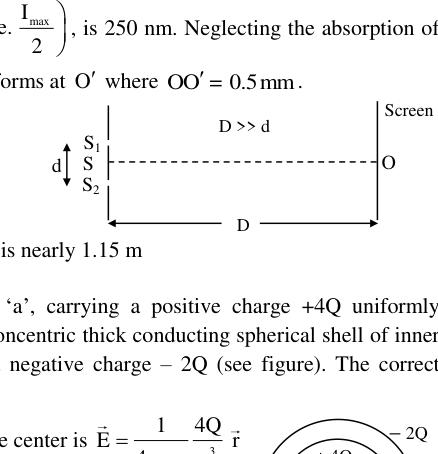
In Young’s double slit experiment, a fine beam of coherent monochromatic light of wavelength is incident on identical slits and at separation . The intensity at the central maximum formed at O is and the angular fringe width is . When a thin transparent film is placed in front of the slit , the intensity at O changes. It is found that the smallest thickness of the film, for which the intensity at O becomes half the maximum intensity , is 250 nm. Neglecting the absorption of light by the film, the zero order fringe earlier at O now forms at O where . Choose correct option(s)
Quesito 52
- (a) The refractive index of the film is 1.6.
- (b) The fringe width near O is 2 mm.
- (c) On the screen, O is above O.
- (d) The distance of the screen from the double slit is nearly 1.15 m.
Topic: Wave Optics Metodi: Interference & Diffraction Analysis Competenze: Physical Reasoning Objects: Slit, Screen Fonte: Testo (PDF) — p.14 Soluzione: Soluzioni (PDF)
Nell’esperimento di Young su due fessure, un fascio di luce monocromatica coerente di lunghezza d’onda si incide su fessure identiche e alla separazione . L’intensità al massimo centrale formato a O è e la larghezza angolare della margine è . Quando viene posto un sottile film trasparente davanti alla fessura , l’intensità a O cambia. Si constata che il più piccolo spessore del film, per il quale l’intensità a O diventa la metà dell’intensità massima , è di 250 nm. Neglecting the absorption of light by the film, the zero order fringe earlier at O now forms at O where . Scegliere l’opzione corretta
Quesito 52
- a) L’indice di rifrazione del film è di 1,6.
- (b) La larghezza del margine vicino a O è di 2 mm.
- (c) Sullo schermo, O è superiore a O.
- (d) La distanza dello schermo dalla doppia fessura è di quasi 1,15 m.
Topic: Wave Optics Metodi: Interference & Diffraction Analysis Competenze: Physical Reasoning Objects: Slit, Screen Fonte: Testo (PDF) — p.14 Soluzione: Soluzioni (PDF)
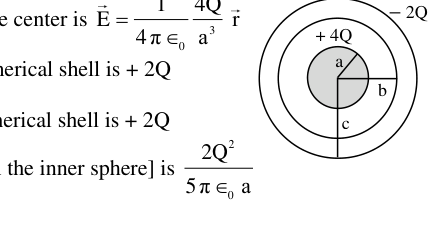
An insulated non-conducting solid sphere of radius , carrying a positive charge uniformly distributed throughout its volume, is surrounded by a concentric thick conducting spherical shell of inner radius and outer radius . This thick shell carries a negative charge (see figure). The correct option(s) is/are
Quesito 53
- (a) Electric field strength at distance () from the center is .
- (b) Charge on the inner surface of the conducting spherical shell is .
- (c) Charge on the outer surface of the conducting spherical shell is .
- (d) Electrical energy stored in region [i.e. in the inner sphere] is .
Topic: Electrostatics Metodi: Gauss’s Law, Calculus-Integration Competenze: Physical Reasoning Objects: Sphere, Conducting Sphere Fonte: Testo (PDF) — p.14 Soluzione: Soluzioni (PDF)
Una sfera solida non conduttiva isolata di raggio , con una carica positiva uniformemente distribuita in tutto il suo volume, è circondata da una conchiglia contigliante spessa di raggio interno e di raggio esterno . Questa conchiglia spessa ha una carica negativa (vedere figura). L’opzione corretta è
Quesito 53
- a) La resistenza del campo elettrico a distanza () dal centro è .
- (b) La carica sulla superficie interna della conchiglia sferica conduttrice è .
- (c) La carica sulla superficie esterna della conchiglia sferica conduttrice è .
- d) Energia elettrica immagazzinata nella regione [cioè nella sfera interna] è .
Topic: Electrostatics Metodi: Gauss’s Law, Calculus-Integration Competenze: Physical Reasoning Objects: Sphere, Conducting Sphere Fonte: Testo (PDF) — p.14 Soluzione: Soluzioni (PDF)
A single electron orbits around a stationary nucleus of charge in a hydrogen-like atom, where is the atomic number and is the magnitude of the charge on an electron. It requires 47.25 eV to excite the electron from second Bohr orbit to the third Bohr orbit. Ionization energy of hydrogen atom is 13.6 eV. Then
- (a) the value of is 5.
- (b) the energy required to excite the electron from the 3rd orbit to the 4th orbit is 16.53 eV (nearly).
- (c) the wavelength of electromagnetic radiation required to liberate the electron completely when in the first Bohr orbit is 36.56 Å.
- (d) the angular momentum of an electron in the second Bohr orbit is .
Topic: Modern-Quantum Physics Metodi: Bohr Model & Quantization Competenze: Physical Reasoning Objects: Electron, Nucleus, Atom Fonte: Testo (PDF) — p.14 Soluzione: Soluzioni (PDF)
Un singolo elettrone orbita intorno a un nucleo di carica stazionario in un atomo simile all’idrogeno, dove è il numero atomico e è la magnitudine della carica su un elettrone. Ci vuole 47,25 eV per eccitare l’elettrone dalla seconda orbita di Bohr alla terza orbita di Bohr. L’energia di ionizzazione dell’atomo di idrogeno è di 13,6 eV. Allora…
- a) il valore di è 5.
- b) l’energia necessaria per eccitare l’elettrone dalla terza orbita alla quarta orbita è di 16,53 eV (quasi).
- (c) la lunghezza d’onda della radiazione elettromagnetica necessaria per liberare completamente l’elettrone quando si trova nella prima orbita di Bohr è di 36,56 Å.
- (d) la dinamica angolare di un elettrone nella seconda orbita di Bohr è .
Topic: Modern-Quantum Physics Metodi: Bohr Model & Quantization Competenze: Physical Reasoning Objects: Electron, Nucleus, Atom Fonte: Testo (PDF) — p.14 Soluzione: Soluzioni (PDF)
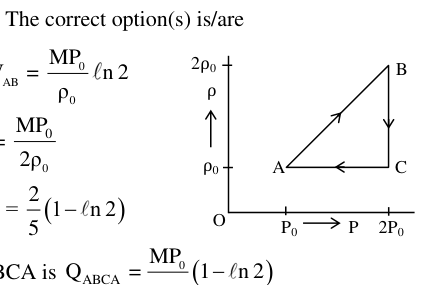
One mole of an ideal monoatomic gas of molecular mass undergoes a cyclic process (ABCA) shown in the figure as a density versus pressure () curve. The correct option(s) is/are
Quesito 55
- (a) Work done on the gas in going from A to B is .
- (b) Work done by the gas in the process BC is .
- (c) Efficiency () of the complete cycle ABCA is .
- (d) Heat rejected by the gas in the complete cycle ABCA is .
Topic: Thermodynamics Metodi: Thermodynamic Cycle Analysis, First Law of Thermodynamics Competenze: Physical Reasoning Objects: Gas Fonte: Testo (PDF) — p.14 Soluzione: Soluzioni (PDF)
Un mole di un gas monoatomo ideale di massa molecolare subisce un processo ciclico (ABCA) mostrato nella figura come curva di densità contro pressione (). L’opzione corretta è
Quesito 55
- (a) Il lavoro svolto sul gas in passaggio da A a B è .
- (b) Il lavoro svolto dal gas nel processo BC è .
- (c) L’efficienza () del ciclo completo ABCA è .
- (d) Il calore rifiutato dal gas nel ciclo completo ABCA è .
Topic: Thermodynamics Metodi: Thermodynamic Cycle Analysis, First Law of Thermodynamics Competenze: Physical Reasoning Objects: Gas Fonte: Testo (PDF) — p.14 Soluzione: Soluzioni (PDF)
Two ideal inductors and three identical resistors have been connected to a DC source of emf as shown in the circuit. When the key K is kept pressed (closed) for a long time, the current through the resistance on the extreme right is measured to be . Immediately after releasing (switching off) the key, the current through the resistors is
Quesito 56
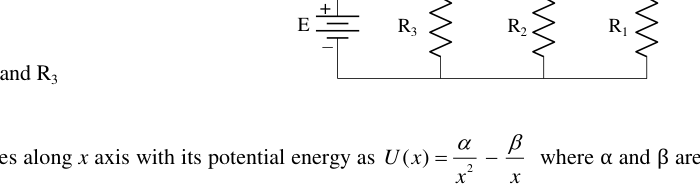
- (a) downwards in
- (b) downwards in
- (c) upwards in
- (d) zero in each , and
Topic: Electromagnetic Induction, Circuits Metodi: Faraday’s Law of Induction, Kirchhoff’s Laws Competenze: Physical Reasoning Objects: Inductor, Resistor, Battery, Switch Fonte: Testo (PDF) — p.15 Soluzione: Soluzioni (PDF)
Due induttori ideali e tre resistori identici sono stati collegati a una fonte di corrente continua di emf come mostrato nel circuito. Quando la chiave K viene tenuta premuta (chiusa) per un lungo periodo, la corrente attraverso la resistenza all’estrema destra viene misurata a . Immediatamente dopo aver rilasciato (spinto) la chiave, la corrente attraverso le resistori è
Quesito 56
- a) verso il basso in
- b) verso il basso in
- (c) in su in
- d) zero in ciascuna , e
Topic: Electromagnetic Induction, Circuits Metodi: Faraday’s Law of Induction, Kirchhoff’s Laws Competenze: Physical Reasoning Objects: Inductor, Resistor, Battery, Switch Fonte: Testo (PDF) — p.15 Soluzione: Soluzioni (PDF)
A particle of mass moves along the axis with its potential energy as where and are positive constants. The particle is released from rest at . Then
- (a) can be expressed as .
- (b) velocity of the particle as a function of can be expressed as .
- (c) the maximum speed of the particle is .
- (d) the total energy of the particle is zero.
Topic: Conservation of Energy, Oscillations & Waves Metodi: Conservation of Energy, Simple Harmonic Motion Analysis Competenze: Mathematical Modeling Objects: — Fonte: Testo (PDF) — p.15 Soluzione: Soluzioni (PDF)
Una particella di massa si muove lungo l’asse con la sua energia potenziale come dove e sono costanti positive. La particella viene rilasciata dal riposo a . Allora…
- a) può essere espressa come .
- (b) la velocità della particella come funzione di può essere espressa come .
- c) la velocità massima della particella è .
- d) l’energia totale della particella è zero.
Topic: Conservation of Energy, Oscillations & Waves Metodi: Conservation of Energy, Simple Harmonic Motion Analysis Competenze: Mathematical Modeling Objects: — Fonte: Testo (PDF) — p.15 Soluzione: Soluzioni (PDF)
Two blocks A and B, of masses and , respectively, are connected by a massless spring of natural length and spring constant . The blocks are initially at rest on a smooth horizontal floor with spring at its natural length . A third block C of mass , identical to that of block A, moves on the floor with speed along the line joining A and B and collides with A elastically. In the subsequent motion
Quesito 58
- (a) the spring will be compressed to a maximum when at a length of .
- (b) the kinetic energy of A and B together, when the spring is compressed to the maximum, is .
- (c) the blocks A and B stop for a moment when the spring is at the maximum compression.
- (d) the time required to reach the maximum compression from the normal length is .
Topic: Conservation of Momentum, Oscillations & Waves Metodi: Conservation of Momentum, Simple Harmonic Motion Analysis Competenze: Physical Reasoning Objects: Block, Spring Fonte: Testo (PDF) — p.15 Soluzione: Soluzioni (PDF)
Due blocchi A e B, rispettivamente di massa e , sono collegati da una molla senza massa di lunghezza naturale e da una costante di molla . I blocchi sono inizialmente riposti su un pavimento orizzontale liscio con molla alla sua lunghezza naturale . Un terzo blocco C di massa , identico a quello del blocco A, si muove sul pavimento con velocità lungo la linea che collega A e B e collide con A in modo elastico. Nella mozione successiva
Quesito 58
- (a) la molla sarà compressa al massimo a una lunghezza .
- b) l’energia cinetica di A e B insieme, quando la molla è compressa al massimo, è .
- c) i blocchi A e B si fermano per un momento quando la molla è al massimo livello di compressione.
- d) il tempo necessario per raggiungere la compressione massima dalla lunghezza normale è .
Topic: Conservation of Momentum, Oscillations & Waves Metodi: Conservation of Momentum, Simple Harmonic Motion Analysis Competenze: Physical Reasoning Objects: Block, Spring Fonte: Testo (PDF) — p.15 Soluzione: Soluzioni (PDF)
A small block B of mass , lying on a frictionless horizontal table, is attached to a massless cord (breaking strength 40 N) passing through a narrow hole C at the center of the table. Initially when the block is revolving in a circle of radius about a vertical axis through the hole, with a tangential speed of ; the tension in the string is and the kinetic energy of the block is . The string is then pulled down slowly from below, decreasing the radius of circular path from to so that the kinetic energy of the block is now and the tension in the string is . As a result
Quesito 59
- (a) the tension .
- (b) the kinetic energy .
- (c) the radius of the circular path just when the string breaks is 0.40 m.
- (d) the work done by the tension in the string in reducing the radius of circle from to is .
Topic: Rotational Dynamics Metodi: Conservation Laws, Torque & Angular Momentum Analysis Competenze: Physical Reasoning Objects: Block, String Fonte: Testo (PDF) — p.16 Soluzione: Soluzioni (PDF)
Un piccolo blocco B di massa , che si trova su una tavola orizzontale senza attrito, è attaccato a un cavo senza massa (forza di rottura 40 N) che passa attraverso un piccolo buco C al centro della tavola. Inizialmente quando il blocco ruota in un cerchio di raggio intorno ad un asse verticale attraverso il foro, con una velocità tangenziale di ; la tensione nella corda è e l’energia cinetica del blocco è . La stringa viene poi tirata lentamente giù da sotto, riducendo il raggio di percorso circolare da a in modo che l’energia cinetica del blocco sia ora e la tensione nella stringa . Di conseguenza
Quesito 59
- a) la tensione .
- b) l’energia cinetica .
- (c) il raggio del percorso circolare proprio quando la corda si rompe è di 0,40 m.
- (d) il lavoro svolto dalla tensione della corda per ridurre il raggio del cerchio da a è .
Topic: Rotational Dynamics Metodi: Conservation Laws, Torque & Angular Momentum Analysis Competenze: Physical Reasoning Objects: Block, String Fonte: Testo (PDF) — p.16 Soluzione: Soluzioni (PDF)
A circular coil of thin insulated copper wire ( turns), wrapped around an iron cylinder of cross-section area , is connected to a suspended type moving coil ballistic galvanometer. The suspended rectangular coil of the galvanometer is of mass , length , breadth and has turns of fine copper wire wound on a non-metallic frame of ivory. This rectangular coil of the galvanometer is free to execute torsional oscillations in a radial magnetic field . The galvanometer is being used to measure the charge by employing the formula . [Given that the moment of inertia of the oscillating coil about the vertical axis is and the torsional constant (torsional rigidity) of the suspension fiber is ; is the area of the coil.] When the magnetic induction of , perpendicular to the plane of the circular coil, is reversed (in opposite direction), a deflection of 40 mm is observed on a scale placed 1.0 meter away in front of the reflecting mirror attached with the suspension fiber of the rectangular coil. The correct statement(s) is/are
- (a) the time period of the oscillating rectangular coil is .
- (b) the net change in flux through the circular coil wrapped on the iron cylinder is 4.0 weber.
- (c) the induced charge in the circular coil wrapped on the iron cylinder is .
- (d) total resistance of the circuit containing the circular coil is .
Topic: Electromagnetic Induction, Magnetism Metodi: Faraday’s Law of Induction, Simple Harmonic Motion Analysis Competenze: Measurement & Instrumentation Objects: Coil, Wire, Galvanometer, Cylinder, Magnet Fonte: Testo (PDF) — p.16 Soluzione: Soluzioni (PDF)
Una bobina circolare di filo di rame isolato sottile (torni ), avvolta attorno a un cilindro di ferro con superficie di sezione trasversale , è collegata a un galvanometro balistico di bobina in movimento di tipo sospeso. La bobina retangolare sospesa del galvanometro ha una massa , lunghezza , larghezza e ha giri di fine ferite di filo di rame su un telaio non metallico di marfil. Questa bobina rettangolare del galvanometro è libera di eseguire oscillazioni torsionali in un campo magnetico radial . Il galvanometro viene utilizzato per misurare la carica utilizzando la formula . [Dato che il momento di inerzia della bobina oscillante attorno all’asse verticale è e la costante torsione (rigidità torsione) della fibra di sospensione è ; è l’area della bobina.] Quando l’induzione magnetica di , perpendicolare al piano della bobina circolare, è inversa (in direzione opposta), si osserva una deviazione di 40 mm su una scala posta a 1,0 metri di distanza davanti allo specchio riflettente collegato alla fibra di sospensione della bobina rettangolare. La corretta dichiarazione (s) è/sono
- a) il periodo di tempo della bobina rettangolare oscillante è .
- b) il cambiamento netto del flusso attraverso la bobina circolare avvolta sul cilindro di ferro è di 4,0 t.
- c) la carica indotta nella bobina circolare avvolta sul cilindro di ferro è .
- d) la resistenza totale del circuito contenente la bobina circolare è .
Topic: Electromagnetic Induction, Magnetism Metodi: Faraday’s Law of Induction, Simple Harmonic Motion Analysis Competenze: Measurement & Instrumentation Objects: Coil, Wire, Galvanometer, Cylinder, Magnet Fonte: Testo (PDF) — p.16 Soluzione: Soluzioni (PDF)