Um bloco de massa desliza para baixo sobre uma superfície sem atrito como mostra a figura. O bloco parte do repouso de uma altura acima da base do loop circular, onde é o raio do loop. Considere .
- A. Qual é a força que a superfície exerce sobre o bloco na base (ponto )? E no ponto , onde acaba a superfície?
- B. A que distância do ponto o bloco atinge a superfície horizontal?
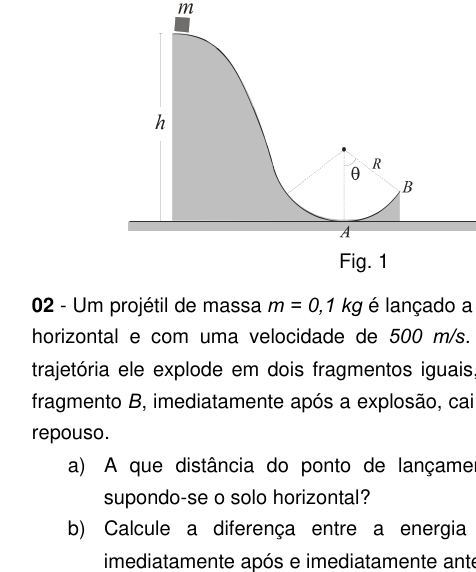 Ramp with circular loop, points A and B
Topic: Newtonian Mechanics, Conservation of Energy Metodi: Energy Conservation Method, Free-Body Diagram, Kinematic Equations Competenze: Physical Reasoning, Mathematical Modeling Objects: Block Fonte: Testo (PDF) — p.2
Un blocco di massa scivola giù su una superficie senza attrito come mostra la figura. Il blocco parte dal riposo di una altezza sopra la base del loop circolare, dove è il raggio del loop. Considera .
- A. Qual è la forza che la superficie esercita sul blocco alla base (punto )? E no ponto , onde acaba a superfície?
- B. A che distanza dal punto il blocco raggiunge la superficie orizzontale?
Ramp with circular loop, points A and B
Topic: Newtonian Mechanics, Conservation of Energy Metodi: Energy Conservation Method, Free-Body Diagram, Kinematic Equations Competenze: Physical Reasoning, Mathematical Modeling Objects: Block Fonte: Testo (PDF) — p.2
A mass block slides down on a frictionless surface as shown in the figure. The block starts at the rest of a height above the base of the circular loop, where is the radius of the loop. Consider .
- A. What is the force exerted by the surface on the block at the base (point )? E no ponto , onde acaba a superfície?
- B. How far from the point does the block reach the horizontal surface?
Ramp with circular loop, points A and B
Topic: Newtonian Mechanics, Conservation of Energy Metodi: Energy Conservation Method, Free-Body Diagram, Kinematic Equations Competenze: Physical Reasoning, Mathematical Modeling Objects: Block Fonte: Testo (PDF) — p.2
Um projétil de massa é lançado a um ângulo de com a horizontal e com uma velocidade de . No ponto mais alto da trajetória ele explode em dois fragmentos iguais, e . Suponha que o fragmento , imediatamente após a explosão, cai verticalmente a partir do repouso.
- A. A que distância do ponto de lançamento cai o fragmento , supondo-se o solo horizontal?
- B. Calcule a diferença entre a energia mecânica do sistema, imediatamente após e imediatamente antes da explosão.
Topic: Newtonian Mechanics, Conservation of Momentum Metodi: Kinematic Equations, Conservation of Momentum, Conservation Laws Competenze: Physical Reasoning, Mathematical Modeling Objects: Projectile Fonte: Testo (PDF) — p.2
Un proiettile di massa è lanciato ad un angolo di con la linea orizzontale e con una velocità di . Al punto più alto della traccia esplode in due frammenti uguali, e . Supponiamo che il frammento , immediatamente dopo l’esplosione, cade verticalmente dal riposo.
- A. A che distanza dal punto di lancio cade il frammento , se si presume che il suolo sia orizzontale?
- B. Calcola la differenza tra l’energia meccanica del sistema immediatamente dopo e immediatamente prima dell’esplosione.
Topic: Newtonian Mechanics, Conservation of Momentum Metodi: Kinematic Equations, Conservation of Momentum, Conservation Laws Competenze: Physical Reasoning, Mathematical Modeling Objects: Projectile Fonte: Testo (PDF) — p.2
A mass projectile is launched at an angle of with the horizontal and a speed of . At the highest point of the trajectory it explodes into two equal fragments, and . Suppose the fragment immediately after the explosion falls vertically from rest.
- A. A que distância do ponto de lançamento cai o fragmento , supondo-se o solo horizontal?
- B. Calculate the difference between the mechanical energy of the system immediately after and immediately before the explosion.
Topic: Newtonian Mechanics, Conservation of Momentum Metodi: Kinematic Equations, Conservation of Momentum, Conservation Laws Competenze: Physical Reasoning, Mathematical Modeling Objects: Projectile Fonte: Testo (PDF) — p.2
Um projétil é disparado obliquamente com uma velocidade tal que ele passa por dois pontos, ambos a uma altura acima da horizontal. Se a arma é ajustada para o alcance máximo, determine o valor da separação dos dois pontos, em termos de , e .
Topic: Newtonian Mechanics Metodi: Kinematic Equations, Physical Modeling Competenze: Mathematical Modeling, Physical Reasoning Objects: Projectile Fonte: Testo (PDF) — p.2
Un proiettile viene lanciato obliquamente a una velocità tale che passa attraverso due punti, entrambi ad un’altezza sopra l’orizzontale. Se la pistola è regolata al massimo raggio, determinare il valore della separazione dei due punti in termini di , e .
Topic: Newtonian Mechanics Metodi: Kinematic Equations, Physical Modeling Competenze: Mathematical Modeling, Physical Reasoning Objects: Projectile Fonte: Testo (PDF) — p.2
A projectile is fired obliquely at a speed such that it passes through two points, both at a height above the horizontal. If the weapon is set to maximum range, determine the value of the separation of the two points in terms of , and .
Topic: Newtonian Mechanics Metodi: Kinematic Equations, Physical Modeling Competenze: Mathematical Modeling, Physical Reasoning Objects: Projectile Fonte: Testo (PDF) — p.2
Uma esfera de aço de massa está presa à extremidade de uma corda de comprimento , e que tem fixa a outra extremidade. A esfera é abandonada sob a ação de seu peso quando a corda está na horizontal. No ponto mais baixo de sua trajetória a esfera colide elasticamente com um bloco de aço de massa , inicialmente em repouso, sobre uma superfície horizontal, cujo coeficiente de atrito vale .
- A. Qual a velocidade dos corpos imediatamente após a colisão?
- B. Quanto o bloco se desloca sobre a superfície horizontal até atingir o repouso?
Topic: Newtonian Mechanics, Conservation of Energy, Conservation of Momentum Metodi: Energy Conservation Method, Conservation of Momentum, Free-Body Diagram Competenze: Physical Reasoning, Mathematical Modeling Objects: Pendulum, Block Fonte: Testo (PDF) — p.2
Una sfera di acciaio di massa è attaccata all’estremità di una corda di lunghezza , e che ha fissato l’altra estremità. La sfera viene abbandonata sotto l’azione del suo peso quando la corda è orizzontale. Al punto più basso della sua trajectoria la sfera colpisce elasticamente con un blocco di acciaio di massa , inizialmente a riposo, su una superficie orizzontale il cui coefficiente di attrito è .
Qual è la velocità dei corpi immediatamente dopo l’impatto?
- B. Quanto si sposta il blocco sulla superficie orizzontale fino a raggiungere il riposo?
Topic: Newtonian Mechanics, Conservation of Energy, Conservation of Momentum Metodi: Energy Conservation Method, Conservation of Momentum, Free-Body Diagram Competenze: Physical Reasoning, Mathematical Modeling Objects: Pendulum, Block Fonte: Testo (PDF) — p.2
A steel ball of mass is attached to the end of a length rope , and which is fixed at the other end. The sphere is abandoned under the action of its weight when the rope is horizontal. At the lowest point of its trajectory the sphere shall collide elastically with a steel block of mass, initially at rest, on a horizontal surface with a coefficient of friction of .
- A. What is the speed of the bodies immediately after the collision?
- B. How far does the block move over the horizontal surface until it reaches rest?
Topic: Newtonian Mechanics, Conservation of Energy, Conservation of Momentum Metodi: Energy Conservation Method, Conservation of Momentum, Free-Body Diagram Competenze: Physical Reasoning, Mathematical Modeling Objects: Pendulum, Block Fonte: Testo (PDF) — p.2
Um corpo de massa é lançado do ponto com velocidade e se desloca segundo a curva mostrada na figura 2, onde o trecho é uma semicircunferência de raio e a distância vale . Determinar o menor valor de para o qual o corpo se deslocará sobre a curva e permanecerá sempre em contato com a mesma.
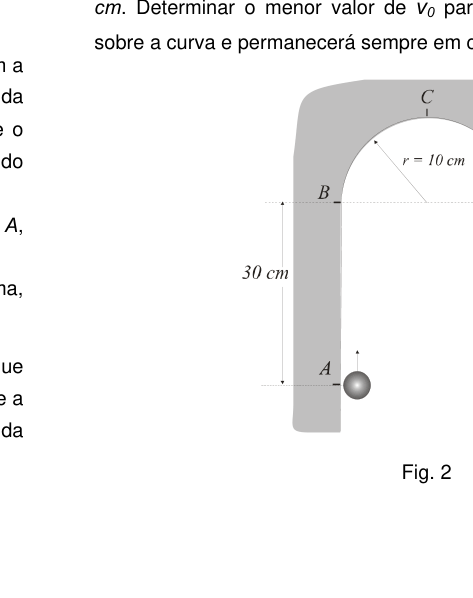 Curved track ABCDE with semicircle BCD
Topic: Newtonian Mechanics, Conservation of Energy Metodi: Energy Conservation Method, Free-Body Diagram, Physical Modeling Competenze: Physical Reasoning, Mathematical Modeling Objects: — Fonte: Testo (PDF) — p.2
Un corpo di massa viene lanciato dal punto con velocità e si sposta secondo la curva mostrata in figura 2, dove il tratto è una semicirconferenza di raggio e la distanza è . Determinare il minimo valore di per il quale il corpo si muoverà sulla curva e rimarrà sempre in contatto con essa.
Curved track ABCDE with semicircle BCD
Topic: Newtonian Mechanics, Conservation of Energy Metodi: Energy Conservation Method, Free-Body Diagram, Physical Modeling Competenze: Physical Reasoning, Mathematical Modeling Objects: — Fonte: Testo (PDF) — p.2
A mass body is launched from the point at speed and moves along the curve shown in Figure 2, where the stretch is a radius semicircular and the distance is . Determine the lowest value of to which the body will move over the curve and remain in contact with it at all times.
The following table shows the results of the tests:
Topic: Newtonian Mechanics, Conservation of Energy Metodi: Energy Conservation Method, Free-Body Diagram, Physical Modeling Competenze: Physical Reasoning, Mathematical Modeling Objects: — Fonte: Testo (PDF) — p.2
(Somente para o 1.º Ano) Uma partícula de massa tem velocidade inicial horizontal de . Ao receber um impulso de uma força constante, modifica sua velocidade para , em direção perpendicular à inicial, num intervalo de tempo .
- A. Qual a intensidade do impulso da força ?
- B. Qual a intensidade da força ?
Topic: Newtonian Mechanics Metodi: Impulse-Momentum Theorem, Vector Decomposition Competenze: Physical Reasoning, Mathematical Modeling Objects: — Fonte: Testo (PDF) — p.3
*(Solo per il primo anno) * Una particella di massa ha una velocità iniziale orizzontale di . Quando riceve un impulso di una forza costante , modifica la sua velocità a , in direzione perpendicolare all’inizio, in un intervallo di tempo .
- A Qual è l’intensità della forza di impulso ?
- B. Qual è l’intensità della forza ?
Topic: Newtonian Mechanics Metodi: Impulse-Momentum Theorem, Vector Decomposition Competenze: Physical Reasoning, Mathematical Modeling Objects: — Fonte: Testo (PDF) — p.3
*(For Year 1 only) * A particle mass has a horizontal starting speed of . When receiving a pulse of a constant force , it changes its speed to in the direction perpendicular to the start, at a time interval .
- A What is the strength of the force pulse ?
- **B ** What is the strength ?
Topic: Newtonian Mechanics Metodi: Impulse-Momentum Theorem, Vector Decomposition Competenze: Physical Reasoning, Mathematical Modeling Objects: — Fonte: Testo (PDF) — p.3
Um anel de massa está preso a uma mola e desliza sem atrito ao longo de um fio circular de raio , situado num plano vertical. A outra extremidade da mola é presa ao ponto que se encontra a do centro da circunferência (veja figura 3). Calcule a constante elástica da mola para que a velocidade do anel seja a mesma nos pontos e , sabendo que ela não está deformada quando o anel estiver na posição .
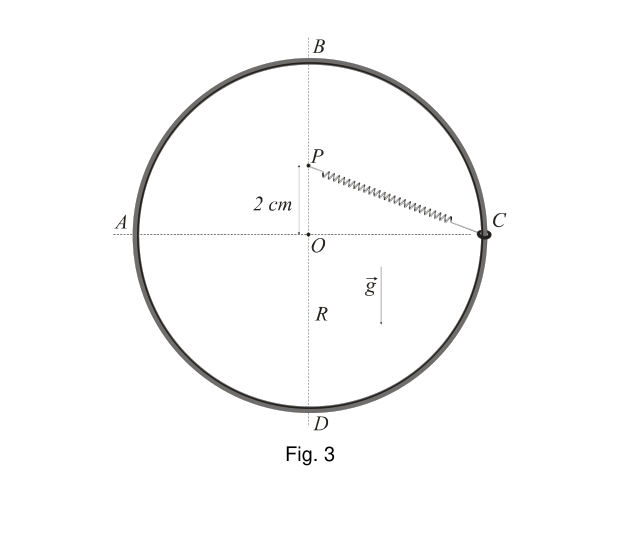 Ring on circular wire with spring at P
Topic: Newtonian Mechanics, Conservation of Energy, Oscillations & Waves Metodi: Energy Conservation Method, Hooke’s Law, Physical Modeling Competenze: Physical Reasoning, Mathematical Modeling Objects: Spring, Wire Fonte: Testo (PDF) — p.3
Un anello di massa è attaccato a una mola e scivola senza attrito lungo un filo circolare di raggio , situato in un piano verticale. L’altra estremità della mola è fissata al punto che si trova del centro della circonferenza (vedere figura 3). Calcolare la costante elastica della molla in modo che la velocità del anello sia la stessa nei punti e , sapendo che non è deformata quando il anello è nella posizione .
Ring on circular wire with spring at P
Topic: Newtonian Mechanics, Conservation of Energy, Oscillations & Waves Metodi: Energy Conservation Method, Hooke’s Law, Physical Modeling Competenze: Physical Reasoning, Mathematical Modeling Objects: Spring, Wire Fonte: Testo (PDF) — p.3
A mass ring is attached to a spring and slides without friction along a circular wire of radius, located in a vertical plane. The other end of the spring is attached to the point which is of the centre of the circumference (see Figure 3). Calculate the elastic constant of the spring so that the speed of the ring is the same at and points, knowing that it is not warped when the ring is at .
Ring on circular wire with spring at P
Topic: Newtonian Mechanics, Conservation of Energy, Oscillations & Waves Metodi: Energy Conservation Method, Hooke’s Law, Physical Modeling Competenze: Physical Reasoning, Mathematical Modeling Objects: Spring, Wire Fonte: Testo (PDF) — p.3
Num macaco hidráulico os êmbolos apresentam áreas iguais a e . Uma força de é aplicada no êmbolo menor, deslocando-o de , em um tempo .
- A. Qual a intensidade da força transmitida para o êmbolo maior?
- B. Nesse intervalo de tempo, qual o deslocamento sofrido pelo êmbolo maior?
- C. Qual a potência da força aplicada no êmbolo maior?
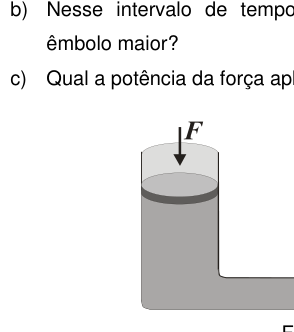 Hydraulic jack with two pistons and force F
Topic: Fluid Mechanics Metodi: Hydrostatic Equilibrium, Continuity Equation, Physical Modeling Competenze: Physical Reasoning, Mathematical Modeling Objects: Piston Fonte: Testo (PDF) — p.3
In un scimmia idraulico le embleme presentano aree uguali a e . Una forza di è applicata all’embaldo minore, spostandolo da , in un tempo .
- A. Qual è l’intensità della forza trasmessa all’embolo maggiore?
- B. In questo intervallo di tempo, quale spostamento ha subito l’embolo maggiore?
- C. Qual è la potenza della forza applicata al colpo maggiore?
*Scacca idraulica con due pistoni e forza F *
Topic: Fluid Mechanics Metodi: Hydrostatic Equilibrium, Continuity Equation, Physical Modeling Competenze: Physical Reasoning, Mathematical Modeling Objects: Piston Fonte: Testo (PDF) — p.3
In a hydraulic monkey the embolus has areas equal to and . A force of is applied to the lower embolism, displacing it from , at a time .
- What is the intensity of the force transmitted to the main embolus?
- B. In this time interval, what is the displacement of the main embolus?
- C. What is the force force applied to the main body?
*Hydraulic jack with two pistons and force F *
Topic: Fluid Mechanics Metodi: Hydrostatic Equilibrium, Continuity Equation, Physical Modeling Competenze: Physical Reasoning, Mathematical Modeling Objects: Piston Fonte: Testo (PDF) — p.3
Uma esfera de massa está apoiada numa parede vertical sem atrito e mantida nessa posição por um plano inclinado, também sem atrito, que forma um ângulo com o plano horizontal. Calcular as reações da parede e do plano sobre a esfera.
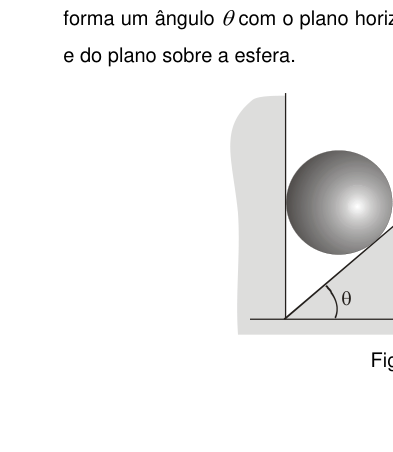 Sphere between vertical wall and inclined plane
Topic: Rigid Body Statics, Newtonian Mechanics Metodi: Free-Body Diagram, Vector Decomposition, Physical Modeling Competenze: Physical Reasoning, Mathematical Modeling Objects: Sphere, Inclined Plane Fonte: Testo (PDF) — p.3
Una sfera di massa è appoggiata su un muro verticale senza attrito e tenuta in tale posizione da un piano inclinato, anche senza attrito, che forma un angolo con il piano orizzontale. Calcolare le reazioni del muro e del piano sulla sfera.
Sphere between vertical wall and inclined plane
Topic: Rigid Body Statics, Newtonian Mechanics Metodi: Free-Body Diagram, Vector Decomposition, Physical Modeling Competenze: Physical Reasoning, Mathematical Modeling Objects: Sphere, Inclined Plane Fonte: Testo (PDF) — p.3
A mass sphere is supported on a vertical wall without friction and held in that position by an inclined plane, also without friction, which forms an angle to the horizontal plane. Calculate the reaction of the wall and plane on the sphere.
Sphere between vertical wall and inclined plane
Topic: Rigid Body Statics, Newtonian Mechanics Metodi: Free-Body Diagram, Vector Decomposition, Physical Modeling Competenze: Physical Reasoning, Mathematical Modeling Objects: Sphere, Inclined Plane Fonte: Testo (PDF) — p.3
(Somente para o 1.º Ano) Na figura os corpos possuem massas e . Considere desprezível o atrito nos planos e nas polias. A corda é horizontal e a corda é paralela ao plano.
- A. Calcule o peso necessário para manter o sistema em equilíbrio.
- B. Determine a reação do plano sobre o corpo 1.
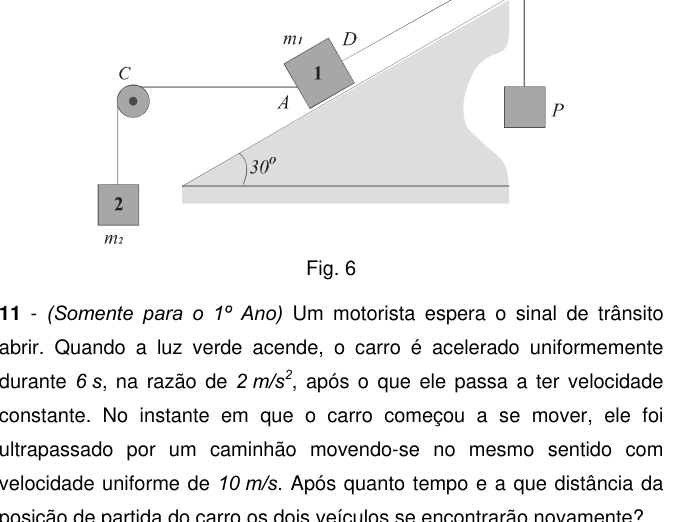 Pulley system on inclined plane, masses m1 and m2
Topic: Rigid Body Statics, Newtonian Mechanics Metodi: Free-Body Diagram, Vector Decomposition, Torque & Angular Momentum Analysis Competenze: Physical Reasoning, Diagrammatic Reasoning Objects: Pulley, String, Inclined Plane Fonte: Testo (PDF) — p.4
*(Solo per l’anno 1°) * Nella figura i corpi hanno masse e . Considerate dispregiato lo scatto nei piani e nelle polizze. La corda è orizzontale e la corda è parallela al piano.
- A. Calcola il peso necessario per mantenere il sistema in equilibrio.
- B. Determina la reazione del piano sul corpo 1.
Pulley system on inclined plane, masses m1 and m2
Topic: Rigid Body Statics, Newtonian Mechanics Metodi: Free-Body Diagram, Vector Decomposition, Torque & Angular Momentum Analysis Competenze: Physical Reasoning, Diagrammatic Reasoning Objects: Pulley, String, Inclined Plane Fonte: Testo (PDF) — p.4
*(Only for Year 1) * In the figure the bodies have masses and . Consider the friction in the plans and the polishes despicable. The rope is horizontal and the rope is parallel to the plane.
- A. Calculate the weight needed to keep the system in balance. Determine the reaction of the plane to the body 1.
Pulley system on inclined plane, masses m1 and m2
Topic: Rigid Body Statics, Newtonian Mechanics Metodi: Free-Body Diagram, Vector Decomposition, Torque & Angular Momentum Analysis Competenze: Physical Reasoning, Diagrammatic Reasoning Objects: Pulley, String, Inclined Plane Fonte: Testo (PDF) — p.4
(Somente para o 1.º Ano) Um motorista espera o sinal de trânsito abrir. Quando a luz verde acende, o carro é acelerado uniformemente durante , na razão de , após o que ele passa a ter velocidade constante. No instante em que o carro começou a se mover, ele foi ultrapassado por um caminhão movendo-se no mesmo sentido com velocidade uniforme de . Após quanto tempo e a que distância da posição de partida do carro os dois veículos se encontrarão novamente?
Topic: Newtonian Mechanics Metodi: Kinematic Equations, Physical Modeling Competenze: Mathematical Modeling, Physical Reasoning Objects: — Fonte: Testo (PDF) — p.4
Un autista sta aspettando che il segnale di traffico si aprisca. Quando la luce verde accende, la vettura viene accelerata uniformemente per , al rapporto di , dopo di che essa passa a velocità costante. L’istante in cui la macchina ha iniziato a muoversi, è stato superato da un camion che si muoveva nella stessa direzione a velocità uniforme di . Dopo quanto tempo e a che distanza dalla posizione di partenza della macchina i due veicoli si incontreranno di nuovo?
Topic: Newtonian Mechanics Metodi: Kinematic Equations, Physical Modeling Competenze: Mathematical Modeling, Physical Reasoning Objects: — Fonte: Testo (PDF) — p.4
A driver is waiting for the traffic signal to open. When the green light is turned on, the car is accelerated evenly during , at the ratio of , after which it goes to a constant speed. The moment the car started moving, it was overtaken by a truck moving in the same direction at a uniform speed of . After how long and how far from the starting position of the car will the two vehicles meet again?
Topic: Newtonian Mechanics Metodi: Kinematic Equations, Physical Modeling Competenze: Mathematical Modeling, Physical Reasoning Objects: — Fonte: Testo (PDF) — p.4
Uma bola movendo-se inicialmente a , no sentido positivo do eixo , fica, durante , sob a ação de uma força que causa uma aceleração de , no sentido positivo do eixo . Determine:
- A. O módulo e a direção da velocidade final da bola;
- B. A equação da sua trajetória e esboce o gráfico ;
- C. O deslocamento sofrido pela bola no intervalo de tempo de .
Topic: Newtonian Mechanics Metodi: Kinematic Equations, Vector Decomposition Competenze: Mathematical Modeling, Physical Reasoning Objects: Ball Fonte: Testo (PDF) — p.4
Una palla che si muove inizialmente a , nella direzione positiva dell’asse , durante , è sottoposta all’azione di una forza che provoca un’accelerazione di , nella direzione positiva dell’asse . Determina:
- A. Il modulo e la direzione della velocità finale della palla;
- B. L’equazione del suo percorso e il grafico ;
- C. Il spostamento della palla nell’intervallo di tempo .
Topic: Newtonian Mechanics Metodi: Kinematic Equations, Vector Decomposition Competenze: Mathematical Modeling, Physical Reasoning Objects: Ball Fonte: Testo (PDF) — p.4
A ball initially moving at in the positive direction of the axis is subjected during to the action of a force causing an acceleration of in the positive direction of the axis. Determine:
- A. The final speed module and direction of the ball;
- B. The equation of its trajectory and outline the graph ;
- C. The displacement of the ball in the time interval.
Topic: Newtonian Mechanics Metodi: Kinematic Equations, Vector Decomposition Competenze: Mathematical Modeling, Physical Reasoning Objects: Ball Fonte: Testo (PDF) — p.4
Um balão está no fundo de um lago de de profundidade e para trazê-lo à superfície começa a ser preenchido, por meio de uma bomba, com um hipotético gás ideal, cuja densidade é menor que a densidade do ar. O volume deste balão se altera de maneira que a pressão interna do gás seja igual à pressão média externa. Num determinado instante, quando o seu volume é , ele é desconectado da bomba, começa a subir e escapa da água. Considere que a massa do balão, incluindo a massa do gás, é de e que as variações de temperatura são desprezíveis. Determine o menor volume que faz com que o balão não retorne ao lago.
(Obs.: Para fins de cálculo, despreze a diferença da pressão externa entre a base e o topo do balão.)
Topic: Fluid Mechanics, Thermodynamics Metodi: Hydrostatic Equilibrium, Ideal Gas Law, Physical Modeling Competenze: Physical Reasoning, Mathematical Modeling Objects: Gas Fonte: Testo (PDF) — p.4
Un pallone è al fondo di un lago di profondità e per portarlo alla superficie inizia a essere riempito, con una bomba, con un ipotetico gas ideale, la cui densità è inferiore alla densità dell’aria. Il volume di questo pallone cambia in modo tale che la pressione interna del gas sia uguale alla pressione media esterna. In un certo istante, quando il suo volume è , viene disattivato dalla pompa, inizia a salire e sfugge dall’acqua. Considera che la massa del pallone, compreso il gas, è e che le variazioni di temperatura sono scarsa. Determina il minor volume che impedisce al pallone di tornare nel lago.
(OBS: Per calcolo, disprezza la differenza di pressione esterna tra la base e la parte superiore del pallone.)
Topic: Fluid Mechanics, Thermodynamics Metodi: Hydrostatic Equilibrium, Ideal Gas Law, Physical Modeling Competenze: Physical Reasoning, Mathematical Modeling Objects: Gas Fonte: Testo (PDF) — p.4
A balloon is at the bottom of a lake of depth and to bring it to the surface it begins to be filled, by means of a pump, with a hypothetical ideal gas, whose density is less than the density of the air. The volume of this balloon is changed so that the internal pressure of the gas is equal to the average external pressure. At a certain moment, when its volume is , it is disconnected from the pump, starts to rise and escapes from the water. Consider that the mass of the balloon, including the mass of the gas, is and that temperature variations are negligible. Determine the lowest volume that prevents the balloon from returning to the lake.
(Obs.: For calculation purposes, disregard the difference in external pressure between the base and the top of the balloon.)
Topic: Fluid Mechanics, Thermodynamics Metodi: Hydrostatic Equilibrium, Ideal Gas Law, Physical Modeling Competenze: Physical Reasoning, Mathematical Modeling Objects: Gas Fonte: Testo (PDF) — p.4
(Somente para o 1.º Ano) A conhecida fórmula de dilatação térmica, na qual o comprimento de uma barra varia linearmente com a temperatura, só é exata se a variação de temperatura não for grande. Para grandes variações de temperatura esta fórmula perde precisão e pode levar a erros grosseiros. Contudo, podemos, mesmo assim, utilizar esta fórmula para grandes variações se admitirmos que o coeficiente de dilatação térmica varie com a temperatura, ou melhor, que este coeficiente permaneça constante em uma determinada faixa de temperatura e tome outro valor em outra faixa. Suponha que uma barra, construída com material cujo coeficiente de dilatação varie com a temperatura como mostrado na figura 7, tenha comprimento à temperatura .
- A. Qual o comprimento da barra na temperatura ?
- B. Se, ao invés do procedimento anterior, admitirmos que o valor é o mesmo para todas as temperaturas (e igual ao valor médio dos coeficientes de temperatura apresentados no gráfico), qual seria o comprimento da barra à temperatura ?
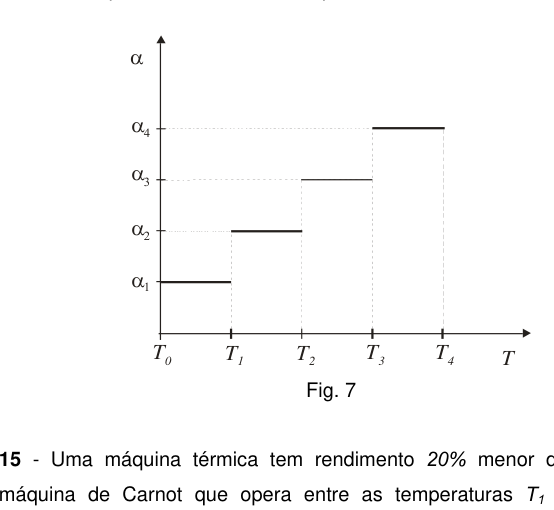 Step-function graph of α vs temperature T
Topic: Thermodynamics Metodi: Physical Modeling, Approximation & Series Expansion Competenze: Physical Reasoning, Mathematical Modeling Objects: Rod Fonte: Testo (PDF) — p.4
*(Solo per l’anno 1°) * La formula di dilatazione termico nota, in cui la lunghezza di una barra varia linearmente con la temperatura, è accurata solo se la variazione di temperatura non è grande. Per grandi variazioni di temperatura questa formula perde precisione e può portare a grossi errori. Tuttavia, possiamo comunque utilizzare questa formula per grandi variazioni se ammettiamo che il coefficiente di dilatazione termica varia con la temperatura, o meglio, che questo coefficiente rimanga costante in una certa fascia di temperatura e prende un altro valore in un’altra fascia. Supponiamo che una barra, costruita con materiale il cui coefficiente di dilatazione varia con la temperatura come mostrato in figura 7, abbia una lunghezza a temperatura .
- A. Qual è la lunghezza della barra a temperatura ?
- B. Se, invece della precedente procedura, si ammette che il valore è lo stesso per tutte le temperature (e uguale al valore medio dei coefficienti di temperatura presentati nel grafico), quale sarebbe la lunghezza della barra alla temperatura ?
Step-function graph of α vs temperature T
Topic: Thermodynamics Metodi: Physical Modeling, Approximation & Series Expansion Competenze: Physical Reasoning, Mathematical Modeling Objects: Rod Fonte: Testo (PDF) — p.4
*(Only for Year 1) * The known thermal dilation formula, in which the length of a bar varies linearly with temperature, is only accurate if the temperature variation is not large. For large temperature variations this formula loses accuracy and can lead to gross errors. However, we can still use this formula for large variations if we admit that the coefficient of thermal dilation varies with temperature, or rather, that this coefficient remains constant in a certain temperature range and takes another value in another range. Suppose a bar, constructed from a material whose coefficient of dilation varies with temperature as shown in Figure 7, is long at .
- A What is the length of the bar at ?
- B. If, instead of the previous procedure, we assume that is the same for all temperatures (and equal to the mean value of the temperature coefficients shown in the graph), what would be the length of the bar at temperature?
The following table shows the results of the calculations:
Topic: Thermodynamics Metodi: Physical Modeling, Approximation & Series Expansion Competenze: Physical Reasoning, Mathematical Modeling Objects: Rod Fonte: Testo (PDF) — p.4
Uma máquina térmica tem rendimento menor do que uma máquina de Carnot que opera entre as temperaturas e . A quantidade de calor por unidade de tempo recebida pela máquina é igual à que ocorre quando uma parede de de espessura, área de e condutividade térmica de é submetida a uma diferença de temperatura de .
- A. Determine a potência desta máquina.
- B. Que quantidade de gelo a seria possível derreter usando a quantidade de calor descartada pela máquina, durante um tempo de minutos?
Topic: Thermodynamics Metodi: Thermodynamic Cycle Analysis, First Law of Thermodynamics, Physical Modeling Competenze: Physical Reasoning, Mathematical Modeling Objects: Heat Engine Fonte: Testo (PDF) — p.5
Una macchina termico ha un rendimento inferiore a quello di una macchina Carnot che opera tra le temperature e . La quantità di calore per unità di tempo ricevuta dalla macchina è pari a quella che si verifica quando un muro di di spessore, area e conducibilità termico di è sottoposto a una differenza di temperatura di .
- A. Determina la potenza di questa macchina.
- **B ** Che quantità di ghiaccio a potrebbe essere fuso utilizzando la quantità di calore scartata dalla macchina per un tempo di minuti?
Topic: Thermodynamics Metodi: Thermodynamic Cycle Analysis, First Law of Thermodynamics, Physical Modeling Competenze: Physical Reasoning, Mathematical Modeling Objects: Heat Engine Fonte: Testo (PDF) — p.5
A heat engine has a yield lower than a Carnot machine operating between temperatures and . The amount of heat per unit of time received by the machine is equal to that which occurs when a wall of thickness, area of and thermal conductivity of is subjected to a temperature difference of .
- A Determine the power of this machine.
- What amount of ice at could be melted using the amount of heat discarded by the machine over a time of minutes?
Topic: Thermodynamics Metodi: Thermodynamic Cycle Analysis, First Law of Thermodynamics, Physical Modeling Competenze: Physical Reasoning, Mathematical Modeling Objects: Heat Engine Fonte: Testo (PDF) — p.5
Certa quantidade de gás Hélio, inicialmente no estado , em que a pressão e o volume valem e , sofre o processo . O processo é isobárico e é adiabático. Considere o gás ideal e que para o Hélio, e são os calores específicos molares a volume e a pressão constante, respectivamente.
- A. Construa o diagrama , sabendo que o volume do gás no estado é e a pressão no estado é .
- B. Quanto trabalho foi realizado pelo gás na expansão ?
- C. Qual a variação na energia interna do gás de ?
Observação: Num processo adiabático, o trabalho realizado (ou recebido) pelo gás entre os estados é dado por: onde é o fator de Poisson.
Topic: Thermodynamics, Kinetic Theory Metodi: Thermodynamic Cycle Analysis, First Law of Thermodynamics, Ideal Gas Law Competenze: Physical Reasoning, Mathematical Modeling Objects: Gas Fonte: Testo (PDF) — p.5
Una certa quantità di gas elio, inizialmente allo stato , in cui la pressione e il volume valono e , subisce il processo . Il processo è isobarico e è adiabatico. Considerare il gas ottimale e che per gli Helio e sono calori specifici molari a volume e pressione costante, rispettivamente.
- A. Costruisce il diagramma sapendo che il volume del gas nello stato è e la pressione nello stato è .
- B. Quanto lavoro è stato fatto per il gas nell’espansione ?
- C. Qual è la variazione dell’energia interna del gas ?
Nota: In un processo adiabatico, il lavoro svolto (o ricevuto) dal gas tra gli stati è dato da: dove è il fattore di Poisson.
Topic: Thermodynamics, Kinetic Theory Metodi: Thermodynamic Cycle Analysis, First Law of Thermodynamics, Ideal Gas Law Competenze: Physical Reasoning, Mathematical Modeling Objects: Gas Fonte: Testo (PDF) — p.5
A certain amount of helium gas, initially in the state , where the pressure and volume are and , undergoes the process. The process is isobaric and is adiabatic. Consider the ideal gas and that for helium and are the specific molar heat at volume and constant pressure, respectively.
- A. Construct the diagram , knowing that the gas volume in the state is and the pressure in the state is .
- B. How much work has been done on gas in the expansion ?
- C. What is the change in the internal energy of the gas ?
Note: In an adiabatic process, the work done (or received) by the gas between the states is given by: where is the Poisson factor.
Topic: Thermodynamics, Kinetic Theory Metodi: Thermodynamic Cycle Analysis, First Law of Thermodynamics, Ideal Gas Law Competenze: Physical Reasoning, Mathematical Modeling Objects: Gas Fonte: Testo (PDF) — p.5
Um mergulhador está a abaixo da superfície de um lago. No instante ele aponta um feixe de laser na direção de um avião, que está exatamente acima dele na direção vertical e, após (lembre-se que ), o feixe refletido pelo avião chega nele. No instante ele aponta o laser para o ponto , que está a do ponto (veja figura 8) e a luz atinge o avião. Considere que os índices de refração da água e do ar sejam respectivamente e , que a velocidade da luz no vácuo seja .
- A. Qual é a velocidade do avião (em km/h)?
- B. Irá o feixe de luz atingir o avião se no instante o mergulhador incidir o feixe de laser no ponto , que está a de ?
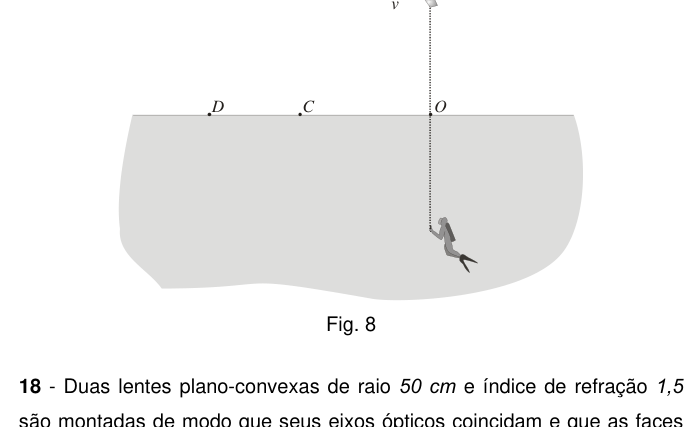 Diver underwater, laser to airplane above, points O, C, D
Topic: Geometric Optics, Newtonian Mechanics Metodi: Snell’s Law, Kinematic Equations, Physical Modeling Competenze: Physical Reasoning, Mathematical Modeling Objects: — Fonte: Testo (PDF) — p.5
Un subacqueo è sotto la superficie di un lago. In questo istante punta un fascio laser verso un aereo, che è esattamente sopra di lui nella direzione verticale e, dopo (ricordate che ), il fascio riflesso dall’aereo arriva in esso. In questo istante , il laser punta al punto , che è del punto (vedi figura 8) e la luce raggiunge l’aereo. Considera che i tassi di refrazione dell’acqua e dell’aria siano e , rispettivamente, e che la velocità della luce nel vuoto sia .
- A. Qual è la velocità dell’aereo (in km/h)?
- B. Il fascio di luce raggiungerà l’aereo se l’immediato il subacqueo incide sul fascio laser al punto , che è di ?
Diver underwater, laser to airplane above, points O, C, D
Topic: Geometric Optics, Newtonian Mechanics Metodi: Snell’s Law, Kinematic Equations, Physical Modeling Competenze: Physical Reasoning, Mathematical Modeling Objects: — Fonte: Testo (PDF) — p.5
A diver is below the surface of a lake. In the instant it points a laser beam towards an aircraft, which is just above it in the vertical direction and, after (remember ), the beam reflected by the aircraft reaches it. In the instant, it points the laser to the point, which is from the point (see figure 8) and the light hits the plane. Consider that the refractive indices of water and air are and respectively, and that the speed of light in vacuum is .
- A. What is the speed of the aeroplane (in km/h)?
- B. Irá o feixe de luz atingir o avião se no instante o mergulhador incidir o feixe de laser no ponto , que está a de ?
Diver underwater, laser to airplane above, points O, C, D
Topic: Geometric Optics, Newtonian Mechanics Metodi: Snell’s Law, Kinematic Equations, Physical Modeling Competenze: Physical Reasoning, Mathematical Modeling Objects: — Fonte: Testo (PDF) — p.5
Duas lentes plano-convexas de raio e índice de refração são montadas de modo que seus eixos ópticos coincidam e que as faces convexas fiquem uma defronte à outra, a uma distância de . Um objeto de altura é colocado a uma distância à esquerda da primeira lente. Determine a altura da imagem, informando se ela é real ou virtual, direita ou invertida para os seguintes casos:
- A. O espaço entre as lentes é preenchido com água () e .
- B. Todo o conjunto, inclusive o objeto, é imerso na água e .
Topic: Geometric Optics Metodi: Thin Lens & Mirror Equation, Snell’s Law, Ray Tracing Competenze: Mathematical Modeling, Physical Reasoning Objects: Lens Fonte: Testo (PDF) — p.6
Due obiettivi piano-convex di raggio e indice di refrazione sono montati in modo che i loro assi ottici coincidano e che le facce convex si trovino una di fronte all’altra, a una distanza di . Un oggetto di altezza è posto a una distanza a sinistra della prima lente. Determina la altezza dell’immagine, indicando se è reale o virtuale, destra o inversa per i seguenti casi:
- A. Lo spazio tra le lenti è riempito di acqua () e .
- B. L’intero insieme, compreso l’oggetto, è immerso nell’acqua e .
Topic: Geometric Optics Metodi: Thin Lens & Mirror Equation, Snell’s Law, Ray Tracing Competenze: Mathematical Modeling, Physical Reasoning Objects: Lens Fonte: Testo (PDF) — p.6
Two flat-convex lenses of radius and refractive index are mounted so that their optical axes coincide and the convex faces face each other at a distance of . A height object is placed at a distance to the left of the first lens. Determine the height of the image, stating whether it is real or virtual, straight or inverted for the following cases:
- A. The space between the lenses is filled with water () and .
- B. The whole set including the object is immersed in water and .
Topic: Geometric Optics Metodi: Thin Lens & Mirror Equation, Snell’s Law, Ray Tracing Competenze: Mathematical Modeling, Physical Reasoning Objects: Lens Fonte: Testo (PDF) — p.6
(Somente para o 1.º Ano) Um feixe de luz paralelo incide sobre um sistema formado por duas lentes separadas por uma distância . O feixe emergente também é paralelo, mas com diâmetro vezes maior que o feixe incidente. Discuta como esse sistema pode ser construído, explicitando o tipo de lentes, as distâncias focais, a relação entre os diâmetros, etc. Esse sistema é único? Em caso negativo, descreva um outro sistema que leve ao mesmo resultado.
Topic: Geometric Optics, Wave Optics Metodi: Thin Lens & Mirror Equation, Ray Tracing, Physical Modeling Competenze: Physical Reasoning, Diagrammatic Reasoning Objects: Lens Fonte: Testo (PDF) — p.6
*(Solo per il 1° anno) * Un fascio di luce parallela incide su un sistema formato da due obiettivi separati da una distanza . Il fascio emergente è anche parallelo, ma diametro volte superiore al fascio incidente. Discutere di come si può costruire questo sistema, spiegando il tipo di lenti, le distanze focali, il rapporto tra i diametri, ecc. Questo sistema è unico? In caso negativo, descrivi un altro sistema che porta allo stesso risultato.
Topic: Geometric Optics, Wave Optics Metodi: Thin Lens & Mirror Equation, Ray Tracing, Physical Modeling Competenze: Physical Reasoning, Diagrammatic Reasoning Objects: Lens Fonte: Testo (PDF) — p.6
*(Only for Year 1 only) * A parallel beam of light hits a system consisting of two lenses separated by a distance . The outgoing beam is also parallel but times larger in diameter than the incident beam. Discuss how this system can be built, explaining the type of lenses, focal lengths, the relationship between diameters, etc. Is this system unique? If not, describe another system that leads to the same result.
Topic: Geometric Optics, Wave Optics Metodi: Thin Lens & Mirror Equation, Ray Tracing, Physical Modeling Competenze: Physical Reasoning, Diagrammatic Reasoning Objects: Lens Fonte: Testo (PDF) — p.6
Uma moeda se encontra exatamente na parte central do fundo de um tanque de água montado sobre a carroceria de um caminhão. Um rapaz que observa a moeda, segundo um ângulo em relação à normal à superfície do líquido, mede uma profundidade aparente de . Em certo instante o caminhão se move para frente com aceleração constante e o rapaz, observando a moeda com o mesmo ângulo em relação à normal à superfície do líquido (que agora está inclinada), atribui uma profundidade aparente de . Determine a aceleração do caminhão.
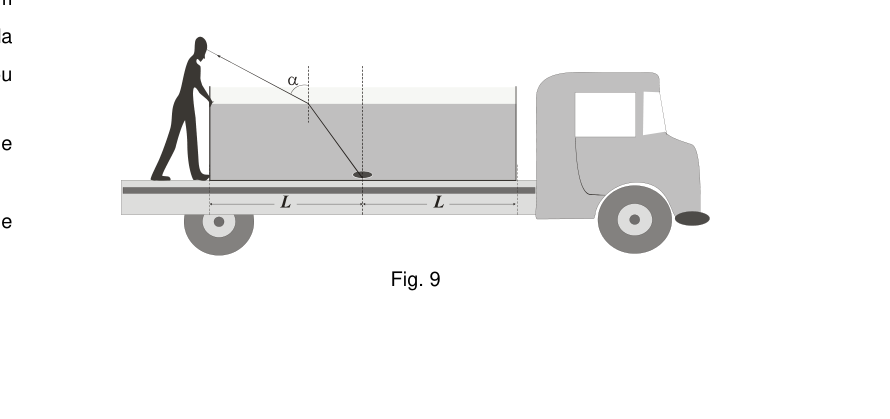 Man observing coin in water tank on accelerating truck
Topic: Geometric Optics, Newtonian Mechanics, Fluid Mechanics Metodi: Snell’s Law, Physical Modeling, Free-Body Diagram Competenze: Physical Reasoning, Mathematical Modeling Objects: Container Fonte: Testo (PDF) — p.6
Una moneta si trova proprio nella parte centrale del fondo di un serbatoio d’acqua montato sul carrozzeria di un camion. Un ragazzo che osserva la moneta, da un angolo rispetto alla normale sulla superficie del liquido, misura una profondità apparente di . A un certo punto il camion si muove avanti con costante accelerazione e il ragazzo, osservando la moneta con lo stesso angolo rispetto alla normale sulla superficie del liquido (che ora è inclinata), attribuisce una profondità apparente di . Determina la velocità del camion.
Man observing coin in water tank on accelerating truck
Topic: Geometric Optics, Newtonian Mechanics, Fluid Mechanics Metodi: Snell’s Law, Physical Modeling, Free-Body Diagram Competenze: Physical Reasoning, Mathematical Modeling Objects: Container Fonte: Testo (PDF) — p.6
A coin is located exactly in the central part of the bottom of a water tank mounted on the body of a truck. A boy observing the coin at an angle of from the normal to the surface of the liquid measures an apparent depth of . At a certain moment the truck moves forward at constant acceleration and the boy, observing the coin at the same angle to the normal surface of the liquid (which is now tilted), assigns an apparent depth of . Determine the acceleration of the truck.
Man observing coin in water tank on accelerating truck
Topic: Geometric Optics, Newtonian Mechanics, Fluid Mechanics Metodi: Snell’s Law, Physical Modeling, Free-Body Diagram Competenze: Physical Reasoning, Mathematical Modeling Objects: Container Fonte: Testo (PDF) — p.6