- A intensidade da força horizontal resultante aplicada a um avião que voa em linha reta com velocidade e altura constantes, depende de sua velocidade e é dada por em que e são duas constantes. Das unidades citadas a seguir, a única que corresponde à constante é:
- A.
- B.
- C.
- D.
- E.
Topic: Newtonian Mechanics Metodi: Dimensional Analysis Competenze: Physical Reasoning, Unit Conversion Objects: — Fonte: Testo (PDF) — p.2
- L’intensità della forza orizzontale risultante applicata ad un aereo che vola in linea retta a velocità e altezza costanti dipende dalla sua velocità ed è data da in cui e sono due costanti. Tra le unità di cui sopra, l’unica che corrisponde alla costante è:
- A.
- B.
- C.
- D.
- E.
Topic: Newtonian Mechanics Metodi: Dimensional Analysis Competenze: Physical Reasoning, Unit Conversion Objects: — Fonte: Testo (PDF) — p.2
- The intensity of the resulting horizontal force applied to an aeroplane flying in a straight line with constant speed and altitude depends on its speed and is given by where and are two constants. Of the units listed below, the only one corresponding to the constant is:
- A.
- B.
- C.
- D.
- E.
Topic: Newtonian Mechanics Metodi: Dimensional Analysis Competenze: Physical Reasoning, Unit Conversion Objects: — Fonte: Testo (PDF) — p.2
- Um motorista, viajando de uma para outra cidade, usualmente gasta 2 horas e meia para completar o trajeto quando consegue manter uma velocidade média de 90 km/h. Num dia de tráfego mais intenso demorou 3 horas no mesmo percurso. Neste caso, sua velocidade média, em km/h, foi igual a:
- A. 75
- B. 68
- C. 70
- D. 80
- E. 85
Topic: Newtonian Mechanics Metodi: Kinematic Equations Competenze: Physical Reasoning, Mathematical Modeling Objects: — Fonte: Testo (PDF) — p.2
- Un autista che viaggia da una città all’altra, di solito spende 2 ore e mezza per completare il percorso quando riesce a mantenere una velocità media di 90 km/h. In un giorno di traffico più intenso, ci sono volute tre ore per seguire la stessa rotta. In questo caso, la sua velocità media in km/h è stata pari a:
- A. 75
- B. 68
- C. 70
- D. 80
- E. 85
Topic: Newtonian Mechanics Metodi: Kinematic Equations Competenze: Physical Reasoning, Mathematical Modeling Objects: — Fonte: Testo (PDF) — p.2
- A driver, travelling from one city to another, usually spends 2 and a half hours completing the route when he can maintain an average speed of 90 km/h. On a more busy day, it took three hours on the same route. In this case, its average speed in km/h was:
- A. 75
- B. 68
- C. 70
- D. 80
- E. 85
Topic: Newtonian Mechanics Metodi: Kinematic Equations Competenze: Physical Reasoning, Mathematical Modeling Objects: — Fonte: Testo (PDF) — p.2
- Três blocos “A”, “B” e “C” de mesmos tamanhos e forma têm massas respectivamente iguais a , e . Eles são abandonados a partir de um mesmo ponto P da rampa representada, deslizam sem atrito e finalmente caem colidindo contra o piso plano e horizontal. Após ser solto, o bloco “B” cai em 1 segundo e sofre o impacto no ponto assinalado com a letra O. Considere que todas as forças dissipativas são irrelevantes no evento. É possível afirmar que o bloco:
- A. “C” cai à direita do ponto O.
- B. “C” cai à esquerda do ponto O.
- C. “A” também cai no ponto O.
- D. “A” cai em um tempo menor que 1s.
- E. “A” cai em um tempo maior que 1s.
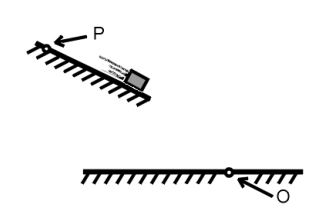 Ramp with blocks falling to floor
Topic: Newtonian Mechanics, Conservation of Energy Metodi: Kinematic Equations, Energy Conservation Method, Free-Body Diagram Competenze: Physical Reasoning, Diagrammatic Reasoning Objects: Block, Inclined Plane Fonte: Testo (PDF) — p.2
- Tre blocchi “A”, “B” e “C” della stessa dimensione e forma hanno masse rispettivamente uguali a , e . Sono abbandonate da un punto P della rampa rappresentata, scivolavano senza attrito e finalmente cadono colludendo contro il pavimento piatto e orizzontale. Dopo essere stato rilasciato, il blocco “B” cade in 1 secondo e subisce l’impatto sul punto indicato dalla lettera O. Considera che tutte le forze dissipative sono irrilevanti nell’evento. Si può affermare che il blocco:
- A. “C” cade a destra del punto O.
- **B ** “C” cade a sinistra del punto O.
- C. “A” cade anche al punto O.
- **D ** “A” cade in meno di 1s.
- **E ** “A” cade in più di 1 secondi.
Ramp with blocks falling to floor
Topic: Newtonian Mechanics, Conservation of Energy Metodi: Kinematic Equations, Energy Conservation Method, Free-Body Diagram Competenze: Physical Reasoning, Diagrammatic Reasoning Objects: Block, Inclined Plane Fonte: Testo (PDF) — p.2
- Three blocks ‘A’, ‘B’ and ‘C’ of the same size and shape have masses equal to , and respectively. They are abandoned from the same P point of the ramp represented, slip without friction and finally falling into collision with the flat, horizontal floor. After being released, block ‘B’ falls within 1 second and is impacted at the point marked with the letter ‘O’. Consider that all dissipative forces are irrelevant to the event. It is possible to state that the block:
- **A ** “C” falls to the right of point O.
- **B ** “C” falls to the left of point O.
- C. “A” also falls in point O.
- **D ** “A” falls in less than 1s.
- **E ** “A” falls in more than 1s.
Ramp with blocks falling to the floor
Topic: Newtonian Mechanics, Conservation of Energy Metodi: Kinematic Equations, Energy Conservation Method, Free-Body Diagram Competenze: Physical Reasoning, Diagrammatic Reasoning Objects: Block, Inclined Plane Fonte: Testo (PDF) — p.2
- O movimento bidimensional de uma partícula é descrito pelas equações de suas coordenadas em função do tempo por
É possível afirmar que os módulos de sua velocidade e aceleração, para o instante , valem respectivamente:
- A. 5 m/s e 10 m/s²
- B. 1 m/s e 5 m/s²
- C. 5 m/s e 5 m/s²
- D. 13 m/s e 20 m/s²
- E. 39 m/s e 14 m/s²
Topic: Newtonian Mechanics Metodi: Kinematic Equations, Vector Decomposition Competenze: Mathematical Modeling, Physical Reasoning Objects: — Fonte: Testo (PDF) — p.2
- Il movimento bidimensionale di una particella è descritto dalle equazioni delle sue coordinate in funzione del tempo per
È possibile affermare che i moduli di velocità e di accelerazione per l’istante valono rispettivamente:
- A. 5 m/s e 10 m/s²
- B. 1 m/s e 5 m/s²
- C. 5 m/s e 5 m/s²
- D. 13 m/s e 20 m/s²
- E. 39 m/s e 14 m/s²
Topic: Newtonian Mechanics Metodi: Kinematic Equations, Vector Decomposition Competenze: Mathematical Modeling, Physical Reasoning Objects: — Fonte: Testo (PDF) — p.2
- The two-dimensional motion of a particle is described by the equations of its coordinates with respect to time by
It is possible to state that the modules of its speed and acceleration, for the instant , are respectively:
- A. 5 m/s e 10 m/s²
- B. 1 m/s e 5 m/s²
- C. 5 m/s e 5 m/s²
- D. 13 m/s e 20 m/s²
- E. 39 m/s e 14 m/s²
Topic: Newtonian Mechanics Metodi: Kinematic Equations, Vector Decomposition Competenze: Mathematical Modeling, Physical Reasoning Objects: — Fonte: Testo (PDF) — p.2
- As polias A, B, C e D estão acopladas como mostrado na figura. A tem contato pela periferia com B, que por sua vez, tem um acoplamento pelo eixo com a polia C e esta liga-se à polia D por meio de uma correia.
A relação entre os raios das polias é dado por .
Está correto afirmar que:
- A. a frequência de rotação da polia A é a metade da frequência de rotação da polia B.
- B. as velocidades angulares de rotação das polias A e B são iguais.
- C. o período de rotação da polia C é a metade do período de rotação da polia A.
- D. quando a polia B dá 4 voltas a polia D dá 3 voltas.
- E. as periferias das polias C e D apresentam velocidades escalares diferentes.
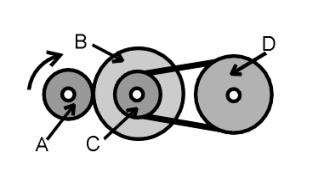 Four coupled pulleys A B C D
Topic: Rotational Dynamics Metodi: Torque & Angular Momentum Analysis, Physical Modeling Competenze: Physical Reasoning, Mathematical Modeling Objects: Pulley Fonte: Testo (PDF) — p.2
- Le polisse A, B, C e D sono accoppiate come mostrato nella figura. A ha un contatto per la periferia con B, che a sua volta ha un accoppiamento per l’asse con la pollice C e questa si collega alla pollice D attraverso una cintura.
Il rapporto tra i raggi dei poli è dato da .
È corretto affermare che:
- A. la frequenza di rotazione del pollice A è la metà della frequenza di rotazione del pollice B.
- B. le velocità angolari di rotazione dei poli A e B sono uguali.
- C. il periodo di rotazione del pollice C è la metà del periodo di rotazione del pollice A.
- D. quando la pollice B fa 4 giri la pollice D fa 3 giri.
- E. le periferie dei poli C e D presentano velocità scalari diverse.
*Four coupled pulleys A B C D *
Topic: Rotational Dynamics Metodi: Torque & Angular Momentum Analysis, Physical Modeling Competenze: Physical Reasoning, Mathematical Modeling Objects: Pulley Fonte: Testo (PDF) — p.2
- The poles A, B, C and D are coupled as shown in Figure 1. A has peripheral contact with B, which in turn has a axis coupling with the C pole and this is connected to the D pole via a belt.
The ratio of the radii of the polishes is given by .
It is correct to state that:
- A. the rotation frequency of pole A is half the rotation frequency of pole B.
- B. the angular rotational speeds of the A and B poles are the same.
- C. the rotation period of the C-pole is half the rotation period of the A-pole.
- D when polymer B is 4 turns, polymer D is 3 turns.
- **E ** the peripherals of the C and D poles have different scalar speeds.
The following table shows the number of pulleys:
Topic: Rotational Dynamics Metodi: Torque & Angular Momentum Analysis, Physical Modeling Competenze: Physical Reasoning, Mathematical Modeling Objects: Pulley Fonte: Testo (PDF) — p.2
- As quatro forças representadas estão, cada uma delas, aplicadas aos quatro lados de uma placa. Elas formam um sistema de forças bidimensional. Cada quadrícula mostrada equivale a 1 kN. As opções fornecidas envolvem o cálculo da intensidade da força resultante de duas ou de três das forças representadas. É possível afirmar que, dentre as opções fornecidas, está correta apenas a correspondente à letra:
- A.
- B.
- C.
- D.
- E.
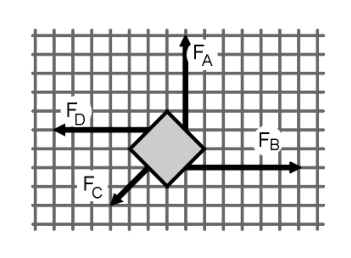 Four forces on plate, grid 1 kN
Topic: Newtonian Mechanics, Rigid Body Statics Metodi: Vector Decomposition, Superposition Principle Competenze: Diagrammatic Reasoning, Mathematical Modeling Objects: — Fonte: Testo (PDF) — p.3
- Le quattro forze rappresentate sono applicate a ciascuna delle quattro spalle di una targa. Formano un sistema di forze bidimensionali. Ogni quadrante mostrata è pari a 1 kN. Le opzioni fornite comportano il calcolo dell’intensità della forza derivante da due o tre delle forze rappresentate. Si può affermare che, tra le opzioni fornite, è corretta solo la lettera:
- A.
- B.
- C.
- D.
- E.
*Four forces on plate, grid 1 kN *
Topic: Newtonian Mechanics, Rigid Body Statics Metodi: Vector Decomposition, Superposition Principle Competenze: Diagrammatic Reasoning, Mathematical Modeling Objects: — Fonte: Testo (PDF) — p.3
- The four forces represented are each applied to the four sides of a plate. They form a two-dimensional system of forces. Each grid shown is equal to 1 kN. The options provided involve calculating the force intensity resulting from two or three of the forces represented. It can be stated that only the following is correct among the options provided:
- A.
- B.
- C.
- D.
- E.
The following is the list of the main components of the vehicle:
Topic: Newtonian Mechanics, Rigid Body Statics Metodi: Vector Decomposition, Superposition Principle Competenze: Diagrammatic Reasoning, Mathematical Modeling Objects: — Fonte: Testo (PDF) — p.3
- Diz-se que a Lua gira em torno da Terra. Na realidade, tanto a Terra quanto a Lua giram em torno de um ponto comum que pertence à linha que passa pelos centros de massa de ambas e que está 81 vezes mais próximo do centro da Terra que da Lua, pois a massa terrestre vale por 81 massas lunares. Este ponto é o centro de massa do sistema Terra-Lua.
Portanto, é possível afirmar, relativamente aos seus movimentos de translações em relação a esse centro de massa, que:
- A. as suas acelerações centrípetas são iguais em intensidade.
- B. as suas velocidades angulares são proporcionais ao quadrado da relação 1 para 81.
- C. as forças centrípetas aplicadas em cada uma delas são iguais em intensidade.
- D. seus períodos de translação são proporcionais aos números 1 e 81.
- E. suas velocidades escalares são proporcionais aos quadrados dos números 1 e 81.
Topic: Gravitation, Newtonian Mechanics Metodi: Newton’s Law of Gravitation, Conservation Laws, Physical Modeling Competenze: Physical Reasoning, Mathematical Modeling Objects: Planet Fonte: Testo (PDF) — p.3
Si dice che la luna ruota intorno alla Terra. In realtà, sia la Terra che la Luna ruotano attorno a un punto comune che appartiene alla linea che attraversa i centri di massa di entrambi e che è 81 volte più vicino al centro della Terra che alla Luna, poiché la massa terrestre è pari a 81 masse lunari. Questo punto è il centro di massa del sistema Terra-Luna.
Si può quindi affermare, per quanto riguarda i suoi movimenti di traduzione rispetto a questo centro di massa, che:
- A. le loro accelerazioni centripetali sono uguali in intensità.
- B. le sue velocità angolari sono proporzionali al quadrato del rapporto 1 a 81.
- C. le forze centripetali applicate a ciascuna di esse sono uguali in intensità.
- D. i suoi periodi di traduzione sono proporzionali ai numeri 1 e 81.
- E. le sue velocità scalari sono proporzionali ai quadrati dei numeri 1 e 81.
Topic: Gravitation, Newtonian Mechanics Metodi: Newton’s Law of Gravitation, Conservation Laws, Physical Modeling Competenze: Physical Reasoning, Mathematical Modeling Objects: Planet Fonte: Testo (PDF) — p.3
The moon is said to revolve around the earth. In fact, both the Earth and the Moon orbit around a common point that belongs to the line that passes through the mass centers of both and that is 81 times closer to the center of the Earth than the Moon, because the Earth’s mass is 81 lunar masses. This point is the center of mass of the Earth-Moon system.
It is therefore possible to state, with regard to its translation movements in relation to this mass centre, that:
- **A ** its centrifugal accelerations are equal in intensity.
- B. its angular velocities are proportional to the square of the ratio 1 to 81.
- C. the centrifugal forces applied to each of them are equal in intensity.
- D. their translation periods are proportional to numbers 1 and 81.
- E. its scalar speeds are proportional to the squares of numbers 1 and 81.
Topic: Gravitation, Newtonian Mechanics Metodi: Newton’s Law of Gravitation, Conservation Laws, Physical Modeling Competenze: Physical Reasoning, Mathematical Modeling Objects: Planet Fonte: Testo (PDF) — p.3
- Um carrinho de massa 1,0 kg move-se em um movimento harmônico simples horizontal, por ação de uma mola de massa irrelevante, sem atrito algum com o plano em que se apoia. No instante em que passa por um ponto de velocidade nula, 3,0 kg de massa de concreto recém preparado caem vertical e instantaneamente, e ficam nele alojados. Confrontando-se as situações antes e depois do carrinho ter recebido a carga de concreto, é possível afirmar que:
- A. nem a aceleração máxima do carrinho nem sua energia total mudam.
- B. a energia total do sistema aumenta, porém a velocidade máxima não muda.
- C. a velocidade máxima não muda, mas o período de oscilação do carrinho fica reduzido à metade.
- D. nem o período de oscilação nem a amplitude do movimento sofrem modificação.
- E. a amplitude do movimento não muda mas a velocidade máxima do carrinho fica reduzida à metade.
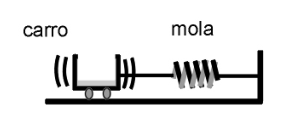 Cart on spring SHM horizontal
Topic: Oscillations & Waves Metodi: Simple Harmonic Motion Analysis, Conservation of Energy Competenze: Physical Reasoning, Mathematical Modeling Objects: Cart, Spring Fonte: Testo (PDF) — p.3
- Un carrello di massa di 1,0 kg si muove in un semplice movimento armonioso orizzontale, per l’azione di una molla di massa irrilevante, senza attrito con il piano su cui si appoggia. Appena passa da un punto di velocità zero, 3,0 kg di massa di cemento appena preparato cadono verticalmente e istantaneamente, e vengono ospitati. Considerando le situazioni prima e dopo che il carrello ha ricevuto il carico di cemento, si può affermare che:
- **A ** né la velocità massima del carrello né la sua energia totale cambiano.
- B. l’energia totale del sistema aumenta, ma la velocità massima non cambia.
- C. la velocità massima non cambia, ma il periodo di oscillazione del carrello viene ridotto di metà.
- D. né il periodo di oscillazione né l’ampiezza del movimento subiscono modificazioni.
- E. l’ampiezza del movimento non cambia ma la velocità massima del carrello viene ridotta di metà.
*Cart on spring SHM orizzontale *
Topic: Oscillations & Waves Metodi: Simple Harmonic Motion Analysis, Conservation of Energy Competenze: Physical Reasoning, Mathematical Modeling Objects: Cart, Spring Fonte: Testo (PDF) — p.3
- A 1.0 kg weighted cart moves in a simple horizontal harmonious motion by the action of an irrelevant weighted spring without any friction with the plane on which it rests. As soon as it passes a zero-speed point, three kilograms of freshly prepared concrete mass falls vertically and instantly, and is housed there. Comparing the situation before and after the cart received the concrete load, it can be stated that:
- ** The maximum acceleration of the cart or its total energy does not change.
- **B ** the total system energy increases but the maximum speed does not change.
- C. the maximum speed does not change, but the period of oscillation of the cart is reduced by half.
- D. neither the period of oscillation nor the amplitude of movement are modified.
- E. the range of motion does not change but the maximum speed of the cart is reduced by half.
The following table shows the results of the evaluation:
Topic: Oscillations & Waves Metodi: Simple Harmonic Motion Analysis, Conservation of Energy Competenze: Physical Reasoning, Mathematical Modeling Objects: Cart, Spring Fonte: Testo (PDF) — p.3
- Um motorista, colocando seu automóvel de massa 750 kg em movimento, troca as duas primeiras marchas (1ª. e 2ª.) nos 17 primeiros segundos de sua viagem. Tendo como base o diagrama que mostra como a força resultante sobre o automóvel variou no tempo, que ele partiu do repouso e que equivale a , no instante a velocidade do automóvel será, em km/h, igual a:
- A. 57,6
- B. 43,2
- C. 86,4
- D. 39,6
- E. 32,4
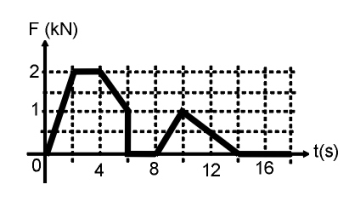 Force vs time diagram for car
Topic: Newtonian Mechanics Metodi: Impulse-Momentum Theorem, Kinematic Equations Competenze: Graph Linearization, Physical Reasoning Objects: — Fonte: Testo (PDF) — p.3
- Un autista, mettendo in moto la sua macchina di massa 750 kg, cambia le prime due marce (1a. e 2a.) nei primi 17 secondi del suo viaggio. Sulla base del diagramma che mostra come la forza risultante sulla vettura sia variata nel tempo, che sia partita dal riposo e che sia , nell’istante la velocità della vettura sarà, in km/h, pari a:
- A. 57,6
- B. 43,2
- C. 86,4
- D. 39,6
- E. 32,4
Force vs time diagram for car
Topic: Newtonian Mechanics Metodi: Impulse-Momentum Theorem, Kinematic Equations Competenze: Graph Linearization, Physical Reasoning Objects: — Fonte: Testo (PDF) — p.3
- A driver, moving his 750 kg car, exchanges the first two steps (1a. and 2a.) in the first 17 seconds of your journey. Based on the diagram showing how the resulting force on the vehicle has varied over time, that it has departed from rest and that is , in the instant the speed of the vehicle shall be equal to:
- A. 57,6
- B. 43,2
- C. 86,4
- D. 39,6
- E. 32,4
The following table shows the results of the tests:
Topic: Newtonian Mechanics Metodi: Impulse-Momentum Theorem, Kinematic Equations Competenze: Graph Linearization, Physical Reasoning Objects: — Fonte: Testo (PDF) — p.3
- Por um canhão dispara uma granada de 20 kg que adquire velocidade igual a 500 m/s quando passa pelo ponto mais alto de sua trajetória. Exatamente nesse instante, a granada explode e se divide em dois fragmentos de massas iguais. Com a explosão, um dos fragmentos inicia um movimento vertical para baixo com uma velocidade igual a 2400 m/s. Imediatamente após a explosão, o módulo da velocidade do outro fragmento, em m/s, vale:
- A. 3400
- B. 3200
- C. 1800
- D. 2400
- E. 2600
Topic: Conservation of Momentum, Newtonian Mechanics Metodi: Conservation of Momentum, Vector Decomposition Competenze: Physical Reasoning, Mathematical Modeling Objects: Projectile Fonte: Testo (PDF) — p.4
- Per un cannone lancia una granata di 20 kg che raggiunge una velocità pari a 500 m/s quando passa il punto più alto del suo percorso. Proprio in quel momento, la granata esplode e si divide in due frammenti di uguale massa. Con l’esplosione, uno dei frammenti inizia un movimento verticale verso il basso a una velocità pari a 2400 m/s. Subito dopo l’esplosione, il modulo di velocità dell’altro frammento, in m/s, vale:
- A. 3400
- B. 3200
- C. 1800
- D. 2400
- E. 2600
Topic: Conservation of Momentum, Newtonian Mechanics Metodi: Conservation of Momentum, Vector Decomposition Competenze: Physical Reasoning, Mathematical Modeling Objects: Projectile Fonte: Testo (PDF) — p.4
- A 20 kg grenade fired by a cannon reaches a speed of 500 m/s when it passes the highest point of its trajectory. At that very moment, the grenade explodes and splits into two fragments of equal mass. With the explosion, one of the fragments starts a vertical downward movement at a speed equal to 2,400 m/s. Immediately after the explosion, the speed module of the other fragment, in m/s, shall be:
- A. 3400
- B. 3200
- C. 1800
- D. 2400
- E. 2600
Topic: Conservation of Momentum, Newtonian Mechanics Metodi: Conservation of Momentum, Vector Decomposition Competenze: Physical Reasoning, Mathematical Modeling Objects: Projectile Fonte: Testo (PDF) — p.4
- Uma bola maciça e praticamente indeformável tem uma densidade inferior à da água. Estando totalmente imersa, um mergulhador carrega-a desde as proximidades da superfície da água até tocá-la no fundo de uma piscina. O diagrama que melhor traduz a dependência entre a força de empuxo sobre a bola como função da profundidade da piscina, está melhor representado por:
(A) (B) (C) (D) (E)
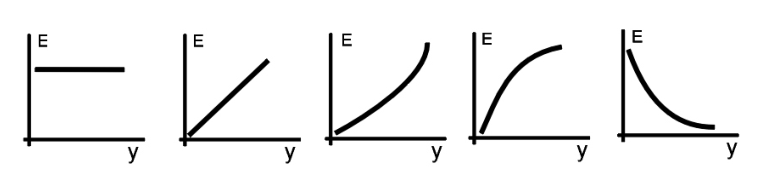 Five E vs y diagrams for buoyancy
Topic: Fluid Mechanics Metodi: Hydrostatic Equilibrium, Physical Modeling Competenze: Diagrammatic Reasoning, Physical Reasoning Objects: Ball Fonte: Testo (PDF) — p.4
- Una palla massiccia e praticamente indeformabile ha una densità inferiore a quella dell’acqua. Completamente immersa, un subacqueo la porta dalla superficie dell’acqua fino a toccarla al fondo di una piscina. Il diagramma che meglio traduce la dipendenza tra la forza di spinta sulla palla a seconda della profondità della piscina, è meglio rappresentato da:
(A) (B) (C) (D) (E)
Five E vs y diagrammi per buoyancy
Topic: Fluid Mechanics Metodi: Hydrostatic Equilibrium, Physical Modeling Competenze: Diagrammatic Reasoning, Physical Reasoning Objects: Ball Fonte: Testo (PDF) — p.4
- A massive, almost deformed ball has a density lower than that of water. Being fully submerged, a diver carries it from near the surface of the water until it touches the bottom of a pool. The diagram that best translates the dependency between the force of thrust on the ball as a function of the depth of the pool is best represented by:
(A) (B) (C) (D) (E)
The following table shows the results of the calculations for the calculation of the total cost of the calculation.
Topic: Fluid Mechanics Metodi: Hydrostatic Equilibrium, Physical Modeling Competenze: Diagrammatic Reasoning, Physical Reasoning Objects: Ball Fonte: Testo (PDF) — p.4
- Deseja-se projetar um balão de gás que deve ser enchido com gás hélio para transportar uma pessoa. A massa do material do balão, da estrutura de acomodação, do indivíduo e dos aparelhos que levará, totalizará 200 kg e seus volumes serão considerados irrelevantes frente ao volume do gás contido pelo balão. Admita que o balão será esférico e que as massas específicas do ar e a do gás hélio sejam respectivamente iguais a e .
Apenas para mantê-lo em repouso no ar (não sobe e nem desce), o diâmetro deste balão, em m, deverá valer:
- A.
- B.
- C.
- D.
- E.
Topic: Fluid Mechanics Metodi: Hydrostatic Equilibrium, Physical Modeling Competenze: Mathematical Modeling, Physical Reasoning Objects: Gas Fonte: Testo (PDF) — p.4
- Si desidera progettare un pallone di gas che deve essere riempito di gas elio per trasportare una persona. La massa del materiale del ballo, della struttura di alloggio, dell’individuo e degli apparecchi che lo porteranno totalizzerà 200 kg e i loro volumi saranno considerati irrilevanti rispetto al volume di gas contenuto nel ballo. Accetti che il pallone sia sferico e che le masse specifiche dell’aria e del gas elio siano rispettivamente uguali a e .
Solo per mantenerlo in aria a riposo (non salire e non scendere), il diametro di questo pallone, in m, deve essere:
- A.
- B.
- C.
- D.
- E.
Topic: Fluid Mechanics Metodi: Hydrostatic Equilibrium, Physical Modeling Competenze: Mathematical Modeling, Physical Reasoning Objects: Gas Fonte: Testo (PDF) — p.4
- It is desirable to design a gas balloon which must be filled with helium gas to carry a person. The mass of the balloon material, the accommodation structure, the individual and the appliances it will carry shall total 200 kg and their volumes shall be considered irrelevant to the volume of gas contained in the balloon. Assume that the balloon will be spherical and that the specific masses of air and helium gas are and respectively.
Only to keep it at rest in the air (not rising or falling), the diameter of this balloon in m shall be:
- A.
- B.
- C.
- D.
- E.
Topic: Fluid Mechanics Metodi: Hydrostatic Equilibrium, Physical Modeling Competenze: Mathematical Modeling, Physical Reasoning Objects: Gas Fonte: Testo (PDF) — p.4
- O par de valores temperatura e pressão corresponde ao chamado ponto crítico da água. Analise as afirmações a seguir:
I – Em temperaturas inferiores a é possível obter água no estado líquido se a pressão for adequada.
II – Em temperaturas superiores a água existe apenas, ou como um vapor ou como um gás.
III – É impossível liquefazer uma massa de água se a sua temperatura estiver compreendida entre e .
IV – Em pressões superiores a 218 atm a água só pode existir num único estado físico.
Está correto o que se afirma apenas em:
- A. I e IV.
- B. I
- C. II e IV.
- D. II e III.
- E. III.
Topic: Thermodynamics Metodi: Physical Modeling, Thermodynamic Cycle Analysis Competenze: Physical Reasoning, Diagrammatic Reasoning Objects: Gas Fonte: Testo (PDF) — p.4
- La coppia di valori temperatura e pressione corrisponde al cosiddetto punto critico dell’acqua. Analizzare le seguenti affermazioni:
I A temperature inferiori a è possibile ottenere acqua liquida se la pressione è adeguata.
II A temperature superiori l’acqua esiste solo, o come vapore o come gas.
III È impossibile liqueficare un’acqua se la sua temperatura è compresa tra e .
IV A pressioni superiori a 218 atm l’acqua può esistere solo in un unico stato fisico.
È corretto quello che si afferma solo in:
- A. I e IV.
- B. I
- C. II e IV.
- D II e III.
- **E ** III.
Topic: Thermodynamics Metodi: Physical Modeling, Thermodynamic Cycle Analysis Competenze: Physical Reasoning, Diagrammatic Reasoning Objects: Gas Fonte: Testo (PDF) — p.4
- The temperature and pressure pair corresponds to the so-called water critical point. Analyze the following statements:
I At temperatures below it is possible to obtain liquid water if the pressure is adequate.
II At temperatures above water exists only, either as a steam or as a gas.
III It is impossible to liquefy a body of water if its temperature is between and .
IV At pressures above 218 atm water can only exist in a single physical state.
It is correct what is stated only in:
- A. I e IV.
- B. I
- C. II e IV.
- ** D** II and III.
- **E ** III.
Topic: Thermodynamics Metodi: Physical Modeling, Thermodynamic Cycle Analysis Competenze: Physical Reasoning, Diagrammatic Reasoning Objects: Gas Fonte: Testo (PDF) — p.4
- Dizemos que uma evolução gasosa é adiabática quando uma determinada massa de gás passa de um estado inicial a um outro sem receber ou ceder calor para o exterior (a vizinhança). Na prática pode-se, com aproximação, considerar como adiabática uma evolução em que o sistema é isolado termicamente ou em que a evolução for realizada rapidamente ou, ainda, se a quantidade de gás for tão grande que as trocas de calor com o exterior sejam irrelevantes.
Analise as afirmações a seguir:
I – Durante uma evolução gasosa adiabática a temperatura do gás não varia.
II – A evolução gasosa adiabática explica porque o ar que se move entre lugares mais baixos e mais altos deixa as localidades no alto mais frias.
III – Quando enchemos os pneus de uma bicicleta com uma bomba manual, esta esquenta, pois as compressões rápidas e sucessivas, que se aproximam de compressões adiabáticas, não permitem, praticamente, trocas de calor com o meio.
Podemos assinalar que está(ão) correta(s) apenas a(s) afirmações:
- A. II e III.
- B. I e II.
- C. I e III.
- D. I
- E. II
Topic: Thermodynamics Metodi: First Law of Thermodynamics, Thermodynamic Cycle Analysis, Physical Modeling Competenze: Physical Reasoning, Mathematical Modeling Objects: Gas Fonte: Testo (PDF) — p.5
- Si dice che un’evoluzione gassosa è adiabatica quando una determinata massa di gas passa da uno stato iniziale a un altro senza ricevere o cedere calore all’esterno (il vicinato). In pratica, si può considerare adiabaticamente un’evoluzione in cui il sistema è isolato termicamente o in cui l’evoluzione si svolge rapidamente o, inoltre, se la quantità di gas è così grande che gli scambi di calore con l’esterno sono irrilevanti.
Analizzare le seguenti affermazioni:
I Durante un’evoluzione gassosa adiabatica la temperatura del gas non varia.
II L’evoluzione gassosa adiabatica spiega perché l’aria che si muove tra i luoghi più bassi e i luoghi più alti rende i luoghi più alti più freddi.
III Quando si riempie le gomme di una bicicletta con una pompa manuale, essa si riscalda, poiché le compressioni rapide e successive, che si avvicinano alle compressioni adiabatiche, non consentono praticamente scambi di calore con il mezzo.
Possiamo sottolineare che non sono corrette solo le affermazioni:
- A II e III.
- B. I e II.
- C. I e III.
- D. I
- E. II
Topic: Thermodynamics Metodi: First Law of Thermodynamics, Thermodynamic Cycle Analysis, Physical Modeling Competenze: Physical Reasoning, Mathematical Modeling Objects: Gas Fonte: Testo (PDF) — p.5
- We say that a gas evolution is adiabatic when a given mass of gas passes from one initial state to another without receiving or giving heat to the outside (the neighborhood). In practice, an evolution in which the system is heat-insulated or in which the evolution is carried out rapidly or, even more, if the amount of gas is so large that the heat exchanges with the outside are irrelevant, can be considered as adiabatic.
Analyze the following statements:
I During adiabatic gas evolution the gas temperature does not change.
II The adiabatic gas evolution explains why air moving between lower and higher places makes the upper locations colder.
III When you fill the tyres of a bicycle with a manual pump, it heats up, because the rapid and successive compression, which approaches adiabatic compression, does not allow for practically any heat exchange with the medium.
We can point out that only the following statements are incorrect:
- **A ** II and III.
- B. I e II.
- **C ** I and III.
- D. I
- E. II
Topic: Thermodynamics Metodi: First Law of Thermodynamics, Thermodynamic Cycle Analysis, Physical Modeling Competenze: Physical Reasoning, Mathematical Modeling Objects: Gas Fonte: Testo (PDF) — p.5
- Sobre a luz e os fenômenos a ela relacionados são feitas as seguintes afirmações:
I – As cores que percebemos quando iluminamos um “CD”, originam-se da luz branca incidente que se decompõe graças ao fenômeno da dispersão da luz.
II – Ao se iluminar uma fotografia de um arco-íris, impressa e colorida, com uma intensa luz monocromática amarela, perceberemos o arco-íris sendo formado apenas com tons mais ou menos escuros de amarelo.
III – Mesmo que um feixe luminoso tenha atravessado uma fina placa transparente de gelo, perceberemos em nossa mão o aquecimento ocasionado por ele.
Podemos afirmar que está(ão) correta(s) apenas a(s) afirmação(ões):
- A. I e II.
- B. II.
- C. III.
- D. II e III.
- E. I.
Topic: Wave Optics, Geometric Optics Metodi: Superposition Principle, Physical Modeling Competenze: Physical Reasoning, Diagrammatic Reasoning Objects: — Fonte: Testo (PDF) — p.5
- La luce e i fenomeni che la riguardano sono le seguenti affermazioni:
I Colori che percepiamo quando illuminiamo un CD provengono dalla luce bianca incidente che si decompone grazie al fenomeno della dispersione della luce.
II Quando illuminiamo una fotografia di un arcobaleno, stampata e colorata, con un’intensa luce gialla monocromatica, notiamo che l’arcobaleno è formato solo con toni più o meno scuri di giallo.
III Anche se un fascio luminoso ha attraversato una sottile lastra di ghiaccio trasparente, si percepirà nel nostro braccio il riscaldamento causato da esso.
Possiamo affermare che è corretto solo affermazione:
- A. I e II.
- B. II.
- C. III.
- D II e III.
- E. I.
Topic: Wave Optics, Geometric Optics Metodi: Superposition Principle, Physical Modeling Competenze: Physical Reasoning, Diagrammatic Reasoning Objects: — Fonte: Testo (PDF) — p.5
- The following statements are made about light and its phenomena:
I The colors we perceive when we light a CD originate from incident white light that decomposes due to the phenomenon of light scattering.
II When illuminating a photograph of a rainbow, printed and colored, with an intense yellow monochrome light, we notice the rainbow being formed only with more or less dark shades of yellow.
Even if a beam of light has passed through a thin transparent ice sheet, we will notice in our hand the warming caused by it.
We can say that it is not correct only a statement is true:
- A. I e II.
- B. II.
- **C ** III.
- ** D** II and III.
- E. I.
Topic: Wave Optics, Geometric Optics Metodi: Superposition Principle, Physical Modeling Competenze: Physical Reasoning, Diagrammatic Reasoning Objects: — Fonte: Testo (PDF) — p.5
- A figura representa três sistemas ópticos transparentes , e atravessados pela luz emitida por uma fonte puntual O e as frentes de ondas (representadas por linhas) que emanam desta fonte. A luz que penetra em , emerge em .
Podemos afirmar que são sistemas ópticos convergentes:
- A. apenas .
- B. apenas e .
- C. todos os três.
- D. apenas .
- E. apenas e .
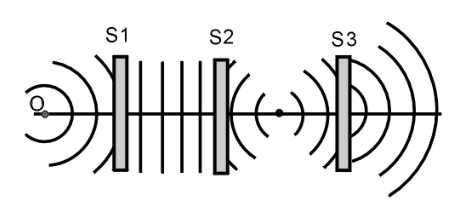 Three optical systems with wavefronts
Topic: Geometric Optics, Wave Optics Metodi: Ray Tracing, Physical Modeling Competenze: Diagrammatic Reasoning, Physical Reasoning Objects: Lens Fonte: Testo (PDF) — p.5
- La figura rappresenta tre sistemi ottici trasparenti , e attraversati dalla luce emessa da una fonte puntuale O e dai frunti d’onda (representati da linee) che emanano da questa fonte. La luce che penetra in emerge in .
Possiamo affermare che sono sistemi ottici convergenti:
- A solo .
- B. solo e .
- MSK1/C tutti e tre.
- **D ** solo .
- E. solo e .
Three optical systems with wavefronts
Topic: Geometric Optics, Wave Optics Metodi: Ray Tracing, Physical Modeling Competenze: Diagrammatic Reasoning, Physical Reasoning Objects: Lens Fonte: Testo (PDF) — p.5
- The figure represents three transparent optical systems , and traversed by the light emitted by a point source O and the wavefronts (represented by lines) emanating from this source. The light that penetrates emerges at .
We can say that they are convergent optical systems:
- A only .
- B. only and .
- All three of them.
- **D ** only .
- E. only and .
Three optical systems with wavefronts
Topic: Geometric Optics, Wave Optics Metodi: Ray Tracing, Physical Modeling Competenze: Diagrammatic Reasoning, Physical Reasoning Objects: Lens Fonte: Testo (PDF) — p.5
- Três partículas iguais e eletricamente carregadas, cada uma com massa e carga de módulo , estão no plano , ocupando os vértices de um triângulo isósceles, como mostra a figura. Considere as interações, gravitacional e elétrica, apenas entre elas. A ação dessas interações sobre a partícula posicionada na origem do sistema de coordenadas, permite afirmar corretamente que:
- A. as forças resultantes gravitacional e eletrostática têm uma mesma direção e um mesmo sentido.
- B. os vetores que representam as forças resultantes gravitacional e eletrostática são ortogonais entre si.
- C. as resultantes gravitacional e eletrostática têm uma mesma direção, mas têm sentidos opostos.
- D. o ângulo entre as forças resultantes gravitacional e eletrostática vale 45°.
- E. a força eletrostática resultante é nula, mas a gravitacional não.
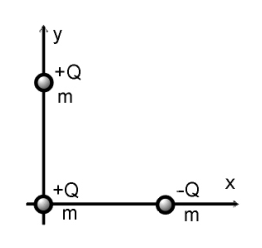 Isosceles triangle of charged particles
Topic: Electrostatics, Gravitation Metodi: Coulomb’s Law, Newton’s Law of Gravitation, Vector Decomposition, Symmetry Argument Competenze: Diagrammatic Reasoning, Physical Reasoning Objects: Point Charge Fonte: Testo (PDF) — p.5
- Tre particelle uguali e elettricamente cariche, ciascuna con massa e carico modulo , sono nel piano , occupando le vertici di un triangolo isosceles, come mostra la figura. Considerate le interazioni, gravitazionali ed elettriche, solo tra loro. L’azione di queste interazioni sulla particella posizionata alla fonte del sistema di coordinate consente di affermare correttamente che:
Le forze gravitazionali e elettrostatiche risultanti hanno la stessa direzione e la stessa direzione.
- B. i vettori che rappresentano le forze gravitazionali e elettrostatiche risultanti sono ortogonali tra loro.
- **C ** i risultati gravitazionali e elettrostatici hanno la stessa direzione, ma hanno sentimenti opposti.
- D. l’angolo tra le forze gravitazionali e elettrostatiche risultanti è 45°.
- E la forza elettrostatica risultante è nulla, ma la forza gravitazionale no.
Isosceles triangle of charged particles
Topic: Electrostatics, Gravitation Metodi: Coulomb’s Law, Newton’s Law of Gravitation, Vector Decomposition, Symmetry Argument Competenze: Diagrammatic Reasoning, Physical Reasoning Objects: Point Charge Fonte: Testo (PDF) — p.5
- Three equal, electrically charged particles, each with mass and module charge , are in the plane occupying the vertices of an isosceles triangle, as shown in the figure. Consider the interactions, gravitational and electrical, just between them. The action of these interactions on the particle at the origin of the coordinate system makes it possible to correctly state that:
The resulting gravitational and electrostatic forces have the same direction and direction.
- **B ** the vectors representing the resulting gravitational and electrostatic forces are orthogonal to each other. The resulting gravitational and electrostatic results have the same direction but have opposite senses.
- **D ** the angle between the resulting gravitational and electrostatic forces is 45°. The resulting electrostatic force is zero, but gravitational force is not.
Isosceles triangle of charged particles
Topic: Electrostatics, Gravitation Metodi: Coulomb’s Law, Newton’s Law of Gravitation, Vector Decomposition, Symmetry Argument Competenze: Diagrammatic Reasoning, Physical Reasoning Objects: Point Charge Fonte: Testo (PDF) — p.5
- Um menino se pendura por meio de uma corda de 8 m de extensão a um galho de árvore. Nessa situação ele oscila descrevendo um arco de 30 cm de comprimento.
São feitas três afirmações a respeito do evento e que são:
I) se ele passar a oscilar segundo um arco de 60 cm, o período das oscilações dobrará.
II) se o menino tivesse uma massa duas vezes maior do que a que efetivamente tem, o período de oscilação ficaria reduzido à metade.
III) se o comprimento da corda for reduzido à metade, o período de oscilação ficará cerca de duas vezes maior.
Destas afirmações é possível concluir que:
- A. apenas as afirmações I e II são corretas.
- B. apenas a afirmação I é correta.
- C. nenhuma das três está correta.
- D. somente a afirmação III é correta.
- E. apenas as afirmações II e III são corretas.
Topic: Oscillations & Waves Metodi: Simple Harmonic Motion Analysis, Small-Angle Approximation Competenze: Physical Reasoning, Mathematical Modeling Objects: Pendulum, String Fonte: Testo (PDF) — p.6
- Un bambino si appende a mezzo di una corda di 8 metri di lunghezza a un ramo di albero. In questa situazione oscilla descrivendo un arco lungo 30 centimetri.
Sono state fatte tre affermazioni sull’evento:
I) se si oscilla su un arco di 60 cm, il periodo di oscillazione raddoppierà.
II) se il bambino avesse un peso doppio di quello che ha effettivamente, il periodo di oscillazione sarebbe ridotto di metà.
III) se la lunghezza della corda è ridotta di metà, il periodo di oscillazione sarà di circa il doppio.
Da queste affermazioni si può concludere che:
- A. solo le affermazioni I e II sono corrette.
- B. solo l’affermazione I è corretta.
- C. nessuno dei tre è corretto.
- D. solo l’affermazione III è corretta.
- E. solo le affermazioni II e III sono corrette.
Topic: Oscillations & Waves Metodi: Simple Harmonic Motion Analysis, Small-Angle Approximation Competenze: Physical Reasoning, Mathematical Modeling Objects: Pendulum, String Fonte: Testo (PDF) — p.6
- A boy hangs himself by a 20-foot-long rope from a tree branch. In this situation he oscillates describing a 30 cm long arc.
Three statements are made about the event and they are:
(i) if it oscillates along a 60 cm arc, the period of oscillations will double.
(ii) if the boy had a mass twice that of the actual one, the period of oscillation would be halved.
(iii) if the length of the rope is halved, the period of oscillation will be about twice as long.
From these statements it can be concluded that:
- A. only statements I and II are correct.
- B. only statement I is correct.
- None of the three is correct.
- D. only statement III is correct.
- E. only statements II and III are correct.
Topic: Oscillations & Waves Metodi: Simple Harmonic Motion Analysis, Small-Angle Approximation Competenze: Physical Reasoning, Mathematical Modeling Objects: Pendulum, String Fonte: Testo (PDF) — p.6
- A figura representa um tanque com uma lâmina de água de espessura constante e as frentes de onda das ondas provocadas logo após uma pedra ter caído no ponto P desse tanque. As ondas geradas na superfície da água pela pedra movem-se de encontro a três obstáculos fixados ao tanque e que formam duas passagens. Depois de atravessarem as passagens, será possível observar os fenômenos de:
- A. dispersão e refração.
- B. difração e dispersão.
- C. refração e interferência.
- D. difração e refração.
- E. difração e interferência.
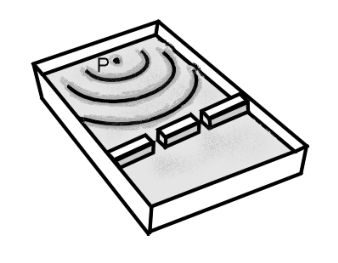 Wave tank with two-slit obstacles
Topic: Oscillations & Waves, Wave Optics Metodi: Interference & Diffraction Analysis, Superposition Principle Competenze: Diagrammatic Reasoning, Physical Reasoning Objects: Container, Slit Fonte: Testo (PDF) — p.6
- La figura rappresenta un serbatoio con una lamella d’acqua di spessore costante e i frunti delle onde provocati subito dopo che una pietra è caduta nel punto P di tale serbatoio. Le onde generate sulla superficie dell’acqua dalla roccia si muovono in fronte a tre ostacoli fissati al serbatoio e che formano due passaggi. Dopo aver attraversato i passaggi, si potranno osservare i fenomeni di:
- A dispersione e rifrazione.
- B. difrazione e dispersione.
- C. rifrazione e interferenza.
- D. difrazione e refrazione.
- E. difrazione e interferenza.
Wave tank with two-slit obstacles
Topic: Oscillations & Waves, Wave Optics Metodi: Interference & Diffraction Analysis, Superposition Principle Competenze: Diagrammatic Reasoning, Physical Reasoning Objects: Container, Slit Fonte: Testo (PDF) — p.6
- The figure depicts a tank with a constant thickness water blade and the wavefronts of the waves caused immediately after a stone has fallen at the P point of that tank. The waves generated on the surface of water by the rock move against three obstacles fixed to the tank and forming two passages. After crossing the passages, it will be possible to observe the phenomena of:
- A dispersion and refraction.
- B. diffraction and dispersion.
- **C ** refraction and interference.
- **D ** diffraction and refraction.
- **E ** diffraction and interference.
The following table shows the results of the tests:
Topic: Oscillations & Waves, Wave Optics Metodi: Interference & Diffraction Analysis, Superposition Principle Competenze: Diagrammatic Reasoning, Physical Reasoning Objects: Container, Slit Fonte: Testo (PDF) — p.6
- Dois fios condutores cilíndricos de ferro e de comprimentos diferentes são ligados, um por vez, a uma fonte de tensão elétrica constante e resistência interna desprezível. Observa-se que um amperímetro conectado ao circuito acusa, nos dois casos, que a corrente elétrica tem sempre uma mesma intensidade. O fio condutor de maior comprimento tem comprimento e diâmetro . O menor, por sua vez, tem comprimento e diâmetro . Para que a situação acusada pelo amperímetro seja possível, a relação entre seus correspondentes diâmetros deve ser:
- A.
- B.
- C.
- D.
- E.
Topic: Circuits, Electromagnetism Metodi: Kirchhoff’s Laws, Physical Modeling Competenze: Physical Reasoning, Mathematical Modeling Objects: Wire, Battery Fonte: Testo (PDF) — p.6
- Due fili di conduttori cilindrici di ferro e di lunghezze diverse sono collegati, una alla volta, a una fonte di tensione elettrica costante e di resistenza interna scarsa. Si osserva che un amperimetro collegato al circuito accusa, in entrambi i casi, che la corrente elettrica abbia sempre la stessa intensità. Il filo conduttore di più lunghezza ha una lunghezza e un diametro . La minore, invece, ha una lunghezza e un diametro . Per consentire la situazione di accusa dell’ampielitro, il rapporto tra i suoi diametri corrispondenti deve essere:
- A.
- B.
- C.
- D.
- E.
Topic: Circuits, Electromagnetism Metodi: Kirchhoff’s Laws, Physical Modeling Competenze: Physical Reasoning, Mathematical Modeling Objects: Wire, Battery Fonte: Testo (PDF) — p.6
- Two iron-cylindrical conductive wires of different lengths are connected one at a time to a source of constant electrical voltage and negligible internal resistance. It is noted that an ampere connected to the circuit charges, in both cases, that the electric current is always the same intensity. The longer conductive wire shall have a length and a diameter . The smallest, in turn, has a length and a diameter . For the position charged by the ampere to be possible, the ratio between its corresponding diameters shall be:
- A.
- B.
- C.
- D.
- E.
Topic: Circuits, Electromagnetism Metodi: Kirchhoff’s Laws, Physical Modeling Competenze: Physical Reasoning, Mathematical Modeling Objects: Wire, Battery Fonte: Testo (PDF) — p.6