Leia atentamente o texto abaixo e responda as questões de 01 a 05.
O Sol é a estrela mais próxima de nós. Todos os planetas do sistema solar giram ao seu redor e cada um com um período diferente. Ele é o responsável pelo suprimento de energia da maioria dos planetas. O Sol só é uma estrela por causa da sua enorme quantidade de massa que é da ordem de 300.000 vezes a massa da Terra.
Dados sobre o Sol:
| Grandeza | Valor |
|---|---|
| Raio | 695.500 km |
| Superfície | km² |
| Volume | km³ |
| Massa | kg |
| Densidade | g/cm³ |
| Luminosidade | kW |
| Temperatura Superficial | 5770 K |
| Temperatura no Centro | K |
| Gravidade Superficial | 276 m/s² |
01) Qual das seguintes unidades abaixo não pode ser utilizada para representar a massa do Sol:
- A. kg (kilograma)
- B. g (grama)
- C. ton (tonelada)
- D. mg (miligrama)
- E. kgf (kilograma-força)
Topic: Astrophysics, Order-of-Magnitude Estimation Metodi: Dimensional Analysis, Order-of-Magnitude Estimation Competenze: Unit Conversion, Physical Reasoning Objects: Star, Planet Fonte: Testo (PDF) — p.2
Leggi attentamente il testo di seguito e rispondi alle domande dal 01 al 05.
Il sole è la stella più vicina a noi. Tutti i pianeti del sistema solare girano intorno a loro e ognuno ha un periodo diverso. È responsabile dell’alimentazione di molti pianeti. Il sole è solo una stella a causa della sua enorme massa che è dell’ordine di 300.000 volte la massa della Terra.
Dati sul Sole:
Grandezza # Valore
|---|---| ♬ Raimondo ♬ 695.500 chilometri ♬ | Superfície | km² | | Volume | km³ | | Massa | kg | | Densidade | g/cm³ | | Luminosidade | kW | Temperatura superficiale 5770 K | Temperatura no Centro | K | Gravità superficiale 276 m/s2
**01) ** Qualsiasi delle seguenti unità non può essere utilizzata per rappresentare la massa del Sole:
- A kg (kg)
- B. g (gramo)
- **C ** tonnellate
- D mg (miligramma)
- E. kgf (kg/forza)
Topic: Astrophysics, Order-of-Magnitude Estimation Metodi: Dimensional Analysis, Order-of-Magnitude Estimation Competenze: Unit Conversion, Physical Reasoning Objects: Star, Planet Fonte: Testo (PDF) — p.2
Please read the text below carefully and answer the questions from 01 to 05.
The sun is the closest star to us. All the planets in the solar system orbit around it, and each one has a different period. He’s responsible for the energy supply of most planets. The Sun is only a star because of its enormous mass, which is about 300,000 times the mass of the Earth.
Data on the Sun:
♪ Greatness and Value ♪ |---|---| ♪ I’m going to be a big fan ♪ | Superfície | km² | | Volume | km³ | | Massa | kg | | Densidade | g/cm³ | | Luminosidade | kW | This is the surface temperature. | Temperatura no Centro | K | This is the first time that we’ve seen this.
**01) ** Which of the following units cannot be used to represent the mass of the Sun:
- **A ** kg (kg)
- **B ** g (gram)
- **C ** tonne (tonne)
- D mg (milligrams)
- **E ** kgf (kg/force)
Topic: Astrophysics, Order-of-Magnitude Estimation Metodi: Dimensional Analysis, Order-of-Magnitude Estimation Competenze: Unit Conversion, Physical Reasoning Objects: Star, Planet Fonte: Testo (PDF) — p.2
02) Indique a seguir qual é a temperatura do centro do Sol:
- A. 15.000.000 K
- B. 1.500.000 K
- C. 1,5 K
- D. 1.000.000 K
- E. 150 K
Topic: Astrophysics, Order-of-Magnitude Estimation Metodi: Order-of-Magnitude Estimation, Dimensional Analysis Competenze: Physical Reasoning, Significant Figures Objects: Star Fonte: Testo (PDF) — p.2
**02) ** Indicare la temperatura del centro del Sole:
- A. 15.000.000 K
- B. 1.500.000 K
- C. 1,5 K
- D. 1.000.000 K
- E. 150 K
Topic: Astrophysics, Order-of-Magnitude Estimation Metodi: Order-of-Magnitude Estimation, Dimensional Analysis Competenze: Physical Reasoning, Significant Figures Objects: Star Fonte: Testo (PDF) — p.2
**02) ** Please indicate below the temperature of the centre of the Sun:
- A. 15.000.000 K
- B. 1.500.000 K
- C. 1,5 K
- D. 1.000.000 K
- E. 150 K
Topic: Astrophysics, Order-of-Magnitude Estimation Metodi: Order-of-Magnitude Estimation, Dimensional Analysis Competenze: Physical Reasoning, Significant Figures Objects: Star Fonte: Testo (PDF) — p.2
03) Assinale o valor aproximado da massa da Terra:
- A. kg
- B. 300.000 kg
- C. kg
- D. 300.000 ton
- E. kg
Topic: Astrophysics, Order-of-Magnitude Estimation Metodi: Order-of-Magnitude Estimation, Dimensional Analysis Competenze: Physical Reasoning, Estimation & Approximation Objects: Planet, Star Fonte: Testo (PDF) — p.2
**03) ** Indicare il valore approssimativo della massa terrestre:
- A. kg
- B. 300.000 kg
- C. kg
- D. 300 000 tonnellate
- E. kg
Topic: Astrophysics, Order-of-Magnitude Estimation Metodi: Order-of-Magnitude Estimation, Dimensional Analysis Competenze: Physical Reasoning, Estimation & Approximation Objects: Planet, Star Fonte: Testo (PDF) — p.2
**03) ** Indicate the approximate value of the mass of the Earth:
- A. kg
- B. 300.000 kg
- C. kg
- ** D ** 300,000 tonnes
- E. kg
Topic: Astrophysics, Order-of-Magnitude Estimation Metodi: Order-of-Magnitude Estimation, Dimensional Analysis Competenze: Physical Reasoning, Estimation & Approximation Objects: Planet, Star Fonte: Testo (PDF) — p.2
04) Uma pessoa com massa igual a 100 kg terá um peso “solar” de:
- A. 100 kg
- B. 100 ton
- C. 276 N
- D. 27.600 N
- E. 2,76 N
Topic: Newtonian Mechanics, Astrophysics Metodi: Free-Body Diagram, Dimensional Analysis Competenze: Physical Reasoning, Unit Conversion Objects: Star Fonte: Testo (PDF) — p.2
**04) ** Una persona di massa pari a 100 kg avrà un peso “solari” di:
- A. 100 kg
- **B ** 100 tonnellate
- C. 276 N
- D. 27.600 N
- E. 2,76 N
Topic: Newtonian Mechanics, Astrophysics Metodi: Free-Body Diagram, Dimensional Analysis Competenze: Physical Reasoning, Unit Conversion Objects: Star Fonte: Testo (PDF) — p.2
**04) ** A person weighing 100 kg shall have a ‘solar’ weight of:
- A. 100 kg
- **B ** 100 tonnes
- C. 276 N
- D. 27.600 N
- E. 2,76 N
Topic: Newtonian Mechanics, Astrophysics Metodi: Free-Body Diagram, Dimensional Analysis Competenze: Physical Reasoning, Unit Conversion Objects: Star Fonte: Testo (PDF) — p.2
05) Qual a energia total emitida pelo Sol num intervalo de tempo de 100 segundos em kJ:
- A. 100
- B.
- C.
- D. 3,9
- E. 3.900
Topic: Astrophysics, Order-of-Magnitude Estimation Metodi: Order-of-Magnitude Estimation, Dimensional Analysis Competenze: Physical Reasoning, Unit Conversion Objects: Star Fonte: Testo (PDF) — p.2
**05) ** Qual è l’energia totale emessa dal Sole in un intervallo di tempo di 100 secondi in kJ:
- A. 100
- B.
- C.
- D. 3,9
- E. 3.900
Topic: Astrophysics, Order-of-Magnitude Estimation Metodi: Order-of-Magnitude Estimation, Dimensional Analysis Competenze: Physical Reasoning, Unit Conversion Objects: Star Fonte: Testo (PDF) — p.2
**05) ** What is the total energy emitted by the Sun over a time interval of 100 seconds in kJ:
- A. 100
- B.
- C.
- D. 3,9
- E. 3.900
Topic: Astrophysics, Order-of-Magnitude Estimation Metodi: Order-of-Magnitude Estimation, Dimensional Analysis Competenze: Physical Reasoning, Unit Conversion Objects: Star Fonte: Testo (PDF) — p.2
Um ciclista percorre um percurso plano em linha reta. A distância por ele percorrida em função do tempo está representada no gráfico a seguir. O eixo horizontal representa o tempo (horas) de 0 a 20 h, e o eixo vertical representa a distância (km) de 0 a 70 km.
Responda as questões de 06 a 09 usando os dados representados no gráfico acima.
06) Qual foi o deslocamento do ciclista em seu percurso de 20 horas:
- A. 5 km
- B. 10 km
- C. 15 km
- D. 20 km
- E. 25 km
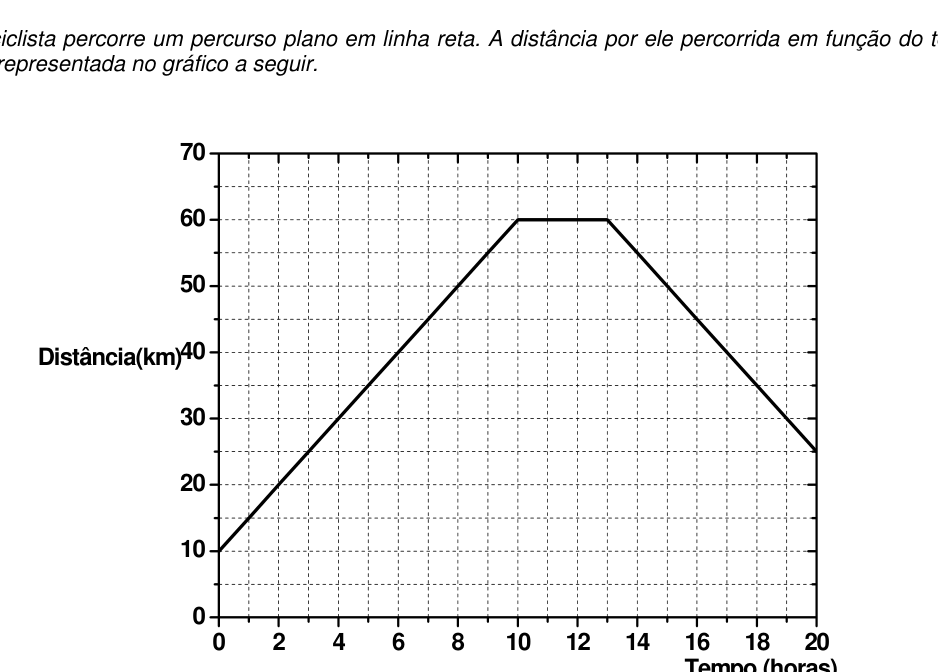 Distância vs tempo do ciclista 0–20 h
Topic: Newtonian Mechanics Metodi: Kinematic Equations Competenze: Physical Reasoning, Graph Linearization Objects: — Fonte: Testo (PDF) — p.3
Un ciclista percorre un percorso piano in linea retta. La distanza percorsa in funzione del tempo è rappresentata nel grafico seguente. L’asse orizzontale rappresenta il tempo (orari) da 0 a 20 h e l’asse verticale rappresenta la distanza (km) da 0 a 70 km.
Rispondere alle domande da 06 a 09 utilizzando i dati riportati nel grafico sopra.
**06) ** Qual è stato il spostamento del ciclista nel corso delle sue 20 ore:
- A. 5 km
- B. 10 km
- C. 15 km
- D. 20 km
- E. 25 km
Distanza vs tempo del ciclista 020 h
Topic: Newtonian Mechanics Metodi: Kinematic Equations Competenze: Physical Reasoning, Graph Linearization Objects: — Fonte: Testo (PDF) — p.3
A cyclist runs a flat course in a straight line. The distance travelled by it in terms of time is shown in the following graph. The horizontal axis represents the time (hours) from 0 to 20 h, and the vertical axis represents the distance (km) from 0 to 70 km.
Answer questions 06 to 09 using the data shown in the graph above.
What was the cyclist’s 20 hour journey:
- A. 5 km
- B. 10 km
- C. 15 km
- D. 20 km
- E. 25 km
The distance to the rider’s time is 020 h*
Topic: Newtonian Mechanics Metodi: Kinematic Equations Competenze: Physical Reasoning, Graph Linearization Objects: — Fonte: Testo (PDF) — p.3
07) Qual foi a distância total percorrida pelo ciclista em seu percurso de 20 horas:
- A. 10 km
- B. 50 km
- C. 60 km
- D. 85 km
- E. 95 km
Topic: Newtonian Mechanics Metodi: Kinematic Equations Competenze: Physical Reasoning, Graph Linearization Objects: — Fonte: Testo (PDF) — p.3
**07) ** Qual è stata la distanza totale percorsa dal ciclista nel corso delle 20 ore:
- A. 10 km
- B. 50 km
- C. 60 km
- D. 85 km
- E. 95 km
Topic: Newtonian Mechanics Metodi: Kinematic Equations Competenze: Physical Reasoning, Graph Linearization Objects: — Fonte: Testo (PDF) — p.3
What was the total distance travelled by the rider on his 20-hour journey:
- A. 10 km
- B. 50 km
- C. 60 km
- D. 85 km
- E. 95 km
Topic: Newtonian Mechanics Metodi: Kinematic Equations Competenze: Physical Reasoning, Graph Linearization Objects: — Fonte: Testo (PDF) — p.3
08) Qual foi a velocidade média do ciclista no percurso de 20 horas:
- A. 0,25 km/h
- B. 0,30 km/h
- C. 0,50 km/h
- D. 0,65 km/h
- E. 0,75 km/h
Topic: Newtonian Mechanics Metodi: Kinematic Equations Competenze: Physical Reasoning, Graph Linearization Objects: — Fonte: Testo (PDF) — p.3
**08) ** Qual è stata la velocità media del ciclista nel corso di 20 ore:
- A. 0,25 km/h
- B. 0,30 km/h
- C. 0,50 km/h
- D. 0,65 km/h
- E. 0,75 km/h
Topic: Newtonian Mechanics Metodi: Kinematic Equations Competenze: Physical Reasoning, Graph Linearization Objects: — Fonte: Testo (PDF) — p.3
**08) ** What was the average speed of the rider over the 20-hour course:
- A. 0,25 km/h
- B. 0,30 km/h
- C. 0,50 km/h
- D. 0,65 km/h
- E. 0,75 km/h
Topic: Newtonian Mechanics Metodi: Kinematic Equations Competenze: Physical Reasoning, Graph Linearization Objects: — Fonte: Testo (PDF) — p.3
09) Qual a velocidade do ciclista no trecho compreendido entre o início até horas:
- A. 5 km/h
- B. 4 km/h
- C. 3 km/h
- D. 2 km/h
- E. 1 km/h
Topic: Newtonian Mechanics Metodi: Kinematic Equations Competenze: Physical Reasoning, Graph Linearization Objects: — Fonte: Testo (PDF) — p.3
**09) ** Qual è la velocità del ciclista nel tratto compreso tra l’inizio e ore:
- A. 5 km/h
- B. 4 km/h
- C. 3 km/h
- D. 2 km/h
- E. 1 km/h
Topic: Newtonian Mechanics Metodi: Kinematic Equations Competenze: Physical Reasoning, Graph Linearization Objects: — Fonte: Testo (PDF) — p.3
**09) ** What is the speed of the rider on the stretch between the start and hours:
- A. 5 km/h
- B. 4 km/h
- C. 3 km/h
- D. 2 km/h
- E. 1 km/h
Topic: Newtonian Mechanics Metodi: Kinematic Equations Competenze: Physical Reasoning, Graph Linearization Objects: — Fonte: Testo (PDF) — p.3
Um pêndulo simples é composto por um fio inextensível (de massa desprezível), comprimento , no qual é pendurado um corpo de massa . O pêndulo é utilizado desde a antiguidade como um instrumento de padrão de tempo. Na figura a seguir é representado um pêndulo, formado por um fio fixo a um ponto e livre para oscilar. Responda as questões de 10 a 13 considerando que da posição 1 a massa é solta, a partir do repouso, oscila até o ponto 3, passando pelo ponto 2 que é a posição onde esta se encontra alinhada com a vertical. e representam distâncias medidas a partir do ponto onde o pêndulo é fixo até o ponto 2, é a aceleração gravitacional e é o deslocamento angular entre 1 e 3. Desconsidere a ação de qualquer tipo de forças de atrito neste sistema.
10) Qual das alternativas abaixo é uma informação incorreta sobre o movimento do pêndulo conforme descrito anteriormente:
- A. O tempo de oscilação do pêndulo, entre as posições 1 e 3, e o tempo de retorno da posição 3 para 1 são iguais.
- B. A massa tem velocidade máxima na posição 2.
- C. quanto maior for a massa , menor será o tempo gasto para percorrer o percurso de 1 a 3.
- D. na posição 3 a velocidade da massa é nula.
- E. quanto maior o comprimento maior será o tempo que este leva entre as posições 1 e 3.
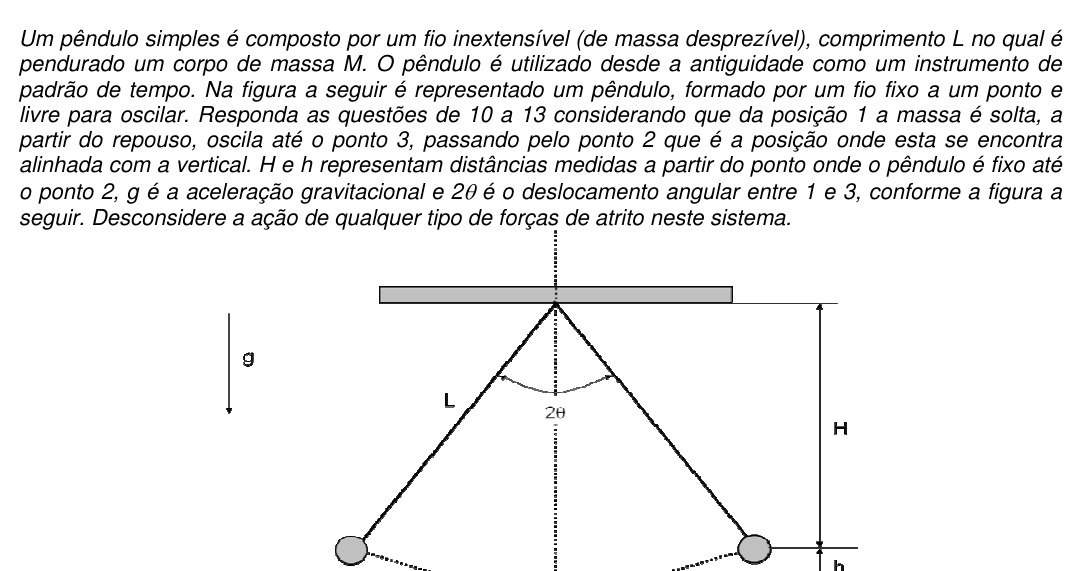 Pêndulo simples posições 1, 2, 3 com H, h, θ
Topic: Oscillations & Waves, Newtonian Mechanics Metodi: Simple Harmonic Motion Analysis, Energy Conservation Method Competenze: Physical Reasoning, Diagrammatic Reasoning Objects: Pendulum Fonte: Testo (PDF) — p.4
Un semplice pendolo è costituito da un filo inestensibile (di massa scarsa) di lunghezza , su cui è appeso un corpo di massa . Il pendolo è stato utilizzato fin dall’antichità come strumento di tempo standard. La figura seguente raffigura un pendolo, formato da un filo fisso a un punto e libero da oscillazione. Rispondi alle domande da 10 a 13, considerando che dalla posizione 1 la massa è libera, dal riposo oscilla fino al punto 3, passando per il punto 2, che è la posizione in cui si trova allineata alla verticale. e rappresentano le distanze misurate dal punto in cui il pendolo è fisso fino al punto 2, è l’accelerazione gravitazionale e è il spostamento angolare tra 1 e 3. Non considerare l’azione di qualsiasi tipo di forza di attrito in questo sistema.
**10) ** Qual è l’alternativa seguente che rappresenta un’informazione errata sul movimento del pendolo come descritto sopra:
- A. Il tempo di oscillazione del pendolo tra le posizioni 1 e 3 e il tempo di ritorno da posizione 3 a 1 sono uguali.
- B. La massa ha la massima velocità nella posizione 2.
- C. più grande è la massa , meno tempo sarà impiegato per percorrere il percorso da 1 a 3.
- D. in posizione 3 la velocità di massa è zero.
- E. più lungo è il più lungo sarà il tempo che ci vuole tra le posizioni 1 e 3.
Pensolo semplice posizioni 1, 2, 3 con H, h, θ
Topic: Oscillations & Waves, Newtonian Mechanics Metodi: Simple Harmonic Motion Analysis, Energy Conservation Method Competenze: Physical Reasoning, Diagrammatic Reasoning Objects: Pendulum Fonte: Testo (PDF) — p.4
A simple pendulum is made up of an unstretchable wire (of negligible mass) in length, on which a body of mass is suspended. The pendulum has been used since ancient times as a time-standard instrument. The following figure shows a pendulum, made of a wire fixed to a point and free to oscillate. Answer questions 10 to 13 as from position 1 the mass is released, from the resting point it oscillates to point 3, passing through point 2, which is the position where it is aligned with the vertical. and represent measured distances from the point where the pendulum is fixed to point 2, is the gravitational acceleration and is the angular displacement between 1 and 3. Disregard the action of any frictional forces in this system.
**10) ** Which of the alternatives below is incorrect information about the movement of the pendulum as described above:
- A. The pendulum oscillation time between positions 1 and 3 and the return time from position 3 to 1 are equal.
- B. The mass has maximum speed at position 2.
- C. the greater the mass , the less time it will take to travel the route from 1 to 3.
- D. in position 3 the mass speed is zero.
- E. The longer the length, the longer it takes between positions 1 and 3.
Simple pendulum positions 1, 2, 3 with H, h, θ
Topic: Oscillations & Waves, Newtonian Mechanics Metodi: Simple Harmonic Motion Analysis, Energy Conservation Method Competenze: Physical Reasoning, Diagrammatic Reasoning Objects: Pendulum Fonte: Testo (PDF) — p.4
11) Qual o deslocamento linear da massa ao longo da trajetória entre os pontos 1 e 2:
- A.
- B.
- C.
- D.
- E.
Topic: Oscillations & Waves, Newtonian Mechanics Metodi: Simple Harmonic Motion Analysis, Kinematic Equations Competenze: Physical Reasoning, Mathematical Modeling Objects: Pendulum Fonte: Testo (PDF) — p.4
**11) ** Qual è il spostamento lineare della massa lungo la tragittoria tra i punti 1 e 2:
- A.
- B.
- C.
- D.
- E.
Topic: Oscillations & Waves, Newtonian Mechanics Metodi: Simple Harmonic Motion Analysis, Kinematic Equations Competenze: Physical Reasoning, Mathematical Modeling Objects: Pendulum Fonte: Testo (PDF) — p.4
**11) ** What is the linear displacement of the mass along the trajectory between points 1 and 2:
- A.
- B.
- C.
- D.
- E.
Topic: Oscillations & Waves, Newtonian Mechanics Metodi: Simple Harmonic Motion Analysis, Kinematic Equations Competenze: Physical Reasoning, Mathematical Modeling Objects: Pendulum Fonte: Testo (PDF) — p.4
12) Qual das alternativas abaixo é uma informação incorreta sobre a energia mecânica deste sistema:
- A. não é conservada.
- B. é igual nos pontos 1 e 3.
- C. é igual nos pontos 2 e 3.
- D. permanece constante durante um período de oscilação.
- E. aumenta com o aumento da altura .
Topic: Oscillations & Waves, Conservation of Energy Metodi: Energy Conservation Method, Conservation of Energy Competenze: Physical Reasoning, Diagrammatic Reasoning Objects: Pendulum Fonte: Testo (PDF) — p.4
**12) ** Qual è l’alternativa seguente che fornisce informazioni errate sull’energia meccanica di questo sistema:
- A. non è conservato.
- B. è uguale ai punti 1 e 3.
- C. è uguale ai punti 2 e 3.
- D. rimane costante durante un periodo di oscillazione.
- E. aumenta con l’ aumento della altezza .
Topic: Oscillations & Waves, Conservation of Energy Metodi: Energy Conservation Method, Conservation of Energy Competenze: Physical Reasoning, Diagrammatic Reasoning Objects: Pendulum Fonte: Testo (PDF) — p.4
**12) ** Which of the following alternatives is incorrect information about the mechanical energy of this system:
- A is not preserved.
- B. is equal to points 1 and 3.
- C. is equal to points 2 and 3.
- D. remains constant during a period of oscillation.
- E. increases with increasing height .
Topic: Oscillations & Waves, Conservation of Energy Metodi: Energy Conservation Method, Conservation of Energy Competenze: Physical Reasoning, Diagrammatic Reasoning Objects: Pendulum Fonte: Testo (PDF) — p.4
13) Qual é a velocidade da massa nos pontos 2 e 3, respectivamente:
- A. 0 e
- B. e 0
- C. e 0
- D. e
- E. e
Topic: Oscillations & Waves, Conservation of Energy Metodi: Energy Conservation Method, Conservation of Energy Competenze: Physical Reasoning, Mathematical Modeling Objects: Pendulum Fonte: Testo (PDF) — p.4
**13) ** Qual è la velocità di massa di cui rispettivamente ai punti 2 e 3:
- A. 0 e
- B. e 0
- C. e 0
- D. e
- E. e
Topic: Oscillations & Waves, Conservation of Energy Metodi: Energy Conservation Method, Conservation of Energy Competenze: Physical Reasoning, Mathematical Modeling Objects: Pendulum Fonte: Testo (PDF) — p.4
**13) ** What is the mass speed in points 2 and 3, respectively:
- A. 0 e
- B. e 0
- C. e 0
- D. e
- E. e
Topic: Oscillations & Waves, Conservation of Energy Metodi: Energy Conservation Method, Conservation of Energy Competenze: Physical Reasoning, Mathematical Modeling Objects: Pendulum Fonte: Testo (PDF) — p.4
Aquecimento global refere-se ao aumento da temperatura média dos oceanos e do ar perto da superfície da Terra que se tem verificado nas décadas mais recentes e sua possível continuação durante o século XXI. O clima marítimo depende da temperatura dos oceanos nos Trópicos; e este está em equilíbrio com a velocidade de evaporação da água e com a radiação solar que atinge a Terra. A principal evidência do aquecimento global vem das medidas de temperatura em todo o globo desde 1860. Os dados com a correção dos efeitos de “ilhas urbanas” mostra que o aumento médio da temperatura foi de °C durante o século XX. O grande responsável pelo aquecimento é a queima de combustível fóssil. Cada tonelada de carvão consumida em usinas de geração de energia elétrica produz cerca de 2.000 kWh.
Responda as questões de 14 a 17 baseando-se no texto anterior e considerando que a temperatura da água nos oceanos pode variar entre 10 °C a 35 °C, intervalo onde as propriedades físicas da água têm um comportamento linear.
14) Qual das alternativas abaixo não corresponde a processos que ocorrem quando uma certa quantidade de água tem um aumento na temperatura:
- A. aumento da velocidade média das moléculas no líquido.
- B. a densidade da água aumenta.
- C. a quantidade de calor absorvida pela água é proporcional ao incremento de temperatura.
- D. a massa da água permanece inalterada.
- E. o volume da água aumenta.
Topic: Thermodynamics, Kinetic Theory Metodi: Kinetic Theory of Gases, First Law of Thermodynamics Competenze: Physical Reasoning Objects: — Fonte: Testo (PDF) — p.5
Il riscaldamento globale si riferisce all’aumento della temperatura media degli oceani e dell’aria vicino alla superficie terrestre che si è verificato negli ultimi decenni e alla sua possibile continuazione nel XXI secolo. Il clima marino dipende dalla temperatura degli oceani dei tropici, e questo è in equilibrio con la velocità di evaporazione dell’acqua e con la radiazione solare che raggiunge la Terra. La principale prova del riscaldamento globale viene dalle misurazioni di temperatura a livello globale dal 1860. I dati correlati agli effetti delle “ille urbane” mostrano che l’aumento medio della temperatura è stato di °C durante il XX secolo. Il grande responsabile del riscaldamento è la combustione di combustibili fossili. Ogni tonnellata di carbone consumata in impianti di generazione elettrica produce circa 2.000 kWh.
Rispondere alle domande 14 a 17 sulla base del testo precedente, considerando che la temperatura dell’acqua negli oceani può variare da 10 °C a 35 °C, intervallo in cui le proprietà fisiche dell’acqua hanno un comportamento lineare.
**14) ** Qual è l’alternativa che non corrisponde ai processi che si verificano quando una certa quantità di acqua ha un aumento della temperatura:
- A. aumento della velocità media delle molecole nel liquido.
- B. la densità dell’acqua aumenta.
- C. la quantità di calore assorbita dall’acqua è proporzionale all’aumento della temperatura.
- D. la massa dell’acqua rimane invariata.
- E. il volume dell’acqua aumenta.
Topic: Thermodynamics, Kinetic Theory Metodi: Kinetic Theory of Gases, First Law of Thermodynamics Competenze: Physical Reasoning Objects: — Fonte: Testo (PDF) — p.5
Global warming refers to the increase in average ocean and near-Earth air temperatures that has occurred in recent decades and its possible continuation during the 21st century. The maritime climate depends on the temperature of the tropical oceans, and this is in balance with the speed at which water evaporates and the solar radiation reaching the Earth. The main evidence of global warming comes from measurements of global temperatures since 1860. Data with the correction of the effects of ‘urban islands’ shows that the average temperature increase was °C during the 20th century. The biggest cause of warming is the burning of fossil fuels. Each tonne of coal consumed in power plants produces about 2,000 kWh.
Answer questions 14 to 17 based on the previous text and considering that the temperature of water in the oceans can vary from 10 °C to 35 °C, an interval where the physical properties of water have a linear behaviour.
**14) ** Which of the following alternatives does not correspond to processes that occur when a certain amount of water has a temperature increase:
- A increase in the mean velocity of molecules in the liquid.
- **B ** the density of the water increases.
- C. the amount of heat absorbed by the water is proportional to the increase in temperature.
- D. the water mass remains unchanged.
- **E ** the volume of water increases.
Topic: Thermodynamics, Kinetic Theory Metodi: Kinetic Theory of Gases, First Law of Thermodynamics Competenze: Physical Reasoning Objects: — Fonte: Testo (PDF) — p.5
15) Sem considerarmos o derretimento da camada de gelo nos pólos, o que podemos dizer sobre o efeito do aquecimento global sobre o nível dos oceanos:
- A. o nível permanecerá inalterado.
- B. o nível diminuirá.
- C. o nível aumentará.
- D. um aumento seguido de uma diminuição.
- E. não é possível afirmar o que poderá ocorrer, pois não há dados suficientes.
Topic: Thermodynamics, Fluid Mechanics Metodi: First Law of Thermodynamics, Physical Modeling Competenze: Physical Reasoning, Estimation & Approximation Objects: — Fonte: Testo (PDF) — p.5
Senza considerare il fatto che il ghiaccio si scioglie nei poli, cosa possiamo dire sull’effetto del riscaldamento globale sul livello degli oceani:
- A. il livello rimarrà invariato.
- B. il livello diminuirà.
- C. il livello aumenterà.
- D. un aumento seguito da un calo.
- E. non è possibile affermare cosa potrebbe accadere, poiché non ci sono dati sufficienti.
Topic: Thermodynamics, Fluid Mechanics Metodi: First Law of Thermodynamics, Physical Modeling Competenze: Physical Reasoning, Estimation & Approximation Objects: — Fonte: Testo (PDF) — p.5
Without considering the melting of the ice sheet at the poles, what can we say about the effect of global warming on ocean levels:
- A the level will remain unchanged.
- **B ** the level will decrease.
- **C ** the level will increase.
- ** D** an increase followed by a decrease.
- **E ** it is not possible to say what may happen because there is insufficient data.
Topic: Thermodynamics, Fluid Mechanics Metodi: First Law of Thermodynamics, Physical Modeling Competenze: Physical Reasoning, Estimation & Approximation Objects: — Fonte: Testo (PDF) — p.5
16) Qual é a energia consumida por uma lâmpada de 100 W ligada durante uma hora:
- A. 2.000 kWh
- B. 100 J
- C. 3.600 J
- D. 1.000 J
- E. J
Topic: Thermodynamics, Conservation of Energy Metodi: Dimensional Analysis, Energy Conservation Method Competenze: Unit Conversion, Physical Reasoning Objects: — Fonte: Testo (PDF) — p.5
**16) ** Qual è l’energia consumata da una lampada da 100 W collegata per un’ora:
- **A ** 2.000 kWh
- B. 100 J
- C. 3.600 J
- D. 1.000 J
- E. J
Topic: Thermodynamics, Conservation of Energy Metodi: Dimensional Analysis, Energy Conservation Method Competenze: Unit Conversion, Physical Reasoning Objects: — Fonte: Testo (PDF) — p.5
**16) ** What is the energy consumed by a 100 W lamp on for one hour:
- **A ** 2,000 kWh
- B. 100 J
- C. 3.600 J
- D. 1.000 J
- E. J
Topic: Thermodynamics, Conservation of Energy Metodi: Dimensional Analysis, Energy Conservation Method Competenze: Unit Conversion, Physical Reasoning Objects: — Fonte: Testo (PDF) — p.5
17) Uma família consome em média 100 kWh de energia elétrica por mês. Indique qual o valor equivalente em consumo de carvão desta família:
- A. 4.500 kg
- B. 45.000 kg
- C. 100 kg
- D. 50 kg
- E. 4,5 kg
Topic: Thermodynamics, Order-of-Magnitude Estimation Metodi: Dimensional Analysis, Order-of-Magnitude Estimation Competenze: Unit Conversion, Estimation & Approximation Objects: — Fonte: Testo (PDF) — p.5
**17) ** Una famiglia consuma in media 100 kWh di energia elettrica al mese. Indicare il valore equivalente in consumo di carbone di questa famiglia:
- A. 4.500 kg
- B. 45.000 kg
- C. 100 kg
- D. 50 kg
- E. 4,5 kg
Topic: Thermodynamics, Order-of-Magnitude Estimation Metodi: Dimensional Analysis, Order-of-Magnitude Estimation Competenze: Unit Conversion, Estimation & Approximation Objects: — Fonte: Testo (PDF) — p.5
The average household consumption is 100 kWh of electricity per month. Indicate the equivalent value in coal consumption of this family:
- A. 4.500 kg
- B. 45.000 kg
- C. 100 kg
- D. 50 kg
- E. 4,5 kg
Topic: Thermodynamics, Order-of-Magnitude Estimation Metodi: Dimensional Analysis, Order-of-Magnitude Estimation Competenze: Unit Conversion, Estimation & Approximation Objects: — Fonte: Testo (PDF) — p.5
A figura a seguir representa a posição relativa do eixo de rotação da Terra com relação aos raios luminosos que chegam do Sol no dia 21 de dezembro. Podemos criar um modelo no qual a absorção de energia do Sol pela Terra seja proporcional a:
onde é a quantidade de energia absorvida pela Terra, é uma constante, a latitude ( no hemisfério Norte e no hemisfério Sul) e a inclinação do eixo de rotação da Terra com relação à sua órbita em torno do Sol. No hemisfério Norte o modelo só vale quando .
Responda as questões de 18 a 20 baseando-se neste modelo.
18) De acordo com este modelo, em qual latitude a absorção de energia é máxima no dia 21 de dezembro:
- A. no equador ().
- B. no Trópico de Capricórnio ().
- C. no Trópico de Câncer ().
- D. no Polo Sul ().
- E. no Polo Norte ().
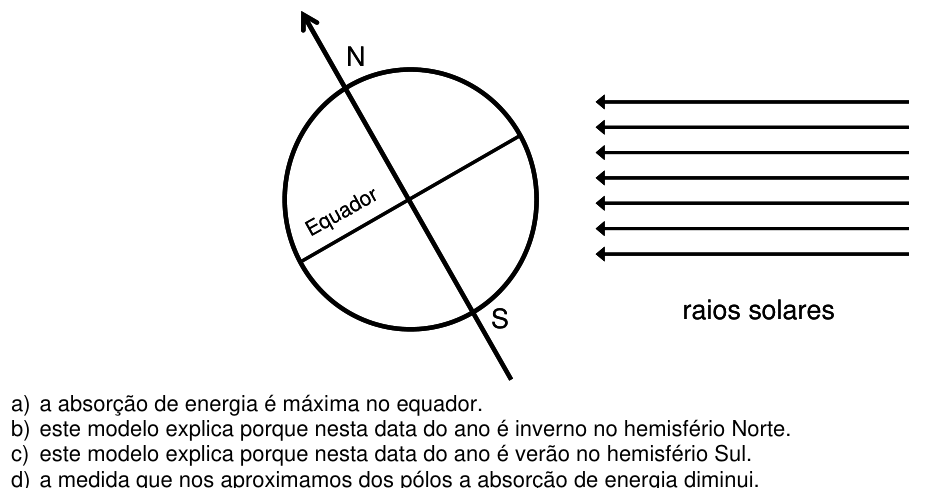 Terra eixo rotação vs raios solares 21 dezembro
Topic: Astrophysics, Thermodynamics Metodi: Physical Modeling, Approximation & Series Expansion Competenze: Physical Reasoning, Mathematical Modeling Objects: Planet, Star Fonte: Testo (PDF) — p.6
La figura seguente rappresenta la posizione relativa dell’asse di rotazione della Terra rispetto ai raggi luminosi che arrivano dal Sole il 21 dicembre. Possiamo creare un modello in cui l’assorbimento di energia dal Sole sulla Terra sia proporzionale a:
dove è la quantità di energia assorbita dalla Terra, è una costante, la latitudine ( nell’emisfero nord e nell’emisfero sud) e l’inclinazione dell’asse di rotazione della Terra rispetto alla sua orbita intorno al Sole. Nel Nord, il modello vale solo quando .
Rispondi alle domande 18-20 basandosi su questo modello.
**18) ** Secondo questo modello, in cui la latitudine di assorbimento dell’energia è massima il 21 dicembre:
- A all’equatore ().
- B. nel Tropico di Capricorno ().
- C. nel Tropico del cancro ().
- D. al Polo Sud ().
- E. al Polo Nord ().
Ecce di rotazione della terra contro i raggi solari 21 dicembre
Topic: Astrophysics, Thermodynamics Metodi: Physical Modeling, Approximation & Series Expansion Competenze: Physical Reasoning, Mathematical Modeling Objects: Planet, Star Fonte: Testo (PDF) — p.6
The following figure represents the relative position of the Earth’s axis of rotation relative to the light rays reaching the Sun on December 21. We can create a model where the absorption of energy from the sun by the Earth is proportional to:
where is the amount of energy absorbed by the Earth, is a constant, the latitude ( in the Northern Hemisphere and in the Southern Hemisphere) and the tilt of the Earth’s axis of rotation relative to its orbit around the Sun. In the Northern Hemisphere the model is only valid when .
Answer questions 18 to 20 based on this model.
**18) ** According to this model, at which latitude the energy absorption is maximum on 21 December:
- A at the equator ().
- **B ** in the Tropic of Capricorn ().
- C in the Tropic of Cancer ().
- D at the South Pole ().
- E at the North Pole ().
The Earth’s axis of rotation vs. the sun’s rays 21 December
Topic: Astrophysics, Thermodynamics Metodi: Physical Modeling, Approximation & Series Expansion Competenze: Physical Reasoning, Mathematical Modeling Objects: Planet, Star Fonte: Testo (PDF) — p.6
19) De acordo com este modelo, verifique qual das alternativas é incorreta:
- A. a absorção de energia é máxima no hemisfério Sul nessa data.
- B. este modelo explica porque nesta data do ano é inverno no hemisfério Norte.
- C. este modelo explica porque nesta data do ano é verão no hemisfério Sul.
- D. à medida que nos aproximamos dos pólos a absorção de energia diminui.
- E. este modelo não consegue explicar o que ocorre no Polo Norte nessa data.
Topic: Astrophysics, Thermodynamics Metodi: Physical Modeling, Approximation & Series Expansion Competenze: Physical Reasoning, Mathematical Modeling Objects: Planet, Star Fonte: Testo (PDF) — p.6
**19) ** In base a questo modello, verificare quale delle alternative sia sbagliata:
- A. l’assorbimento di energia è massimo nell’emisfero sud a questa data. Questo modello spiega perché in questo periodo dell’anno è inverno nell’emisfero nord. Questo modello spiega perché a questa data dell’anno è estate nell’emisfero sud.
- D. M.S.K. 1 - Quando ci avviciniamo ai poli l’assorbimento di energia diminuisce.
- MSK1/> E questo modello non riesce a spiegare cosa accade al Polo Nord a quella data.
Topic: Astrophysics, Thermodynamics Metodi: Physical Modeling, Approximation & Series Expansion Competenze: Physical Reasoning, Mathematical Modeling Objects: Planet, Star Fonte: Testo (PDF) — p.6
**19) ** According to this model, check which of the alternatives is incorrect:
- MSK1/> energy absorption is peak in the Southern Hemisphere on this date. This model explains why this time of year it’s winter in the Northern Hemisphere. This model explains why this time of year is summer in the Southern Hemisphere.
- MSK1/>D as we approach the poles the energy absorption decreases.
- This model cannot explain what is happening at the North Pole on that date.
Topic: Astrophysics, Thermodynamics Metodi: Physical Modeling, Approximation & Series Expansion Competenze: Physical Reasoning, Mathematical Modeling Objects: Planet, Star Fonte: Testo (PDF) — p.6
20) Sabendo que a inclinação do eixo da Terra é , qual é o valor aproximado da absorção de energia no Polo Norte () no dia 21 de dezembro, em termos da constante :
- A.
- B.
- C. 0
- D.
- E.
Topic: Astrophysics, Order-of-Magnitude Estimation Metodi: Physical Modeling, Dimensional Analysis Competenze: Physical Reasoning, Mathematical Modeling Objects: Planet, Star Fonte: Testo (PDF) — p.6
Sapendo che l’inclinazione dell’asse terrestre è , quale è il valore approssimativo dell’assorbimento di energia al Polo Nord () il 21 dicembre, in termini di costante :
- A.
- B.
- C. 0
- D.
- E.
Topic: Astrophysics, Order-of-Magnitude Estimation Metodi: Physical Modeling, Dimensional Analysis Competenze: Physical Reasoning, Mathematical Modeling Objects: Planet, Star Fonte: Testo (PDF) — p.6
**20) ** Knowing that the tilt of the Earth’s axis is , what is the approximate value of the energy absorption at the North Pole () on 21 December, in terms of the constant :
- A.
- B.
- C. 0
- D.
- E.
Topic: Astrophysics, Order-of-Magnitude Estimation Metodi: Physical Modeling, Dimensional Analysis Competenze: Physical Reasoning, Mathematical Modeling Objects: Planet, Star Fonte: Testo (PDF) — p.6