Técnicos de um laboratório de testes desejam determinar se um novo dispositivo é capaz de resistir a grandes acelerações e desacelerações. Para descobrir isso, eles colam tal dispositivo de 5,0 kg a uma plataforma de testes que depois é deslocada verticalmente para cima e para baixo. O gráfico da figura 1 mostra a aceleração durante um segundo do movimento.
- A. Identifique as forças exercidas sobre o dispositivo e desenhe um diagrama de forças para ele.
- B. Em que instante o peso do dispositivo é máximo? Quanto vale a aceleração neste instante?
- C. O peso do dispositivo é nulo em algum momento? Em caso afirmativo, em que instante isso ocorre? Qual é a aceleração neste instante?
- D. Suponha que os técnicos se esqueçam de colar o dispositivo à plataforma de testes. O dispositivo permanecerá sobre a plataforma de testes durante o primeiro segundo de movimento ou ele sairá voando da plataforma em algum instante de tempo? Em caso afirmativo, em que instante isso ocorreria?
 Graph of acceleration vs time (figura 1)
Topic: Newtonian Mechanics Metodi: Free-Body Diagram, Kinematic Equations Competenze: Diagrammatic Reasoning, Physical Reasoning Objects: — Fonte: Testo (PDF) — p.2
I tecnici di un laboratorio di test desiderano determinare se un nuovo dispositivo sia in grado di resistere a grandi accelerazioni e decelerazioni. Per scoprirlo, attaccano un dispositivo di 5 kg a una piattaforma di test che viene poi spostata verticalmente su e giù. Il grafico di figura 1 mostra l’accelerazione durante un secondo del movimento.
- A. Identifica le forze esercitate sul dispositivo e disegna un diagramma delle forze per esso.
- B. In che momento il peso del dispositivo è massimo? Quanto vale l’accelerazione in questo momento?
- Il peso del dispositivo è nullo in un certo momento? Se sì, in che momento si verifica? Qual è l’accelerazione in questo istante?
- D. Supponiamo che i tecnici dimentichino di attaccare il dispositivo alla piattaforma di prova. Il dispositivo rimarrà sulla piattaforma di prova per il primo secondo di movimento o uscirà volando dalla piattaforma in un istante di tempo? Se sì, in che momento sarebbe avvenuto?
*Grafico di accelerazione vs tempo (figura 1) *
Topic: Newtonian Mechanics Metodi: Free-Body Diagram, Kinematic Equations Competenze: Diagrammatic Reasoning, Physical Reasoning Objects: — Fonte: Testo (PDF) — p.2
Technicians in a test laboratory want to determine whether a new device is capable of withstanding high accelerations and decelerations. To find out, they attach such a 5 kg device to a test rig that is then moved vertically up and down. The graph in Figure 1 shows the acceleration during a second of motion.
- A. Identify the forces exerted on the device and draw a force diagram for it.
- B. When is the maximum device weight? How much is the acceleration worth right now?
- C Is the weight of the device zero at any time? If so, at what moment does this occur? What’s the acceleration right now? Suppose technicians forget to stick the device to the test platform. Will the device remain on the test platform for the first second of movement or will it fly off the platform in any moment of time? If so, at what time would that occur?
The acceleration rate is the maximum value of the acceleration rate.
Topic: Newtonian Mechanics Metodi: Free-Body Diagram, Kinematic Equations Competenze: Diagrammatic Reasoning, Physical Reasoning Objects: — Fonte: Testo (PDF) — p.2
O planeta Saturno possui uma grande lua chamada Titã. Titã possui uma massa de 1,85 vezes a massa da nossa lua. Saturno em si possui uma massa 95 vezes maior que a massa da Terra. Nossa lua possui uma massa 0,0123 vezes aquela da Terra. A distância entre os centros da Terra e a Lua é de 240.000 milhas, e a distância entre os centros de Saturno e Titã é 760.000 milhas. Referindo-se à lei da gravitação e explicando seu raciocínio em termos da razão entre escalas apenas (sem substituição na fórmula), calcule a razão da força centrípeta exercida sobre Titã por Saturno com a força centrípeta , exercida sobre a Lua pela Terra (forneça seus argumentos em termos de se será maior ou menor que , e em que razão, como prescrito pela lei da gravitação).
Topic: Gravitation Metodi: Newton’s Law of Gravitation, Dimensional Analysis Competenze: Physical Reasoning, Mathematical Modeling Objects: Planet, Satellite Fonte: Testo (PDF) — p.2
Il pianeta Saturno ha una grande luna chiamata Titano. Titano ha una massa 1,85 volte quella della nostra luna. Saturno ha una massa 95 volte maggiore della massa della Terra. La nostra luna ha una massa 0,0123 volte quella della Terra. La distanza tra i centri della Terra e della Luna è di 240.000 miglia, e la distanza tra i centri di Saturno e Titano è di 760.000 miglia. Riferendosi alla legge della gravità e spiegando il suo ragionamento in termini di rapporto tra scale solo (senza sostituzione nella formula), calcola il rapporto della forza centripeta esercitata su Titano da Saturno con la forza centripeta esercitata sulla Luna dalla Terra (fornisce i suoi argomenti in termini di se sarà maggiore o inferiore a , e a quale ragione, come prescritto dalla legge della gravità).
Topic: Gravitation Metodi: Newton’s Law of Gravitation, Dimensional Analysis Competenze: Physical Reasoning, Mathematical Modeling Objects: Planet, Satellite Fonte: Testo (PDF) — p.2
The planet Saturn has a large moon called Titan. Titan has a mass 1.85 times that of our moon. Saturn itself has a mass 95 times that of Earth. Our moon has a mass of 0.0123 times that of the Earth. The distance between the centers of the Earth and the Moon is 240,000 miles, and the distance between the centers of Saturn and Titan is 760,000 miles. Referring to the law of gravitation and explaining its reasoning in terms of the ratio between scales only (without substitution in the formula), calculate the ratio of the centrifugal force exerted on Titan by Saturn to the centrifugal force exerted on the Moon by the Earth (provide your arguments in terms of whether will be greater or less than , and at what ratio, as prescribed by the law of gravitation).
Topic: Gravitation Metodi: Newton’s Law of Gravitation, Dimensional Analysis Competenze: Physical Reasoning, Mathematical Modeling Objects: Planet, Satellite Fonte: Testo (PDF) — p.2
A figura 2 representa a força que uma partícula sofre durante um pequeno intervalo de tempo. Calcule o impulso que a partícula sofreu.
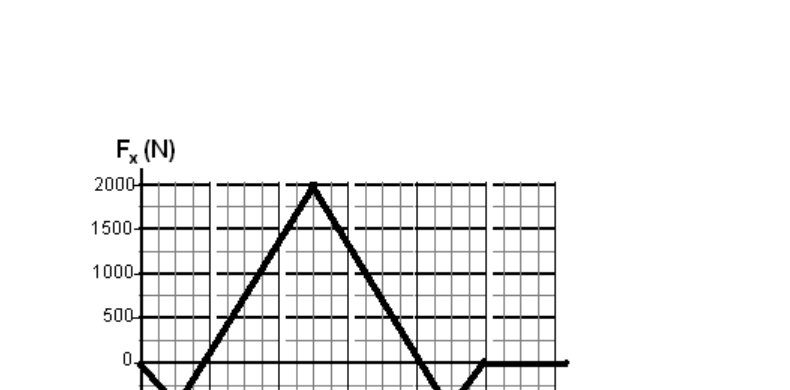 Force vs time graph (figura 2)
Topic: Newtonian Mechanics Metodi: Impulse-Momentum Theorem Competenze: Mathematical Modeling, Diagrammatic Reasoning Objects: Particle Beam Fonte: Testo (PDF) — p.3
La figura 2 rappresenta la forza che una particella subisce per un breve periodo di tempo. Calcola il impulso che la particella ha subito.
*Force vs time graph (fig. 2) *
Topic: Newtonian Mechanics Metodi: Impulse-Momentum Theorem Competenze: Mathematical Modeling, Diagrammatic Reasoning Objects: Particle Beam Fonte: Testo (PDF) — p.3
Figure 2 represents the force a particle suffers over a short period of time. Calculate the momentum the particle has suffered.
The following table shows the results of the calculations:
Topic: Newtonian Mechanics Metodi: Impulse-Momentum Theorem Competenze: Mathematical Modeling, Diagrammatic Reasoning Objects: Particle Beam Fonte: Testo (PDF) — p.3
A Figura 3 representa a energia potencial associada a uma partícula de 500 g que se move ao longo do eixo . Supondo que a energia mecânica da partícula é igual a 12 J, responda:
- A. Quais os pontos de retorno da partícula?
- B. Qual é a máxima velocidade da partícula? Em que ou quais pontos ocorre?
- C. Faça uma descrição do movimento da partícula quando esta se move da esquerda para a direita.
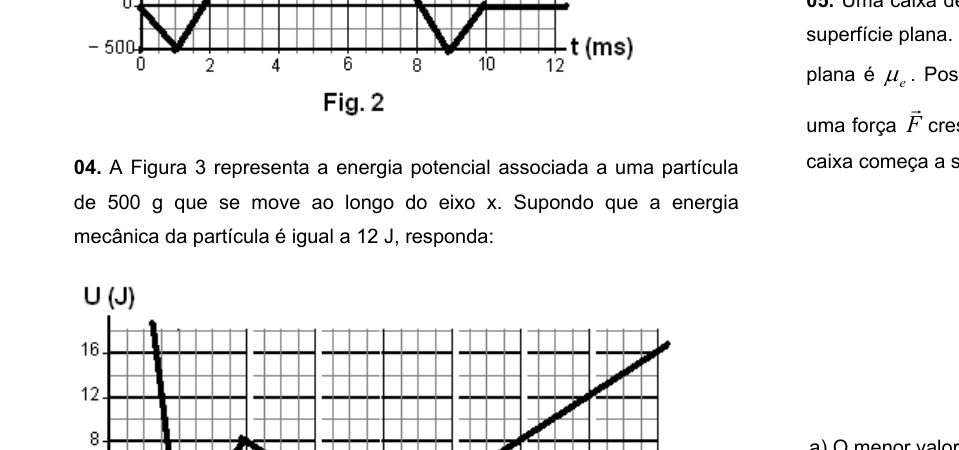 Potential energy U(x) vs position (figura 3)
Topic: Conservation of Energy, Newtonian Mechanics Metodi: Energy Conservation Method Competenze: Physical Reasoning, Diagrammatic Reasoning Objects: — Fonte: Testo (PDF) — p.3
La figura 3 rappresenta l’energia potenziale associata a una particella di 500 g che si muove lungo l’asse . Supponendo che l’energia meccanica della particella sia pari a 12 J, rispondi:
- A. Quali sono i punti di ritorno della particella? Qual è la velocità massima della particella? In che punto o in quali punti si verifica?
- C. Descrivi il movimento della particella quando si muove da sinistra a destra.
*Potential energy U(x) vs position (Figura 3) *
Topic: Conservation of Energy, Newtonian Mechanics Metodi: Energy Conservation Method Competenze: Physical Reasoning, Diagrammatic Reasoning Objects: — Fonte: Testo (PDF) — p.3
Figure 3 represents the potential energy associated with a 500 g particle moving along the axis. Assuming the particle’s mechanical energy is equal to 12 J, answer:
- A. What are the return points of the particle?
- What is the maximum particle velocity? What or what points does it occur?
- C. Describe the motion of the particle as it moves from left to right.
The value of the input data shall be calculated as follows:
Topic: Conservation of Energy, Newtonian Mechanics Metodi: Energy Conservation Method Competenze: Physical Reasoning, Diagrammatic Reasoning Objects: — Fonte: Testo (PDF) — p.3
Uma caixa de madeira de peso encontra-se em repouso sobre uma superfície plana. O coeficiente de atrito estático entre a caixa e a superfície plana é . Posteriormente, um garoto começa a empurrar a caixa com uma força crescente, que faz um ângulo com a horizontal, até que a caixa começa a se mover, como mostra a figura 4. Calcule:
- A. O menor valor de para que a caixa se mova.
- B. A força de reação normal à superfície, associada ao valor de do ítem a), sobre o bloco.
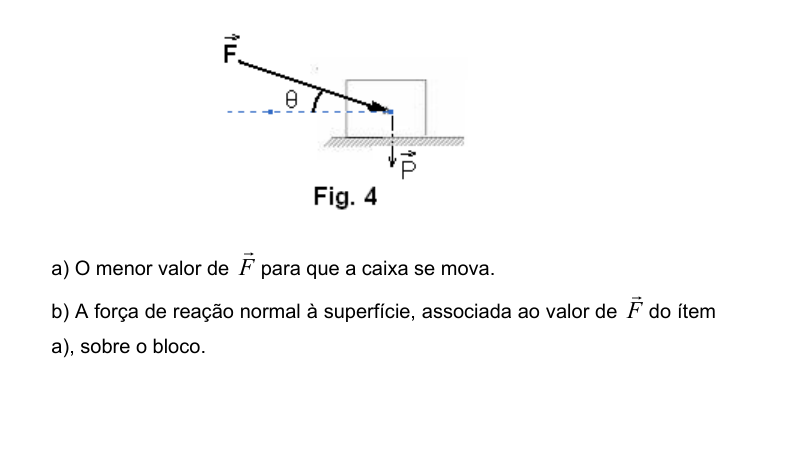 Box pushed at angle θ on surface (figura 4)
Topic: Newtonian Mechanics Metodi: Free-Body Diagram, Vector Decomposition Competenze: Mathematical Modeling, Diagrammatic Reasoning Objects: Block Fonte: Testo (PDF) — p.3
Una scatola di legno di peso si trova a riposo su una superficie piana. Il coefficiente di attrito statico tra la cassa e la superficie piana è . Posteriormente, um garoto começa a empurrar a caixa com uma força crescente, que faz um ângulo com a horizontal, até que a caixa começa a se mover, como mostra a figura 4. Calcola:
- A. Il minimo valore di per il movimento della scatola.
- B. La forza di reazione normale sulla superficie, associata al valore di dell’oggetto a), sul blocco.
*Box pushed at angle θ on surface (Figura 4) *
Topic: Newtonian Mechanics Metodi: Free-Body Diagram, Vector Decomposition Competenze: Mathematical Modeling, Diagrammatic Reasoning Objects: Block Fonte: Testo (PDF) — p.3
A wooden box weighing rests on a flat surface. The static friction coefficient between the box and the flat surface is . Posteriormente, um garoto começa a empurrar a caixa com uma força crescente, que faz um ângulo com a horizontal, até que a caixa começa a se mover, como mostra a figura 4. Calculate:
- A. The minimum value of for the box to move.
- B. The normal surface reaction force, associated with the value of of item a), on the block.
Box pushed at angle θ on surface (figura 4)
Topic: Newtonian Mechanics Metodi: Free-Body Diagram, Vector Decomposition Competenze: Mathematical Modeling, Diagrammatic Reasoning Objects: Block Fonte: Testo (PDF) — p.3
Uma partícula é lançada verticalmente para cima com velocidade inicial formando um ângulo com a horizontal. Se o ângulo é escolhido tal que o alcance é máximo, calcule a distância entre dois pontos e da trajetória que ficam a uma mesma altura .
Topic: Newtonian Mechanics Metodi: Kinematic Equations, Approximation & Series Expansion Competenze: Mathematical Modeling, Physical Reasoning Objects: Projectile Fonte: Testo (PDF) — p.4
Una particella viene lanciata verticalmente verso l’alto con velocità iniziale formando un angolo con la orizzontale. Se l’angolo è scelto in modo tale che la portata sia massima, calcola la distanza tra due punti e della trajectoria che si trovano alla stessa altezza .
Topic: Newtonian Mechanics Metodi: Kinematic Equations, Approximation & Series Expansion Competenze: Mathematical Modeling, Physical Reasoning Objects: Projectile Fonte: Testo (PDF) — p.4
A particle is thrown vertically upwards at initial speed forming an angle with the horizontal. If the angle is chosen such that the range is maximum, calculate the distance between two points and of the trajectory that are at the same height .
Topic: Newtonian Mechanics Metodi: Kinematic Equations, Approximation & Series Expansion Competenze: Mathematical Modeling, Physical Reasoning Objects: Projectile Fonte: Testo (PDF) — p.4
A figura 5 representa duas partículas de massas kg e kg movendo-se em direções opostas, sobre uma superfície plana sem atrito. Elas têm velocidades constantes, cujos módulos são m/s e m/s e colidem. A colisão é frontal e perfeitamente elástica. Calcule as velocidades finais das partículas.
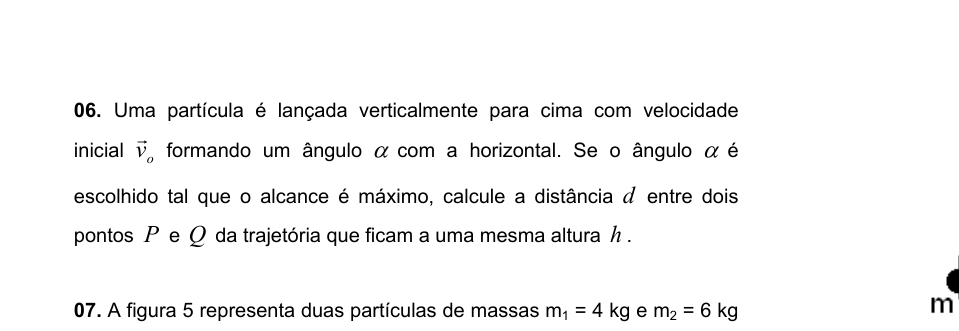 Two particles moving toward each other (figura 5)
Topic: Conservation of Momentum, Newtonian Mechanics Metodi: Conservation of Momentum, Conservation of Energy Competenze: Mathematical Modeling, Physical Reasoning Objects: — Fonte: Testo (PDF) — p.4
La figura 5 rappresenta due particelle di massa kg e kg che si muovono in direzioni opposte su una superficie piana senza attrito. I moduli sono m/s e m/s e si incollano a velocità costanti. La collisione è frontale e perfettamente elastica. Calcola le velocità finali delle particelle.
*Due particelle che si muovono l’una verso l’altra (Figura 5) *
Topic: Conservation of Momentum, Newtonian Mechanics Metodi: Conservation of Momentum, Conservation of Energy Competenze: Mathematical Modeling, Physical Reasoning Objects: — Fonte: Testo (PDF) — p.4
Figure 5 represents two particles of mass kg and kg moving in opposite directions on a flat surface without friction. They have constant speeds, the modules of which are m/s and m/s and they collide. The collision is frontal and perfectly elastic. Calculate the final velocities of the particles.
*Two particles moving towards each other (Figure 5) *
Topic: Conservation of Momentum, Newtonian Mechanics Metodi: Conservation of Momentum, Conservation of Energy Competenze: Mathematical Modeling, Physical Reasoning Objects: — Fonte: Testo (PDF) — p.4
Dois satélites de massa se movem em uma mesma órbita circular de raio em torno de um planeta de massa , como ilustra a figura 6. Os dois satélites estão sempre em extremidades opostas de um mesmo diâmetro enquanto realizam seu movimento. Calcule o período do movimento orbital.
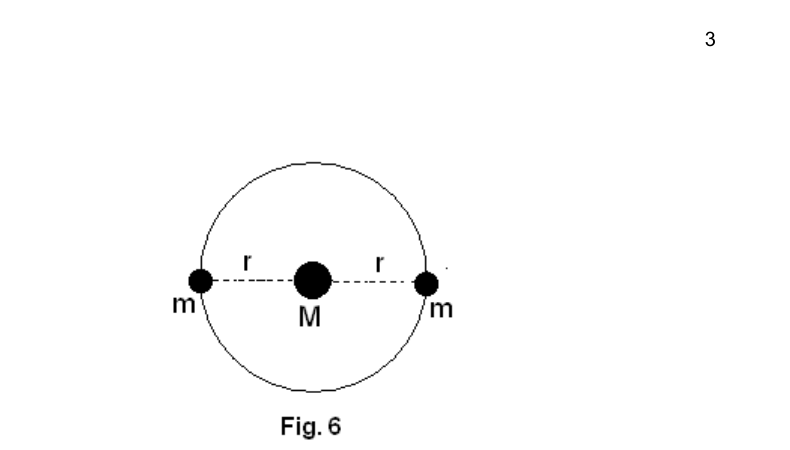 Two satellites in circular orbit (figura 6)
Topic: Gravitation, Newtonian Mechanics Metodi: Newton’s Law of Gravitation, Kinematic Equations Competenze: Physical Reasoning, Mathematical Modeling Objects: Satellite, Planet Fonte: Testo (PDF) — p.4
Due satelliti di massa si muovono in una stessa orbita circolare di raggio attorno a un pianeta di massa , come illustrato in figura 6. I due satelliti sono sempre in estremità opposte dello stesso diametro mentre si muovono. Calcola il periodo di movimento orbitale.
*Two satelliti in orbita circolare (Figura 6) *
Topic: Gravitation, Newtonian Mechanics Metodi: Newton’s Law of Gravitation, Kinematic Equations Competenze: Physical Reasoning, Mathematical Modeling Objects: Satellite, Planet Fonte: Testo (PDF) — p.4
Two mass satellites are moving in the same circular orbit of radius around a planet of mass, as illustrated in Figure 6. The two satellites are always at opposite ends of the same diameter while performing their movement. Calculate the period of orbital motion.
The following table shows the results of the calculations:
Topic: Gravitation, Newtonian Mechanics Metodi: Newton’s Law of Gravitation, Kinematic Equations Competenze: Physical Reasoning, Mathematical Modeling Objects: Satellite, Planet Fonte: Testo (PDF) — p.4
Uma cunha de massa submetida a uma força horizontal (ver figura 7) encontra-se sobre uma superfície horizontal sem atrito. Coloca-se um bloco de massa sobre a superfície inclinada da cunha. Se o coeficiente de atrito estático entre as superfícies da cunha e do bloco é , encontre os valores máximos e mínimos da força para que o bloco permaneça em repouso sobre a cunha.
 Wedge with block on inclined surface (figura 7)
Topic: Newtonian Mechanics Metodi: Free-Body Diagram, Vector Decomposition Competenze: Diagrammatic Reasoning, Mathematical Modeling Objects: Wedge, Block Fonte: Testo (PDF) — p.4
Una conia di massa sottoposta a una forza orizzontale (vedere figura 7) si trova su una superficie orizzontale senza attrito. Un blocco di massa è posto sulla superficie inclinata della cunha. Se il coefficiente di attrito statico tra le superfici della cucina e del blocco è , trovare i valori massimi e minimi di forza per mantenere il blocco a riposo sulla cucina.
*Wedge with block on inclined surface (Figura 7) *
Topic: Newtonian Mechanics Metodi: Free-Body Diagram, Vector Decomposition Competenze: Diagrammatic Reasoning, Mathematical Modeling Objects: Wedge, Block Fonte: Testo (PDF) — p.4
A wedge of mass subjected to a horizontal force (see Figure 7) is on a horizontal surface without friction. A block of mass shall be placed on the sloping surface of the wedge. If the coefficient of static friction between the wedge and block surfaces is , find the maximum and minimum values of force so that the block remains at rest on the wedge.
*Wedge with block on inclined surface (Figure 7) *
Topic: Newtonian Mechanics Metodi: Free-Body Diagram, Vector Decomposition Competenze: Diagrammatic Reasoning, Mathematical Modeling Objects: Wedge, Block Fonte: Testo (PDF) — p.4
Um gato de 5,0 kg e uma tigela de 2,0 kg de atum estão em posições opostas de uma gangorra de 4,0 m de comprimento e massa negligenciável. Um segundo gato de 4,0 kg é posicionado a uma distância à esquerda do ponto de apoio como ilustrado na figura 8. Calcule a distância de modo a que o sistema atinja o equilíbrio estático.
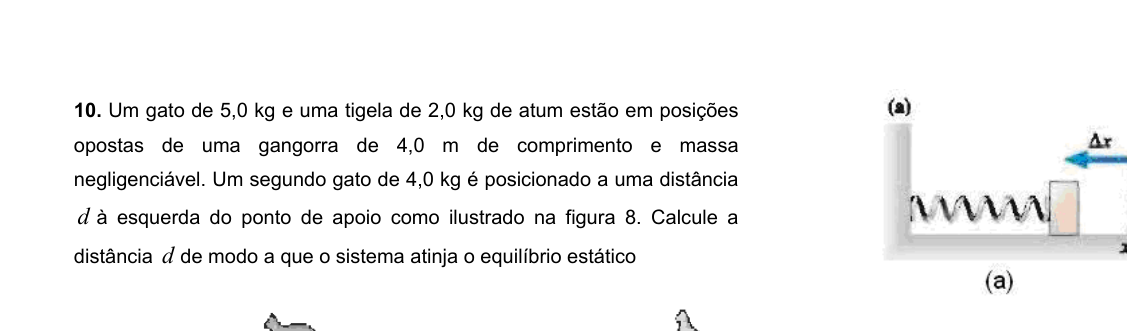 Seesaw with cats and tuna bowl (figura 8)
Topic: Rigid Body Statics, Newtonian Mechanics Metodi: Torque & Angular Momentum Analysis, Free-Body Diagram Competenze: Physical Reasoning, Mathematical Modeling Objects: Lever, Beam Fonte: Testo (PDF) — p.5
Un gatto di 5 kg e una ciotola di 2 kg di tonno sono in posizioni opposte a una gangora di 4 m di lunghezza e massa trascurabile. Un secondo gatto di 4,0 kg è posizionato a una distanza a sinistra del punto di supporto come illustrato in figura 8. Calcolare la distanza in modo che il sistema raggiunga l’equilibrio statico.
*Seesaw with cats and tuna bowl (Figura 8) *
Topic: Rigid Body Statics, Newtonian Mechanics Metodi: Torque & Angular Momentum Analysis, Free-Body Diagram Competenze: Physical Reasoning, Mathematical Modeling Objects: Lever, Beam Fonte: Testo (PDF) — p.5
A 5 kg cat and a 2 kg bowl of tuna are in opposite positions to a 4 m long gangorra and negligible mass. A second cat of 4.0 kg is positioned at a distance to the left of the support point as shown in Figure 8. Calculate the distance so that the system reaches static equilibrium.
*Seesaw with cats and tuna bowl (Figure 8) *
Topic: Rigid Body Statics, Newtonian Mechanics Metodi: Torque & Angular Momentum Analysis, Free-Body Diagram Competenze: Physical Reasoning, Mathematical Modeling Objects: Lever, Beam Fonte: Testo (PDF) — p.5
A força necessária para comprimir ou distender uma mola com constante de rigidez elástica é dada por . Esta é a lei de Hooke. O trabalho realizado pela força aplicada à mola para promover uma deformação na mesma é dado por . A mola da figura 9a é comprimida em . Ela lança o bloco com velocidade ao longo de uma superfície livre de atrito. As duas molas da figura 9b são idênticas à mola da figura 9a. Elas são comprimidas no mesmo valor e são usadas para lançar o mesmo bloco.
- A. Determine a constante de elasticidade da mola equivalente ao conjunto de molas.
- B. Qual será, agora, o módulo da velocidade do bloco, para a configuração (b)?
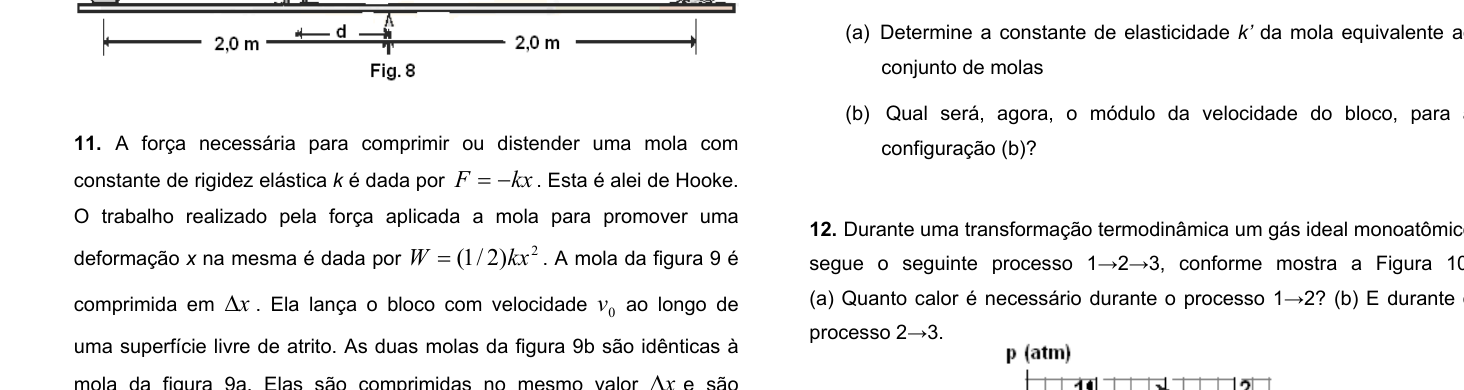 Single spring (9a) and two springs in parallel (9b)
Topic: Oscillations & Waves, Conservation of Energy Metodi: Hooke’s Law, Energy Conservation Method Competenze: Mathematical Modeling, Physical Reasoning Objects: Spring, Block Fonte: Testo (PDF) — p.5
La forza necessaria per comprimere o allontanarsi una molla con costante rigidità elastica è data da . Questa è la legge di Hooke. Il lavoro effettuato dalla forza applicata al mollo per promuovere una deformazione in esso è dato da . La molla di figura 9a è compressa a . Lancia il blocco a velocità su una superficie libera da attrito. Le due molle di figura 9b sono identiche alla molla di figura 9a. Sono compressi allo stesso valore e vengono utilizzati per lanciare lo stesso blocco.
- A. Determina la costante di elasticità della molla equivalente all’insieme delle molle.
- B. Qual sarà, ora, il modulo di velocità del blocco, per la configurazione (b)?
*Single spring (9a) and two springs in parallel (9b) *
Topic: Oscillations & Waves, Conservation of Energy Metodi: Hooke’s Law, Energy Conservation Method Competenze: Mathematical Modeling, Physical Reasoning Objects: Spring, Block Fonte: Testo (PDF) — p.5
The force required to compress or stretch a spring with a constant elastic stiffness is given by . This is Hooke’s law. The work performed by the force applied to the spring to promote a deformation in the spring is given by . The spring in Figure 9a is compressed to . It throws the block at speed along a friction-free surface. The two springs in Figure 9b are identical to the springs in Figure 9a. They are compressed to the same value and used to cast the same block.
- A. Determine the elasticity constant of the spring equivalent to the spring set.
- B. What will the block speed module be for configuration (b) now?
Single spring (9a) and two springs in parallel (9b)
Topic: Oscillations & Waves, Conservation of Energy Metodi: Hooke’s Law, Energy Conservation Method Competenze: Mathematical Modeling, Physical Reasoning Objects: Spring, Block Fonte: Testo (PDF) — p.5
Durante uma transformação termodinâmica um gás ideal monoatômico segue o seguinte processo , conforme mostra a Figura 10.
- A. Quanto calor é necessário durante o processo ?
- B. E durante o processo ?
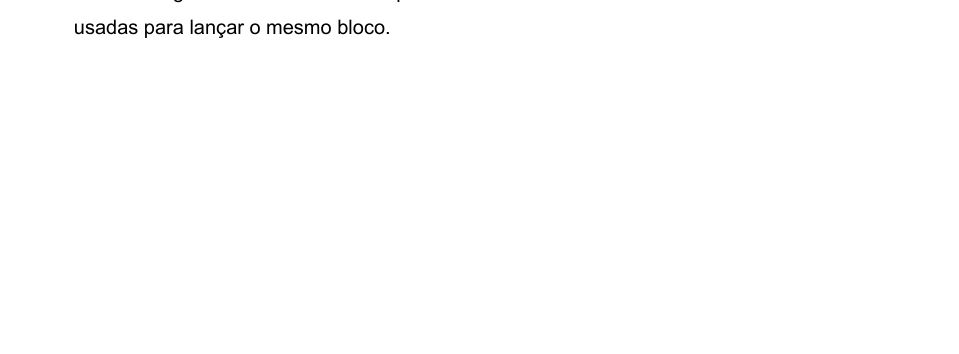 p-V diagram for process 1→2→3 (figura 10)
Topic: Thermodynamics Metodi: First Law of Thermodynamics, Ideal Gas Law Competenze: Mathematical Modeling, Physical Reasoning Objects: Gas Fonte: Testo (PDF) — p.5
Durante una trasformazione termodinamica un gas ideale monoatomo segue il processo , come mostra la figura 10.
- A. Quanto calore è necessario durante il processo ?
- B. E durante il processo ?
p-V diagramma per processo 1→2→3 (fig. 10)
Topic: Thermodynamics Metodi: First Law of Thermodynamics, Ideal Gas Law Competenze: Mathematical Modeling, Physical Reasoning Objects: Gas Fonte: Testo (PDF) — p.5
During a thermodynamic transformation a monoatomic ideal gas follows the following process as shown in Figure 10.
- A How much heat is needed during the process?
- B. And during the process ?
The following table shows the data set of the data set and the data set of the data set.
Topic: Thermodynamics Metodi: First Law of Thermodynamics, Ideal Gas Law Competenze: Mathematical Modeling, Physical Reasoning Objects: Gas Fonte: Testo (PDF) — p.5
Uma máquina fotográfica possui uma lente com distância focal igual a 35,0 mm e o filme possui largura igual a 36,0 mm. Ao fotografar um veleiro com 12,0 m de comprimento verifica-se que a imagem do veleiro abrange somente um quarto da largura do filme. Calcule:
- A. a distância entre o fotógrafo e o veleiro.
- B. a distância que o fotógrafo deve mover-se a partir da posição do item a) para que a imagem do veleiro preencha totalmente a largura do filme.
Topic: Geometric Optics Metodi: Thin Lens & Mirror Equation, Ray Tracing Competenze: Mathematical Modeling, Physical Reasoning Objects: Lens Fonte: Testo (PDF) — p.6
Una macchina fotografica ha un obiettivo con una distanza focale pari a 35,0 mm e il film ha una larghezza pari a 36,0 mm. Quando si fotografa una barca da mare lunga 12,0 metri si verifica che l’immagine della barca da mare copre solo un quarto della larghezza del film. Calcola:
- A la distanza tra il fotografo e il velivolo.
- B. la distanza che il fotografo deve spostare dalla posizione di punto (a) per far sì che l’immagine del velivolo riempia pienamente la larghezza del film.
Topic: Geometric Optics Metodi: Thin Lens & Mirror Equation, Ray Tracing Competenze: Mathematical Modeling, Physical Reasoning Objects: Lens Fonte: Testo (PDF) — p.6
A camera has a lens with a focal length of 35.0 mm and the film has a width of 36.0 mm. When photographing a sailing vessel 12 m long, it turns out that the image of the sailing vessel covers only a quarter of the film’s width. Calculate:
- **A ** the distance between the photographer and the sailor.
- B. the distance the photographer must move from the position of item (a) so that the image of the sailboat fully fills the width of the film.
Topic: Geometric Optics Metodi: Thin Lens & Mirror Equation, Ray Tracing Competenze: Mathematical Modeling, Physical Reasoning Objects: Lens Fonte: Testo (PDF) — p.6
Um cone de base circular de densidade e altura flutua em um líquido de densidade . A parte do cone acima do líquido tem altura , como mostra a figura 11. Determine a altura .
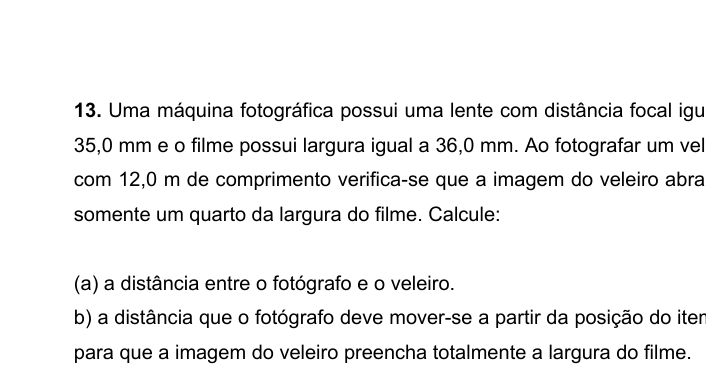 Cone floating partially submerged in liquid (figura 11)
Topic: Fluid Mechanics Metodi: Hydrostatic Equilibrium, Conservation Laws Competenze: Mathematical Modeling, Physical Reasoning Objects: — Fonte: Testo (PDF) — p.6
Un cono di base circolare di densità e altezza fluttuano in un liquido di densità . La parte del cono sopra il liquido ha una altezza , come mostra la figura 11. Determina l’altezza .
*Cone floating partially submerged in liquid (Figura 11) *
Topic: Fluid Mechanics Metodi: Hydrostatic Equilibrium, Conservation Laws Competenze: Mathematical Modeling, Physical Reasoning Objects: — Fonte: Testo (PDF) — p.6
A circular base cone of density and height floats in a liquid of density. The cone part above the liquid is in height, as shown in Figure 11. Determine the height .
*Cone floating partially submerged in liquid (Figure 11) *
Topic: Fluid Mechanics Metodi: Hydrostatic Equilibrium, Conservation Laws Competenze: Mathematical Modeling, Physical Reasoning Objects: — Fonte: Testo (PDF) — p.6
Uma caixa isolante é dividida em duas partes A e B com volumes constantes por uma parede que não deixa passar calor de um lado para o outro da caixa. Na parte A existe um gás monoatômico de uma determinada substância com moles a uma temperatura . No lado B, o número de moles da mesma substância é a uma temperatura , como mostra a figura 12. Em um dado momento, por algum mecanismo, é permitido fluir calor de um lado da caixa para o outro sem que o volume de cada lado mude. Em uma situação final de equilíbrio termodinâmico, calcule:
- A. A temperatura de equilíbrio entre os dois sistemas A e B.
- B. A energia final no lado A em função da energia total.
- C. A energia final do lado B em função da energia total.
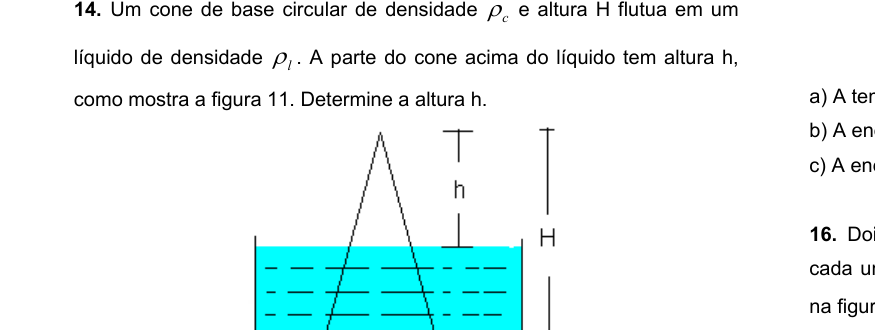 Insulated box divided into A and B (figura 12)
Topic: Thermodynamics, Kinetic Theory Metodi: First Law of Thermodynamics, Ideal Gas Law, Kinetic Theory of Gases Competenze: Mathematical Modeling, Physical Reasoning Objects: Gas, Container Fonte: Testo (PDF) — p.6
Una scatola isolante è divisa in due parti A e B con volumi costanti da un muro che non permette di passare calore da un lato all’altro della scatola. Nella parte A, c’è un gas monoatomo di una determinata sostanza con mole a una temperatura . Sul lato B, il numero di mole della stessa sostanza è a una temperatura , come mostra la figura 12. In un certo momento, per un meccanismo, si permette di fluire calore da un lato della scatola all’altro senza che il volume di ciascun lato cambie. In una situazione di equilibrio termodinamico finale, calcolare:
- A. La temperatura di equilibrio tra i due sistemi A e B.
- B. L’energia finale sul lato A in funzione dell’energia totale.
- C. L’energia finale del lato B in funzione dell’energia totale.
*Insulated box divided into A and B (fig. 12) *
Topic: Thermodynamics, Kinetic Theory Metodi: First Law of Thermodynamics, Ideal Gas Law, Kinetic Theory of Gases Competenze: Mathematical Modeling, Physical Reasoning Objects: Gas, Container Fonte: Testo (PDF) — p.6
An insulating box is divided into two parts A and B with constant volumes by a wall that prevents heat from passing from one side of the box to the other. In Part A there is a monoatomic gas of a given substance with moles at a temperature . On side B, the number of moles of the same substance is at a temperature , as shown in Figure 12. At a given moment, by some mechanism, heat is allowed to flow from one side of the box to the other without the volume on each side changing. In a final thermodynamic equilibrium situation, calculate:
- A. The equilibrium temperature between the two systems A and B.
- B. The final energy on side A in terms of total energy.
- C. The final energy of side B in terms of total energy.
Insulated box divided into A and B (Figure 12)
Topic: Thermodynamics, Kinetic Theory Metodi: First Law of Thermodynamics, Ideal Gas Law, Kinetic Theory of Gases Competenze: Mathematical Modeling, Physical Reasoning Objects: Gas, Container Fonte: Testo (PDF) — p.6
Dois caçadores estão em um labirinto formado por três espelhos e cada um vê o outro através da geometria de espelhos planos mostrados na figura 13. Calcule o ângulo especificado na figura.
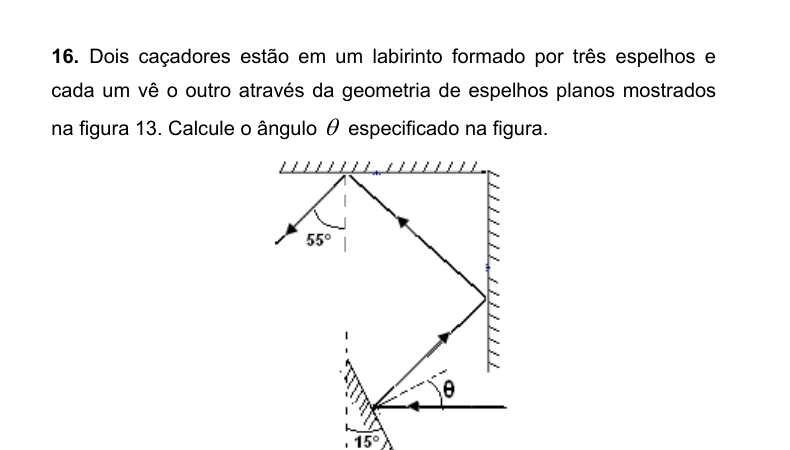 Three-mirror labyrinth geometry (figura 13)
Topic: Geometric Optics Metodi: Ray Tracing, Superposition Principle Competenze: Diagrammatic Reasoning, Physical Reasoning Objects: Mirror Fonte: Testo (PDF) — p.6
Due cacciatori sono in un labirinto formato da tre specchi e ognuno vede l’altro attraverso la geometria di specchi piatti mostrata nella figura 13. Calcolare l’angolo specificato nella figura.
*Gioemettria di labirinto a tre specchi (fig. 13) *
Topic: Geometric Optics Metodi: Ray Tracing, Superposition Principle Competenze: Diagrammatic Reasoning, Physical Reasoning Objects: Mirror Fonte: Testo (PDF) — p.6
Two hunters are in a maze made up of three mirrors and each sees the other through the geometry of flat mirrors shown in Figure 13. Calculate the angle specified in the figure.
The following table shows the results of the calculations:
Topic: Geometric Optics Metodi: Ray Tracing, Superposition Principle Competenze: Diagrammatic Reasoning, Physical Reasoning Objects: Mirror Fonte: Testo (PDF) — p.6