- Analise as seguintes afirmativas abaixo e indique qual a incorreta.
- A. Todo corpo permanece em movimento uniforme caso não haja ação de uma força externa.
- B. Corpos em queda livre, soltos de uma mesma altura, chegam ao solo com velocidades que variam de acordo com sua massa.
- C. A velocidade de queda livre de um corpo depende apenas da massa da Terra.
- D. As leis da mecânica são as mesmas em qualquer referencial inercial.
- E. No sistema Terra-Sol, o Sol pode ser considerado um centro de referencial inercial.
Topic: Newtonian Mechanics Metodi: Free-Body Diagram, Physical Modeling Competenze: Physical Reasoning Objects: — Fonte: Testo (PDF) — p.2
- Analizzare le seguenti affermazioni e indicare quale di esse ** è errato **.
- A. Tutto il corpo rimane in movimento uniforme in assenza di un’azione di forza esterna.
- B. Corpi in caduta libera, lasciati a distanza dalla stessa altezza, arrivano al suolo a velocità che variano a seconda della loro massa. La velocità di caduta libera di un corpo dipende solo dalla massa della Terra. Le leggi della meccanica sono le stesse in qualsiasi riferimento inerziale.
- E. Nel sistema Terra-Sol, il Sole può essere considerato un centro di riferimento inerziale.
Topic: Newtonian Mechanics Metodi: Free-Body Diagram, Physical Modeling Competenze: Physical Reasoning Objects: — Fonte: Testo (PDF) — p.2
- Please analyse the following statements below and indicate which ** is incorrect **.
- A. The whole body remains in uniform motion in the absence of external force.
- B. Free-falling bodies, loose at the same height, reach the ground at speeds that vary according to their mass. The free fall velocity of a body depends only on the mass of the Earth. The laws of mechanics are the same in any inertial reference. In the Earth-Sun system, the Sun can be considered an inertial reference centre.
Topic: Newtonian Mechanics Metodi: Free-Body Diagram, Physical Modeling Competenze: Physical Reasoning Objects: — Fonte: Testo (PDF) — p.2
- Porque uma bola de futebol pode alcançar uma velocidade maior num estádio de futebol a 3.000 metros de altitude em comparação com um estádio situado ao nível do mar, considerando como parâmetro o chute do mesmo jogador.
- A. A massa da bola é menor.
- B. O peso da bola varia.
- C. A pressão interna da bola é menor.
- D. A pressão interna da bola é maior.
- E. O ar é mais rarefeito.
Topic: Fluid Mechanics, Newtonian Mechanics Metodi: Physical Modeling Competenze: Physical Reasoning Objects: Ball Fonte: Testo (PDF) — p.2
- Perché una palla di calcio può raggiungere una velocità maggiore in un stadio di calcio a 3.000 metri di altitudine rispetto a uno stadio situato a livello del mare, considerando come parametro il calcio dello stesso giocatore.
- La massa della palla è minore.
- B. Il peso della palla varia.
- C. La pressione interna della palla è minore.
- D. La pressione interna della palla è maggiore.
- L’aria è più rara.
Topic: Fluid Mechanics, Newtonian Mechanics Metodi: Physical Modeling Competenze: Physical Reasoning Objects: Ball Fonte: Testo (PDF) — p.2
- Because a football can reach a higher speed in a football stadium at 3,000 metres of altitude than a stadium at sea level, considering the same player’s kick as a parameter.
- The mass of the ball is smaller.
- B. The weight of the ball varies.
- MSK1/ The internal pressure of the ball is lower. The internal pressure of the ball is higher.
- The air is more rarefied.
Topic: Fluid Mechanics, Newtonian Mechanics Metodi: Physical Modeling Competenze: Physical Reasoning Objects: Ball Fonte: Testo (PDF) — p.2
- Você gostaria de medir a profundidade de um poço deixando cair uma moeda e medindo o tempo entre o início da queda e o retorno do som devido à colisão com o fundo. Para um tempo medido de , qual a profundidade ? (desconsidere o efeito da velocidade finita do som)
- A. 10 m
- B. 20 m
- C. 30 m
- D. 40 m
- E. 50 m
Topic: Newtonian Mechanics Metodi: Kinematic Equations Competenze: Mathematical Modeling Objects: — Fonte: Testo (PDF) — p.2
- Você gostaria de medir a profundidade de um poço deixando cair uma moeda e medindo o tempo entre o início da queda e o retorno do som devido à colisão com o fundo. Per un tempo misurato di , quale è la profondità ? (non si considera l’effetto della velocità finita del suono)
- A. 10 m
- B. 20 m
- C. 30 m
- D. 40 m
- E. 50 m
Topic: Newtonian Mechanics Metodi: Kinematic Equations Competenze: Mathematical Modeling Objects: — Fonte: Testo (PDF) — p.2
- Você gostaria de medir a profundidade de um poço deixando cair uma moeda e medindo o tempo entre o início da queda e o retorno do som devido à colisão com o fundo. For a measured time of , what is the depth ? (disregard the effect of the finite speed of sound)
- A. 10 m
- B. 20 m
- C. 30 m
- D. 40 m
- E. 50 m
Topic: Newtonian Mechanics Metodi: Kinematic Equations Competenze: Mathematical Modeling Objects: — Fonte: Testo (PDF) — p.2
- Considere novamente o problema 3), só que neste caso leve em consideração a velocidade do som e adote-a como sendo . Calcule novamente a altura corrigida do poço.
- A. 16 m
- B. 25 m
- C. 19 m
- D. 29 m
- E. 39 m
Topic: Newtonian Mechanics, Oscillations & Waves Metodi: Kinematic Equations, Approximation & Series Expansion Competenze: Mathematical Modeling Objects: — Fonte: Testo (PDF) — p.2
- Rilascia il problema 3), ma in questo caso considera la velocità del suono e la adotti come . Calcola di nuovo la altezza corretta del pozzo.
- A. 16 m
- B. 25 m
- C. 19 m
- D. 29 m
- E. 39 m
Topic: Newtonian Mechanics, Oscillations & Waves Metodi: Kinematic Equations, Approximation & Series Expansion Competenze: Mathematical Modeling Objects: — Fonte: Testo (PDF) — p.2
- Consider again problem 3), only in this case take the speed of sound into account and adopt it as . Calculate the correct height of the well again.
- A. 16 m
- B. 25 m
- C. 19 m
- D. 29 m
- E. 39 m
Topic: Newtonian Mechanics, Oscillations & Waves Metodi: Kinematic Equations, Approximation & Series Expansion Competenze: Mathematical Modeling Objects: — Fonte: Testo (PDF) — p.2
- Uma ampulheta composta por dois recipientes de vidro separados por uma pequena abertura é posicionada sobre uma balança conforme a figura abaixo. Em toda a areia está na parte de baixo. Em , após a ampulheta ser virada, a areia cai para a parte de baixo e em todo o material está na parte de baixo novamente. O que acontece no mostrador da balança à medida que a areia cai.
- A. O mostrador permanece constante.
- B. O mostrador sempre anotará um peso menor.
- C. O mostrador sempre anotará um peso maior.
- D. O mostrador aumenta o seu valor com relação ao peso em , à medida que a areia cai, voltando novamente ao valor inicial em .
- E. O mostrador diminui o seu valor com relação ao peso em , à medida que a areia cai, voltando novamente ao valor inicial em .
 Ampulheta sobre balança (posição virada)
 Ampulheta sobre balança (areia caindo)
Topic: Newtonian Mechanics Metodi: Conservation of Momentum, Free-Body Diagram Competenze: Physical Reasoning, Diagrammatic Reasoning Objects: — Fonte: Testo (PDF) — p.2
- Un’ampollata composta da due recipienti di vetro separati da una piccola apertura è posizionata su una bilancia come riportato in appresso. In tutta la sabbia è in fondo. In , dopo aver girato l’ampolla, la sabbia cade verso il basso e in tutto il materiale è di nuovo verso il basso. Cosa succede sul banco di balanza quando la sabbia cade.
- A. Il mostratore rimane costante.
- B. Il mostratore annoterà sempre un peso minore.
- C. Il mostratore annoterà sempre un peso maggiore.
- D. Il mostratore aumenta il suo valore rispetto al peso a , mentre la sabbia scende, tornando di nuovo al suo valore iniziale a .
- E. Il mostratore diminuisce il suo valore rispetto al peso in , mentre la sabbia scende, tornando di nuovo al suo valore iniziale in .
*Impulso su bilancia (positazione girata) *
*Impulsa su bilancia (sand declinante) *
Topic: Newtonian Mechanics Metodi: Conservation of Momentum, Free-Body Diagram Competenze: Physical Reasoning, Diagrammatic Reasoning Objects: — Fonte: Testo (PDF) — p.2
- A vial consisting of two glass containers separated by a small opening is placed on a scale as shown below. Em toda a areia está na parte de baixo. In , after the ampoule is turned, the sand falls to the bottom and in all the material is at the bottom again. What happens on the dial of the scale as the sand falls.
- A. O mostrador permanece constante.
- B. The dial will always record a smaller weight.
- C. The dial will always record a higher weight.
- D. The dial increases its value relative to the weight at as the sand falls, returning to its original value at .
- E. The dial decreases its value relative to the weight in as the sand falls, returning to its original value in .
Ampulheta sobre balança (posição virada)
*Pulse on the scale (falling sand) *
Topic: Newtonian Mechanics Metodi: Conservation of Momentum, Free-Body Diagram Competenze: Physical Reasoning, Diagrammatic Reasoning Objects: — Fonte: Testo (PDF) — p.2
- Qual das alternativas abaixo é uma afirmação incorreta com relação às leis de Kepler:
- A. A velocidade orbital de um planeta permanece constante durante todo o período orbital.
- B. A velocidade orbital do planeta é maior quando este se aproxima do Sol.
- C. A velocidade orbital do planeta é menor quando este se afasta do Sol.
- D. Planetas descrevem órbitas elípticas ao redor do Sol.
- E. O Sol está num dos focos da elipse que representa a órbita de um planeta.
Topic: Gravitation, Astrophysics Metodi: Kepler’s Laws Competenze: Physical Reasoning Objects: Planet, Star Fonte: Testo (PDF) — p.3
- Qual è l’alternativa seguente che è un’affermazione **errore ** rispetto alle leggi di Kepler:
La velocità orbitale di un pianeta rimane costante per tutto il periodo orbitale. La velocità orbitale del pianeta è maggiore quando si avvicina al Sole. La velocità orbitale del pianeta è minore quando si allontana dal Sole. I pianeti descrivono orbite elliptiche attorno al Sole. Il sole è uno dei foci dell’ellipse che rappresenta l’orbita di un pianeta.
Topic: Gravitation, Astrophysics Metodi: Kepler’s Laws Competenze: Physical Reasoning Objects: Planet, Star Fonte: Testo (PDF) — p.3
- Which of the following alternatives is an ** incorrect ** statement with respect to Kepler’s laws:
The orbital velocity of a planet remains constant throughout its orbital period. The planet’s orbital velocity is higher as it approaches the Sun. The planet’s orbital speed is lower as it moves away from the Sun. Planets describe elliptical orbits around the Sun. The Sun is one of the focuses of the ellipse that represents the orbit of a planet.
Topic: Gravitation, Astrophysics Metodi: Kepler’s Laws Competenze: Physical Reasoning Objects: Planet, Star Fonte: Testo (PDF) — p.3
- Qual a velocidade orbital da Terra considerando que seu raio médio é de ?
- A. 10 km/s
- B. 10 km/h
- C. 30 km/s
- D. 30 km/h
- E. 50 m/s
Topic: Gravitation, Astrophysics Metodi: Kepler’s Laws, Kinematic Equations Competenze: Mathematical Modeling, Estimation & Approximation Objects: Planet Fonte: Testo (PDF) — p.3
Qual è la velocità orbitale della Terra considerando che il suo raggio medio è ?
- A. 10 km/s
- B. 10 km/h
- C. 30 km/s
- D. 30 km/h
- E. 50 m/s
Topic: Gravitation, Astrophysics Metodi: Kepler’s Laws, Kinematic Equations Competenze: Mathematical Modeling, Estimation & Approximation Objects: Planet Fonte: Testo (PDF) — p.3
- What is the Earth’s orbital speed considering its mean radius is ?
- A. 10 km/s
- B. 10 km/h
- C. 30 km/s
- D. 30 km/h
- E. 50 m/s
Topic: Gravitation, Astrophysics Metodi: Kepler’s Laws, Kinematic Equations Competenze: Mathematical Modeling, Estimation & Approximation Objects: Planet Fonte: Testo (PDF) — p.3
- Retome o problema 7). Fazendo uma composição da velocidade orbital com a velocidade devida à rotação da Terra, na sua superfície, faça uma estimativa da máxima velocidade que um observador posicionado no referencial do Sol observaria de um objeto na superfície da Terra. (Adote como diâmetro médio da Terra .)
- A. 9,6 km/s
- B. 10 km/s
- C. 1000 m/s
- D. 30,4 km/s
- E. 410 m/s
Topic: Newtonian Mechanics, Astrophysics Metodi: Kinematic Equations, Vector Decomposition Competenze: Estimation & Approximation, Mathematical Modeling Objects: Planet Fonte: Testo (PDF) — p.3
- Riprendi il problema 7). Fate una composizione della velocità orbitale con la velocità dovuta alla rotazione della Terra sulla sua superficie, fate una stima della velocità massima che un osservatore posizionato sul punto di riferimento del Sole osserverebbe di un oggetto sulla superficie della Terra. (Adote come diametro medio della Terra .)
- A. 9,6 km/s
- B. 10 km/s
- C. 1000 m/s
- D. 30,4 km/s
- E. 410 m/s
Topic: Newtonian Mechanics, Astrophysics Metodi: Kinematic Equations, Vector Decomposition Competenze: Estimation & Approximation, Mathematical Modeling Objects: Planet Fonte: Testo (PDF) — p.3
- Repeat the problem 7). By making a composition of the orbital speed with the speed due to the Earth’s rotation on its surface, make an estimate of the maximum speed that an observer positioned in the reference sun would observe of an object on the surface of the Earth. (Adote as mean diameter of the Earth .)
- A. 9,6 km/s
- B. 10 km/s
- C. 1000 m/s
- D. 30,4 km/s
- E. 410 m/s
Topic: Newtonian Mechanics, Astrophysics Metodi: Kinematic Equations, Vector Decomposition Competenze: Estimation & Approximation, Mathematical Modeling Objects: Planet Fonte: Testo (PDF) — p.3
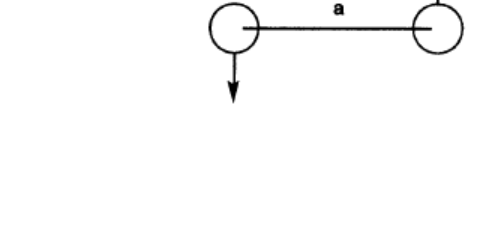
- Uma das técnicas utilizadas para se determinar a massa de uma estrela num sistema de estrelas binárias é baseada na medida da distância (separação entre as estrelas — vide figura a seguir) através de uma técnica chamada de paralaxe e do período de revolução do sistema . Suponha que as estrelas têm massas iguais a . Determine o valor de em função de e .
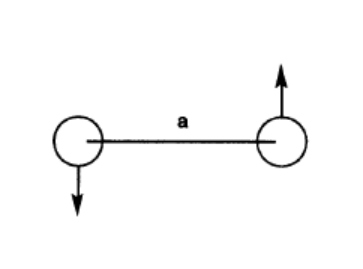 Sistema de estrelas binárias com separação a
Topic: Gravitation, Astrophysics Metodi: Kepler’s Laws, Newton’s Law of Gravitation Competenze: Mathematical Modeling, Physical Reasoning Objects: Star Fonte: Testo (PDF) — p.3
- Una delle tecniche utilizzate per determinare la massa di una stella in un sistema di stelle binarie è basata sulla misurazione della distanza (separazione tra le stelle vide figura seguente) attraverso una tecnica chiamata parallax e il periodo di rivoluzione del sistema . Supponiamo che le stelle abbiano massa uguale a . Determina il valore di per e .
*Sistema di stelle binarie separate da *
Topic: Gravitation, Astrophysics Metodi: Kepler’s Laws, Newton’s Law of Gravitation Competenze: Mathematical Modeling, Physical Reasoning Objects: Star Fonte: Testo (PDF) — p.3
- One of the techniques used to determine the mass of a star in a binary star system is based on measuring the distance (separation between stars vide figure below) by a technique called parallax and the system’s period of revolution . Suppose the stars have masses equal to . Determine the value of as a function of and .
*Binary star system with a separation of *
Topic: Gravitation, Astrophysics Metodi: Kepler’s Laws, Newton’s Law of Gravitation Competenze: Mathematical Modeling, Physical Reasoning Objects: Star Fonte: Testo (PDF) — p.3
- Considere o pêndulo balístico como indicado na figura abaixo. Um projétil de massa é lançado sobre o pêndulo de massa . Após a colisão o projétil fica preso ao corpo e este se eleva a uma altura de acima do nível de repouso. Determine qual a velocidade inicial do projétil.
- A. 10 m/s
- B. 100 m/s
- C. 200 m/s
- D. 300 m/s
- E. 400 m/s
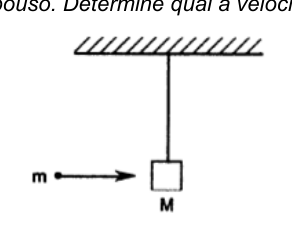 Pêndulo balístico com projétil e bloco
Topic: Conservation of Momentum, Conservation of Energy Metodi: Conservation of Momentum, Conservation of Energy Competenze: Mathematical Modeling, Physical Reasoning Objects: Pendulum, Projectile, Block Fonte: Testo (PDF) — p.4
- Considerare il pendolo balistico come indicato nella figura seguente. Un proiettile di massa è lanciato sul pendolo di massa . Dopo l’impatto il proiettile si attacca al corpo e si eleva a una altezza di al di sopra del livello di riposo. Determina la velocità iniziale del proiettile.
- A. 10 m/s
- B. 100 m/s
- C. 200 m/s
- D. 300 m/s
- E. 400 m/s
Pensillo balistico con proiettile e blocco
Topic: Conservation of Momentum, Conservation of Energy Metodi: Conservation of Momentum, Conservation of Energy Competenze: Mathematical Modeling, Physical Reasoning Objects: Pendulum, Projectile, Block Fonte: Testo (PDF) — p.4
- Consider the ballistic pendulum as shown in the figure below. A projectile of mass is launched over the pendulum mass. After impact the projectile is attached to the body and it rises to a height of above the resting level. Determine the initial velocity of the projectile.
- A. 10 m/s
- B. 100 m/s
- C. 200 m/s
- D. 300 m/s
- E. 400 m/s
Ballistic pencil with projectile and block
Topic: Conservation of Momentum, Conservation of Energy Metodi: Conservation of Momentum, Conservation of Energy Competenze: Mathematical Modeling, Physical Reasoning Objects: Pendulum, Projectile, Block Fonte: Testo (PDF) — p.4
- Um homem de 55 anos de idade tem um ponto próximo de aproximadamente . Qual a lente que ele necessita utilizar para que ele consiga enxergar um objeto com nitidez a ? (determine o foco desta lente).
- A. +20 cm
- B. −33,3 cm
- C. +33,3 cm
- D. −25 cm
- E. +100 cm
Topic: Geometric Optics Metodi: Thin Lens & Mirror Equation Competenze: Mathematical Modeling Objects: Lens Fonte: Testo (PDF) — p.4
- Un uomo di 55 anni ha un punto vicino di circa . Quale lente deve usare per vedere un oggetto con una chiarezza ? (determinare il focus di questo obiettivo).
- A. +20 cm
- B. −33,3 cm
- C. +33,3 cm
- D. −25 cm
- E. +100 cm
Topic: Geometric Optics Metodi: Thin Lens & Mirror Equation Competenze: Mathematical Modeling Objects: Lens Fonte: Testo (PDF) — p.4
- A 55-year-old man has a near spot of approximately . What lens does he need to use to see an object with a sharpness of ? (determines the focus of this lens).
- A. +20 cm
- B. −33,3 cm
- C. +33,3 cm
- D. −25 cm
- E. +100 cm
Topic: Geometric Optics Metodi: Thin Lens & Mirror Equation Competenze: Mathematical Modeling Objects: Lens Fonte: Testo (PDF) — p.4
- Uma esfera de massa desliza sem rolar num plano inclinado conforme indicado na figura abaixo. Determine a velocidade da esfera no ponto mais baixo do plano (use como aceleração gravitacional e desconsidere o atrito entre as superfícies).
- A.
- B.
- C.
- D.
- E.
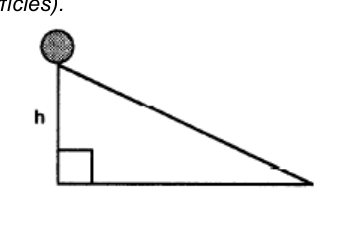 Esfera deslizando em plano inclinado de altura h
Topic: Conservation of Energy, Newtonian Mechanics Metodi: Conservation of Energy Competenze: Mathematical Modeling, Diagrammatic Reasoning Objects: Sphere, Inclined Plane Fonte: Testo (PDF) — p.4
- Una sfera di massa scivola senza rotolare in un piano inclinato come indicato nella figura seguente. Determina la velocità della sfera al punto più basso del piano (utilizza come accelerazione gravitazionale e disprezza lo scosciamento tra le superfici).
- A.
- B.
- C.
- D.
- E.
Sfera scivolante in piano inclinato di altezza h
Topic: Conservation of Energy, Newtonian Mechanics Metodi: Conservation of Energy Competenze: Mathematical Modeling, Diagrammatic Reasoning Objects: Sphere, Inclined Plane Fonte: Testo (PDF) — p.4
- A mass sphere slides without rolling in an inclined plane as shown in the figure below. Determine the speed of the sphere at the lowest point of the plane (use as gravitational acceleration and disregard friction between surfaces).
- A.
- B.
- C.
- D.
- E.
Slide sphere in inclined plane of height h
Topic: Conservation of Energy, Newtonian Mechanics Metodi: Conservation of Energy Competenze: Mathematical Modeling, Diagrammatic Reasoning Objects: Sphere, Inclined Plane Fonte: Testo (PDF) — p.4
- Retomando o problema 12). Caso haja atrito entre as superfícies a esfera rola sem deslizar. Indique qual das alternativas abaixo é incorreta.
- A. A velocidade de rotação da esfera permanece constante ao longo de todo o plano inclinado.
- B. Parte da energia potencial gravitacional é transformada em energia cinética de rotação.
- C. No ponto mais baixo do plano a energia potencial gravitacional será mínima.
- D. A energia cinética de translação é máxima no ponto mais baixo do plano.
- E. A velocidade de translação no ponto mais baixo do plano é menor que a obtida no problema 12).
Topic: Rotational Dynamics, Conservation of Energy Metodi: Conservation of Energy, Torque & Angular Momentum Analysis Competenze: Physical Reasoning Objects: Sphere, Inclined Plane Fonte: Testo (PDF) — p.4
- Riprendendo il problema 12). In caso di attrito tra le superfici, la sfera ruota senza scivolare. Indicare quale delle alternative seguenti è errato.
- A. La velocità di rotazione della sfera rimane costante lungo tutto il piano inclinato.
- B. Parte dell’energia potenziale gravitazionale viene trasformata in energia cinetica di rotazione.
- C. Al punto più basso del piano l’energia potenziale gravitazionale sarà minima.
- D. L’energia cinetica di traduzione è massima al punto più basso del piano.
- E. La velocità di traslazione al punto più basso del piano è inferiore a quella ottenuta nel problema 12).
Topic: Rotational Dynamics, Conservation of Energy Metodi: Conservation of Energy, Torque & Angular Momentum Analysis Competenze: Physical Reasoning Objects: Sphere, Inclined Plane Fonte: Testo (PDF) — p.4
- Repeating the problem 12) If there is friction between the surfaces, the sphere rolls without slipping. Please indicate which of the alternatives below is ** incorrect**.
- A. The speed of rotation of the sphere remains constant throughout the slope.
- B. Part of the gravitational potential energy is converted into rotational kinetic energy.
- MSK1/ at the lowest point of the plane the gravitational potential energy will be minimal.
- D. The kinetic energy of translation is maximum at the lowest point of the plane.
- E. The translation speed at the lowest point of the plane is less than that obtained in problem 12).
Topic: Rotational Dynamics, Conservation of Energy Metodi: Conservation of Energy, Torque & Angular Momentum Analysis Competenze: Physical Reasoning Objects: Sphere, Inclined Plane Fonte: Testo (PDF) — p.4
- Encontre a tensão na corda 2 para o sistema em equilíbrio da figura abaixo. (; )
- A. 19,6 N
- B. 39,2 N
- C. 0 N
- D. 17,0 N
- E. 34,8 N
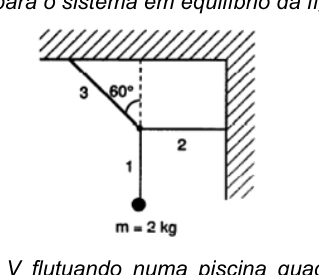 Sistema de cordas em equilíbrio com ângulo 60°
Topic: Rigid Body Statics, Newtonian Mechanics Metodi: Free-Body Diagram, Vector Decomposition Competenze: Diagrammatic Reasoning, Mathematical Modeling Objects: String Fonte: Testo (PDF) — p.5
- Trova la tensione nella corda 2 per il sistema in equilibrio nella figura seguente. (; )
- A. 19,6 N
- B. 39,2 N
- C. 0 N
- D. 17,0 N
- E. 34,8 N
Sistema di corde in equilibrio con angolo 60°
Topic: Rigid Body Statics, Newtonian Mechanics Metodi: Free-Body Diagram, Vector Decomposition Competenze: Diagrammatic Reasoning, Mathematical Modeling Objects: String Fonte: Testo (PDF) — p.5
- Find the voltage on string 2 for the equilibrium system in the figure below. (; )
- A. 19,6 N
- B. 39,2 N
- C. 0 N
- D. 17,0 N
- E. 34,8 N
The following table shows the number of lines of the line:
Topic: Rigid Body Statics, Newtonian Mechanics Metodi: Free-Body Diagram, Vector Decomposition Competenze: Diagrammatic Reasoning, Mathematical Modeling Objects: String Fonte: Testo (PDF) — p.5
- Considere um navio de volume flutuando numa piscina quadrada (cheia de água — vide figura abaixo) de forma que uma fração do volume do navio se encontra abaixo do nível da água . Considere que a área da superfície da piscina é . Determine quanto o nível aumenta/diminui caso o navio afunde.
- A. aumenta de
- B. diminui de
- C. diminui de
- D. aumenta de
- E. não varia
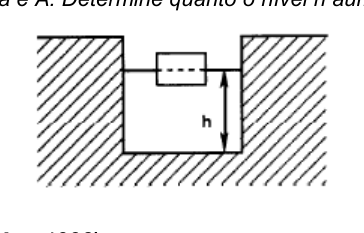 Navio flutuando em piscina quadrada
Topic: Fluid Mechanics Metodi: Hydrostatic Equilibrium, Physical Modeling Competenze: Physical Reasoning, Mathematical Modeling Objects: Container Fonte: Testo (PDF) — p.5
- Considerare una nave di volume galleggiando in una piscina quadrata (piene d’acqua vide figura sotto) in modo che una frazione del volume della nave sia sotto il livello dell’acqua . Considera che l’area della superficie della piscina è . Determina quanto il livello aumenta/diminui in caso di affondamento della nave.
- A aumenta di
- B. diminuisce di
- C. diminuisce di
- D. aumenta di
- E. non varia
Nave galleggiante in piscina quadrata
Topic: Fluid Mechanics Metodi: Hydrostatic Equilibrium, Physical Modeling Competenze: Physical Reasoning, Mathematical Modeling Objects: Container Fonte: Testo (PDF) — p.5
- Considere um navio de volume flutuando numa piscina quadrada (cheia de água — vide figura abaixo) de forma que uma fração do volume do navio se encontra abaixo do nível da água . Consider that the surface area of the pool is . Determine how much the level rises/decreases if the ship sinks.
- **A ** increases by
- B decreases by
- C decreases by
- **D ** increases by
- E. does not change
Ship floating in a square pool
Topic: Fluid Mechanics Metodi: Hydrostatic Equilibrium, Physical Modeling Competenze: Physical Reasoning, Mathematical Modeling Objects: Container Fonte: Testo (PDF) — p.5
- No laboratório, duas quantidades do mesmo líquido são misturadas. A massa do líquido mais quente é o dobro da massa do líquido mais frio . Da mesma forma, a temperatura do líquido mais quente é o dobro da temperatura do líquido mais frio . Determine a temperatura de equilíbrio da mistura.
- A. 40°C
- B. 45°C
- C. 50°C
- D. 55°C
- E. 35°C
Topic: Thermodynamics Metodi: First Law of Thermodynamics, Physical Modeling Competenze: Mathematical Modeling Objects: — Fonte: Testo (PDF) — p.5
- In laboratorio, due quantità dello stesso liquido vengono mescolate. La massa del liquido più caldo è doppia della massa del liquido più freddo . Allo stesso modo, la temperatura del liquido più caldo è doppia della temperatura del liquido più freddo . Determina la temperatura di equilibrio del miscelato.
- A. 40°C
- B. 45°C
- C. 50°C
- D. 55°C
- E. 35°C
Topic: Thermodynamics Metodi: First Law of Thermodynamics, Physical Modeling Competenze: Mathematical Modeling Objects: — Fonte: Testo (PDF) — p.5
- In the laboratory, two quantities of the same liquid are mixed. The mass of the hotest liquid is twice the mass of the coldest liquid . Similarly, the temperature of the hotest liquid is twice the temperature of the coldest liquid . Determine the equilibrium temperature of the mixture.
- A. 40°C
- B. 45°C
- C. 50°C
- D. 55°C
- E. 35°C
Topic: Thermodynamics Metodi: First Law of Thermodynamics, Physical Modeling Competenze: Mathematical Modeling Objects: — Fonte: Testo (PDF) — p.5
- Dois corpos A e B são aquecidos. Nos gráficos abaixo (°C) representa a temperatura dos corpos e (kJ) a quantidade de calor absorvida. Qual é a Capacidade Calorífica de cada corpo A e B (respectivamente em kJ/°C)?
- A. 2,0 e 4,0
- B. 2,0 e 3,0
- C. 3,0 e 2,0
- D. 5,0 e 2,0
- E. 4,0 e 2,0
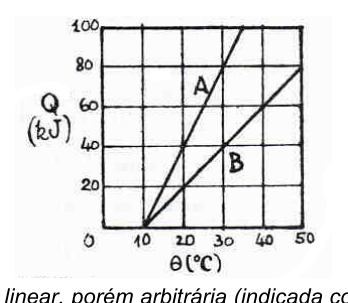 Gráficos θ vs Q para corpos A e B
Topic: Thermodynamics Metodi: Experimental Data Analysis, Graph Linearization Competenze: Graph Linearization, Experimental Data Analysis Objects: — Fonte: Testo (PDF) — p.5
- Due corpi A e B sono riscaldati. Nei grafici di seguito (°C) rappresenta la temperatura dei corpi e (kJ) la quantità di calore assorbita. Qual è la capacità calorifica di ciascun corpo A e B (rispettivamente in kJ/°C)?
- A. 2,0 e 4,0
- B. 2,0 e 3,0
- C. 3,0 e 2,0
- D. 5,0 e 2,0
- E. 4,0 e 2,0
*Grafici θ vs Q per corpi A e B *
Topic: Thermodynamics Metodi: Experimental Data Analysis, Graph Linearization Competenze: Graph Linearization, Experimental Data Analysis Objects: — Fonte: Testo (PDF) — p.5
- Two bodies A and B are heated. In the graphs below (°C) represents the body temperature and (kJ) the amount of heat absorbed. What is the Caloric Capacity of each body A and B (respectively in kJ/°C)?
- A. 2,0 e 4,0
- B. 2,0 e 3,0
- C. 3,0 e 2,0
- D. 5,0 e 2,0
- E. 4,0 e 2,0
*Graphs θ vs Q for bodies A and B *
Topic: Thermodynamics Metodi: Experimental Data Analysis, Graph Linearization Competenze: Graph Linearization, Experimental Data Analysis Objects: — Fonte: Testo (PDF) — p.5
- Um termômetro com escala linear, porém arbitrária (indicada como X), marca no ponto de fusão do gelo e no ponto de ebulição da água. Qual é a leitura deste termômetro no ponto de ebulição do álcool etílico ?
- A. 100°X
- B. 158°X
- C. 165°X
- D. 175°X
- E. 190°X
Topic: Thermodynamics Metodi: Physical Modeling Competenze: Mathematical Modeling, Unit Conversion Objects: — Fonte: Testo (PDF) — p.5
- Un termometro a scala lineare ma arbitraria (indicato come X) segna al punto di fusione del ghiaccio e al punto di scaldamento dell’acqua. Qual è la lettura di questo termometro al punto di ebollizione dell’alcol etilico ?
- A. 100°X
- B. 158°X
- C. 165°X
- D. 175°X
- E. 190°X
Topic: Thermodynamics Metodi: Physical Modeling Competenze: Mathematical Modeling, Unit Conversion Objects: — Fonte: Testo (PDF) — p.5
- A thermometer with a linear but arbitrary scale (indicated as X) shall mark at the melting point of the ice and at the boiling point of the water. What is the reading of this thermometer at the boiling point of ethyl alcohol ?
- A. 100°X
- B. 158°X
- C. 165°X
- D. 175°X
- E. 190°X
Topic: Thermodynamics Metodi: Physical Modeling Competenze: Mathematical Modeling, Unit Conversion Objects: — Fonte: Testo (PDF) — p.5
- O diagrama de estado abaixo pertence à água. Sob a pressão de (), qual a temperatura em que a água ferve?
- A. −10°C
- B. +10°C
- C. −6°C
- D. +6°C
- E. 100°C
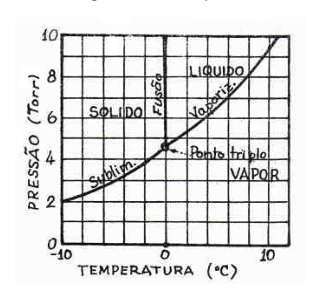 Diagrama de fases da água (P-T)
Topic: Thermodynamics Metodi: Thermodynamic Cycle Analysis, Physical Modeling Competenze: Diagrammatic Reasoning, Physical Reasoning Objects: — Fonte: Testo (PDF) — p.6
- Il diagramma di stato qui sotto riguarda l’acqua. Sotto la pressione di (), a che temperatura si bolle l’acqua?
- A. −10°C
- B. +10°C
- C. −6°C
- D. +6°C
- E. 100°C
*Diagramma delle fasi dell’acqua (P-T) *
Topic: Thermodynamics Metodi: Thermodynamic Cycle Analysis, Physical Modeling Competenze: Diagrammatic Reasoning, Physical Reasoning Objects: — Fonte: Testo (PDF) — p.6
- The state diagram below is water. Under the pressure of (), what temperature does the water boil at?
- A. −10°C
- B. +10°C
- C. −6°C
- D. +6°C
- E. 100°C
The water phase diagram (P-T)
Topic: Thermodynamics Metodi: Thermodynamic Cycle Analysis, Physical Modeling Competenze: Diagrammatic Reasoning, Physical Reasoning Objects: — Fonte: Testo (PDF) — p.6
- Uma esfera condutora oca está dentro de uma região de campo elétrico uniforme de módulo . Determine o valor do campo elétrico na superfície da esfera e no seu interior (respectivamente em V/m).
- A. 100 e 0
- B. 100 e 100
- C. 0 e 100
- D. 100 e 50
- E. 50 e 50
Topic: Electrostatics Metodi: Gauss’s Law, Symmetry Argument Competenze: Physical Reasoning Objects: Conducting Sphere Fonte: Testo (PDF) — p.6
- Una sfera conduttiva vuota è all’interno di una regione di campo elettrico uniforme modulo . Determina il valore del campo elettrico sulla superficie e all’interno della sfera (rispettivamente in V/m).
- A. 100 e 0
- B. 100 e 100
- C. 0 e 100
- D. 100 e 50
- E. 50 e 50
Topic: Electrostatics Metodi: Gauss’s Law, Symmetry Argument Competenze: Physical Reasoning Objects: Conducting Sphere Fonte: Testo (PDF) — p.6
- A hollow conductive sphere is within a uniform electric field region of the module. Determine the value of the electric field on the surface of the sphere and inside it (in V/m, respectively).
- A. 100 e 0
- B. 100 e 100
- C. 0 e 100
- D. 100 e 50
- E. 50 e 50
Topic: Electrostatics Metodi: Gauss’s Law, Symmetry Argument Competenze: Physical Reasoning Objects: Conducting Sphere Fonte: Testo (PDF) — p.6
- Qual das afirmativas abaixo é incorreta.
- A. Cargas elétricas manifestam-se em duas espécies: conhecidas como positiva e negativa.
- B. Cargas de espécies diferentes se atraem.
- C. Cargas de mesma espécie se atraem.
- D. Cargas de mesma espécie se repelem.
- E. Campos elétricos estáticos são gerados pela presença de cargas elétricas.
Topic: Electrostatics Metodi: Coulomb’s Law Competenze: Physical Reasoning Objects: — Fonte: Testo (PDF) — p.6
- Qual è l’affermazione ** errata ** di seguito riportata?
- A. Le cariche elettriche si manifestano in due specie: positive e negative.
- B. Si attraggono carichi di diverse specie.
- C. Carichi della stessa specie si attirano.
- D. Carichi della stessa specie si ripudiano.
- E. I campi elettrici statici sono generati dalla presenza di cariche elettriche.
Topic: Electrostatics Metodi: Coulomb’s Law Competenze: Physical Reasoning Objects: — Fonte: Testo (PDF) — p.6
- Which of the following is ** incorrect **.
- A. Electrical charges occur in two species: known as positive and negative.
- B. Loads of different species are attracted.
- C. Loads of the same kind are attracted.
- D. Loads of the same kind are repelled.
- E. Static electric fields are generated by the presence of electric charges.
Topic: Electrostatics Metodi: Coulomb’s Law Competenze: Physical Reasoning Objects: — Fonte: Testo (PDF) — p.6
- Imagine que você consiga carregar um bastão muito longo (comprimento ), de material não condutor, com uma certa quantidade de carga elétrica . Vamos representar a distância radial entre o bastão e um ponto qualquer do espaço ao seu redor. Considere as seguintes afirmações sobre o campo gerado pelo bastão carregado e indique qual a incorreta.
- A. A intensidade do campo diminui com nas proximidades do bastão.
- B. A intensidade do campo depende da quantidade de carga.
- C. O campo elétrico tem simetria radial.
- D. Na condição em que , a intensidade do campo diminui com .
- E. O campo é nulo em todo espaço para esta particular distribuição de cargas.
Topic: Electrostatics Metodi: Gauss’s Law, Symmetry Argument Competenze: Physical Reasoning, Mathematical Modeling Objects: Rod Fonte: Testo (PDF) — p.6
- Immaginate di poter caricare un bastone molto lungo (lenghezza ), di materiale non conduttore, con una certa quantità di carica elettrica . Vamos representar a distância radial entre o bastão e um ponto qualquer do espaço ao seu redor. Considerare le seguenti affermazioni sul campo generato dal bastone caricato e indicare quale ** è errato **.
- A. L’intensità del campo diminuisce di nei pressi del bastone.
- B. L’intensità del campo dipende dalla quantità di carico.
- C. Il campo elettrico ha simmetria radial.
- D. In condizione che , l’intensità del campo diminuisce di .
- E. Il campo è nullo in ogni spazio per questa particolare distribuzione di cariche.
Topic: Electrostatics Metodi: Gauss’s Law, Symmetry Argument Competenze: Physical Reasoning, Mathematical Modeling Objects: Rod Fonte: Testo (PDF) — p.6
- Imagine that you can carry a very long rod (length ) of non-conductive material with a certain amount of electrical charge . Vamos representar a distância radial entre o bastão e um ponto qualquer do espaço ao seu redor. Consider the following statements about the field generated by the loaded rod and indicate which ** is incorrect**.
- A. The field intensity decreases by near the stick.
- B. The intensity of the field depends on the amount of load.
- C. O campo elétrico tem simetria radial.
- D. In the condition that , the field intensity decreases by .
- E. The field is zero in all space for this particular load distribution.
Topic: Electrostatics Metodi: Gauss’s Law, Symmetry Argument Competenze: Physical Reasoning, Mathematical Modeling Objects: Rod Fonte: Testo (PDF) — p.6
- Um capacitor é construído a partir de duas placas de metal quadradas de área , separadas por uma distância . Numa das metades do espaço interno, preenche-se com material de constante dielétrica e na outra metade com material de constante dielétrica . Calcule a capacitância deste capacitor, assumindo que seu valor é na situação em que não há material dentro das placas.
- A.
- B.
- C.
- D.
- E.
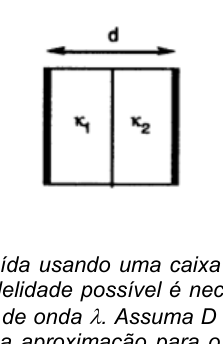 Capacitor com dois dielétricos k1 e k2
Topic: Electrostatics, Circuits Metodi: Equivalent Circuit Reduction, Electric Potential Method Competenze: Mathematical Modeling, Physical Reasoning Objects: Capacitor Fonte: Testo (PDF) — p.6
- Un condensatore è costruito da due piastre di metallo quadrate di superficie , separate da una distanza . Una metà dello spazio interno è riempita di materiale di costante dielettrico e l’altra metà di materiale di costante dielettrico . Calcolare la capacità di questo condensatore, assumendo che il suo valore sia in caso di mancata presenza di materiale all’interno delle plache.
- A.
- B.
- C.
- D.
- E.
Capacitore a due dielettrici k1 e k2
Topic: Electrostatics, Circuits Metodi: Equivalent Circuit Reduction, Electric Potential Method Competenze: Mathematical Modeling, Physical Reasoning Objects: Capacitor Fonte: Testo (PDF) — p.6
- A capacitor is constructed from two square metal plates of area separated by a distance . One half of the interior space is filled with dielectric constant material and the other half with dielectric constant material . Calculate the capacitance of this capacitor assuming that its value is in the case where there is no material inside the plates.
- A.
- B.
- C.
- D.
- E.
Capacitor with two dielectric k1 and k2
Topic: Electrostatics, Circuits Metodi: Equivalent Circuit Reduction, Electric Potential Method Competenze: Mathematical Modeling, Physical Reasoning Objects: Capacitor Fonte: Testo (PDF) — p.6
- Uma câmera fotográfica pode ser construída usando uma caixa com um orifício (câmera de orifício). Para se obter uma imagem com a máxima fidelidade possível é necessário que o objeto seja iluminado com uma luz monocromática de comprimento de onda . Assuma = distância do orifício ao objeto e o diâmetro do orifício (). Obtenha uma boa aproximação para o valor de nas condições em que a imagem possa ser a mais nítida possível para este comprimento de onda.
- A.
- B.
- C.
- D. (i.e. )
- E.
Topic: Wave Optics, Geometric Optics Metodi: Interference & Diffraction Analysis, Small-Angle Approximation Competenze: Mathematical Modeling, Physical Reasoning Objects: — Fonte: Testo (PDF) — p.7
- Una fotocamera può essere costruita utilizzando una cassa con un foro (camera di foro). Per ottenere un’immagine con la massima fedeltà possibile, l’oggetto deve essere illuminato con una luce monocromatica di lunghezza d’onda . Assumi = distanza dal foro all’oggetto e il diametro del foro (). Ottieni un buon approccio al valore in condizioni in cui l’immagine possa essere il più nitida possibile per questa lunghezza d’onda.
- A.
- B.
- C.
- D. (i.e. )
- E.
Topic: Wave Optics, Geometric Optics Metodi: Interference & Diffraction Analysis, Small-Angle Approximation Competenze: Mathematical Modeling, Physical Reasoning Objects: — Fonte: Testo (PDF) — p.7
- A camera can be constructed using a box with a hole (hole camera). To obtain an image with the highest possible fidelity, the object must be illuminated with a monochrome light of wavelength. Assume = distance from the hole to the object and the diameter of the hole (). Get a good approximation to under conditions where the image can be as sharp as possible for this wavelength.
- A.
- B.
- C.
- D. (i.e. )
- E.
Topic: Wave Optics, Geometric Optics Metodi: Interference & Diffraction Analysis, Small-Angle Approximation Competenze: Mathematical Modeling, Physical Reasoning Objects: — Fonte: Testo (PDF) — p.7
- Considere o circuito abaixo. Determine qual a corrente elétrica que atravessa o resistor de .
- A. 0,25 A
- B. 0,50 A
- C. 0,75 A
- D. 1,00 A
- E. 1,25 A
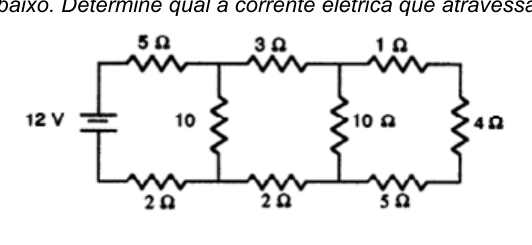 Circuito elétrico com resistor de 4 Ω
Topic: Circuits Metodi: Kirchhoff’s Laws, Equivalent Circuit Reduction Competenze: Diagrammatic Reasoning, Mathematical Modeling Objects: Resistor Fonte: Testo (PDF) — p.7
- Considerate il circuito di seguito. Determina quale corrente elettrica attraversa la resistenza di .
- A. 0,25 A
- B. 0,50 A
- C. 0,75 A
- D. 1,00 A
- E. 1,25 A
Circuito elettrico con resistenza di 4 Ω
Topic: Circuits Metodi: Kirchhoff’s Laws, Equivalent Circuit Reduction Competenze: Diagrammatic Reasoning, Mathematical Modeling Objects: Resistor Fonte: Testo (PDF) — p.7
- Consider the circuit below. Determine which electric current passes through the resistor.
- A. 0,25 A
- B. 0,50 A
- C. 0,75 A
- D. 1,00 A
- E. 1,25 A
Electrical circuit with resistor of 4 Ω
Topic: Circuits Metodi: Kirchhoff’s Laws, Equivalent Circuit Reduction Competenze: Diagrammatic Reasoning, Mathematical Modeling Objects: Resistor Fonte: Testo (PDF) — p.7
- Faça uma estimativa de quantos passos um maratonista dá durante uma prova (lembre-se que a maratona é uma prova com 42 km de percurso).
- A. 35.000
- B. 420
- C. 4.200
- D. 3.500
- E. 420.000
Topic: Order-of-Magnitude Estimation Metodi: Order-of-Magnitude Estimation Competenze: Estimation & Approximation Objects: — Fonte: Testo (PDF) — p.7
- Fai una stima di quanti passi fa un maratonista durante una gara (ricorda che la maratona è una gara di 42 km).
- A. 35.000
- B. 420
- C. 4.200
- D. 3.500
- E. 420.000
Topic: Order-of-Magnitude Estimation Metodi: Order-of-Magnitude Estimation Competenze: Estimation & Approximation Objects: — Fonte: Testo (PDF) — p.7
- Estimate how many steps a marathon runner takes during a race (remember that the marathon is a 42 km race).
- A. 35.000
- B. 420
- C. 4.200
- D. 3.500
- E. 420.000
Topic: Order-of-Magnitude Estimation Metodi: Order-of-Magnitude Estimation Competenze: Estimation & Approximation Objects: — Fonte: Testo (PDF) — p.7
- Quantas barrinhas de cereal são necessárias, como referência, para a medida de uma linha de 100 m?
- A. 100
- B. 1.000
- C.
- D.
- E.
Topic: Order-of-Magnitude Estimation Metodi: Order-of-Magnitude Estimation Competenze: Estimation & Approximation, Unit Conversion Objects: — Fonte: Testo (PDF) — p.7
- Quanti bari di cereali sono necessari per la misura di una linea di 100 m?
- A. 100
- B. 1.000
- C.
- D.
- E.
Topic: Order-of-Magnitude Estimation Metodi: Order-of-Magnitude Estimation Competenze: Estimation & Approximation, Unit Conversion Objects: — Fonte: Testo (PDF) — p.7
- How many cereal barrels are required as a reference for the measurement of a 100 m line?
- A. 100
- B. 1.000
- C.
- D.
- E.
Topic: Order-of-Magnitude Estimation Metodi: Order-of-Magnitude Estimation Competenze: Estimation & Approximation, Unit Conversion Objects: — Fonte: Testo (PDF) — p.7
- Quanto tempo (em horas) são necessários para se contar até um milhão?
- A. 10
- B. 278
- C. 27
- D. 10.000
- E. 2.777
Topic: Order-of-Magnitude Estimation Metodi: Order-of-Magnitude Estimation Competenze: Estimation & Approximation Objects: — Fonte: Testo (PDF) — p.7
- Quanto tempo (in ore) ci vuole per contare fino a un milione?
- A. 10
- B. 278
- C. 27
- D. 10.000
- E. 2.777
Topic: Order-of-Magnitude Estimation Metodi: Order-of-Magnitude Estimation Competenze: Estimation & Approximation Objects: — Fonte: Testo (PDF) — p.7
- How much time (in hours) is it necessary to count to a million?
- A. 10
- B. 278
- C. 27
- D. 10.000
- E. 2.777
Topic: Order-of-Magnitude Estimation Metodi: Order-of-Magnitude Estimation Competenze: Estimation & Approximation Objects: — Fonte: Testo (PDF) — p.7
- Qual a potência elétrica necessária para iluminar as ruas de uma cidade de 100.000 habitantes?
- A. 1 W
- B. 10 W
- C. 1 kW
- D. 10 kW
- E. 1.000 kW
Topic: Order-of-Magnitude Estimation, Circuits Metodi: Order-of-Magnitude Estimation Competenze: Estimation & Approximation Objects: — Fonte: Testo (PDF) — p.7
- Quale potenza elettrica è necessaria per illuminare le strade di una città di 100.000 abitanti?
- A. 1 W
- B. 10 W
- C. 1 kW
- D. 10 kW
- E. 1.000 kW
Topic: Order-of-Magnitude Estimation, Circuits Metodi: Order-of-Magnitude Estimation Competenze: Estimation & Approximation Objects: — Fonte: Testo (PDF) — p.7
- What electrical power is needed to light the streets of a city of 100,000?
- A. 1 W
- B. 10 W
- C. 1 kW
- D. 10 kW
- E. 1.000 kW
Topic: Order-of-Magnitude Estimation, Circuits Metodi: Order-of-Magnitude Estimation Competenze: Estimation & Approximation Objects: — Fonte: Testo (PDF) — p.7
- O planeta tem hoje aproximadamente 6 bilhões de habitantes. Qual o total de litros de água armazenados nos corpos da população humana?
- A.
- B.
- C.
- D.
- E.
Topic: Order-of-Magnitude Estimation Metodi: Order-of-Magnitude Estimation Competenze: Estimation & Approximation Objects: — Fonte: Testo (PDF) — p.7
- Oggi il pianeta ha circa 6 miliardi di abitanti. Quanti litri di acqua sono stati conservati nel corpo della popolazione umana?
- A.
- B.
- C.
- D.
- E.
Topic: Order-of-Magnitude Estimation Metodi: Order-of-Magnitude Estimation Competenze: Estimation & Approximation Objects: — Fonte: Testo (PDF) — p.7
- The planet today has about 6 billion inhabitants. What is the total amount of liters of water stored in the human population’s bodies?
- A.
- B.
- C.
- D.
- E.
Topic: Order-of-Magnitude Estimation Metodi: Order-of-Magnitude Estimation Competenze: Estimation & Approximation Objects: — Fonte: Testo (PDF) — p.7