Questão 1 (exclusiva para alunos da 2ª série)
Dois blocos são posicionados sobre uma superfície horizontal e sem atrito e conectados por uma mola que é comprimida. Imediatamente após a liberação dos blocos, o bloco de massa adquire uma velocidade de . Determine a velocidade do bloco de imediatamente após a liberação da mola (valor e unidade).
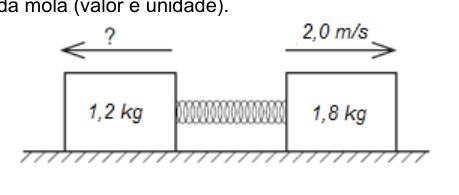 Two blocks connected by compressed spring
Topic: Conservation of Momentum, Newtonian Mechanics Metodi: Conservation of Momentum, Impulse-Momentum Theorem Competenze: Physical Reasoning, Mathematical Modeling Objects: Block, Spring Fonte: Testo (PDF) — p.2
Questione 1 (esclusiva per studenti della seconda elementare)
Due blocchi sono posizionati su una superficie orizzontale e senza attrito e collegati da una molla che viene compressa. Immediatamente dopo la liberazione dei blocchi, il blocco di massa acquista una velocità . Determina la velocità del blocco immediatamente dopo la liberazione della mola (valore e unità).
Two blocks connected by compressed spring
Topic: Conservation of Momentum, Newtonian Mechanics Metodi: Conservation of Momentum, Impulse-Momentum Theorem Competenze: Physical Reasoning, Mathematical Modeling Objects: Block, Spring Fonte: Testo (PDF) — p.2
Question 1 (MSK1/> *(exclusive for secondary school students)
Two blocks are placed on a horizontal surface without friction and connected by a spring that is compressed. Immediately after the blocks are released, the mass block acquires a speed of . Determine the block speed immediately after release of the spring (value and unit).
Two blocks connected by compressed spring
Topic: Conservation of Momentum, Newtonian Mechanics Metodi: Conservation of Momentum, Impulse-Momentum Theorem Competenze: Physical Reasoning, Mathematical Modeling Objects: Block, Spring Fonte: Testo (PDF) — p.2
Questão 2 (exclusiva para alunos da 2ª série)
Um corpo tem um peso de na superfície da Terra. Qual é o peso equivalente deste corpo quando posicionado a uma distância de um raio terrestre acima da superfície da Terra?
Topic: Gravitation, Newtonian Mechanics Metodi: Newton’s Law of Gravitation, Free-Body Diagram Competenze: Physical Reasoning, Mathematical Modeling Objects: Planet Fonte: Testo (PDF) — p.2
Questione 2 (esclusiva per studenti della seconda elementare)
Un corpo ha un peso di sulla superficie della Terra. Qual è il peso equivalente di questo corpo quando posizionato a una distanza di un raggio terrestre sopra la superficie della Terra?
Topic: Gravitation, Newtonian Mechanics Metodi: Newton’s Law of Gravitation, Free-Body Diagram Competenze: Physical Reasoning, Mathematical Modeling Objects: Planet Fonte: Testo (PDF) — p.2
Question 2 (MSK1/> *(exclusive for secondary school students)
A body has a mass of on the Earth’s surface. What is the equivalent weight of this body when placed at a distance of one Earth radius above the Earth’s surface?
Topic: Gravitation, Newtonian Mechanics Metodi: Newton’s Law of Gravitation, Free-Body Diagram Competenze: Physical Reasoning, Mathematical Modeling Objects: Planet Fonte: Testo (PDF) — p.2
Questão 3
Um bloco de , inicialmente em repouso, está posicionado numa superfície plana e sem atrito. O bloco é movimentado por por uma força constante de , em segundos. Qual a potência média da força durante o movimento?
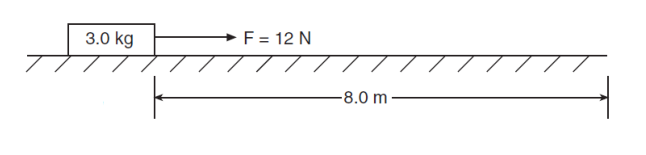 Block on frictionless surface under constant force
Topic: Newtonian Mechanics, Conservation of Energy Metodi: Kinematic Equations, Energy Conservation Method Competenze: Physical Reasoning, Mathematical Modeling Objects: Block Fonte: Testo (PDF) — p.2
La domanda 3
Un blocco , inizialmente a riposo, è posizionato su una superficie piana e senza attrito. Il blocco è spostato da con una forza costante di in secondi. Qual è la potenza media della forza durante il movimento?
Block on frictionless surface under constant force
Topic: Newtonian Mechanics, Conservation of Energy Metodi: Kinematic Equations, Energy Conservation Method Competenze: Physical Reasoning, Mathematical Modeling Objects: Block Fonte: Testo (PDF) — p.2
Question 3 - The Commission has decided to take the necessary measures to ensure that the Commission is able to take the necessary measures to ensure that the Commission is able to take the necessary measures to ensure that the Commission is able to take the necessary measures.
A block, initially at rest, is placed on a flat, frictionless surface. The block is moved by by a constant force of in seconds. What is the mean force force during movement?
Block on frictionless surface under constant force
Topic: Newtonian Mechanics, Conservation of Energy Metodi: Kinematic Equations, Energy Conservation Method Competenze: Physical Reasoning, Mathematical Modeling Objects: Block Fonte: Testo (PDF) — p.2
Questão 4
Um raio monocromático de luz atravessa um conjunto de materiais como esquematizado na figura abaixo ().
a) Em qual(is) material(is) a luz se propaga com a maior velocidade?
b) Em qual(is) material(is) a luz se propaga com a menor velocidade?
c) Qual o valor de ?
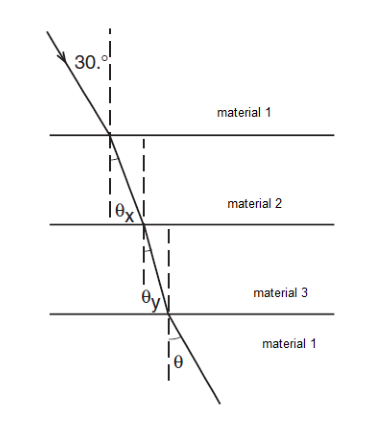 Monochromatic ray through layered materials
Topic: Geometric Optics Metodi: Snell’s Law, Ray Tracing Competenze: Diagrammatic Reasoning, Physical Reasoning Objects: — Fonte: Testo (PDF) — p.2
Il numero di persone che hanno ricevuto il messaggio è stato di circa un milione di persone.
Un raggio monocromatico di luce attraversa un insieme di materiali come illustrato nella figura seguente ().
a) In quale materiale la luce si diffonde più velocemente?
b) In quale materiale la luce si diffonde più rapidamente?
c) Qual è il valore di ?
Rai monocromatico attraverso materiali stratificati
Topic: Geometric Optics Metodi: Snell’s Law, Ray Tracing Competenze: Diagrammatic Reasoning, Physical Reasoning Objects: — Fonte: Testo (PDF) — p.2
Question 4 - The Commission has not yet decided on the application of this Regulation.
A monochrome beam of light passes through a set of materials as outlined in the figure below ().
(a) In which material does light spread at the fastest speed?
(b) In which material does light spread at the slowest speed?
(c) What is the value of ?
Monochromatic ray through layered materials
Topic: Geometric Optics Metodi: Snell’s Law, Ray Tracing Competenze: Diagrammatic Reasoning, Physical Reasoning Objects: — Fonte: Testo (PDF) — p.2
Questão 5
Numa parte de um circuito elétrico (como indicado na figura abaixo) um amperímetro é conectado para determinar a corrente que atravessa um determinado fio. Qual o valor da corrente indicada no amperímetro? (valor e unidade)
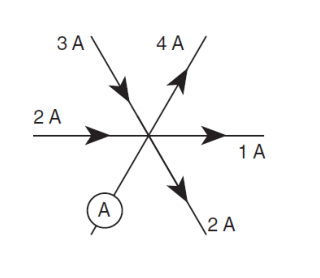 Circuit section with ammeter
Topic: Circuits Metodi: Kirchhoff’s Laws, Equivalent Circuit Reduction Competenze: Diagrammatic Reasoning, Physical Reasoning Objects: Galvanometer, Wire Fonte: Testo (PDF) — p.2
Il numero di persone che hanno ricevuto il servizio è stato di circa un milione di persone.
In una parte di un circuito elettrico (come indicato nella figura seguente) un amperimetro è collegato per determinare il corrente che attraversa un determinato filo. Qual è il valore di corrente indicato sull’ampimetro? (valore e unità)
Sezione di circuito con ammeter
Topic: Circuits Metodi: Kirchhoff’s Laws, Equivalent Circuit Reduction Competenze: Diagrammatic Reasoning, Physical Reasoning Objects: Galvanometer, Wire Fonte: Testo (PDF) — p.2
Question 5 - The Commission has not yet decided on the application of the rules on the application of the rules of procedure.
In one part of an electrical circuit (as shown in the figure below) an ampere is connected to determine the current running through a given wire. What is the current value on the amp? (value and unit)
The following table shows the results of the tests:
Topic: Circuits Metodi: Kirchhoff’s Laws, Equivalent Circuit Reduction Competenze: Diagrammatic Reasoning, Physical Reasoning Objects: Galvanometer, Wire Fonte: Testo (PDF) — p.2
Questão 6
O gráfico abaixo representa a amplitude de oscilação com função do tempo para um sistema massa-mola (oscilador harmônico). Qual par de pontos indicados no gráfico abaixo possui a mesma fase?
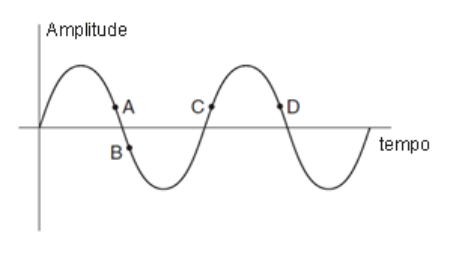 Amplitude vs time for mass-spring oscillator
Topic: Oscillations & Waves Metodi: Simple Harmonic Motion Analysis, Wave Equation Competenze: Diagrammatic Reasoning, Physical Reasoning Objects: Spring, Block Fonte: Testo (PDF) — p.3
Il numero di persone che hanno ricevuto la domanda è stato di:
Il grafico seguente rappresenta l’ampiezza di oscillazione a funzione del tempo per un sistema massa-mola (oscillatore armonico). Quale coppia di punti indicata nel grafico seguente ha la stessa fase?
Amplitude vs time for mass-spring oscillator
Topic: Oscillations & Waves Metodi: Simple Harmonic Motion Analysis, Wave Equation Competenze: Diagrammatic Reasoning, Physical Reasoning Objects: Spring, Block Fonte: Testo (PDF) — p.3
Question 6 - The Commission has not yet decided on the draft budget.
The graph below represents the time-spaced oscillation amplitude for a mass-moll system (harmonic oscillator). Which of the pairs of points shown in the graph below has the same phase?
The following table shows the results of the calculations:
Topic: Oscillations & Waves Metodi: Simple Harmonic Motion Analysis, Wave Equation Competenze: Diagrammatic Reasoning, Physical Reasoning Objects: Spring, Block Fonte: Testo (PDF) — p.3
Questão 7
Uma bola A de massa desliza sem atrito com velocidade constante de sobre uma mesa como indicado no esquema representado abaixo. A bola A colide com a bola B de massa que está no canto da mesa na iminência de cair, mantendo a mesma direção anterior ao choque.
Determine a distância percorrida pela bola B como indicado na figura anterior. Se a bola A cair da mesa qual será a distância equivalente à distância percorrida pela bola A?
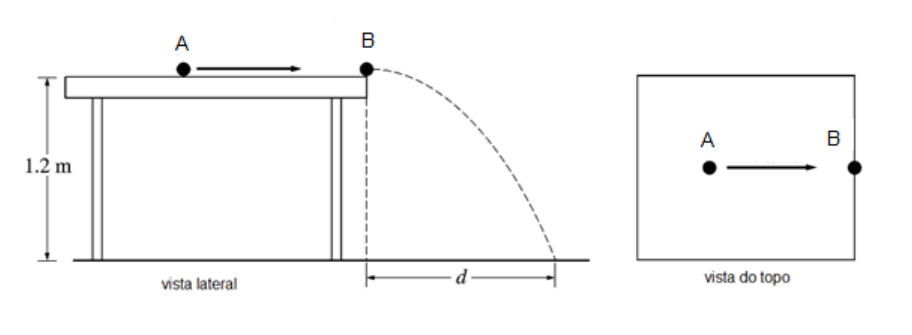 Ball A sliding on table, colliding with ball B at edge
Topic: Conservation of Momentum, Newtonian Mechanics Metodi: Conservation of Momentum, Kinematic Equations Competenze: Physical Reasoning, Mathematical Modeling Objects: Ball Fonte: Testo (PDF) — p.4
Questão 7
Una palla A di massa scivola senza attrito a velocità costante di su una tavola come indicato nel diagramma riportato di seguito. La palla A colpisce la palla B di massa che si trova nel canto del tavolo sull’imminenza di cadere, mantenendo la stessa direzione prima dello scatto.
Determina la distanza percorsa dalla palla B come indicato nella figura precedente. Se a bola A cair da mesa qual será a distância equivalente à distância percorrida pela bola A?
Ball A sliding on table, colliding with ball B at edge
Topic: Conservation of Momentum, Newtonian Mechanics Metodi: Conservation of Momentum, Kinematic Equations Competenze: Physical Reasoning, Mathematical Modeling Objects: Ball Fonte: Testo (PDF) — p.4
Questão 7
A ball A of mass slides without friction at a constant speed of over a table as shown in the diagram below. Ball A collides with ball B of mass that is in the corner of the table in the impending fall, maintaining the same direction prior to impact.
Determine the distance travelled by the ball B as shown in the figure above. Se a bola A cair da mesa qual será a distância equivalente à distância percorrida pela bola A?
Ball A sliding on table, colliding with ball B at edge
Topic: Conservation of Momentum, Newtonian Mechanics Metodi: Conservation of Momentum, Kinematic Equations Competenze: Physical Reasoning, Mathematical Modeling Objects: Ball Fonte: Testo (PDF) — p.4
Questão 8
Uma bola de massa desliza sem atrito num plano horizontal com velocidade de . A bola A colide elasticamente com uma bola B idêntica a ela, e inicialmente em repouso. Faça um diagrama das velocidades das bolas A e B após o choque, indicando o ângulo que a bola A faz com relação aos eixos e .
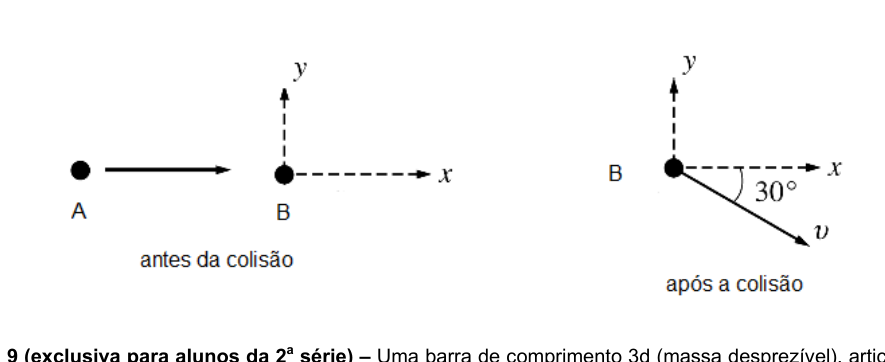 Elastic collision between two identical balls on plane
Topic: Conservation of Momentum, Conservation of Energy Metodi: Conservation of Momentum, Conservation of Energy Competenze: Diagrammatic Reasoning, Physical Reasoning Objects: Ball Fonte: Testo (PDF) — p.4
La domanda 8
Una palla di massa scivola senza attrito in un piano orizzontale a velocità . La palla A colpisce elasticamente con una palla B identica a lei, e inizialmente a riposo. Sviluppa un diagramma delle velocità delle palle A e B dopo l’impatto, indicando l’angolo che la palla A fa rispetto agli assi e .
Elastic collision between two identical balls on plane
Topic: Conservation of Momentum, Conservation of Energy Metodi: Conservation of Momentum, Conservation of Energy Competenze: Diagrammatic Reasoning, Physical Reasoning Objects: Ball Fonte: Testo (PDF) — p.4
Question 8 - The Commission has not yet decided on the draft budget.
A ball of mass slides without friction in a horizontal plane at a speed of . Ball A collides elastically with a ball B identical to it, and initially rests. Draw a diagram of the velocities of balls A and B after impact, indicating the angle that ball A makes with respect to the axes and .
Elastic collision between two identical balls on plane
Topic: Conservation of Momentum, Conservation of Energy Metodi: Conservation of Momentum, Conservation of Energy Competenze: Diagrammatic Reasoning, Physical Reasoning Objects: Ball Fonte: Testo (PDF) — p.4
Questão 9 (exclusiva para alunos da 2ª série)
Uma barra de comprimento (massa desprezível), articulada no ponto W, é submetida nas extremidades a duas forças de magnitude como esquematizado na figura abaixo.
Determine a magnitude de uma força , sua direção e sentido, e o ponto em que deve ser aplicada na barra para que esta permaneça em equilíbrio na horizontal.
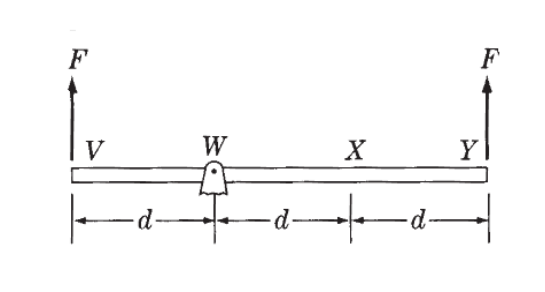 Bar of length 3d with two forces F at ends
Topic: Rigid Body Statics, Newtonian Mechanics Metodi: Torque & Angular Momentum Analysis, Free-Body Diagram Competenze: Diagrammatic Reasoning, Physical Reasoning Objects: Rod Fonte: Testo (PDF) — p.4
Questione 9 (esclusiva per studenti della seconda elementare)
Una barra di lunghezza (massa scarsa) articolata al punto W è sottoposta alle estremità a due forze di magnitudo come illustrato nella figura seguente.
Determina la magnitudine di una forza , la sua direzione e direzione e il punto in cui deve essere applicata sulla barra per mantenerla in equilibrio orizzontale.
Bar of length 3d with two forces F at ends
Topic: Rigid Body Statics, Newtonian Mechanics Metodi: Torque & Angular Momentum Analysis, Free-Body Diagram Competenze: Diagrammatic Reasoning, Physical Reasoning Objects: Rod Fonte: Testo (PDF) — p.4
Question 9 (MSK1/> *(exclusive for secondary school students)
A length bar (negligible mass), articulated at the W-point, is subjected at the ends to two forces of magnitude as outlined in the figure below.
Determine the magnitude of a force , its direction and direction, and the point at which it must be applied to the bar to keep it in balance horizontally.
Bar of length 3d with two forces F at ends
Topic: Rigid Body Statics, Newtonian Mechanics Metodi: Torque & Angular Momentum Analysis, Free-Body Diagram Competenze: Diagrammatic Reasoning, Physical Reasoning Objects: Rod Fonte: Testo (PDF) — p.4
Questão 10
Um estudante está numa plataforma (vide figura a seguir) acima do mar, observando as ondulações na superfície. Ele percebe que as ondulações na superfície do mar fazem um pedaço de madeira subir e descer. Ele então cronometra o tempo entre duas subidas sucessivas e obtém um tempo de segundos.
a) Determine a frequência da ondulação na superfície do mar.
b) Calcule a velocidade da ondulação (velocidade da onda).
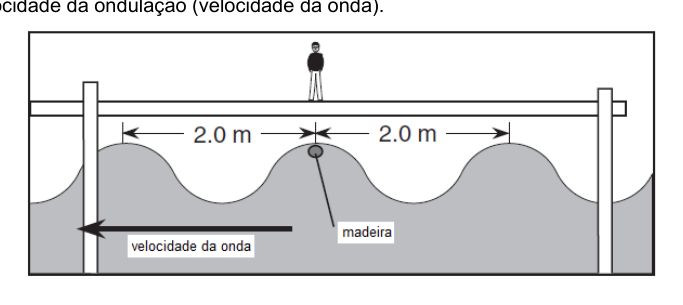 Student on platform observing sea surface waves
Topic: Oscillations & Waves Metodi: Wave Equation, Simple Harmonic Motion Analysis Competenze: Physical Reasoning, Mathematical Modeling Objects: — Fonte: Testo (PDF) — p.4
Il numero di persone che hanno ricevuto il messaggio è stato di circa un milione di persone.
Uno studente è su un piattaforma (vedi figura seguente) sopra il mare, osservando le onde sulla superficie. Egli si rende conto che le ondulazioni sulla superficie del mare fanno salire e scendere un pezzo di legno. Quindi cronometra il tempo tra due successive altezze e ottiene un tempo di secondi.
a) Determina la frequenza di ondulazione sulla superficie del mare.
b) Calcolare la velocità di ondulazione (velocità d’onda).
Student on platform observing sea surface waves
Topic: Oscillations & Waves Metodi: Wave Equation, Simple Harmonic Motion Analysis Competenze: Physical Reasoning, Mathematical Modeling Objects: — Fonte: Testo (PDF) — p.4
The Commission has also adopted a number of measures to combat the use of the ‘small’ technology.
A student stands on a platform above the sea, observing the waves on the surface. He realizes that the ripples on the sea surface cause a piece of wood to rise and fall. It then times the time between two successive ascents and gets a time of seconds.
(a) Determine the frequency of rippling on the sea surface.
(b) Calculate the wave velocity (wavelength).
Student on platform observing sea surface waves
Topic: Oscillations & Waves Metodi: Wave Equation, Simple Harmonic Motion Analysis Competenze: Physical Reasoning, Mathematical Modeling Objects: — Fonte: Testo (PDF) — p.4
Questão 11 (exclusiva para alunos da 2ª série)
Um corpo de peso , pendurado na vertical, está em equilíbrio como indicado no esquema abaixo. , e representam as tensões nas cordas que suportam o peso .
Determine os valores das tensões , e como função de .
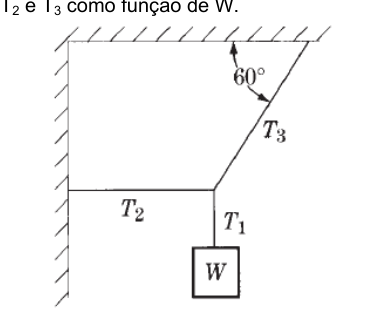 Weight W suspended by three ropes in equilibrium
Topic: Newtonian Mechanics, Rigid Body Statics Metodi: Free-Body Diagram, Vector Decomposition Competenze: Diagrammatic Reasoning, Physical Reasoning Objects: String Fonte: Testo (PDF) — p.5
Questione 11 (esclusiva per studenti della seconda classe)
Un corpo di peso , appeso verticalmente, è in equilibrio come indicato nel diagramma seguente. , e rappresentano le tensioni delle corde che supportano il peso .
Determina i valori delle tensioni , e come funzione di .
Weight W suspended by three ropes in equilibrium
Topic: Newtonian Mechanics, Rigid Body Statics Metodi: Free-Body Diagram, Vector Decomposition Competenze: Diagrammatic Reasoning, Physical Reasoning Objects: String Fonte: Testo (PDF) — p.5
Question 11 (MSK1/> *(exclusive for secondary school students)
A body of weight, suspended vertically, is in equilibrium as shown in the diagram below. The voltages on the strings supporting the weight are , and .
Determine the values of the voltages , and as a function of .
Weight W suspended by three ropes in equilibrium
Topic: Newtonian Mechanics, Rigid Body Statics Metodi: Free-Body Diagram, Vector Decomposition Competenze: Diagrammatic Reasoning, Physical Reasoning Objects: String Fonte: Testo (PDF) — p.5
Questão 12
Um gás ideal passa de um estado para um estado seguindo o caminho determinado por como indicado no diagrama abaixo. Ao longo deste caminho de calor são absorvidos pelo sistema e de trabalho são realizados pelo sistema. Determine o calor absorvido pelo sistema ao longo do caminho , sabendo que neste caso o trabalho realizado pelo sistema é de .
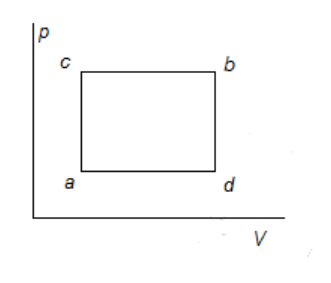 pV diagram with paths a-c-b and a-d-b
Topic: Thermodynamics Metodi: First Law of Thermodynamics, Thermodynamic Cycle Analysis Competenze: Physical Reasoning, Mathematical Modeling Objects: Gas Fonte: Testo (PDF) — p.5
Il numero di persone che hanno ricevuto il messaggio è stato di circa un milione di persone.
Un gas ideale passa da uno stato a uno stato seguendo il percorso determinato da come indicato nel diagramma di seguito. L’attività di calore è assorbita dal sistema e è eseguita dal sistema. Determina il calore assorbito dal sistema lungo il percorso , sapendo che in questo caso il lavoro svolto dal sistema è di .
pV diagram with paths a-c-b and a-d-b
Topic: Thermodynamics Metodi: First Law of Thermodynamics, Thermodynamic Cycle Analysis Competenze: Physical Reasoning, Mathematical Modeling Objects: Gas Fonte: Testo (PDF) — p.5
Question 12 - The Commission has decided to take the necessary measures to ensure that the Commission is able to take the necessary measures to ensure that the Commission is able to take the necessary measures to ensure that the Commission is able to take the necessary measures.
An ideal gas passes from a state to a state following the path determined by as shown in the diagram below. Along this path heat is absorbed by the system and work is carried out by the system. Determine the heat absorbed by the system along the path, knowing that in this case the work performed by the system is .
pV diagram with paths a-c-b and a-d-b
Topic: Thermodynamics Metodi: First Law of Thermodynamics, Thermodynamic Cycle Analysis Competenze: Physical Reasoning, Mathematical Modeling Objects: Gas Fonte: Testo (PDF) — p.5
Questão 13
O enunciado abaixo serve como referência para as questões 13 e 14.
Foi realizado um experimento de laboratório fazendo com que um feixe de luz monocromático se propague por um bloco de vidro, emergindo no ar. Considere para o ar um índice de refração . Variando o ângulo de incidência da luz foi montado o gráfico da dependência entre os senos dos ângulos de incidência () e refração () como indicado na figura a seguir.
A partir do gráfico anterior calcule o índice de refração do vidro.
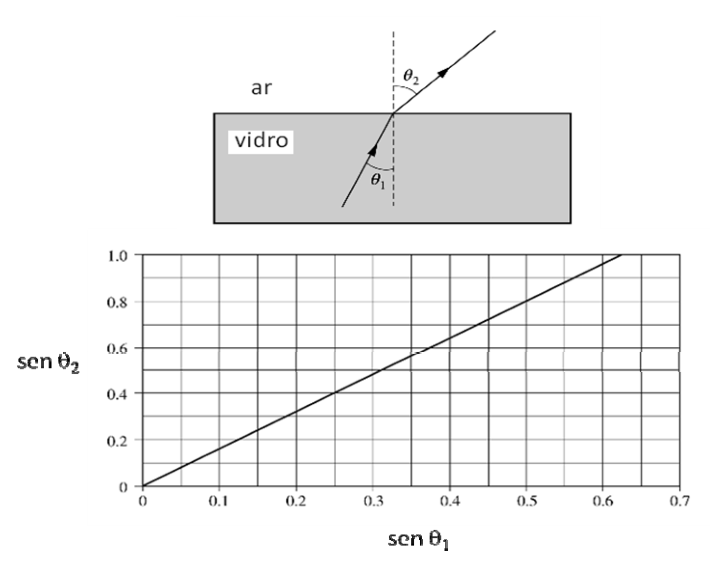 Graph of sin θ₂ vs sin θ₁ for glass-air interface
Topic: Geometric Optics Metodi: Snell’s Law, Graph Linearization Competenze: Diagrammatic Reasoning, Graph Linearization Objects: — Fonte: Testo (PDF) — p.6
Il numero di persone che hanno ricevuto il diploma è stato di circa un milione di persone.
La seguente citazione serve come riferimento alle domande 13 e 14.
Un esperimento di laboratorio è stato eseguito facendo diffondere un fascio di luce monocromatica attraverso un blocco di vetro, emergendosi nell’aria. Considerare per l’aria un indice di refrazione . Variando l’angolo di incidenza della luce è stato montato il grafico della dipendenza tra i seni degli angoli di incidenza () e di refrazione () come indicato nella figura seguente.
Sulla base del grafico precedente calcoli l’indice di refrazione del vetro.
Grafico di sin θ2 vs sin θ1 per interfaccia glass-air
Topic: Geometric Optics Metodi: Snell’s Law, Graph Linearization Competenze: Diagrammatic Reasoning, Graph Linearization Objects: — Fonte: Testo (PDF) — p.6
Question No 13 - The Commission has not yet decided on the application of this Regulation.
The following statement serves as a reference to questions 13 and 14.
A laboratory experiment was conducted by causing a monochrome beam of light to spread through a block of glass, emerging into the air. Consider a refractive index for air. Varying the angle of incidence of the light, the graph of the dependence between the breasts of the angle of incidence () and the refraction () was drawn as shown in the following figure.
From the above chart, calculate the refractive index of the glass.
The following table shows the number of samples taken from the sample:
Topic: Geometric Optics Metodi: Snell’s Law, Graph Linearization Competenze: Diagrammatic Reasoning, Graph Linearization Objects: — Fonte: Testo (PDF) — p.6
Questão 14
O enunciado de referência (experimento de laboratório com bloco de vidro e gráfico vs ) é o mesmo descrito na Questão 13.
Denhe a interface vidro/ar e esboce os raios que emergem do vidro para o ar para as três situações:
i)
ii)
iii)
Topic: Geometric Optics Metodi: Snell’s Law, Ray Tracing Competenze: Diagrammatic Reasoning, Physical Reasoning Objects: — Fonte: Testo (PDF) — p.6
Il numero di persone che hanno ricevuto il diploma è stato di circa un milione di persone.
La dichiarazione di riferimento (esperimento di laboratorio con blocco di vetro e grafico vs ) è la stessa descritta in Ques. 13.
Fate un’interfaccia vetro/aria e disegnate i raggi che emergono dal vetro verso l’aria per le tre situazioni:
i)
ii)
(iii)
Topic: Geometric Optics Metodi: Snell’s Law, Ray Tracing Competenze: Diagrammatic Reasoning, Physical Reasoning Objects: — Fonte: Testo (PDF) — p.6
Question 14 - The Commission has not yet decided on the draft budget.
The reference statement (lab experiment with glass block and graphic vs ) is the same as described in Question 13.*
Draw the glass/air interface and outline the rays emerging from the glass into the air for the three situations:
i)
ii)
(iii)
Topic: Geometric Optics Metodi: Snell’s Law, Ray Tracing Competenze: Diagrammatic Reasoning, Physical Reasoning Objects: — Fonte: Testo (PDF) — p.6
Questão 15
Um circuito elétrico contendo dois resistores ( e ), um capacitor () e uma chave () é conectado a uma fonte de corrente contínua de acordo com a montagem da figura abaixo.
Em a chave é fechada. O gráfico à direita representa o comportamento da diferença de potencial no capacitor (Voltagem no capacitor) como função do tempo transcorrido após a chave ser fechada ().
a) Determine o valor da resistência .
b) Qual o valor da corrente que atravessa a fonte imediatamente após a chave ser fechada ()?
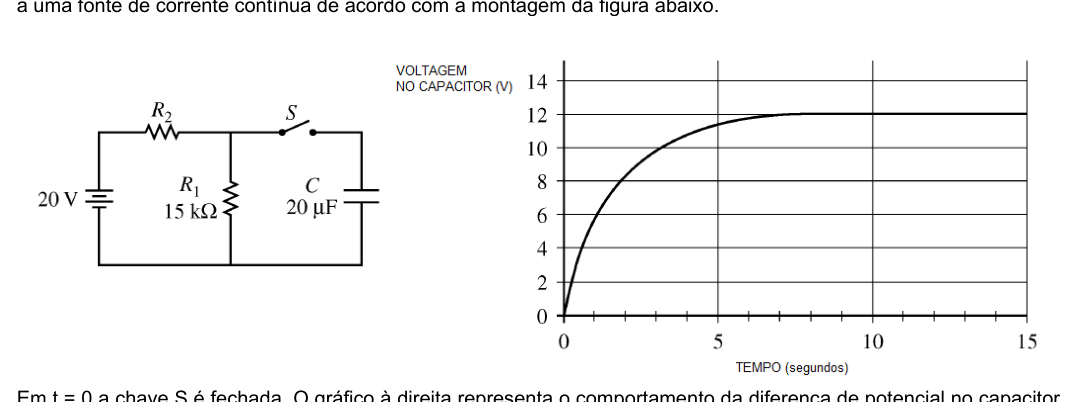 RC circuit diagram and voltage vs time graph
Topic: Circuits Metodi: Kirchhoff’s Laws, Equivalent Circuit Reduction Competenze: Diagrammatic Reasoning, Graph Linearization Objects: Resistor, Capacitor, Switch, Battery Fonte: Testo (PDF) — p.6
Il numero di persone che hanno ricevuto la domanda è stato di circa un milione di persone.
Un circuito elettrico contenente due resistori ( e ), un condensatore () e una chiave () è collegato a una fonte di corrente continua secondo l’assemblaggio della figura seguente.
In il tasto è chiuso. Il grafico a destra rappresenta il comportamento della differenza di potenziale nel condensatore (Voltage in condensatore) in funzione del tempo trascorso dopo che la chiave è stata chiusa ().
a) Determina il valore della resistenza .
b) Qual è il valore del corrente che attraversa la sorgente immediatamente dopo che la chiave è chiusa ()?
RC circuit diagram and voltage vs time graph
Topic: Circuits Metodi: Kirchhoff’s Laws, Equivalent Circuit Reduction Competenze: Diagrammatic Reasoning, Graph Linearization Objects: Resistor, Capacitor, Switch, Battery Fonte: Testo (PDF) — p.6
Question 15 - The Commission has decided to take a decision on the draft budget.
An electrical circuit containing two resistors ( and ), a capacitor () and a switch () is connected to a DC source according to the installation in the figure below.
In the key is closed. The graph on the right represents the behavior of the capacitor potential difference (capacitor voltage) as a function of the time elapsed after the key has been closed ().
(a) Determine the resistance value .
(b) What is the current value that passes through the source immediately after the key is closed ()?
The following table shows the following:
Topic: Circuits Metodi: Kirchhoff’s Laws, Equivalent Circuit Reduction Competenze: Diagrammatic Reasoning, Graph Linearization Objects: Resistor, Capacitor, Switch, Battery Fonte: Testo (PDF) — p.6
Questão 16
A equação de estado de Van der Waals foi proposta para corrigir a equação do gás ideal no regime em que a atração entre as moléculas não pode ser mais desprezada. A equação de Van der Waals (para 1 mol de gás) é escrita como:
onde é a pressão do gás, o volume, a temperatura e a constante universal dos gases ideais. e são constantes que dependem do gás.
a) Determine as unidades das constantes e no Sistema Internacional.
b) Reescreva a equação de Van der Waals na condição em que .
c) Sabendo que em 1 mol de gás temos moléculas e considerando que cada molécula pode ser aproximada por uma esfera de diâmetro , faça uma estimativa do valor do parâmetro (volume real de 1 mol de moléculas do gás) para o gás Nitrogênio sabendo que .
d) Faça a razão para o Nitrogênio (use o valor do item c), onde é o volume de 1 mol de gás ideal nas condições normais de temperatura e pressão.
Topic: Thermodynamics, Kinetic Theory Metodi: Ideal Gas Law, Order-of-Magnitude Estimation, Dimensional Analysis Competenze: Estimation & Approximation, Mathematical Modeling Objects: Gas Fonte: Testo (PDF) — p.6
Il numero di persone che hanno ricevuto la domanda è stato di:
La equazione di stato di Van der Waals è stata proposta per correggere l’equazione del gas ideale nel regime in cui l’attrazione tra le molecole non può più essere disprezzata. L’equazione di Van der Waals (per 1 mol di gas) è scritta come:
dove è la pressione del gas, il volume, la temperatura e la costante universale dei gas ideali. e sono costanti che dipendono dal gas.
a) Determina le unità delle costanti e nel Sistema Internazionale.
b) Riscrissi l’equazione di Van der Waals nella condizione che .
c) Sapendo che in 1 mol di gas abbiamo molecole e considerando che ogni molecola può essere avvicinata da una sfera di diametro , fate una stima del valore del parametro (volume reale di 1 mol di molecole di gas) per il gas nitrogeno sapendo che .
d) Fare il rapporto per il nitrogeno (utilizzare il valore di punto c), dove è il volume ottimale di 1 mol di gas in condizioni normali di temperatura e pressione.
Topic: Thermodynamics, Kinetic Theory Metodi: Ideal Gas Law, Order-of-Magnitude Estimation, Dimensional Analysis Competenze: Estimation & Approximation, Mathematical Modeling Objects: Gas Fonte: Testo (PDF) — p.6
Question 16 - The Commission has not yet adopted a proposal for a regulation on the application of the rules on the protection of workers’ rights.
The Van der Waals state equation was proposed to correct the ideal gas equation in the regime where the attraction between molecules can no longer be neglected. The Van der Waals equation (for 1 mol of gas) is written as:
where is the gas pressure, the volume, the temperature and the universal constant of ideal gases. and are gas-dependent constants.
(a) Determine the units of the constants and in the International System.
(b) Rewrite the Van der Waals equation as .
c) Knowing that in 1 mol of gas we have molecules and considering that each molecule can be approximated by a sphere of diameter, estimate the value of the parameter (real volume of 1 mol of gas molecules) for nitrogen gas knowing that .
(d) Make the ratio for nitrogen (use the value of item c) where is the volume of 1 mol of gas ideal under normal temperature and pressure conditions.
Topic: Thermodynamics, Kinetic Theory Metodi: Ideal Gas Law, Order-of-Magnitude Estimation, Dimensional Analysis Competenze: Estimation & Approximation, Mathematical Modeling Objects: Gas Fonte: Testo (PDF) — p.6