PARTE I – PROPRIEDADES GEOMÉTRICAS
Meça as dimensões do semi-cilindro de acrílico como indicado na figura abaixo. Use = raio e = altura. Expresse seus valores em cm, indicando-os na tabela correspondente.
(Vista superior: medir raio e altura do semi-cilindro)
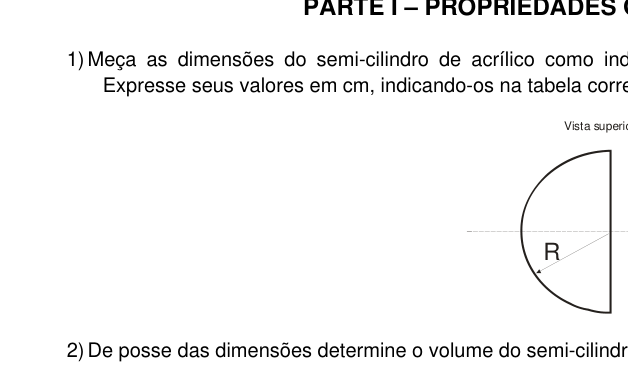 Vista superior semi-cilindro acrílico, raio R
Topic: Geometric Optics, Elasticity & Materials Metodi: Physical Modeling, Dimensional Analysis Competenze: Measurement & Instrumentation, Significant Figures Objects: Cylinder Fonte: Testo (PDF) — p.4
PARTICO I PROPERTIE GEOMETRIche
Misura le dimensioni del semicilindro di acrilico come indicato nella figura seguente. Utilizzare = raggio e = altezza. Esprimere i suoi valori in cm, indicandoli nella tabella corrispondente.
*(Visto superiore: misura il raggio e l’altezza del semicilindro) *
Visto superiore semicilindro acrilico, raggio R
Topic: Geometric Optics, Elasticity & Materials Metodi: Physical Modeling, Dimensional Analysis Competenze: Measurement & Instrumentation, Significant Figures Objects: Cylinder Fonte: Testo (PDF) — p.4
The following information is provided by the Commission to the European Parliament and to the Council:
Measure the dimensions of the acrylic semi-cylinder as shown in the figure below. Use = radius and = height. Express their values in cm, indicating them in the corresponding table.
*(Overview: measuring the radius and height of the semi-cylinder) *
The following conditions shall apply:
Topic: Geometric Optics, Elasticity & Materials Metodi: Physical Modeling, Dimensional Analysis Competenze: Measurement & Instrumentation, Significant Figures Objects: Cylinder Fonte: Testo (PDF) — p.4
PARTE I – PROPRIEDADES GEOMÉTRICAS
De posse das dimensões determine o volume do semi-cilindro de acrílico. Dê sua resposta em cm³.
Topic: Geometric Optics, Elasticity & Materials Metodi: Physical Modeling, Dimensional Analysis Competenze: Mathematical Modeling, Significant Figures Objects: Cylinder Fonte: Testo (PDF) — p.4
PARTICO I PROPERTIE GEOMETRIche
Dalle dimensioni si determina il volume del semicilindro acrilico. Rispondi in centimetri 3.
Topic: Geometric Optics, Elasticity & Materials Metodi: Physical Modeling, Dimensional Analysis Competenze: Mathematical Modeling, Significant Figures Objects: Cylinder Fonte: Testo (PDF) — p.4
The following information is provided by the Commission to the European Parliament and to the Council:
The volume of the acrylic semi-cylinder is determined by the dimensions. Give your answer in cm3.
Topic: Geometric Optics, Elasticity & Materials Metodi: Physical Modeling, Dimensional Analysis Competenze: Mathematical Modeling, Significant Figures Objects: Cylinder Fonte: Testo (PDF) — p.4
PARTE I – PROPRIEDADES GEOMÉTRICAS
Determine a massa do semi-cilindro em gramas.
Topic: Elasticity & Materials Metodi: Physical Modeling, Dimensional Analysis Competenze: Measurement & Instrumentation, Significant Figures Objects: Cylinder Fonte: Testo (PDF) — p.4
PARTICO I PROPERTIE GEOMETRIche
Determina la massa del semicilindro in grassi.
Topic: Elasticity & Materials Metodi: Physical Modeling, Dimensional Analysis Competenze: Measurement & Instrumentation, Significant Figures Objects: Cylinder Fonte: Testo (PDF) — p.4
The following information is provided by the Commission to the European Parliament and to the Council:
Determine the mass of the semicylinder in grams.
Topic: Elasticity & Materials Metodi: Physical Modeling, Dimensional Analysis Competenze: Measurement & Instrumentation, Significant Figures Objects: Cylinder Fonte: Testo (PDF) — p.4
PARTE II – DIVERGÊNCIA DA FONTE
Considerando o LED como uma fonte pontual, a luz ao atravessar a fenda de saída terá uma certa divergência a qual denotaremos por . Coloque a fonte de luz sobre a folha do caderno de respostas. Faça o contorno da fonte, identificando-a, e trace os dois raios mais externos, juntamente com o raio central.
A partir do desenho da montagem meça o valor do ângulo em graus.
(Vista superior da fonte: traçar os dois raios extremos do feixe e o raio central, medir )
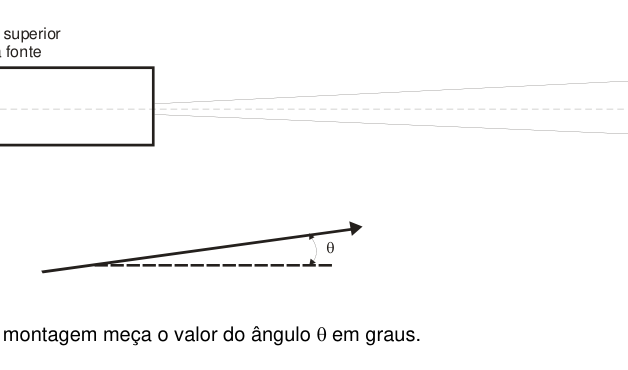 Vista superior fonte de luz, ângulo de divergência α
Topic: Geometric Optics Metodi: Ray Tracing, Physical Modeling Competenze: Measurement & Instrumentation, Diagrammatic Reasoning Objects: Slit Fonte: Testo (PDF) — p.4
PARTICO II DIVERGENZA DEL FONTE
Considerando che il LED è una fonte puntaria, la luce che attraversa la fessura di uscita avrà una certa divergenza che indicheremo con . Metti la fonte di luce sul foglio del libretto di risposte. Sfruttate la fonte, identificandola, e tracciate i due raggi più esterni, insieme al raggi centrale.
Dal disegno dell’assemblaggio misurare il valore dell’angolo in gradi.
*(Visto superiore della fonte: tracciare i due raggi estremi del fascio e il raggio centrale, misurare ) *
Visto superiore fonte di luce, angolo di divergenza α
Topic: Geometric Optics Metodi: Ray Tracing, Physical Modeling Competenze: Measurement & Instrumentation, Diagrammatic Reasoning Objects: Slit Fonte: Testo (PDF) — p.4
The following information is provided by the Commission to the Member States:
Considering the LED as a point source, the light passing through the output gap will have a certain divergence which we will denote by . Put the light source on the answering book sheet. Make the contour of the source, identify it, and plot the two outermost rays along with the central ray.
From the assembly drawing measure the value of the angle in degrees.
*(Overview of the source: map the two extreme beam radii and the central radii, measure ) *
The following shall be added to the list of the following:
Topic: Geometric Optics Metodi: Ray Tracing, Physical Modeling Competenze: Measurement & Instrumentation, Diagrammatic Reasoning Objects: Slit Fonte: Testo (PDF) — p.4
PARTE III – MEDIDA DO DESVIO ANGULAR
Um feixe de luz ao atravessar um semi-cilindro inclinado sofrerá um desvio angular, o qual denotaremos por . Veja o esquema da montagem representado na figura abaixo, o qual deverá ser reproduzido experimentalmente na folha de resposta.
Faça três desenhos para montagens diferentes. Nestas três montagens use valores diferentes para a inclinação do semi-cilindro com relação ao feixe. Desenhe somente o feixe de luz central. Faça o contorno da fonte e o do semi-cilindro de acrílico. Determine para estas três montagens os valores de (grau) e (grau), indicando-os na tabela.
(Vista superior: normal à superfície, ângulo de incidência , ângulo de refração , fonte de luz)
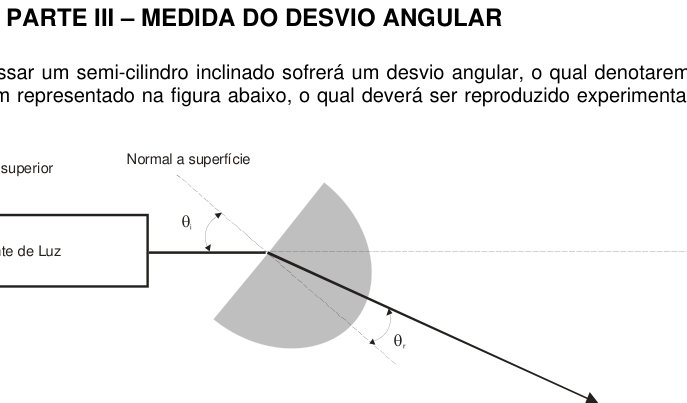 Vista superior semi-cilindro, ângulos i e r de refração
Topic: Geometric Optics Metodi: Ray Tracing, Snell’s Law, Experimental Data Analysis Competenze: Diagrammatic Reasoning, Measurement & Instrumentation Objects: Cylinder Fonte: Testo (PDF) — p.4
**PARTICO III METTAZIONE DELLE SCEPTI ANGLIARE **
Un fascio di luce che attraversa un semicilindro inclinato subirà una deviazione angolare, che denoteremo con . Si veda il diagramma di montaggio illustrato nella figura seguente, che deve essere riprodotto sperimentalmente nella scheda di risposta.
Fate tre disegni per montature diverse. In questi tre assemblaggi utilizzare valori diversi per l’inclinazione del semicilindro rispetto al fascio. Disegna solo il fascio di luce centrale. Fate il contorno della fonte e del semicilindro acrilico. Determina per questi tre assemblaggi i valori (grado) e (grado), indicandoli nella tabella.
*(Visto superiore: normale sulla superficie, angolo di incidenza , angolo di rifrazione , fonte di luce) *
Vista superiore semicilindro, angoli i e r di rifrazione
Topic: Geometric Optics Metodi: Ray Tracing, Snell’s Law, Experimental Data Analysis Competenze: Diagrammatic Reasoning, Measurement & Instrumentation Objects: Cylinder Fonte: Testo (PDF) — p.4
PARTE III – MEDIDA DO DESVIO ANGULAR
A beam of light passing through an inclined semicircular will experience an angular deviation, which we will denote by . See the assembly scheme shown in the figure below, which should be reproduced experimentally in the reply sheet.
Make three drawings for different assemblies. In these three assemblies use different values for the slope of the semi-cylinder relative to the beam. Draw only the central beam of light. Make the contour of the fountain and the semi-acrylic cylinder. Determine for these three assemblies the values of (grade) and (grade), indicating them in the table.
(Vista superior: normal à superfície, ângulo de incidência , ângulo de refração , fonte de luz)
Semi-cylinder upper view, angles i and r of refraction
Topic: Geometric Optics Metodi: Ray Tracing, Snell’s Law, Experimental Data Analysis Competenze: Diagrammatic Reasoning, Measurement & Instrumentation Objects: Cylinder Fonte: Testo (PDF) — p.4
PARTE III – MEDIDA DO DESVIO ANGULAR
Considerando como 1 o índice de refração do ar, determine o índice de refração () do semi-cilindro para as três montagens. Indique os valores obtidos para na tabela. Calcule o valor médio para o índice de refração do acrílico.
Topic: Geometric Optics Metodi: Snell’s Law, Experimental Data Analysis, Graph Linearization Competenze: Mathematical Modeling, Experimental Data Analysis Objects: Cylinder Fonte: Testo (PDF) — p.5
**PARTICO III METTAZIONE DELLE SCEPTI ANGLIARE **
Considerando come 1 l’indice di refrazione dell’aria, determina l’indice di refrazione () del semicilindro per i tre montamenti. Indicare i valori ottenuti per nella tabella. Calcola il valore medio per l’indice di refrazione dell’acrilico.
Topic: Geometric Optics Metodi: Snell’s Law, Experimental Data Analysis, Graph Linearization Competenze: Mathematical Modeling, Experimental Data Analysis Objects: Cylinder Fonte: Testo (PDF) — p.5
The following table shows the results of the measurement of the angular deviation of the measurement:
Considering as 1 the air refractive index, determine the refractive index () of the semi-cylinder for the three assemblies. Enter the values obtained for in the table. Calculate the mean value for the refractive index of the acrylic.
Topic: Geometric Optics Metodi: Snell’s Law, Experimental Data Analysis, Graph Linearization Competenze: Mathematical Modeling, Experimental Data Analysis Objects: Cylinder Fonte: Testo (PDF) — p.5
PARTE IV – MEDIDA DO FOCO
Faça as duas montagens como representado na figura abaixo usando o semi-cilindro como uma lente plano-convexa. Desenhe o feixe central nos espaços reservados. Meça e indique seus valores na tabela.
(Vista superior: fonte de luz, semi-cilindro como lente plano-convexa, distância focal )
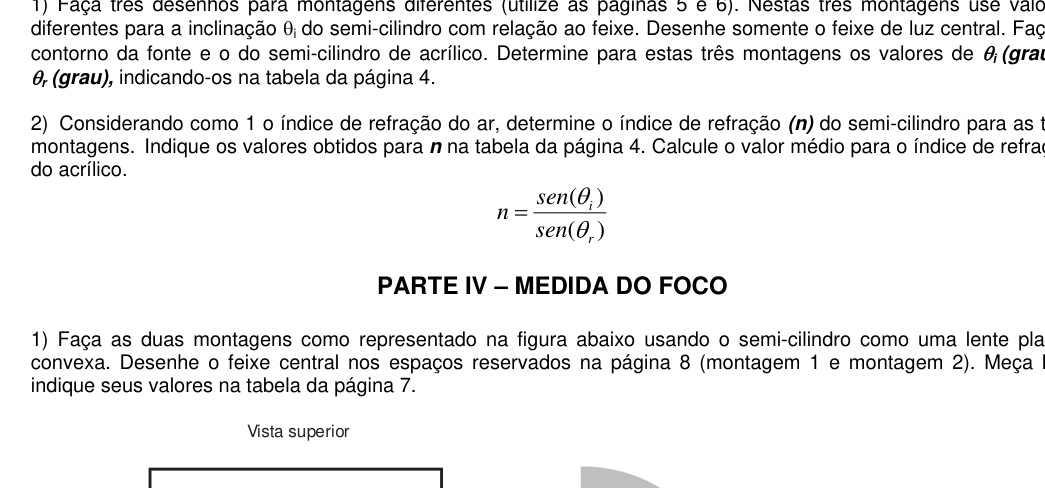 Vista superior lente plano-convexa, distância focal F
Topic: Geometric Optics Metodi: Ray Tracing, Thin Lens & Mirror Equation, Physical Modeling Competenze: Measurement & Instrumentation, Diagrammatic Reasoning Objects: Cylinder, Lens Fonte: Testo (PDF) — p.5
PARTIVO METTA DELFOCALE
Fate entrambi i montaggi come illustrato nella figura seguente usando il semicilindro come lente piano-convexa. Disegna il fascio centrale negli spazi riservati. Misura e indica i suoi valori nella tabella.
*(Visto superiore: fonte di luce, semicilindro come lente piano-convexa, distanza focale ) *
Vista superiore lente piano-convexa, distanza focale F
Topic: Geometric Optics Metodi: Ray Tracing, Thin Lens & Mirror Equation, Physical Modeling Competenze: Measurement & Instrumentation, Diagrammatic Reasoning Objects: Cylinder, Lens Fonte: Testo (PDF) — p.5
PARTE IV – MEDIDA DO FOCO
Make both mountings as shown in the figure below using the semicylinder as a flat-convex lens. Draw the central beam in the reserved spaces. Measure and indicate its values in the table.
(Vista superior: fonte de luz, semi-cilindro como lente plano-convexa, distância focal )
Vista superior lente plano-convexa, distância focal F
Topic: Geometric Optics Metodi: Ray Tracing, Thin Lens & Mirror Equation, Physical Modeling Competenze: Measurement & Instrumentation, Diagrammatic Reasoning Objects: Cylinder, Lens Fonte: Testo (PDF) — p.5
PARTE IV – MEDIDA DO FOCO
A partir da equação do fabricante de lente determine o valor do índice de refração para as duas montagens. Indique os valores na tabela e calcule o valor médio. Para a lente Plano-Convexa:
onde é o raio do semi-cilindro.
Topic: Geometric Optics Metodi: Thin Lens & Mirror Equation, Experimental Data Analysis Competenze: Mathematical Modeling, Significant Figures Objects: Cylinder, Lens Fonte: Testo (PDF) — p.5
PARTIVO METTA DELFOCALE
Sulla base dell’equazione del produttore di lente, determina il valore dell’indice di refrazione per le due montature. Indicare i valori nella tabella e calcolare la media. Per il lente piano-convexa:
dove è il raggio del semicilindro.
Topic: Geometric Optics Metodi: Thin Lens & Mirror Equation, Experimental Data Analysis Competenze: Mathematical Modeling, Significant Figures Objects: Cylinder, Lens Fonte: Testo (PDF) — p.5
The following information is provided by the manufacturer:
From the lens manufacturer’s equation, determine the value of the refractive index for both assemblies. Enter the values in the table and calculate the mean. For the flat-convex lens:
where is the radius of the half-cylinder.
Topic: Geometric Optics Metodi: Thin Lens & Mirror Equation, Experimental Data Analysis Competenze: Mathematical Modeling, Significant Figures Objects: Cylinder, Lens Fonte: Testo (PDF) — p.5
PARTE IV – MEDIDA DO FOCO
Compare os valores médios dos índices de refração obtidos para o acrílico na Parte III e na Parte IV.
Topic: Geometric Optics Metodi: Experimental Data Analysis, Physical Modeling Competenze: Experimental Data Analysis, Physical Reasoning Objects: — Fonte: Testo (PDF) — p.5
PARTIVO METTA DELFOCALE
Confronta i valori medi degli indici di refrazione ottenuti per l’acrilico in Parte III e in Parte IV.
Topic: Geometric Optics Metodi: Experimental Data Analysis, Physical Modeling Competenze: Experimental Data Analysis, Physical Reasoning Objects: — Fonte: Testo (PDF) — p.5
The following information is provided by the manufacturer:
Compare the mean values of the refractive indices obtained for acrylic in Part III and Part IV.
Topic: Geometric Optics Metodi: Experimental Data Analysis, Physical Modeling Competenze: Experimental Data Analysis, Physical Reasoning Objects: — Fonte: Testo (PDF) — p.5