PARTE I – PROPRIEDADES E DIMENSÕES DA BÚSSOLA
O kit experimental é composto por: 1 – Bússola; 2 – Magneto encapsulado num suporte de plástico; 3 – Régua de 15 cm; 4 – Transferidor de 180°.
a) Relação entre o ângulo da agulha da bússola e a escala impressa na bússola.
A bússola possui uma escala impressa com o zero indicado da direção norte (N). Indicando como o valor lido na escala impressa da bússola, determine a relação de proporcionalidade entre esta e o ângulo medido em graus.
b) Área da Bússola.
Considerando a área da região circular da escala da bússola (olhe na parte de traz da bússola – fundo), meça o diâmetro desta região e calcule a sua área. Indique os resultados numa tabela no caderno de respostas usando o modelo como o indicado abaixo (use ):
| Medida | Diâmetro (cm) | Área (cm²) |
|---|---|---|
| 1 | ||
| 2 | ||
| 3 |
Faça três medidas de diâmetro em posições diferentes. Use dois algarismos significativos para representar o valor da área.
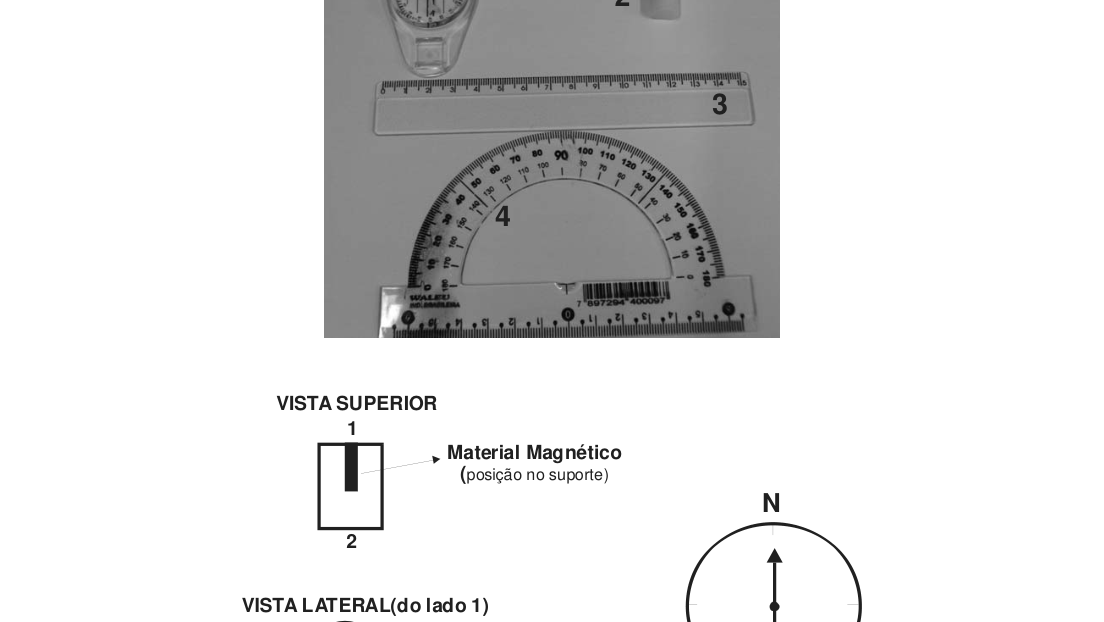 Kit components: compass, magnet N/S views, ruler, protractor
Topic: Magnetism, Order-of-Magnitude Estimation Metodi: Experimental Data Analysis, Dimensional Analysis, Physical Modeling Competenze: Measurement & Instrumentation, Significant Figures Objects: Magnet Fonte: Testo (PDF) — p.2
PARTICO I Proprietà e dimensioni della busta
Il kit di prova è composto da: 1 Compass; 2 Magnet in un supporto in plastica; 3 Regola di 15 cm; 4 Trasferitore 180°.
a) Relazione tra l’angolo della ago della compassa e la scala stampata sulla compassa.
La compassa ha una scala stampata con lo zero indicato dalla direzione nord (N). Indicando come il valore letto sulla scala stampata della compassa, determina il rapporto di proporzionalità tra questa e l’angolo misurato in gradi.
b) Area della bussola.
Considerando l’area della regione circolare della scala della compassa (vedere la parte trasversale della compassa fondo), misurare il diametro di questa regione e calcolare la sua area. Indicare i risultati in una tabella del libretto di risposte usando il modello seguente (utilizza ):
∙ ∙ ∙ ∙ ∙ ∙ ∙ ∙ ∙ ∙ ∙ ∙ ∙ ∙ ∙ ∙ ∙ ∙ ∙ ∙ ∙ ∙ ∙ ∙ ∙ ∙ ∙ ∙ ∙ ∙ ∙ ∙ ∙ ∙ ∙ ∙ ∙ ∙ ∙ ∙ ∙ ∙ ∙ ∙ ∙ ∙ ∙ ∙ ∙ ∙
|--------|--------------|-------------|
| 1 | | |
| 2 | | |
| 3 | | |
Fai tre misure di diametro in posizioni diverse. Utilizzare due numeri significativi per rappresentare il valore dell’area.
Kit components: compass, magnet N/S views, ruler, protractor
Topic: Magnetism, Order-of-Magnitude Estimation Metodi: Experimental Data Analysis, Dimensional Analysis, Physical Modeling Competenze: Measurement & Instrumentation, Significant Figures Objects: Magnet Fonte: Testo (PDF) — p.2
Part I BUSH properties and dimensions
The experimental kit consists of: 1 Compass; 2 Magnet encapsulated in a plastic support; 3 15 cm Regular; 4 Transferor of 180°.
(a) Relation between the angle of the needle of the compass and the scale printed on the compass.
The compass has a scale printed with the indicated zero of the north direction (N). Indicating how the value read on the printed scale of the compass determines the proportionality ratio between this and the angle measured in degrees.
(b) Compass area.
Considering the area of the circular region of the compass scale (see the trajectory part of the compass bottom), measure the diameter of this region and calculate its area. Enter the results in a table in the answer book using the model as shown below (use ):
♪ Size ♪ Diameters ♪ Areas ♪ |--------|--------------|-------------| | 1 | | | | 2 | | | | 3 | | |
Make three measurements of diameter in different positions. Use two significant algebraic notations to represent the value of the area.
The following components are used:
Topic: Magnetism, Order-of-Magnitude Estimation Metodi: Experimental Data Analysis, Dimensional Analysis, Physical Modeling Competenze: Measurement & Instrumentation, Significant Figures Objects: Magnet Fonte: Testo (PDF) — p.2
PARTE II – PROPRIEDADES DA INTERAÇÃO DO MAGNETO COM A BÚSSOLA (medidas na direção perpendicular ao eixo Norte-Sul)
Coloque a bússola sobre uma folha de papel (página da parte II) do caderno de respostas. Não aproxime o magneto da bússola. Esta deverá ficar alinhada indicando o Norte na sua posição. Trace uma reta perpendicular ao eixo Norte e Sul como indicado na figura abaixo.
Ao aproximar o magneto da bússola a agulha começa a girar. Meça a distância do magneto ao centro da bússola e o ângulo (ângulo em graus entre o eixo Norte e a agulha). Faça 6 medidas de 2 em 2 cm a partir do centro da bússola. Indique os resultados numa tabela no caderno de resoluções usando o modelo:
| Medida | (cm) | (graus) |
|---|---|---|
| 1 | ||
| 2 | ||
| 3 | ||
| 4 | ||
| 5 | ||
| 6 |
Repita o procedimento anterior para as três configurações abaixo (Posições 2, 3 e 4). Use a mesma montagem, trocando somente a orientação do magneto como indicado nas figuras. Faça uma tabela para cada posição.
Pergunta: Baseando-se na análise dos resultados obtidos indique para as posições 3 e 4 qual delas representa atração e a repulsão.
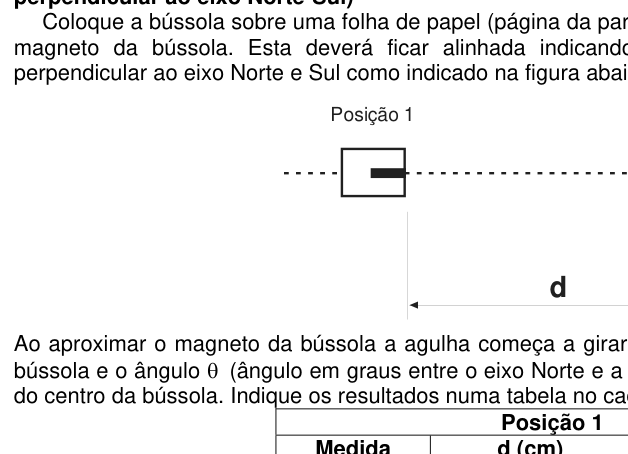 Compass with N-S axis and perpendicular distance d
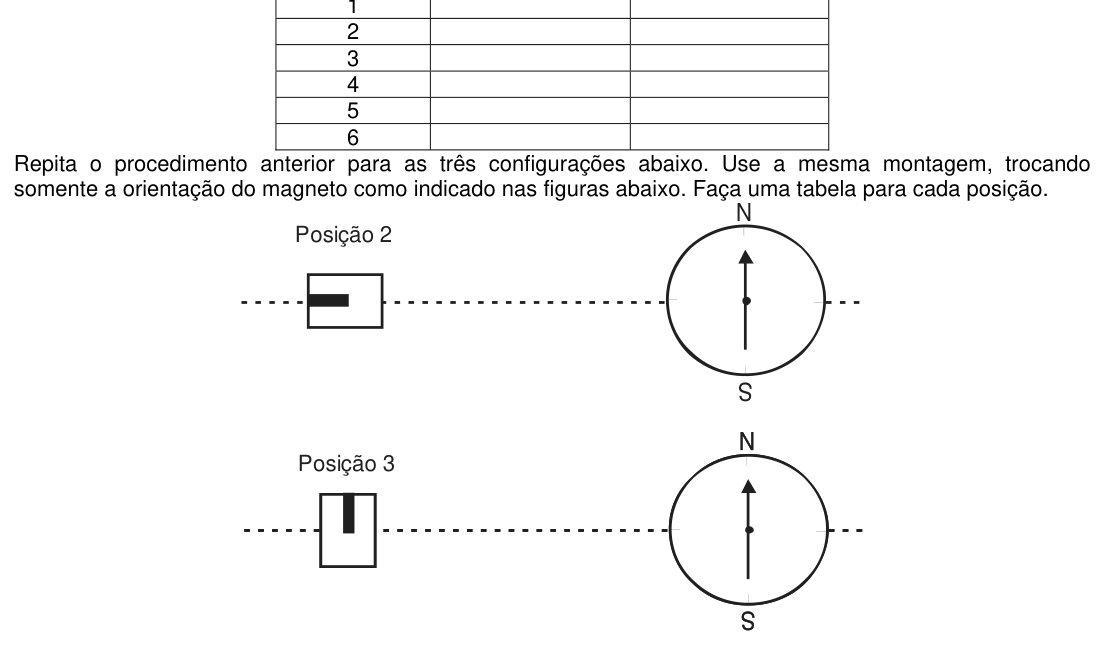 Magnet orientations Positions 1–4 perpendicular direction
Topic: Magnetism, Electromagnetism Metodi: Experimental Data Analysis, Physical Modeling, Free-Body Diagram Competenze: Measurement & Instrumentation, Experimental Data Analysis, Physical Reasoning Objects: Magnet Fonte: Testo (PDF) — p.3
**PARTICO II Proprietà di interazione del magnete con la bussola (misurate in direzione perpendicolare all’asse nord-sud) **
Metti la compassa su una foglia di carta (pagina della parte II) del libretto di risposte. Non avvicinare il magnete della bussola. Questa deve essere allineata indicando il Nord nella sua posizione. Tracciare una linea perpendicolare all’asse Nord e Sud come indicato nella figura seguente.
Appostando il magnete alla compassa, l’ago inizia a girare. Misura la distanza dal magnete al centro della compassa e l’angolo (angolo in gradi tra l’asse nord e l’ago). Fai 6 misure di 2 cm su 2 dal centro della compassa. Indicare i risultati in una tabella del libretto di risoluzioni utilizzando il modello:
| Medida | (cm) | (graus) |
|---|---|---|
| 1 | ||
| 2 | ||
| 3 | ||
| 4 | ||
| 5 | ||
| 6 |
Ripeti la procedura precedente per le tre configurazioni di seguito (punto 2, 3 e 4). Utilizzare lo stesso montaggio, cambiando solo l’orientamento del magnete come indicato nelle figure. Fai una tavola per ogni posizione.
**Questa:**Sulla base dell’analisi dei risultati ottenuti indicare per le posizioni 3 e 4 quale di esse rappresenta l’attrazione e la repulsione.
Compass with N-S axis and perpendicular distance d
Magnet orientations Positions 14 perpendicolare direction
Topic: Magnetism, Electromagnetism Metodi: Experimental Data Analysis, Physical Modeling, Free-Body Diagram Competenze: Measurement & Instrumentation, Experimental Data Analysis, Physical Reasoning Objects: Magnet Fonte: Testo (PDF) — p.3
**Part II Property of the magnetic interaction with the bubble (measured in the direction perpendicular to the North-South axis) **
Place the compass on a sheet of paper (page of Part II) of the answer book. Don’t move the magnet to the compass. This one should be aligned with the North in its position. Draw a straight line perpendicular to the north and south axis as shown in the figure below.
As the magnet approaches the compass, the needle begins to spin. Measure the distance from the magnet to the center of the compass and the angle (angle in degrees between the North axis and the needle). Make six measurements of two by two centimeters from the center of the compass. Enter the results in a table in the resolution book using the model:
| Medida | (cm) | (graus) |
|---|---|---|
| 1 | ||
| 2 | ||
| 3 | ||
| 4 | ||
| 5 | ||
| 6 |
Repeat the previous procedure for the three settings below (Sections 2, 3 and 4). Use the same assembly, changing only the orientation of the magnet as shown in the figures. Make a table for each position.
Pergunta: Baseando-se na análise dos resultados obtidos indique para as posições 3 e 4 qual delas representa atração e a repulsão.
Compass with N-S axis and perpendicular distance d
Magnet orientations Positions 1–4 perpendicular direction
Topic: Magnetism, Electromagnetism Metodi: Experimental Data Analysis, Physical Modeling, Free-Body Diagram Competenze: Measurement & Instrumentation, Experimental Data Analysis, Physical Reasoning Objects: Magnet Fonte: Testo (PDF) — p.3
PARTE III – PROPRIEDADES DA INTERAÇÃO DO MAGNETO COM A BÚSSOLA (medidas na direção paralela ao eixo Norte-Sul)
Repita o mesmo procedimento da PARTE II só que na direção paralela ao eixo Norte-Sul para as 4 posições indicadas na figura abaixo. Neste caso trace uma reta paralela ao eixo Norte-Sul com o magneto longe da Bússola e depois inicie suas medidas. Indique os resultados em 4 tabelas no mesmo modelo que a anterior.
Pergunta: Baseando-se na análise dos resultados obtidos indique para as posições 3 e 4 qual delas representa atração e a repulsão.
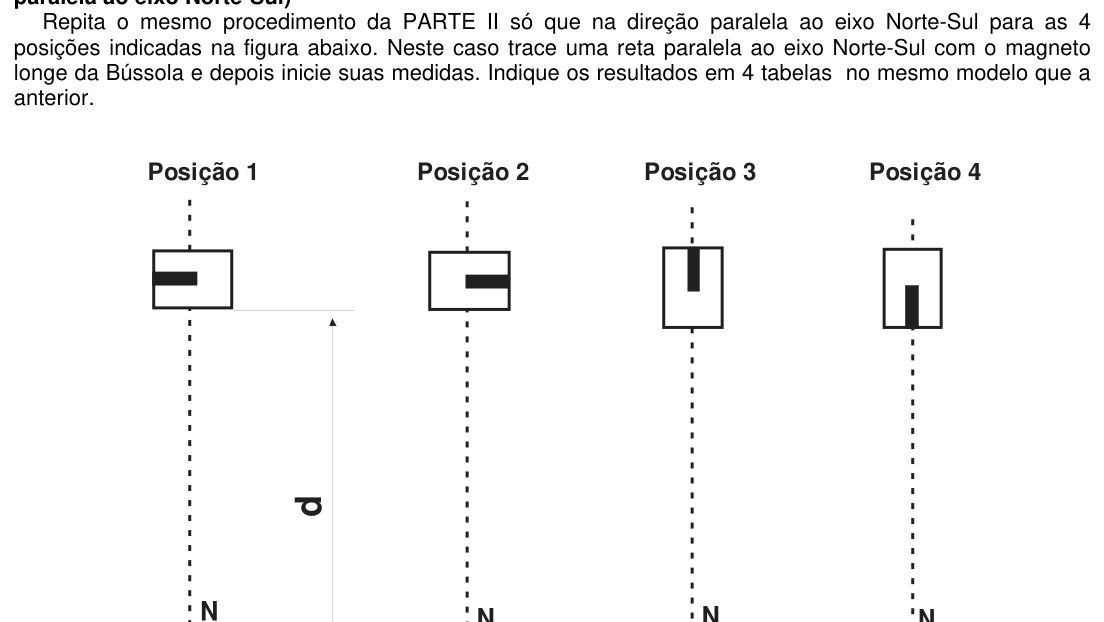 Magnet orientations Positions 1–4 parallel to N-S axis
Topic: Magnetism, Electromagnetism Metodi: Experimental Data Analysis, Physical Modeling, Superposition Principle Competenze: Measurement & Instrumentation, Experimental Data Analysis, Physical Reasoning Objects: Magnet Fonte: Testo (PDF) — p.4
**PARTOLO III Proprietà di interazione del magnete con la bussola (misurate in direzione parallela all’asse nord-sud) **
Ripetere la stessa procedura di PARTE II, solo che nella direzione parallela all’asse Nord-Sud per le 4 posizioni indicate nella figura seguente. In questo caso traccia una linea parallela all’asse Nord-Sud con il magnete lontano dalla bussola e poi inizia le sue misurazioni. Indicare i risultati in 4 tabelle sul modello precedente.
**Questa:**Sulla base dell’analisi dei risultati ottenuti indicare per le posizioni 3 e 4 quale di esse rappresenta l’attrazione e la repulsione.
Magnet orientations Positions 14 parallel to N-S axis
Topic: Magnetism, Electromagnetism Metodi: Experimental Data Analysis, Physical Modeling, Superposition Principle Competenze: Measurement & Instrumentation, Experimental Data Analysis, Physical Reasoning Objects: Magnet Fonte: Testo (PDF) — p.4
**Part III Property of the magnetic interaction with the bubble (measured in the direction parallel to the North-South axis) **
Repeat the same procedure as in PART II only in the direction parallel to the North-South axis for the 4 positions shown in the figure below. In this case, draw a straight line parallel to the North-South axis with the magnet away from the compass and then start measuring. Indicate the results in 4 tables in the same model as the previous one.
Question: Based on the analysis of the results obtained, indicate for positions 3 and 4 which of them represents attraction and repulsion.
The following information is provided for in the Annex to Regulation (EU) No 1303/2013.
Topic: Magnetism, Electromagnetism Metodi: Experimental Data Analysis, Physical Modeling, Superposition Principle Competenze: Measurement & Instrumentation, Experimental Data Analysis, Physical Reasoning Objects: Magnet Fonte: Testo (PDF) — p.4
PARTE IV – REPRESENTAÇÃO GRÁFICA
Utilize os resultados obtidos para a Posição 1 (Parte II) e faça um gráfico do ângulo como função da distância (use o quadriculado do caderno de respostas). Indique os eixos e as escalas.
Topic: Magnetism, Electromagnetism Metodi: Graph Linearization, Experimental Data Analysis Competenze: Graph Linearization, Experimental Data Analysis Objects: — Fonte: Testo (PDF) — p.4
PARTIVO Rappresentazione grafica
Utilizzare i risultati ottenuti per la posizione 1 (parte II) e fare un grafico dell’angolo come funzione della distanza (utilizzare il quadricolo del libretto di risposte). Indicate gli assi e le scale.
Topic: Magnetism, Electromagnetism Metodi: Graph Linearization, Experimental Data Analysis Competenze: Graph Linearization, Experimental Data Analysis Objects: — Fonte: Testo (PDF) — p.4
The following table shows the results of the evaluation:
Use the results obtained for Position 1 (Part II) and draw a graph of the angle as a function of the distance (use the answer book quadrillation). Point out the axes and scales.
Topic: Magnetism, Electromagnetism Metodi: Graph Linearization, Experimental Data Analysis Competenze: Graph Linearization, Experimental Data Analysis Objects: — Fonte: Testo (PDF) — p.4