Pai e filho estão caminhando com velocidade constante por uma via que forma um arco de circunferência e desejam ir do ponto A ao ponto B. Ambos argumentam qual seria o trajeto com o menor tempo: AB ou ADCB. O filho acredita que indo diretamente de A a B pode ir no menor tempo, já o pai pensa que atravessando a via e indo a D, em seguida a C e atravessando novamente a via chegando em B pode chegar primeiro que o filho. A figura ao lado mostra esquematicamente as trajetórias para um ângulo .
Qual o ângulo (em radianos) em que os tempos das duas trajetórias serão os mesmos?
 Arc path A-D-C-B vs chord AB, angle theta
Topic: Newtonian Mechanics, Oscillations & Waves Metodi: Kinematic Equations, Physical Modeling Competenze: Mathematical Modeling, Physical Reasoning Objects: — Fonte: Testo (PDF) — p.1
Padre e figlio camminano a velocità costante su una via che forma un arco di circonferenza e desiderano andare dal punto A al punto B. Entrambi discutono quale sarebbe il percorso con il minor tempo: AB o ADCB. Il figlio crede che andare direttamente da A a B può andare in meno tempo, mentre il padre pensa che attraversando la via e andando a D, poi a C e attraversando di nuovo la via arrivando a B può arrivare prima del figlio. La figura di cui al lato mostra schematicamente le traiettorie per un angolo .
Qual o ângulo (em radianos) em que os tempos das duas trajetórias serão os mesmos?
Arc path A-D-C-B vs chord AB, angle theta
Topic: Newtonian Mechanics, Oscillations & Waves Metodi: Kinematic Equations, Physical Modeling Competenze: Mathematical Modeling, Physical Reasoning Objects: — Fonte: Testo (PDF) — p.1
Father and son are walking at constant speed along a path that forms a circle arc and want to go from point A to point B. Both argue which would be the shortest route: AB or ADCB. The son believes that going straight from A to B can go in the shortest time, while the father thinks that crossing the path and going to D, then to C and crossing the path again reaching B can get there first than the son. The figure next to the diagram shows the trajectories for an angle .
Qual o ângulo (em radianos) em que os tempos das duas trajetórias serão os mesmos?
Arc path A-D-C-B vs chord AB, angle theta
Topic: Newtonian Mechanics, Oscillations & Waves Metodi: Kinematic Equations, Physical Modeling Competenze: Mathematical Modeling, Physical Reasoning Objects: — Fonte: Testo (PDF) — p.1
Um carro viaja a 100 km/h durante 40 minutos quando o motorista decide fazer uma parada de 20 minutos. Em seguida viaja por mais 2 horas a uma velocidade de 95 km/h. Qual foi a velocidade média da viagem em km/h? Despreze os intervalos de tempo em que houve aceleração e desaceleração nas paradas e partidas.
Topic: Newtonian Mechanics Metodi: Kinematic Equations Competenze: Physical Reasoning, Unit Conversion Objects: Cart Fonte: Testo (PDF) — p.1
Una macchina percorre a 100 km/h per 40 minuti quando il conducente decide di fare un’ostazione di 20 minuti. Poi viaggia per altre due ore a 95 km/h. Qual è stata la velocità media del viaggio in chilometri orari? Scommettiamo che i tempi di accelerazione e di rallentamento dei fermi e delle partenze sono stati trascurati.
Topic: Newtonian Mechanics Metodi: Kinematic Equations Competenze: Physical Reasoning, Unit Conversion Objects: Cart Fonte: Testo (PDF) — p.1
A car travels at 100 km/h for 40 minutes when the driver decides to make a 20-minute stop. Then travel for another 2 hours at a speed of 95 km/h. What was the average speed of the trip in km/h? Disregard the time intervals in which there was acceleration and deceleration at stops and departures.
Topic: Newtonian Mechanics Metodi: Kinematic Equations Competenze: Physical Reasoning, Unit Conversion Objects: Cart Fonte: Testo (PDF) — p.1
A figura mostra um pêndulo simples ideal em várias posições diferentes oscilando entre A e B. Em cada uma das posições mostradas esquematize o vetor aceleração. Na posição central o pêndulo está na vertical.
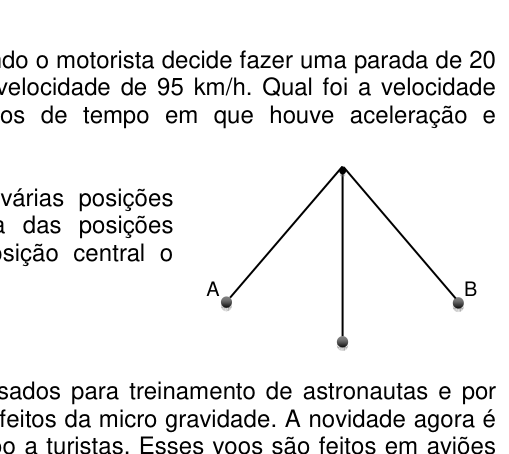 Pendulum oscillating between positions A and B
Topic: Oscillations & Waves, Newtonian Mechanics Metodi: Simple Harmonic Motion Analysis, Free-Body Diagram Competenze: Diagrammatic Reasoning, Physical Reasoning Objects: Pendulum Fonte: Testo (PDF) — p.1
La figura mostra un semplice pendolo ideale in diverse posizioni diverse oscillanti tra A e B. In ciascuna delle posizioni mostrate schematizzare il vettore di accelerazione. Nella posizione centrale il pendolo è verticale.
*Pendulum oscillating between positions A and B *
Topic: Oscillations & Waves, Newtonian Mechanics Metodi: Simple Harmonic Motion Analysis, Free-Body Diagram Competenze: Diagrammatic Reasoning, Physical Reasoning Objects: Pendulum Fonte: Testo (PDF) — p.1
The figure shows an ideal simple pendulum in several different positions swinging between A and B. In each of the positions shown, sketch the acceleration vector. In the central position the pendulum is vertical.
*Pendulum oscillating between positions A and B *
Topic: Oscillations & Waves, Newtonian Mechanics Metodi: Simple Harmonic Motion Analysis, Free-Body Diagram Competenze: Diagrammatic Reasoning, Physical Reasoning Objects: Pendulum Fonte: Testo (PDF) — p.1
Há mais de 20 anos voos parabólicos têm sido usados para treinamento de astronautas e por cientistas das mais diversas áreas interessados nos efeitos da micro gravidade. A novidade agora é que algumas empresas têm oferecido esse tipo de voo a turistas. Esses voos são feitos em aviões adaptados onde os ocupantes podem experimentar a “ausência” de gravidade. A uma altitude de 6000 m o piloto inicia uma subida até alcançar 7600 m com o avião a uma inclinação de , produzindo uma aceleração de aproximadamente . Nesse momento, o piloto reduz a potência do avião a praticamente zero – potência suficiente apenas para vencer o arraste do ar. Durante aproximadamente 20 s, o avião e os seus ocupantes são lançados numa trajetória parabólica subindo por mais 2000 m. Quando o avião atinge novamente o piloto retoma a potência do motor e retorna ao voo horizontal, podendo eventualmente repetir o procedimento. Baseado no texto e fazendo a hipótese de que o avião pode ser considerado como uma partícula, responda:
(a) Qual é, em quilômetros por hora, a velocidade do avião no momento em que o piloto reduz a potência?
(b) Qual a distância horizontal percorrida pelo avião durante a trajetória parabólica?
(c) Supondo que ao retomar a potência o avião descreva uma trajetória circular de raio 4500 m, qual é a aceleração dos ocupantes no ponto mais baixo da trajetória?
Topic: Newtonian Mechanics Metodi: Kinematic Equations, Free-Body Diagram, Energy Conservation Method Competenze: Physical Reasoning, Mathematical Modeling Objects: — Fonte: Testo (PDF) — p.1
Per oltre 20 anni, i voli parabolici sono stati utilizzati per addestrare gli astronauti e gli scienziati di vari settori interessati agli effetti della microgravità. La novità ora è che alcune compagnie hanno offerto questo tipo di volo ai turisti. Questi voli sono effettuati su aerei adattati dove gli occupanti possono sperimentare l’assenza di gravità. A 6000 m di altitudine il pilota inizia un’ascensione fino a raggiungere i 7600 m con l’aereo ad un’inclinazione di , producendo un’accelerazione di circa . A quel punto, il pilota riduce la potenza dell’aereo a quasi zero potenza sufficiente solo per vincere il tralaggio dell’aria. Per circa 20 secondi, l’aereo e i suoi passeggeri vengono lanciati in un percorso parabolico che sale per altri 2000 m. Quando l’aereo raggiunge di nuovo, il pilota riprende la potenza del motore e torna a volo orizzontale, potendo eventualmente ripetere la procedura. Sulla base del testo e facendo la ipotesi che l’aereo possa essere considerato come una particella, risponde:
(a) Qual è la velocità dell’aereo in chilometri orari quando il pilota riduce la potenza?
b) Qual è la distanza orizzontale percorsa dall’aereo durante il percorso parabolico?
(c) Supponendo che, riprendendo la potenza, l’aereo descriva un percorso circolare di 4500 m di raggio, quale è l’accelerazione degli occupanti al punto più basso del percorso?
Topic: Newtonian Mechanics Metodi: Kinematic Equations, Free-Body Diagram, Energy Conservation Method Competenze: Physical Reasoning, Mathematical Modeling Objects: — Fonte: Testo (PDF) — p.1
For more than 20 years, parabolic flights have been used for training astronauts and scientists in a variety of fields interested in the effects of microgravity. The news now is that some companies have offered this type of flight to tourists. These flights are made in adapted aircraft where the occupants can experience the “absence” of gravity. At an altitude of 6000 m, the pilot starts a climb to reach 7600 m with the aircraft at an inclination of , producing an acceleration of approximately . At that moment, the pilot reduces the power of the aircraft to virtually zero enough power just to overcome the drag of the air. For approximately 20 seconds, the aircraft and its occupants are launched into a parabolic trajectory rising for another 2000 m. When the aircraft reaches again, the pilot restarts the engine power and returns to horizontal flight, possibly repeating the procedure. Based on the text and assuming that the plane can be considered a particle, answer:
(a) What is the speed of the aircraft in kilometres per hour at the time the pilot reduces power?
(b) What is the horizontal distance travelled by the aircraft during the parabolic path?
(c) Assuming that when the aircraft restarts, it describes a circular trajectory of 4500 m radius, what is the acceleration of the occupants at the lowest point of the trajectory?
Topic: Newtonian Mechanics Metodi: Kinematic Equations, Free-Body Diagram, Energy Conservation Method Competenze: Physical Reasoning, Mathematical Modeling Objects: — Fonte: Testo (PDF) — p.1
Um certo planeta tem massa que é o dobro da massa da Terra. Neste planeta, o peso de um corpo é metade do peso na Terra. Qual é o raio deste planeta em termos do raio da Terra?
Topic: Gravitation, Newtonian Mechanics Metodi: Newton’s Law of Gravitation, Free-Body Diagram Competenze: Physical Reasoning, Mathematical Modeling Objects: Planet Fonte: Testo (PDF) — p.2
Um certo planeta tem massa que é o dobro da massa da Terra. Su questo pianeta, il peso di un corpo è metà del peso della Terra. Qual è il problema di questo pianeta in termini di problemi di terra?
Topic: Gravitation, Newtonian Mechanics Metodi: Newton’s Law of Gravitation, Free-Body Diagram Competenze: Physical Reasoning, Mathematical Modeling Objects: Planet Fonte: Testo (PDF) — p.2
Um certo planeta tem massa que é o dobro da massa da Terra. On this planet, the weight of a body is half the weight of the Earth. What the hell is this planet in terms of the Earth?
Topic: Gravitation, Newtonian Mechanics Metodi: Newton’s Law of Gravitation, Free-Body Diagram Competenze: Physical Reasoning, Mathematical Modeling Objects: Planet Fonte: Testo (PDF) — p.2
Uma bola de futebol de 450 g está se movendo a 2,0 m/s quando um jogador a chuta com uma força constante de 45,0 N na mesma direção de seu movimento. Por quanto tempo o pé do jogador ficará em contato com a bola para aumentar sua velocidade para 4,0 m/s?
Topic: Newtonian Mechanics Metodi: Impulse-Momentum Theorem Competenze: Physical Reasoning, Mathematical Modeling Objects: Ball Fonte: Testo (PDF) — p.2
Una palla da calcio da 450 g si muove a 2,0 m/s quando un giocatore lancia con una forza costante di 45,0 N nella stessa direzione del suo movimento. Per quanto tempo il piede del giocatore rimarrà in contatto con la palla per aumentare la velocità a 4 metri al secondo?
Topic: Newtonian Mechanics Metodi: Impulse-Momentum Theorem Competenze: Physical Reasoning, Mathematical Modeling Objects: Ball Fonte: Testo (PDF) — p.2
A 450 g football is moving at 2.0 m/s when a player kicks with a constant force of 45.0 N in the same direction of his movement. How long will the player’s foot stay in contact with the ball to increase its speed to 4 m/s?
Topic: Newtonian Mechanics Metodi: Impulse-Momentum Theorem Competenze: Physical Reasoning, Mathematical Modeling Objects: Ball Fonte: Testo (PDF) — p.2
Engenheiros britânicos estão trabalhando na construção do carro mais veloz do mundo. A expectativa é que o Bloodhound SSC ultrapasse 1600 km/h batendo o recorde mundial de velocidade em terra que é, atualmente, de 1228 km/h. O carro terá dois estágios de aceleração, onde um motor a jato atuará na primeira fase e um foguete na segunda fase além de um motor a combustão auxiliar. O carro deve estar pronto para os primeiros testes em julho de 2015 e a previsão dos engenheiros é que o teste definitivo ocorra em 2016. O gráfico ao lado mostra a velocidade do veículo em função da distância (dados extraídos de http://www.bloodhoundssc.com) e o ponto destacado marca o início do acionamento do foguete. Usando os dados fornecidos pelo gráfico, determine:
(a) o instante de tempo em que o foguete será acionado
(b) o tempo que levará o carro para atingir a velocidade máxima.
 Velocity vs distance graph for Bloodhound SSC
Topic: Newtonian Mechanics Metodi: Kinematic Equations, Graph Linearization, Experimental Data Analysis Competenze: Graph Linearization, Physical Reasoning Objects: — Fonte: Testo (PDF) — p.2
Ingegneri britannici stanno lavorando alla costruzione della macchina più veloce del mondo. L’aspettativa è che il Bloodhound SSC supererà i 1600 km/h battendo il record mondiale di velocità a terra che è attualmente di 1228 km/h. La vettura avrà due fasi di accelerazione, dove un motore a jato agirà nella prima fase e un razzo nella seconda fase oltre a un motore a combustione ausiliare. La macchina dovrebbe essere pronta per i primi test nel luglio 2015 e gli ingegneri prevedono che il test definitivo si verifichi nel 2016. Il grafico di fianco mostra la velocità del veicolo in funzione della distanza (dati tratti da http://www.bloodhoundssc.com) e il punto di riferimento segna l’inizio del lancio del razzo. Usando i dati forniti dal grafico, determinare:
(a) l’istante in cui il razzo sarà attivato
(b) il tempo necessario per raggiungere la velocità massima.
Velocity vs distance graph for Bloodhound SSC
Topic: Newtonian Mechanics Metodi: Kinematic Equations, Graph Linearization, Experimental Data Analysis Competenze: Graph Linearization, Physical Reasoning Objects: — Fonte: Testo (PDF) — p.2
British engineers are working on building the world’s fastest car. Bloodhound SSC is expected to exceed 1,600 km/h, breaking the world land speed record of 1,228 km/h. The car will have two acceleration stages, where a jet engine will operate in the first phase and a rocket in the second phase in addition to an auxiliary combustion engine. The car is expected to be ready for first tests in July 2015 and the engineers predict that the final test will take place in 2016. The next graph shows the vehicle’s speed based on distance (data extracted from http://www.bloodhoundssc.com) and the highlight marks the start of the rocket’s start. Using the data provided by the chart, determine:
(a) the time of the rocket’s launch
(b) the time it will take the car to reach maximum speed.
The following is the list of the most commonly used methods of measuring the speed of a vehicle:
Topic: Newtonian Mechanics Metodi: Kinematic Equations, Graph Linearization, Experimental Data Analysis Competenze: Graph Linearization, Physical Reasoning Objects: — Fonte: Testo (PDF) — p.2
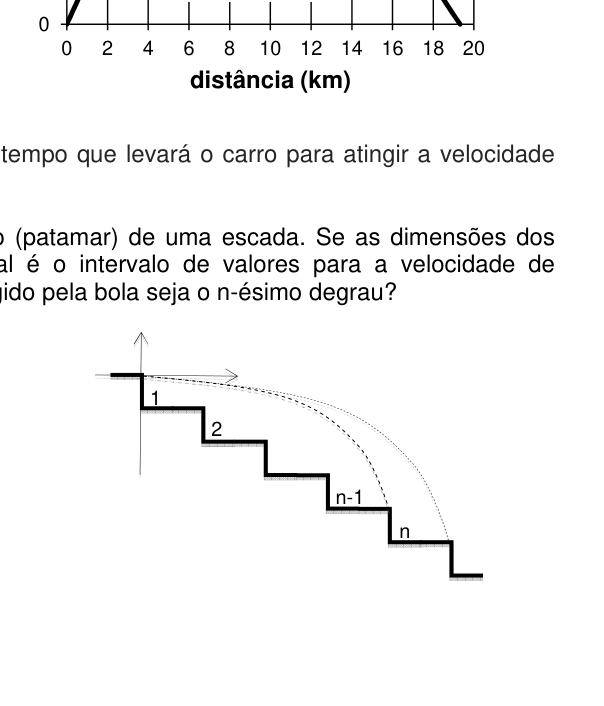
Uma bola é lançada horizontalmente do topo (patamar) de uma escada. Se as dimensões dos degraus são de largura e de altura, qual é o intervalo de valores para a velocidade de lançamento de forma que o primeiro degrau atingido pela bola seja o -ésimo degrau?
 Ball launched horizontally from stair landing, n-th step
Topic: Newtonian Mechanics Metodi: Kinematic Equations, Free-Body Diagram Competenze: Mathematical Modeling, Physical Reasoning Objects: Ball, Projectile Fonte: Testo (PDF) — p.3
Una palla viene lanciata orizzontalmente dalla cima (piano) di una scala. Se le dimensioni dei gradini sono di larghezza e di altezza, qual è l’intervallo di valori per la velocità di lancio in modo che il primo gradino raggiunto dalla palla sia -esimo gradino?
Ball launched horizontally from stair landing, n-th step
Topic: Newtonian Mechanics Metodi: Kinematic Equations, Free-Body Diagram Competenze: Mathematical Modeling, Physical Reasoning Objects: Ball, Projectile Fonte: Testo (PDF) — p.3
A ball is thrown horizontally from the top (bottom) of a ladder. If the dimensions of the steps are wide and high, what is the range of values for the launch speed so that the first step reached by the ball is -eighth step?
Ball launched horizontally from stair landing, n-th step
Topic: Newtonian Mechanics Metodi: Kinematic Equations, Free-Body Diagram Competenze: Mathematical Modeling, Physical Reasoning Objects: Ball, Projectile Fonte: Testo (PDF) — p.3