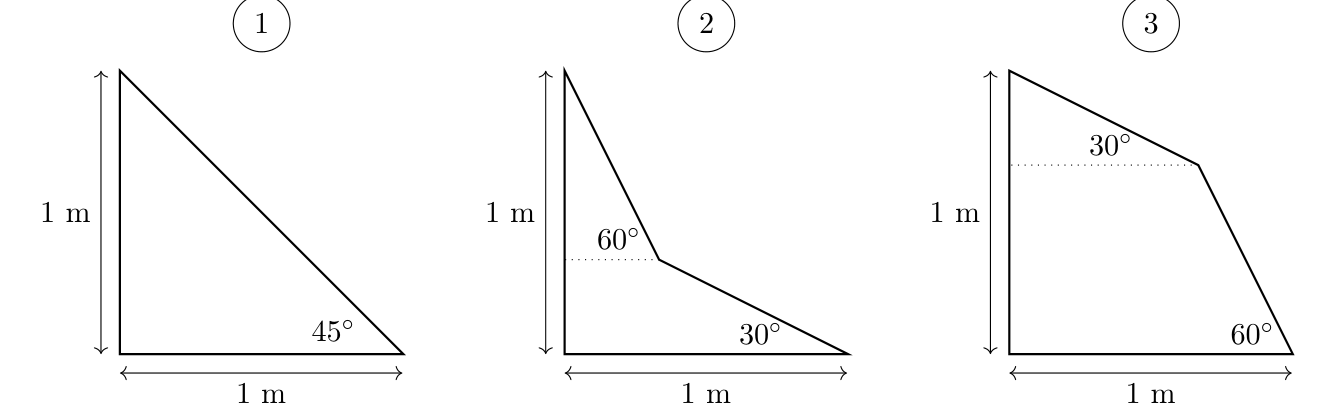
Fastest Path. A small toy car rolls down three ramps with the same height and horizontal length, but different shapes, starting from rest. The car stays in contact with the ramp at all times and no energy is lost. Order the ramps from the fastest to slowest time it takes for the toy car to drop the full . For example, if ramp 1 is the fastest and ramp 3 is the slowest, then enter 123 as your answer choice.
Fonte: Testo (PDF) — p.4 Topic: Newtonian Mechanics, Conservation of Energy Metodi: Conservation of Energy, Kinematic Equations, Calculus-Integration Competenze: Physical Reasoning, Mathematical Modeling Objects: Cart, Inclined Plane
Un piccolo autovettore da giocattoli scende su tre rampe con la stessa altezza e lunghezza orizzontali, ma con forme diverse, partendo dal riposo. L’auto rimane in contatto con la rampa in ogni momento e non si perde energia. Ordina le rampe dal più veloce al più lento tempo necessario per far cadere il pieno . Ad esempio, se la rampa 1 è la più veloce e la rampa 3 la più lenta, inserisci 123 come scelta della risposta.
Fonte: Testo (PDF) — p.4 Topic: Newtonian Mechanics, Conservation of Energy Metodi: Conservation of Energy, Kinematic Equations, Calculus-Integration Competenze: Physical Reasoning, Mathematical Modeling Objects: Cart, Inclined Plane
Resistor Puzzle. What is the smallest number of resistors needed such that when arranged in a certain arrangement involving only series and parallel connections, the equivalent resistance is ?
Fonte: Testo (PDF) — p.4 Topic: Circuits Metodi: Equivalent Circuit Reduction, Symmetry Argument Competenze: Physical Reasoning, Mathematical Modeling Objects: Resistor
Resistor Puzzle. Qual è il numero più piccolo di resistori necessari in modo che, quando disposti in una determinata disposizione che coinvolge solo serie e connessioni parallele, la resistenza equivalente sia ?
Fonte: Testo (PDF) — p.4 Topic: Circuits Metodi: Equivalent Circuit Reduction, Symmetry Argument Competenze: Physical Reasoning, Mathematical Modeling Objects: Resistor
Derby Race. In a typical derby race, cars start at the top of a ramp, accelerate downwards, and race on a flat track, and are always set-up in the configuration shown below.
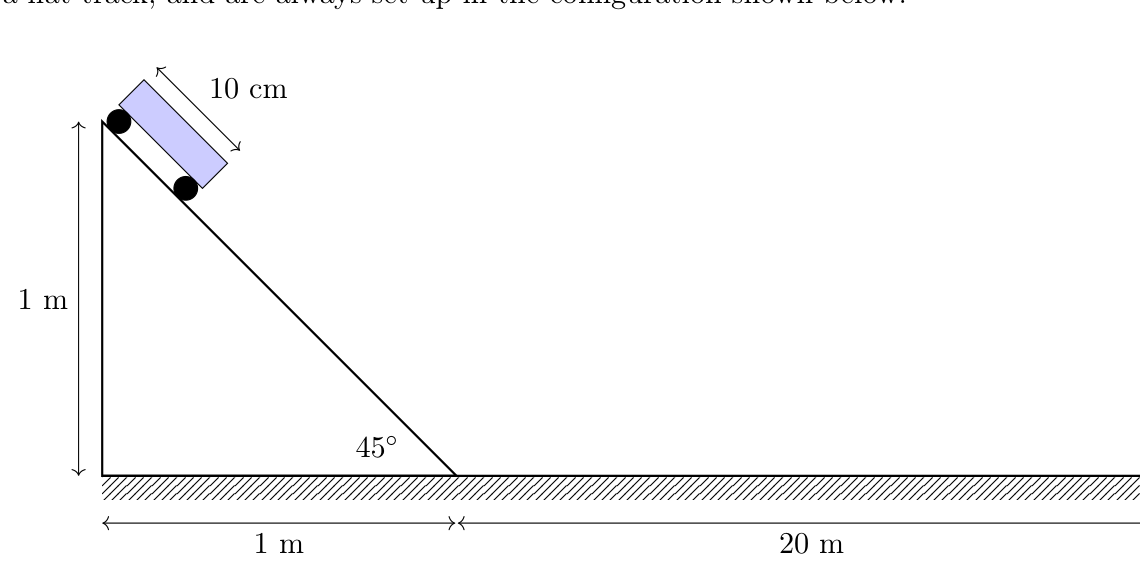
A common technique is to change the location of the center of mass of the car to gain an advantage. Alice ensures the center of mass of her car is at the rear and Bob puts the center of mass of his car at the very front. Otherwise, their cars are exactly the same. Each car’s time is defined as the time from when the car is placed on the top of the ramp to when the front of the car reaches the end of the flat track. At the competition, Alice’s car beat Bob’s. What is the ratio of Bob’s car’s time and Alice’s car’s time?
Assume that the wheels are small and light compared to the car body, neglect air resistance, and the height of the cars are small compared to the height of the ramp. In addition, neglect all energy losses during the race and the time it takes to turn onto the horizontal surface from the ramp. Express your answer as a decimal greater than 1.
Fonte: Testo (PDF) — p.4 Topic: Rotational Dynamics, Conservation of Energy Metodi: Conservation of Energy, Torque & Angular Momentum Analysis, Kinematic Equations Competenze: Physical Reasoning, Mathematical Modeling Objects: Cart, Inclined Plane
In una gara tipica, le auto partono in cima alla rampa, accelerano verso il basso e corrono su una pista piatta, e sono sempre montate nella configurazione mostrata di seguito.
Una tecnica comune è quella di cambiare la posizione del centro di massa dell’auto per ottenere un vantaggio. Alice si assicura che il centro di massa della sua auto sia nella parte posteriore e Bob mette il centro di massa della sua auto proprio nella parte anteriore. Altrimenti, le loro auto sono esattamente le stesse. Il tempo di ciascuna auto è definito come il tempo che passa dal momento in cui la vettura è posta sulla cima della rampa fino al momento in cui la parte anteriore della vettura raggiunge la fine della pista piatta. Alla gara, la macchina di Alice ha battuto quella di Bob. Qual è il rapporto tra il tempo della macchina di Bob e quello di Alice?
Supponiamo che le ruote siano piccole e leggere rispetto al corpo della macchina, trascurate la resistenza all’aria e che l’altezza delle auto sia piccola rispetto all’altezza della rampa. Inoltre, trascurare tutte le perdite di energia durante la gara e il tempo necessario per girare sulla superficie orizzontale dalla rampa. Esprimete la vostra risposta come decimale superiore a 1.
Fonte: Testo (PDF) — p.4 Topic: Rotational Dynamics, Conservation of Energy Metodi: Conservation of Energy, Torque & Angular Momentum Analysis, Kinematic Equations Competenze: Physical Reasoning, Mathematical Modeling Objects: Cart, Inclined Plane
Crane. A simple crane is shown in the below diagram, consisting of light rods with length and . The end of the crane is supporting a object. Point is known as a “pin.” It is attached to the main body and can exert both a vertical and horizontal force. Point is known as a “roller” and can only exert vertical forces. Rods can only be in pure compression or pure tension.
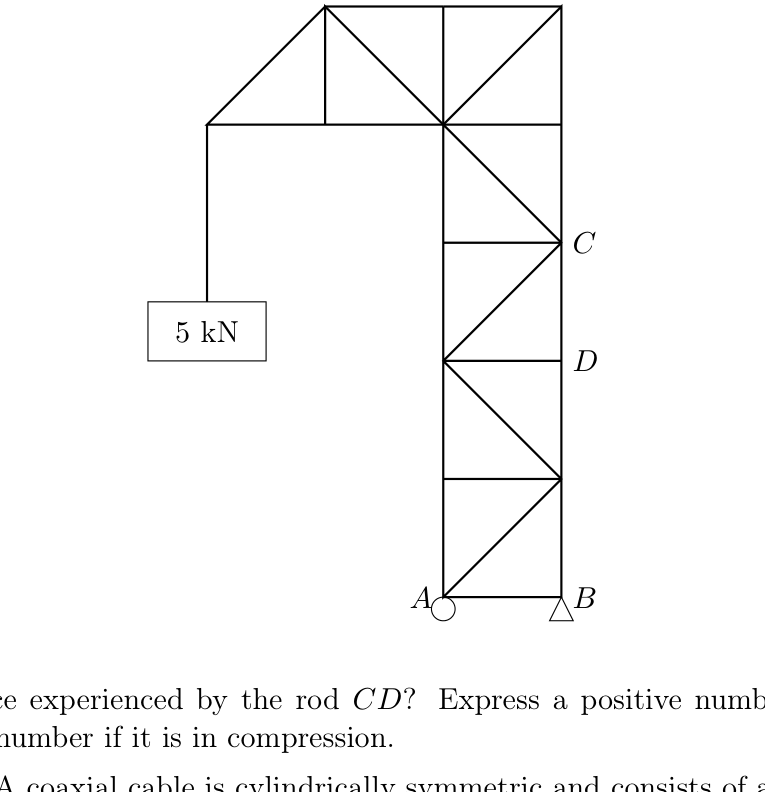
In kN, what is the force experienced by the rod ? Express a positive number if the member is in tension and a negative number if it is in compression.
Fonte: Testo (PDF) — p.5 Topic: Rigid Body Statics Metodi: Free-Body Diagram, Torque & Angular Momentum Analysis, Vector Decomposition Competenze: Diagrammatic Reasoning, Physical Reasoning Objects: Rod
Gran. Nel diagramma di seguito è mostrata una semplice gru, costituita da barre di luce con lunghezza e . L’estremità della gru supporta un oggetto . Il punto è noto come “pin”. È attaccato al corpo principale e può esercitare sia una forza verticale che orizzontale. Il punto è noto come “roller” e può esercitare solo forze verticali. I bastoni possono essere solo in pura compressione o pura tensione.
In kN, qual è la forza sperimentata dalla canna ? Esprimere un numero positivo se il membro è in tensione e un numero negativo se è in compressione.
Fonte: Testo (PDF) — p.5 Topic: Rigid Body Statics Metodi: Free-Body Diagram, Torque & Angular Momentum Analysis, Vector Decomposition Competenze: Diagrammatic Reasoning, Physical Reasoning Objects: Rod
Coaxial Cable. A coaxial cable is cylindrically symmetric and consists of a solid inner cylinder of radius and an outer cylindrical shell of inner radius and outer radius . A uniformly distributed current of total magnitude is flowing in the inner cylinder and a uniformly distributed current of the same magnitude but opposite direction flows in the outer shell. Find the magnitude of the magnetic field as a function of distance from the axis of the cable. As the final result, submit . In case this is infinite, submit .
Fonte: Testo (PDF) — p.5 Topic: Magnetism Metodi: Ampère’s Law, Symmetry Argument, Calculus-Integration Competenze: Physical Reasoning, Mathematical Modeling Objects: Wire, Cylinder
Cabello coaxiale. Un cavo coaxiale è cilindricamente simmetrico e consiste in un cilindro interno solido di raggio e in una conchiglia cilindrica esterna di raggio interno e raggio esterno . Nel cilindro interno scorre una corrente uniformemente distribuita di magnitudo totale e nella conchiglia esterna scorre una corrente uniformemente distribuita di stessa magnitudo ma in direzione opposta. Trova la magnitudine del campo magnetico in funzione della distanza dall’asse del cavo. Come risultato finale, presentare . Nel caso in cui questo numero sia infinito, inviare .
Fonte: Testo (PDF) — p.5 Topic: Magnetism Metodi: Ampère’s Law, Symmetry Argument, Calculus-Integration Competenze: Physical Reasoning, Mathematical Modeling Objects: Wire, Cylinder
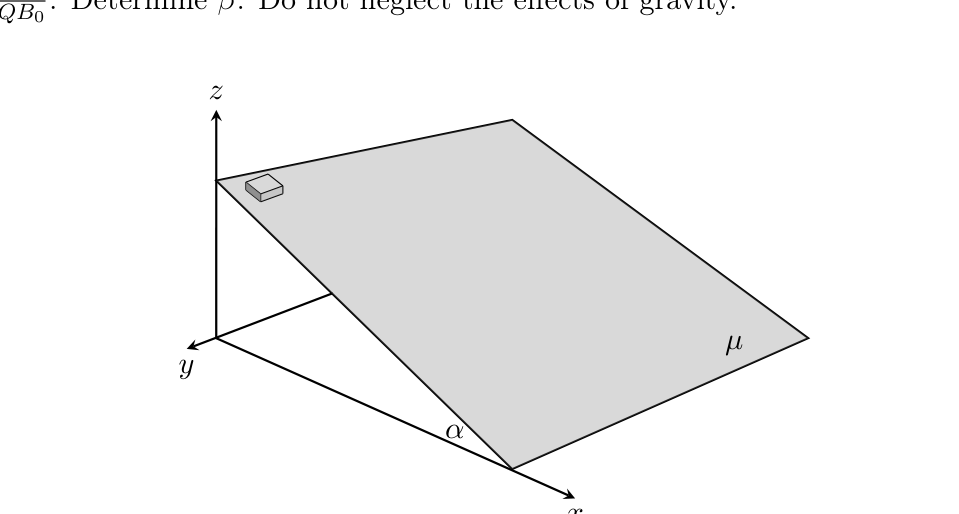
Magnetic Block. A small block of mass and charge is placed at rest on an inclined plane with a slope . The coefficient of friction between them is . A homogeneous magnetic field of magnitude is applied perpendicular to the slope. The speed of the block after a very long time is given by . Determine . Do not neglect the effects of gravity.
Fonte: Testo (PDF) — p.5 Topic: Electromagnetism, Newtonian Mechanics Metodi: Lorentz Force Analysis, Free-Body Diagram, Differential Equations Competenze: Physical Reasoning, Mathematical Modeling Objects: Block, Inclined Plane
Blocco magnetico. Un piccolo blocco di massa e carica è posto a riposo su un piano inclinato con pendenza . Il coefficiente di attrito tra loro è . Si applica un campo magnetico omogeneo di magnitudo perpendicolare alla pendenza. La velocità del blocco dopo un lungo periodo di tempo è data da . Determina . Non trascurare gli effetti della gravità.
Fonte: Testo (PDF) — p.5 Topic: Electromagnetism, Newtonian Mechanics Metodi: Lorentz Force Analysis, Free-Body Diagram, Differential Equations Competenze: Physical Reasoning, Mathematical Modeling Objects: Block, Inclined Plane
Thermal Train. A train of length and mass is travelling at along a straight track. The driver engages the brakes and the train starts decelerating at a constant rate, coming to a stop after travelling a distance . As the train decelerates, energy released as heat from the brakes goes into the tracks, which have a linear heat capacity of . Assume the rate of heat generation and transfer is uniform across the length of the train at any given moment.
If the tracks start at an ambient temperature of , there is a function that describes the temperature (in Celsius) of the tracks at each point , where the rear of where the train starts is at . Assume (unrealistically) that 100% of the original kinetic energy of the train is transferred to the tracks (the train does not absorb any energy), that there is no conduction of heat along the tracks, and that heat transfer between the tracks and the surroundings is negligible.
Compute in degrees Celsius.
Fonte: Testo (PDF) — p.6 Topic: Thermodynamics, Newtonian Mechanics Metodi: Conservation of Energy, Kinematic Equations, Calculus-Integration Competenze: Physical Reasoning, Mathematical Modeling Objects: —
**Termo ** Un treno di lunghezza e massa viaggia a lungo una pista retta. Il conducente attiva i freni e il treno inizia a rallentare a velocità costante, arrivando a fermarsi dopo aver percorso una distanza . Quando il treno rallenta, l’energia rilasciata come calore dai freni va nelle binarie, che hanno una capacità termico lineare di . Supponiamo che la velocità di generazione e trasferimento del calore sia uniforme nel corso del treno in un determinato momento.
Se le binarie partono a una temperatura ambientale di , esiste una funzione che descrive la temperatura (in Celsius) delle binarie a ciascun punto , dove la parte posteriore del punto di partenza del treno è a . Supponiamo (irrealizzativamente) che il 100% dell’energia cinetica originale del treno sia trasferito sulle binarie (il treno non assorbe alcuna energia), che non vi sia alcuna conduzione di calore lungo le binarie e che il trasferimento di calore tra le binarie e l’ambiente è trascurabile.
Calcolare in gradi Celsius.
Fonte: Testo (PDF) — p.6 Topic: Thermodynamics, Newtonian Mechanics Metodi: Conservation of Energy, Kinematic Equations, Calculus-Integration Competenze: Physical Reasoning, Mathematical Modeling Objects: —
Fountain. A sprinkler fountain is in the shape of a semi-sphere that spews out water from all angles at a uniform speed such that without the presence of wind, the wetted region around the fountain forms a circle in the plane with the fountain centered on it.
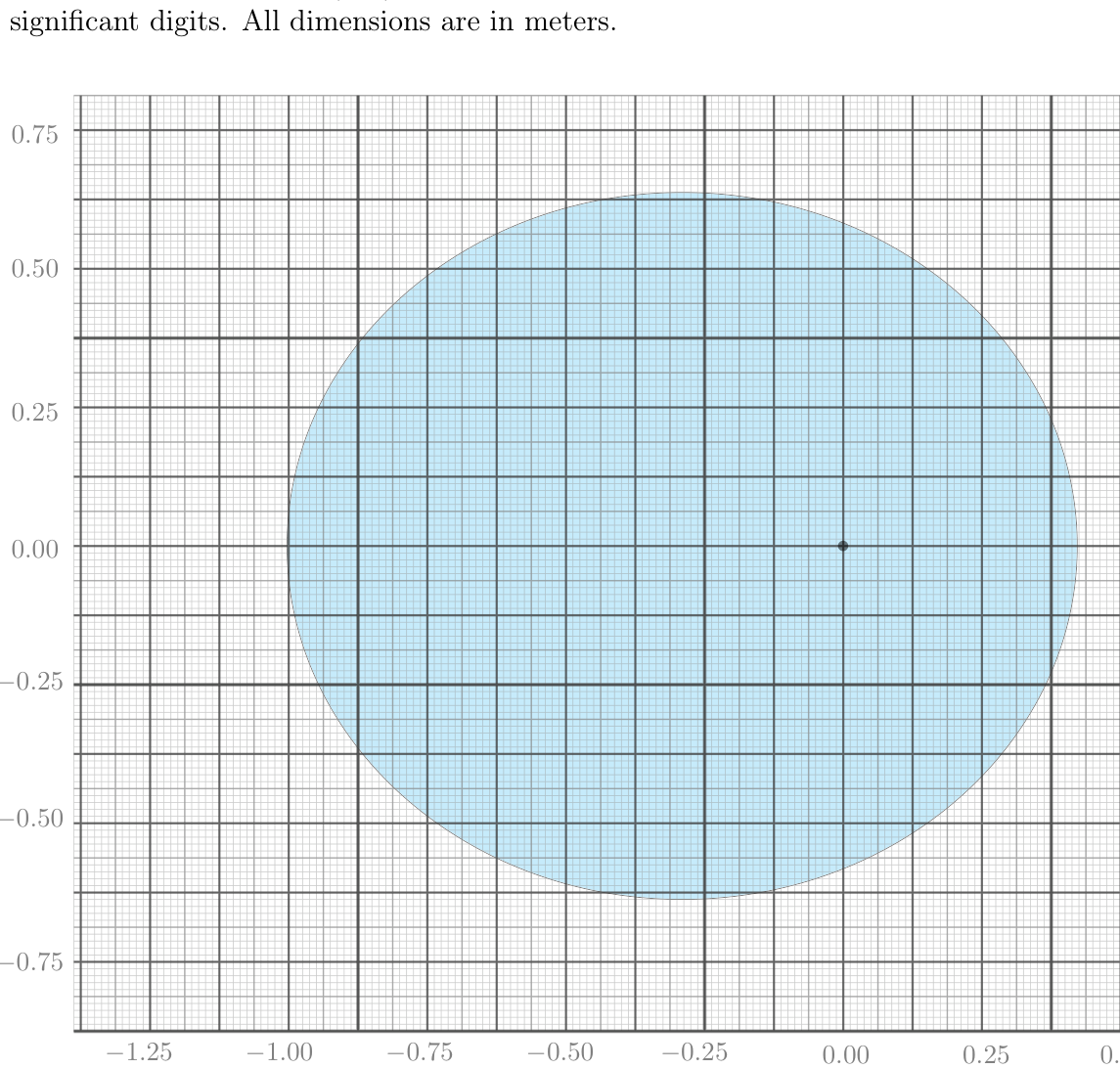
Now suppose there is a constant wind blowing in a direction parallel to the ground such that the force acting on each water molecule is proportional to their weight. The wetted region forms the shape below where the fountain is placed at . Determine the exit speed of water in meters per second. Round to two significant digits. All dimensions are in meters.
Fonte: Testo (PDF) — p.6 Topic: Newtonian Mechanics Metodi: Kinematic Equations, Vector Decomposition, Physical Modeling Competenze: Physical Reasoning, Mathematical Modeling Objects: Droplet, Projectile
Una fontana sprinkler ha la forma di una semisfera che spezza acqua da tutti gli angoli a velocità uniforme in modo tale che, senza la presenza di vento, la regione umida intorno alla fontana forma un cerchio nel piano con la fontana centrata su di essa.
Supponiamo che ci sia un vento costante che soffia in direzione parallela al suolo in modo tale che la forza che agisce su ogni molecola d’acqua sia proporzionale al loro peso. La regione umida forma la forma di sotto, dove la fontana è collocata a . Determinare la velocità di uscita dell’acqua in metri al secondo. Rondo a due cifre significative. Tutte le dimensioni sono in metri.
Fonte: Testo (PDF) — p.6 Topic: Newtonian Mechanics Metodi: Kinematic Equations, Vector Decomposition, Physical Modeling Competenze: Physical Reasoning, Mathematical Modeling Objects: Droplet, Projectile
Escaping Nieons. Consider a gas of mysterious particles called nieons that all travel at the same speed, . They are enclosed in a cubical box, and there are nieons per unit volume. A very small hole of area is punched in the side of the box. The number of nieons that escape the box per unit time is given by
where , , , and are all dimensionless constants. Calculate .
Fonte: Testo (PDF) — p.7 Topic: Kinetic Theory Metodi: Kinetic Theory of Gases, Dimensional Analysis, Statistical Averaging Competenze: Physical Reasoning, Mathematical Modeling Objects: Gas, Container
Escaping Nieons. Considera un gas di particelle misteriose chiamate nieons che viaggiano tutte alla stessa velocità, . Sono incastrate in una scatola cubica e ci sono nioni per unità di volume. Un piccolo buco di superficie viene perforato nel lato della scatola. Il numero di nioni che escono dalla scatola per unità di tempo è dato da
dove , , e sono tutte costanti senza dimensioni. Calcolare .
Fonte: Testo (PDF) — p.7 Topic: Kinetic Theory Metodi: Kinetic Theory of Gases, Dimensional Analysis, Statistical Averaging Competenze: Physical Reasoning, Mathematical Modeling Objects: Gas, Container
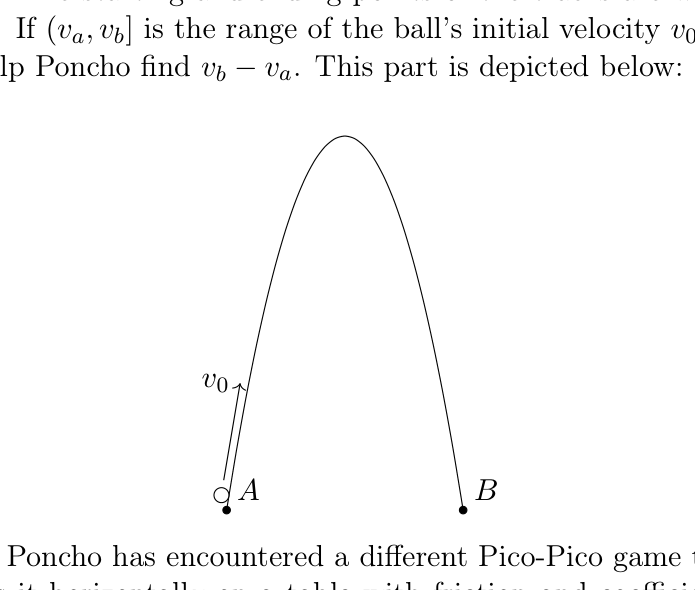
Pico-Pico 1. Poncho is a very good player of the legendary carnival game known as Pico-Pico. Its setup consists of a steel ball, represented by a point mass, of negligible radius and a frictionless vertical track. The goal of Pico-Pico is to flick the ball from the beginning of the track (point ) such that it is able to traverse through the track while never leaving the track, successfully reaching the end (point ). The most famous track design is one of parabolic shape; specifically, the giant track is of the shape in meters. The starting and ending points of the tracks are the two points where the track intersects . If is the range of the ball’s initial velocity that satisfies the winning condition of Pico-Pico, help Poncho find . This part is depicted below:
Fonte: Testo (PDF) — p.7 Topic: Newtonian Mechanics, Conservation of Energy Metodi: Conservation of Energy, Free-Body Diagram, Calculus-Integration Competenze: Physical Reasoning, Mathematical Modeling Objects: Ball
Pico-Pico 1.** Poncho è un giocatore molto bravo del leggendario gioco di carnevale noto come Pico-Pico. La sua configurazione consiste in una sfera di acciaio, rappresentata da una massa puntaria, di raggio trascurabile e di una pista verticale senza attrito. L’obiettivo di Pico-Pico è quello di spostare la palla dall’inizio della pista (punto ) in modo che possa attraversare la pista senza mai uscire dalla pista, raggiungendo con successo la fine (punto ). Il design più famoso della pista è quello di forma parabola; in particolare, la pista gigante è di forma in metri. I punti di partenza e di fine delle binarie sono i due punti di intersezione della binaria . Se è l’intervallo della velocità iniziale della palla che soddisfa la condizione di vincita di Pico-Pico, aiuta Poncho a trovare . Questa parte è raffigurata di seguito:
Fonte: Testo (PDF) — p.7 Topic: Newtonian Mechanics, Conservation of Energy Metodi: Conservation of Energy, Free-Body Diagram, Calculus-Integration Competenze: Physical Reasoning, Mathematical Modeling Objects: Ball
Pico-Pico 2. Now, Poncho has encountered a different Pico-Pico game that uses the same shaped frictionless track, but lays it horizontally on a table with friction and coefficient of friction . In addition, the ball, which can once again be considered a point mass, is placed on the other side of the track as the ball in part 1. Finally, a buzzer on the other side of the track requires the mass to hit with at least velocity in order to trigger the buzzer and win the game. Find the minimum velocity required for the ball to reach the end of the track with a velocity of at least . The initial velocity must be directed along the track.
Fonte: Testo (PDF) — p.7 Topic: Newtonian Mechanics, Conservation of Energy Metodi: Free-Body Diagram, Energy Conservation Method, Calculus-Integration Competenze: Physical Reasoning, Mathematical Modeling Objects: Ball
Ora, Poncho ha incontrato un altro gioco Pico-Pico che utilizza la stessa pista senza attrito, ma la pone orizzontalmente su un tavolo con attrito e coefficiente di attrito . Inoltre, la palla, che può ancora una volta essere considerata una massa puntaria, viene collocata dall’altra parte della pista come la palla nella parte 1. Infine, un buzzer dall’altra parte della pista richiede che la massa colpisca con almeno una velocità per attivare il buzzer e vincere la partita. Trova la velocità minima necessaria per raggiungere la fine della pista con una velocità di almeno . La velocità iniziale deve essere diretta lungo la pista.
Fonte: Testo (PDF) — p.7 Topic: Newtonian Mechanics, Conservation of Energy Metodi: Free-Body Diagram, Energy Conservation Method, Calculus-Integration Competenze: Physical Reasoning, Mathematical Modeling Objects: Ball
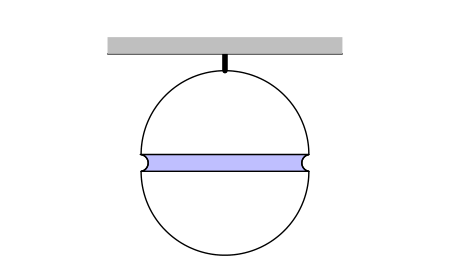
Golden Apple. Anyone who’s had an apple may know that pieces of an apple stick together: when picking up one piece a second piece may also come with the first piece. The same idea is tried on a golden apple. Consider two uniform hemispheres with radius made of gold of density . The top half is nailed to a support and the space between is filled with water.
Given that the surface tension of water is and that the contact angle between gold and water is , what is the maximum distance between the two hemispheres so that the bottom half doesn’t fall? Answer in millimeters.
Fonte: Testo (PDF) — p.7 Topic: Fluid Mechanics Metodi: Hydrostatic Equilibrium, Free-Body Diagram, Physical Modeling Competenze: Physical Reasoning, Mathematical Modeling Objects: Sphere, Droplet
Chiunque abbia mangiato una mela sa che i pezzi di una mela si attaccano: quando si raccoglie un pezzo, un secondo pezzo può venire anche con il primo pezzo. La stessa idea viene provato su una mela d’oro. Considerate due emisferi uniformi con raggio in oro di densità . La metà superiore è chiusa a un supporto e lo spazio tra è riempito di acqua.
Dato che la tensione superficiale dell’acqua è e che l’angolo di contatto tra oro e acqua è , qual è la distanza massima tra i due emisferi in modo che la metà inferiore non cade? Rispondi in millimetri.
Fonte: Testo (PDF) — p.7 Topic: Fluid Mechanics Metodi: Hydrostatic Equilibrium, Free-Body Diagram, Physical Modeling Competenze: Physical Reasoning, Mathematical Modeling Objects: Sphere, Droplet
The following information applies to Problems 13 and 14. In the following two problems we will look at shooting a basketball. Model the basketball as an elastic hollow sphere with radius meters. Model the net and basket as shown below, dimensions marked. Neglect friction between the backboard and basketball, and assume all collisions are perfectly elastic.
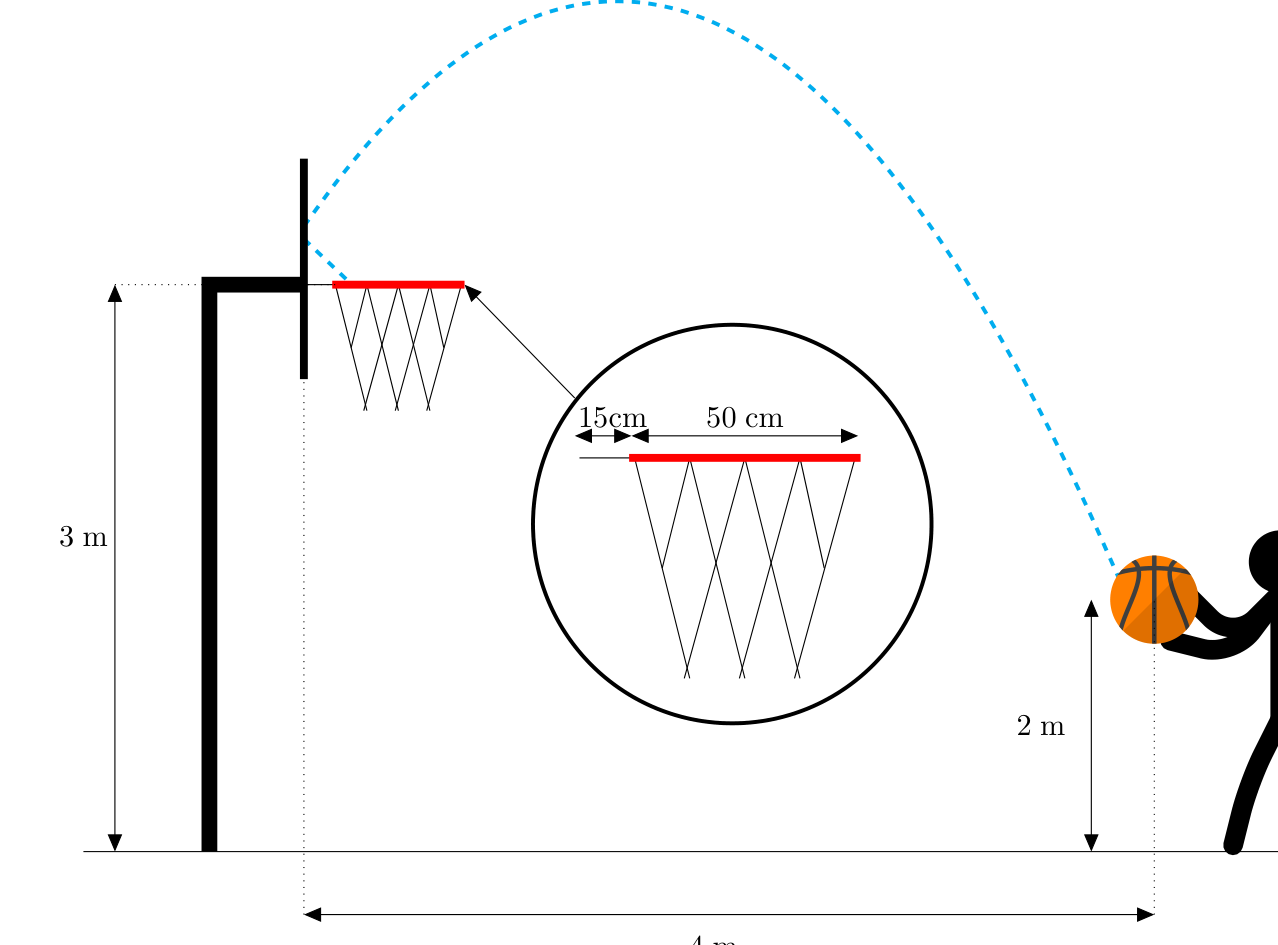
Free Throw. For this problem, you launch the basketball from the point that is meters above the ground and meters from the backboard as shown. You attempt to make a shot by hitting the basketball off the backboard as depicted above. What is the minimum initial speed required for the ball to make this shot?
Note: For this problem, you may assume that the size of the ball is negligible.
Fonte: Testo (PDF) — p.8 Topic: Newtonian Mechanics Metodi: Kinematic Equations, Vector Decomposition, Conservation of Energy Competenze: Physical Reasoning, Mathematical Modeling Objects: Ball
**Le seguenti informazioni si applicano ai problemi 13 e 14. ** Nei due seguenti problemi esamineremo il tiro a basket. Modellare la pallacanestro come una sfera vuota elastica con raggio metri. Modellare la rete e il cestino come mostrato di seguito, dimensioni segnate. Non si deve pensare all’attrito tra la schiena e il basket, e assumere che tutte le collisioni siano perfettamente elasticate.
Per questo problema, si lancia il basket dal punto che è metri sopra il terreno e metri dal tavolo posteriore come mostrato. Si tenta di fare un colpo colpendo la palla da dietro come raffigurato sopra. Qual è la velocità iniziale minima necessaria per fare questo colpo?
Nota: Per questo problema, si può presumere che la dimensione della palla sia trascurabile.
Fonte: Testo (PDF) — p.8 Topic: Newtonian Mechanics Metodi: Kinematic Equations, Vector Decomposition, Conservation of Energy Competenze: Physical Reasoning, Mathematical Modeling Objects: Ball
Layup. You now wish to practice closer shots. You walk up until you’re away from the backboard (the changes to a ). You jump in the air. What is the minimum initial speed of the ball that allows you to score off the backboard if you release the ball at the top of your jump? Note that scoring off the backboard means that the ball bounces off the backboard and into the net. Do not consider cases where the ball bounces off of the rim or the protrusion. That’s just luck and you want a consistent strategy.
Hint: Neglecting the size of the ball may no longer be possible.
Fonte: Testo (PDF) — p.8 Topic: Newtonian Mechanics Metodi: Kinematic Equations, Vector Decomposition, Physical Modeling Competenze: Physical Reasoning, Mathematical Modeling Objects: Ball
Layup. You now wish to practice closer shots. Si cammina fino a quando si è lontano dal cartone posteriore (il cambia a un ). You jump in the air. Qual è la velocità minima iniziale della palla che ti permette di segnare sul piano posteriore se rilasci la palla in cima al tuo salto? Si noti che segnare dal banco significa che la palla rimbalza dal banco e entra nella rete. Non considerare i casi in cui la palla rimbalza dal bordo o dalla protrusione. E’ solo fortuna e vuoi una strategia coerente.
Suggerimento: Non è più possibile trascurare la dimensione della palla.
Fonte: Testo (PDF) — p.8 Topic: Newtonian Mechanics Metodi: Kinematic Equations, Vector Decomposition, Physical Modeling Competenze: Physical Reasoning, Mathematical Modeling Objects: Ball
Right Triangle Potentials. Let be a solid right triangle (, , and ) with uniform charge density . Let be the midpoint of . We denote the electric potential of a point by . The electric potential at infinity is . If where is a dimensionless constant, determine .
Fonte: Testo (PDF) — p.9 Topic: Electrostatics Metodi: Electric Potential Method, Calculus-Integration, Superposition Principle Competenze: Physical Reasoning, Mathematical Modeling Objects: —
Potenziali del triangolo retto. sia un triangolo retto solido (, e ) con densità di carica uniforme . Il punto medio di è . Indichiamo il potenziale elettrico di un punto con . Il potenziale elettrico all’infinito è . Se , dove è una costante senza dimensioni, determinare .
Fonte: Testo (PDF) — p.9 Topic: Electrostatics Metodi: Electric Potential Method, Calculus-Integration, Superposition Principle Competenze: Physical Reasoning, Mathematical Modeling Objects: —
Toilet Paper Roll. Consider a toilet paper roll with some length of it hanging off as shown. The toilet paper roll rests on a cylindrical pole of radius and the coefficient of static friction between the roll and the pole is .
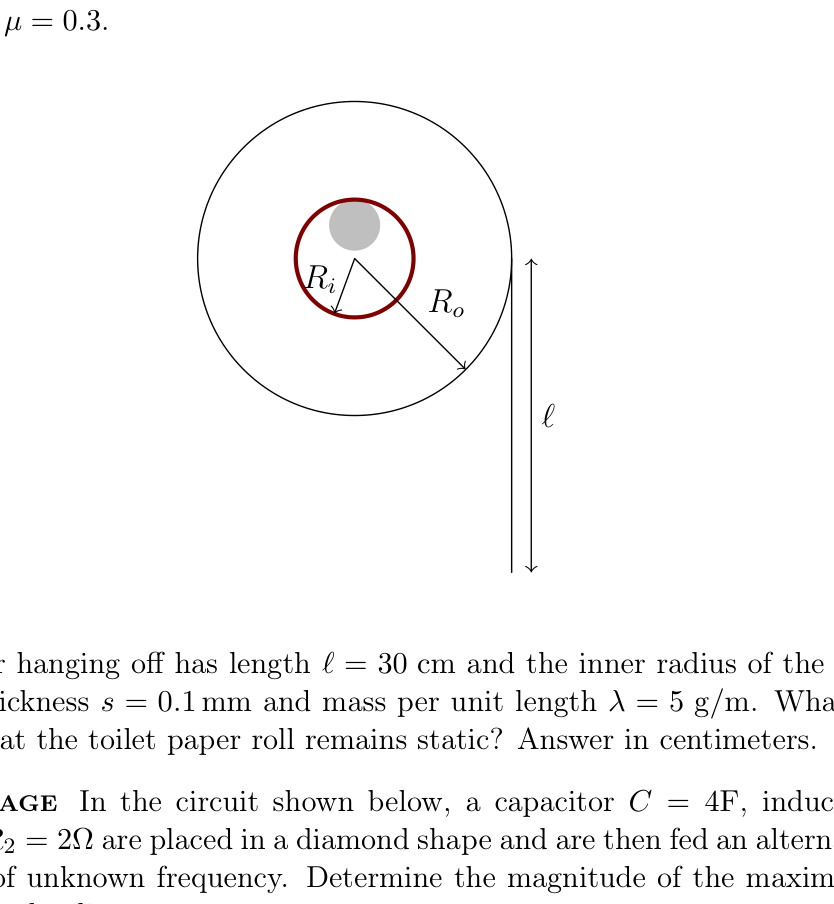
The length of the paper hanging off has length and the inner radius of the roll is . The toilet paper has thickness and mass per unit length . What is the minimum outer radius such that the toilet paper roll remains static? Answer in centimeters.
Fonte: Testo (PDF) — p.9 Topic: Rigid Body Statics Metodi: Free-Body Diagram, Torque & Angular Momentum Analysis, Calculus-Integration Competenze: Physical Reasoning, Mathematical Modeling Objects: Cylinder
Rollino di carta igienica. Considerate un rollino di carta igienica con una certa lunghezza appesa come mostrato. Il rollo di carta igienica si fonda su un polo cilindrico di raggio e il coefficiente di attrito statico tra il rollo e il polo è .
La lunghezza della carta appesa è e il raggio interno del rotolio è . La carta igienica ha spessore e massa per unità di lunghezza . Qual è il raggio esterno minimo tale da mantenere la rola di carta igienica in stato statico? Rispondi in centimetri.
Fonte: Testo (PDF) — p.9 Topic: Rigid Body Statics Metodi: Free-Body Diagram, Torque & Angular Momentum Analysis, Calculus-Integration Competenze: Physical Reasoning, Mathematical Modeling Objects: Cylinder
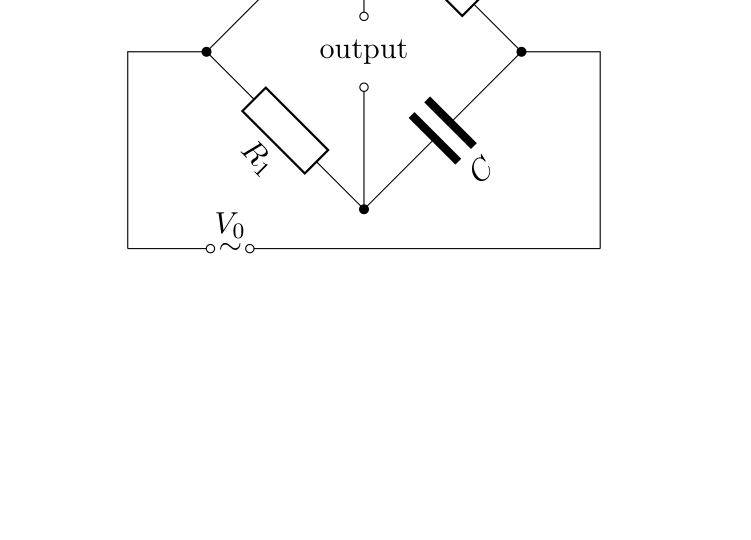
Maximum Voltage. In the circuit shown below, a capacitor , inductor , and resistors and are placed in a diamond shape and are then fed an alternating current with peak voltage of unknown frequency. Determine the magnitude of the maximum instantaneous output voltage shown in the diagram.
Fonte: Testo (PDF) — p.9 Topic: Circuits Metodi: Kirchhoff’s Laws, Equivalent Circuit Reduction, Differential Equations Competenze: Physical Reasoning, Mathematical Modeling Objects: Capacitor, Inductor, Resistor
Voltaggio massimo. Nel circuito riportato di seguito, un condensatore , un induttore e le resistenze e sono posizionati in forma di diamante e vengono quindi alimentati con una corrente alternata con una tensione di picco di frequenza sconosciuta. Determinare la magnitudine della tensione di uscita massima istantanea mostrata nel diagramma.
Fonte: Testo (PDF) — p.9 Topic: Circuits Metodi: Kirchhoff’s Laws, Equivalent Circuit Reduction, Differential Equations Competenze: Physical Reasoning, Mathematical Modeling Objects: Capacitor, Inductor, Resistor
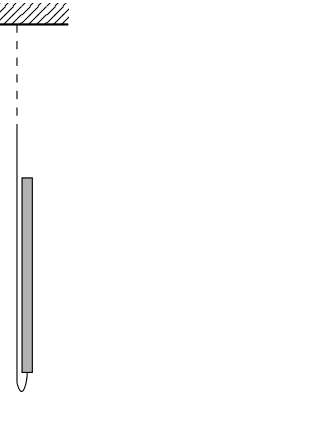
Suspended Rod - 1. A uniform bar of length and mass is connected to a very long thread of negligible mass suspended from a ceiling. It is then rotated such that it is vertically upside down and then released. Initially, the rod is in unstable equilibrium. As it falls down, the minimum tension acting on the thread over the rod’s entire motion is given by . Determine .
Fonte: Testo (PDF) — p.10 Topic: Rotational Dynamics, Conservation of Energy Metodi: Torque & Angular Momentum Analysis, Conservation of Energy, Free-Body Diagram Competenze: Physical Reasoning, Mathematical Modeling Objects: Rod, String
Rota sospesa - 1. Un’artigliatura uniforme di lunghezza e massa è collegata a un filo molto lungo di massa trascurabile sospeso da un soffitto. Si ruota in modo che sia verticalmente al contrario e poi rilasciato. Inizialmente, la canna è in equilibrio instabile. Quando cade, la tensione minima che agisce sul filo su tutto il movimento della canna è data da . Determina .
Fonte: Testo (PDF) — p.10 Topic: Rotational Dynamics, Conservation of Energy Metodi: Torque & Angular Momentum Analysis, Conservation of Energy, Free-Body Diagram Competenze: Physical Reasoning, Mathematical Modeling Objects: Rod, String
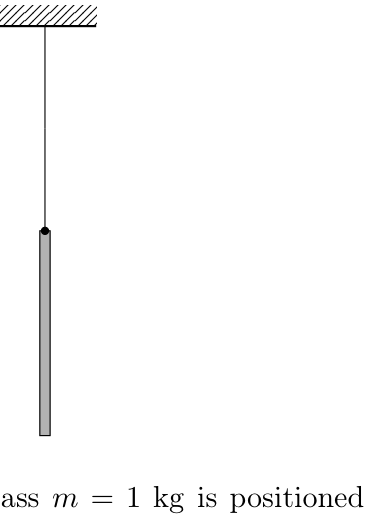
Suspended Rod - 2. A uniform bar of length and mass is connected to a thread of length of negligible mass and is suspended from the ceiling at equilibrium. The rod is then slightly nudged at a point on its body. The largest stable frequency of oscillations of the system is given by . Determine .
Fonte: Testo (PDF) — p.10 Topic: Oscillations & Waves, Rotational Dynamics Metodi: Simple Harmonic Motion Analysis, Torque & Angular Momentum Analysis, Small-Angle Approximation Competenze: Physical Reasoning, Mathematical Modeling Objects: Rod, String
Suspended Rod - 2. Un’artigliatura uniforme di lunghezza e massa è collegata a un filo di lunghezza di massa trascurabile e è sospesa dal soffitto in equilibrio. La canna viene poi leggermente spinta in un punto del corpo. La frequenza stabile più elevata di oscillazioni del sistema è data da . Determina .
Fonte: Testo (PDF) — p.10 Topic: Oscillations & Waves, Rotational Dynamics Metodi: Simple Harmonic Motion Analysis, Torque & Angular Momentum Analysis, Small-Angle Approximation Competenze: Physical Reasoning, Mathematical Modeling Objects: Rod, String
One Ladder. A straight ladder of mass is positioned almost vertically such that point is in contact with the ground with a coefficient of friction . It is given an infinitesimal kick at the point so that the ladder begins rotating about point . Find the value of angle of the ladder with the vertical at which the lower end starts slipping on the ground.
Fonte: Testo (PDF) — p.10 Topic: Rigid Body Statics, Rotational Dynamics Metodi: Torque & Angular Momentum Analysis, Free-Body Diagram, Energy Conservation Method Competenze: Physical Reasoning, Mathematical Modeling Objects: Rod
Una scala retta di massa è posizionata quasi verticalmente in modo tale che il punto sia in contatto con il terreno con un coefficiente di attrito . Si dà un calcio infinitesimale al punto in modo che la scala comincia a ruotare intorno al punto . Trova il valore dell’angolo della scala con la verticale alla quale l’estremità inferiore inizia a scivolare sul terreno.
Fonte: Testo (PDF) — p.10 Topic: Rigid Body Statics, Rotational Dynamics Metodi: Torque & Angular Momentum Analysis, Free-Body Diagram, Energy Conservation Method Competenze: Physical Reasoning, Mathematical Modeling Objects: Rod
Two Ladders. Two straight ladders and , each with length , are symmetrically placed on smooth ground, leaning on each other, such that they are touching with their ends and , ends and are touching the floor. The friction at any two surfaces is negligible. Initially both ladders are almost parallel and vertical. Find the distance when the points and lose contact.
Fonte: Testo (PDF) — p.10 Topic: Rotational Dynamics, Conservation of Energy Metodi: Energy Conservation Method, Torque & Angular Momentum Analysis, Free-Body Diagram Competenze: Physical Reasoning, Mathematical Modeling Objects: Rod
Due scale dritte e , ciascuna di lunghezza , sono posizionate simmetricamente su un terreno liscio, appoggiate l’una sull’altra, in modo che si toccino con le loro estremità e , le estremità e toccano il pavimento. La frizione su due superfici è trascurabile. Inizialmente entrambe le scale sono quasi parallele e verticali. Trova la distanza quando i punti e perdono contatto.
Fonte: Testo (PDF) — p.10 Topic: Rotational Dynamics, Conservation of Energy Metodi: Energy Conservation Method, Torque & Angular Momentum Analysis, Free-Body Diagram Competenze: Physical Reasoning, Mathematical Modeling Objects: Rod
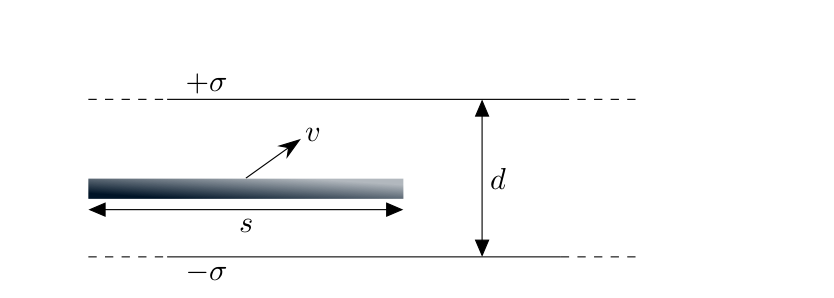
Colliding Conducting Slab. A thin conducting square slab with side length , initial charge , and mass is given a kick and sent bouncing between two infinite conducting plates separated by a distance and with surface charge density . After a long time it is observed exactly in the middle of the two plates to be traveling with velocity of magnitude and direction with respect to the horizontal line parallel to the plates. How many collisions occur after it has traveled a distance horizontally from when it was last observed? Assume that all collisions are elastic, and neglect induced charges. Note that the setup is horizontal so gravity does not need to be accounted for.
Fonte: Testo (PDF) — p.11 Topic: Electrostatics, Newtonian Mechanics Metodi: Gauss’s Law, Kinematic Equations, Free-Body Diagram Competenze: Physical Reasoning, Mathematical Modeling Objects: Capacitor
L’artigliatura di conduttore di collisione. Una sottile lastra di conduttore quadrata con lunghezza laterale , carica iniziale e massa riceve un calcio e viene inviata un rimbalzo tra due lastre di conduttore infinite separate da una distanza e con densità di carica superficiale . Dopo un lungo periodo si osserva che esattamente nel mezzo delle due lastre si muove con velocità di magnitudo e direzione rispetto alla linea orizzontale parallela alle lastre. Quante collisioni si verificano dopo aver percorso una distanza orizzontale rispetto all’ultima volta osservata? Supponiamo che tutte le collisioni siano elastiche, e trascuri le cariche indotte. Si noti che la configurazione è orizzontale, quindi non è necessario tenere conto della gravità.
Fonte: Testo (PDF) — p.11 Topic: Electrostatics, Newtonian Mechanics Metodi: Gauss’s Law, Kinematic Equations, Free-Body Diagram Competenze: Physical Reasoning, Mathematical Modeling Objects: Capacitor
Evil Gamma Photon. An evil gamma photon of energy is heading towards a spaceship. The commander’s only choice is shooting another photon in the direction of the gamma photon such that they ‘collide’ head on and produce an electron-positron pair (both have mass ). Find the lower bound on the energy of the photon as imposed by the principles of special relativity such that this occurs. Answer in keV.
Fonte: Testo (PDF) — p.11 Topic: Nuclear & Particle Physics, Special Relativity Metodi: Relativistic Energy-Momentum, Mass-Energy Equivalence, Conservation Laws Competenze: Physical Reasoning, Mathematical Modeling Objects: Photon, Electron
Evil Gamma Photon. An evil gamma photon of energy is heading towards a spaceship. L’unica scelta del comandante è quella di sparare un altro fotone nella direzione del fotone gamma in modo tale che ‘coliscano’ di testa e producano una coppia di elettroni-positroni (entrambi hanno massa ). Trova il limite inferiore dell’energia del fotone come imposto dai principi della relatività speciale in modo tale che questo accada. Rispondi in keV.
Fonte: Testo (PDF) — p.11 Topic: Nuclear & Particle Physics, Special Relativity Metodi: Relativistic Energy-Momentum, Mass-Energy Equivalence, Conservation Laws Competenze: Physical Reasoning, Mathematical Modeling Objects: Photon, Electron
Spinning Cylinder. Adithya has a solid cylinder of mass , radius , and height . He is running a test in a chamber on Earth over a distance of as shown below. Assume that the physical length of the chamber is much greater than (i.e. the chamber extends far to the left and right of the testing area). The chamber is filled with an ideal fluid with uniform density . Adithya’s cylinder is launched with linear velocity and spins counterclockwise with angular velocity . Adithya notices that the cylinder continues on a horizontal path until the end of the chamber. Find the angular velocity . Do not neglect forces due to fluid pressure differences. Note that the diagram presents a side view of the chamber (i.e. gravity is oriented downwards with respect to the diagram).
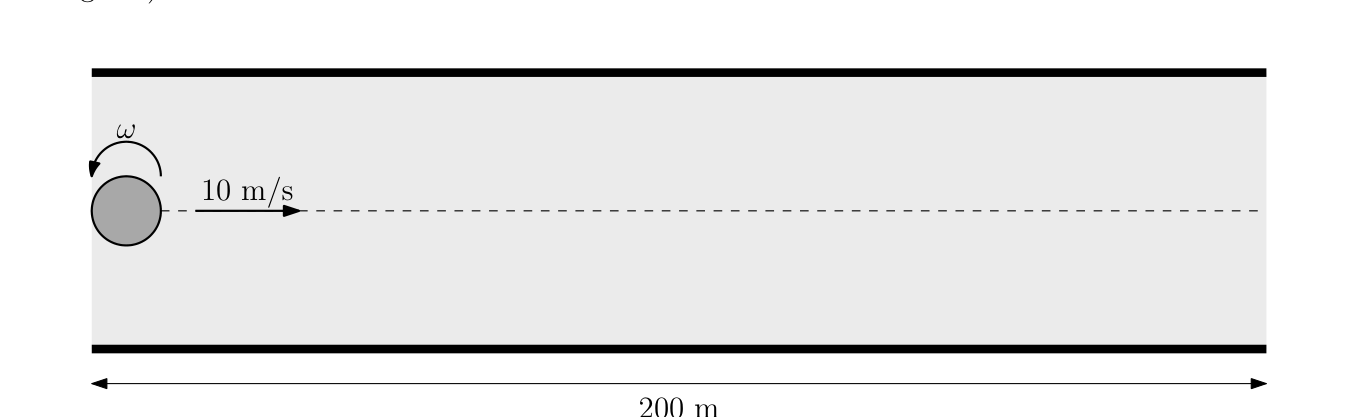
Assume the following about the setup and the ideal fluid:
- fluid flow is steady in the frame of the center of mass of the cylinder
- the ideal fluid is incompressible, irrotational, and has zero viscosity
- the angular velocity of the cylinder is approximately constant during its subsequent motion
Hint: For a uniform cylinder of radius rotating counterclockwise at angular velocity situated in an ideal fluid with flow velocity to the right far away from the cylinder, the velocity potential is given by
where is the polar coordinate system with origin at the center of the cylinder. is the circulation and is equal to . The fluid velocity is given by
Fonte: Testo (PDF) — p.12 Topic: Fluid Mechanics Metodi: Bernoulli’s Equation, Calculus-Integration, Physical Modeling Competenze: Mathematical Modeling, Physical Reasoning Objects: Cylinder
Cilindro a rotazione. Adithya ha un cilindro solido di massa , raggio e altezza . Sta eseguendo un test in una camera sulla Terra su una distanza di come mostrato di seguito. Supponiamo che la lunghezza fisica della camera sia molto maggiore di (cioè: la camera si estende a destra e sinistra della zona di prova). La camera è riempita di un fluido ideale con densità uniforme . Il cilindro di Adithya viene lanciato con velocità lineare e ruota contro il senso dell’orologio con velocità angolare . Adithya nota che il cilindro continua su un percorso orizzontale fino alla fine della camera. Trova la velocità angolare . Non trascurare le forze dovute alle differenze di pressione dei fluidi. Si noti che il diagramma presenta una vista laterale della camera (cioè: La gravità è orientata verso il basso rispetto al diagramma).
Supponiamo quanto segue sulla configurazione e sul fluido ideale:
- il flusso di fluido è costante nel quadro del centro di massa del cilindro
- il liquido ideale è incompressibile, irrotativo e ha zero viscosità
- la velocità angolare del cilindro è approssimativamente costante durante il suo successivo movimento
Suggerimento: per un cilindro uniforme di raggio che ruota in senso contrario all’orologio a velocità angolare situato in un fluido ideale con velocità di flusso a destra lontano dal cilindro, il potenziale di velocità è dato da:
dove è il sistema di coordinate polari con origine al centro del cilindro. è la circolazione ed è uguale a . La velocità del fluido è data da
Fonte: Testo (PDF) — p.12 Topic: Fluid Mechanics Metodi: Bernoulli’s Equation, Calculus-Integration, Physical Modeling Competenze: Mathematical Modeling, Physical Reasoning Objects: Cylinder
Optimal Launch. Adithya is launching a package from New York City ( and ) to Guam ( and ). Find the minimal launch velocity from New York City to Guam. Ignore the rotation of the Earth, effects due to the atmosphere, and the gravitational force from the Sun. Additionally, assume the Earth is a perfect sphere with radius and mass .
Fonte: Testo (PDF) — p.12 Topic: Gravitation Metodi: Kepler’s Laws, Energy Conservation Method, Newton’s Law of Gravitation Competenze: Mathematical Modeling, Physical Reasoning Objects: Planet
Lancio ottimale. Adithya sta lanciando un pacchetto da New York City ( e ) a Guam ( e ). Trova la velocità minima di lancio da New York City a Guam. Ignorare la rotazione della Terra, gli effetti dovuti all’atmosfera e la forza gravitazionale del Sole. Inoltre, supponiamo che la Terra sia una sfera perfetta con raggio e massa .
Fonte: Testo (PDF) — p.12 Topic: Gravitation Metodi: Kepler’s Laws, Energy Conservation Method, Newton’s Law of Gravitation Competenze: Mathematical Modeling, Physical Reasoning Objects: Planet
Drag on the Plate. Consider a container filled with argon, with molar mass , whose pressure is much smaller than that of atmospheric pressure. Suppose there is a plate of area moving with a speed perpendicular to its plane. If the gas has density , and temperature , find an approximate value for the drag force acting on the plate. Suppose that the speed of the plate is .
Fonte: Testo (PDF) — p.12 Topic: Kinetic Theory Metodi: Kinetic Theory of Gases, Statistical Averaging, Impulse-Momentum Theorem Competenze: Estimation & Approximation, Physical Reasoning Objects: Gas, Container
Straggere sulla piastra. Considera un contenitore riempito di argone, con massa molare , la cui pressione è molto inferiore a quella della pressione atmosferica. Supponiamo che ci sia una piastra di superficie in movimento a velocità perpendicolare al suo piano. Se il gas ha una densità e una temperatura , si deve trovare un valore approssimativo della forza di resistenza che agisce sulla piastra. Supponiamo che la velocità della piastra sia .
Fonte: Testo (PDF) — p.12 Topic: Kinetic Theory Metodi: Kinetic Theory of Gases, Statistical Averaging, Impulse-Momentum Theorem Competenze: Estimation & Approximation, Physical Reasoning Objects: Gas, Container
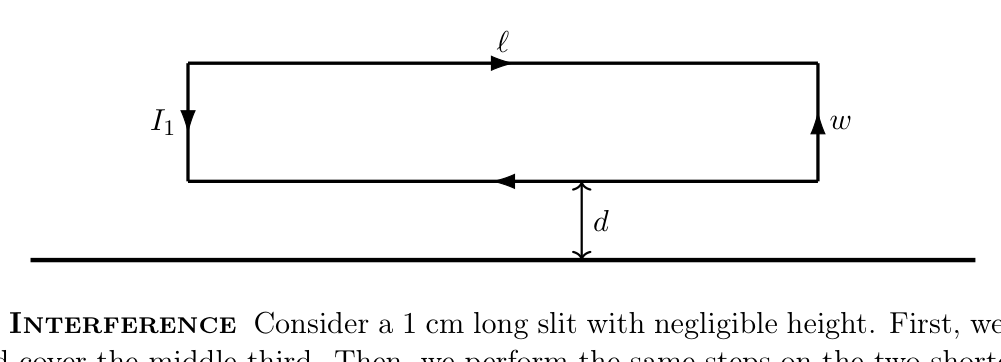
Superconducting Loop. Consider a rectangular loop made of superconducting material with length and width . The radius of this particular wire is . This superconducting rectangular loop initially has a current in the counterclockwise direction as shown in the figure below. This rectangular loop is situated a distance above an infinitely long wire that initially contains no current. Suppose that the current in the infinitely long wire is increased to some current such that there is an attractive force between the rectangular loop and the long wire. Find the maximum possible value of . Write your answer in newtons.
Hint: You may neglect the magnetic field produced by the vertical segments in the rectangular loop.
Fonte: Testo (PDF) — p.13 Topic: Electromagnetism, Magnetism Metodi: Ampère’s Law, Lorentz Force Analysis, Calculus-Integration Competenze: Mathematical Modeling, Physical Reasoning Objects: Wire, Coil
Luglio superconduttore. Considera un ciclo rettangolare fatto di materiale superconduttore con lunghezza e larghezza . Il raggio di questo particolare filo è . Questo ciclo rettangolare superconduttore ha inizialmente una corrente nella direzione contraria al senso orario come mostrato nella figura seguente. Questo ciclo rettangolare è situato a una distanza sopra un filo infinitamente lungo che inizialmente non contiene corrente. Supponiamo che la corrente nel filo infinitamente lungo sia aumentata a qualche corrente in modo tale che ci sia una forza di attrazione tra il ciclo rettangolare e il filo lungo. Trova il valore massimo possibile di . Scrivi la tua risposta in newton.
Suggerimento: Potresti trascurare il campo magnetico prodotto dai segmenti verticali del ciclo rettangolare.
Fonte: Testo (PDF) — p.13 Topic: Electromagnetism, Magnetism Metodi: Ampère’s Law, Lorentz Force Analysis, Calculus-Integration Competenze: Mathematical Modeling, Physical Reasoning Objects: Wire, Coil
Cantor Interference. Consider a long slit with negligible height. First, we divide the slit into thirds and cover the middle third. Then, we perform the same steps on the two shorter slits. Again, we perform the same steps on the four even shorter slits and continue for a very long time.
Then, we shine a monochromatic, coherent light source of wavelength on our slits, which creates an interference pattern on a wall meters away. On the wall, what is the distance between the central maximum and the first side maximum? Assume the distance to the wall is much greater than the width of the slit. Answer in millimeters.
Fonte: Testo (PDF) — p.13 Topic: Wave Optics Metodi: Interference & Diffraction Analysis, Superposition Principle, Small-Angle Approximation Competenze: Mathematical Modeling, Physical Reasoning Objects: Slit, Screen
Interferenza Cantore. Considera una fessura lunga con altezza trascurabile. Prima di tutto, dividiamo la fessura in terzi e copriamo il terzo medio. Quindi, eseguiamo gli stessi passi sulle due fessure più corte. Ancora una volta, eseguiamo gli stessi passi sulle quattro fessure ancora più corte e continuiamo per molto tempo.
Quindi, illuminiamo una fonte di luce monocromatica e coerente di lunghezza d’onda sulle nostre fessure, che crea un modello di interferenza su un muro a metri di distanza. Sul muro, qual è la distanza tra il massimo centrale e il massimo laterale? Supponiamo che la distanza verso il muro sia molto maggiore della larghezza della fessura. Rispondi in millimetri.
Fonte: Testo (PDF) — p.13 Topic: Wave Optics Metodi: Interference & Diffraction Analysis, Superposition Principle, Small-Angle Approximation Competenze: Mathematical Modeling, Physical Reasoning Objects: Slit, Screen
The following information applies to Problems 29 and 30. A certain planet with radius is made of a liquid with constant density with the exception of a homogeneous solid core of radius and mass . Normally, the core is situated at the geometric center of the planet. However, a small disturbance has moved the center of the core away from the geometric center of the planet. The core is released from rest, and the fluid is inviscid and incompressible.
Solid Core - 1. Calculate the magnitude of the force due to gravity that now acts on the core. Work under the assumption that .
Fonte: Testo (PDF) — p.13 Topic: Gravitation Metodi: Newton’s Law of Gravitation, Superposition Principle, Symmetry Argument Competenze: Mathematical Modeling, Physical Reasoning Objects: Planet
**Le seguenti informazioni si applicano ai problemi 29 e 30. ** Un certo pianeta con raggio è costituito da un liquido con densità costante , ad eccezione di un nucleo solido omogeneo di raggio e di massa . Normalmente, il nucleo si trova al centro geometrico del pianeta. Tuttavia, un piccolo disturbo ha spostato il centro del nucleo lontano dal centro geometrico del pianeta. Il nucleo viene rilasciato dal riposo e il fluido è invisibile e incompressibile.
Core solido - 1. Calcolare la grandezza della forza dovuta alla gravità che agisce ora sul nucleo. Lavorare con l’ipotesi che .
Fonte: Testo (PDF) — p.13 Topic: Gravitation Metodi: Newton’s Law of Gravitation, Superposition Principle, Symmetry Argument Competenze: Mathematical Modeling, Physical Reasoning Objects: Planet
Solid Core - 2. Calculate the magnitude of the force due to the pressure from the liquid that now acts on the core.
Fonte: Testo (PDF) — p.13 Topic: Fluid Mechanics, Gravitation Metodi: Hydrostatic Equilibrium, Newton’s Law of Gravitation, Calculus-Integration Competenze: Mathematical Modeling, Physical Reasoning Objects: Planet
Core solido - 2. Calcolare l’entità della forza dovuta alla pressione del liquido che agisce ora sul nucleo.
Fonte: Testo (PDF) — p.13 Topic: Fluid Mechanics, Gravitation Metodi: Hydrostatic Equilibrium, Newton’s Law of Gravitation, Calculus-Integration Competenze: Mathematical Modeling, Physical Reasoning Objects: Planet
Solenoids. A scientist is doing an experiment with a setup consisting of ideal solenoids that share the same axis. The lengths of the solenoids are both , the radii of the solenoids are and , and the smaller solenoid is completely inside the larger one. Suppose that the solenoids share the same (constant) current , but the inner solenoid has loops while the outer one has , and they have opposite polarities (meaning the current is clockwise in one solenoid but counterclockwise in the other).
Model the Earth’s magnetic field as one produced by a magnetic dipole centered in the Earth’s core. Let be the magnitude of the total magnetic force the whole setup feels due to Earth’s magnetic field.
Now the scientist replaces the setup with a similar one: the only differences are that the radii of the solenoids are (inner) and (outer), the length of each solenoid is , and the number of loops of each solenoid is (inner) and (outer). The scientist now drives a constant current through the setup (the solenoids still have opposite polarities), and the whole setup feels a total force of magnitude due to the Earth’s magnetic field. Assuming the new setup was in the same location on Earth and had the same orientation as the old one, find .
Assume the dimensions of the solenoids are much smaller than the radius of the Earth.
Fonte: Testo (PDF) — p.14 Topic: Magnetism, Electromagnetism Metodi: Lorentz Force Analysis, Dimensional Analysis, Ampère’s Law Competenze: Mathematical Modeling, Physical Reasoning Objects: Solenoid, Magnetic Dipole
Solenoids. A scientist is doing an experiment with a setup consisting of ideal solenoids that share the same axis. Le lunghezze dei solenoidi sono entrambe , i raggi dei solenoidi sono e , e il solenoide più piccolo è completamente all’interno del più grande. Supponiamo che i solenoidi condividano la stessa corrente (constante) , ma il solenoide interno ha loop mentre quello esterno ha , e hanno polarità opposte (il che significa che la corrente è in senso orario in un solenoide ma in senso contrario all’altro).
Modellare il campo magnetico terrestre come quello prodotto da un dipolo magnetico centrato nel nucleo terrestre. Lasciate che sia la magnitudine della forza magnetica totale che l’intero setup sente a causa del campo magnetico terrestre.
Ora lo scienziato sostituisce la configurazione con una simile: le uniche differenze sono che i raggi dei solenoidi sono (interno) e (esterno), la lunghezza di ogni solenoide è , e il numero di loop di ogni solenoide è (interno) e (esterno). Lo scienziato ora guida una corrente costante attraverso l’impostazione (i solenoidi hanno ancora polarità opposte), e l’intera impostazione sente una forza totale di magnitudo a causa del campo magnetico terrestre. Supponendo che la nuova configurazione si trovi nella stessa posizione sulla Terra e abbia lo stesso orientamento della vecchia, trovi .
Supponiamo che le dimensioni dei solenoidi siano molto più piccole del raggio della Terra.
Fonte: Testo (PDF) — p.14 Topic: Magnetism, Electromagnetism Metodi: Lorentz Force Analysis, Dimensional Analysis, Ampère’s Law Competenze: Mathematical Modeling, Physical Reasoning Objects: Solenoid, Magnetic Dipole
The following information applies to Problems 32 and 33. Adithya is in a rocket with proper acceleration to the right, and Eddie is in a rocket with proper acceleration to the left. Let the frame of Adithya’s rocket be , and the frame of Eddie’s rocket be . Initially, both rockets are at rest with respect to each other, and Adithya’s clock and Eddie’s clock are both set to .
Accelerating Rockets - 1. At the moment Adithya’s clock reaches in , what is the velocity of Adithya’s rocket in ?
Fonte: Testo (PDF) — p.14 Topic: Special Relativity Metodi: Lorentz Transformation, Differential Equations, Physical Modeling Competenze: Mathematical Modeling, Physical Reasoning Objects: —
**Le seguenti informazioni si applicano ai problemi 32 e 33. ** Adithya è in un razzo con corretta accelerazione a destra, ed Eddie è in un razzo con corretta accelerazione a sinistra. Che il telaio del razzo di Adithya sia , e il telaio del razzo di Eddie sia . Inizialmente, entrambi i razzi sono a riposo rispetto l’uno all’altro, e l’orologio di Adithya e quello di Eddie sono entrambi impostati su .
**Racetti acceleranti - 1. ** Nel momento in cui l’orologio di Adithya raggiunge in , qual è la velocità del razzo di Adithya in ?
Fonte: Testo (PDF) — p.14 Topic: Special Relativity Metodi: Lorentz Transformation, Differential Equations, Physical Modeling Competenze: Mathematical Modeling, Physical Reasoning Objects: —
Accelerating Rockets - 2. At the moment Adithya’s clock reaches in , what is the acceleration of Adithya’s rocket in ?
Fonte: Testo (PDF) — p.14 Topic: Special Relativity Metodi: Lorentz Transformation, Differential Equations, Physical Modeling Competenze: Mathematical Modeling, Physical Reasoning Objects: —
**Accelerazione dei razzi - 2. ** Nel momento in cui l’orologio di Adithya raggiunge in , qual è l’accelerazione del razzo di Adithya in ?
Fonte: Testo (PDF) — p.14 Topic: Special Relativity Metodi: Lorentz Transformation, Differential Equations, Physical Modeling Competenze: Mathematical Modeling, Physical Reasoning Objects: —
The following information applies to Problems 34 and 35. Suppose a ping pong ball of radius , thickness , made out of a material with density , and Young’s modulus , is hit so that it resonates in mid-air with small amplitude oscillations. Assume . The density of air around (and inside) the ball is , and the air pressure is , where and .
Ping Pong - 1. An estimate for the resonance frequency is . Find the value of .
Hint: The surface of the ball will oscillate by “bending” instead of “stretching”, since the former takes much less energy than the latter.
Fonte: Testo (PDF) — p.14 Topic: Oscillations & Waves, Elasticity & Materials Metodi: Dimensional Analysis, Simple Harmonic Motion Analysis, Stress-Strain Analysis Competenze: Estimation & Approximation, Physical Reasoning Objects: Ball
**Le seguenti informazioni si applicano ai problemi 34 e 35. ** Supponiamo che una palla di ping pong di raggio , spessore , fatta di un materiale con densità e modulo di Young , sia colpita in modo che risonasse in mezzo all’aria con piccole oscillazioni di amplitudine. Supponiamo che . La densità dell’aria intorno (e all’interno) della palla è , e la pressione dell’aria è , dove e .
Ping Pong - 1. Una stima della frequenza di risonanza è . Trova il valore di .
Suggerimento: La superficie della palla oscilla “endendendo” invece di “stendere”, poiché la prima richiede molto meno energia rispetto alla seconda.
Fonte: Testo (PDF) — p.14 Topic: Oscillations & Waves, Elasticity & Materials Metodi: Dimensional Analysis, Simple Harmonic Motion Analysis, Stress-Strain Analysis Competenze: Estimation & Approximation, Physical Reasoning Objects: Ball
Ping Pong - 2. Assuming that the ball loses mechanical energy only through the surrounding air, find an estimate of the characteristic time it takes for the ball to stop resonating (or to lose half its mechanical energy), that is . Find the value of . (Note that in reality, the ball also loses mechanical energy to heat, but we will neglect that for simplicity.)
Fonte: Testo (PDF) — p.14 Topic: Oscillations & Waves, Elasticity & Materials Metodi: Dimensional Analysis, Simple Harmonic Motion Analysis, Stress-Strain Analysis Competenze: Estimation & Approximation, Physical Reasoning Objects: Ball
Ping Pong - 2. Supponendo che la palla perda energia meccanica solo attraverso l’aria circostante, si trova una stima del tempo caratteristico necessario per smettere di risonare (o perdere la metà della sua energia meccanica), cioè . Trova il valore di . (Ricorda che in realtà la palla perde anche energia meccanica per il calore, ma questo lo trascureremo per semplicità.)
Fonte: Testo (PDF) — p.14 Topic: Oscillations & Waves, Elasticity & Materials Metodi: Dimensional Analysis, Simple Harmonic Motion Analysis, Stress-Strain Analysis Competenze: Estimation & Approximation, Physical Reasoning Objects: Ball