T1: Maxwell’s Demon
Zed has a container divided by a wall into two chambers of equal volume . The left chamber has molecules and the right chamber has molecules of some monatomic ideal gas (). Each gas molecule has mass and can be treated as a point particle. The entire system is isolated and is at temperature .
(a) (5 pts.) Let’s say that he makes a hole in the wall. Then there will be a net flow of molecules from the right chamber to the left chamber. At equilibrium, let’s say each chamber has molecules. By how much has the entropy increased?
Zed now wants to revert the container back to its original state with and molecules in each chamber. He plans to achieve this by covering the hole with a door with area that only opens towards the second chamber.
(b) (5 pts.) He thinks that any molecule in the left chamber incident on the door will enter the right chamber, and no molecules in the right chamber will enter the left one. Under such a model, what is the initial rate of change in entropy of the system?
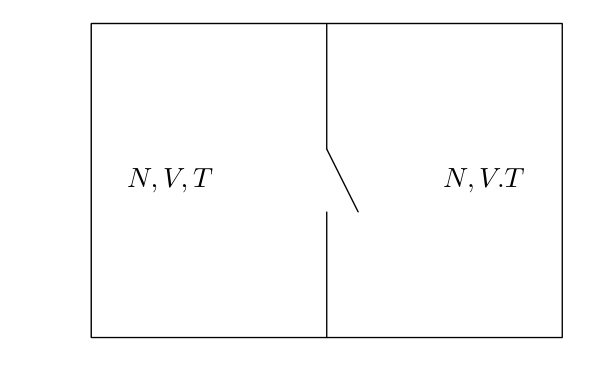 Figure 1: Parts (c) and (d).
Under the assumptions made by part (b), Zed’s device violates the second law of thermodynamics. We’ll now investigate why this actually does not happen for a particular kind of door. This door, of mass , has a hinge that exerts a restoring torque when the door is open at an angle , where is not necessarily small (Figure 1).
(c) (5 pts.) Explain in one or two sentences why this door behaves effectively like a hole in the wall with area , and hence the second law of thermodynamics is not violated.
(d) (10 pts.) Estimate in terms of the variables given and fundamental constants. You may make appropriate simplifying assumptions.
Fonte: Testo (PDF) — p.4 Topic: Thermodynamics, Kinetic Theory Metodi: Kinetic Theory of Gases, Statistical Averaging, Order-of-Magnitude Estimation, Ideal Gas Law Competenze: Physical Reasoning, Estimation & Approximation Objects: Gas, Container
T1: Il Demone di Maxwell
Il Zed ha un contenitore diviso da una parete in due camere di volume uguale . La camera sinistra ha molecole e la camera destra molecole di qualche gas ideale monatomo (). Ogni molecola di gas ha una massa e può essere trattata come una particella puntata. L’intero sistema è isolato e ha una temperatura .
Diciamo che fa un buco nel muro. Poi ci sarà un flusso netto di molecole dalla camera destra alla camera sinistra. All’equilibrio, diciamo che ogni camera ha molecole. Quanto è aumentata l’entropia?
Zed ora vuole riportare il contenitore al suo stato originale con e molecole in ogni camera. Il suo obiettivo è quello di coprire il buco con una porta con superficie che si apre solo verso la seconda camera.
Pensa che qualsiasi molecola nella camera sinistra incidentale sulla porta entrera’ nella camera destra, e nessuna molecola nella camera destra entrera’ nella sinistra. Secondo tale modello, qual è il tasso iniziale di cambiamento dell’entropia del sistema?
Figura 1: Parti c) e d).
Secondo le ipotesi di parte b, il dispositivo di Zed viola la seconda legge della termodinamica. Ora esamineremo perché questo non accade per un particolare tipo di porta. Questa porta, di massa , ha una cerniera che esercita una coppia di ripristino quando la porta è aperta ad un angolo , dove non è necessariamente piccola (Figura 1).
**(c) (5 punti) ** Spiegare in una o due frasi perché questa porta si comporta in modo efficace come un buco nel muro con superficie , e quindi non viene violata la seconda legge della termodinamica.
**(d) (10 punti) ** Estimare in termini di variabili date e costanti fondamentali. Potreste fare le ipotesi semplificate appropriate.
Fonte: Testo (PDF) — p.4 Topic: Thermodynamics, Kinetic Theory Metodi: Kinetic Theory of Gases, Statistical Averaging, Order-of-Magnitude Estimation, Ideal Gas Law Competenze: Physical Reasoning, Estimation & Approximation Objects: Gas, Container
T2: Euler’s Disk
A thin, uniform disk of mass and radius is initially set at an angle to the horizontal, on a frictionless surface. It is given an initial angular velocity with respect to a vertical axis passing through its center.
(a) (4 pts.) Determine for the steady state case, where .
(b) (2 pts) Write an expression for the total energy of the disk.
The disk is then moved onto a special surface with small bumps of height spread over it — each bump is separated by . As the disk climbs over a bump and falls back down, its impact is absorbed by the surface, causing a net energy loss in the system. The disk is set in motion with the same initial conditions as before but with .
(c) (6 pts.) Assuming that this is the only source of energy loss, write a differential equation for in first order to .
(d) (4 pts.) Hence, write an approximate expression for as a function of time.
(e) (2 pts.) Using this model, determine the time it takes for the frequency of the sound the disk makes against the surface to reach the maximum audible frequency .
Fonte: Testo (PDF) — p.5 Topic: Rotational Dynamics, Conservation of Energy Metodi: Torque & Angular Momentum Analysis, Conservation of Energy, Differential Equations, Approximation & Series Expansion Competenze: Physical Reasoning, Mathematical Modeling Objects: Disk
T2: Disco di Euler
Un disco sottile e uniforme di massa e di raggio è inizialmente fissato in un angolo orizzontale su una superficie senza attrito. Si dà una velocità angolare iniziale rispetto ad un asse verticale che attraversa il suo centro.
**(a) (4 punti) ** Determina per il caso di stato stazionario, dove .
**(b) (2 pts) ** Scrivere un’espressione per l’energia totale del disco.
Il disco viene poi spostato su una superficie speciale con piccoli bump di altezza diffusi su di esso ogni bump è separato da . Quando il disco si arrampicano su un’orbita e si riprendono, il suo impatto viene assorbito dalla superficie, causando una perdita netta di energia nel sistema. Il disco viene messo in movimento con le stesse condizioni iniziali di prima ma con .
**(c) (6 punti) ** Supponendo che questa sia l’unica fonte di perdita di energia, scrivere un’equazione differenziale per in primo ordine a .
**(d) (4 punti) ** Scrivi quindi un’espressione approssimativa per come funzione del tempo.
**(e) (2 pts.) ** Con questo modello, si determina il tempo necessario per la frequenza del suono che il disco produce contro la superficie per raggiungere la frequenza audibile massima .
Fonte: Testo (PDF) — p.5 Topic: Rotational Dynamics, Conservation of Energy Metodi: Torque & Angular Momentum Analysis, Conservation of Energy, Differential Equations, Approximation & Series Expansion Competenze: Physical Reasoning, Mathematical Modeling Objects: Disk
T3: Rocket
OPhO organizers have a “propulsionless” rocket, which for simplicity can be assumed to be a 2-dimensional rectangular box of mass and horizontal length . Assume that the horizontal sides of the box are massless while the vertical sides of the box each have mass . The rocket is initially at rest. We will now explore the mechanism for how this rocket moves. Suppose we have particles of mass each on the left and right sides of the box. At time , we launch the particles on the left side of the box together to the right with velocity . In addition, in intervals of time , starting at , we launch a particle from the right side of the box to the left side with velocity . Once a particle reaches the opposite side of the box, it is stopped. The particular mechanism to shoot and catch the particles can be ignored here. Assume that this mechanism can conserve energy. After time , there will be particles on each side of the box, which is identical to the initial state.
Neglect relativistic effects in part (a) only.
(a) (1 pt.) According to classical (Newtonian) mechanics, what happens to the rocket? Does it move?
(b) (5 pts.) If , how far does the rocket move? Answer in lowest nonzero order in .
(c) (10 pts.) How far does the center of mass of the rocket system move? Once again, answer in lowest nonzero order in . Justify your answer.
(d) (6 pts.) Explain why this process cannot continue indefinitely. If it could continue forever, we would be able to move the rocket indefinitely with no propulsion.
(e) (5 pts.) Give an estimate for how long this process can continue. How far does the rocket move in this time?
Fonte: Testo (PDF) — p.6 Topic: Special Relativity, Conservation of Momentum Metodi: Mass-Energy Equivalence, Conservation of Momentum, Relativistic Energy-Momentum, Approximation & Series Expansion Competenze: Physical Reasoning, Estimation & Approximation Objects: Block, Projectile
T3: razzo**
Gli organizzatori dell’OphO hanno un razzo “senza propulsione”, che per semplicità può essere presunto una scatola rettangolare bidimensionale di massa e lunghezza orizzontale . Supponiamo che i lati orizzontali della scatola siano senza massa mentre i lati verticali della scatola abbiano massa . Il razzo è inizialmente a riposo. Ora esploreremo il meccanismo di movimento di questo razzo. Supponiamo di avere particelle di massa ciascuno sui lati sinistro e destro della scatola. Al tempo , lanciamo le particelle sul lato sinistro della scatola insieme a destra con velocità . Inoltre, in intervalli di tempo , a partire da , lanciamo una particella dal lato destro della scatola al lato sinistro con velocità . Una volta che una particella raggiunge il lato opposto della scatola, viene fermata. Il particolare meccanismo per sparare e catturare le particelle può essere ignorato qui. Supponiamo che questo meccanismo possa risparmiare energia. Dopo il tempo , ci saranno particelle su ciascun lato della scatola, identiche allo stato iniziale.
Negli effetti relativistici si trascurano solo nella parte (a).
Secondo la meccanica classica (Newtonian), cosa succede al razzo? Si muove?
**(b) (5 punti) ** Se , fino a che punto si muove il razzo? Risposta nell’ordine non zero più basso in .
**(c) (10 pts.) ** Quanto si muove il centro di massa del sistema missilistico? Ancora una volta, rispondere in ordine non zero più basso in . giustifica la tua risposta.
**(d) (6 punti) ** Spiegate perché questo processo non può continuare indefinitamente. Se potesse continuare per sempre, potremmo muovere il razzo indefinitamente senza propulsione.
**(e) (5 punti) ** Indicare quanto tempo può durare questo processo. Quanto si muove il razzo in questo momento?
Fonte: Testo (PDF) — p.6 Topic: Special Relativity, Conservation of Momentum Metodi: Mass-Energy Equivalence, Conservation of Momentum, Relativistic Energy-Momentum, Approximation & Series Expansion Competenze: Physical Reasoning, Estimation & Approximation Objects: Block, Projectile
T4: Magical Box
A cubical box of mass and side length sits on a horizontal, frictionless plane. The box is filled with an ideal gas of particle mass , particle volume density , and initial temperature . One of the vertical walls inside the cube is made of a highly conductive material, kept at a constant temperature . The wall is so conductive that the temperature of gas instantaneously changes to after rebounding. All other walls are made of ideal insulators.
(a) (1 pt.) State, with a reasoning, the direction in which the box will start moving.
(b) (7 pts.) Approximate the initial acceleration of the box. For this question, make sure your equation is valid for as well.
(c) (3 pts.) The acceleration of the box then decreases from to for a short time until . Determine .
(d) (3 pts.) If is the time it takes for acceleration to level off for an identical box with the conductive wall at temperature , calculate .
Fonte: Testo (PDF) — p.7 Topic: Kinetic Theory, Thermodynamics Metodi: Kinetic Theory of Gases, Impulse-Momentum Theorem, Statistical Averaging, Ideal Gas Law Competenze: Physical Reasoning, Estimation & Approximation Objects: Gas, Container
**T4: Cassa magica **
Una scatola cubica di massa e lunghezza laterale si trova su un piano orizzontale senza attrito. La scatola è riempita di un gas ideale di massa delle particelle , densità del volume delle particelle e temperatura iniziale . Una delle pareti verticali all’interno del cubo è costituita da un materiale altamente conduttivo, mantenuto a temperatura costante . Il muro è così conduttivo che la temperatura del gas cambia istantaneamente a dopo il rimbalzo. Tutti gli altri muri sono fatti di isolanti ideali.
**(a) (1 p.) ** Indicare, con un ragionamento, la direzione in cui la casella inizierà a muoversi.
**(b) (7 punti) ** Approximare l’accelerazione iniziale della scatola. Per questa domanda, assicurati che la tua equazione sia valida anche per .
**(c) (3 pts.) ** L’accelerazione della scatola diminuisce quindi da a per un breve periodo fino a . Determina .
**(d) (3 pts.) ** Se è il tempo necessario per l’accelerazione di un’identica scatola con la parete conduttiva a temperatura , calcolare .
Fonte: Testo (PDF) — p.7 Topic: Kinetic Theory, Thermodynamics Metodi: Kinetic Theory of Gases, Impulse-Momentum Theorem, Statistical Averaging, Ideal Gas Law Competenze: Physical Reasoning, Estimation & Approximation Objects: Gas, Container
T5: Quantum Computing
In this problem, you will learn the fundamentals of quantum computers, as well as the physics on how they can be constructed! We have tried to provide as much background information as necessary, but if you believe some part is missing or unclear, please fill out the clarifications form.
Introduction
Physicists use braket notation to describe vectors in quantum systems. When using a vector to describe a quantum state, the ket, written as can be used. Both notations below are equivalent:
The bra, on the other hand, is the conjugate transpose of the ket . Given two vectors and , the braket is the inner product of both vectors. This notation will be used throughout this problem.
In any digital device, information is communicated via 0s and 1s, or binary code. The simplest units of this information are called bits. Similar to a bit, the qubit can be represented as a linear combination of two orthogonal states: quantum-0 and quantum-1, which are typically and . Here,
Typically, we write a single qubit state as
where , and .
(a) (1 pt.) A qubit is prepared in the state .
(i) What is the probability of measuring the qubit in the state ?
(ii) What is the probability of measuring the qubit in the state ?
Hint: If you are still confused about measurement (it’s tricky!), check out this qiskit article. You can ignore all the parts with code, we’ll save those for the computer science students writing OCSO.
A quantum gate performs a unitary operator on a quantum state. Applying an operator (sometimes known as a gate) to a qubit state can be represented in the diagram below.
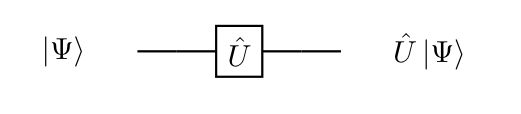
where is a local unitary since it only acts on a single qubit. There are five important gates:
Here, form the four Pauli matrices and is known as the Hadamard gate, which we will use later on when we talk about entanglement.
For example, if and apply the gate , we end up with
(b) (1 pt.) A qubit is prepared in the state . What is the probability of measuring the qubit in the state ? Express your answer in terms of , , and properties of the unitary .
The heart of quantum information lies in what we can do with more than a single qubit. If one qubit has two dimensions ( and ), then a two-qubit system can be represented in four dimensions. For a two qubit system, the state can be written as , where can be seen as the “basis vectors.” If we have two independent qubits, i.e. and , we can represent their combined state using the tensor product, i.e.
Here, we can see that
Note that not every two qubit state can be written as a tensor product. When this occurs, we say that they are entangled. We can immediately determine if a state is entangled by calculating its concurrence, defined by
If , then the two qubits are separate and the system is separable. If , the system is maximally entangled, such as
Physically, this means that a measurement of one qubit directly leads to a “collapse” of the other qubit (this is the classic example shown in popular science media). Note that .
We can change the concurrence using a control operation. For example,
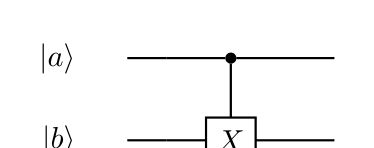
performs the CNOT gate. The unitary is applied to if , otherwise nothing is done. That is, we have:
The CNOT gate is an example of a global unitary, since it acts on more than one qubit. Global unitaries for 2 qubit systems can be written as a matrix. For example, we can write
where form the 4 standard basis vectors. We can combine local and global unitaries to create entangled states. For example, consider the following circuit:
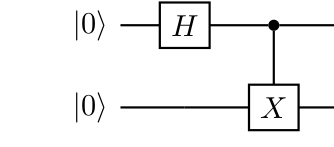
The initial state is . After applying the Hadamard gate , the state becomes
After applying the CNOT gate, the state becomes:
Note that we can avoid matrix multiplication in this last step by seeing what CNOT does on each term of . CNOT will not have an effect on since the first qubit is . CNOT will have an effect on since the first qubit is a , so it’ll flip the second qubit to a , giving us the map .
(c) (1 pt.) Construct a quantum circuit where the input state is and the output state is
using only gates.
Quantum Teleportation
Quantum teleportation is the transfer of the quantum state of one qubit to another (not the actual physical qubit) using a shared entangled resource and two classical bits of information. It is performed using the following circuit.
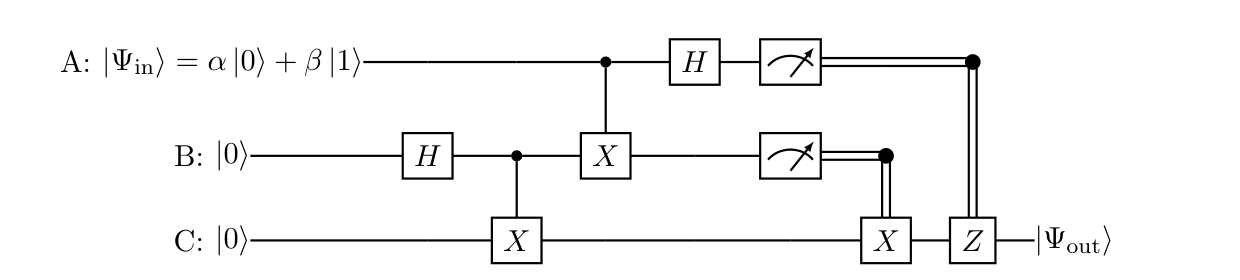
The measurement gate measures the qubit (returns either a 0 or a 1) and the wider wire represents that information that flows through this wire is a classical bit.
(d) (1 pt.) Verify that the above circuit does teleport the qubit from the top branch to the bottom branch by looking at the specific case of .
(e) (3 pts.) After the first operation is performed on branch C, the branch is brought a very far distance from the other two branches. By doing so, it appears we can create faster-than-light communication during the teleportation process, which is impossible! Explain why there is no contradiction. Justify rigorously.
We can analyze this by performing matrix multiplication, but using a circuit-based approach is much cleaner. To do so, we need to use the Griffiths-Niu Theorem.
(f) (2 pts.) The following circuits, according to the Griffiths-Niu Theorem, are equivalent:
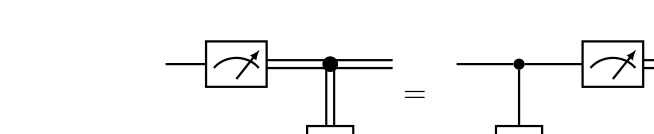
Prove the Griffiths-Niu Theorem.
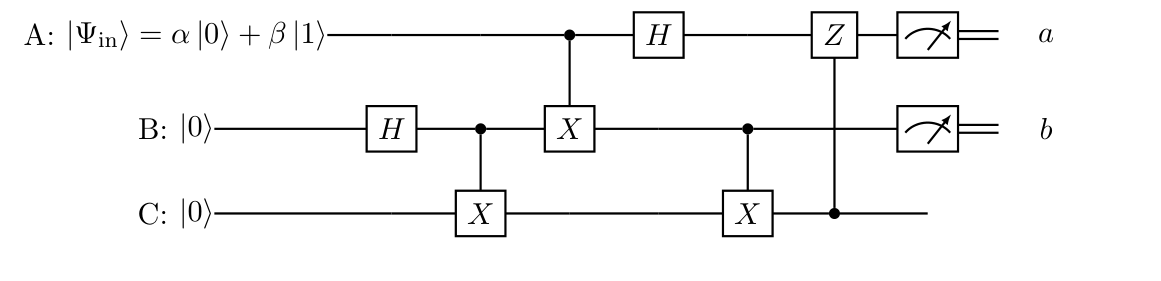
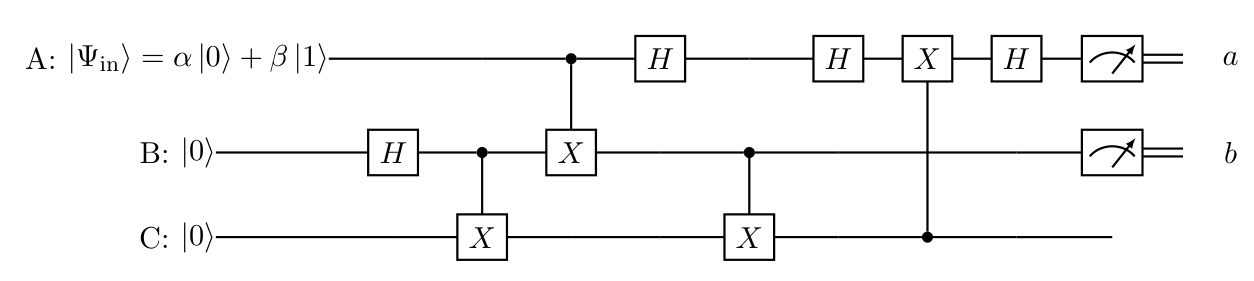
Using this theorem, we can redraw our circuit as:
(g) (1 pts.) For a control-Z gate, it doesn’t matter which branch is the control. In other words,
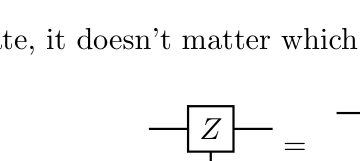
Prove this relationship.
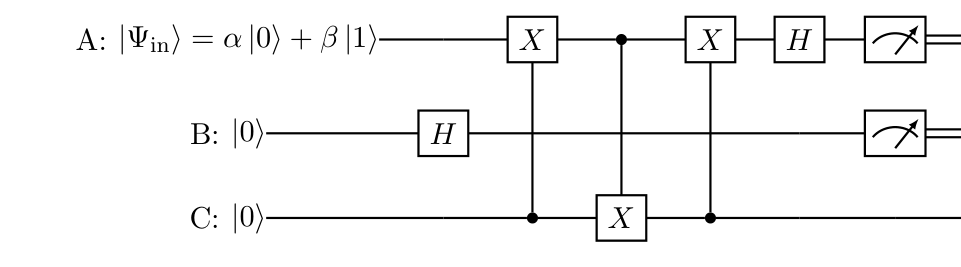
Using the above problem, we can flip the control-Z gate. Then using the identity , we can reduce it further:
Since , we can simplify the top part. Furthermore, we can introduce another CNOT between the first and the second branch.
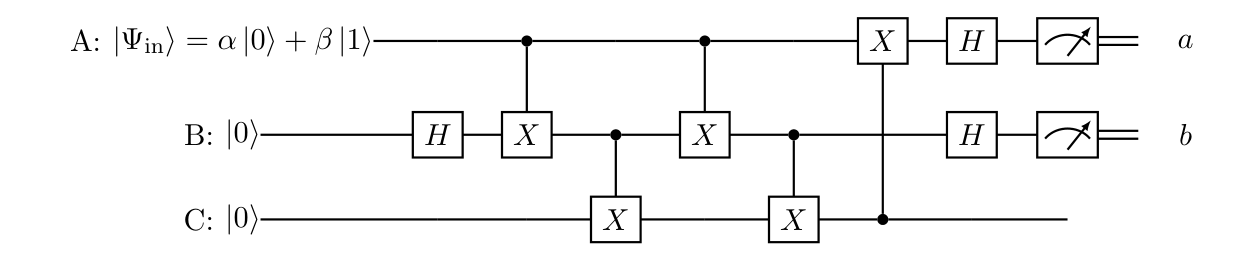
We were allowed to introduce this CNOT gate since . This actually makes it easier using the following problem:
(h) (2 pts.) Prove that the below two circuits are equivalent.
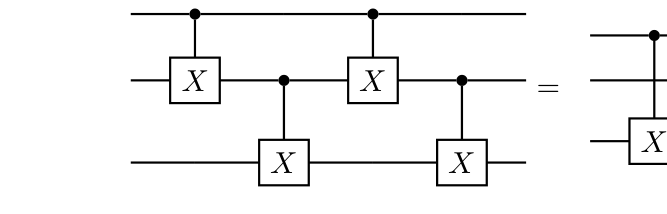
Using this substitution, we end up with:
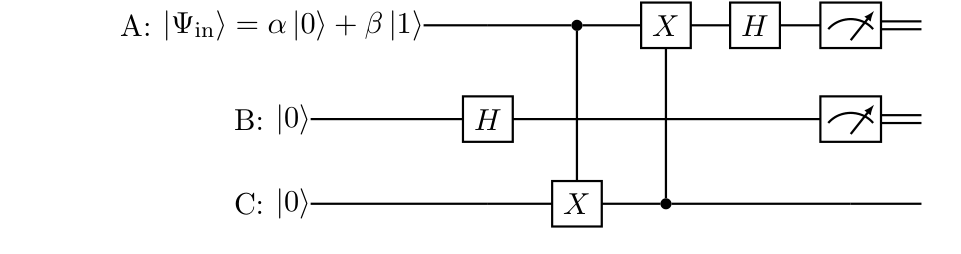
We can now introduce another CNOT gate, which doesn’t do anything since C will always be .
Three alternating CNOT gates is equivalent to the SWAP gate, so we can write:
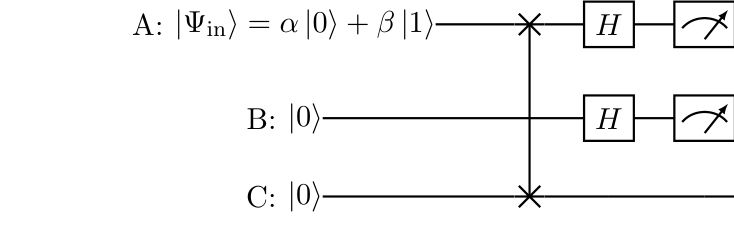
where we clearly see a swapping that occurs between the top and bottom branch!
Building Quantum Computers
According to theoretical physicist David P. Divencenzo, there are five necessary (but not necessarily sufficient) criteria to build a quantum computer:
- A well-characterized qubit.
- The ability to initialize qubits.
- Long and relevant decoherence times.
- A “universal set” of quantum gates.
- The ability to measure qubits.
In this section, we will focus on how we can create qubits and how we can create a universal set of quantum gates. Consider two energy levels as the qubit states respectively. Assume that
Also assume that the qubit state is time varying, in the form of:
(i) (14 pts.) Using the above setup, show how we can implement the quantum gates . Hint: The Schrödinger Equation tells us
where .
Fonte: Testo (PDF) — p.8 Topic: Modern-Quantum Physics, Mathematics Metodi: Bohr Model & Quantization, Differential Equations, Superposition Principle, Symmetry Argument Competenze: Mathematical Modeling, Physical Reasoning Objects: Atom
T5: Calcolo quantistico
In questo problema imparerai i fondamenti dei computer quantistici, nonché la fisica di come possono essere costruiti! Abbiamo cercato di fornire tutte le informazioni di base necessarie, ma se ritieni che qualche parte sia mancante o poco chiara, compila il modulo per i chiarimenti.
Introduzione
I fisici usano la notazione bra-ket per descrivere i vettori nei sistemi quantistici. Quando si usa un vettore per descrivere uno stato quantistico, si può usare il ket, scritto come . Entrambe le notazioni seguenti sono equivalenti:
Il bra, d’altra parte, è il trasposto coniugato del ket . Dati due vettori e , il bra-ket è il prodotto interno dei due vettori. Questa notazione sarà usata in tutto questo problema.
In qualsiasi dispositivo digitale, l’informazione è comunicata tramite 0 e 1, ovvero il codice binario. Le unità più semplici di questa informazione sono chiamate bit. Analogamente a un bit, il qubit può essere rappresentato come una combinazione lineare di due stati ortogonali: quantum-0 e quantum-1, che tipicamente sono e . Qui,
Tipicamente, scriviamo lo stato di un singolo qubit come
dove , e .
(a) (1 pt.) Un qubit è preparato nello stato .
(i) Qual è la probabilità di misurare il qubit nello stato ?
(ii) Qual è la probabilità di misurare il qubit nello stato ?
Suggerimento: se sei ancora confuso riguardo alla misurazione (è complicata!), dai un’occhiata a questo articolo di qiskit. Puoi ignorare tutte le parti con il codice, le riserveremo agli studenti di informatica che partecipano a OCSO.
Una porta quantistica applica un operatore unitario a uno stato quantistico. L’applicazione di un operatore (talvolta chiamato porta) a uno stato di qubit può essere rappresentata nel diagramma qui sotto.
dove è un unitario locale poiché agisce solo su un singolo qubit. Esistono cinque porte importanti:
Qui, formano le quattro matrici di Pauli e è nota come porta di Hadamard, che useremo più avanti quando parleremo di entanglement.
Per esempio, se e applichiamo la porta , otteniamo
(b) (1 pt.) Un qubit è preparato nello stato . Qual è la probabilità di misurare il qubit nello stato ? Esprimi la tua risposta in termini di , e delle proprietà dell’unitario .
Il cuore dell’informazione quantistica risiede in ciò che possiamo fare con più di un singolo qubit. Se un qubit ha due dimensioni ( e ), allora un sistema a due qubit può essere rappresentato in quattro dimensioni. Per un sistema a due qubit, lo stato può essere scritto come , dove possono essere visti come i “vettori di base”. Se abbiamo due qubit indipendenti, cioè e , possiamo rappresentare il loro stato combinato usando il prodotto tensoriale, cioè
Qui, possiamo vedere che
Nota che non ogni stato a due qubit può essere scritto come prodotto tensoriale. Quando questo accade, diciamo che sono entangled. Possiamo determinare immediatamente se uno stato è entangled calcolando la sua concorrenza, definita da
Se , allora i due qubit sono separati e il sistema è separabile. Se , il sistema è massimamente entangled, come
Fisicamente, questo significa che una misurazione di un qubit porta direttamente a un “collasso” dell’altro qubit (questo è l’esempio classico mostrato nei media di divulgazione scientifica). Nota che .
Possiamo modificare la concorrenza usando un’operazione di controllo. Per esempio,
esegue la porta CNOT. L’unitario è applicato a se , altrimenti non viene fatto nulla. Cioè, abbiamo:
La porta CNOT è un esempio di unitario globale, poiché agisce su più di un qubit. Gli unitari globali per i sistemi a 2 qubit possono essere scritti come una matrice . Per esempio, possiamo scrivere
dove formano i 4 vettori di base standard. Possiamo combinare unitari locali e globali per creare stati entangled. Per esempio, considera il seguente circuito:
Lo stato iniziale è . Dopo aver applicato la porta di Hadamard , lo stato diventa
Dopo aver applicato la porta CNOT, lo stato diventa:
Nota che possiamo evitare la moltiplicazione matriciale in quest’ultimo passaggio osservando cosa fa CNOT su ciascun termine di . CNOT non avrà effetto su poiché il primo qubit è . CNOT avrà effetto su poiché il primo qubit è un , quindi capovolgerà il secondo qubit in un , dandoci la mappa .
(c) (1 pt.) Costruisci un circuito quantistico in cui lo stato di ingresso è e lo stato di uscita è
usando solo le porte .
Teletrasporto quantistico
Il teletrasporto quantistico è il trasferimento dello stato quantistico di un qubit a un altro (non del qubit fisico effettivo) usando una risorsa entangled condivisa e due bit classici di informazione. Viene eseguito usando il seguente circuito.
La porta di misura misura il qubit (restituisce uno 0 o un 1) e il filo più spesso rappresenta il fatto che l’informazione che scorre attraverso questo filo è un bit classico.
(d) (1 pt.) Verifica che il circuito sopra teletrasporti effettivamente il qubit dal ramo superiore al ramo inferiore analizzando il caso specifico di .
(e) (3 pts.) Dopo che la prima operazione è stata eseguita sul ramo C, il ramo viene portato a grandissima distanza dagli altri due rami. Facendo così, sembra che possiamo creare una comunicazione più veloce della luce durante il processo di teletrasporto, cosa che è impossibile! Spiega perché non c’è contraddizione. Giustifica rigorosamente.
Possiamo analizzare questo eseguendo la moltiplicazione matriciale, ma usare un approccio basato sui circuiti è molto più pulito. Per farlo, dobbiamo usare il Teorema di Griffiths-Niu.
(f) (2 pts.) I seguenti circuiti, secondo il Teorema di Griffiths-Niu, sono equivalenti:
Dimostra il Teorema di Griffiths-Niu.
Usando questo teorema, possiamo ridisegnare il nostro circuito come:
(g) (1 pts.) Per una porta control-Z, non importa quale ramo sia il controllo. In altre parole,
Dimostra questa relazione.
Usando il problema precedente, possiamo capovolgere la porta control-Z. Poi, usando l’identità , possiamo ridurla ulteriormente:
Poiché , possiamo semplificare la parte superiore. Inoltre, possiamo introdurre un’altra CNOT tra il primo e il secondo ramo.
Ci è stato permesso di introdurre questa porta CNOT poiché . Questo in realtà lo rende più facile usando il problema seguente:
(h) (2 pts.) Dimostra che i due circuiti sottostanti sono equivalenti.
Usando questa sostituzione, otteniamo:
Possiamo ora introdurre un’altra porta CNOT, che non fa nulla poiché C sarà sempre .
Tre porte CNOT alternate sono equivalenti alla porta SWAP, quindi possiamo scrivere:
dove vediamo chiaramente uno scambio che avviene tra il ramo superiore e quello inferiore!
Costruire computer quantistici
Secondo il fisico teorico David P. Divencenzo, ci sono cinque criteri necessari (ma non necessariamente sufficienti) per costruire un computer quantistico:
- Un qubit ben caratterizzato.
- La capacità di inizializzare i qubit.
- Tempi di decoerenza lunghi e rilevanti.
- Un “insieme universale” di porte quantistiche.
- La capacità di misurare i qubit.
In questa sezione, ci concentreremo su come creare qubit e come creare un insieme universale di porte quantistiche. Considera due livelli energetici come gli stati di qubit rispettivamente. Assumi che
Assumi inoltre che lo stato del qubit vari nel tempo, nella forma:
(i) (14 pts.) Usando l’impostazione precedente, mostra come possiamo implementare le porte quantistiche . Suggerimento: l’Equazione di Schrödinger ci dice
dove .
Fonte: Testo (PDF) — p.8 Topic: Modern-Quantum Physics, Mathematics Metodi: Bohr Model & Quantization, Differential Equations, Superposition Principle, Symmetry Argument Competenze: Mathematical Modeling, Physical Reasoning Objects: Atom