Coin Flip 1. The coin flip has long been recognized as a simple and unbiased method to randomly determine the outcome of an event. In the case of an ideal coin, it is well-established that each flip has an equal chance of landing as either heads or tails.
However, coin flips are not entirely random. They appear random to us because we lack sufficient information about the coin’s initial conditions. If we possessed this information, we would always be able to predict the outcome without needing to flip the coin. For an intriguing discussion on why this observation is significant, watch this video by Vsauce.
Now, consider a scenario where a coin with uniform density and negligible width is tossed directly upward from a height of m above the ground. The coin starts with its heads facing upward and is given an initial vertical velocity of m/s and a positive angular velocity of rad/s. What face does the coin display upon hitting the ground? Submit 0 for heads and 1 for tails. You only have one attempt for this problem. Assume the floor is padded and it absorbs all of the coin’s energy upon contact. The radius of the coin is negligible.
Fonte: Testo (PDF) — p.4
Topic: Newtonian Mechanics, Rotational Dynamics Metodi: Kinematic Equations, Simple Harmonic Motion Analysis, Physical Modeling Competenze: Physical Reasoning, Mathematical Modeling Objects: Disk
Il coin flipping è stato riconosciuto da tempo come un metodo semplice e imparziale per determinare casualmente l’esito di un evento. Nel caso di una moneta ideale, è ben noto che ogni flip ha una probabilità di atterraggio uguale come testa o coda.
Tuttavia, le lanciate di moneta non sono del tutto casuali. A noi sembrano casuali perché non abbiamo abbastanza informazioni sulle condizioni iniziali della moneta. Se possedessimo queste informazioni, saremmo sempre in grado di prevedere il risultato senza dover girare la moneta. Per una interessante discussione sul perché questa osservazione sia significativa, guardate questo video di Vsauce.
Ora, considerate uno scenario in cui una moneta con densità uniforme e larghezza trascurabile viene gettata direttamente verso l’alto da un’altezza di m sopra il terreno. La moneta inizia con la testa rivolta verso l’alto e riceve una velocità verticale iniziale di m/s e una velocità angolare positiva di rad/s. Che faccia mostra la moneta quando colpisce il terreno? Inviare 0 per le teste e 1 per le code. Per questo problema si deve fare solo un tentativo. Supponiamo che il pavimento sia imbottito e assorba tutta l’energia della moneta al contatto. Il raggio della moneta è trascurabile.
Fonte: Testo (PDF) — p.4
Topic: Newtonian Mechanics, Rotational Dynamics Metodi: Kinematic Equations, Simple Harmonic Motion Analysis, Physical Modeling Competenze: Physical Reasoning, Mathematical Modeling Objects: Disk
Coin Flip 2. A coin of uniform mass density with a radius of cm is initially at rest and is released from a slight tilt of onto a horizontal surface with an infinite coefficient of static friction. The coin has a thicker rim, allowing it to drop and rotate on one point. With every collision, the coin switches pivot points on the rim, and energy is dissipated through heat so that of the coin’s prior total energy is conserved. How long will it take for the coin to come to a complete stop?
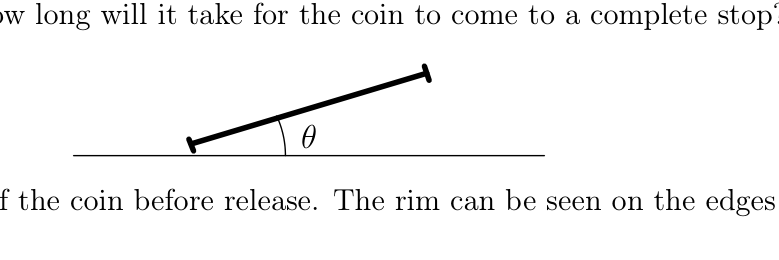 A cross-sectional view of the coin before release. The rim can be seen on the edges of the coin.
Fonte: Testo (PDF) — p.4
Topic: Rotational Dynamics, Conservation of Energy Metodi: Conservation of Energy, Torque & Angular Momentum Analysis, Approximation & Series Expansion Competenze: Physical Reasoning, Mathematical Modeling Objects: Disk
**Flip Coin 2. ** Una moneta di densità di massa uniforme con un raggio di cm è inizialmente in riposo e viene rilasciata da una leggera inclinazione di su una superficie orizzontale con un coefficiente di attrito statico infinito. La moneta ha un bordo più spessore, che le consente di cadere e ruotare su un punto. Con ogni collisione, la moneta cambia i punti di pivot sul bordo e l’energia viene dissipata attraverso il calore in modo che dell’energia totale precedente della moneta sia conservata. Quanto tempo ci vorrà prima che la moneta si fermi completamente?
*Una visione trasversale della moneta prima del rilascio. Il bordo è visibile sui bordi della moneta.
Fonte: Testo (PDF) — p.4
Topic: Rotational Dynamics, Conservation of Energy Metodi: Conservation of Energy, Torque & Angular Momentum Analysis, Approximation & Series Expansion Competenze: Physical Reasoning, Mathematical Modeling Objects: Disk
Highway. Suppose all cars on a (single-lane) highway are identical. Their length is m, their wheels have coefficients of friction , and they all travel at speed . Find the which maximizes the flow rate of cars (i.e. how many cars travel across an imaginary line per minute). Assume that they need to be able to stop in time if the car in front instantaneously stops. Disregard reaction time.
Fonte: Testo (PDF) — p.4
Topic: Newtonian Mechanics Metodi: Kinematic Equations, Free-Body Diagram, Physical Modeling Competenze: Mathematical Modeling, Physical Reasoning Objects: —
Autostrada. Supponiamo che tutte le auto su una autostrada (a singola corsia) siano identiche. La loro lunghezza è m, le loro ruote hanno coefficienti di attrito e tutte viaggiano a velocità . Trova il che massimizza il flusso di auto (cioè quante auto attraversano una linea immaginaria al minuto). Supponiamo che abbiano bisogno di poter fermarsi in tempo se l’auto davanti si ferma istantaneamente. Ignora il tempo di reazione.
Fonte: Testo (PDF) — p.4
Topic: Newtonian Mechanics Metodi: Kinematic Equations, Free-Body Diagram, Physical Modeling Competenze: Mathematical Modeling, Physical Reasoning Objects: —
Spinning Around. Here is a Physoly round button badge, in which the logo is printed on the flat and rigid surface of this badge. Toss it in the air and track the motions of three points (indicated by cyan circles in the figure) separated a straight-line distance of mm apart. At a particular moment, we find that these all have the same speed cm/s but are heading to different directions which form an angle of between each pair. Determine the then angular velocity of the badge (in rad/s).
Fonte: Testo (PDF) — p.4
Topic: Rotational Dynamics Metodi: Torque & Angular Momentum Analysis, Vector Decomposition, Symmetry Argument Competenze: Physical Reasoning, Mathematical Modeling Objects: Disk
Rotare intorno. Ecco un distintivo a pulsante rotondo Physoly, nel quale il logo è stampato sulla superficie piatta e rigida di questo distintivo. Lanciare in aria e seguire i movimenti di tre punti (indicati da cerchi di cianuro nella figura) separati in linea retta di mm. In un momento particolare, troviamo che tutti questi hanno la stessa velocità cm/s ma si dirigono in direzioni diverse che formano un angolo di tra ogni coppia. Determinare la velocità angolare del distintivo (in rad/s).
Fonte: Testo (PDF) — p.4
Topic: Rotational Dynamics Metodi: Torque & Angular Momentum Analysis, Vector Decomposition, Symmetry Argument Competenze: Physical Reasoning, Mathematical Modeling Objects: Disk
Born To Try. In a resource-limited ecological system, a population of organisms cannot keep growing forever (such as lab bacteria growing inside culture tube). The effective growth rate (including contributions from births and deaths) depends on the instantaneous abundance of resource , which in this problem we will consider the simple case of linear-dependency:
where is the population size at time . The resources is consumed at a constant rate by each organism:
Initially, the total amount of resources is and the population size is . Given that resource-units, resource-unit/s, resource-units and cell, find the total time it takes from the beginning to when all resources are depleted (in hours).
Fonte: Testo (PDF) — p.5
Topic: Biology, Mathematics Metodi: Differential Equations, Calculus-Integration, Physical Modeling Competenze: Mathematical Modeling, Physical Reasoning Objects: —
In un sistema ecologico limitato alle risorse, una popolazione di organismi non può continuare a crescere per sempre (come i batteri di laboratorio che crescono all’interno del tubo di coltura). Il tasso di crescita effettivo (inclusi i contributi da nascite e morti) dipende dall’abbondanza istantanea di risorse , che in questo problema considereremo il semplice caso di dipendenza lineare:
dove è la dimensione della popolazione in tempo . Le risorse sono consumate a un tasso costante da ciascun organismo:
Inizialmente, la quantità totale delle risorse è e la dimensione della popolazione è . Considerando che unità di risorses, unità di risorse/s, unità di risorse e cellula , si trova il tempo totale necessario dall’inizio fino al momento in cui tutte le risorse sono esaurite (in ore).
Fonte: Testo (PDF) — p.5
Topic: Biology, Mathematics Metodi: Differential Equations, Calculus-Integration, Physical Modeling Competenze: Mathematical Modeling, Physical Reasoning Objects: —
Lightbulb. [This problem is removed from the test.]
Topic: Circuits Metodi: Physical Modeling Competenze: Physical Reasoning Fonte: Testo (PDF) — p.5 Objects: —
L’ampolla. [Questo problema viene rimosso dalla prova.]
Topic: Circuits Metodi: Physical Modeling Competenze: Physical Reasoning Fonte: Testo (PDF) — p.5 Objects: —
Hyperdrive. In hyperdrive, Spaceship-0 is relativistically moving at the velocity with respect to reference frame , as measured by Spaceship-1. Spaceship-1 is moving at with respect to reference frame , as measured by Spaceship-2. Spaceship- is moving at speed with respect to reference frame . The speed of Spaceship-0 with respect to reference frame can be expressed as a decimal fraction of the speed of light which has only number of 9s following the decimal point (i.e., in the form of ). Find the value of .
Fonte: Testo (PDF) — p.5
Topic: Special Relativity Metodi: Lorentz Transformation, Approximation & Series Expansion, Symmetry Argument Competenze: Mathematical Modeling, Physical Reasoning Objects: —
Hyperdrive. In iperdrive, lo Spaceship-0 si muove relativisticamente alla velocità rispetto al quadro di riferimento , misurato da Spaceship-1. La nave spaziale-1 si muove a rispetto al quadro di riferimento , misurato dalla nave spaziale-2. La nave spaziale- si muove a velocità rispetto al quadro di riferimento . La velocità della nave spaziale-0 rispetto al quadro di riferimento può essere espressa come una frazione decimale della velocità della luce che ha solo numero di 9s dopo il punto decimale (cioè sotto forma di ). Trova il valore di .
Fonte: Testo (PDF) — p.5
Topic: Special Relativity Metodi: Lorentz Transformation, Approximation & Series Expansion, Symmetry Argument Competenze: Mathematical Modeling, Physical Reasoning Objects: —
Asteroid. The path of an asteroid that comes close to the Earth can be modeled as follows: neglect gravitational effects due to other bodies, and assume the asteroid comes in from far away with some speed and lever arm distance to Earth’s center. On January 26, 2023, a small asteroid called 2023 BU came within a distance of 3541 km to Earth’s surface with a speed of 9300 m/s. Although BU had a very small mass estimated to be about 300,000 kg, if it was much more massive, it could have hit the Earth. How massive would BU have had to have been to make contact with the Earth? Express your answer in scientific notation with 3 significant digits. Use 6357 km as the radius of the Earth. The parameters that remain constant when the asteroid mass changes are and , where is the speed at infinity and is the impact parameter.
Fonte: Testo (PDF) — p.5
Topic: Gravitation Metodi: Newton’s Law of Gravitation, Conservation Laws, Conservation of Energy Competenze: Physical Reasoning, Significant Figures Objects: Planet
Asteroide. Il percorso di un asteroide che si avvicina alla Terra può essere modellato come segue: trascurare gli effetti gravitazionali dovuti ad altri corpi, e supporre che l’asteroide venga da lontano con una certa velocità e leva distanza braccio al centro della Terra. Il 26 gennaio 2023, un piccolo asteroide chiamato 2023 BU arrivò a una distanza di 3541 km dalla superficie terrestre con una velocità di 9300 m/s. Anche se la BU aveva una massa molto piccola stimata a circa 300.000 kg, se fosse molto più massiccia, avrebbe potuto colpire la Terra. Quanto sarebbe stato massiccio per entrare in contatto con la Terra? Esprimi la tua risposta con notazione scientifica con 3 cifre significative. Utilizzare 6357 km come raggio della Terra. I parametri che rimangono costanti quando la massa dell’asteroide cambia sono e , dove è la velocità all’infinito e è il parametro di impatto.
Fonte: Testo (PDF) — p.5
Topic: Gravitation Metodi: Newton’s Law of Gravitation, Conservation Laws, Conservation of Energy Competenze: Physical Reasoning, Significant Figures Objects: Planet
Spaceship. IK Pegasi and Betelgeuse are two star systems that can undergo a supernova. Betelgeuse is 548 light-years away from Earth and IK Pegasi is 154 light-years away from Earth. Assume that the two star systems are 500 light-years away from each other.
Astronomers on Earth observe that the two star systems undergo a supernova explosion 300 years apart. A spaceship, the OPhO Galaxia Explorer which left Earth in an unknown direction before the first supernova observes both explosions occur simultaneously. Assume that this spaceship travels in a straight line at a constant speed . How far are the two star systems according to the OPhO Galaxia Explorer at the moment of the simultaneous supernovae? Answer in light-years.
Note: Like standard relativity problems, we are assuming intelligent observers that know the finite speed of light and correct for it.
Fonte: Testo (PDF) — p.5
Topic: Special Relativity Metodi: Lorentz Transformation, Physical Modeling, Vector Decomposition Competenze: Physical Reasoning, Mathematical Modeling Objects: Star
Il sistema stellare IK Pegasi e Betelgeuse sono due sistemi stellari che possono subire una supernova. Betelgeuse è a 548 anni luce dalla Terra e IK Pegasi a 154 anni luce dalla Terra. Supponiamo che i due sistemi stellari siano a 500 anni luce l’uno dall’altro.
Gli astronomi sulla Terra osservano che i due sistemi stellari subiscono un’esplosione di supernova a 300 anni di distanza. Una nave spaziale, l’Opho Galaxia Explorer, che ha lasciato la Terra in una direzione sconosciuta prima che la prima supernova osservasse che entrambe le esplosioni avvengono contemporaneamente. Supponiamo che questa nave spaziale si muova in linea retta a una velocità costante . Quanto sono lontani i due sistemi stellari secondo l’Opho Galaxia Explorer al momento delle simultane supernovae? Rispondi in anni luce.
Nota: Come i problemi di relatività standard, stiamo assumendo osservatori intelligenti che conoscono la velocità finita della luce e correggono la velocità.
Fonte: Testo (PDF) — p.5
Topic: Special Relativity Metodi: Lorentz Transformation, Physical Modeling, Vector Decomposition Competenze: Physical Reasoning, Mathematical Modeling Objects: Star
Drag 1. A ball of mass 1 kg is thrown vertically upwards and it faces a quadratic drag with a terminal velocity of 20 m/s. It reaches a maximum height of 30 m and falls back to the ground. Calculate the energy dissipated until the point of impact (in J).
Fonte: Testo (PDF) — p.6
Topic: Newtonian Mechanics, Conservation of Energy Metodi: Differential Equations, Conservation of Energy, Calculus-Integration Competenze: Physical Reasoning, Mathematical Modeling Objects: Ball
Raggio 1. Una palla di massa di 1 kg viene lanciata verticalmente verso l’alto e si trova di fronte a un arrastamento quadratico con una velocità terminale di 20 m/s. L’albero raggiunge un’altezza massima di 30 m e ricadono a terra. Calcolare l’energia dissipata fino al punto di impatto (in J).
Fonte: Testo (PDF) — p.6
Topic: Newtonian Mechanics, Conservation of Energy Metodi: Differential Equations, Conservation of Energy, Calculus-Integration Competenze: Physical Reasoning, Mathematical Modeling Objects: Ball
Drag 2. In general, we can describe the quadratic drag on an object by the following force law:
where is the cross-sectional area of the object exposed to the airflow, is the speed of the object in a fluid, and is the drag coefficient, a dimensionless quantity that varies based on shape.
Another useful quantity to know is the Reynold’s number, a dimensionless quantity that helps predict fluid flow patterns. It is given by the formula:
where is the density of the surrounding fluid, is the dynamic viscosity of the fluid, and is a reference length parameter that varies based on each object. For a smooth sphere traveling in a fluid, its diameter serves as the reference length parameter.
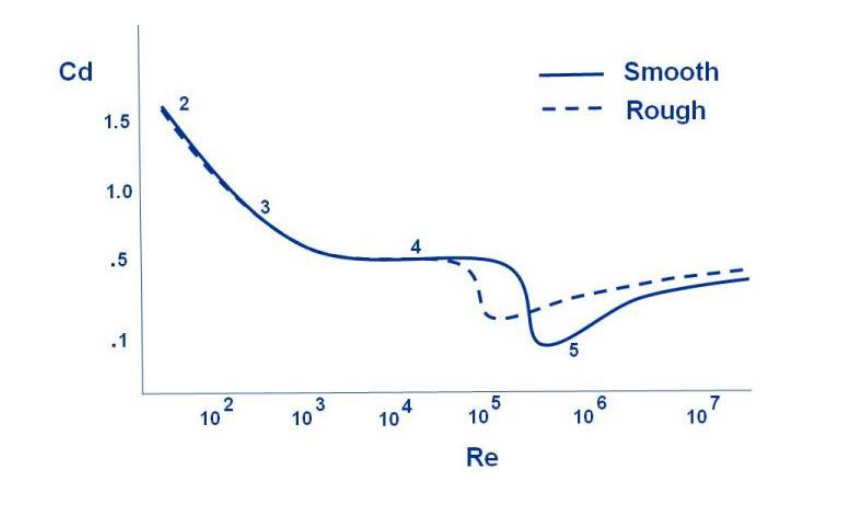 A logarithmic graph of vs Re of a sphere from the NASA Glenn Research Center.
The relationship between the drag coefficient and the Reynold’s number holds significant importance. Due to the complexity of fluid dynamics, empirical data is commonly used, as depicted in the figure provided above. Notably, the figure indicates a significant decrease in the drag coefficient around . This phenomenon, known as the drag crisis, occurs when a sphere transitions from laminar to turbulent flow, resulting in a broad wake and high drag. The table in the link below presents a range of versus Re values of a smooth sphere.
meaning a smooth surface.
Desmos table: https://www.desmos.com/calculator/wmpkg5wnt0
Let’s consider a smooth ball with a radius of m and a mass of kg dropped in air with a constant density of kg/m. It is found that at velocity 5 m/s, the Reynold’s number of the ball is . If the ball is dropped from rest, it approaches a stable terminal velocity . If the ball is dropped downwards with enough velocity, it will experience turbulence, and approach a stable terminal velocity . Find . Ignore any terminal velocities found for Reynold numbers less than an order of magnitude .
Note: This problem is highly idealized as it assumes the atmosphere has air of constant density and temperature. In reality, this is not true!
Fonte: Testo (PDF) — p.6
Topic: Fluid Mechanics Metodi: Dimensional Analysis, Experimental Data Analysis, Free-Body Diagram Competenze: Experimental Data Analysis, Physical Reasoning Objects: Sphere
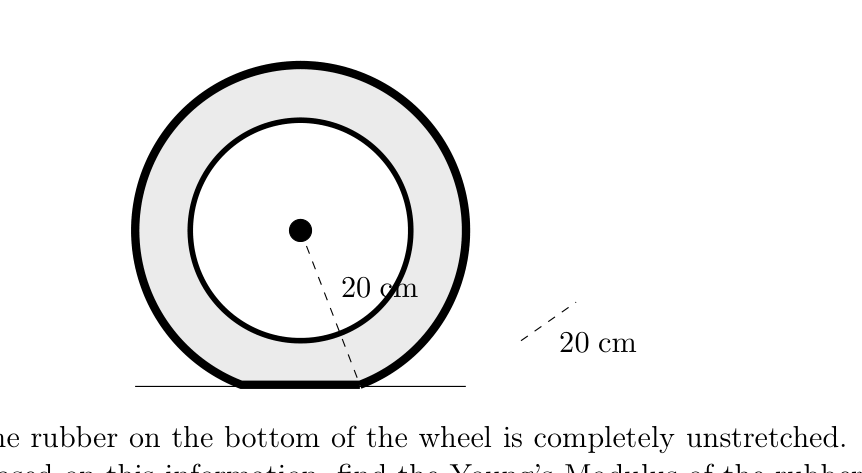
The following information applies for the next two problems. Pictured is a wheel from a 4-wheeled car of weight 1200kg. The absolute pressure inside the tire is Pa. Atmospheric pressure is Pa. Assume the rubber has negligible “stiffness” (i.e. a negligibly low Sheer modulus compared to its Young’s modulus).
Stragg 2. In generale, possiamo descrivere la traggere quadratica su un oggetto con la seguente legge di forza:
se è l’area trasversale dell’oggetto esposto al flusso d’aria, è la velocità dell’oggetto in un fluido e è il coefficiente di resistenza, una quantità senza dimensioni che varia in base alla forma.
Un’altra quantità utile da conoscere è il numero di Reynold, una quantità senza dimensioni che aiuta a prevedere i modelli di flusso dei fluidi. È data dalla formula:
dove è la densità del fluido circostante, è la viscosità dinamica del fluido e è un parametro di lunghezza di riferimento che varia a seconda di ogni oggetto. Per una sfera liscia che viaggia in un fluido, il suo diametro serve come parametro di lunghezza di riferimento.
Un grafico logaritmico di vs Re di una sfera dal Centro di Ricerca Glenn della NASA.
La relazione tra il coefficiente di resistenza e il numero di Reynold è di grande importanza. A causa della complessità della dinamica dei fluidi, i dati empirici sono comunemente utilizzati, come illustrato nella figura sopra. In particolare, la cifra indica una significativa diminuzione del coefficiente di resistenza intorno a . Questo fenomeno, noto come la crisi di trazione, si verifica quando una sfera passa dal flusso laminare al flusso turbolento, con conseguente ampia trazione e alta trazione. La tabella del link seguente presenta un intervallo di rispetto ai valori Re di una sfera liscia.
che significa superficie liscia.
Tabella Desmos: https://www.desmos.com/calculator/wmpkg5wnt0
Consideriamo una palla liscia con un raggio di m e una massa di kg caduta in aria con una densità costante di kg/m. Si scopre che a velocità di 5 m/s, il numero di palla di Reynold è . Se la palla viene abbassata dal riposo, si avvicina a una velocità terminale *stabile * . Se la palla viene abbassata verso il basso con velocità sufficiente, subirà turbolenze e si avvicinerà a una velocità terminale * stabile * . Trova . Ignorare le velocità terminali trovate per i numeri Reynold inferiori ad un ordine di magnitudine .
Nota: Questo problema è altamente idealizzato in quanto presuppone che l’atmosfera abbia un’aria di densità e temperatura costanti. In realtà, questo non è vero!
Fonte: Testo (PDF) — p.6
Topic: Fluid Mechanics Metodi: Dimensional Analysis, Experimental Data Analysis, Free-Body Diagram Competenze: Experimental Data Analysis, Physical Reasoning Objects: Sphere
Le seguenti informazioni si applicano ai due seguenti problemi. La foto mostra una ruota di un’auto a 4 ruote di peso 1200 kg. La pressione assoluta all’interno del pneumatico è Pa. La pressione atmosferica è Pa. Supponiamo che la gomma abbia una “rigidità” trascurabile (cioè: un modulo di Sheer negligibilmente basso rispetto al modulo di Young).
Hysteresis 1. The rubber on the bottom of the wheel is completely unstretched. The rubber has a thickness of 7 mm. Based on this information, find the Young’s Modulus of the rubber. Is this answer reasonable?
Fonte: Testo (PDF) — p.7
Topic: Elasticity & Materials Metodi: Stress-Strain Analysis, Hooke’s Law, Physical Modeling Competenze: Physical Reasoning, Estimation & Approximation Objects: Wheel
** Isteresis 1. ** La gomma sul fondo della ruota è completamente distaccata. La gomma ha uno spessore di 7 mm. Sulla base di queste informazioni, trovate il modulo del gomma del giovane. È ragionevole questa risposta?
Fonte: Testo (PDF) — p.7
Topic: Elasticity & Materials Metodi: Stress-Strain Analysis, Hooke’s Law, Physical Modeling Competenze: Physical Reasoning, Estimation & Approximation Objects: Wheel
Hysteresis 2. The rubber experiences a phenomena known as hysteresis — it takes more force to stretch the rubber than allow it to return to equilibrium. Specifically, assume that the Young’s Modulus when the rubber is stretched is the same to 12, and is of that when the rubber returns to equilibrium. Compute the power the car’s engines has to deliver to overcome the hysteresis losses, if the car moves at 20 m/s. Remember that there are 4 tires!
Fonte: Testo (PDF) — p.7
Topic: Elasticity & Materials Metodi: Stress-Strain Analysis, Hooke’s Law, Calculus-Integration Competenze: Physical Reasoning, Mathematical Modeling Objects: Wheel
**Isteresi 2. ** La gomma subisce un fenomeno noto come isteresis occorre più forza per allungare la gomma che per permetterle di tornare in equilibrio. In particolare, supponiamo che il modulo del Young quando la gomma è estesa sia uguale a 12, ed è di quello quando la gomma ritorna all’equilibrio. Calcolare la potenza che i motori dell’auto devono fornire per superare le perdite di isteresi, se l’auto si muove a 20 m/s. Ricordate che ci sono 4 pneumatici!
Fonte: Testo (PDF) — p.7
Topic: Elasticity & Materials Metodi: Stress-Strain Analysis, Hooke’s Law, Calculus-Integration Competenze: Physical Reasoning, Mathematical Modeling Objects: Wheel
Marbles. Two identical spherical marbles of radius 3 cm are placed in a spherical bowl of radius 10 cm. The coefficient of static friction between the surfaces of the marble is 0.31 and the coefficient of static friction between the surfaces of the marbles and the bowl is 0.13. Find the maximum elevation from the bottom of the bowl that the center of one of the marbles can achieve in equilibrium. The bowl is fixed in place and will neither rotate nor translate. Equilibrium refers to stable equilibrium.
Fonte: Testo (PDF) — p.7
Topic: Rigid Body Statics Metodi: Free-Body Diagram, Torque & Angular Momentum Analysis, Vector Decomposition Competenze: Physical Reasoning, Diagrammatic Reasoning Objects: Sphere, Container
Marmi. Due marmi sferici identici di raggio di 3 cm sono collocati in una ciotola sferica di raggio di 10 cm. Il coefficiente di attrito statico tra le superfici del marmo è di 0,31 e il coefficiente di attrito statico tra le superfici del marmo e la ciotola è di 0,13. Trova la massima elevazione dal fondo della ciotola che il centro di uno dei marmi può raggiungere in equilibrio. La ciotola è fissata e non girerà né si tradurrà. L’equilibrio si riferisce a equilibrio stabile.
Fonte: Testo (PDF) — p.7
Topic: Rigid Body Statics Metodi: Free-Body Diagram, Torque & Angular Momentum Analysis, Vector Decomposition Competenze: Physical Reasoning, Diagrammatic Reasoning Objects: Sphere, Container
Fringe effect approximation. Two parallel square plates of side length 1 m are placed a distance 30 cm apart whose centers are at and have uniform charge densities C/m and C/m respectively. Find the magnitude of the component of the electric field perpendicular to axis passing through the centers of the two plates at .
Fonte: Testo (PDF) — p.7
Topic: Electrostatics Metodi: Coulomb’s Law, Superposition Principle, Calculus-Integration Competenze: Physical Reasoning, Mathematical Modeling Objects: Capacitor
Approximation of fringe effect. Due piastre quadrate parallele di lunghezza laterale di 1 m sono posizionate a 30 cm di distanza i cui centri sono rispettivamente e con densità di carica uniformi C/m e C/m. Trova la magnitudine della componente del campo elettrico perpendicolare all’asse che attraversa i centri delle due lastre a .
Fonte: Testo (PDF) — p.7
Topic: Electrostatics Metodi: Coulomb’s Law, Superposition Principle, Calculus-Integration Competenze: Physical Reasoning, Mathematical Modeling Objects: Capacitor
Sliding Along. A hollow sphere of mass and radius is placed under a plank of mass and length . The plank is hinged to the floor, and it initially makes an angle rad to the horizontal.
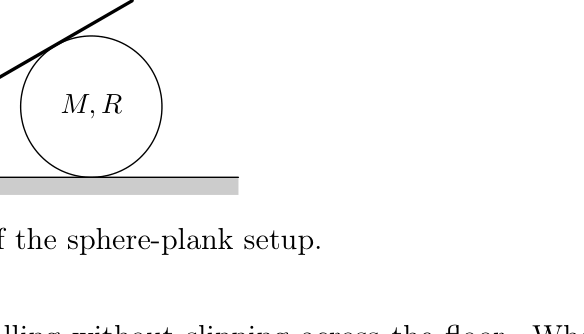 A not-to-scale picture of the sphere-plank setup.
Under the weight of the plank, the sphere starts rolling without slipping across the floor. What is the sphere’s initial translational acceleration? Assume the plank is frictionless.
Fonte: Testo (PDF) — p.8
Topic: Rotational Dynamics, Newtonian Mechanics Metodi: Torque & Angular Momentum Analysis, Free-Body Diagram, Conservation of Energy Competenze: Physical Reasoning, Diagrammatic Reasoning Objects: Sphere, Beam
The following information applies for the next two problems. A space elevator consists of a heavy counterweight placed near geostationary orbit, a thread that connects it to the ground (assume this is massless), and elevators that run on the threads (also massless). The mass of the counterweight is kg. Mass is continuously delivered to the counterweight at a rate of 0.001 kg/s. The elevators move upwards at a rate of 20 m/s. Assume there are many elevators, so their discreteness can be neglected. The elevators are massless. The counterweight orbits the Earth.
Sliding Along. Una sfera vuota di massa e di raggio è collocata sotto una tavola di massa e lunghezza . La tavola è inclinata al pavimento e inizia a fare un angolo rad verso l’orizzontale.
Un’immagine non su scala dell’impianto di tabella sfera.
Sotto il peso della tavola, la sfera inizia a rotolare senza scivolare sul pavimento. Qual è l’accelerazione traslazionale iniziale della sfera? Supponiamo che la tavola sia senza attriti.
Fonte: Testo (PDF) — p.8
Topic: Rotational Dynamics, Newtonian Mechanics Metodi: Torque & Angular Momentum Analysis, Free-Body Diagram, Conservation of Energy Competenze: Physical Reasoning, Diagrammatic Reasoning Objects: Sphere, Beam
Le seguenti informazioni si applicano ai due seguenti problemi. Un ascensore spaziale è costituito da un pesante contrapeso posizionato vicino all’orbita geostazionaria, un filo che lo collega al suolo (presumendo che questo sia senza massa) e ascensori che funzionano sui fili (anche senza massa). La massa del contrappeso è kg. La massa viene consegnata continuamente al contrappeso a una velocità di 0,001 kg/s. Gli ascensori si muovono verso l’alto a una velocità di 20 m/s. Supponiamo che ci siano molti ascensori, quindi la loro discrezione può essere trascurata. Gli ascensori sono senza massa. Il contrappeso orbita la Terra.
Space Elevator 1. Find the minimum possible displacement radially of the counterweight. Specify the sign.
Fonte: Testo (PDF) — p.8
Topic: Gravitation Metodi: Newton’s Law of Gravitation, Conservation of Momentum, Physical Modeling Competenze: Physical Reasoning, Mathematical Modeling Objects: Satellite, Planet
**Elevatore spaziale 1. ** Trova il minimo spostamento possibile radialmente del contrappeso. - Specifica il segno.
Fonte: Testo (PDF) — p.8
Topic: Gravitation Metodi: Newton’s Law of Gravitation, Conservation of Momentum, Physical Modeling Competenze: Physical Reasoning, Mathematical Modeling Objects: Satellite, Planet
Space Elevator 2. Assuming a radial displacement that is 10 times what you found in the previous part, find the displacement vertically of the counterweight. Does it lag or lead Earth’s rotation?
Fonte: Testo (PDF) — p.8
Topic: Gravitation Metodi: Newton’s Law of Gravitation, Conservation of Momentum, Approximation & Series Expansion Competenze: Physical Reasoning, Mathematical Modeling Objects: Satellite, Planet
**Elevatore spaziale 2. ** Supponendo un spostamento radial 10 volte quello trovato nella parte precedente, trovare il spostamento verticalmente del contrappeso. Raggiunga o guida la rotazione terrestre?
Fonte: Testo (PDF) — p.8
Topic: Gravitation Metodi: Newton’s Law of Gravitation, Conservation of Momentum, Approximation & Series Expansion Competenze: Physical Reasoning, Mathematical Modeling Objects: Satellite, Planet
Laser Power. Consider a spherical shell of thickness mm and radius cm made of an Ohmic material with resistivity m. A spherical laser source with a tuned frequency of Hz and intensity W/m is placed at the center of the shell and turned on. Working in the limit , approximate the initial average power dissipated by the shell. Neglect inductance.
Fonte: Testo (PDF) — p.8 Topic: Electromagnetism, Electromagnetic Induction Metodi: Faraday’s Law of Induction, Approximation & Series Expansion, Physical Modeling Competenze: Physical Reasoning, Estimation & Approximation Objects: Sphere
Laser Power. Considera una conchiglia sferica di spessore mm e di raggio cm fatta di materiale ohmico con resistività m. Una sorgente laser sferica con una frequenza sintonizzata di Hz e intensità W/m è collocata al centro della conchiglia e accesa. Lavorando nel limite , si approssimano le potenze medie iniziali dissipate dalla conchiglia. - Non si tratta di induzione.
Fonte: Testo (PDF) — p.8 Topic: Electromagnetism, Electromagnetic Induction Metodi: Faraday’s Law of Induction, Approximation & Series Expansion, Physical Modeling Competenze: Physical Reasoning, Estimation & Approximation Objects: Sphere
Twinkle Twinkle. A stable star of radius has a mass density profile . Here, “stable” means that the star doesn’t collapse under its own gravity. If the internal pressure at the core is provided solely by the radiation of photons, calculate the temperature at the core. Assume the star is a perfect black body and treat photons as a classical ideal gas. Use km and g/cm. Round your answer to the nearest kilokelvin. We treat photons as a classical gas here to neglect any relativistic effects.
Fonte: Testo (PDF) — p.8 Topic: Astrophysics, Thermodynamics Metodi: Hydrostatic Equilibrium, Newton’s Law of Gravitation, Ideal Gas Law Competenze: Physical Reasoning, Mathematical Modeling Objects: Star, Photon, Gas
Twinkle Twinkle. Una stella stabile di raggio ha un profilo di densità di massa . Qui, “stabile” significa che la stella non crolla sotto la sua stessa gravità. Se la pressione interna al nucleo è fornita esclusivamente dalla radiazione dei fotoni, calcolare la temperatura al nucleo. Supponiamo che la stella sia un corpo nero perfetto e trattate i fotoni come un gas ideale classico. Utilizzare km e g/cm. Ronda la tua risposta al kilokelvin più vicino. Qui trattiamo i fotoni come un gas classico per trascurare gli effetti relativistici.
Fonte: Testo (PDF) — p.8 Topic: Astrophysics, Thermodynamics Metodi: Hydrostatic Equilibrium, Newton’s Law of Gravitation, Ideal Gas Law Competenze: Physical Reasoning, Mathematical Modeling Objects: Star, Photon, Gas
My Heart Will Go On. On a flat playground, choose a Cartesian coordinate system (in unit of meters). A child running at a constant velocity m/s around a heart-shaped path satisfies the following order-6 algebraic equation:
When the child is at the position , what is the magnitude of their acceleration?
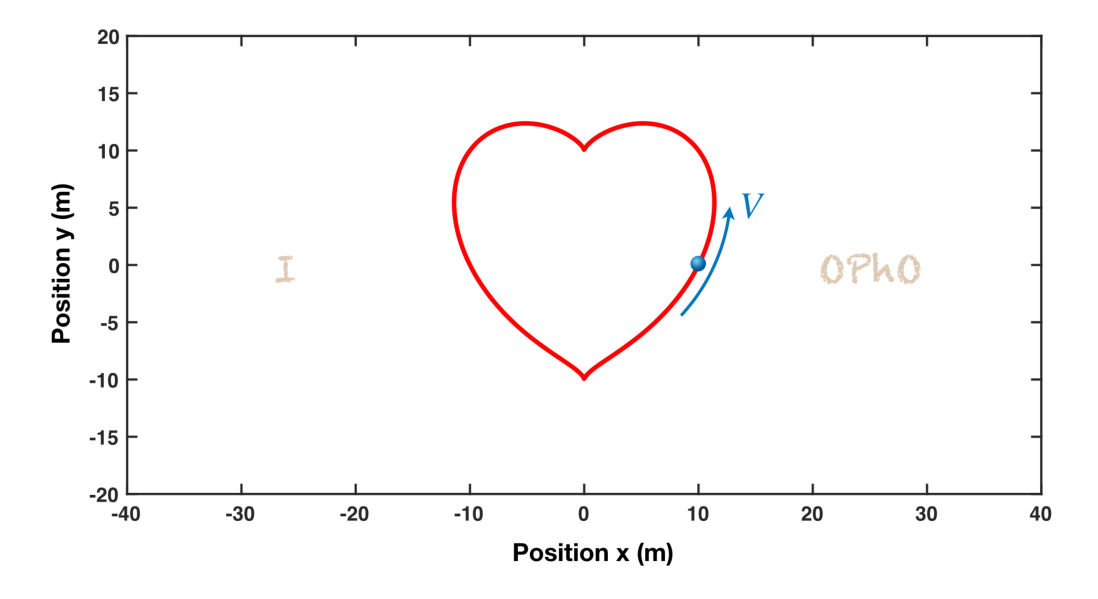
Fonte: Testo (PDF) — p.8 Topic: Newtonian Mechanics, Mathematics Metodi: Kinematic Equations, Calculus-Integration, Vector Decomposition Competenze: Mathematical Modeling, Physical Reasoning Objects: —
Il mio cuore continuerà. Su un parco giochi piatto, scegli un sistema di coordinate cartesiano (in unità di metri). Un bambino che corre a velocità costante m/s attorno a un percorso a forma di cuore soddisfa la seguente equazione algebrica di ordine 6:
Quando il bambino è in posizione , qual è la magnitudine della loro accelerazione?
Fonte: Testo (PDF) — p.8 Topic: Newtonian Mechanics, Mathematics Metodi: Kinematic Equations, Calculus-Integration, Vector Decomposition Competenze: Mathematical Modeling, Physical Reasoning Objects: —
Tricycle. A boy is riding a tricycle across along a sidewalk that is parallel to the -axis. This tricycle contains three identical wheels with radius 0.5 m. The front wheel is free to rotate while the last two wheels are parallel to each other and to the main body of the tricycle. See the diagram.
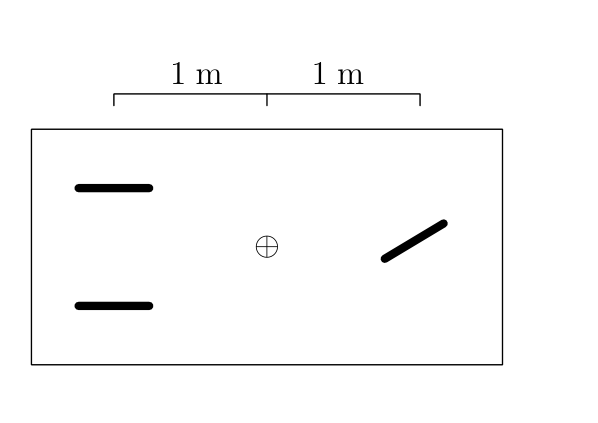
The front wheel is rotating at a constant angular speed of rad/s. The child is controlling the tricycle such that the front wheel is making an angle of with the main body of the tricycle. Determine the maximum lateral acceleration in m/s. Assume a massless frame. The marked plus sign implies CoM. The degree is in radians.
Fonte: Testo (PDF) — p.9 Topic: Newtonian Mechanics, Rotational Dynamics Metodi: Kinematic Equations, Vector Decomposition, Small-Angle Approximation Competenze: Physical Reasoning, Mathematical Modeling Objects: Wheel
Un ragazzo sta guidando una tricicletta lungo un marciapiede parallelo all’asse . Questo triciclo contiene tre ruote identiche con raggio di 0,5 m. La ruota anteriore è libera di rotazione mentre le ultime due ruote sono parallele tra loro e al corpo principale del triciclo. Guarda il diagramma.
La ruota anteriore ruota a una velocità angolare costante di rad/s. Il bambino sta controllando il triciclo in modo tale che la ruota anteriore faccia un angolo di con il corpo principale del triciclo. Determinare l’accelerazione laterale massima in m/s. Supponiamo un quadro senza massa. Il segno più indicato indica la CoM. Il grado è in radiani.
Fonte: Testo (PDF) — p.9 Topic: Newtonian Mechanics, Rotational Dynamics Metodi: Kinematic Equations, Vector Decomposition, Small-Angle Approximation Competenze: Physical Reasoning, Mathematical Modeling Objects: Wheel
Sonic Fryer. In this problem, we consider a simple model for a thermoacoustic device. The device uses heavily amplified sound to provide work for a pump that can then extract heat. Sound waves form standing waves in a tube of radius 0.25 mm that is closed on both sides, and a two-plate stack is inserted in the tube. A temperature gradient forms between the plates of the stack, and the parcel of gas trapped between the plates oscillates sinusoidally between a maximum pressure of 1.03 MPa and a minimum of 0.97 MPa. The gas is argon, with density 1.78 kg/m and adiabatic constant . The speed of sound is 323 m/s. The heat pump itself operates as follows:
The parcel of gas starts at minimum pressure. The stack plates adiabatically compress the parcel of gas to its maximum pressure, heating the gas to a temperature higher than that of the hotter stack plate. Then, the gas is allowed to isobarically cool to the temperature of the hotter stack plate. Next, the plates adiabatically expand the gas back to its minimum pressure, cooling it to a temperature lower than that of the colder plate. Finally, the gas is allowed to isobarically heat up to the temperature of the colder stack plate.
Find the power at which the thermoacoustic heat pump emits heat.
Fonte: Testo (PDF) — p.9 Topic: Thermodynamics, Oscillations & Waves Metodi: Thermodynamic Cycle Analysis, First Law of Thermodynamics, Ideal Gas Law Competenze: Physical Reasoning, Mathematical Modeling Objects: Tube, Gas
The following information applies for the next two problems. For your mass spectroscopy practical you are using an apparatus consisting of a solenoid enclosed by a uniformly charged hollow cylinder of charge density μC/m and radius cm. There exists an infinitesimal slit of insular material between the cylinder and solenoid to stop any charge transfer. Also, assume that there is no interaction between the solenoid and the cylinder, and that the magnetic field produced by the solenoid can be easily controlled to a value of .
An electron is released from rest at a distance of cm from the axis. Assume that it is small enough to pass through the cylinder in both directions without exchanging charge. It is observed that the electron reaches a distance at different points from the axis 7 times before returning to the original position.
In questo problema, consideriamo un modello semplice per un dispositivo termicoacustico. Il dispositivo utilizza un suono fortemente amplificato per fornire lavoro a una pompa che può quindi estrarre il calore. Le onde sonore formano onde in piedi in un tubo di raggio di 0,25 mm chiuso da entrambi i lati e viene inserito un’ampolla di due piastre nel tubo. Si forma un gradiente di temperatura tra le piastre del piatto e il gas intrappolato tra le piastre oscilla sinusoidamente tra una pressione massima di 1,03 MPa e un minimo di 0,97 MPa. Il gas è l’argon, con densità di 1,78 kg/m e costante adiabatica . La velocità del suono è di 323 m/s. La pompa di calore stessa funziona come segue:
Il pacchetto di gas inizia a pressione minima. Le piastre di pila compresso adiabaticamente il pacco di gas alla pressione massima, riscaldando il gas a una temperatura superiore a quella della piastra di pila più calda. Il gas viene quindi lasciato raffreddare isobaricamente alla temperatura della piastra di piattaforma più calda. Successivamente, le lastre ampliano adiabaticamente il gas fino alla pressione minima, raffreddandolo a una temperatura inferiore a quella della lastra più fredda. Infine, il gas è permesso di riscaldarsi isobaricamente fino alla temperatura della piastra a piombo più fredda.
Trova la potenza con cui la pompa termicoacustica emette il calore.
Fonte: Testo (PDF) — p.9 Topic: Thermodynamics, Oscillations & Waves Metodi: Thermodynamic Cycle Analysis, First Law of Thermodynamics, Ideal Gas Law Competenze: Physical Reasoning, Mathematical Modeling Objects: Tube, Gas
Le seguenti informazioni si applicano ai due seguenti problemi. Per la pratica di spettroscopia di massa si utilizza un apparecchio costituito da un solenoide chiuso da un cilindro vuoto uniformemente caricato di densità di carica μC/m e di raggio cm. Esiste una fessura infinitesimale di materiale isolante tra il cilindro e il solenoide per fermare qualsiasi trasferimento di carica. Inoltre, supponiamo che non vi sia alcuna interazione tra il solenoide e il cilindro e che il campo magnetico prodotto dal solenoide possa essere facilmente controllato a un valore di .
Un elettrone viene rilasciato dal riposo a una distanza di cm dall’asse. Supponiamo che sia abbastanza piccola da attraversare il cilindro in entrambe le direzioni senza scambiare carica. Si osserva che l’elettrone raggiunge una distanza in punti diversi dall’asse 7 volte prima di tornare alla posizione originale.
Isotope Separator 1. Calculate under the assumption that the path of the electron does not self-intersect with itself.
Fonte: Testo (PDF) — p.10 Topic: Electromagnetism, Magnetism Metodi: Lorentz Force Analysis, Gauss’s Law, Conservation of Energy Competenze: Physical Reasoning, Mathematical Modeling Objects: Electron
Separatore isotopo 1. Calcolare supponendo che il percorso dell’elettrone non si intersechi da sé.
Fonte: Testo (PDF) — p.10 Topic: Electromagnetism, Magnetism Metodi: Lorentz Force Analysis, Gauss’s Law, Conservation of Energy Competenze: Physical Reasoning, Mathematical Modeling Objects: Electron
Isotope Separator 2. Calculate the time it took for the particle to return to original position. Answer in milliseconds.
Hint: You may find interest in the Gaussian error function:
Specific values of the error function can be calculated on desmos.
Fonte: Testo (PDF) — p.10 Topic: Electromagnetism, Mathematics Metodi: Lorentz Force Analysis, Calculus-Integration, Differential Equations Competenze: Mathematical Modeling, Physical Reasoning Objects: Electron
**Separatore isotopo 2. ** Calcolare il tempo necessario per il ritorno della particella alla posizione originale. Rispondi in millisecondi.
**Signore: ** Potresti trovare interesse nella funzione di errore di Gaussian:
I valori specifici della funzione di errore possono essere calcolati su desmos.
Fonte: Testo (PDF) — p.10 Topic: Electromagnetism, Mathematics Metodi: Lorentz Force Analysis, Calculus-Integration, Differential Equations Competenze: Mathematical Modeling, Physical Reasoning Objects: Electron
Somos El Barco. For any circuit network made of batteries and resistors, if we know the voltages of all the batteries and the resistance values of all the resistors, we can calculate all the electrical currents. However, if we know the voltages of all the batteries and all the currents, it is still not enough to uniquely determine the resistance values of all the resistors. Consider a sail-shape circuit network, in which we connect points H and N with a charge of V battery, points A and M with a charge of V battery. The electrical currents in this network have directions and magnitudes (in mA) as shown the figure. The possible resistance values of resistors , , is not a single point (corresponds to an unique solution) but a confined region in the three-dimensional -space. Determine the volume of this region (in ).
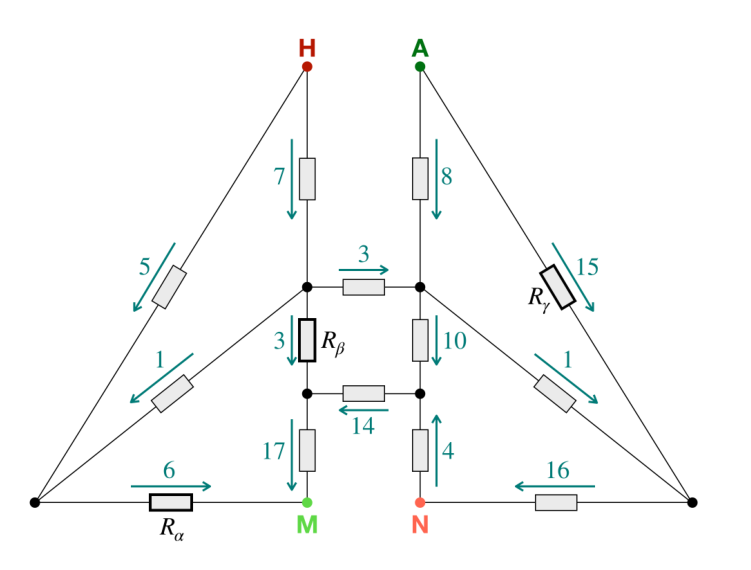 The title of this problem means “we are the boat”.
Fonte: Testo (PDF) — p.10 Topic: Circuits, Mathematics Metodi: Kirchhoff’s Laws, Equivalent Circuit Reduction, Calculus-Integration Competenze: Mathematical Modeling, Physical Reasoning Objects: Battery, Resistor
MSK1/> Per qualsiasi rete di circuiti realizzata in batterie e resistenti, se conosciamo le tensioni di tutte le batterie e i valori di resistenza di tutte le resistenze, possiamo calcolare tutte le correnti elettriche. Tuttavia, se conosciamo le tensioni di tutte le batterie e di tutte le correnti, non è ancora sufficiente determinare in modo unico i valori di resistenza di tutte le resistenze. Considera una rete di circuiti a vela, in cui colleghiamo i punti H e N con una carica di batteria V, i punti A e M con una carica di batteria V. Le correnti elettriche di questa rete hanno direzioni e magnitudini (in mA) come mostrato nella figura. I possibili valori di resistenza delle resistenze , , non sono un singolo punto (corrisponde a una soluzione unica), ma una regione limitata nello spazio tridimensionale . Determinare il volume di questa regione (in ).
*Il titolo di questo problema significa “noi siamo la barca”. *
Fonte: Testo (PDF) — p.10 Topic: Circuits, Mathematics Metodi: Kirchhoff’s Laws, Equivalent Circuit Reduction, Calculus-Integration Competenze: Mathematical Modeling, Physical Reasoning Objects: Battery, Resistor
The Final Countdown. A model of cancer tumor dynamics under a low-dose chemotherapy consists of three non-negative variables , in which represents the cancer tumor size, represents the (normalized) carrying capability of the tumor vasculature network, and represents the local (normalized) activity of the immunology system:
undefined