Jaywalking. You are a jaywalker at a distance from an intersection. At time you start to cross it at a constant velocity perpendicular to the direction of the street such that it would take you time to cross it. Incidentally, at , there is also a car at away from the intersection on the same side as you. It is a self-driving Tesla, and it drives toward the intersection at such a speed that if the light remained green, the car would reach the intersection at .
At time , the light turns red, and since the car is driven by a computer, it immediately begins decelerating with constant acceleration such that it comes to a stop at exactly .
Do you get hit by the car? If yes, report the speed of the car relative to the ground when it hits you, as a percent of its original speed before the light turned red. If no, report how far away the car is from you when you finish crossing the street.
Fonte: Testo (PDF) — p.4
Topic: Newtonian Mechanics Metodi: Kinematic Equations, Vector Decomposition Competenze: Physical Reasoning Objects: —
Jaywalking. Si tratta di un jaywalker a una distanza da un’intersezione. Al tempo si inizia a attraversarlo a velocità costante perpendicolare alla direzione della strada in modo che ci vorrebbe tempo per attraversarlo. A proposito, a , c’è anche un’auto a lontano dall’incrocio sullo stesso lato che tu. E’ una Tesla autonoma, e si dirige verso l’intersezione a una velocità tale che se la luce rimaneva verde, l’auto raggiungerebbe l’intersezione a .
Al momento , la luce diventa rossa e, poiché l’auto è guidata da un computer, inizia immediatamente a rallentare con un’accelerazione costante in modo tale che si ferma esattamente .
Sei stato colpito dalla macchina? Se sì, segna la velocità della macchina rispetto al suolo quando ti colpisce, come percentuale della sua velocità originale prima che la luce si faccia rossa. Se no, segna quanto lontano è l’auto quando hai finito di attraversare la strada.
Fonte: Testo (PDF) — p.4
Topic: Newtonian Mechanics Metodi: Kinematic Equations, Vector Decomposition Competenze: Physical Reasoning Objects: —
Ambidexterity. When plane-polarized light is passed through a solution with chiral molecules (e.g. glucose/DNA), the exiting light is observed to have been rotated by an angle . In chemistry, this optical rotation is measured with a polarimeter device. It is used to measure the relative abundances of left-handed and right-handed molecules, each having their own refractive index and affecting left and right circularly polarized light respectively.
If the length of the solution container is , by which angle will the polarization of light rotate, i.e. what is the total optical rotation , in radians? Input the smallest positive answer to this question.
Fonte: Testo (PDF) — p.4
Topic: Wave Optics Metodi: Superposition Principle, Wave Equation Competenze: Mathematical Modeling Objects: Container
Ambidexterity. Quando la luce polarizzata a piano viene trasmessa attraverso una soluzione con molecole chirali (ad esempio, glucose/DNA), the exiting light is observed to have been rotated by an angle . In chimica, questa rotazione ottica viene misurata con un dispositivo polarimetro. È usato per misurare le relative abbondance di molecole a sinistra e a destra, ognuna con il proprio indice di rifrazione e che influenzano rispettivamente la luce polarizzata a destra e a sinistra.
Se la lunghezza del contenitore di soluzione è , a quale angolo ruoterà la polarizzazione della luce, ovvero Qual è la rotazione ottica totale , in radiani? Inserisci la più piccola risposta positiva a questa domanda.
Fonte: Testo (PDF) — p.4
Topic: Wave Optics Metodi: Superposition Principle, Wave Equation Competenze: Mathematical Modeling Objects: Container
Ball Drop. A ball with uniform density is placed on the surface of a pool with depth and liquid density . Another identical ball is lifted a height above the pool, and then both balls are released at the same time. In order for both balls to touch the bottom of the pool at the same time, the condition must be met for some dimensionless that depends on the values of and . If we define
then we can express as
where are all nonzero integers, , and . What is ? You may assume that the only forces present are gravity and the buoyant force from the pool. The airborne ball retains all of its energy as it enters the pool.
Fonte: Testo (PDF) — p.4
Topic: Fluid Mechanics, Newtonian Mechanics Metodi: Free-Body Diagram, Kinematic Equations, Hydrostatic Equilibrium Competenze: Mathematical Modeling Objects: Ball
Ball Drop. Una palla con densità uniforme viene posizionata sulla superficie di una piscina con profondità e densità liquida . Un’altra palla identica viene sollevata a una altezza sopra la piscina, e poi entrambe le palle vengono rilasciate allo stesso tempo. Per poter raggiungere contemporaneamente il fondo della piscina, occorre soddisfare la condizione per un senza dimensioni che dipende dai valori di e . Se definiamo
Quindi possiamo esprimere come
in cui sono tutti numeri interi non zero, e . Che cos’è ? Potreste supporre che le uniche forze presenti siano la gravità e la forza galleggiante della piscina. La palla aerea conserva tutta la sua energia quando entra nella piscina.
Fonte: Testo (PDF) — p.4
Topic: Fluid Mechanics, Newtonian Mechanics Metodi: Free-Body Diagram, Kinematic Equations, Hydrostatic Equilibrium Competenze: Mathematical Modeling Objects: Ball
Coilfun. Consider an air-cored superconducting solenoid of length with cross-sectional area and turns. We connect the ends of the solenoid to each other with superconducting wires and run a current through the entire setup. Assume that the solenoid behaves ideally.
Cosmonaut Carla has a core with the same dimensions as the solenoid. The core has relative permeability and mass . The core is released at rest far from the solenoid and, due to magnetic forces, flies through the solenoid. Cosmonaut Carla can choose to quench the solenoid (instantaneously removing the current) at any time. What is the maximum attainable exit velocity of the core?
Fonte: Testo (PDF) — p.4
Topic: Electromagnetism, Magnetism Metodi: Energy Conservation Method, Ampère’s Law, Physical Modeling Competenze: Physical Reasoning Objects: Solenoid, Wire
Coilfun. Considera un solenoide superconduttore a corteccia d’aria di lunghezza con area di sezione trasversale e torsioni . Connettiamo le estremità del solenoide tra loro con fili superconduttori e eseguiamo una corrente attraverso l’intera configurazione. Supponiamo che il solenoide si comporti in modo ideale.
La cosmonauta Carla ha un nucleo con le stesse dimensioni del solenoide. Il nucleo ha una permeabilità relativa e una massa . Il nucleo viene rilasciato a riposo lontano dal solenoide e, a causa delle forze magnetiche, vola attraverso il solenoide. Il cosmonauta Carla può scegliere di spegnere il solenoide (rilevando istantaneamente la corrente) in qualsiasi momento. Qual è la velocità massima di uscita raggiungibile del nucleo?
Fonte: Testo (PDF) — p.4
Topic: Electromagnetism, Magnetism Metodi: Energy Conservation Method, Ampère’s Law, Physical Modeling Competenze: Physical Reasoning Objects: Solenoid, Wire
Into Orbit. A cannon is fixed to the top of a platform of height , which sits on a planet of mass and radius . Both the cannon and the platform it rests on have negligible mass, and the cannon’s chamber is angled horizontally relative to the planet below it. The cannon then fires a cannonball of mass through a chamber of length at a constant acceleration such that the cannonball is able to successfully enter an elliptical orbit around the planet. What is the minimum force that must be applied by the cannon on the cannonball in order to make this possible? You may assume that both the planet and the platform do not move during this process.
Fonte: Testo (PDF) — p.5
Topic: Gravitation, Newtonian Mechanics Metodi: Newton’s Law of Gravitation, Kepler’s Laws, Conservation of Energy Competenze: Physical Reasoning Objects: Projectile, Planet
Un cannone è fissato sulla parte superiore di una piattaforma di altezza , che si trova su un pianeta di massa e raggio . Sia il cannone che la piattaforma su cui si poggia hanno una massa trascurabile, e la camera del cannone è angolata orizzontalmente rispetto al pianeta sotto di esso. Il cannone spara poi una palla di cannone di massa attraverso una camera di lunghezza ad una costante accelerazione tale che la palla di cannone sia in grado di entrare con successo in un’orbita ellittica intorno al pianeta. Qual è la forza minima che deve essere applicata dal cannone sulla palla da cannone per rendere possibile questo? Potresti supporre che sia il pianeta che la piattaforma non si muovano durante questo processo.
Fonte: Testo (PDF) — p.5
Topic: Gravitation, Newtonian Mechanics Metodi: Newton’s Law of Gravitation, Kepler’s Laws, Conservation of Energy Competenze: Physical Reasoning Objects: Projectile, Planet
Roundabout 1. A ramp with length is raised an angle () above the horizontal. A block with mass is placed at the top of the ramp, with the coefficient of friction between the block and the ramp being . Once the block reaches the bottom of the ramp, it retains its velocity as it is smoothly transitioned onto a frictionless circular track with radius and bank angle , rotating on the track without sliding off. A solution is a set of values that result in the situation described above. What is the largest (in degrees) for which a solution exists?
Fonte: Testo (PDF) — p.5
Topic: Newtonian Mechanics, Conservation of Energy Metodi: Free-Body Diagram, Conservation of Energy, Vector Decomposition Competenze: Physical Reasoning Objects: Inclined Plane, Block
Ronda 1. Una rampa di lunghezza è sollevata ad un angolo () sopra l’orizzontale. Un blocco di massa è posizionato in cima alla rampa, con un coefficiente di attrito tra il blocco e la rampa . Una volta raggiunto il fondo della rampa, il blocco mantiene la sua velocità, in quanto viene facilmente trasmesso su una pista circolare senza attrito con raggio e angolo di spalla , ruotando sulla pista senza scivolare. Una soluzione è un insieme di valori che si traducono nella situazione descritta sopra. Qual è la più grande (in gradi) per la quale esiste una soluzione?
Fonte: Testo (PDF) — p.5
Topic: Newtonian Mechanics, Conservation of Energy Metodi: Free-Body Diagram, Conservation of Energy, Vector Decomposition Competenze: Physical Reasoning Objects: Inclined Plane, Block
Roundabout 2. While the block is going around the circular track, it is given a small push perpendicular to its current velocity and parallel to the surface of the track, causing it to oscillate with period . What is the smallest possible value of when ?
Fonte: Testo (PDF) — p.5
Topic: Oscillations & Waves, Newtonian Mechanics Metodi: Simple Harmonic Motion Analysis, Small-Angle Approximation, Free-Body Diagram Competenze: Physical Reasoning Objects: Block
Ronda 2. Mentre il blocco gira intorno alla pista circolare, viene dato un piccolo spinto perpendicolare alla sua velocità corrente e parallelo alla superficie della pista, causando un’oscillazione con il periodo . Qual è il valore più piccolo possibile di quando ?
Fonte: Testo (PDF) — p.5
Topic: Oscillations & Waves, Newtonian Mechanics Metodi: Simple Harmonic Motion Analysis, Small-Angle Approximation, Free-Body Diagram Competenze: Physical Reasoning Objects: Block
Atom Smasher. An alpha particle is the nucleus of a He atom, and is composed of two protons and two neutrons bound together. A neutron is given speed and collides with an alpha particle at rest. If all five protons and neutrons become unbound as a result of the collision, what is the minimum possible value of ? You may find the following values useful:
Fonte: Testo (PDF) — p.5
Topic: Nuclear & Particle Physics, Special Relativity Metodi: Relativistic Energy-Momentum, Mass-Energy Equivalence, Conservation of Momentum Competenze: Physical Reasoning Objects: Nucleus
Atom Smasher. Una particella alfa è il nucleo di un atomo E è composta da due protoni e due neutroni legati tra loro. Un neutrone ha una velocità e collide con una particella alfa in riposo. Se tutti e cinque i protoni e i neutroni si dissociano a causa della collisione, quale è il valore minimo possibile di ? Potreste trovare utili i seguenti valori:
Fonte: Testo (PDF) — p.5
Topic: Nuclear & Particle Physics, Special Relativity Metodi: Relativistic Energy-Momentum, Mass-Energy Equivalence, Conservation of Momentum Competenze: Physical Reasoning Objects: Nucleus
Dying Light. Follin creates a vat of a peculiar liquid with index of refraction . Just a bit complex. While working with the liquid, he accidentally drops a photodetector into it. Follin shines a red laser with wavelength and vacuum intensity down into the liquid. How far does the photodetector sink before it detects an intensity less than ? Assume that the lab is completely dark and that the laser light is perfectly transmitted into the liquid.
Fonte: Testo (PDF) — p.5
Topic: Wave Optics Metodi: Wave Equation, Physical Modeling Competenze: Mathematical Modeling Objects: Container
Lumina morente. Follin crea un vassoio di un liquido particolare con indice di rifrazione . E’ un po’ complicato. Mentre lavora con il liquido, accidentalmente gli scende un fotodettore. Follin illumina un laser rosso con lunghezza d’onda e intensità di vuoto nel liquido. Quanto si affonda il fotodettore prima di rilevare un’intensità inferiore a ? Supponiamo che il laboratorio sia completamente buio e che la luce laser sia perfettamente trasmessa nel liquido.
Fonte: Testo (PDF) — p.5
Topic: Wave Optics Metodi: Wave Equation, Physical Modeling Competenze: Mathematical Modeling Objects: Container
Motorized Pendulum 1. A pendulum is made of a massless rod of length and a point mass hanging at one end. The angle between the rod and the vertical is . A motor attached to the pivot supplies a torque. The maximum value of this torque is angle-dependent and is given by
The pendulum initially is given a small angular velocity counterclockwise and is at . The mass is extremely sensitive and cannot tolerate high speeds. Therefore, assume the motor always supplies just enough torque for the mass to move at a negligibly small constant speed. What is the minimum value of needed so that the pendulum eventually reaches ?
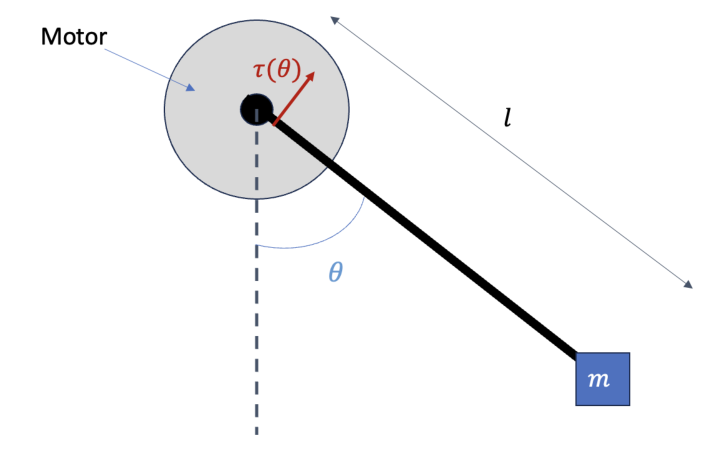 Figure 1: Motorized pendulum
Fonte: Testo (PDF) — p.5
Topic: Rotational Dynamics, Conservation of Energy Metodi: Torque & Angular Momentum Analysis, Energy Conservation Method, Calculus-Integration Competenze: Physical Reasoning Objects: Pendulum, Rod
**Pendolo motore 1. ** Un pendolo è costituito da una barra senza massa di lunghezza e da una massa puntaria appesa ad una estremità. L’angolo tra la canna e la verticale è . Un motore collegato al pivot fornisce una coppia. Il valore massimo di questa coppia è a seconda dell’angolo e viene dato da:
All’inizio il pendolo ha una velocità angolare di piccola velocità contro il senso orario e si trova a . La massa è estremamente sensibile e non tollerano alte velocità. Pertanto, supponiamo che il motore fornisca sempre la coppia sufficiente per la massa a muoversi a una velocità costante trascurabilmente piccola. Qual è il valore minimo di necessario affinché il pendolo raggiunga infine ?
Figura 1: Pendolo motorizzato
Fonte: Testo (PDF) — p.5
Topic: Rotational Dynamics, Conservation of Energy Metodi: Torque & Angular Momentum Analysis, Energy Conservation Method, Calculus-Integration Competenze: Physical Reasoning Objects: Pendulum, Rod
Motorized Pendulum 2. The pendulum initially is at . This time, the mass is not so sensitive. The motor may supply its full torque for all . What is the minimum value of needed so that the pendulum reaches in a single unidirectional swing?
Fonte: Testo (PDF) — p.6
Topic: Rotational Dynamics, Conservation of Energy Metodi: Torque & Angular Momentum Analysis, Energy Conservation Method, Calculus-Integration Competenze: Physical Reasoning Objects: Pendulum, Rod
**Pendolo motore 2. ** Il pendolo è inizialmente a . Questa volta, la massa non e’ cosi’ sensibile. Il motore può fornire la coppia completa per tutti i . Qual è il valore minimo di necessario affinché il pendolo raggiunga in un solo swing unidirezionale?
Fonte: Testo (PDF) — p.6
Topic: Rotational Dynamics, Conservation of Energy Metodi: Torque & Angular Momentum Analysis, Energy Conservation Method, Calculus-Integration Competenze: Physical Reasoning Objects: Pendulum, Rod
Motorized Pendulum 3. The pendulum initially is at . The mass contains extremely sensitive electronics that cannot tolerate speeds above . To three significant figures, what is the minimum value of needed so that the pendulum reaches without exceeding this speed threshold?
Fonte: Testo (PDF) — p.6
Topic: Rotational Dynamics, Conservation of Energy Metodi: Torque & Angular Momentum Analysis, Energy Conservation Method, Calculus-Integration Competenze: Physical Reasoning Objects: Pendulum, Rod
**Pendolo motorizzato 3. ** Il pendolo è inizialmente a . La massa contiene elettronica estremamente sensibile che non può tollerare velocità superiori a . Per tre cifre significative, qual è il valore minimo di necessario affinché il pendolo raggiunga senza superare questa soglia di velocità?
Fonte: Testo (PDF) — p.6
Topic: Rotational Dynamics, Conservation of Energy Metodi: Torque & Angular Momentum Analysis, Energy Conservation Method, Calculus-Integration Competenze: Physical Reasoning Objects: Pendulum, Rod
Gravitational Oscillations 1. You are given the charge distribution on a conductive ellipsoid described by the equation
If we denote its total charge by , the surface charge density is given by
Now suppose we model a planet as a uniform density disk. The issue with this is that everyone at the edges would be pulled towards the center (not “downwards”). In what follows, suppose that the disk has a fixed radius and a height . This comes at the cost that different people feel different gravitational “constants” downward. Consider the density distribution of the disk such that people living on it would only feel a gravitational pull downwards. What is the ratio ?
Fonte: Testo (PDF) — p.6
Topic: Gravitation, Electrostatics Metodi: Newton’s Law of Gravitation, Symmetry Argument, Calculus-Integration Competenze: Mathematical Modeling Objects: Disk, Planet
**Oscillazioni gravitazionali 1. ** Vi viene data la distribuzione di cariche su un ellissoide conduttivo descritto dall’equazione
Se indichiamo la sua carica totale con , la densità di carica superficiale viene data da
Supponiamo di modellare un pianeta come un disco di densità uniforme. Il problema è che tutti i margini sarebbero stati trascinati verso il centro (non “in basso”). In quanto segue, supponiamo che il disco abbia un raggio fisso e un’altezza . Questo si verifica a costo che persone diverse sentano “constanti” gravitazionali diverse verso il basso. Considerate la distribuzione di densità del disco in modo tale che le persone che vi abitano sentano solo un’attrazione gravitazionale verso il basso. Qual è il rapporto ?
Fonte: Testo (PDF) — p.6
Topic: Gravitation, Electrostatics Metodi: Newton’s Law of Gravitation, Symmetry Argument, Calculus-Integration Competenze: Mathematical Modeling Objects: Disk, Planet
Gravitational Oscillations 2. Let the density right at the center of the planet be , and let the height of the disk be . What is the mass enclosed in the ring with outer radius and inner radius , where ?
Fonte: Testo (PDF) — p.6
Topic: Gravitation Metodi: Calculus-Integration, Approximation & Series Expansion Competenze: Mathematical Modeling Objects: Disk, Planet
**Oscillazioni gravitazionali 2. ** La densità al centro del pianeta sia , e l’altezza del disco sia . Qual è la massa chiusa nell’anello con raggio esterno e raggio interno , dove ?
Fonte: Testo (PDF) — p.6
Topic: Gravitation Metodi: Calculus-Integration, Approximation & Series Expansion Competenze: Mathematical Modeling Objects: Disk, Planet
Gravitational Oscillations 3. Now imagine that we drill a hole through the disk at a distance and drop a ball through. In seconds, what is the period of its oscillation? Neglect air friction.
Fonte: Testo (PDF) — p.6
Topic: Gravitation, Oscillations & Waves Metodi: Newton’s Law of Gravitation, Simple Harmonic Motion Analysis, Differential Equations Competenze: Physical Reasoning Objects: Disk, Ball
Gravitational Oscillations 3. Now imagine that we drill a hole through the disk at a distance and drop a ball through. In pochi secondi, qual è il periodo di oscillazione? - Non si deve fare attenzione alla friczione.
Fonte: Testo (PDF) — p.6
Topic: Gravitation, Oscillations & Waves Metodi: Newton’s Law of Gravitation, Simple Harmonic Motion Analysis, Differential Equations Competenze: Physical Reasoning Objects: Disk, Ball
Liquid Lenses. A large cylindrical well, with a radius of and a depth much greater than the radius (), is filled with reflective liquid metal. The well and the liquid within it is then set into rotation around its central axis at an angular speed of , causing the edge of the liquid surface to rise and touch the brim of the well. Positioned directly above the well is a circular lamp with a radius of , emitting photons vertically downward at a uniform rate and density. If the rate at which photons leave the lamp is , then the rate at which photons collide with the liquid metal can be expressed as , where is a dimensionless constant. What is the value of ?
Fonte: Testo (PDF) — p.7
Topic: Geometric Optics, Fluid Mechanics Metodi: Ray Tracing, Calculus-Integration, Physical Modeling Competenze: Physical Reasoning Objects: Container, Mirror, Photon
Un grande pozzo cilindrico, con un raggio di e una profondità molto superiore al raggio (), è riempito di metallo liquido riflettente. Il pozzo e il liquido all’interno sono poi messi in rotazione attorno al suo asse centrale a una velocità angolare di , causando un’ascesa del bordo della superficie del liquido e il tocco del bordo del pozzo. Situata direttamente sopra il pozzo è una lampada circolare con un raggio di , che emette fotoni verticalmente verso il basso a velocità e densità uniformi. Se la velocità con cui i fotoni lasciano la lampada è , allora la velocità con cui i fotoni si schiantano con il metallo liquido può essere espressa come , dove è una costante senza dimensioni. Qual è il valore di ?
Fonte: Testo (PDF) — p.7
Topic: Geometric Optics, Fluid Mechanics Metodi: Ray Tracing, Calculus-Integration, Physical Modeling Competenze: Physical Reasoning Objects: Container, Mirror, Photon
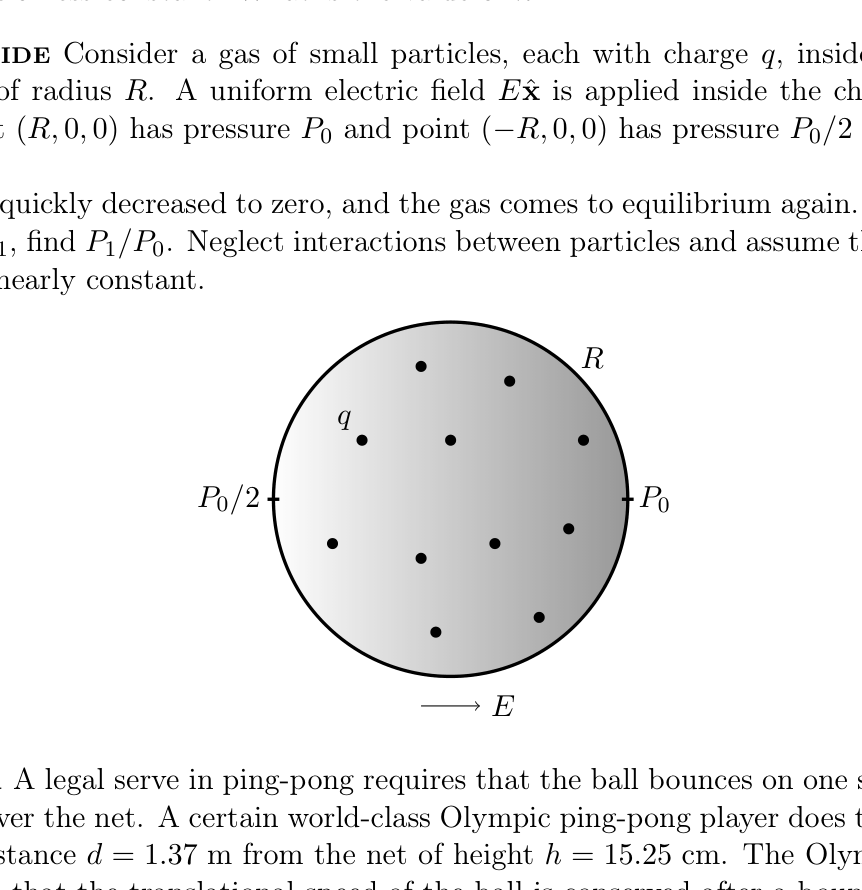
Electric Slide. Consider a gas of small particles, each with charge , inside an origin-centered spherical chamber of radius . A uniform electric field is applied inside the chamber. The field is adjusted until point has pressure and point has pressure (at equilibrium). The electric field is quickly decreased to zero, and the gas comes to equilibrium again. If the final pressure in the chamber is , find . Neglect interactions between particles and assume that the temperature of the gas remains nearly constant.
Fonte: Testo (PDF) — p.7
Topic: Kinetic Theory, Electrostatics Metodi: Kinetic Theory of Gases, Ideal Gas Law, Statistical Averaging Competenze: Physical Reasoning Objects: Gas, Container
Slide elettrico. Considera un gas di piccole particelle, ciascuna con carica , all’interno di una camera sferica centrata sull’origine di raggio . All’interno della camera viene applicato un campo elettrico uniforme . Il campo viene regolato fino a che il punto abbia una pressione e il punto una pressione (in equilibrio). Il campo elettrico viene rapidamente ridotto a zero e il gas torna a equilibrio. Se la pressione finale nella camera è , trova . Trascurare le interazioni tra le particelle e assumere che la temperatura del gas rimanga quasi costante.
Fonte: Testo (PDF) — p.7
Topic: Kinetic Theory, Electrostatics Metodi: Kinetic Theory of Gases, Ideal Gas Law, Statistical Averaging Competenze: Physical Reasoning Objects: Gas, Container
Ping-pong 1. A legal serve in ping-pong requires that the ball bounces on one side of the table and that the ball goes over the net. A certain world-class Olympic ping-pong player does the serve at the level of the table at a distance from the net of height . The Olympic player can give the ball such a spin that the translational speed of the ball is conserved after a bounce but the direction of velocity can be controlled freely. What is the minimal serving speed (up to two decimal places)?
Fonte: Testo (PDF) — p.7
Topic: Newtonian Mechanics Metodi: Kinematic Equations, Vector Decomposition, Approximation & Series Expansion Competenze: Physical Reasoning Objects: Ball
Un servizio legale nel ping-pong richiede che la palla rimbalzi su un lato del tavolo e che la palla vada sopra la rete. Un certo giocatore di ping-pong olimpico di livello mondiale fa il servizio al livello del tavolo a una distanza dalla rete di altezza . Il giocatore olimpico può dare alla palla un giro tale che la velocità traslazionale della palla sia conservata dopo un rimbalzo ma la direzione della velocità può essere controllata liberamente. Qual è la velocità minima di servizio (fino a due decimali)?
Fonte: Testo (PDF) — p.7
Topic: Newtonian Mechanics Metodi: Kinematic Equations, Vector Decomposition, Approximation & Series Expansion Competenze: Physical Reasoning Objects: Ball
Ping-pong 2. We consider a serve with bounces before going over the net. The Olympic player is so incredibly good that he can control the direction of the velocity after each bounce as he pleases. Naturally more bounces decreases the minimal serving speed . However, for some , when the minimal serving speed no longer decreases if bounces are added, i.e. is the smallest natural number such that for all . Find .
Fonte: Testo (PDF) — p.7 Topic: Newtonian Mechanics, Mathematics Metodi: Kinematic Equations, Conservation of Energy, Physical Modeling Competenze: Mathematical Modeling, Physical Reasoning Objects: Ball
**Ping-pong 2. ** Consideramo un serve con rimbalzi prima di passare sulla rete. L’attore olimpico è così incredibilmente bravo che può controllare la direzione della velocità dopo ogni balzo come vuole. Naturalmente, un maggior numero di rimbalzi riduce la velocità minima di servizio . Tuttavia, per alcuni , quando la velocità minima di servizio non diminuisce più se si aggiungono rimbalzi, ovvero è il numero naturale più piccolo tale che per tutti . Trova .
Fonte: Testo (PDF) — p.7 Topic: Newtonian Mechanics, Mathematics Metodi: Kinematic Equations, Conservation of Energy, Physical Modeling Competenze: Mathematical Modeling, Physical Reasoning Objects: Ball
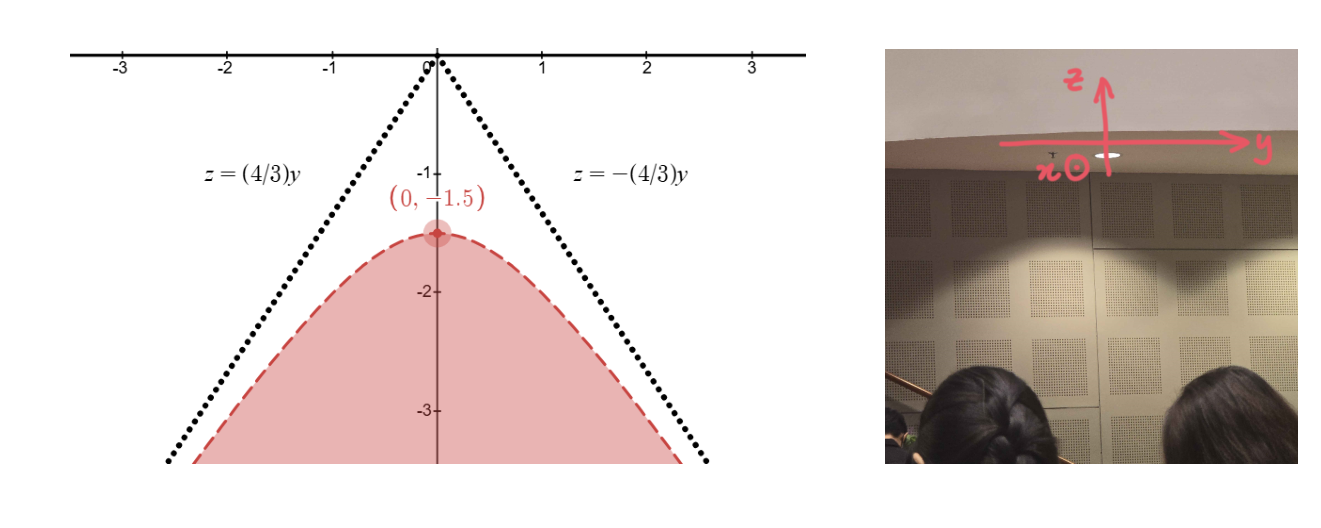
An Envelope of Light. A point light source on the ceiling is located at the center of a cylindrical housing (with an open base) of radius and height . A wall is a horizontal distance from the center of the cylinder. Now consider a coordinate system with the light source at the origin. The wall, at , has the following shape in the – plane:
The vertical coordinate of the highest point of the curve observed is , while the gradients of the lines asymptotically tangent to the curve are . On the right is shown an example setup of this phenomenon. Find the horizontal distance of the wall to the light source.
Fonte: Testo (PDF) — p.7 Topic: Geometric Optics, Mathematics Metodi: Ray Tracing, Physical Modeling, Symmetry Argument Competenze: Diagrammatic Reasoning, Mathematical Modeling Objects: —
Un involucro di luce. Una fonte di luce puntaria sul soffitto si trova al centro di una struttura cilindrica (con base aperta) di raggio e altezza . Un muro è una distanza orizzontale dal centro del cilindro. Ora consideriamo un sistema di coordinate con la fonte luminosa all’origine. Il muro, a , ha la seguente forma nel piano y$$z:
La coordinata verticale del punto più alto della curva osservata è , mentre i gradienti delle linee asintoticamente tangenti alla curva sono . A destra è mostrato un esempio di configurazione di questo fenomeno. Trova la distanza orizzontale della parete alla fonte luminosa.
Fonte: Testo (PDF) — p.7 Topic: Geometric Optics, Mathematics Metodi: Ray Tracing, Physical Modeling, Symmetry Argument Competenze: Diagrammatic Reasoning, Mathematical Modeling Objects: —
Under The Lamplight. A large vat of the magical liquid Ophonium lies before you, with a depth of . This liquid has a special property — its index of refraction changes relative to its depth! Its index of refraction can be expressed by the equation
where is the depth of the liquid, in meters.
A lamp, acting as a point source of light, is hung above the vat. Light emanates from the lamp, casting its glow onto a circular section of the Ophonium’s surface directly beneath it, covering an area of square meters. As this light continues to travel downward, it enters the Ophonium, gradually penetrating its depths until it reaches the bottom of the vat. What is the area, in square meters, of the circle illuminated at the bottom of the vat? You may find the following integral useful:
Fonte: Testo (PDF) — p.8 Topic: Geometric Optics, Mathematics Metodi: Snell’s Law, Calculus-Integration, Ray Tracing Competenze: Mathematical Modeling, Physical Reasoning Objects: Container
Sotto la lampada. Si trova davanti a voi un grande vassoio di Ophonium, il liquido magico, con una profondità di . Questo liquido ha una proprietà speciale: il suo indice di rifrazione cambia rispetto alla sua profondità! Il suo indice di rifrazione può essere espresso con l’equazione
dove è la profondità del liquido, in metri.
Una lampada, che agisce come fonte di luce di punto, è appesa sopra il vassoio. La luce emana dalla lampada, che lancia il suo brillo su una sezione circolare della superficie dell’Ophonium direttamente sotto di essa, coprendo un’area di metri quadrati. Mentre questa luce continua a viaggiare verso il basso, entra nell’Ophonium, penetrando gradualmente nelle sue profondità fino a raggiungere il fondo del vassoio. Qual è l’area, in metri quadrati, del cerchio illuminato al fondo della vasca? Potreste trovare utile la seguente integrale:
Fonte: Testo (PDF) — p.8 Topic: Geometric Optics, Mathematics Metodi: Snell’s Law, Calculus-Integration, Ray Tracing Competenze: Mathematical Modeling, Physical Reasoning Objects: Container
Cannonball. On flat ground, a cannonball is shot with a speed of over a wall of height located a distance away from the cannon. If is the farthest away the ball can be shot over the wall and is the shortest distance the ball can reach while going over the wall, find .
Fonte: Testo (PDF) — p.8 Topic: Newtonian Mechanics Metodi: Kinematic Equations, Vector Decomposition, Approximation & Series Expansion Competenze: Mathematical Modeling, Physical Reasoning Objects: Projectile
Bolla di cannone. Su terreno piatto, una palla di cannone viene sparata a una velocità su un muro di altezza situato a una distanza dal cannone. Se è la distanza più lontana che la palla può essere sparata attraverso il muro e è la distanza più breve che la palla può raggiungere mentre attraversa il muro, trova .
Fonte: Testo (PDF) — p.8 Topic: Newtonian Mechanics Metodi: Kinematic Equations, Vector Decomposition, Approximation & Series Expansion Competenze: Mathematical Modeling, Physical Reasoning Objects: Projectile
Filament 1. Follin has developed a revolutionary new lightbulb filament. The filament is in the shape of a spherical shell of radius and thickness , and the ends of the filament are diametrically opposite. To attach the wires, the filament is slightly flattened on the ends, forming two circles of radius , each of which is completely covered by the corresponding contact wire. If the resistivity of the filament material is , what is the resistance of Follin’s lightbulb?
Fonte: Testo (PDF) — p.8 Topic: Circuits Metodi: Calculus-Integration, Equivalent Circuit Reduction, Physical Modeling Competenze: Mathematical Modeling, Physical Reasoning Objects: Resistor, Wire
Follin ha sviluppato un nuovo filamento rivoluzionario per lampadine. Il filamento è a forma di una conchiglia sferica di raggio e spessore , e le estremità del filamento sono diametralmente opposte. Per attaccare i fili, il filamento è leggermente appiattito sulle estremità, formando due cerchi di raggio , ognuno dei quali è completamente coperto dal corrispondente filo di contatto. Se la resistenza del materiale filamentare è , quale è la resistenza dell’ampolla di Follin?
Fonte: Testo (PDF) — p.8 Topic: Circuits Metodi: Calculus-Integration, Equivalent Circuit Reduction, Physical Modeling Competenze: Mathematical Modeling, Physical Reasoning Objects: Resistor, Wire
Filament 2. Follin now modifies his filament to have six instead of two flattened circles arranged symmetrically around the sphere. He places contact wires at two flattened circles that are spaced apart on their shared great circle. Find the new resistance of the lightbulb.
Fonte: Testo (PDF) — p.8 Topic: Circuits Metodi: Equivalent Circuit Reduction, Symmetry Argument, Superposition Principle Competenze: Physical Reasoning, Mathematical Modeling Objects: Resistor, Wire
**Filamento 2. ** Follin modifica ora il suo filamento per avere sei invece di due cerchi appiattiti disposti simmetricamente attorno alla sfera. Si collocano i fili di contatto in due cerchi appiattiti che sono spaziati a parte sul loro grande cerchio condiviso. Trova la nuova resistenza della lampadina.
Fonte: Testo (PDF) — p.8 Topic: Circuits Metodi: Equivalent Circuit Reduction, Symmetry Argument, Superposition Principle Competenze: Physical Reasoning, Mathematical Modeling Objects: Resistor, Wire
A Question of Counting. A uniform beam of cold neutrons (neutrons have mass and speed ) passes through a thin slit of width . A detector, of width , is placed a distance from the slit. Find the percentage of neutrons passing through the slit that are actually recorded by the detector.
Fonte: Testo (PDF) — p.8 Topic: Modern-Quantum Physics, Wave Optics Metodi: de Broglie Relation, Interference & Diffraction Analysis, Calculus-Integration Competenze: Mathematical Modeling, Physical Reasoning Objects: Particle Beam, Slit, Screen
Un raggio uniforme di neutroni freddi (i neutroni hanno massa e velocità ) passa attraverso una slitta sottile di larghezza . Un rilevatore di larghezza è posizionato a una distanza dalla fessura. Trova la percentuale di neutroni che attraversano la fessura che viene registrata dal rilevatore.
Fonte: Testo (PDF) — p.8 Topic: Modern-Quantum Physics, Wave Optics Metodi: de Broglie Relation, Interference & Diffraction Analysis, Calculus-Integration Competenze: Mathematical Modeling, Physical Reasoning Objects: Particle Beam, Slit, Screen
Peculiar Pump. A box with volume and initial temperature contains monatomic ideal gas initially kept at a constant low pressure . The mass of the gas molecules is . The box is connected to a very large reservoir which contains monatomic ideal gas at temperature and pressure . A small hole with area is poked in the box at time days, allowing gas to escape. (The box is no longer at constant pressure after this point.) For every molecule of gas that escapes through this hole, molecules of gas are let into the box from the reservoir. (The particles let in from the reservoir are selected with probability proportional to their velocity component perpendicular to the hole. In other words, the particles effuse through the hole but with the door to the hole restricting their number to times the number of outgoing particles.) How many days does it take for the temperature in the box to double? Assume changes in the reservoir’s pressure and temperature are negligible. For reference, the rate of particles escaping out of a hole with area is given by:
where is the pressure of the gas, is the mass of the gas molecules, is the Boltzmann constant and is the temperature of the gas. Please note that the average energy per particle of particles leaving via effusion is .
Fonte: Testo (PDF) — p.9 Topic: Kinetic Theory, Thermodynamics Metodi: Kinetic Theory of Gases, Differential Equations, Ideal Gas Law Competenze: Mathematical Modeling, Physical Reasoning Objects: Gas, Container
Pompina particolare. Una scatola con volume e temperatura iniziale contiene un gas ideale monatomo inizialmente tenuto a una pressione bassa costante . La massa delle molecole di gas è . La scatola è collegata a un grande serbatoio contenente gas ideale monatomo a temperatura e pressione . Un piccolo buco con superficie viene inserito nella scatola a tempo giorni, consentendo la fuga del gas. (La scatola non è più a pressione costante dopo questo punto.) Per ogni molecola di gas che scappa attraverso questo buco, le molecole di gas vengono lasciate entrare nella scatola dal serbatoio. (Le particelle che vengono rilasciate dal serbatoio vengono selezionate con probabilità proporzionale alla loro componente di velocità perpendicolare al foro. In altre parole, le particelle sfondano attraverso il buco, ma la porta del buco limita il loro numero a volte il numero delle particelle uscite.) Supponiamo che i cambiamenti nella pressione e nella temperatura del serbatoio siano trascurabili. Per riferimento, il tasso di fughe di particelle da un foro con superficie è indicato da:
dove è la pressione del gas, è la massa delle molecole del gas, è la costante di Boltzmann e è la temperatura del gas. Si prega di notare che l’energia media per particella di particelle che usciranno per effusione è .
Fonte: Testo (PDF) — p.9 Topic: Kinetic Theory, Thermodynamics Metodi: Kinetic Theory of Gases, Differential Equations, Ideal Gas Law Competenze: Mathematical Modeling, Physical Reasoning Objects: Gas, Container
Air Cushion. An air cushion is in the shape of a cylinder with length and circular cross-sectional radius . The ends of the cylinder lie in vertical planes, and the length lies parallel to the horizontal ground. It is filled with an incompressible gas. Both the surface of the air cushion and gas inside have negligible weight compared to other forces in the scenario. The surface maintains a constant surface tension whenever deformed. A flat slab of mass which is wider than the cushion is balanced on top, squishing the cushion. Find the new horizontal width of the cushion. Assume that its cross-section remains symmetric about a vertical axis.
Fonte: Testo (PDF) — p.9 Topic: Fluid Mechanics, Rigid Body Statics Metodi: Hydrostatic Equilibrium, Free-Body Diagram, Calculus-Integration Competenze: Mathematical Modeling, Physical Reasoning Objects: Cylinder, Gas, Block
Cuccino d’aria. Un cuscino d’aria è a forma di cilindro con lunghezza e raggio di sezione trasversale circolare . Le estremità del cilindro si trovano in piani verticali e la lunghezza si trova parallela al terreno orizzontale. È riempito di un gas incompressibile. Sia la superficie del cuscino d’aria che il gas all’interno hanno un peso trascurabile rispetto alle altre forze dello scenario. La superficie mantiene una tensione superficiale costante ogni volta che si deforma. Una lastra piatta di massa più larga del cuscino è bilanciata in alto, schiacciando il cuscino. Trova la nuova larghezza orizzontale del cuscino. Supponiamo che la sua sezione trasversale rimanga simmetrica intorno ad un asse verticale.
Fonte: Testo (PDF) — p.9 Topic: Fluid Mechanics, Rigid Body Statics Metodi: Hydrostatic Equilibrium, Free-Body Diagram, Calculus-Integration Competenze: Mathematical Modeling, Physical Reasoning Objects: Cylinder, Gas, Block
Soapy oscillator. On a smooth table lies a square frame made of four homogeneous rods of length and mass which are hinged together at the corners. Each (massless) hinge carries a charge . Before the frame was put on the table, it was put in a liquid soap mixture which left a soap film within the frame defined by the rods. The surface tension of said soapy water is . It turns out that it is possible to have small amplitude oscillations where opposing corners of the frame have opposite velocities (away/towards from the centre). What is the respective angular frequency of the oscillations?
Fonte: Testo (PDF) — p.9 Topic: Oscillations & Waves, Electrostatics Metodi: Simple Harmonic Motion Analysis, Coulomb’s Law, Energy Conservation Method Competenze: Mathematical Modeling, Physical Reasoning Objects: Rod, Membrane, Point Charge
Oscillatore di sapone. Su un tavolo liscio si trova un telaio quadrato costituito da quattro barre omogenee di lunghezza e massa che sono incastrate insieme negli angoli. Ogni cerniera (senza massa) porta una carica . Prima di mettere il telaio sul tavolo, veniva inserito in una miscela di sapone liquido che lasciava un film di sapone all’interno del telaio definito dalle barre. La tensione superficiale di tale acqua saponeosa è . Si scopre che è possibile avere piccole oscillazioni di amplitudine in cui gli angoli opposti del telaio hanno velocità opposte (all’infuori/in direzione del centro). Qual è la rispettiva frequenza angolare delle oscillazioni?
Fonte: Testo (PDF) — p.9 Topic: Oscillations & Waves, Electrostatics Metodi: Simple Harmonic Motion Analysis, Coulomb’s Law, Energy Conservation Method Competenze: Mathematical Modeling, Physical Reasoning Objects: Rod, Membrane, Point Charge
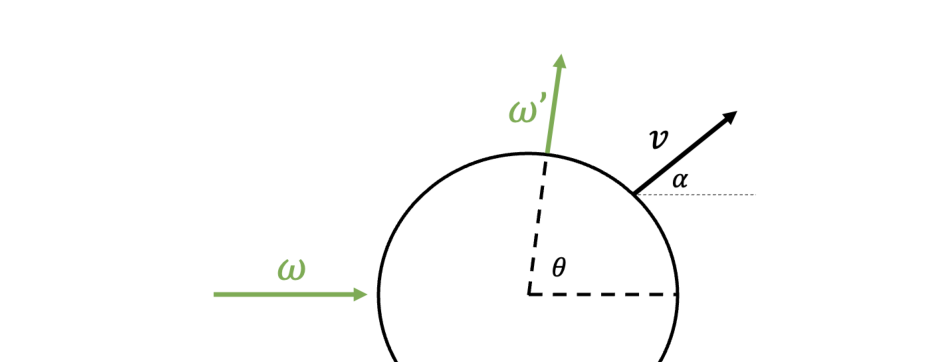
Relativistic Scattering. A small spherical particle traveling at a speed at an angle from the horizontal is struck by an electromagnetic plane wave of angular frequency propagating directly to the right. In its own reference frame, the particle scatters light in all directions with the same frequency as the frequency of incident light it perceives. Due to the relativistic Doppler effect, however, the frequency of the scattered light measured in the lab frame is generally not the same as the incident light frequency. What is the angular frequency of light scattered into a scattering angle of ? Assume the radius of the particle is small enough that .
Fonte: Testo (PDF) — p.9 Topic: Special Relativity, Electromagnetism Metodi: Lorentz Transformation, Relativistic Energy-Momentum, Vector Decomposition Competenze: Mathematical Modeling, Physical Reasoning Objects: Sphere
Scattering relativistico. Una piccola particella sferica che viaggia ad una velocità ad un angolo dall’orizzontale è colpita da un’onda elettromagnetica a piano di frequenza angolare che si propaga direttamente a destra. Nella sua cornice di riferimento, la particella disperde la luce in tutte le direzioni con la stessa frequenza della luce incidente che percepisce. A causa dell’effetto relativistico di Doppler, tuttavia, la frequenza della luce dispersa misurata nel quadro di laboratorio non è generalmente la stessa della frequenza della luce incidente. Qual è la frequenza angolare della luce sparsi in un angolo di sparsione ? Supponiamo che il raggio della particella sia abbastanza piccolo da .
Fonte: Testo (PDF) — p.9 Topic: Special Relativity, Electromagnetism Metodi: Lorentz Transformation, Relativistic Energy-Momentum, Vector Decomposition Competenze: Mathematical Modeling, Physical Reasoning Objects: Sphere
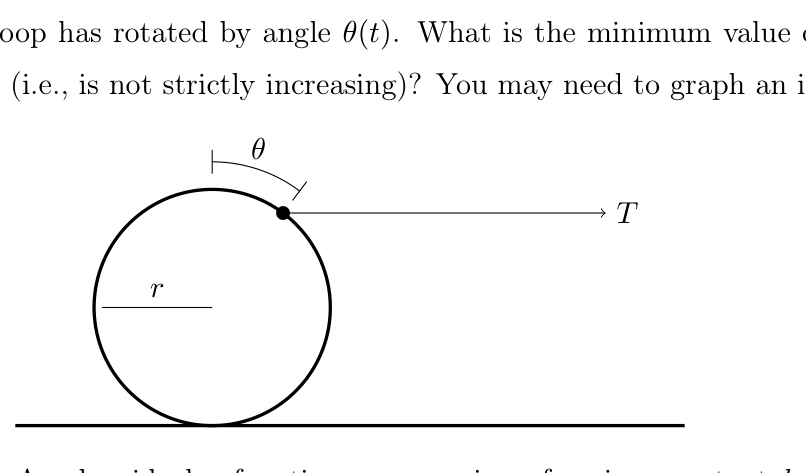
Reluctant Roller. A hoop of mass and radius rests on a surface with coefficient of friction . At time , a string is attached to the hoop’s highest point and a constant horizontal tension is applied. By time , the hoop has rotated by angle . What is the minimum value of such that has a local maximum (i.e., is not strictly increasing)? You may need to graph an implicit function.
Fonte: Testo (PDF) — p.10 Topic: Rotational Dynamics, Newtonian Mechanics Metodi: Torque & Angular Momentum Analysis, Free-Body Diagram, Differential Equations Competenze: Mathematical Modeling, Diagrammatic Reasoning Objects: Wheel, String
Relutante Rolo. Un cerchio di massa e di raggio si posa su una superficie con coefficiente di attrito . Al tempo , viene attaccata una corda al punto più alto del cerchio e viene applicata una tensione orizzontale costante . Nel tempo , l’orlo è rotato per angolo . Qual è il valore minimo di tale che abbia un massimo locale (cioè non aumenta strettamente)? Potrebbe essere necessario graficare una funzione implicita.
Fonte: Testo (PDF) — p.10 Topic: Rotational Dynamics, Newtonian Mechanics Metodi: Torque & Angular Momentum Analysis, Free-Body Diagram, Differential Equations Competenze: Mathematical Modeling, Diagrammatic Reasoning Objects: Wheel, String
Solenoid Spring. A solenoid also functions as a spring of spring constant . It is connected in series with a resistor of very small resistance. One end of the solenoid is firmly fixed to its wire while the other end has a conducting ring of mass that is free to frictionlessly slide on its wire but always remains in contact. The inductance is at its relaxed length . If the free end of the solenoid is slightly displaced, find the angular frequency of the resulting oscillations. The initial current through the circuit is . Assume that the thermal power lost by the resistor is negligible.
Fonte: Testo (PDF) — p.10 Topic: Electromagnetic Induction, Oscillations & Waves Metodi: Faraday’s Law of Induction, Simple Harmonic Motion Analysis, Energy Conservation Method Competenze: Mathematical Modeling, Physical Reasoning Objects: Solenoid, Resistor, Spring
Un solenoide funziona anche come una sorgente di costante sorgente . È collegato in serie con una resistenza di resistenza molto piccola. Una estremità del solenoide è fissata saldamente al filo mentre l’altra è dotata di un anello di conduttore di massa che può scivolare senza attrito sul filo, ma rimane sempre in contatto. L’induttanza è alla sua lunghezza rilassata . Se l’estremità libera del solenoide è leggermente spostata, si trova la frequenza angolare delle oscillazioni risultanti. La corrente iniziale attraverso il circuito è . Supponiamo che la potenza termica perduta dalla resistenza sia trascurabile.
Fonte: Testo (PDF) — p.10 Topic: Electromagnetic Induction, Oscillations & Waves Metodi: Faraday’s Law of Induction, Simple Harmonic Motion Analysis, Energy Conservation Method Competenze: Mathematical Modeling, Physical Reasoning Objects: Solenoid, Resistor, Spring
Devil’s Trill. Consider a string of length and linear mass density , fixed on both ends and vibrating in the first normal mode with amplitude . A frictionless, negligibly-small finger, initially at the right endpoint, slides slowly toward the left, flattening the oscillation as it goes. When the vibrating part of the string has length , find the new amplitude of vibrations , in meters. You may assume . Diagrams are not necessarily drawn to scale.
Fonte: Testo (PDF) — p.10 Topic: Oscillations & Waves Metodi: Wave Equation, Energy Conservation Method, Calculus-Integration Competenze: Mathematical Modeling, Physical Reasoning Objects: String
Trill del diavolo. Considera una stringa di lunghezza e di densità di massa lineare , fissata su entrambe le estremità e vibrante nella prima modalità normale con amplitudine . Un dito senza attrito, trascurabilmente piccolo, inizialmente al punto di fine destro, scivola lentamente verso sinistra, appiattendo l’oscillazione mentre va. Quando la parte vibrante della corda ha lunghezza , trovare la nuova amplitudine delle vibrazioni , in metri. Si può supporre . I diagrammi non sono necessariamente disegnati su scala.
Fonte: Testo (PDF) — p.10 Topic: Oscillations & Waves Metodi: Wave Equation, Energy Conservation Method, Calculus-Integration Competenze: Mathematical Modeling, Physical Reasoning Objects: String
Chess. Imagine a grid with a particle in each cell. These particles move in an L-shape, similar to knights in chess. Every second, a particle moves randomly in one of the cells it can access with an L jump. Two or more particles are allowed to occupy the same cell. After some time, this system will reach an equilibrium. If the (statistical) temperature of the system and thus each cell is , all the cells will have a definite energy level. Find the difference between the highest and lowest energy states in eV.
Fonte: Testo (PDF) — p.11 Topic: Kinetic Theory, Mathematics Metodi: Statistical Averaging, Physical Modeling, Symmetry Argument Competenze: Mathematical Modeling, Physical Reasoning Objects: —
** scacchi.** Immaginate una griglia con una particella in ogni cella. Queste particelle si muovono in forma di L, simile a cavalieri negli scacchi. Ogni secondo, una particella si muove in modo casuale in una delle cellule che può accedere con un salto L. Due o più particelle possono occupare la stessa cellula. Dopo un po’ di tempo, questo sistema raggiungerà un equilibrio. Se la temperatura (statistica) del sistema e quindi di ciascuna cella è , tutte le celle avranno un livello di energia definito. Trova la differenza tra gli stati di energia più elevati e più bassi in eV.
Fonte: Testo (PDF) — p.11 Topic: Kinetic Theory, Mathematics Metodi: Statistical Averaging, Physical Modeling, Symmetry Argument Competenze: Mathematical Modeling, Physical Reasoning Objects: —
Conducting sheets. [This problem has been removed from the test.]
Topic: Electrostatics Metodi: Physical Modeling Competenze: Physical Reasoning Fonte: Testo (PDF) — p.11 Objects: —
L’esecuzione delle foglie. * [Questo problema è stato rimosso dalla prova.]*
Topic: Electrostatics Metodi: Physical Modeling Competenze: Physical Reasoning Fonte: Testo (PDF) — p.11 Objects: —
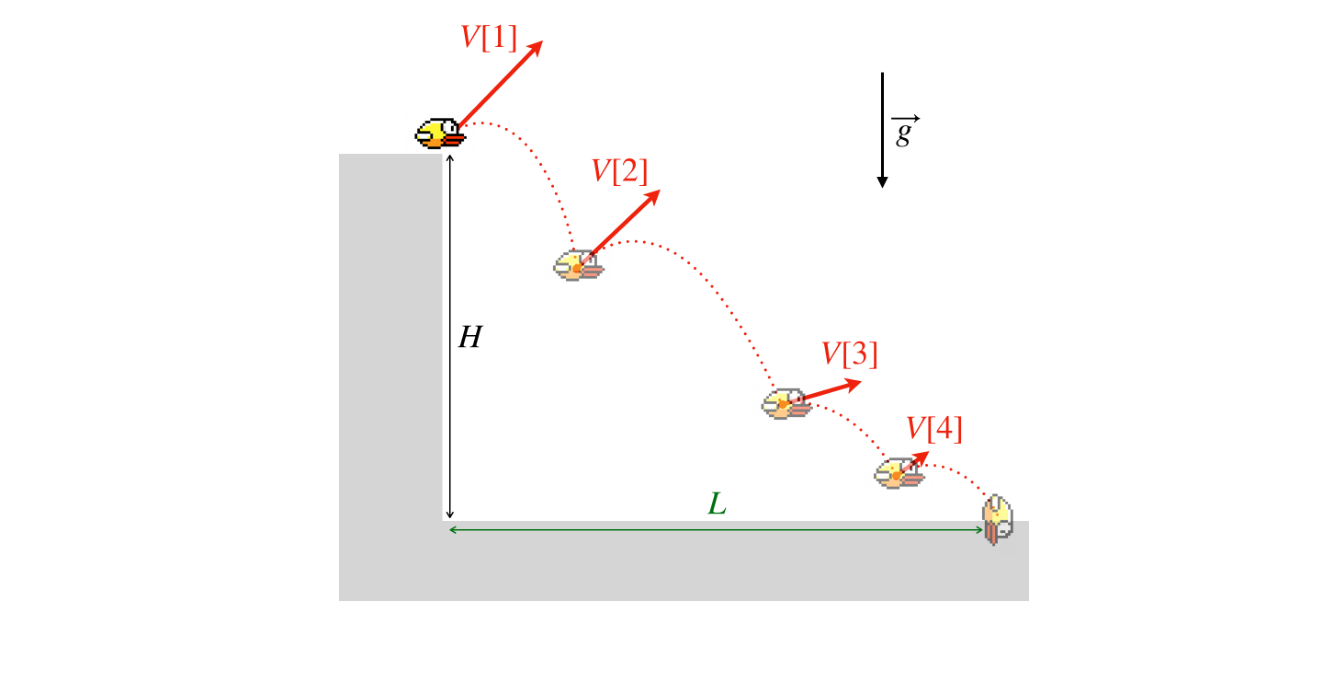
A Tired Flappy Bird. A flappy bird can jump multiple times in the air. Each time it jumps mid-air, it can suddenly change its speed and direction. For every jump, the bird can decide when to jump and in which direction. Between jumps, the bird falls freely under gravity, which pulls it down at the acceleration . Say, our tired flappy bird starts off the cliff of height with the jumping velocity . Subsequent jumps in mid-air have decreasing velocities, i.e. the -th jump has speed (). This majestic Vietnamese animal wants to travel as far as possible horizontally before it lands on the ground. Find the maximum horizontal distance the bird can travel (denoted as in the figure below) in meters, given that and . Note that each jumping velocity is the total speed of the bird after the jump (rather than e.g. adding to its speed before the jump).
Fonte: Testo (PDF) — p.11 Topic: Newtonian Mechanics, Mathematics Metodi: Kinematic Equations, Physical Modeling, Approximation & Series Expansion Competenze: Mathematical Modeling, Physical Reasoning Objects: Projectile
A Tired Flappy Bird. A flappy bird can jump multiple times in the air. Ogni volta che salta in aria, può cambiare improvvisamente velocità e direzione. Per ogni salto, l’uccello può decidere quando saltare e in quale direzione. Tra i salti, l’uccello cade liberamente sotto la gravità, che lo tira giù all’accelerazione . Say, our tired flappy bird starts off the cliff of height with the jumping velocity . I successivi salti in aria hanno velocità diminuenti, cioè il salto -th ha velocità (). Questo maestoso animale vietnamita vuole viaggiare il più lontano possibile orizzontalmente prima di atterrare a terra. Trova la distanza orizzontale massima che l’uccello può percorrere (indicata come nella figura seguente) in metri, dato che e . Si noti che ogni velocità di salto è la velocità totale dell’uccello dopo il salto (piuttosto che ad esempio aggiungendo la sua velocità prima del salto).
Fonte: Testo (PDF) — p.11 Topic: Newtonian Mechanics, Mathematics Metodi: Kinematic Equations, Physical Modeling, Approximation & Series Expansion Competenze: Mathematical Modeling, Physical Reasoning Objects: Projectile