Theory Question 1 [10 marks]
This problem consists of two independent parts.
A. Magnetosphere [5 marks]
Iron is a soft ferromagnetic material, meaning that it has relative permeability and zero intrinsic magnetisation.
(A.1) Show that the magnetic field at the surface of an iron body is approximately perpendicular to the surface. [0.5 pts]
An iron hemisphere of radius sits face down on a very large iron plane. Assume that there is a small air gap between the plane and the bottom of the hemisphere (with relative permeability 1). A thin conducting loop of radius is centered a distance above the hemisphere and has current flowing through it.
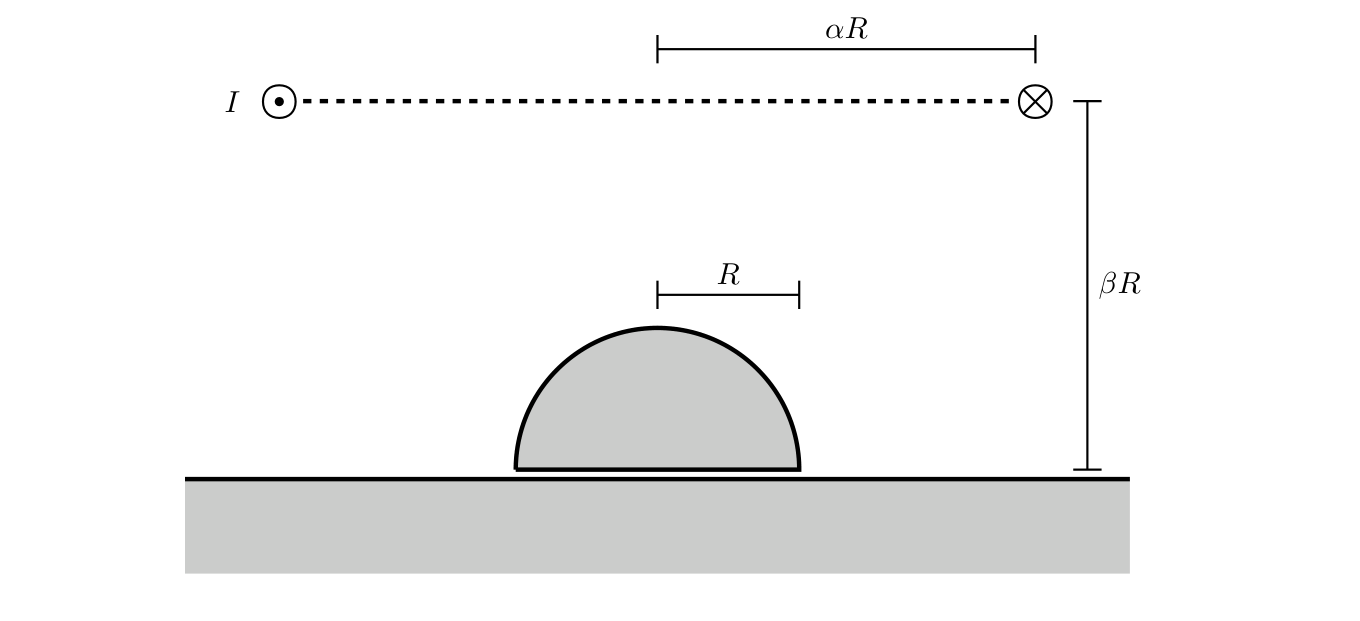
(A.2) Find the net magnetic force on the hemisphere. [3 pts] Give your answer in terms of the integral
(A.3) Find numerically the maximum value of such that the hemisphere can be lifted, assuming that and can be chosen freely. [0.5 pts]
(A.4) Find an equation for the maximum value of such that the hemisphere can be lifted, assuming that and can be chosen freely. [1 pt]
B. World Eater [5 marks]
According to general relativity, a particle’s distance from a black hole of mass obeys:
Here, is the particle’s proper time and is its conserved angular momentum per unit mass around the black hole.
A black hole of mass travels at speed through a medium with density , accreting mass as it moves. Near the black hole, the gravitational field is so strong that you may treat the medium as a fluid of noninteracting particles. Assume that .
(B.1) Find the rate of increase of the black hole’s mass. [1.5]
(B.2) Find the drag force on the black hole, neglecting the medium’s gravitational interaction with itself. Qualitatively explain your result. [2]
(B.3) Including the medium’s gravitational interaction with itself, give an asymptotic estimate for the drag force. [1.5]
Fonte: Testo (PDF) — p.4 Topic: Magnetism, Astrophysics Metodi: Symmetry Argument, Newton’s Law of Gravitation, Conservation Laws, Calculus-Integration Competenze: Physical Reasoning, Mathematical Modeling, Estimation & Approximation Objects: Coil, Black Hole
Teoria 1 Domanda 10 punti]
Questo problema consiste in due parti indipendenti.
A. Magnetosfera [5 punti]
Il ferro è un materiale * morbido ferromagnetico*, il che significa che ha una relativa permeabilità e zero magnetizzazione intrinseca.
**(A.1) ** Mostra che il campo magnetico alla superficie di un corpo di ferro è approssimativamente perpendicolare alla superficie. [0,5 pts]
Un emisfero di ferro di raggio si trova faccia a faccia su un piano di ferro molto grande. Supponiamo che ci sia un piccolo spazio aereo tra il piano e il fondo dell’emisfero (con relativa permeabilità 1). Un sottile ciclo di conduttore di raggio è centrato a una distanza sopra l’emisfero e ha una corrente che fluisce attraverso di esso.
**(A.2) ** Trova la forza magnetica netta sull’emisfero. [3 punti] Dare la risposta in termini di integrale
**(A.3) ** Trova numericamente il valore massimo di in modo tale che l’emisfero possa essere sollevato, supponendo che e possano essere scelti liberamente. [0,5 pts]
**(A.4) ** Trova un’equazione per il valore massimo di tale da poter sollevare l’emisfero, supponendo che e possano essere scelti liberamente. [1 pt]
B. World Eater [5 punti]
Secondo la relatività generale, la distanza di una particella da un buco nero di massa obbedisce:
Qui, è il tempo appropriato della particella e è il suo momento angolare conservato per unità di massa intorno al buco nero.
Un buco nero di massa viaggia a velocità attraverso un mezzo di densità , accumulando massa mentre si muove. Vicino al buco nero, il campo gravitazionale è così forte che si può trattare il mezzo come un fluido di particelle non interagiscono. Supponiamo che .
**(B.1) ** Trova il tasso di aumento della massa del buco nero. [1.5]
**(B.2) ** Trova la forza di resistenza sul buco nero, trascurando l’interazione gravitazionale del mezzo con se stesso. Spiegate qualitativamente il vostro risultato. [2]
**(B.3) ** Inclusa l’interazione gravitazionale del mezzo con se stesso, si deve dare una stima asimptotica della forza di trazione. [1.5]
Fonte: Testo (PDF) — p.4 Topic: Magnetism, Astrophysics Metodi: Symmetry Argument, Newton’s Law of Gravitation, Conservation Laws, Calculus-Integration Competenze: Physical Reasoning, Mathematical Modeling, Estimation & Approximation Objects: Coil, Black Hole
Theory Question 2 [10 marks]
This problem consists of two independent parts.
A. Efficient Lighting [5.5 marks]
Let be a two-dimensional, simply connected room with perfectly reflecting walls, illuminated by omnidirectional light sources located in the room’s interior. We strictly work in the geometric optics regime and neglect all reflections off of non-differentiable corners. Sources do not affect light passing through them.
(A.1) For any given configuration of distinct point sources, construct such that the parts of the room illuminated by each source are disjoint, and the total illuminated area is equal to the area of . Sketch two concrete examples of your construction that differ in more than a trivial sense. [1 pt]
(A.2) Now, for a finite number sources which are finite, disjoint and simply connected 2D regions, whose shape and placement are of your choice, construct satisfying the conditions of part (a). Sketch your construction of and indicate the chosen source shape and placement. [2 pts]
(A.3) Likewise, for any arbitrary sources which are finite, disjoint and simply connected 2D regions, describe how to generally construct satisfying the conditions of part (a). Sketch one possible example of your construction, differing in more than a trivial sense from your answer to part (b). [2.5 pts]
B. Gas Gas Gas [4.5 marks]
(B.1) Consider a viscous gas cloud of finite extent orbiting around a dominating central mass. Prove that no steady state or periodic solution exists. Do not assume any specific equation of state (i.e., relation between and ). [4.5 pts] Note: Solutions which do not demonstrate the non-existence of local minima will receive no points. Solutions which prove the result in the case of a disk will receive half points.
Fonte: Testo (PDF) — p.6 Topic: Geometric Optics, Fluid Mechanics Metodi: Ray Tracing, Symmetry Argument, Physical Modeling, Hydrostatic Equilibrium Competenze: Diagrammatic Reasoning, Physical Reasoning, Mathematical Modeling Objects: Mirror, Gas
Teoria Domanda 2 [10 punti]
Questo problema consiste in due parti indipendenti.
A. L’illuminazione efficiente [5,5 punti]
Che il sia una stanza bidimensionale, semplicemente connessa con pareti perfettamente riflessive, illuminata da fonti luminose omnidirezionali situate all’interno della stanza. Lavoriamo rigorosamente nel regime dell’ottica geometrica e trascuriamo tutti i riflessi fuori da angoli non differenziabili. Le fonti non influenzano la luce che passa attraverso di loro.
**(A.1) ** Per qualsiasi configurazione di fonti di punto distinte, costruire in modo tale che le parti della stanza illuminate da ciascuna fonte siano disconseguite e la superficie totale illuminata sia uguale alla superficie di . Segna due esempi concreti della tua costruzione che differiscono in più di un senso banale. [1 pt]
(A.2) ** Ora, per un numero finito di fonti che sono regioni 2D finite, disconnesse e semplicemente collegate, la cui forma e collocazione sono ** della vostra scelta, costruire soddisfacendo le condizioni della parte (a). Sketta la tua costruzione di e indica la forma e la posizione della fonte scelte. [2 punti]
**(A.3) ** Allo stesso modo, per tutte le fonti ** arbitrarie ** che sono regioni 2D finite, disconnesse e semplicemente connesse, descrivere come generalmente costruire soddisfacendo le condizioni della parte (a). Sine di un possibile esempio della tua costruzione, che differisce in più di un senso banale dalla tua risposta alla parte (b). [2,5 punti]
B. Gas Gas Gas [4,5 punti]
**(B.1) ** Considera una nuvola di gas viscosa di portata finita che orbita attorno a una massa centrale dominante. Prove che non esiste una soluzione stabile o periodica. Non assumere alcuna equazione specifica di stato (cioè rapporto tra e ). [4.5 punti] Nota: Le soluzioni che non dimostrano l’assenza di minimi locali non riceveranno punti. Le soluzioni che dimostrano il risultato nel caso di un disco riceveranno metà dei punti.
Fonte: Testo (PDF) — p.6 Topic: Geometric Optics, Fluid Mechanics Metodi: Ray Tracing, Symmetry Argument, Physical Modeling, Hydrostatic Equilibrium Competenze: Diagrammatic Reasoning, Physical Reasoning, Mathematical Modeling Objects: Mirror, Gas
Theory Question 3 [10 marks]
On Ice [10 marks]
A skater is skating on ice on a dry day with ambient temperature . The skater has mass kg and the skates have total area and length cm in contact with the ice. The skater is moving forward at a velocity . You may assume throughout the question that the stakes are perfectly vertical.
The goal of this question is to consider the physical effects that affect skating.
(A.1) Estimate the melting point of the ice directly under the skate in terms of the given quantities, the density of water at , the density of ice at , the latent heat of fusion for water , and K is the temperature at which ice melts under standard conditions. [0.8 pts]
(A.2) In what regime do you expect the melting of the ice due to the pressure of the blade to be significant? [0.2 pts]
For part (B), we assume that lies within the regime where the effect we considered in (A) is significant. Do not make this assumption for the remainder of the question.
Aside from the pressure of the blade, intermolecular forces also play a role to create meltwater at the ice surface. The force between a molecule of water vapour and a molecule of ice with a liquid layer separating them can be modelled by
where is a constant determining the strength of the intermolecular forces, and is the separation between the two molecules.
(B.1) Considering only the interaction between the vapour and ice layers, find the potential energy per unit area of a layer of liquid layer of height , defining any quantities you need and stating any simplifying assumptions made. [1 pt]
(B.2) Estimate the equilibrium thickness of the liquid layer due to intermolecular forces. You are given the strength of interaction , the molar mass of water , the latent heat of vaporisation of water , and atmospheric pressure Pa. [1.4 pts]
(B.3) Estimate the thickness of the liquid layer caused by pressure melting. The heat capacity of ice is and the thermal conductivity of ice is . When does each effect dominate? [0.8 pts]
(B.4) Based on these answers, estimate the frictional force experienced by the skater near . The viscosity of water is . What does this tell you about the effects governing the frictional force experienced by the skater? [0.4 pts]
We now consider the correction caused by the frictional heat generated while the blade is sliding. This heat is conducted into the ice, which melts some of it. In previous sections we have assumed that the thickness of the liquid layer is constant across the length of the blade, but this is not the case once friction is taken into account. In this part, you may assume that the blade glides on top of the liquid layer.
(C.1) By considering the power dissipated by friction in shear flow in the liquid layer, write down an expression for the rate of change of the thickness along the blade length, i.e. as the ice spends more time in contact with the blade. [0.4 pts]
(C.2) Assume that as the blade comes into contact with the ice, an infinitesimal component of the ice is immediately molten and heated to . By considering the vertical heat transfer into the ice block, find the rate of change of thickness along the blade length due to heat conduction into the ice. [1.4 pts]
(C.3) Combining the two effects, find an expression relating the thickness of the liquid layer with the distance along the blade . How does this compare to the effect considered in part B? [0.8 pts]
(C.4) Find an expression for the total frictional force experienced by the blade. How does this scale at low and high temperatures? [0.6 pts]
(C.5) Using this model, explain why we cannot skate on wax at room temperature. [0.4 pts]
In previous sections we have considered that the blade remains on top of the liquid layer. However, this is not in reality the case. In this section we consider the corrections caused by the effect of the blade sinking into the liquid layer.
(D.1) Consider a stationary blade which is sinking into a water layer of height at a rate of . Neglecting the vertical pressure variation, any obstacles to the side of the blade, and the fluid movement along the blade, find , the pressure field as a function of the vertical coordinate and the lateral coordinate. [1 pt]
(D.2) Find the condition for the lateral flow to have a small effect on the height profile. Find the minimum velocity for this criteria to be satisfied. [0.8 pts]
Fonte: Testo (PDF) — p.7 Topic: Thermodynamics, Fluid Mechanics Metodi: First Law of Thermodynamics, Order-of-Magnitude Estimation, Physical Modeling, Calculus-Integration Competenze: Estimation & Approximation, Physical Reasoning, Unit Conversion Objects: —
Teoria Domanda 3 [10 punti]
On Ice
Un pattinatore patina su ghiaccio in una giornata secca con temperatura ambiente . Il pattinatore ha una massa kg e i pattinatori hanno una superficie totale e una lunghezza cm in contatto con il ghiaccio. Il pattinatore si sta muovendo in avanti a una velocità . Durante la domanda, potreste presumere che le puntate siano perfettamente verticali.
L’obiettivo di questa domanda è quello di considerare gli effetti fisici che influenzano lo scivolo.
**(A.1) ** Calcolare il punto di fusione del ghiaccio direttamente sotto la pattinata in termini di quantità indicate, la densità dell’acqua a , la densità del ghiaccio a , il calore latente di fusione dell’acqua e K è la temperatura alla quale il ghiaccio si scioglie in condizioni standard. [0,8 pts]
In quale regime si prevede che la fusione del ghiaccio dovuta alla pressione della lama sia significativa? [0,2 pts]
Per quanto riguarda la parte (B), presumiamo che sia contenuta nel regime in cui l’effetto considerato in (A) sia significativo. Non ** non ** fare questa ipotesi per il resto della domanda.
Oltre alla pressione della lama, le forze intermolecolari svolgono anche un ruolo per creare acqua di fusione sulla superficie del ghiaccio. La forza tra una molecola di vapore d’acqua e una molecola di ghiaccio con uno strato liquido che li separa può essere modellata da
dove è una costante che determina la forza delle forze intermolecolari e è la separazione tra le due molecole.
**(B.1) ** Considerando solo l’interazione tra i livelli di vapore e ghiaccio, si trova l’energia potenziale per unità di superficie di uno strato di strato liquido di altezza , definendo le quantità necessarie e indicando le ipotesi semplificanti fatte. [1 pt]
**(B.2) ** Estimare lo spessore di equilibrio dello strato liquido a causa delle forze intermolecolari. Vi viene data la forza di interazione , la massa molare dell’ acqua , il calore latente della vaporizzazione dell’ acqua e la pressione atmosferica Pa. [1,4 pts]
**(B.3) ** Estimare lo spessore dello strato liquido causato dalla fusione a pressione. La capacità termica del ghiaccio è e la conducibilità termica del ghiaccio è . Quando ogni effetto domina? [0,8 pts]
**(B.4) ** Sulla base di queste risposte, calcolare la forza di attrito sperimentata dal pattinatore nei pressi di . La viscosità dell’acqua è . Cosa dice questo di quanto gli effetti che regolano la forza di attrito che il pattinatore prova? [0,4 pts]
Ora consideriamo la correzione causata dal calore di attrito generato mentre la lama scivola. Questo calore viene condotto nel ghiaccio, che lo scioglie in parte. In precedenti sezioni abbiamo presupposto che lo spessore dello strato liquido sia costante lungo la lunghezza della lama, ma non è così una volta che si tiene conto dell’attrito. In questa parte, si può presumere che la lama scivoli sopra lo strato liquido.
**(C.1) ** Considerando la potenza dissipata da attrito nel flusso di taglio nel strato liquido, scrivete un’espressione per il tasso di variazione dello spessore lungo la lunghezza della lama, ovvero il ghiaccio passa più tempo in contatto con la lama. [0,4 pts]
**(C.2) ** Supponiamo che quando la lama entra in contatto con il ghiaccio, una componente infinitesimale del ghiaccio si scioglia immediatamente e si riscaldano a . Considerando il trasferimento verticale di calore nel blocco di ghiaccio, si trova il tasso di cambiamento di spessore lungo la lunghezza della lama a causa della conduzione del calore nel ghiaccio. [1,4 pts]
**(C.3) ** Combinando i due effetti, si trova un’espressione che relaziona lo spessore dello strato liquido con la distanza lungo la lama . Come si confronta questo con l’effetto considerato nella parte B? [0,8 pts]
**(C.4) ** Trova un’espressione per la forza di attrito totale sperimentata dalla lama. Come fa a scalare a temperature basse e alte? [0,6 pts]
**(C.5) ** Usando questo modello, spiegate perché non possiamo pattinare su cera a temperatura ambiente. [0,4 pts]
In precedenti sezioni abbiamo considerato che la lama rimane sopra lo strato liquido. Tuttavia, in realtà non è così. In questa sezione consideriamo le correzioni causate dall’effetto del affondamento della lama nello strato liquido.
**(D.1) ** Considera una lama stazionaria che si affonda in uno strato di acqua di altezza a velocità . Trascurando la variazione della pressione verticale, eventuali ostacoli al lato della lama e il movimento del fluido lungo la lama, trovi , il campo di pressione come funzione della coordinata verticale e della coordinata laterale. [1 pt]
**(D.2) ** Trova la condizione per che il flusso laterale abbia un piccolo effetto sul profilo di altezza. Trova la velocità minima per soddisfare questi criteri. [0,8 pts]
Fonte: Testo (PDF) — p.7 Topic: Thermodynamics, Fluid Mechanics Metodi: First Law of Thermodynamics, Order-of-Magnitude Estimation, Physical Modeling, Calculus-Integration Competenze: Estimation & Approximation, Physical Reasoning, Unit Conversion Objects: —