Free Bird. The rest mass of the observable universe is as measured in the Earth frame. If is the maximum possible speed of an electron in this frame, find . Ignore the effects of general relativity.
Fonte: Testo (PDF) — p.4
Topic: Special Relativity, Astrophysics Metodi: Mass-Energy Equivalence, Relativistic Energy-Momentum, Approximation & Series Expansion Competenze: Estimation & Approximation, Physical Reasoning Objects: Electron
Ura libera. La massa di riposo dell’universo osservabile è misurata nel quadro terrestre. Se è la velocità massima possibile di un elettrone in questo quadro, trovare . Ignorare gli effetti della relatività generale.
Fonte: Testo (PDF) — p.4
Topic: Special Relativity, Astrophysics Metodi: Mass-Energy Equivalence, Relativistic Energy-Momentum, Approximation & Series Expansion Competenze: Estimation & Approximation, Physical Reasoning Objects: Electron
Racing Line. A race track is constructed from two semi-infinite straight sections, joined by a circular turn of radius and angle . A small race car of mass moves along the straight section of the track at a constant speed and impact parameter from the inner wall of the track. At time , the driver rotates the steering wheel by a fixed amount, setting the car into uniform circular motion as it goes around the turn. At a later time , the driver exits the turn by straightening the steering wheel and begins to move in a straight line staying distance from the inner wall of the race track. Given and assuming that the car does not skid or change its speed along its path, find the maximum speed possible for the car to complete the turn.
Fonte: Testo (PDF) — p.4
Topic: Newtonian Mechanics Metodi: Free-Body Diagram, Kinematic Equations, Vector Decomposition Competenze: Physical Reasoning, Mathematical Modeling Objects: Cart
Linea di corsa. Una pista di corsa è costruita da due sezioni rette semipermanenti, unite da una curva circolare di raggio e angolo . Una piccola auto da corsa di massa si muove lungo la sezione retta della pista a velocità costante e parametro di impatto dalla parete interna della pista. Al tempo , il conducente ruota il volante per un numero fisso, mettendo l’auto in movimento circolare uniforme mentre gira intorno alla curva. In un secondo momento , il conducente esce dalla curva raddrizzando il volante e inizia a muoversi in linea retta, mantenendo la distanza dalla parete interna della pista di gara. Considerato il e presumendo che l’auto non scivoli o non modifichi la sua velocità lungo il suo percorso, trovare la velocità massima possibile per l’auto per completare la curva.
Fonte: Testo (PDF) — p.4
Topic: Newtonian Mechanics Metodi: Free-Body Diagram, Kinematic Equations, Vector Decomposition Competenze: Physical Reasoning, Mathematical Modeling Objects: Cart
The Cake is a Lie. Two identical rectangular portals are set horizontally in a watertight chamber such that no water can escape. A solid cylindrical water wheel with mass and radius is mounted such that its horizontal axle is halfway between the two portals. Each paddle of the wheel extends a small distance and the wheel is positioned so that when a paddle is horizontal it fits entirely between the portals and exactly lines up with the portal openings. Water entering a portal is instantaneously transported to the corresponding location on the other portal and emerges with the same velocity it had upon entry. The portals do not interact with the water wheel. At time , a horizontal slab of water with mass , initially at rest, is released from directly under the top portal. Determine the energy of the wheel after minutes.
Fonte: Testo (PDF) — p.4
Topic: Rotational Dynamics, Conservation of Momentum Metodi: Torque & Angular Momentum Analysis, Impulse-Momentum Theorem, Energy Conservation Method Competenze: Physical Reasoning, Mathematical Modeling Objects: Cylinder, Wheel
MSK1/> Due portali rettangolari identici sono disposti orizzontalmente in una camera impermeabile in modo che non possa sfuggire acqua. Una ruota idrica cilindrica solida con massa e raggio è montata in modo tale che il suo asse orizzontale sia a metà strada tra i due portali. Ogni paga della ruota si estende a una piccola distanza e la ruota è posizionata in modo che, quando una paga è orizzontale, si adatta interamente tra i portali e si allinea esattamente con le aperture del portale. L’acqua che entra in un portale viene trasportata istantaneamente alla posizione corrispondente dell’altro portale e esce con la stessa velocità che aveva all’ingresso. I portali non interagiscono con la ruota idrica. Al momento , una lastra orizzontale di acqua di massa , inizialmente a riposo, viene rilasciata direttamente sotto il portale superiore. Determinare l’energia della ruota dopo minuti.
Fonte: Testo (PDF) — p.4
Topic: Rotational Dynamics, Conservation of Momentum Metodi: Torque & Angular Momentum Analysis, Impulse-Momentum Theorem, Energy Conservation Method Competenze: Physical Reasoning, Mathematical Modeling Objects: Cylinder, Wheel
Fiber Optics. A laser emitting light of wavelength in vacuum is coupled with a straight optical fibre of refractive index , radius and length . The laser periodically transmits impulses of very narrow width. Find the maximum frequency of pulse transmission that can guarantee that the receiver on the other end of the fibre can distinguish between pulses without interference.
Fonte: Testo (PDF) — p.4
Topic: Geometric Optics Metodi: Snell’s Law, Ray Tracing, Physical Modeling Competenze: Physical Reasoning, Mathematical Modeling Objects: Tube
Fibra ottica. Un laser che emette luce a lunghezza d’onda in vuoto è accoppiato a una fibra ottica dritta di indice di rifrazione , raggio e lunghezza . Il laser trasmette periodicamente impulsi di larghezza molto ristretta. Trova la frequenza massima di trasmissione dell’impulso che possa garantire che il ricevitore all’altra estremità della fibra possa distinguere tra gli impulsi senza interferenze.
Fonte: Testo (PDF) — p.4
Topic: Geometric Optics Metodi: Snell’s Law, Ray Tracing, Physical Modeling Competenze: Physical Reasoning, Mathematical Modeling Objects: Tube
Cosmological GPS. In a future where humanity is travelling outside of our galaxy, GPS satellites are scattered throughout the Local Group and beyond to provide for the navigational needs of intergalactic travellers. A traveller in the Andromeda galaxy, million light years away, connects to a satellite in the Milky Way. Calculate the absolute error in distance reported by the satellite caused by the expansion of the universe. The Hubble constant is , and it gives a cosmological velocity away from the observer.
Fonte: Testo (PDF) — p.5
Topic: Astrophysics Metodi: Physical Modeling, Approximation & Series Expansion, Calculus-Integration Competenze: Estimation & Approximation, Physical Reasoning Objects: Satellite
Cosmological GPS. In a future where humanity is travelling outside of our galaxy, GPS satellites are scattered throughout the Local Group and beyond to provide for the navigational needs of intergalactic travellers. Un viaggiatore nella galassia di Andromeda, a milioni di anni luce di distanza, si collega a un satellite della Via Lattea. Calcola l’errore assoluto di distanza riportato dal satellite causato dall’espansione dell’universo. La costante di Hubble è , e dà una velocità cosmologica lontano dall’osservatore.
Fonte: Testo (PDF) — p.5
Topic: Astrophysics Metodi: Physical Modeling, Approximation & Series Expansion, Calculus-Integration Competenze: Estimation & Approximation, Physical Reasoning Objects: Satellite
Water Droplet. Find the maximum height of a water droplet on a flat table. The density of water is and the surface tension between water and air is . Assume that the surface tensions between the table and air or water are .
Fonte: Testo (PDF) — p.5
Topic: Fluid Mechanics Metodi: Hydrostatic Equilibrium, Energy Conservation Method, Physical Modeling Competenze: Physical Reasoning, Mathematical Modeling Objects: Droplet
Gattola d’acqua. Trova l’altezza massima di una goccia d’acqua su un tavolo piatto. La densità dell’acqua è e la tensione superficiale tra acqua e aria è . Supponiamo che le tensioni superficiali tra il tavolo e l’aria o l’acqua siano .
Fonte: Testo (PDF) — p.5
Topic: Fluid Mechanics Metodi: Hydrostatic Equilibrium, Energy Conservation Method, Physical Modeling Competenze: Physical Reasoning, Mathematical Modeling Objects: Droplet
A Balancing Act. A pencil of uniform density and length is vertically oriented and a frictionless pivot is put a distance below the midpoint of the pencil. The pencil is then let go. Find the maximum such that the pencil will remain stably upright. Neglect all forces except gravitational forces and the normal force from the pivot. Treat the Earth as spherically symmetric with radius .
Fonte: Testo (PDF) — p.5
Topic: Newtonian Mechanics, Gravitation Metodi: Torque & Angular Momentum Analysis, Newton’s Law of Gravitation, Approximation & Series Expansion Competenze: Physical Reasoning, Mathematical Modeling Objects: Rod, Planet
Un atto di bilanciamento. Una matita di densità e lunghezza uniformi è orientata verticalmente e un pivot senza attrito viene posto a una distanza al di sotto del punto medio della matita. La matita viene poi lasciata andare. Trova il massimo in modo che la matita rimanga stabile. Ignorare tutte le forze eccetto le forze gravitazionali e la forza normale dal pivot. Trattare la Terra come sferica simmetrica con raggio .
Fonte: Testo (PDF) — p.5
Topic: Newtonian Mechanics, Gravitation Metodi: Torque & Angular Momentum Analysis, Newton’s Law of Gravitation, Approximation & Series Expansion Competenze: Physical Reasoning, Mathematical Modeling Objects: Rod, Planet
The following applies for the next two problems. It is possible to do a cool trick using a plastic water bottle. In the following two problems, we will analyze the conditions required for such a trick to be performed. The procedure is as follows:
- Empty a small plastic water bottle, and dry it such that it has no liquid water inside. The interior air will have the same temperature and composition as the room’s air.
- Screw the cap tightly onto the bottle such that it is airtight.
- Twist the bottle, such that the air in the bottle is effectively compressed to of its original volume. The twisting process is done quickly enough that negligible heat is transferred to/from the interior air.
- After waiting for a while, the interior air returns to room temperature. Unscrew the bottle cap, causing it to pop out quickly. A fine mist is produced.
You may treat the air, and all of its components, as an ideal diatomic gas. The room temperature is . If you need the vapour pressure of water, use the Buck formula at the online calculator referenced in the original test.
Bottle trick 1. Find the minimum relative humidity the room’s air needs to have for this trick to work. Give your answer as a decimal (where would mean that the air is saturated with water vapour).
Fonte: Testo (PDF) — p.5
Topic: Thermodynamics Metodi: First Law of Thermodynamics, Ideal Gas Law, Physical Modeling Competenze: Physical Reasoning, Mathematical Modeling Objects: Container, Gas
Il seguente si applica ai due seguenti problemi. È possibile eseguire un trucco fresco utilizzando una bottiglia di acqua in plastica. Nei due seguenti problemi analizzeremo le condizioni necessarie per eseguire tale trucco. La procedura è la seguente:
- svuotare una piccola bottiglia di acqua in plastica e asciugarla in modo che non abbia acqua liquida all’interno. L’aria interna avrà la stessa temperatura e composizione dell’aria della stanza.
- Rivolga il cappuccio strettamente sulla bottiglia in modo tale che sia a prova d’aria.
- Torciare la bottiglia in modo che l’aria contenuta nella bottiglia sia compresa in modo efficace a del suo volume originale. Il processo di torsione è eseguito abbastanza rapidamente da trasferire calore trascurabile all’aria interna.
- Dopo aver aspettato un po’, l’aria interna torna a temperatura ambiente. Sgroveggia il cappuccio della bottiglia, facendo scoppiare rapidamente. Si produce una fine nebbia.
Si può trattare l’aria e tutti i suoi componenti come un gas diatomico ideale. La temperatura ambiente è . Se è necessario la pressione del vapore dell’acqua, utilizzare la formula di Buck nella calcolatrice online indicata nel test originale.
Trako di bottiglia 1. Trova la minima umidità relativa che l’aria della stanza deve avere per funzionare. Risposta decimale (dove significherebbe che l’aria è satura di vapore d’acqua).
Fonte: Testo (PDF) — p.5
Topic: Thermodynamics Metodi: First Law of Thermodynamics, Ideal Gas Law, Physical Modeling Competenze: Physical Reasoning, Mathematical Modeling Objects: Container, Gas
Bottle trick 2. Immediately after twisting the bottle, water droplets form on the inside wall of the water bottle. Find the minimum relative humidity of the air that allows for the water droplets to form.
Fonte: Testo (PDF) — p.6
Topic: Thermodynamics Metodi: First Law of Thermodynamics, Ideal Gas Law, Physical Modeling Competenze: Physical Reasoning, Mathematical Modeling Objects: Container, Droplet, Gas
**Triccio della bottiglia 2. ** Subito dopo aver torto la bottiglia, si formano goccioline d’acqua sulla parete interna della bottiglia. Trova la minima umidità relativa dell’aria che permette di formare le goccioline d’acqua.
Fonte: Testo (PDF) — p.6
Topic: Thermodynamics Metodi: First Law of Thermodynamics, Ideal Gas Law, Physical Modeling Competenze: Physical Reasoning, Mathematical Modeling Objects: Container, Droplet, Gas
Frosty. Four ice cubes are placed in different environments. All the ice cubes are the same size. Your goal is to determine which of ice cube 1 or 2 fully turns to liquid first, and which of ice cube 3 or 4 fully turns to vapor first.
- Ice cube 1 is at room temperature in a slightly more humid atmosphere.
- Ice cube 2 is at room temperature in a slightly less humid atmosphere.
- Ice cube 3 is on a hot plate at in a slightly more humid atmosphere.
- Ice cube 4 is on a hot plate at in a slightly less humid atmosphere.
You may neglect heat conduction and heat capacity of air, and assume that the difference in humidity does not significantly change the boiling point. The room is much larger than the ice cube and the ice cubes are of similar size to the hot plate.
Submit the solution as a 2 digit number as follows:
- The tens digit is if ice cube 1 melts first, if ice cube 2 melts first and if they take the same time.
- The ones digit is if ice cube 3 boils first, if ice cube 4 boils first and if they take the same time.
For example, if ice cube 2 melts first and ice cube 4 boils first, submit the answer . Only one attempt will be accepted for this problem.
Fonte: Testo (PDF) — p.6
Topic: Thermodynamics Metodi: Physical Modeling, First Law of Thermodynamics, Symmetry Argument Competenze: Physical Reasoning, Diagrammatic Reasoning Objects: —
Frosty. Quattro cubetti di ghiaccio sono collocati in ambienti diversi. Tutti i cubetti di ghiaccio sono della stessa dimensione. Il tuo obiettivo è determinare quale di 1 o 2 cubetti di ghiaccio si trasforma completamente in liquido prima, e quale di 3 o 4 cubetti di ghiaccio si trasforma completamente in vapore prima.
- Il cubo di ghiaccio 1 è a temperatura ambiente in un’atmosfera leggermente più umida.
- Il cubo di ghiaccio 2 è a temperatura ambiente in un’atmosfera leggermente meno umida.
- Il cubo di ghiaccio 3 è su una piastra calda a in un’atmosfera leggermente più umida.
- Il cubo di ghiaccio 4 è su una piastra calda a in un’atmosfera leggermente meno umida.
Si può trascurare la conduzione del calore e la capacità termico dell’aria, e presumere che la differenza di umidità non modifichi significativamente il punto di ebollizione. La stanza è molto più grande del cubo di ghiaccio e i cubetti di ghiaccio sono di dimensioni simili al piatto caldo.
Invio della soluzione come numero a 2 cifre come segue:
- La cifra decima è se il cubo di ghiaccio 1 si scioglie prima, se il cubo di ghiaccio 2 si scioglie prima e se prendono lo stesso tempo.
- La cifra uno è se il cubo di ghiaccio 3 bolle prima, se il cubo di ghiaccio 4 bolle prima e se prendono lo stesso tempo.
Ad esempio, se il cubo di ghiaccio 2 si scioglie prima e il cubo di ghiaccio 4 si bolle prima, presentare la risposta . Solo un tentativo sarà accettato per questo problema.
Fonte: Testo (PDF) — p.6
Topic: Thermodynamics Metodi: Physical Modeling, First Law of Thermodynamics, Symmetry Argument Competenze: Physical Reasoning, Diagrammatic Reasoning Objects: —
Electric Disco. A thin, conductive disk of radius is centred at the origin of the -plane, with axis perpendicular to the plane. The potential at the boundary is given by , where and are in meters. What angle, in radians and measured in the counterclockwise direction, does the current density at the origin make with respect to the positive -axis?
Fonte: Testo (PDF) — p.6
Topic: Electrostatics, Circuits Metodi: Electric Potential Method, Vector Decomposition, Calculus-Integration Competenze: Mathematical Modeling, Physical Reasoning Objects: Disk
Disco elettrico. Un sottile disco conduttivo di raggio è centrato all’origine del piano , con asse perpendicolare al piano. Il potenziale al limite è dato da , dove e sono in metri. Quale angolo, in radiani e misurato in senso contrario al senso orario, la densità di corrente all’origine fa rispetto all’asse positivo?
Fonte: Testo (PDF) — p.6
Topic: Electrostatics, Circuits Metodi: Electric Potential Method, Vector Decomposition, Calculus-Integration Competenze: Mathematical Modeling, Physical Reasoning Objects: Disk
Bungee Jumping. Consider a thin hoop of radius , upon which lies four frictionless beads of mass forming two pairs of beads connected by centrally pivoting diametric rods, not unlike a pair of scissors. Consider four elastic “bungee” cords, created by cutting up a single elastic cord of relaxed length and spring constant . These four elastic cords, connected bead to bead, are relaxed but not slack at equilibrium. Find the period of small oscillations about this equilibrium point.
Fonte: Testo (PDF) — p.6
Topic: Oscillations & Waves Metodi: Simple Harmonic Motion Analysis, Hooke’s Law, Energy Conservation Method Competenze: Physical Reasoning, Mathematical Modeling Objects: Ball, Rod, Spring
Saltare a bungee. Considera un sottile cerchio di raggio , su cui si trovano quattro perle senza attrito di massa che formano due coppie di perle collegate da bastone diametriche a rotazione centrale, non diversamente da un paio di forbici. Considerate quattro cavi “bungee” elastici, creati tagliando un singolo cavo elastico di lunghezza rilassata e costante di primavera . Queste quattro corde elastiche, collegate perle a perle, sono rilassate ma non slaccate in equilibrio. Trova il periodo di piccole oscillazioni intorno a questo punto di equilibrio.
Fonte: Testo (PDF) — p.6
Topic: Oscillations & Waves Metodi: Simple Harmonic Motion Analysis, Hooke’s Law, Energy Conservation Method Competenze: Physical Reasoning, Mathematical Modeling Objects: Ball, Rod, Spring
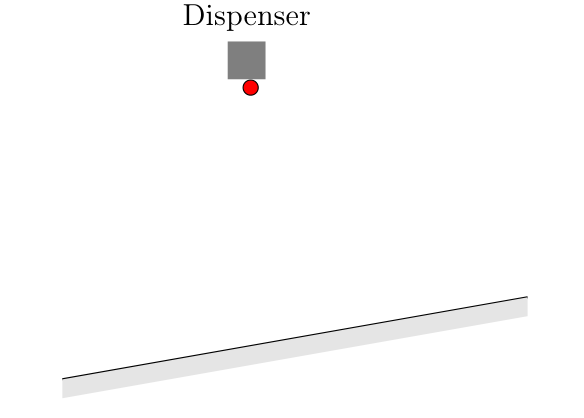
Bouncing Down the Slope. A dispenser releases small identical uniform disks of mass from rest at a height above a long frictionless wedge of mass at a uniform rate of disks per second, beginning at . The wedge is angled at above the horizontal and is fixed on top of a horizontal scale. The disks collide with the slope with a coefficient of restitution . Find the reading on the scale after time in Newtons, averaged over the timescale of a few ball collisions (the scale measures the vertical force exerted on it). Assume that the incline is sufficiently long such that no disks leave the incline.
Fonte: Testo (PDF) — p.7
Topic: Conservation of Momentum, Newtonian Mechanics Metodi: Impulse-Momentum Theorem, Conservation of Momentum, Statistical Averaging Competenze: Physical Reasoning, Mathematical Modeling Objects: Disk, Wedge
Ripuntando verso il basso della pendenza. Un distributore rilascia piccoli dischi uniformi identici di massa dal riposo ad un’altezza sopra una lunga cucita senza attrito di massa ad un ritmo uniforme di dischi al secondo, a partire da . La cucina è angolata a sopra l’orizzontale e è fissata sopra una scala orizzontale. I dischi si schiantano con la pendenza con un coefficiente di restituzione . Trova la lettura sulla scala dopo il tempo in Newton, media sulla scala temporale di alcune collisioni di palle (la scala misura la forza verticale esercitata su di essa). Supponiamo che l’inclinazione sia sufficientemente lunga da non lasciare dischi.
Fonte: Testo (PDF) — p.7
Topic: Conservation of Momentum, Newtonian Mechanics Metodi: Impulse-Momentum Theorem, Conservation of Momentum, Statistical Averaging Competenze: Physical Reasoning, Mathematical Modeling Objects: Disk, Wedge
Gravity Cable Car. An inextensible cable of length is hung over a valley of width . The two walls of the valley are at the same altitude. A cable car is fastened to rollers at one end of the rope, gently lowered along the wall of the valley until it cannot go any further down, and let go. If the cable car takes time to cross the valley, find . You may assume the mass of the cable car is much larger than the mass of the cable itself, and neglect friction.
Fonte: Testo (PDF) — p.7
Topic: Conservation of Energy, Newtonian Mechanics Metodi: Energy Conservation Method, Calculus-Integration, Differential Equations Competenze: Physical Reasoning, Mathematical Modeling Objects: String, Pulley
Gravity Cable Car. Un cavo inestensibile di lunghezza è appeso su una valle di larghezza . Le due mura della valle sono alla stessa altitudine. Un funivario è fissato ai rulli ad una estremità della corda, abbassato delicatamente lungo la parete della valle fino a non poter andare più in basso, e lasciare andare. Se il funivario richiede per attraversare la valle, trovare . Potreste presumere che la massa del cavo sia molto maggiore della massa del cavo stesso, e trascurare l’attrito.
Fonte: Testo (PDF) — p.7
Topic: Conservation of Energy, Newtonian Mechanics Metodi: Energy Conservation Method, Calculus-Integration, Differential Equations Competenze: Physical Reasoning, Mathematical Modeling Objects: String, Pulley
Magnetic Monopole. Consider a hypothetical magnetic monopole of magnetic charge and mass placed at the center of a fixed ring of resistance and radius . The monopole is given an initial velocity along the axis of the ring. Find the minimum velocity such that the monopole can escape from the ring. Assume that the magnetic field produced due to a magnetic monopole is
and that the magnetic force acting on a magnetic monopole is .
Fonte: Testo (PDF) — p.7
Topic: Electromagnetic Induction, Magnetism Metodi: Faraday’s Law of Induction, Lenz’s Law, Energy Conservation Method Competenze: Physical Reasoning, Mathematical Modeling Objects: Magnet, Wire
Monopole magnetico. Considera un ipotetico monopole magnetico di carica magnetica e massa posizionato al centro di un anello fisso di resistenza e di raggio . Il monopole riceve una velocità iniziale lungo l’asse dell’anello. Trova la velocità minima tale che il monopole possa sfuggire dall’anello. Supponiamo che il campo magnetico prodotto a causa di un monopolio magnetico sia
e che la forza magnetica che agisce su un monopolio magnetico è .
Fonte: Testo (PDF) — p.7
Topic: Electromagnetic Induction, Magnetism Metodi: Faraday’s Law of Induction, Lenz’s Law, Energy Conservation Method Competenze: Physical Reasoning, Mathematical Modeling Objects: Magnet, Wire
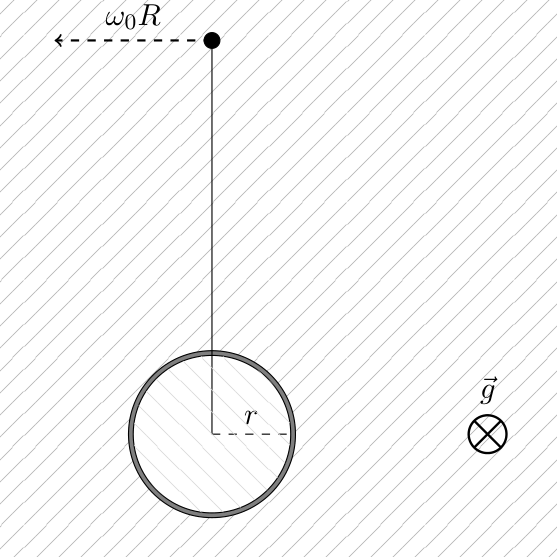
Variant Roulette, House Edge. A spinner, modeled by a massless rod of length connected to a point mass, is attached to the center of a massless cylinder (pin) of radius . The cylinder is almost perfectly fit in a hole in a floor, that is, the cylinder is slightly smaller than the hole. The spinner, laid perfectly flat on the floor and starting at , is given a random angular velocity in the interval , where produces exactly full rotations (assume classical mechanics). What is the probability that it lands in the region if there is a coefficient of friction between the pin and the hole and ?
Fonte: Testo (PDF) — p.7
Topic: Rotational Dynamics Metodi: Torque & Angular Momentum Analysis, Energy Conservation Method, Statistical Averaging Competenze: Physical Reasoning, Mathematical Modeling Objects: Rod, Cylinder
Roulette variabile, bordo della casa. Un rotore, modellato da una barra senza massa di lunghezza collegata a una massa puntaria, è attaccato al centro di un cilindro senza massa (pin) di raggio . Il cilindro si adatta quasi perfettamente in un buco in un pavimento, cioè il cilindro è leggermente più piccolo del buco. Il rotore, posto perfettamente piatto sul pavimento e partendo da , riceve una velocità angolare casuale nell’intervallo , dove produce esattamente rotazioni complete (presumendo la meccanica classica). Qual è la probabilità che atterri nella regione se vi è un coefficiente di attrito tra il pin e il buco e ?
Fonte: Testo (PDF) — p.7
Topic: Rotational Dynamics Metodi: Torque & Angular Momentum Analysis, Energy Conservation Method, Statistical Averaging Competenze: Physical Reasoning, Mathematical Modeling Objects: Rod, Cylinder
Squid Game. We model a prehensile octopus tentacle of length as made of very many servomotors, each of which can apply a torque about any axis. An octopus wishes to pick up a cylinder of radius and mass by wrapping the tentacle around the side and lifting it such that its axis points straight up. What is the maximum the octopus can pick up? Coefficient of friction between tentacle and cylinder is . Neglect buoyancy. Respond with if the answer is infinite.
Hint: is very small, so the octopus is able to lift the cylinder if and only if it can get a grip on it.
Fonte: Testo (PDF) — p.8
Topic: Rigid Body Statics Metodi: Free-Body Diagram, Torque & Angular Momentum Analysis, Physical Modeling Competenze: Physical Reasoning, Mathematical Modeling Objects: Cylinder
Squid Game. Modelliamo un tentacolo di polpo tensile di lunghezza come fatto di molti servomotori, ognuno dei quali può applicare una coppia su qualsiasi asse. Un polpo vuole raccogliere un cilindro di raggio e massa avvolgendo il tentacolo intorno al lato e sollevandolo in modo che il suo asse punta dritto in su. Qual è il massimo che può raccogliere l’ottovo? Il coefficiente di attrito tra tentacolo e cilindro è . - Non si tratta di flotta. Rispondi con se la risposta è infinita.
*Insignia: * è molto piccolo, quindi l’ottopus è in grado di sollevare il cilindro se e solo se riesce a prenderlo.
Fonte: Testo (PDF) — p.8
Topic: Rigid Body Statics Metodi: Free-Body Diagram, Torque & Angular Momentum Analysis, Physical Modeling Competenze: Physical Reasoning, Mathematical Modeling Objects: Cylinder
Radioactive. A thin disk made up of of lies face down on a frictionless table. Find the expected speed of the disk after one half life. has mass and decays to with mass , emitting an alpha particle with mass and two electrons with negligible kinetic energy.
Fonte: Testo (PDF) — p.8
Topic: Nuclear & Particle Physics, Conservation of Momentum Metodi: Mass-Energy Equivalence, Conservation of Momentum, Statistical Averaging Competenze: Physical Reasoning, Mathematical Modeling Objects: Disk, Nucleus, Electron
Radioattivo. Un sottile disco composto da di si trova faccia a faccia su un tavolo senza attrito. Trova la velocità prevista del disco dopo metà vita. ha massa e si decompone a con massa , emettendo una particella alfa con massa e due elettroni con energia cinetica trascurabile.
Fonte: Testo (PDF) — p.8
Topic: Nuclear & Particle Physics, Conservation of Momentum Metodi: Mass-Energy Equivalence, Conservation of Momentum, Statistical Averaging Competenze: Physical Reasoning, Mathematical Modeling Objects: Disk, Nucleus, Electron
Arctic Circle. A freely rotating disk of radius , made of ice at its melting point, is pressed against a belt moving at speed such that the disk’s center is at the edge of the belt. Due to drag, the disk rotates at constant angular velocity. The drag force per unit area is linear (proportional to relative velocity). Find the ratio between the largest and smallest time-averaged rates of melting at a point on the disk. Assume that the pressure is constant across the disk.
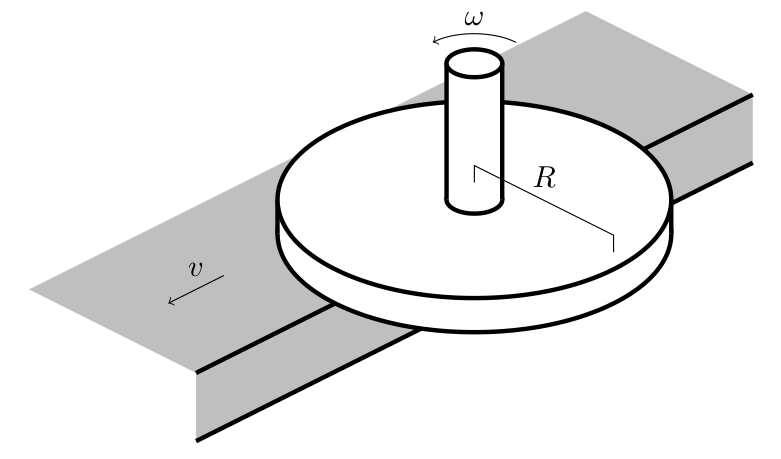
Fonte: Testo (PDF) — p.9 Topic: Thermodynamics, Rotational Dynamics Metodi: Statistical Averaging, Torque & Angular Momentum Analysis, Physical Modeling Competenze: Physical Reasoning, Mathematical Modeling Objects: Disk
Un disco in libera rotazione di raggio , fatto di ghiaccio al punto di fusione, viene premuto contro una cintura in movimento a velocità in modo che il centro del disco sia al bordo della cintura. A causa del traguardo, il disco ruota a velocità angolare costante. La forza di trazione per unità di superficie è lineare (proporzionale alla velocità relativa). Trova il rapporto tra i tassi di fusione più grandi e più piccoli in media temporale in un punto del disco. Supponiamo che la pressione sia costante su tutto il disco.
Fonte: Testo (PDF) — p.9 Topic: Thermodynamics, Rotational Dynamics Metodi: Statistical Averaging, Torque & Angular Momentum Analysis, Physical Modeling Competenze: Physical Reasoning, Mathematical Modeling Objects: Disk
Hexagons are the Bestagons. Consider a two dimensional universe. In the centre of a hexagonal chamber with side length lies a light source. The interior of the chamber is perfectly reflective. What is the pressure at the centre of one of the walls after the light is turned on? Note that pressure in this case indicates force per length.
Fonte: Testo (PDF) — p.9 Topic: Electromagnetism Metodi: Physical Modeling, Superposition Principle, Symmetry Argument Competenze: Physical Reasoning, Mathematical Modeling Objects: —
**L’esagono è il Bestagono.**Consideriamo un universo bidimensionale. Nel centro di una camera esagonale con lunghezza laterale si trova una fonte luminosa . L’interno della camera è perfettamente riflettente. Qual è la pressione al centro di una delle pareti dopo l’apertura della luce? Si noti che la pressione in questo caso indica la forza per lunghezza.
Fonte: Testo (PDF) — p.9 Topic: Electromagnetism Metodi: Physical Modeling, Superposition Principle, Symmetry Argument Competenze: Physical Reasoning, Mathematical Modeling Objects: —
Spring-loaded capacitor. A capacitor is made of two flat metal plates, each of area , separated by an insulating spring of spring constant and natural length with no dielectric material contained within. The plates of the capacitor are then connected to a function generator which outputs a voltage , which consists of a DC component . It is found that for some values of and some initial distances between the plates, the plate settles into an oscillation about a certain point. is increased until just below the point where this behaviour no longer applies, and then adjusted to half of this maximum value. The capacitor is then pulled apart to a distance and released; the two plates slam together. Find the minimum .
Fonte: Testo (PDF) — p.9 Topic: Electrostatics, Oscillations & Waves Metodi: Energy Conservation Method, Hooke’s Law, Differential Equations Competenze: Mathematical Modeling, Physical Reasoning Objects: Capacitor, Spring
Condensatore a molla. Un condensatore è costituito da due piastre di metallo piatte, ciascuna di superficie , separate da una molla isolante di costante molla e di lunghezza naturale senza materiale dielettrico contenuto all’interno. Le piastre del condensatore sono quindi collegate a un generatore di funzione che produce una tensione , che consiste in un componente di corrente continua . Si constata che per alcuni valori di e per alcune distanze iniziali tra le piastre, la piastra si stabilisce in un’oscillazione circa un certo punto. Il viene aumentato fino a poco al di sotto del punto in cui tale comportamento non si applica più, e quindi regolato alla metà di questo valore massimo. Il condensatore viene poi separato fino a una distanza e rilasciato; le due piastre si colpiscono. Trova il minimo .
Fonte: Testo (PDF) — p.9 Topic: Electrostatics, Oscillations & Waves Metodi: Energy Conservation Method, Hooke’s Law, Differential Equations Competenze: Mathematical Modeling, Physical Reasoning Objects: Capacitor, Spring
Supernucleus. Scientists at CERN have recently been working on a novel super-nucleus — a nucleus with a mass number of and proton. Its radius is unusually small, at . As is the natural decision to make, they’ve decided to place the super-nucleus in a box full of electron plasma at a temperature . Given the electron density of the plasma , what is the mean time between electron collisions with the nucleus? Treat all particles classically.
Fonte: Testo (PDF) — p.9 Topic: Nuclear & Particle Physics, Kinetic Theory Metodi: Coulomb’s Law, Kinetic Theory of Gases, Statistical Averaging Competenze: Physical Reasoning, Estimation & Approximation Objects: Nucleus, Electron
Supernucleus. I scienziati del CERN hanno recentemente lavorato su un nuovo supernucleo un nucleo con un numero di massa di e protoni. Il suo raggio è insolitamente piccolo, a . Come è naturale prendere la decisione, hanno deciso di mettere il supernucleo in una scatola piena di plasma di elettroni a una temperatura . Data la densità di elettroni del plasma , qual è il tempo medio tra le collisioni di elettroni con il nucleo? Tratta tutte le particelle in modo classico.
Fonte: Testo (PDF) — p.9 Topic: Nuclear & Particle Physics, Kinetic Theory Metodi: Coulomb’s Law, Kinetic Theory of Gases, Statistical Averaging Competenze: Physical Reasoning, Estimation & Approximation Objects: Nucleus, Electron
I-Conic. A solid cone of uniform density, with slant height and base radius , lies on its curved face in stable equilibrium on a slanted plane such that its axis is horizontal. There is a very high coefficient of friction between the cone and the plane. Find the frequency of small oscillations about this equilibrium.
Fonte: Testo (PDF) — p.10 Topic: Rotational Dynamics, Oscillations & Waves Metodi: Torque & Angular Momentum Analysis, Simple Harmonic Motion Analysis, Small-Angle Approximation Competenze: Physical Reasoning, Mathematical Modeling Objects: Inclined Plane
I-Conic. Un cono solido di densità uniforme, con altezza di pendenza e raggio di base , si trova sulla sua faccia curva in equilibrio stabile su un piano inclinato in modo che il suo asse sia orizzontale. C’è un coefficiente di attrito molto elevato tra il cono e il piano. Trova la frequenza delle piccole oscillazioni intorno a questo equilibrio.
Fonte: Testo (PDF) — p.10 Topic: Rotational Dynamics, Oscillations & Waves Metodi: Torque & Angular Momentum Analysis, Simple Harmonic Motion Analysis, Small-Angle Approximation Competenze: Physical Reasoning, Mathematical Modeling Objects: Inclined Plane
This problem has been removed from the test.
Topic: Mathematics Metodi: Physical Modeling Competenze: Physical Reasoning Fonte: Testo (PDF) — p.10 Objects: —
Questo problema è stato rimosso dal test.
Topic: Mathematics Metodi: Physical Modeling Competenze: Physical Reasoning Fonte: Testo (PDF) — p.10 Objects: —
Relativistic Race. A relativistic tortoise and rabbit are racing. Both animals start running from rest at in the lab frame along a one-dimensional racetrack. To see who wins the race, Biologist Billy gives each animal a stopwatch initially set to , which they start at and stop when they cross the finish line. Unfortunately, when the animals return the stopwatches to Billy, he finds that they both read the same value! The tortoise’s proper acceleration is , and the rabbit’s proper acceleration is , where is the rabbit’s proper stopwatch reading and . In the lab frame, who won the race, and by how much time?
Input the positive value in seconds for the margin of victory if the tortoise won and the negative value if the rabbit won. You may find an online integral calculator helpful.
Fonte: Testo (PDF) — p.10 Topic: Special Relativity Metodi: Lorentz Transformation, Calculus-Integration, Relativistic Energy-Momentum Competenze: Mathematical Modeling, Physical Reasoning Objects: —
Una tartaruga e un coniglio relativisti stanno correndo. Entrambi gli animali iniziano a correre dal riposo a nel telaio del laboratorio lungo una pista di corsa unidimensional. Per vedere chi vince la gara, il biologico Billy dà a ogni animale un orologio di fermo inizialmente impostato su , che inizia a e si ferma quando attraversa la linea di meta. Purtroppo, quando gli animali restituiscono gli orologi a Billy, scopre che entrambi leggono lo stesso valore! L’accelerazione corretta della tartaruga è , e l’accelerazione corretta del coniglio è , dove è la lettura corretta dell’orologio fermo del coniglio e . Nel quadro del laboratorio, chi ha vinto la gara, e per quanto tempo?
Inserisci il valore positivo in secondi per il margine di vittoria se la tartaruga ha vinto e il valore negativo se il coniglio ha vinto. Potresti trovare utile un calcolatore integrale online.
Fonte: Testo (PDF) — p.10 Topic: Special Relativity Metodi: Lorentz Transformation, Calculus-Integration, Relativistic Energy-Momentum Competenze: Mathematical Modeling, Physical Reasoning Objects: —
Glass Block. Steve holds a long square prism with refractive index in midair such that its axis is horizontal. Sunlight is shining on the block. If the magnitude of the radiative force exerted on the block is at half of its maximum possible value, find the smallest angle of a block face to the plane formed by the line from the Sun to the centre of the prism and the horizontal (i.e. the axis of the prism). Assume that no light is reflected when entering the block.
Fonte: Testo (PDF) — p.10 Topic: Geometric Optics, Electromagnetism Metodi: Snell’s Law, Ray Tracing, Conservation of Momentum Competenze: Physical Reasoning, Diagrammatic Reasoning Objects: Prism
Blocco di vetro. Steve tiene un lungo prisma quadrato con indice di rifrazione in mezzo all’aria in modo che il suo asse sia orizzontale. La luce del sole splende sul blocco. Se la grandezza della forza radiativa esercitata sul blocco è alla metà del suo valore massimo possibile, si trova l’angolo più piccolo di un blocco verso il piano formato dalla linea dal Sole al centro del prisma e dall’orizzontale (cioè l’asse del prisma). Supponiamo che non si rifletta alcuna luce quando si entra nel blocco.
Fonte: Testo (PDF) — p.10 Topic: Geometric Optics, Electromagnetism Metodi: Snell’s Law, Ray Tracing, Conservation of Momentum Competenze: Physical Reasoning, Diagrammatic Reasoning Objects: Prism
Sproing. Two point masses of mass are attached to opposite ends of a spring with nonzero rest length. The spring has mass and spring constant . The system is placed in a frictionless and massless tube which rotates around the center of mass of the system with a fixed angular velocity. In the ensuing oscillation, suppose the orbital path of each of the masses is periodic without intersecting with itself. Find the maximum angular velocity for which this is possible.
Fonte: Testo (PDF) — p.10 Topic: Newtonian Mechanics, Oscillations & Waves Metodi: Hooke’s Law, Differential Equations, Energy Conservation Method Competenze: Mathematical Modeling, Physical Reasoning Objects: Spring
Sproing. Due masse puntate di massa sono fissate alle estremità opposte di una molla con lunghezza di riposo non zero. La massa della molla è e la costante della molla . Il sistema è collocato in un tubo senza attrito e senza massa che ruota intorno al centro di massa del sistema con una velocità angolare fissa. Nella oscillazione successiva, supponiamo che il percorso orbitale di ciascuna delle masse sia periodico senza incrociare se stessa. Trova la velocità angolare massima per la quale questo è possibile.
Fonte: Testo (PDF) — p.10 Topic: Newtonian Mechanics, Oscillations & Waves Metodi: Hooke’s Law, Differential Equations, Energy Conservation Method Competenze: Mathematical Modeling, Physical Reasoning Objects: Spring
Five Big Booms. A spherically symmetric explosion occurs at a point along the axis of a very long cylindrical chamber with radius . A sensor is a distance along the axis from the explosion and can be modeled as a sphere of radius . Given that , find the proportion of energy eventually absorbed by the sensor to within relative accuracy. The walls of the chamber are perfectly reflecting.
Fonte: Testo (PDF) — p.10 Topic: Mathematics, Order-of-Magnitude Estimation Metodi: Symmetry Argument, Physical Modeling, Approximation & Series Expansion Competenze: Mathematical Modeling, Estimation & Approximation Objects: Sphere
Cinque grandi boom. Un’esplosione sferica simmetrica si verifica in un punto lungo l’asse di una camera cilindrica molto lunga con raggio . Un sensore è una distanza lungo l’asse dall’esplosione e può essere modellato come una sfera di raggio . Dato che , si trova la percentuale di energia eventualmente assorbita dal sensore entro di precisione relativa. Le pareti della camera riflettono perfettamente.
Fonte: Testo (PDF) — p.10 Topic: Mathematics, Order-of-Magnitude Estimation Metodi: Symmetry Argument, Physical Modeling, Approximation & Series Expansion Competenze: Mathematical Modeling, Estimation & Approximation Objects: Sphere
Hang in there! Consider a very long cylindrical neodymium magnet with radius , uniform longitudinal magnetisation , and density . The magnet is held vertically by its top end. To within relative accuracy, find the distance from the bottom of the magnet where there is no tensile stress in the material (averaged over the cross-section).
Fonte: Testo (PDF) — p.11 Topic: Magnetism, Elasticity & Materials Metodi: Physical Modeling, Stress-Strain Analysis, Calculus-Integration Competenze: Physical Reasoning, Mathematical Modeling Objects: Cylinder, Magnet
Spendetevi! Considera un magnete di neodimio cilindrico molto lungo con raggio , magnetizzazione longitudinale uniforme e densità . Il magnete è tenuto verticalmente dalla sua estremità superiore. Per ottenere una precisione relativa , si deve trovare la distanza dal fondo del magnete, dove non vi è tensione di trazione nel materiale (mediata sul taglio trasversale).
Fonte: Testo (PDF) — p.11 Topic: Magnetism, Elasticity & Materials Metodi: Physical Modeling, Stress-Strain Analysis, Calculus-Integration Competenze: Physical Reasoning, Mathematical Modeling Objects: Cylinder, Magnet
Fly Away. In the lab frame, two birds fly counterclockwise with speed around a circle with radius , starting an angle apart. An observer moves at speed relative to the lab frame. In the observer’s frame, the maximum distance between the birds is . Over all values , find the maximum of .
Fonte: Testo (PDF) — p.11 Topic: Special Relativity Metodi: Lorentz Transformation, Vector Decomposition, Approximation & Series Expansion Competenze: Mathematical Modeling, Physical Reasoning Objects: —
Fly Away. Nel quadro di laboratorio, due uccelli volano in senso contrario all’orologio con velocità intorno a un cerchio con raggio , partendo da un angolo . Un osservatore si muove a velocità rispetto al telaio di laboratorio. Nel quadro dell’osservatore, la distanza massima tra gli uccelli è . Su tutti i valori , trovare il massimo di .
Fonte: Testo (PDF) — p.11 Topic: Special Relativity Metodi: Lorentz Transformation, Vector Decomposition, Approximation & Series Expansion Competenze: Mathematical Modeling, Physical Reasoning Objects: —
Unconventional Oscillations. A thin uniform wire with mass per unit length is shaped into a circular loop and carries a constant current . It is placed in a uniform electric field , with its axis of rotational symmetry parallel to . The wire loop is given an initial angular velocity about its center. Curiously, when , the loop never makes a full rotation with respect to its center. Find in .
The magnitude of the electric field is . Assume that the experiment is conducted in a vacuum, and there is no external gravitational or magnetic field.
Fonte: Testo (PDF) — p.11 Topic: Electromagnetism, Oscillations & Waves Metodi: Torque & Angular Momentum Analysis, Energy Conservation Method, Differential Equations Competenze: Physical Reasoning, Mathematical Modeling Objects: Wire, Coil
Oscillazioni non convenzionali. Un filo uniforme sottile con massa per unità di lunghezza è formato in un ciclo circolare e porta una corrente costante . È posizionato in un campo elettrico uniforme , con l’asse di simmetria di rotazione parallelo a . Il circuito del filo riceve una velocità angolare iniziale intorno al suo centro. Curiosamente, quando , il ciclo non fa mai una rotazione completa rispetto al suo centro. Trova in .
La magnitudine del campo elettrico è . Supponiamo che l’esperimento sia condotto in vuoto e non ci sia alcun campo gravitazionale o magnetico esterno.
Fonte: Testo (PDF) — p.11 Topic: Electromagnetism, Oscillations & Waves Metodi: Torque & Angular Momentum Analysis, Energy Conservation Method, Differential Equations Competenze: Physical Reasoning, Mathematical Modeling Objects: Wire, Coil
Star Power. Fusion takes place when two protons are less than apart. One gram of hydrogen gas at room temperature and pressure is adiabatically compressed by lasers in a fusion reactor into a volume of . Find the initial output power of the fusion reactor. You may assume that other than the proton-deuteron fusion reaction, , no further fusion reactions take place. The accuracy of this problem should be within .
Fonte: Testo (PDF) — p.11 Topic: Nuclear & Particle Physics, Thermodynamics Metodi: Kinetic Theory of Gases, Ideal Gas Law, Statistical Averaging Competenze: Estimation & Approximation, Physical Reasoning Objects: Gas, Nucleus
Potenza stellare. La fusione avviene quando due protoni sono meno di separati. Un grammo di gas idrogeno a temperatura ambiente e pressione viene compresso adiabaticamente con laser in un reattore di fusione in un volume di . Trova la potenza iniziale del reattore a fusione. Si può presumere che, a parte la reazione di fusione protone-deuteron, , non si verifichino ulteriori reazioni di fusione. L’accuratezza di questo problema deve essere entro .
Fonte: Testo (PDF) — p.11 Topic: Nuclear & Particle Physics, Thermodynamics Metodi: Kinetic Theory of Gases, Ideal Gas Law, Statistical Averaging Competenze: Estimation & Approximation, Physical Reasoning Objects: Gas, Nucleus
Party Pooper. A balloon with initial radius is made of a rubber film with constant surface tension . Houlai inflates the balloon with a very small hand pump; the pump injects air into the balloon once it reaches the balloon’s pressure. If the balloon’s final radius is , find the difference between the volume of air used by the pump and the volume change of the balloon. Assume that air is a diatomic ideal gas with pressure and that there is no heat transfer across the balloon or pump surfaces.
Fonte: Testo (PDF) — p.11 Topic: Thermodynamics, Fluid Mechanics Metodi: First Law of Thermodynamics, Ideal Gas Law, Calculus-Integration Competenze: Mathematical Modeling, Physical Reasoning Objects: Bubble, Gas
Party Pooper. Un palloncino con raggio iniziale è realizzato in un film di gomma con tensione superficiale costante . Houlai gonfia il palloncino con una pompa manuale molto piccola; la pompa inietta aria nel palloncino una volta raggiunto la pressione del palloncino. Se il raggio finale del palloncino è , si trova la differenza tra il volume di aria utilizzato dalla pompa e il cambiamento del volume del palloncino. Supponiamo che l’aria sia un gas ideale diatomico a pressione e che non vi sia alcun trasferimento di calore attraverso le superfici del palloncino o della pompa.
Fonte: Testo (PDF) — p.11 Topic: Thermodynamics, Fluid Mechanics Metodi: First Law of Thermodynamics, Ideal Gas Law, Calculus-Integration Competenze: Mathematical Modeling, Physical Reasoning Objects: Bubble, Gas
A Cloudy Day. After an asteroid impact in the middle of a large ocean, a hypercane is forming. The surface temperature is measured to be and the pressure to be . By considering what happens to a parcel of air picking up moisture from the ocean surface as it rises adiabatically in the atmosphere, find to within accuracy the highest altitude at which clouds can form. The latent heat of water is . You may assume that water vapour is an ideal gas with molar mass and dry air is a diatomic ideal gas with molar mass . Also assume that relative humidity may not exceed .
Fonte: Testo (PDF) — p.11 Topic: Thermodynamics, Earth & Environmental Science Metodi: First Law of Thermodynamics, Ideal Gas Law, Hydrostatic Equilibrium Competenze: Physical Reasoning, Estimation & Approximation Objects: Gas
Dopo un impatto di un asteroide nel mezzo di un grande oceano, si sta formando un’ipergena. La temperatura superficiale è misurata a e la pressione a . Considerando cosa succede ad un pezzo di aria che raccoglie l’umidità dalla superficie dell’oceano mentre si alza adiabaticamente nell’atmosfera, si trova entro la massima altitudine a cui possono formarsi le nuvole. Il calore latente dell’acqua è . Si può presumere che il vapore idrico sia un gas ideale con massa molare e l’aria secca un gas ideale diatomico con massa molare . Supponiamo inoltre che l’umidità relativa non possa superare .
Fonte: Testo (PDF) — p.11 Topic: Thermodynamics, Earth & Environmental Science Metodi: First Law of Thermodynamics, Ideal Gas Law, Hydrostatic Equilibrium Competenze: Physical Reasoning, Estimation & Approximation Objects: Gas
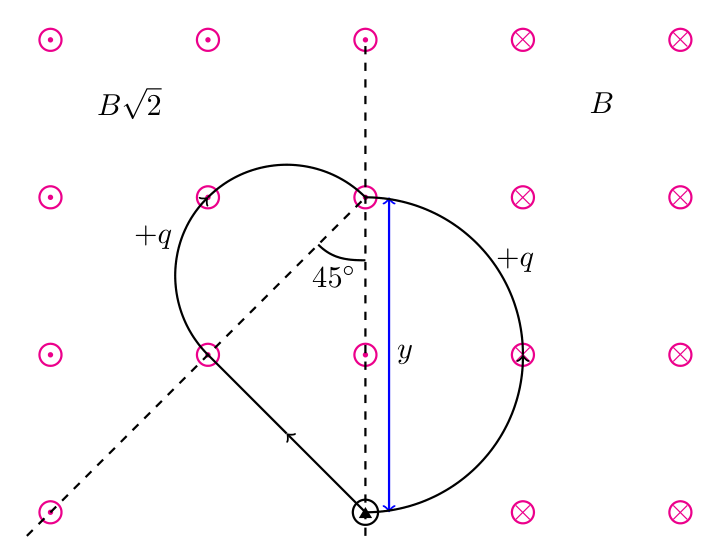
Airplane, QED. In their quest for world domination, the OPhO committee has created an airplane beam generator (ABG) which produces two beams of positively charged airplanes. These airplanes have mass , where is the mass of an electron, and are produced at speed . The two beams are offset by an angle of . The left facing beam is positioned at above the horizontal and hence the right facing beam is parallel to the horizontal.
They mount the ABG on a rail which is mounted parallel to the vertical, and can hence move up and down freely. They set up a magnetic field such that in the 2nd quadrant and the top left half (from the horizontal to down from the horizontal) of the 3rd quadrant, the field is out of the page, and in the 1st and 4th quadrant, the field is into the page. The ABG is then moved such that the two beams intersect at the origin, and there is a phase difference of exactly between the beams at the origin. What must be the charge on the airplane for this to occur? Assume the airplane source is coherent and that there is no initial phase difference. Make sure to submit .
Fonte: Testo (PDF) — p.12 Topic: Electromagnetism, Wave Optics Metodi: Lorentz Force Analysis, de Broglie Relation, Interference & Diffraction Analysis Competenze: Physical Reasoning, Diagrammatic Reasoning Objects: Particle Beam
Nella ricerca del dominio mondiale, il comitato OPhO ha creato un generatore di fasce di aereo (ABG) che produce due fasce di aerei carichi positivamente. Questi aerei hanno massa , dove è la massa di un elettrone, e sono prodotti a velocità . I due raggi sono compensati da un angolo di . Il fascio di orientamento sinistro è posizionato a sopra l’orizzontale e quindi il fascio di orientamento destro è parallelo all’orizzontale.
L’ABG viene montato su una rotaia che è montata parallela alla verticale e può quindi muoversi liberamente su e giù. Hanno impostato un campo magnetico tale che nel secondo quadrante e nella metà superiore sinistra (da orizzontale a in basso dall’orizzontale) del terzo quadrante, il campo è fuori dalla pagina, e nel primo e quarto quadrante, il campo è dentro la pagina. L’ABG viene quindi spostato in modo tale che i due fasci si incrociano all’origine e vi sia una differenza di fase di esattamente tra i fasci all’origine. Qual è la carica dell’aereo per verificare questo? Supponiamo che la fonte dell’aereo sia coerente e che non ci sia alcuna differenza di fase iniziale. Assicurarsi di presentare .
Fonte: Testo (PDF) — p.12 Topic: Electromagnetism, Wave Optics Metodi: Lorentz Force Analysis, de Broglie Relation, Interference & Diffraction Analysis Competenze: Physical Reasoning, Diagrammatic Reasoning Objects: Particle Beam